ORIGINAL ARTICLE
The Management of Nonpoint Source and Storm Water Reduction with LID Techniques in Inchon City, South Korea
Dohun Lim, Yoonjin Lee1)*
Korea Natural Environment Institute, 414, Sungsa, Dukyanggu, Goyang, Gyunggi 412-020, Korea
1)Department of General Education, Konyang University, 121 Daehakro, Nonsan, Chungnam 320-711, Korea
Abstract
Impervious areas have been expanded by urbanization and the natural structure of water circulation has been destroyed. The limits of centralized management for controlling storm water runoff in urban areas have been suggested. Low impact development (LID) technologies have been promoted as a crucial alternative, establishing a connection with city development plans to build green infrastructures in environmentally friendly cities. Thus, the improvement of water circulation and the control of nonpoint source were simulated through XP-SWMM (storm water and wastewater management model for experts) in this study. The application of multiple LID combination practices with permeable pavements, bioretention cells, and gutter filters were observed as reducing the highest runoff volume by up to 70%. The results from four different LID installation scenarios indicated that permeable paving is the most effective method for reducing storm water runoff. The rate of storm water runoff volume reduced as the rainfall duration extended. Based on the simulation results, each LID facility was designed and constructed in the target area. The LID practices in an urban area enable future studies of the analysis of the criteria, suitable capacity, and cost-efficiency, and proper management methods of various LID techniques.
Key words : Low impact development, Storm water runoff, Water resources management, Nonpoint source, Urban design
1. Introduction1)
Woodlands, agricultural lands, and low-density residential areas were industrialized into high-density residential areas, industrial parks, and urban areas, filling the land with high-rise buildings and imper -vious pavement with urban development. The widened urban area is evolving in different phases, which includes various factors such as the hydrologic components and conditions of watersheds. The impervious areas are continued to expand in urban areas, while the infiltration capacity of the soil has dropped drastically. Runoff and the peak flow of
watersheds have increased as a result (Bae et al., 2010; Brabec, 2009; Ju, 2010).
Nonpoint sources of pollutants are distributed over wide areas and have extensive discharge routes depending on the land use. The source of these pollutants cannot be clearly identified because the pollutants are discharged from the entire area of a watershed during precipitation and the pathways are not known (Chen et al., 2014; Koo, 2014; Shen et al., 2014). Therefore, the management of nonpoint source pollutants is an extremely difficult task. The enlarge -ment of urban-type land utilization has made it difficult to confront the difficulty of water manage
Received 8 April, 2015; Revised 12 September, 2015;
Accepted 21 September, 2015
*Corresponding author : Yoonjin Lee, Department of General Edu -cation, Konyang University, 121 Daehakro, Nonsan, Chungnam 320-711, Korea
Phone: +82-41-730-5747 E-mail: [email protected]
ⓒ The Korean Environmental Sciences Society. All rights reserved.
This is an Open-Access article distributed under the terms of the Creative Commons Attribution Non-Commercial License (http://
creativecommons.org/licenses/by-nc/3.0) which permits unrestricted non-commercial use, distribution, and reproduction in any medium, provided the original work is properly cited.
-ment with the existing policy of pollutant-centered point sources. A total integrative water management plan is required to manage for flood discharge, nonpoint pollutant sources, and total pollutant loads.
The application of low impact development (LID) technologies has come to the forefront as a practical alternative.
LID technologies intend to manage integrally small -scale decentralized rainfall runoff treatment compon -ents to preserve the natural hydrological pattern of a target area. LID is a distributed type of technology for runoff reduction that focuses on the conservation of hydrological functions, maintaining the runoff time, and treating of pollutants. The main LID is done on site, using retention, prevention, and treatment technologies. In other words, the main purpose of LID methods is to maintain the original hydrologic functions during a development planning stage while escaping the dependency of large-scale centralized rainwater management and sewage treatment systems.
LID systems intend to control nonpoint sources of pollutants by treating the pollutants before they mix into rainfall runoff using small decentralized devices.
Various kinds of LID facilities can be selected flexibly depending on the geographical and environ -mental conditions of a target area (Akan, 2013;
Brown and Hunt, 2009; Ellott et al., 2009; Guo, 2012; Jia et al, 2012; Jones and Davis, 2012; Lempert and Groves, 2010; Zhang and Guo, 2012) Many countries have already applied storm water runoff reduction technologies. Representative examples are the decentralized urban design of the Netherlands and Taiwan.
The domestic application of LID methods has also been actively considered. The new town plans for Paju, Asan Tangjeong, and East Pangyo have established a water management system with LID technologies. In such cases, the water circulation system components are closely linked throughout the entire city area in connection with water resource planning. In December
2010, the area within 2 km from the boundaries of four major rivers was assigned as a waterfront zone.
The minimization of pollutant loads was constantly promoted while the waterfront area was developed.
LID technologies are related to the regeneration of water’s natural cycle that has been destroyed by urban land development. LID intends to manage rainfall runoff at the on-site area where it was generated. In addition, LID is regarded as a solution for various urban water management issues owing to climate change and urbanization. LID methods are categorized as types of retention infiltration, treatment, and watershed management techniques. An optimal management technique suitable for watershed manage -ment should be adopted after evaluating the existing conditions of the watershed. Hsieh and Davis (2003) found that bioretention had demonstrated an excellent removal efficiency of over 99% of TSS (total suspended solids), oil, and lead. Shin et al. (2013) concluded that the total runoff and peak flow were reduced by 29% with the application of LID methods (green roof and permeable pavement) in a frequently flooded area, which was analyzed through the SWMM-LID model.
There are still limitations and practical difficulties for the application of LID methods, even though positive effects on water circulation and water quality improvement have been reported. It is difficult to evaluate LID facilities for efficiency LID has a difficult in efficiency evaluation of LID facilities and there are a variety of opinions concerning its cost- effectiveness. Although LID requires a hefty invest -ment, the combined sewer overflow reduction is not always guaranteed. Therefore, it is necessary to supply proper guidelines about the selection and maintenance of LID technologies that compare the cost and treatment efficiency of each LID practice.
Assessing the quantitative effects of LID methods is required for individual urban environments to actualize the domestic application of LID methods
Target Area
Fig. 1. Satellite photos of the area.
and use LID in the urban infrastructure and for various policies.
This study analyzed the reduction efficiency of storm water runoff and pollutant load using the SWMM model and evaluated the characteristics of various LID methods. In addition, the applicability and water quality improvement effects of multiple LID methods in each watershed were analyzed. The target area will be utilized as a model LID application site to promote LID technologies in the Incheon environmental research complex, and the data from this study, which was collected through the processes of assigning, designing, applying, and managing LID devices, should supply useful information for deve -loping optimized LID technology.
2. Materials and Methods
2.1. Target Area
The target area was located in the Incheon environ -mental research complex in Incheon City, Korea
(Fig. 1). Most of the area is coastal flatlands and the fan delta is in the south. The total area of the complex is 461,757 m2, most of which consists of silt loams.
The drainage grade was poor, the groundwater level was high, and the soil remained humid. 54.10% of the land was used as a building site; the rest was used as a road, park, and other places (10.97, 6.75, and 28.18%, respectively). The soil was impermeable due to the stratum’s character and the land use. The results of this study about the adoption of LID methods will offer useful data about the management of runoff and nonpoint pollutants.
2.2. Runoff Analysis with SWMM
This study was carried out through XP-SWMM (storm water and wastewater management model for experts). It is a comprehensive and visualization model that can simulate the flow and water quality of a pipe system or subbasin and the flow of runoff and pollutants during rainfall duration, track the runoff amount in pipe systems, and calculate the amount of
Fig. 2. The dividing watershed on the site.
Name Ground Height (m)
Area (ha)
Slope (m/m)
Width (m)
Percentage of impervious areas (%)
A1 6.80 0.580 0.02 76 85
A2 6.50 0.136 0.02 37 85
A3 6.50 0.785 0.02 89 40
B1 6.45 0.326 0.02 57 25
B2 7.00 0.298 0.02 55 80
B3 7.00 0.382 0.02 62 85
B4 7.00 0.198 0.02 44 85
C1 6.60 0.567 0.02 75 85
C2 6.60 0.373 0.02 61 85
D1 7.00 0.221 0.02 47 85
D2 7.00 0.568 0.02 76 30
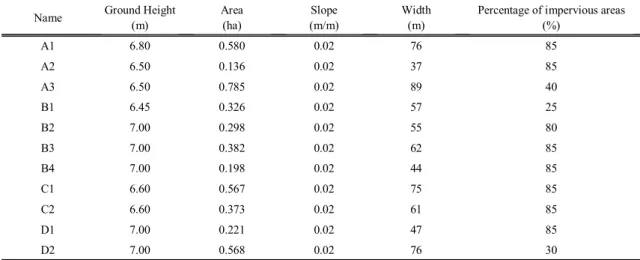
Table 1. Input information for SWMM
the storage and treatment of pollutants (Fig. 2). The target area was already under urban development.
The variations of the runoff and pollutant loads were simulated, and design criteria reflecting the regional characteristics were evaluated in the simulation.
Data on the drainage area, area width, impervious
surface coefficients, the percentage of the impervious area, the slope, height, coefficient of roughness, and amount of storage were punched on subbasin (Table 1). The land status was analyzed through CAD files, satellite photos, and field surveys, and the area of the classified land use was calculated. The data related to
Fig. 3. Seven areas selected for LID applications with their urban storm sewer networks.
Drainage
area Subdivision Alternatives Area Installed (m2)
Water Catchment
Area(m2)
Detention Storage
(m3)
Effective Death
(m)
Infiltration Rate(%)
A 1 Permeable Pavements 1832
2742 463 253 10.5
2 Bioretention swale 395 145 366 15.3
B
3 Permeable Pavements 950
1100 73 77 3.2
4 Bioretention Cell 135 21 158 6.6
5 Gutter-filter 58 400 12 204 8.5
C 6 tree box filter 13.2 900 4 286 11.9
D 7 planter box 10 200 3 262 10.9
Table 2. Basic information for the LID applications the pipelines are the length, pipe slope, and rough -ness coefficients, and those were acquired by using a diagram of the current sewer network.
2.3. LID Design and Application
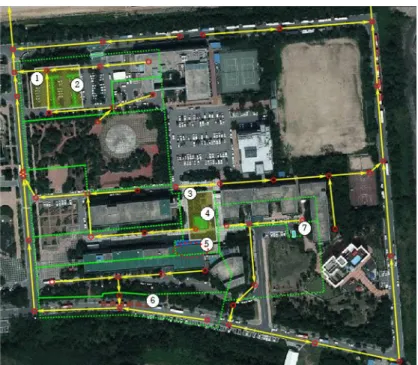
The installation sites of the LID methods were selected after analyzing the areas with satellite images, topographic maps, and the ground coverage diagram of the sewer network. Seven areas were
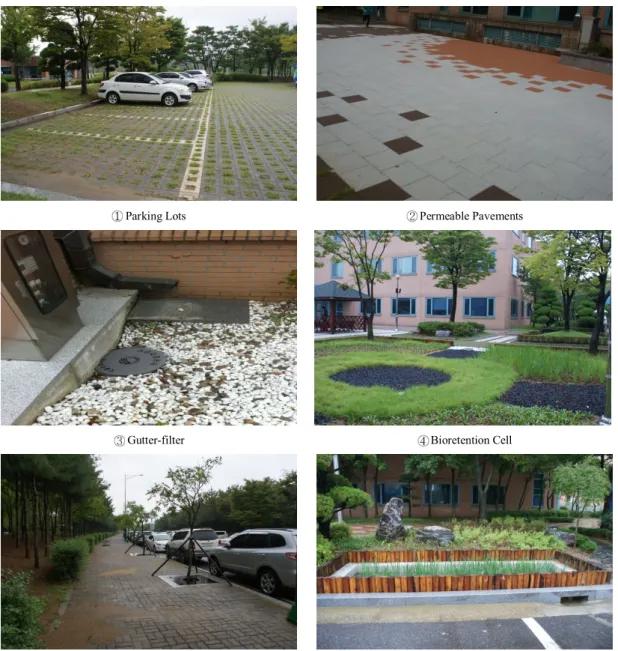
selected by considering the facilitated point analysis of the drainage basin and the wide impervious area, the permeable green areas that cause rainfall runoff due to high ground elevation, and so on. The final selected areas included a parking lot, roads, shelters, landscaped green areas, and tree-lined streets (Fig. 3).
The area’s detailed information for the LID applica -tions is presented in Table 2.
Drainage
area Subdivision Alternatives Before introducing facilities After introducing facilities
6hr 12hr 24hr 6hr 12hr 24hr
A 1 Permeable Pavements
153 146 139 84 71 67
2 Bio retention swale
B
3 Permeable Pavements
52 50 48 26 15 7
4 Bioretention Cell
5 Gutter-filter
C 6 tree box filter 104 100 95 102 98 92
D 7 planter box 61 59 56 60 58 54
Table 3. The variation of simulated runoff volume over time with LID application scenarios (unit: m3)
3. Results and Discussion
3.1. Variation of Storm Water Runoff
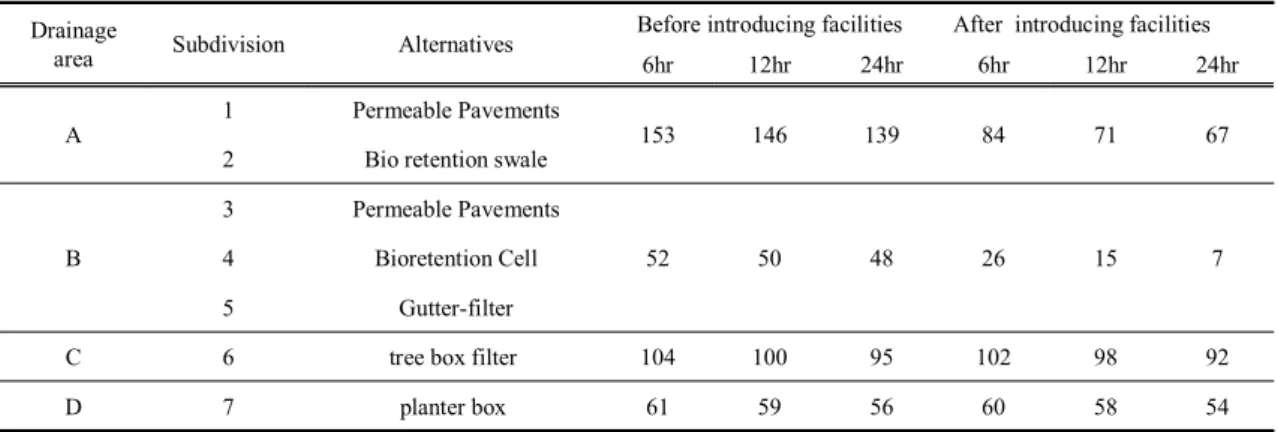
A significant reduction of runoff volume was found as the rainfall duration extended at the LID application areas (Table 3). This result indicated that LID practices could be a reasonable alternative for flood control in urban areas because of climate change. The purpose of area A-1 is mostly parking lots. Therefore, switching the pavement materials to permeable ones could be effective for improving storm water runoff reduction. The installation area of the LID practices and the detention storage were larger at site A than at the others. A 52% decrease of runoff was simulated in area A after the LID appli -cation with permeable pavement and bioretention swale. Also, this result indicated that various criteria should be considered, such as traffic, the purpose of the site, and the soil condition (including the drainage class), before the selection of LID infiltration technologies in the target area.
The highest runoff volume reduction was presented in area B, where multiple LID technologies with permeable pavement, bioretention cells, and gutter filters were applied. The reduction rate of the runoff volume was simulated by 85% compared to that of the non-installation condition until the rainfall duration reached 24 hours in area B. The infiltration velocity
through the soil with the adoption of LID technologies such as bioretention swale and bio-retention cells in area A and B is a crucial factor for building the facilities on site. Water remaining in bioretention facilities for over 48 hours can be problematic for the operation and maintenance of the systems.
The rate of precipitation run-off reduction while applying multiple LID facilities with permeable pavement was much higher compared to applying a single process only. The reduction amount increased as the precipitation duration went longer. This indi -cated that the installation of permeable pavements could contribute to an improvement of the urban water cycle. The utilization of permeable pavements is expected to increase the runoff discharge with prolonged rainfall duration. The runoff discharge was simulated at 84 m3 and 26 m3 in areas A and B, respectively, with rainfall duration of 6 hours. The runoff was reduced significantly compared to areas C and D, where the runoff discharge was at 102 m3 and 60 m3, respectively. Therefore, permeable paving could be an important method for dealing with the issues of climate change and urban floods. The perme -able pavement brought direct infiltration, controlling the amount of infiltration and runoff. Park et al.
(2013) reported that the main function for each LID method is different in terms of its effects on water
retention and permeation.
However, it is difficult to thoughtlessly expand the installation ratio of permeable pavement in urban areas because traffice condition, soil character, strength of pavement. So, design methods and model criteria for LID technologies should evaluate by estimations on the basic of efficiency and economical quality.
The most effective LID method applied and evalu -ated for the runoff controls was the combination of permeable pavements, bioretention cells, and gutter filters. Two infiltration systems were applied in this case. Therefore, the hydrological influence on urban development can be resolved with the application of various storm water infiltration facilities such as infiltration collectors, infiltration gutters, and infiltra -tion trenches.
The rate of the runoff storm water dropped 3%
and 4% respectively at 24 hours in areas C (tree box filter) and D (planter box). A tree box filter of 4.17 m3 was installed in the entire watershed area of 200 m2 . The variation of storm water runoff was not great in areas 6 and 7. Meanwhile, Choi et al. (2013) reported that the retention rate was up to 10% higher than in the biological retention facilities with a tree filtering device of 4 m3 in an area of 48 m2. Tree bos filters can be installed in street tree sections without the preparation of site, and additionally, they can treat various pollutants such as heavy metals. Joo et al.
(2011) reported that runoff discharge can be reduced to 65% during a rainfall intensity of 20 mm/hr while planting trees at intervals of 6 m in four-lane road -ways by utilizing tree box infiltration facilities.
Where pavement with permeable materials was simulated, there was a significant reduction in runoff water quantity as the rainfall runoff lasted. In parti -cular, long-term runoff reduction was seen with the installation of LID infiltration facilities. Additionally, the applications of various scenarios were analyzed as effective in managing floods in urban areas, depend -ing on the field conditions. In area B, the runoff
discharge increased 50% for 6 hours with LID facilities of 43.91 m2, compared to those without the facilities. Also, combinations of multiple LID methods in a drainage area were applied, significantly reduc -ing the runoff through infiltration and the retention function over time. Typically, heavy precipitation between July and September in Korea is frequent.
The application of small-scale infiltration/retention LID equipment can be expected for environment- friendly storm water management for the purpose of advanced control and treatment at the place of origin in city areas, straying from the current water manage -ment policy of focusing on drainage facilities.
3.2. Nonpoint Pollutant Management
The BOD runoff load was 4.02, 0.41, 3.59, and 0.81 kg in areas A, B, C, and D. BOD exports in area A and B were higher than those of the other areas.
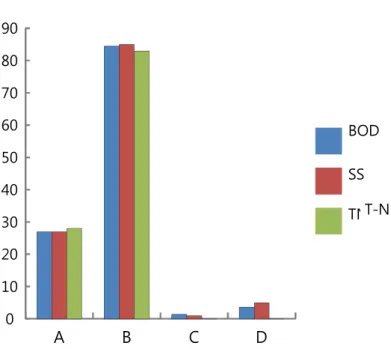
The pollutant load in storm water quality was signi -ficantly reduced in area B (Fig. 4). The reduction rate of BOD exports from area B was 84.5% after applying LID technologies during a 24-hour rainfall duration. In this area, multiple LID methods were used, including the main functions of bioretention and infiltration. The SS removal reduction rate was 85.0%, which was similar to the change in BOD exports, and respectively higher removal efficiency was shown in this area. Brattebo et al. (2003) found that the permeable pavement performance in a parking lot located in Renton, Washington was effective in the removal of Cu, Zn, and motor oil over 5 years. Lim et al. (2014) reported that the application of LID methods was more cost-effective than sewage treatment plants in Ulsan City. They added that tree box filters, rain barrels, and gutter filters are cost- effective in industrial regions. LID methods should be carried out and focus on applicable small areas in the field, such as apartments and parking lots, and a management maintenance guide should be presented.
Scenarios A and B applied multiple devices, and
0 10 20 30 40 50 60 70 80 90
Removal Efficiency(%)
A B C D
BOD
SS TN
Fig. 4. Pollutant load reduction with LID applications during a 24-hour rainfall duration.
were assessed as performing well at reducing the loads of BOD, SS, and T-N. The data presented here show that the LID devices applied in this study work well at removing BOD. The variation in BOD was the most visible compared with the other water items.
The application of BOD, SS, and T-N exported from the watershed areas were higher than those of other LID devices in areas A and B. The application of LID methods was simulated as effective for not only the reduction of storm water runoff, but also the removal of water pollutants in areas A and B. This result clearly indicated that the management of environmen -tal impacts on storm water with properly selected and constructed LID devices could be a good option as much as that of storm water runoff. The removal efficiency of BOD and SS was 3.6 and 5% for the planter box. However, it could not contribute for the removal of T-N.
The BOD and SS reduction rates increased with the increase of the rainfall duration. Joo et al. (2011)
reported analysis results that showed that long-term runoff as simulated in SWMM can be affected by continuous rainfall characteristics such as dry days and antecedent rainfall volume. The proper LID applications fitted for a specific watershed environ -ment can prevent the unnecessary installation of multiple sewage treatment facilities or duplicated sewage devices. This indicated that the application of LID devices planned during the design stage could be an eco-friendly storm water management method for water quality and quantity, and various positive environmental and economic effects can be expected.
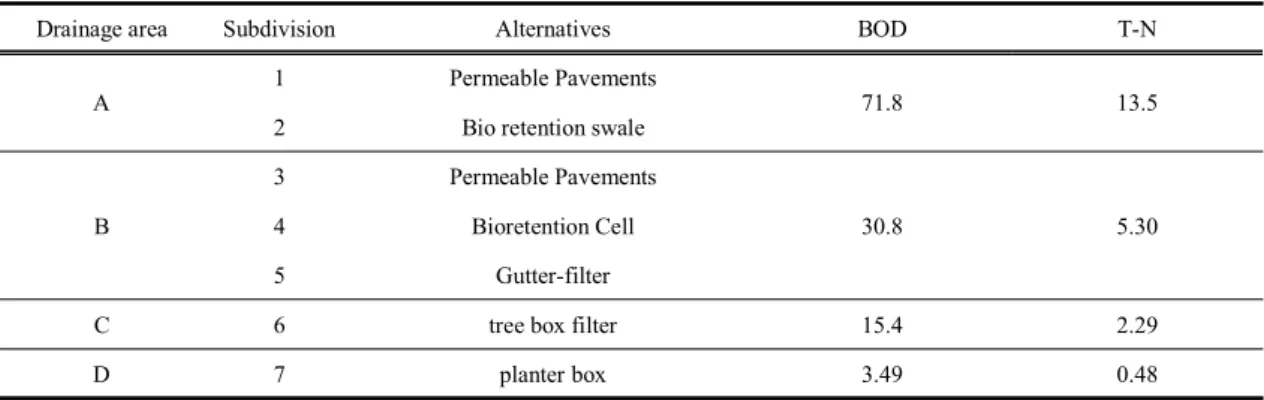
The reduction load per year after the application of LID devices in subdivisions 1 to 7 are presented in Table 4. BOD reduction with the LID devices was assessed as 71.8, 30.8, 15.4, and 3.49 kg/year respec -tively for areas A, B, C, and D. The highest reduction load was found in area A with bioretention swales and permeable pavements. Meanwhile, annual T-N reduction with LID methods in areas A, B, C, and D
T-N
Drainage area Subdivision Alternatives BOD T-N
A 1 Permeable Pavements
71.8 13.5
2 Bio retention swale
B
3 Permeable Pavements
30.8 5.30
4 Bioretention Cell
5 Gutter-filter
C 6 tree box filter 15.4 2.29
D 7 planter box 3.49 0.48
Table 4. Pollutant reduction ratio after LID facilities were used (kg/year)
was at 13.5, 5.30, 2.29, and 0.48 kg/year, respec -tively. BOD and T-N reduction were higher in area A compared with areas C and D because the subdivi -sions were smaller in areas C and D. The highest BOD reduction appeared with bioretention swale, followed by bioretention cells, tree box filters, and planter boxes in this study since the main role of permeable pavements is infiltration. Therefore, the main functions of the LID methods and the infil -tration or storage capacity for individual LID methods should be considered when multiple devices are applied in a drainage area. In this study, the removal efficiency of areas C and D was low, which might be because the LID application area (C and D areas: 13 and 10 m2) was relatively small compared to the total area. This result suggested that the selection of a suitable application area is required in connection with the expenses of the facilities const -ruction and maintenance, and the selection of the LID types must be considered depending on the area’s character.
3.3. LID Application on Site
Based on the results that SWMM predicted, a LID method was designed by considering various factors, such as land status and the environmental effects of the drainage area. The LID facilities were built, making it rule to preserve the existing water resources and
with the consideration of the spatial arrangement of the infiltration and retention facilities. In addition, various factors, such as procuring green areas, mini -mizing impervious surfaces, existing structure and functions maintaining of the drainage area (Fig 5).
In area A, a crucial existing facility was parking lot, and the impermeability area was 75.5%. The selection of LID technology and the construction of the LID facilities without the consideration of the community was done respectively facilitated. The pavements were a crucial cause of impermeability in the city area. The paved area was reported to occupy more than twice as much as the building area. Seeing that the main cause of urban floods is the imper -meability of the type of pavement, permeable paving could be a key solution for solving this problem.
Hyun et al. (2010) reported that pavements can create a better landscape with colorful blocks compatible with nearby structures. In this area, the main work to be performed by LID methods was to enhance the function of the permeability of the soil.
In this work, the existing impermeable asphalt pavements of the parking lot were eliminated, and then the pavement type was switched to grass blocks.
Grass blocks can perform the underground infiltration, retention, and filtration of storm water runoff. Three colors of permeable grass blocks (white, brown, and orange) performed visual and functional roles in the
Parking Lots Permeable Pavements
Gutter-filter Bioretention Cell
⓹ Tree box filter Planter box
Fig. 5. LID techniques applied to the site.
paved areas. Lanes were not drawn in the parking lots and the grass blocks performed those roles. The drainage time of the impermeable pavement was 123 hours in parking lot time.
Bioretention swale performs the retention, and filtration of storm runoff. It eliminates decomposing
organic substances from green areas and pollutants generated from parking lots and roads. The intervals between the plants were over 50 cm.
The main composition of area B was a road and sidewalks. The section of the sidewalks between buildings was replaced by permeable blocks, and
Fig. 6. A picture of the green roof at this site.
bioretention cells that can perform the retention, infiltration, and biological treatment of rainfall runoff were installed in the landscaped green space section.
The existing rain gutters were renovated and func -tional gutter filters that can treat rainfall runoff on the roof were installed in the landscaped area between the buildings and sidewalks.
Area C was tree-lined streets. A tree box filter was installed to preserve the existing environmental conditions, without obstructing the traffic. The tree boxes were installed without a slab and in a side box, and an overflow pipe with a bypass function and a polyethylene perforated drainpipe were installed and the effluents linked to the rainwater pipe. The drainage time in area D was 116.7 hours.
Various LID practices were installed based on the SWMM prediction data and the consideration of the area’s characteristics. A future study on practical runoff reduction and removal of the nonpoint sources of pollution with the maintenance of LID devices will be done in this LID installed complex. Besides the LID devices, a green roof was also installed on the rooftop of a building. This LID practice is based on simple and extensive sedum green roof systems, and
sedum can live on just rainwater and an eco-friendly soil layer, such as cocopeat and volcano stone was applied (Fig. 6). Although the green roof system required higher costs than other LID equipment to install, it could be a solution for urban-issued problems, such as the heat island effect in building areas. In addition, it contributes to public emotion cultivation by providing an escape from the image of a concrete jungle and improving the urban environment. In addition, over 40 tons of the rainwater infiltrated through the system was reserved for supply during the non-rainy season and the water flow rate was monitored through a solar heat based storm water control system.
This study was done in a complex where various LID devices can be integral, and it was the first trial in Korea of using various LID technologies from a simulation with SWMM to the stage of design and installation with the consideration of the practical field conditions. The maintenance of the LID facilities is an important requirement to get good efficiency from the installed LID. It required a lot of work, such as water quality monitoring, plant replacement, sediment and trash removal, and repairing systems. The LID
practices can be managed at the existing facilities management department in this complex. The LID facilities installed at this site do not require elect -ricity, and the pollutant and runoff source manage -ment facilities can be applied without disturbing the existing construction in the complex.
4. Conclusion
This study has analyzed the effects of storm water run-off reduction and the management of nonpoint sources using various LID practices applied to an environmental research complex located in Incheon, Korea with the XP-SWMM model. The drainage area was 5342 m2. The following conclusions were obtained from this study.
1) In this research, the permeable pavement was the most effective LID technology for reducing urban storm water runoff. Because LID devices can be installed on a small scale and reflect specific regional characteristics, multiple LID practices were applied to a drainage area. Therefore, while LID methods are being selected, the main purpose of the practices should be considered along with the consideration of expense. Multiple practices with permeable pavements, bioretention cells, and gutter filters were the most effective for the control of water quality and storm water management. Even when a rainfall lasted more than 24 hours, runoff reduction constantly increased.
This result suggested that the application of selected LID methods, while considering their own functions such as infiltration and reservation of rainwater, can contribute to managing urban rainfall runoff effec -tively by restoring natural hydrologic functions.
2) The runoff pollutants reduction rate with three LID methods (permeable pavements, bioretention cells, and gutter filters) were 49.4% and 50.0% for BOD and SS respectively during a 6-hour rainfall.
When a single method was used, such as tree box filters or planter boxes, the pollutant removal effici
-ency was not great because the applied area ratio of the total drainage area was relatively low. Therefore, determining the pollutant removal amount per unit in the area or selecting a proper area to apply LID is useful with LID methods in urban runoff manage -ment.
3) The area rate of the applied LID technologies was 24.7% for the entire target area. However, the rainfall runoff was assessed as being reduced to 85%
during a 24-hour rainfall duration compared with the non-applied LID area. In terms of runoff water quality control, BOD was reduced up to 84.5%. These data suggest that the operation of LID facilities with infiltration and retention functions for rainfall could improve urban water circulation and reduce the runoff load of nonpoint source pollutants. LID methods should be designed and installed in a site after considering the field conditions, key functions, and treatment capacity for individual LID scenarios.
REFERENCE
Akan, A., 2013, Preliminary design aid for bioretention filters, J Hydrol. Eng., 18, 318-323.
Bae, S. H., Kim, W. J., Yoon, Y. H., Lim, H. M., Park, J.
R., 2010, Characterization of runoff properties of non- point pollutant at a small rural area considering land- use types, J Kor. Soc. Environ. Eng., 31, 1089-1094.
Brabec, E. A., 2009, Imperviousness and land-use policy:
toward an effective approach to watershed planning, J Hydrol. Eng., 14, 425-433.
Brattebo, B. O., Booth, D. B., 2003, Long term storm water quantity and quality performance of permeable pavement systems, Water Res., 37, 4369-4376.
Brown, R., Hunt, W., 2009, Impacts of construction activity on bioretention performance. J Hydrol. Eng., 15, 386- 394.
Chen, L., Wei, G., Zhong, Y., Wang, G., Shen, Z., 2014, Targeting priority management areas for multiple pollutants from non-point sources, J Hazard Mater., 280, 244-251.
Choi, J. Y., Son, Y. G., Lee, S. Y., Lee, Y. W., Kim, L. H.,
2013, Development of tree box filter LID system for treating road runoff., J. Wetlands Res., 15, 407-412.
Ellott, A. H, Trowsdale, S. A, Wadhwa, S., 2009, Effect of aggregation of on site storm water control devices in an urban catchment model, J Hydrol. Eng., 14, 975-983.
Hsieh, C. H., Davis, A. P., 2005, Multiple-event study of bioretention for treatment of urban storm water runoff, Water Sci & Technol., 51, 177-181.
Hyun, K. H., Kim, J. G., Lee, J. M., Jeong, J. S., Kim, J. N., Lee, Y. J., 2010, A Construction plan for the water- circulation green city in Asan Tangjeong, Korea Land and housing Corporation (Land and housing institute), 1.
Jia, H., Lu, Y., Yu, S. L., Chen, Y., 2012, Planning of LID BMPs for urban runoff control: The case of Beijing olympic village, Separ. Purif. Technol., 84, 112-119.
Joo, J. G., Cho, H. J., Lee, Y. H., Kim, L. H., 2011, Development of infiltration facility by utilizing tree box for urban storm water runoff reduction, J Kor.
Acad. Industr. Coop. Soc., 12, 5330 -5336.
Jones, P., Davis, A., 2012, Spatial accumulation and strength of affiliation of heavy metals in bioretention media, J Hydrol. Eng., 139, 479-487.
Ju, M. H., 2010, Application of SWMM and establishment of automonitoring system to evaluate small urban nonpoint source pollutant, Master thesis, Chung-nam National University, Daejeon, Korea.
Koo, Y. M. Kim, Y. D., Park, J. H., 2014, Analysis of non-point pollution source reduction by permeable pavement, J Kor. Water Resour. As. 47, 49-62.
Lempert, R. J., Groves, D. G., 2010, Identifying and evaluating robust adaptive policy responses to climate change for water management agencies in the Ameri -can west, Technol. Forecast. Soc. Change, 77, 960-974.
Lim, Y. K, Jung, J. C., Shin, H. S., and Ha, G. J., 2014, Analyzing the efficiency of LID technique for urban non-point source management-focused on city of Ulsan in Korea, J Korean Environ. Res. Tech., 17, 1- 14.
Park, J. Y., Lim, H. M., Lee, H. I., Yoon, Y. H., Oh, H. J., Kim, W. J., 2013, Water balance and pollutant load analyses according to LID techniques for a town development, J Kor. Soc. Environ. Eng., 35, 792-802.
Shen, Z., Qiu, J., Hong, Q., Chen, L., 2014, Simulation of spatial and temporal distributions of non-point source pollution load in the three Gorges Reservoir region, Sci. Total Environ., 493, 138-146.
Shin, D., Park, J., Kang, D., Jo, D., 2013, An analysis of runoff mitigation effect using SWMM-LID model for frequently inundated basin. J Kor. Soc. Hazard Mitig., 13, 303-309.
Zhang, S., Guo, Y., 2012, Explicit equation for estimating storm-water capture efficiency of rain gardens, J Hyd -rol. Eng., 18, 1739-1748.