Print ISSN: 2288-4637 / Online ISSN 2288-4645 doi:10.13106/jafeb.2021.vol8.no3.1083
Financial Performance Reporting, IFRS Implementation, and Accounting Information: Evidence from Iraqi Banking Sector
Karrar Saleem HAMEEDI
1, Qayssar Ali AL-FATLAWI
2, Maher Naji ALI
3, Akeel Hamza ALMAGTOME
4Received: November 30, 2020 Revised: February 01, 2021 Accepted: February 16, 2021
Abstract
This paper explores the effect of IFRS on the financial performance of Iraqi commercial banks. It also investigates the value significance of financial performance statements using the Ohlson model, which has been used for the stock value relevance test in a number of studies.
Using a sample of 66 listed banks on the Iraq Stock Exchange over three years of IFRS pre-adoption (2011–2013) and three years of IFRS post-adoption (2016–2018), we find financial performance components EPS and BVS value relevant to the stock returns. The findings also indicate that the implementation of IFRS has a major positive effect on the value relevance of the BVS, while the adoption of IFRS does not have a significant impact on the value relevance of the EPS reported by Iraqi banks. Our results indicate that the market value of the bank rises dramatically with enhanced financial performance reporting. In addition, the implementation of IFRS has a major effect on the financial performance measures and the value relevance of financial reporting in the Iraqi banking sector. This paper adds to previous value relevance literature and IFRS by throwing light on the banking sector in a developing country that has recently moved from applying local accounting standards to IFRS.
Keywords: IFRS, Performance Reporting, Accounting Information, Value Relevance, Iraqi Banking Sector JEL Classification Code: E16, H83, M41, Q56
reporting, it is almost impossible to make comparisons correctly (Sovbetov 2015). Before International Financial Reporting Standards (IFRS) were released in April 2001, corporate financial reporting in many countries was based on accepted local or regional accounting principles or standards (Almagtome, Al-Yasiri, Ali, Kadhim, & Bekheet, 2020). However, to guarantee that the qualitative features of financial reporting have been improved, IFRS has become a precondition. Accounting standards are also assumed to sustain capital market efficiency and are based on mitigating the effect of future stock market information asymmetry (Oladele et al., 2018). The transition from national capital markets to global capital markets has led to a set of globally accepted accounting standards to increase transparency and comparability of financial statements. Therefore, IFRSs are widely accepted as a set of global standards and are currently used for general reporting purposes in more than 120 countries (Byers, 2017).
The objective of adopting international accounting standards worldwide is to provide standardized, high-quality economic market data that enhances the effectiveness of the worldwide market, reducing the cost of business access to capital. There are also several views that the implementation
1
First Author. Lecturer, Department of Accounting, Faculty Administration and Economics, University of Kufa, Iraq.
Email: [email protected]
2
Lecturer, Department of Accounting, Faculty Administration and Economics, University of Kufa, Iraq.
Email: [email protected]
3
Lecturer, Department of Accounting, Faculty Administration and Economics, University of Kufa, Iraq.
Email: [email protected]
4
Corresponding Author. Professor, Department of Accounting, Faculty Administration and Economics, University of Kufa, Iraq [Postal Address: Najaf, 540011, Iraq]
Email: [email protected]
© Copyright: The Author(s)
This is an Open Access article distributed under the terms of the Creative Commons Attribution Non-Commercial License (https://creativecommons.org/licenses/by-nc/4.0/) which permits unrestricted non-commercial use, distribution, and reproduction in any medium, provided the original work is properly cited.
1. Introduction
Financial reporting aims to provide useful financial
information about the company to the stakeholders as
a whole, and since companies around the world do not
follow the same principles in accounting and financial
of IFRS may be an instrument to reduce inequalities between accounting systems, while at the same time providing a high degree of transparency in financial information (Chaudhy et al., 2012). The implementation of international financial reporting standards has also drawn the attention of scholars from all over the world, and many forms of study have been carried out and the effect of the adoption of international standards has been evaluated on some related variables. In Iraq, efforts have been diligent in implementing international financial reporting standards, although delayed due to the country’s circumstances. However, as stated in its orders numbered 12/9 on 14/1/2016, the Central Bank of Iraq took the first formal step to comply with international financial reporting standards. IFRS implementation became optional from 2015 onwards, and compliance with the standards has been being compulsory from 2016 onwards. Moreover, as with the majority of the listed Iraqi companies, as of 2021, they are compliant with international financial reporting requirements. This paper aims to analyze the effect of the application of international financial reporting standards on performance metrics and the importance significance of accounting numbers.
2. Literature Review
The banking sector is one of the leading industries in almost all developed and developing countries in today’s diverse global economy. The stock exchange directs financial capital to the attainment of the goals of the economy (Nguyen, Tsai, Kumar, & Hu, 2020). This leads to the promotion of the public budget and to the achievement of state sustainable development plans (Almagtome, Khaghaany, & Önce, 2020). Investors consider the financial success of the banking sector to be the best investment measure to improve their investments and profits. More attention has been paid to the implementation of IFRS in recent years, as several papers have shown that the implementation of IFRS will increase the comparability and consistency of financial statements (Mande 2014). IASBs are a set of universal accounting standards intended to improve the quality of information and standardize accounting information worldwide.
Adopting these standards offers investors with more credible characteristics, as analysts and investors can readily understand IFRS (Gatsios et al., 2016). The International Accounting Standards Board (IASB)’s primary goal is to increase the distribution of corporate financial information from IFRS, which improves worldwide market efficiency.
In addition, IFRS potential advantages lead to drop-in regulation. Furthermore, estimated accounting contributes to
“external comparability” as an individual, corporate financial reports become more market-friendly and synchronize market-wide information flow (Hillier, Hodgson, & Ngole, 2016). IFRS are usually regarded as high-quality because they
constitute a set of finest accounting practices in the globe, are more capital-oriented than local accounting standards, and promote businesses to report accounting information that best represents financial content. Transparency is, therefore, further improved, and the adoption of IFRS is presumed to be associated with high financial performance (Chua, Cheong,
& Gould, 2012). There has been a substantial rise in IFRSs as the worldwide accounting principles in this sense, and many are concerned about their universal applicability and importance to different institutional, political and economic stakeholders (Liu et al., 2011). A rise in the value of financial information is also correlated with the implementation of IFRSs (Alam, Alam, & Chavali, 2020). Besides, the adoption of these standards reduces information asymmetries between companies and investors in the stock market (Kang, 2013).
The companies will be able to establish new relationships globally based on IFRS with investors, clients, vendors and other stakeholders. As an internationally recognized reporting platform, IFRS will improve the reputation and relationship of the company and provide it with a competitive edge in supporting its businesses (Hoang & Ngoc, 2019). In addition, the IFRSs aim to make the capital market easier for foreign investors and to improve investor protection as well as improve the comparison and comprehensiveness of their financial information (Chandrasekar & Kumar, 2016).
Devalle, Magarini, and Onali (2014) propose that IFRS can enhance the value relevance of information by enhancing the cross-border consistency of accounting information, the adequacy of capital markets, and a significant component of IFRSs. They often limit the ability of managers to choose accounting alternatives. The value significance of information can be defined as the ability to capture or summarize information from financial statements that affect equity values (Devalle, Magarini, and Onali, 2014; Suadiye, 2012). Some researchers claim that the value-added ideas of performance reporting clearly refer to the tests used to verify the two key features of the information in the financial statements (relative importance and reliability) (Robu, 2015).
The importance of financial performance reporting can also be clearly measured if the performance data are helpful in making investment decisions. In other words, whether it has a direct impact on consumer prices, information on financial performance is considered to be value-relevant.
Researchers have also been involved in the application of IFRSs and its relationship with other financial performance indicators in many countries around the world (Martins &
Paulo, 2010; Di Domenico et al., 2014; Paiva, Lourenço, &
Branco, 2016; Emeni et al., 2016). In Brazil, Gatsios et al.
(2016) suggest that the implementation of IASs may take
longer to affect the cost of the shares of Brazilian companies
and is also related to an improvement in the quality of the
financial statements. Black and Nakao (2017) note that if
it is focused on IFRS, the excellence in financial reporting
under the Brazilian accounting principles would be higher because the IFRS seeks to limit managers’ ability to report earnings that do not reflect the economic performance of the organization. Khan et al. (2015) found that businesses that have implemented IFRS have demonstrated that the standard of transparency of financial statements is higher than that of GAAP’s Widely Accepted Accounting Principles. Kang (2013) suggests that the introduction of IFRS decreases the asymmetry of information between firms and stock market investors. In turkey, Bozcuk (2012) found that there is a positive relationship between the application of IFRSs and corporate financial performance indicators taking into account size and ownership as control variables.
The study by Uthman and Abdul-Baki (2014) shows that the implementation of IFRSs has improved the value of corporate performance disclosure in Nigeria. Using a sample of 3721 companies listed in five European stock exchanges, Frankfurt, Madrid, Paris and London, Devalle, Magarini, and Onali (2014) indicate that earnings effect on share prices increased following the implementation of IFRSs in Germany, France and the United Kingdom. Júnior et al. (2015) investigate the effect of the application of IFRSs on the accounting reservation in Argentina, Brazil, Chile, Colombia, Mexico and Peru for the period from 2003 to 2013 in a sample of 513 companies. They show that the adoption of IFRS has reduced the accounting reservation in some countries, and there is no impact on other countries. In the same context, Noverizal (2017) examines the impact of the reservation and the adoption of IFRSs on the value relevance of financial disclosures in Indonesia. Using a sample of 429 listed companies from 2003 to 2014, they found that the value relevance of information tends to increase after the adoption of IFRS. In South Korea, Ji (2017) indicates that the application of IFRSs is linked to the rise in the book value and quality of reported earnings.
Khaghaany, Kbelah, and Almagtome (2019) show that the sustainability reporting information voluntarily disclosed by Iraqi tourism firms is a value relevant to the stock value. They also suggest that the outputs of accounting information system can attract the investor responses. On the other hand, Ali, Hameedi, and Almagtome (2019) say that the sustainability reporting by Iraqi banks has an impact on investor behavior. As a result of the above discussions, it can be concluded that most of the findings of the previous studies have led to support the key hypothesis of the current research.
It points out that the implementation of IFRSs contributes to a strengthening of both the financial performance metrics and the importance of the financial performance reporting reported in the Iraqi banks’ financial reports. This paper seeks to enhance the stakeholder’s understanding of the essence and influence of financial performance reporting on the reliability and validity of information published
in the Iraqi banking sector’s financial statements. The paper also provides empirical evidence on the effect of the implementation of IFRSs in Iraq on the level of financial results and the usefulness of accounting information.
3. Model and Hypotheses
Financial performance reporting includes those disclosure elements that assess the company’s annual efficiency as well as the prospects for future firm perfor- mance. The investor’s response to the financial performance information indicates that the performance information reported in the financial statement was favorably evaluated by investors (Oh & Ki, 2020). In this context, Tabash (2019) demonstrates that the firm’s performance has a substantial effect on the magnitude of the disclosure. In addition, high-performance Islamic banks should report more details to investors with a view to reducing equity costs and increasing their market valuation. Rahman, Meah, and Chaudhory (2019) show that there is a major negative correlation between the meeting of the audit committee and the performance of the company. This study, therefore quantitatively explores whether the reporting of performance measures and the relevance of the information in the financial reports of sample banks listed on the Iraqi stock exchange improved following the adoption of IFRSs.
The examination is based on the following hypotheses:
H1: IFRS implementation has a statistically significant effect on the return on equity in the Iraqi banking sector.
H2: IFRS implementation has a statistically significant effect on the return on ownership assets in the Iraqi banking sector.
H3: The accounting earnings are considered to be value relevant to the stock market price of the Iraqi banks.
H4: The book value of equity is considered to be value relevant to stock market price of the Iraqi banks.
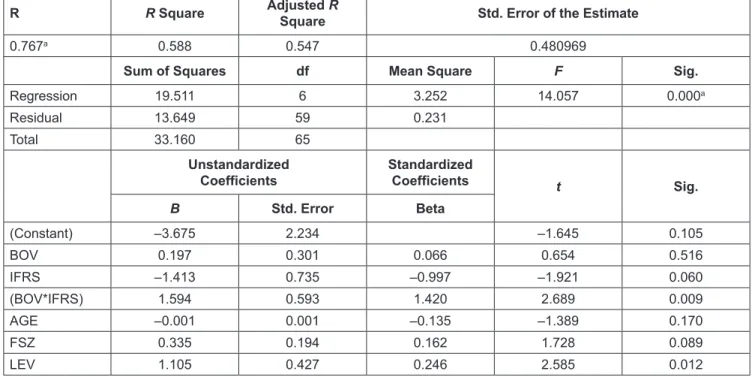
H5: The implementation of IFRS significantly affects the value relevance of the reported earnings of Iraqi banks.
H6: The implementation of IFRS significantly affects the value relevance of the book value of equity of Iraqi banks.
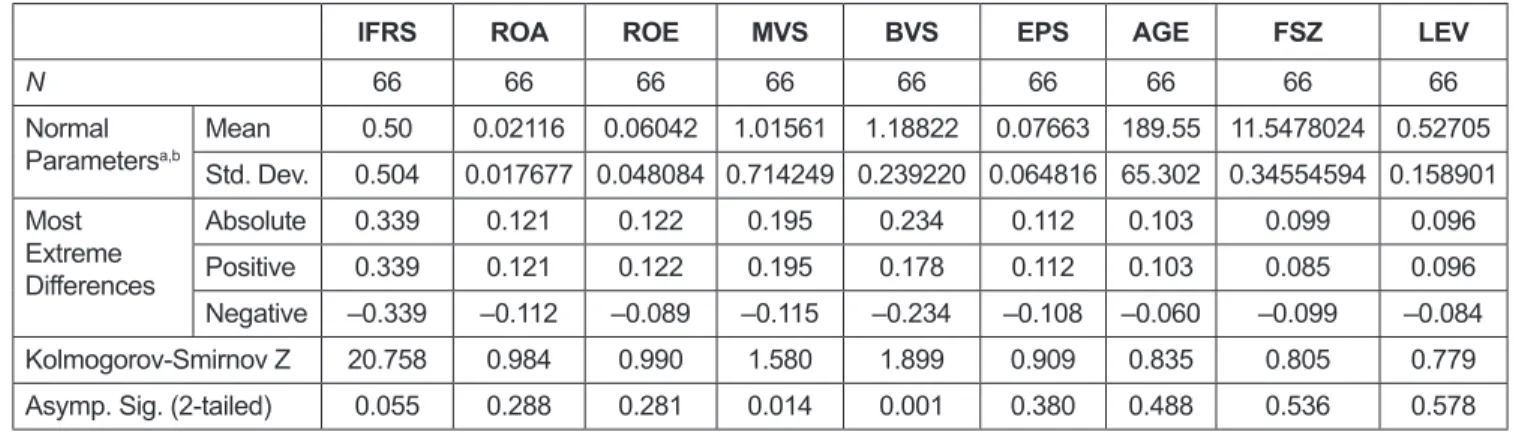
Table 1 shows the definitions of the main variables examined in this study. The adoption of IFRS represents the independent variable, which is measured through a placebo test that gives the number 1 in the years of adoption of IFRS for the years before the adoption of IFRS (Fang, Maffett, &
Zhang, 2015; Beuselinck et al., 2017).
Independent variables include both the financial
performance of the firm and the value of the disclosure of
the financial statements. Both the return on equity (ROE)
and the return on total assets (ROA) are examined in order
to assess the financial performance of Iraqi banks (Major
& Marques, 2009; Aubert & Grudnitski, 2011; Ferrer &
Ferrer, 2011). Independent variables include both the financial performance of the firm and the value of the disclosure of the financial statements. Both the return on equity (ROE) and the return on total assets (ROA) are examined in order to assess the financial performance of Iraqi banks:
Model 1:
X
it= B
0+ B EPS
1 it+ e
it(1) where X
itis the share price, while EPS
itis the share profit of the i company at t year. Model 2 was used to assess the explanatory power of the book share value.
Model 2:
X
it= B B BVS
it it0
+
1+ ε (2)
where X
itis share market value, while BVS
itis the book value of the stock. To examine both of hypothesis 1 and 2, the authors apply the following two multiple regression two methods:
Model 3:
X B B B B
B B
it it it it
it
it 0
BVS
1 2IFRS BVS IFRS Size Lev
= + + +
+ +
3
5 6
( * )
iit
+ B
7Age + e
it(3)
Model 4:
X B B B IFRS B
B B
it it it it it
it it
= + + +
+ + +
0 1
EPS
2EPS IFRS
Size Lev
3
5 6