Print ISSN: 2288-4637 / Online ISSN 2288-4645 doi:10.13106/jafeb.2021.vol8.no8.0409
Digital Accounting, Financial Reporting Quality and Digital Transformation: Evidence from Thai Listed Firms
Kornchai PHORNLAPHATRACHAKORN
1, Khajit NA KALASINDHU
2Received: April 20, 2021 Revised: July 04, 2021 Accepted: July 15, 2021
Abstract
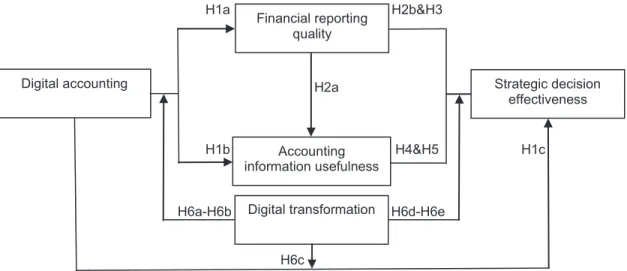
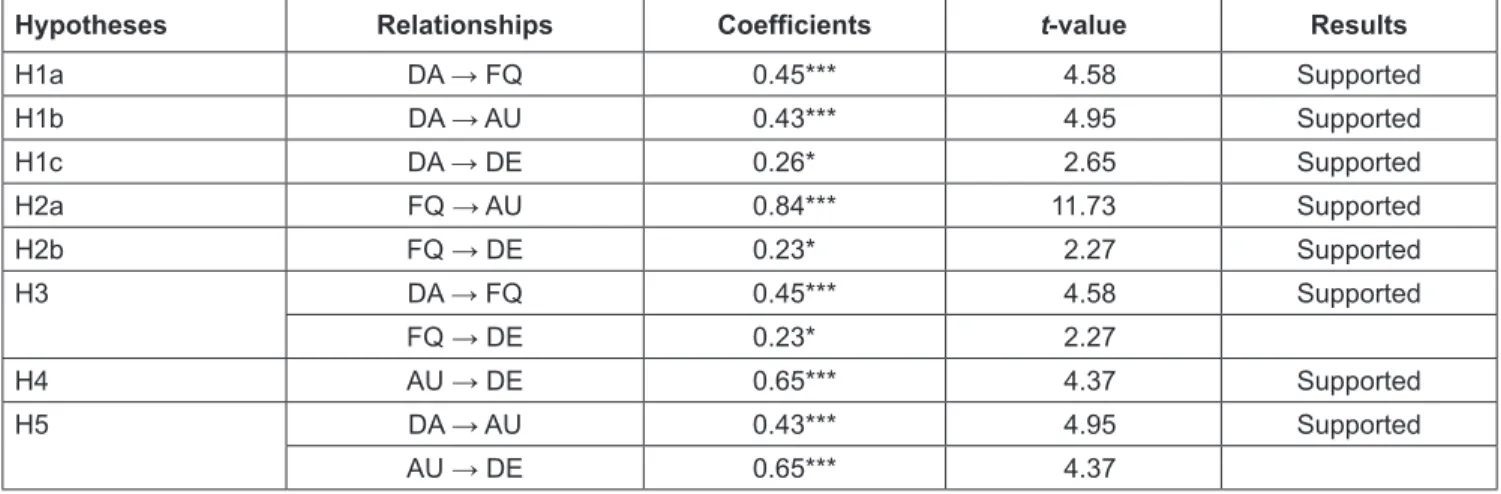
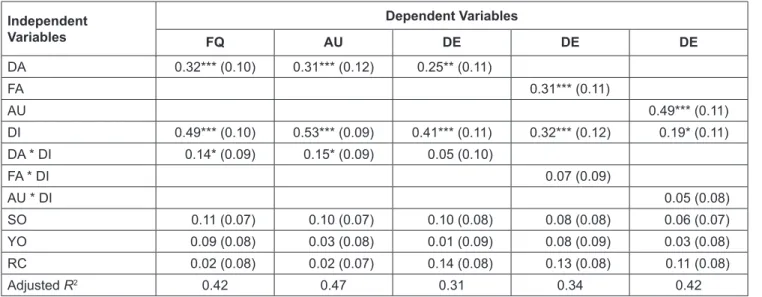
The study examines the effects of digital accounting on financial reporting quality, accounting information usefulness, and strategic decision effectiveness of listed firms in Thailand through digital transformation as the moderating variable. A total of 313 listed firms in Thailand were selected as the sample for the study. Structural equation model and multiple regression analysis are applied to test the research relationships. The results of the study show that digital accounting has a significant effect on financial reporting quality, accounting information usefulness, and strategic decision effectiveness. Financial reporting quality significantly affects both accounting information usefulness and strategic decision effectiveness while accounting information usefulness has a significant effect on strategic decision effectiveness. Both financial reporting quality and accounting information usefulness mediate the digital accounting-strategic decision effectiveness relationship. In addition, digital transformation moderates the digital accounting-financial reporting quality relationship and the digital accounting-accounting information usefulness relationship, but it does not moderate other relationships. Accordingly, digital accounting plays a significant role in determining and explaining firms’ goal achievement. Executives are suggested to learn, invest and utilize the digital accounting system in the organization to ensure goal achievement and enhance organizational sustainability.
Keywords: Digital Accounting, Financial Reporting Quality, Accounting Information Usefulness, Digital Transformation, Strategic Decision Effectiveness
JEL Classification Code: M41, M42, M49
various intelligent and innovative technologies in business environments, such as the Internet of Things, big data, data analytics, artificial intelligence, and cloud computing (Ritter
& Pedersen, 2020).
To achieve business success, efficiency and productivity are vital. Digital technology can help improve communication, collaboration, content management, access to analytics data and social networking as well as staff and customer experience. Successful enterprises are embracing technology to create digital workplaces that improve business cohesion (Khin & Ho, 2019). It’s evident that in this new world, technology is not a choice, but a fundamental business strategy that must be interwoven into every part of an organization. Transformation can enable better collaboration within and between organizations, more personalized ways of customer engagement, higher employee innovation and productivity, and more accurate insights from data, all of which help a business grow and give it a better chance of thriving.
Digital accounting refers to the creation, representation, and transfer of financial information in an electronic format.
1
First Author and Corresponding Author. Associate Professor, Faculty of Management Sciences and Information Technology, Nakhon Phanom University, Nakhon Phanom, Thailand [Postal Address: Nai Mueang, Mueang Nakhon Phanom District, Nakhon Phanom, 48000, Thailand] Email: [email protected]
2
Assistant Professor, Faculty of Management Sciences and Information Technology, Nakhon Phanom University, Nakhon Phanom, Thailand.
Email: [email protected]
© Copyright: The Author(s)
This is an Open Access article distributed under the terms of the Creative Commons Attribution Non-Commercial License (https://creativecommons.org/licenses/by-nc/4.0/) which permits unrestricted non-commercial use, distribution, and reproduction in any medium, provided the original work is properly cited.