1. INTRODUCTION
The non-profit sector is a critical part of the global
economy. The Independent Sector[1] claims that US non-profit organizations employed about 10% of the nation’s workforce in 2010. In spite of the economic and
The Effects of Financial Reporting Transparency and High-Quality Audit on Donations to Non-Profit Organizations: Evidence from
Korean Charitable Organizations
Jong Eun Lee
1*, Ahnkyu Choi
21
Sungkyunkwan University, Business School, Associate Professor
2
L’Oreal Korea, Finance Project Manager
재무보고의 투명성과 감사품질이 비영리법인의 기부금에 미치는 영향 : 한국자선단체로부터의 증거
이종은1*, 최안규2
1성균관대학교 경영대학 부교수, 2L’Oreal Korea, Finance Project Manager
Abstract In this study, we investigate the effects of disclosure and high-quality audit on donations to charitable organizations in Korea. We find that the mandatory disclosure of financial information and high-quality audit is significantly and positively related to donations to charitable organizations. We also find that charitable organizations audited by Big 4 audit firms have greater likelihood to receive more donations, compared to those audited by non-Big 4 audit firms. Furthermore, we find that those positive associations are more pronounced for smaller charitable organizations. Collectively, those results imply that, as in the profit-making sector, disclosure and high-quality audit play a critical role in enhancing accountability and transparency of financial reporting and revenue for charitable organizations.
Key Words : mandatory disclosure, audit quality, non-profit organization, financial reporting transparency, donation
요 약 본 연구는 감사품질이 비영리법인인 자선단체의 기부금에 미치는 영향을 분석하고 있다. 실증분석 결과에 의하면 재무정보의 강제공시와 높은 수준의 감사품질은 자선단체의 기부금과 양(+)의 관계를 가지는 것으로 나타났으며, 또한, 대 형 4개 회계감사법인이 감사업무를 맡은 자선단체는 그렇지 않은 자선단체에 비해 더 많은 기부금을 받을 가능성이 높은 것으로 나타났다. 이와 같은 양(+)의 관계는 규모가 작은 자선단체에서 더욱 유의한 것으로 나타났다. 본 연구에서의 분석 결과는 재무정보의 공시 및 수준 높은 외부감사를 통한 자선단체 재무보고의 투명성 제고가 기부금 증가에 매우 중요한 역할을 하고 있음을 시사하고 있음을 알 수 있다.
주제어 : 강제공시, 감사품질, 비영리법인, 재무보고투명성, 기부금
*This work was supported by the Ministry of Education of the Republic of Korea and the National Research Foundation of Korea (NRF-2015S1A5A8016148)
Corresponding Author : Jong Eun Lee ([email protected]) Received November 14, 2018
Accepted January 20, 2019
Revised January 2, 2019 Published January 28, 2019
social importance of non-profit organizations to our economy, little attention has been paid to them by regulators, media, or the public. Recently, the Independent Sector[1] reports that fraud cases involving for-profit organizations as a proportion of overall fraud decreased from 74.2% in 2010 to 66.4% in 2014, whereas fraud involving non-profit organizations increased from 9.6% in 2010 to 10.8% in 2014.
Accordingly, in Korea, there has been a variety of fraud (e.g., misappropriation, embezzlement, or tax avoidance) committed by non-profit organizations.
Regulators, policy-makers, accounting professionals, and donors are thus becoming increasingly interested in the accountability and transparency of non-profit organizations.
In response to the growing concerns about the opaque financial reporting and unethical behavior of non-profit organizations, the Korean National Tax Service (NTS) enacted a law in 2008 that requires all non-profit organizations with total assets of 1,000 million Korean won or more or with total revenues (including donations) of 500 million KRW or more to disclose their financial statements annually to enhance their financial reporting transparency. Specifically, the disclosure regulation has required related non-profit organizations to electronically file their financial statements with the National Tax Service (NTS) starting the fiscal year beginning in January 2008. An additional tax of a half percent of total assets is levied as monetary penalty for the non-profit organizations that did not disclose their financial statements. Later, on February 2014, NTS expanded the disclosure requirement into non-profit organizations with total assets of 500 million Korean won or more or with total revenues of 300 million KRW or more.
This study examines the association between the mandatory disclosure of financial information and high-quality audit and financial reporting transparency by studying 102 Korean charitable organizations that have disclosed their audited financial statements from January 2009 to April 2014. For-profit sector study
well-documents a negative association between both earnings transparency (e.g., [2]) and quality of financial reporting (e.g., [3-6]) and cost of capital. Moreover, non-profit sector study provides evidence that disclosing accounting information has a positive relationship to donations to charitable organizations. It has also been well documented that for-profit markets value high-quality audits such as Big N audit firms[7]
and industry expertise[8]. Kitching[9] reports a significantly positive association of charitable donations with high-quality audits, suggesting that donors positively react to the financial reporting credibility produced by high-quality audits when deciding on charitable contributions.
Therefore, if the mandatory disclosure of financial information or a high-quality audit improves charitable organizations’ financial reporting transparency, we expect more donations to charitable organizations since the enactment of the disclosure requirement or audited by Big 4 auditors. While for-profit organizations have various types of interesting groups such as shareholders, creditors, and governments, the primary stakeholders of charitable organizations are their donors. Charitable organizations are dependent on charitable contributions.
In this study, we thus focus on the impact of the
mandatory disclosure of financial statements and high
quality audit on donations to charities. We test the
association accounting information or a high quality
audit and donations and find a positive association of
the mandatory disclosure of financial information with
charitable donations. We also find that charitable
organizations audited by Big 4 audit firms are likely to
receive more donations, compared to those audited by
non-Big 4 audit firm. These findings are still robust to
endogeneity issue in auditor selection. As an additional
analysis, we conduct a size-related test and find that
the positive associations are more pronounced for
smaller charitable organizations. Collectively, these
results imply that, as in the profit-making sector, both
disclosure and high-quality audits play an important
role in enhancing financial reporting transparency and revenue for charitable organizations.
Our study contributes to the relevant literature in several ways. First, we believe our study to be the first to address the effects of disclosure regulations governing non-profit organizations and high-quality audits on donations to charitable organizations using Korean data. Second, although concern has been growing about the transparency of non-profit organizations’ financial reporting, few studies have empirically investigated the effect of accounting information on donations to them. Our finding on the positive relationship between disclosure regulations and charitable contributions supports the notion that financial reporting transparency is a critical factor affecting donors’ decisions. Third, our study contributes to the audit quality literature. Numerous studies on publicly traded companies show that high-quality audits produce better financial reporting, featuring lower discretionary accruals, less restatements, and higher accruals quality. Our study, along with Kitching[9], provides additional evidence that high-quality audits are valued by donors to non-profit organizations, leading to more donations.
2. RESEARCH HYPOTHESIS DEVELOPMENT
2.1 LITERATURE REVIEW
2.1.1 Disclosure and Corporate Transparency Research on the association between information disclosure and corporate transparency has mainly focused on publicly traded companies. Corporate transparency can be enhanced in several ways. The most common method is increasing the quantity and/or quality of disclosure. Regulators and policymakers can force or encourage firms to disclose their financial or governance information. The consequences of financial reporting transparency have been thoroughly investigated by researchers. For example, Barth et
al.[2] examine the association of earnings transparency with cost of capital and find a negative association between earnings transparency and expected cost of capital. Other studies (e.g., [3-5]) find a negative relationship between accounting information (e.g., accruals quality) and cost of capital.
Research has also examined the accountability and transparency of non-profit organizations. Most non-profit researches (e.g., [10-12]) focus on the usefulness of information provided by non-profit organizations to donors’ decisions about charitable contributions. They find that this information plays a critical role in attracting more donations to charitable organizations. For instance, Greenlee and Brown[10]
find that the efficiency of administrative costs and the magnitude of fund-raising costs are positively associated with donations to charities. Gordon and Khumawala[12] find that charities’ financial information is more highly valued as the distance between the donors and charitable organizations increases. Other studies (e.g., [13-15]) report that the disclosure of high-quality information is positively associated with donations to charitable organizations. Particularly, Hyndman[14] emphasizes the importance of providing non-financial information for donors. Buchheit and Parsons[16] document that non- financial information like program missions and descriptions of organizational performance and achievement is more effective in inspiring donors’ charity.
Thus, the research suggests that information disclosure is a critical factor in enhancing financial reporting transparency in both the for-profit and non-profit sectors. The positive economic consequences of information disclosure include reduced costs of capital and increased donations to charitable organizations.
Given the positive effects of information disclosure
on financial reporting transparency, the Korean
National Tax Service (NTS) has required non-profit
organizations with total assets of 1,000 million KRW
or more or total revenues (including donations) of 500
million KRW or more to electronically disclose their financial statements on a website designated by the NTS since the 2008 fiscal year-end. Non-profitmaking organizations have had to disclose their financial statements within four months after a fiscal-year end since the end of fiscal year 2008.
In addition, fundraising-related regulations require charitable organizations with donations of 100 million KRW to have their financial statements audited by external auditors. While Korean regulators believe that the new disclosure requirement enhances the financial reporting transparency of non-profit organizations, the effectiveness of the disclosure requirement has not been systematically tested since its enactment.
2.1.2 Audit Quality and Credibility of Information The objective of a financial statement audit is to provide a higher level of assurance, leading to enhanced credibility of financial statements (i.e., reducing information risk). The degrees of credibility provided by auditors vary, as audit quality varies among auditors. Many studies (e.g., [7,17-18,8]) on for-profit organizations empirically indicate that auditors with greater resources (e.g., Big 4 auditors) or more knowledge of specific industries (e.g., industry-specialist auditors) produce higher-quality audits. Big 5 auditors produce more reliable reported earnings, leading to higher ERCs (Earnings Response Coefficients[7] and lower accruals[17-18].
Industry-specialist auditors are more effective in deterring management’s opportunistic behavior of earnings management[8]. Kitching[9] examines 270 non-profit organizations and finds a significant and positive association of donations with high-quality audits, suggesting that donors value financial reporting credibility enhanced by high-quality audit when making charitable contribution decisions. Similarly, several studies (e.g., [11,19-20]) provide an evidence on the positive association between donations and non-profit organizations’ reputational ratings by external agencies, indirectly suggesting that non-profit
organizations with high-quality auditors are more likely to receive donations.
While donors are expected to be more likely to donate to charities with high-quality audits, charity managers have discretion concerning auditor selection, suggesting that a charity’s auditor is endogenously self-selected. Studies on for-profit firms (e.g., [21-23]) report that the demand for a high-quality audit is positively associated with firms’ agency cost. For example, DeFond[21] documents that firms with higher institutional ownership or leverage have more likelihood of hiring high-quality auditors, implying that institutional owners and creditors exert a stronger demand for high-quality auditors to monitor management behavior. Independent and active audit committees also demand high-quality audits to support their monitoring of the firm’s financial reporting and insure against unexpected monetary or reputational damage from potential litigation[24]. In addition, Kitching[9] shows that the charities with greater reputation have more incentives to choose quality auditors to signal the high quality of their financial information to potential donors.
2.2 HYPOTHESIS DEVELOPMENT
As discussed, the extant for-profit literature (e.g., [2-6]) indicates that transparent financial reporting is negatively correlated with cost of capital. Similarly, numerous studies of non-profitmaking sector (e.g., [10-15]) find a positive effect of financial reporting transparency through information disclosure on donations to charitable organizations. Disclosure regulations may be justified when there are externalities or when information acquisition costs are expensive. Therefore, decisions about implementing disclosure regulations should be made carefully, as the impact of such regulations on financial reporting transparency could be affected by externalities or information acquisition costs.
Thus, if the mandatory disclosure of financial
information enhances financial reporting transparency,
and if, in turn, more reliable financial information is disseminated among potential donors, we can expect that the information asymmetry between charities and donors will be reduced and donations to charities will consequently increase. We thus posit that the mandatory disclosure of financial information positively affects donations to charitable organizations. Therefore, we hypothesize as follows (in an alternative form):
H1: For the charitable organizations, the mandatory disclosure of financial information is positively associated with donations to them.
Next, we examine the degree to which donors value audit quality differences among auditors (as in the for-profit literature) by testing if donors are more willing to donate to charities with high-quality audits.
Consistent with the findings in for-profit studies, Kitching[9] documents that the charities with a high-quality audit attract more donors, suggesting that donors are concerned about the proper use of their donations and do care about audit quality as an active monitoring device. We now hypothesize as follows (in an alternative form):
H2: High-quality audits are positively associated with donations to charitable organizations.
3. RESEARCH DESIGN
3.1 SAMPLE SELECTION
We start with 1,562 social welfare organizations that disclosed their 2013 fiscal year financial statements as of April 30, 2014. First, we manually confirm if the organizations are all charities and if their disclosed financial statements are audited by an independent external auditor. We then identify 56 charities that disclosed their audited financial statements. Next, we gather the audited financial statements of the 185 charity-year observations, along with the audit reports the 56 charities disclosed from the 2008 to the 2013
fiscal years. We hand-collect all financial and auditor variables from the audited financial statements and audit reports, respectively. Excluding missing financial variables produces 142 final charity-year observations.
As shown in the research design section, lagged variables of auditor (Lag(Big4)) and program expense ratio (Lag(Progratio)) are required for the regression analysis. Therefore, we have 102 final sample observations, covering the fiscal years from 2009 to 2013. Due to the limited accessibility of financial statements issued prior to fiscal year 2008, financial information for fiscal year 2008 is used to create the lagged variables of the Big 4 auditors and program expense ratio.
3.2 RESEARCH DESIGN
We test the hypotheses on the impact of the mandatory disclosure of financial information and high-quality audits on donations to charities using the following regression model:
Donation
i t= β
0+ β
1*Time
it+ β
2*Lag(Big4)
i t- 1+ β
3
*Lag(Progratio)
i t -1+ β
4*Size
i t+ β
5*Progrev
it+ β
6
*Grants
it+ β
7*Otherrev
it+ β
8*Frexp
it+ β
9*GDP
it+ ε
itS‥·
(1)
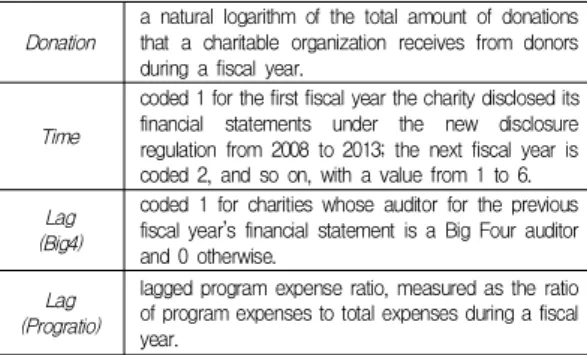
In Eq.(1), dependent variable Donation is the total amount of donations that a charity receives from donors during a fiscal year, measured as a logarithm of the total amount of donation (See Table 1).
Donation
a natural logarithm of the total amount of donations that a charitable organization receives from donors during a fiscal year.
Time
coded 1 for the first fiscal year the charity disclosed its financial statements under the new disclosure regulation from 2008 to 2013; the next fiscal year is coded 2, and so on, with a value from 1 to 6.
Lag (Big4)
coded 1 for charities whose auditor for the previous fiscal year’s financial statement is a Big Four auditor and 0 otherwise.
Lag (Progratio)
lagged program expense ratio, measured as the ratio of program expenses to total expenses during a fiscal year.
Table 1. Definition of research variables
We use two test variables. First, Time represents the number of years that charities have disclosed their financial statements from the 2008 to the 2013 fiscal year end in compliance with the disclosure regulation.
If reporting transparency is enhanced by the disclosure regulation as time passes, we expect a positive coefficient( β
1) of Time in Eq. (1).
Second, Big4, a proxy for audit quality, is a dummy variable coded 1 for charities whose auditor is a Big Four auditor. For the regression analysis, we use Lag(Big4), a lagged form of the Big4 test variables, for the following reason. Unlike in the for-profit sector, non-profit organizations are not required to report which auditor will be conducting the next fiscal year’s audit to regulators such as the Financial Supervisory Service (FSS). Therefore, we assume that it is difficult for donors to confirm the quality of a charity’s current financial statements or its auditor and must thus base their donation decisions primarily on who audited the prior fiscal year’s financial statements.
Next, we control for the accounting information and firms characteristics affecting the donation. First, program expense ratio (Progratio) and fundraising expense ratio (Frexp) are the key factors affecting donors’ charitable contribution decisions. For the same reasons we use Lag(Big4), we use Lag(Progratio), a lagged form of Progratio, representing how appropriately a charity uses donations for its primary objective, measured by program expenses divided by total expenses during the previous fiscal year (e.g., [25-26]).
Second, the donation amount a charity receives is
positively associated with its fundraising activity [27,16]. Therefore, we control for total fundraising expenses (Frexp), measured as the ratio of fundraising expenses to total expenses. Next, we control for factors related to charities’ dependence on donations. Size is measured as a logarithm of total assets at the end of the fiscal year. Charities usually have three revenue resources other than donations: 1) program revenue (Progrev), 2) government grants (Grants), and 3) other (Otherrev). Charities with more program revenues, grants, or other revenues are plausibly less likely to pursue donations, but it is unknown how they make decisions on the issue. Finally, we control for gross domestic product (GDP) as a macro variable representing a nation’s economic condition. A better economy is expected to make people more likely to donate to charity.
4. EMPIRICAL RESULTS
4.1 DESCRIPTIVE ANALYSIS
Table 2 presents yearly sample distribution from 2009 to 2013. Table 3 resents the results of the mean difference test between the charities audited by Big 4 audit firms and those audited by non-Big 4 audit firms.
Charities with Big 4 auditors have more donations, are larger, have more revenue from programs or other sources, and spend more on fundraising activities than those with non-Big 4 auditors.
Year 2009 2010 2011 2012 2013 Total
N 5 7 17 31 42 102
Table 2. Sample distribution by year
Sizea natural logarithm of total assets at the end of the
fiscal year.
Progrev
a natural logarithm of program revenues during a fiscal year.
Grants
a natural logarithm of government grants during a fiscal year.
Otherrev
a natural logarithm of other revenues during a fiscal year.
Frexp
a ratio of fundraising expenses to total expenses during a fiscal year.
GDP
a natural logarithm of gross domestic product during a fiscal year.
Variable Mean
t-statistic
Big4 =1 Big4 =0Donation
9.89 7.35 4.47
***Time
4.06 4.18 -0.40
Progratio
0.76 0.68 1.33
Size
10.66 9.73 2.67
***Table 3. Univariate Analysis
The mean differences of those variables between the two charity groups are significant at the 1% or 10%
level. Charities with Big 4 auditors also have higher Progratio and Grants, but the mean differences are not statistically significant.
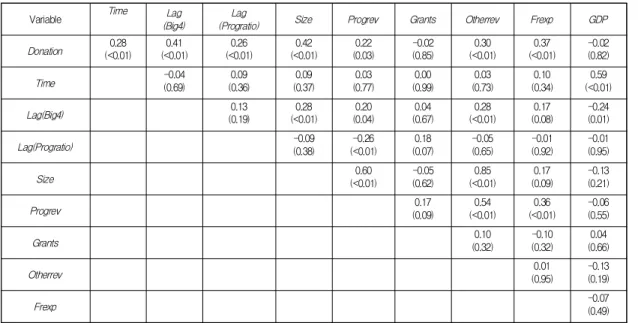
Table 4 reports the results of the correlations among the variables used in the empirical model. The correlations between Donation and Time and Lag(Big4) are 0.28 (p-value <0.01) and 0.41 (p-value
<0.01), respectively, providing preliminary evidence that the new disclosure regulation for non-profit organizations in Korea has positively affected donors’
decisions to give and that high-quality audits are more effective in attracting more donations to charities.
Moreover, Donation is significantly and positively correlated with program ratio (Lag(Progratio)) and charity size (Size): 0.26 (p-value <0.01) and 0.42 (p-value <0.01), respectively. All other correlations,
except for those between Size and Otherrev (0.85, p-value<0.01), are equal to or less than 0.6. The VIF of Size and Otherrev is 4.6 and 4.2, respectively, both of which are below the conventional multicollinearity cutoff of 5. As a further analysis, however, we drop Otherrev and replicate all the regression analyses. The main findings are not affected.
4.2 MULTIVARIATE ANALYSIS
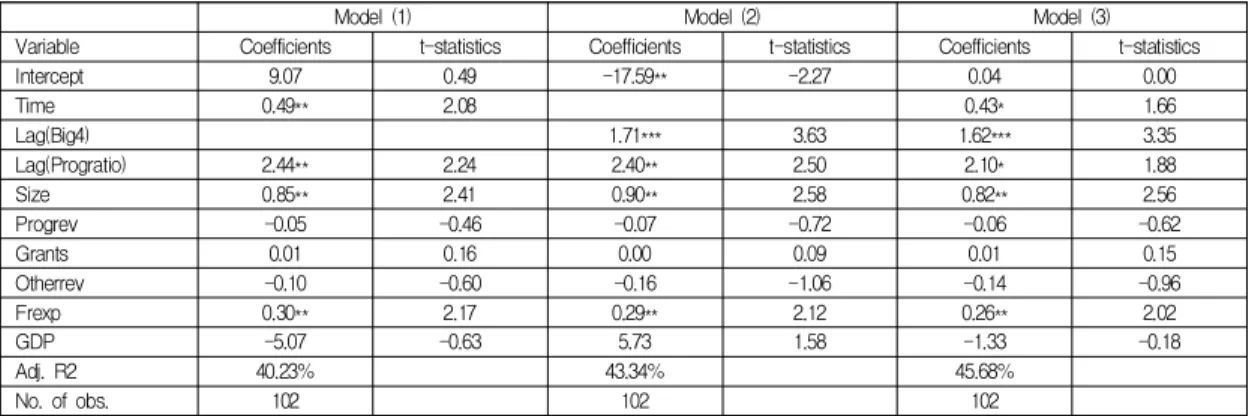
Table 5 presents the regression results, where all statistics and significance levels are based on standard errors adjusted by a two-dimensional cluster at the firm and year levels. The dependent variable is Donation, a natural logarithm of the total amount of donations. We use two test variables: Time and Lag(Big4). Time is coded 1 for the first fiscal year when a charity disclosed its financial statements under the new disclosure regulation from fiscal years 2008 to 2013; the next fiscal year is coded 2, and so on. The next test variable is Lag(Big4).
Korean fundraising-related regulations require charitable organizations with 100 million KRW of donations or more during a fiscal year to have their
Progrev
5.21 3.41 1.85
*Grants
3.97 3.76 0.23
Otherrev
7.75 6.29 2.77
***Frexp
3.82 2.69 1.84
*Number of observations
31 71
***/**/* Significant at or below the 0.01/0.05/0.1 level (two-tailed).
Table 4. Correlation Matrix for the Variables Used in the Model
Variable
Time Lag(Big4)
Lag
(Progratio) Size Progrev Grants Otherrev Frexp GDP
Donation
0.28
(<0.01)
0.41 (<0.01)
0.26 (<0.01)
0.42 (<0.01)
0.22 (0.03)
-0.02 (0.85)
0.30 (<0.01)
0.37 (<0.01)
-0.02 (0.82)
Time
-0.04
(0.69)
0.09 (0.36)
0.09 (0.37)
0.03 (0.77)
0.00 (0.99)
0.03 (0.73)
0.10 (0.34)
0.59 (<0.01)
Lag(Big4)
0.13
(0.19)
0.28 (<0.01)
0.20 (0.04)
0.04 (0.67)
0.28 (<0.01)
0.17 (0.08)
-0.24 (0.01)
Lag(Progratio)
-0.09
(0.38)
-0.26 (<0.01)
0.18 (0.07)
-0.05 (0.65)
-0.01 (0.92)
-0.01 (0.95)
Size
0.60
(<0.01)
-0.05 (0.62)
0.85 (<0.01)
0.17 (0.09)
-0.13 (0.21)
Progrev
0.17
(0.09)
0.54 (<0.01)
0.36 (<0.01)
-0.06 (0.55)
Grants
0.10
(0.32)
-0.10 (0.32)
0.04 (0.66)
Otherrev
0.01
(0.95)
-0.13 (0.19)
Frexp
-0.07
(0.49)
Note: The table reports Pearson correlations. P-values appear in parentheses.
financial statements audited by an external auditor. As a result, charities select their external auditor at the end of the fiscal year, based on the current fiscal year’s total amount of donations. Thus, donors usually have no information about the auditor when making donation decisions. We therefore assume that any decision in a
given year is made based on the previously disclosed financial statements (disclosed within four months after the fiscal year end). We therefore use a lagged external auditor.
We conduct three regressions. First, to test the effect of the disclosure regulation on donations, we Table 5. Results of Regression on the Effects of Disclosure Regulation and High-quality Audit on Donations
Model (1) Model (2) Model (3)
Variable Coefficients t-statistics Coefficients t-statistics Coefficients t-statistics
Intercept 9.07 0.49 -17.59** -2.27 0.04 0.00
Time 0.49** 2.08 0.43* 1.66
Lag(Big4) 1.71*** 3.63 1.62*** 3.35
Lag(Progratio) 2.44** 2.24 2.40** 2.50 2.10* 1.88
Size 0.85** 2.41 0.90** 2.58 0.82** 2.56
Progrev -0.05 -0.46 -0.07 -0.72 -0.06 -0.62
Grants 0.01 0.16 0.00 0.09 0.01 0.15
Otherrev -0.10 -0.60 -0.16 -1.06 -0.14 -0.96
Frexp 0.30** 2.17 0.29** 2.12 0.26** 2.02
GDP -5.07 -0.63 5.73 1.58 -1.33 -0.18
Adj. R2 40.23% 43.34% 45.68%
No. of obs. 102 102 102
a) The dependent variable is Donation, a natural logarithm of the total amount of donations that a charity receives from donors during a fiscal year.
b) All statistics and significance levels are based on standard errors adjusted by a two-dimensional cluster at the firm and year levels.
***/**/* indicate significance at or below the 0.01/0.05/0.1 level (two-tailed)
Table 6. Results of Regression on the Effect of Disclosure Regulation and High-quality Audit on Donations After Controlling for Auditor Self-selection Bias
DV=Lag(Big4) DV=Donation
First-stage Model Second-stage Model
Variable
Exp.
Sign Coefficients t-statistics Coefficients t-statistics
Intercept ? -3.33** -2.29 10.62 0.92
Lag(Progratio) ? 0.63 0.96
Lag(Size) ? 0.00 0.01
Lag(Progrev) ? 0.02 0.36
Lag(Grants) ? -0.00 -0.04
Lag(Otherrev) ? 0.15 1.04
Lag(Frexp) ? 0.04 0.75
Lag(Donation) ? 0.13** 2.07
Time ? 0.12 0.71
Lag(Big4) ? 0.82*** 3.40
Lag(Progratio) + -1.27* -1.72
Size + 0.27 1.51
Progrev ? -0.13*** -2.82
Grants ? 0.01 0.89
Otherrev ? -0.31*** -3.35
Frexp + 0.09 1.03
GDP + 1.23 0.23
Inverse Mill’s Ratio ? -4.60*** -4.98
Adj. R-Square 26.34% 68.55%
No. of observations 102 102
a) For the first-stage regression model, the dependent variable is Lag(Big4), coded 1 for charities whose auditor for the prior financial statement is a Big Four auditor and 0 otherwise. For the second-stage regression model, the dependent variable is Donation, a natural logarithm of the total amount of donations that a charity receives from donors during a fiscal year.
b) All statistics and significance levels are based on standard errors adjusted by a two-dimensional cluster at the firm and year levels.
***/**/* indicate significance at or below the 0.01/0.05/0.1 level (two-tailed)
regress Donation on Time, controlling for the accounting information or charity characteristics affecting donations. The result is shown in Table 5, Model (1). The coefficient of Time is positive and significant (t-statistic = 2.08) at the 5% level, suggesting that the disclosure regulation enhances charities’ financial reporting transparency, leading to more donations. Next, to test the association of high-quality audits and donations, Donation is regressed on Lag(Big4).
According to the result shown in Table 4, Model (2), the coefficient of Lag(Big4) is positive and significant (t-statistic = 3.63) at the 1% level, suggesting that donors positively value a high-quality audit, leading to more charitable contributions. Finally, we regress Donation on the two test variables together with other control variables. The result is presented in Table 4, Model (3). Consistent with the results in Table 4, Models (1) and (2), we find that Time and Lag(Big4) are positive and significant at the 10% and 1% level, respectively.
Thus, the new disclosure requirement for charities’
financial statements plays a critical role in improving charities’ accountability and transparency. Moreover, charities with a high-quality audit are more positively valued by donors. Consequently, both vehicles lead to more charitable contributions.
5. ADDITIONAL ANALYSES
5.1 Auditor Self-Selection Issue
As mentioned, charities’ auditor selections are made internally, potentially causing self-selection bias. To address this potential endogeneity, in this section, we use the Heckman procedure, which considers observable as well as unobservable factors affecting selection bias[28]. As the first step of performing the Heckman procedure, we estimate following probit regression model, using auditors and accounting information on the previously reported financial statements:
Big4
i t - 1= β
0+ β
1*Prograti o
i t - 1+ β
2*Size
i t - 1+ β
3