Print ISSN: 2288-4637 / Online ISSN 2288-4645 doi:10.13106/jafeb.2020.vol7.no7.049
1
First Author and Corresponding Author. Assistant Professor, Department of Accounting, Faculty of Business, Philadelphia University, Jordan [Postal Address: P.O. Box 1, Amman, Jordan 19392] Email: [email protected]
2
Associate Professor, Al-Balqa Applied University (Amman University College for Financial & Administrative Sciences), Amman, Jordan.
3
Assistant Professor, Al-Balqa Applied University, Salt, Jordan.
© Copyright: The Author(s)
This is an Open Access article distributed under the terms of the Creative Commons Attribution
Non-Commercial License (http://Creativecommons.org/licenses/by-nc/4.0/) which permits
unrestricted noncommercial use, distribution, and reproduction in any medium, provided the
original work is properly cited.
The Impact of Horizontal Mergers on the Performance of the Jordanian Banking Sector
Yusuf Ali AL-HROOT
1, Laith Akram AL-QUDAH
2, Faris Irsheid ALKHARABSHA
3
Received: May 11, 2020 Revised: May 17, 2020 Accepted: June 09, 2020
Abstract
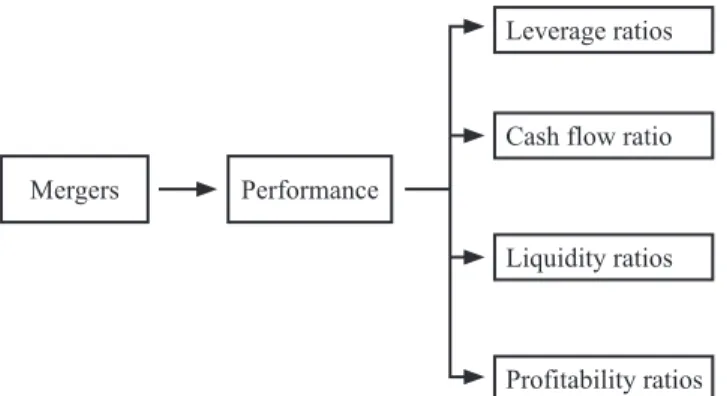
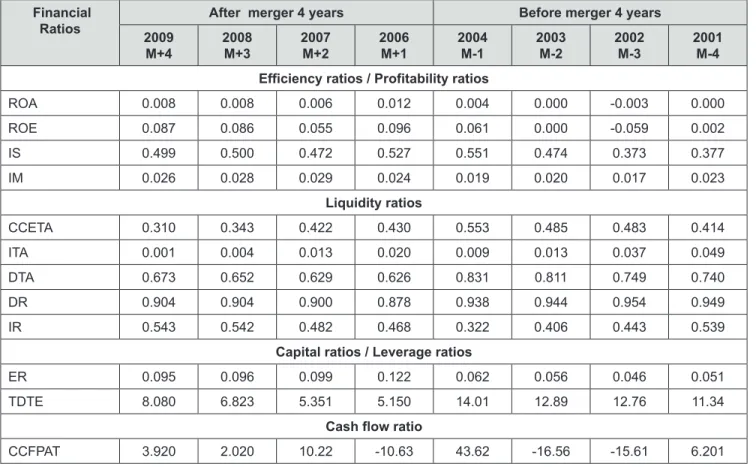
This paper examines the impact of mergers on the financial performance of the Jordanian banking sector. This paper applies the financial approaches in analysing the effects of mergers on Jordanian banks’ performance for two the periods: four years pre-merger and four years’
post-merger for the period from 2001 to 2009. The sample of the study solely contains the case of the merger of the Jordan Ahli Bank (AHLI bank) with Philadelphia Bank in 2005. Data are tested for normality using the Shapiro-Wilk Test and Kolmogorov Smirnov test.
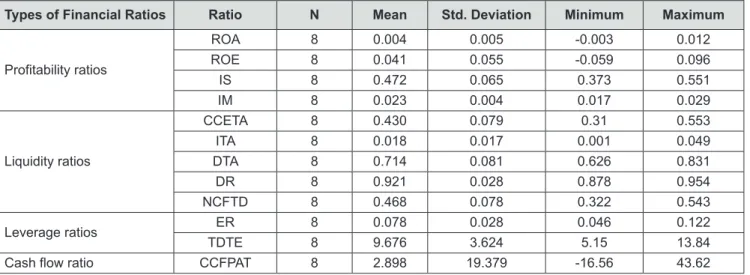
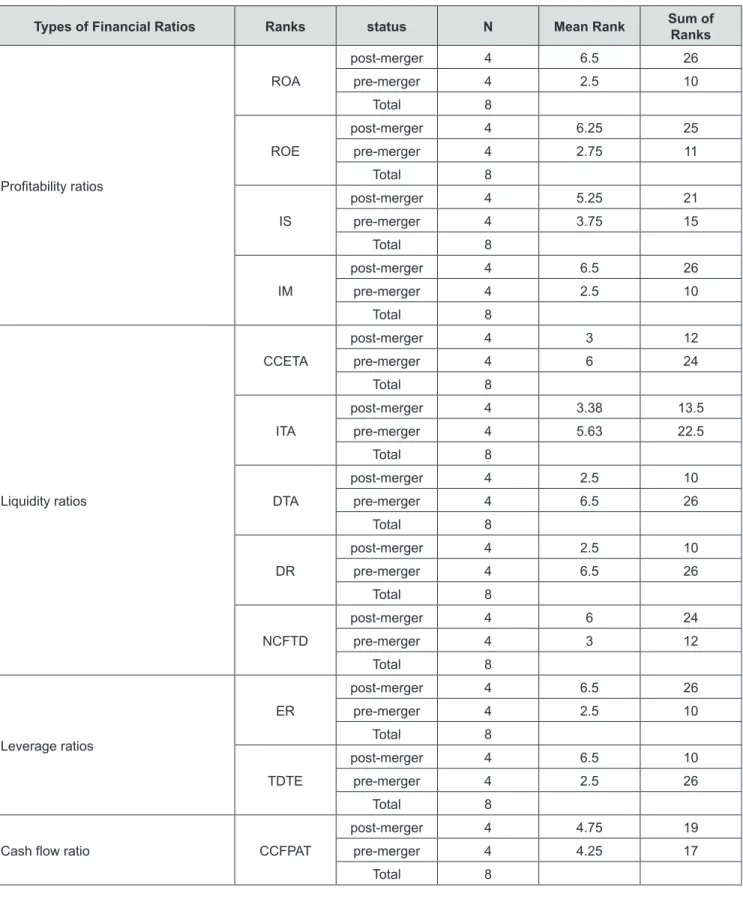
The financial ratios and a statistical technique as a Mann-Whitney U test were used to assess the significant differences in the financial performance of the selected banks pre- and post-merger by investigating the performance-related financial ratio groups that are expressed by leverage, liquidity, efficiency, and cash flow ratio. The results show that there is an insignificant improvement in the ratios of AHLI bank in the period after the merger, except for the superior result provided by this study indicating that the leverage ratios improved significantly.
The reason for the insignificant improvement in financial ratios may be that the post-merger period corresponds to the period of the global financial crisis that began in 2007.
Keywords : Horizontal Mergers, Financial Performance, Banking Sector, Operational Performance Approach, Jordan.
JEL Classification Code: G34, M49, G21.
1. Introduction
The World Bank classifies the countries’ economies into four income categories: high, upper-middle, lower-middle, and low. Jordan’s economy is classified as an upper-middle income country. The banking sector is Jordan’s largest economic sector, representing 15 percent of the nation’s total GDP. The meaning of the merger and procedures going through mergers are provided in Part 11 of the Jordanian
companies’ law no. 22 of 1997 and its amendments from article (222) to article (239).
A merger is the combining of one or more corporations, limited liability companies (LLC), or other business entities into a single larger company to realise productivity and a high level of efficiency. As a brief history of the corporation mergers and acquisitions around the world, many examples may be mentioned: a start-up in 1779, the North West Company was a fur trading company headquartered in Canada; it was forced to merge with Hudson’s Bay Company in 1821. The largest merger and acquisition combining the transaction value between companies is the merger of Mannesmann by Vodafone Air touch PLC, valued at US$202 billion. The most common classification types of mergers were published by The Federal Trade Commission (FTC):
1. Horizontal mergers, which include one or more competitors.
2. Vertical mergers, which include one or more buyer-seller relationships.
3. Potential competition mergers, in which the purchaser is likely to enter the market and turn into a potential competitor of the vendor or seller, or vice versa.
The main aims of a merger are to increase capabilities
and revenue, gain a competitive advantage or larger market