• 검색 결과가 없습니다.

Preparation and Photoluminescent Properties of Ca<sub>2</sub>PO<sub>4</sub>Cl Activated by Divalent Europium

N/A
N/A
Protected

Academic year: 2021

Share "Preparation and Photoluminescent Properties of Ca<sub>2</sub>PO<sub>4</sub>Cl Activated by Divalent Europium"

Copied!
5
0
0

로드 중.... (전체 텍스트 보기)

전체 글

(1)

Preparation and Photoluminescent Properties of Ca 2 PO 4 Cl Activated by Divalent Europium

In Yong Park

Department of Materials Science and Engineering, Hanbat National University, 125 Dongseodaero, Yuseong-gu, Daejeon 34158, Korea

(Received December 5, 2016: Corrected December 21, 2016: Accepted December 23, 2016)

Abstract: Divalent europium-activated Ca

2

PO

4

Cl phosphor powders were prepared by a chemical synthetic method fol- lowed by heat treatment in reduced atmosphere, and the crystal structures, morphologies and photoluminescence properties of the powders were investigated by x-ray powder diffraction, scanning electron microscope and spectrometer. The effect of Ca/P mole ratio at the starting materials on the final products was evaluated. The optimized synthesis condition obtained in this study was Ca/P mole ratio of 2.0. The present phosphor materials had higher photoluminescence intensity and better color purity than the commercial blue phosphor powders, (Ca,Ba,Sr)

10

(PO

4

)

6

Cl

2

:Eu

2+

. The result of excitation spec- trum measurement indicated that the excitation efficiency of the synthesized powders was higher for the long-wavelength UV region than that of the commercial phosphor. It was thus concluded that the samples prepared in this study can be successfully applied for the light-emitting devices such as LED excited with long-wavelength UV light sources.

Keywords: Ca

2

PO

4

Cl:Eu

2+

, phosphor, photoluminescence, apatite, excitation

1. Introduction

Alkaline earth halophosphates for phosphors belong to a family of apatitic compounds like the general formula of M

5

(PO

4

)

3

X:A, where M is Ca

2+

, Sr

2+

, Ba

2+

or combinations of these, X is F

-

, Cl

-

of anion, and A is Eu

2+

, Sb

3+

, Mn

2+

of activator ions.

1)

These phosphors emit the light of range from vacuum ultraviolet to infrared.

1-3)

Also, the emission efficiency of these compounds is superior to other systems, and applied to three-band lamps and lightings for long time.

2-9)

Divalent europium-activated apatitic compounds show the possibility for the purpose of LED (light emitting diode) phosphors due to the effective blue emission from excitation by long wavelength ultraviolet light source.

3)

Among the alkaline earth halophosphates, chlorospodi- osite (Ca

2

PO

4

Cl) has the same crystal structure of spodios- ite (Ca

2

PO

4

F).

10)

Ca

2

PO

4

Cl has orthorhombic crystal struc- ture, which has a=6.185±0.002 Å, b=6.983±0.002 Å and c=10.816±0.004 Å.

10)

The PO

43−

tetrahedra are significantly distorted from the ideal configuration.

10)

Ca

2

PO

4

Cl:Eu

2+

is known as an efficient luminescent material, but the research on this phosphor is very few.

1,11-14)

Ca

2

PO

4

Cl decomposes into apatite Ca

5

(PO

4

)

3

Cl and liquid at above 1040

o

C, which

has incongruent melting point.

15)

Therefore, heat treatment should be conducted below this point.

Ca

2

PO

4

Cl compounds are mainly synthesized via solid- state reaction, and CaCl

2

salts are used as starting materials for this method. However, CaCl

2

salts are deliquescent and it is not easy to handle the salts in ambient atmosphere.

Also research on wet chemical synthesis of Ca

2

PO

4

Cl:Eu

2+

is not reported to the best of our knowledge. In this study, homogeneity in composition mixing was achieved using a wet chemical method, and the effect of mole ratio change on the properties of Ca

2

PO

4

Cl:Eu

2+

phosphors was evalu- ated. For comparison of optical properties, the commercial phosphor of (Ca,Ba,Sr)

10

(PO

4

)

6

Cl

2

:Eu

2+

was chosen as a reference, which is used as blue phosphor for lamps.

2. Experimental Procedure

The starting materials were as follows: CaCl

2

·2H

2

O (Aldrich Co.; 99.99%), EuCl

3

·6H

2

O (Aldrich Co.; 99.9%), H

3

PO

4

(Aldrich Co.; 98%, crystals), HCl (reagent grade), and aqueous ammonia (reagent grade). All reagents were used without further purification.

The Ca

2

PO

4

Cl:Eu

2+

blue phosphor powders were pre-

Corresponding author E-mail: [email protected]

© 2016, The Korean Microelectronics and Packaging Society

This is an Open-Access article distributed under the terms of the Creative Commons Attribution Non-Commercial License(http://creativecommons.org/

licenses/by-nc/3.0) which permits unrestricted non-commercial use, distribution, and reproduction in any medium, provided the original work is

properly cited.

(2)

pared using a coprecipitation method through the following procedure. Mole ratio of Ca/P in the starting solution was changed from 1.6 to 2.4, and mole ratio of Eu/P was fixed to be 0.06. The chemicals of CaCl

2

·2H

2

O, EuCl

3

·6H

2

O and H

3

PO

4

were dissolved with distilled water, and 0.1N HCl solution was added to the mixed salt solution. The concen- trations of EuCl

3

, H

3

PO

4

and HCl were adjusted to 0.06 mole/L, 1 mole/L and 8.3×10

-4

mole/L, respectively, whereas CaCl

2

concentration was varied with mole ratio of Ca/P. In other beaker, concentrated aqueous ammonia corresponded to the chemical equivalent of H

3

PO

4

, CaCl

2

, EuCl

3

and HCl was diluted with distilled water to 4 mole/L. The mixed solution of CaCl

2

/EuCl

3

/H

3

PO

4

was added to the aqueous ammonia solution with vigorous stirring, and the white precipitates were formed. The pH of the colloidal solution after the reaction was about 9. And then the result- ing suspension was stirred continuously and heated with hot plate to evaporate water. The dried precursor cakes were produced. The cakes were put into alumina crucible and calcined at 500

o

C for 1 h. After cooling down to ambi- ent temperature, the white powders were prepared by mill- ing. These powders were placed into the alumina boat and were heat-treated under the reduction atmosphere of 4%H

2

/ 96%Ar at 900

o

C for 2 h. After washing with distilled water for several times and drying at 100

o

C, the Ca

2

PO

4

Cl:Eu

2+

blue phosphor powders were produced.

Crystalline structure of the phosphor powders was mea- sured by X-ray diffractometer (XRD; Rigaku D/MAX 2500H) using Cuk

α

radiation. The microstructure of the powders was examined by scanning electron microscope (SEM; JEOL JSM-6300). The photoluminescence (PL) properties were investigated for 300~800 nm range using spectrometer with He-Cd laser. Excitation and CIE color coordinates were characterized by spectrometer with exci- tation source of xenon lamp.

3. Results and Discussion

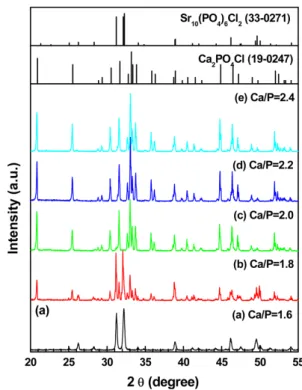
Fig. 1 shows XRD results of the blue phosphor powders obtained with various Ca/P mole ratios. The heat treatment was performed under the reduced atmosphere of 4%H

2

/Ar mixed gas at 900

o

C for 2 h. For Ca/P mole ratio of 1.6 in the starting solution, a crystalline apatite phase of Ca

5

(PO

4

)

3

Cl, which is assigned to JCPDS Card No. 33-0271, was formed. The two crystalline phases of Ca

2

PO

4

Cl (JCPDS Card No. 19-0247) and the apatite were coexisted for Ca/P mole ratio of 1.8. Theoretical Ca/P mole ratio for apatite is about 1.67, and that of Ca

2

PO

4

Cl is 2.0. Since calcium was deficient in the case of Ca/P=1.6, therefore, only the apatite

phase was formed. In the case of the mole ratio of Ca/

P=1.8 located between theoretical ones of apatite and Ca

2-

PO

4

Cl, and the apatite and Ca

2

PO

4

Cl phases were obtained.

For the Ca/P mole ratio of 2.0 and over, only Ca

2

PO

4

Cl crystalline phase existed and any other crystalline com- pound containing europium was not found, which means that all ions of Eu

2+

ions were participated in Ca

2

PO

4

Cl crystal formation from the following aspect. The apatite phase was formed after precipitation reaction. The Ca

2-

PO

4

Cl phase was then formed during heat treatment proce- dure under reduction atmosphere at high temperature.

Divalent europium ion can be easily substituted for diva- lent calcium ion in the Ca

2

PO

4

Cl structure due to similar ionic radius (Eu

2+

=0.112 nm, Ca

2+

=0.099 nm).

10)

Conse- quently, the Ca/P mole ratio is needed to be over 2.0 in order to synthesize single phase of Ca

2

PO

4

Cl.

SEM micrographs of the blue phosphor powders obtain- ed by changing Ca/P mole ratio in the starting solutions are shown in Fig. 2. The particle sizes of these phosphor pow- ders were changed with the mole ratio of Ca/P. In Fig. 2(a) having apatite phase, the fine particles of 0.1~0.2 μm were formed. For the Ca/P mole ratios of 2.0 and over, their average particle sizes slightly differed from one another, but the powders were made up of several micrometer-sized particles having well-developed crystal facets. In Ca/

P=1.8, on the contrary, the powders consisted of submi-

Fig. 1. X-ray diffraction patterns of the heat-treated powders with

various Ca/P atomic ratios at 900

o

C for 2 hrs under 4%H

2

/

Ar atmosphere: (a) 1.6, (b) 1.8, (c) 2.0, (d) 2.2, and (e) 2.4.

(3)

crometer-sized fine particles and around 1 μm-sized ones having well-developed facets as shown in Fig. 2(b). Over 10 μm-sized, porous and irregular shaped particles were also observed, which were not shown in SEM micrograph of Fig. 2(b). The submicrometer-sized particles in Fig. 2(b) are the same crystalline apatite phase as that of Fig. 2(a), and the bigger particles with highly developed facets corre- spond to the Ca

2

PO

4

Cl phase. The SEM photographs of the Ca

2

PO

4

Cl crystals showed the irregular but well-developed faceted particles. For the comparison, SEM micrograph of commercially available phosphor powders, (Ca,Ba,Sr)

10

(PO

4

)

6

Cl

2

:Eu

2+

, is shown in Fig. 2(f). The surfaces of the apatite par- ticles were rougher, and their crystalline facets were not well-developed than those of the Ca

2

PO

4

Cl in this study. In the XRD result, the XRD pattern of the apatite phase cor- responds to that of Sr

10

(PO

4

)

6

Cl

2

(JCPDS Card No. 16- 0666), but the d-spacings were slightly different to each other due to the mixture of Ca, Ba and Sr.

Fig. 3 represents the photoluminescence spectra of the Ca

2

PO

4

Cl:Eu

2+

phosphor powders with change in mole ratio of Ca/P. The PL spectra were measured using He-Cd laser (λ

ex

=325 nm) at room temperature. The position of maximum intensity was blue-shifted with increase in Ca/P mole ratio from 453.5 nm in Ca/P=1.6 to 449 nm in Ca/

P=2.4. The full width at half maximum intensity of the PL spectrum showed a minimum value of 52 nm at Ca/P=2.0.

The higher the Ca/P ratio, the lower the symmetry of the bands was. The composition showing maximum PL inten- sity was found at Ca/P=2.0, and then the intensity gradu- ally decreased at the above. For Ca/P=1.6, lower emission intensity derived from apatite phase and smaller particle size. The PL spectra showed the radiative transition of Eu

2+

from excited state (4f

6

5d) to ground state (4f

7

).

11,12)

The excitation spectra of a Ca

2

PO

4

Cl:Eu

2+

, which was prepared with Ca/P=2.0, and the commercial (Ca,Ba,Sr)

10

- (PO

4

)

6

Cl

2

:Eu

2+

powders are shown in Fig. 4. After the pho- todetector of spectrophotometer was set to 456 nm, which position showed strongest light emission for the blue phos- phor powders, the excitation spectra were measured using xenon lamp at room temperature. Comparison between the Ca

2

PO

4

Cl:Eu

2+

, which showed the maximum emission intensity in Fig. 3 (Ca/P=2.0), and the commercial blue powders was conducted. The excitation spectra showed the similar shapes of Eu

2+

-activated alkaline earth halophos- phates one another.

13)

The maximum excitation intensity of the prepared Ca

2

PO

4

Cl:Eu

2+

powders at 370 nm showed about 1.6 times higher than that of the commercial one, and the present excitation curve had significantly high emission efficiency for the long wavelength ultraviolet region.

Therefore, application to the light-emitting devices as LED Fig. 2. SEM micrographs of the heat-treated powders with various Ca/P atomic ratios (900

o

C 2h under 4%H

2

/Ar atmosphere): (a) 1.6,

(b) 1.8, (c) 2.0, (d) 2.2, (e) 2.4, and (f) commercial (Ca,Ba,Sr)

10

(PO

4

)

6

Cl

2

:Eu

2+

blue phosphor.

Fig. 3. Room-temperature PL emission spectra (λ

ex

=325 nm) of

Ca

2

PO

4

Cl:Eu

2+

blue phosphor powders: (a) 1.6, (b) 1.8, (c)

2.0, (d) 2.2, and (e) 2.4.

(4)

excited with long-wavelength UV light sources may be possible.

3)

Fig. 5 demonstrates the PL spectra of the prepared Ca

2-

PO

4

Cl:Eu

2+

and the commercial blue phosphors for appli- cation to the light-emitting devices. The spectra were measured using xenon lamp with 380 nm excitation source.

The maximum intensities of the Ca

2

PO

4

Cl:Eu

2+

and the commercial phosphors were revealed at 456 nm and 453 nm, respectively. However, the intensity of the Ca

2

PO

4

Cl:

Eu

2+

phosphor at the peak wavelength was also about 1.6 times higher than that of the commercial one. The spec- trum of the Ca

2

PO

4

Cl:Eu

2+

phosphor was more symmetri- cal and had the narrower full-width at the half maximum intensity than the commercial one. This narrow and sym- metric energy spectral distribution can be explained by constitution of only one kind of alkaline earth metal.

1)

On the contrary, the emission spectrum of the commercial

(Ca,Ba,Sr)

10

(PO

4

)

6

Cl

2

:Eu phosphor was skewed toward longer wavelength region and showed asymmetrical shape, which is originated from combination of three kinds of alkaline earth metals.

1)

CIE color coordinates for PL spectra obtained by 380nm excitation source were x=0.147, y=0.053 for the Ca

2

PO

4

Cl :Eu

2+

phosphor, and x=0.153, y=0.127 for the commercial one, respectively. Color coordinate of the Ca

2

PO

4

Cl:Eu

2+

phosphor was similar to that of Palilla and O'Reilly (x=

0.147, y=0.046).

1)

In terms of color purity, the color coor- dinate of the commercial (Ca,Ba,Sr)

10

(PO

4

)

6

Cl

2

:Eu

2+

phos- phor was inferior to that of Ca

2

PO

4

Cl:Eu

2+

, which can be explained by the following facts. When cation is identical and when Ba is not a major component in alkaline earth halophosphates, the most saturated emissions are obtain- ed.

1)

When cation is Ba or a cationic combination including Ba, desaturation of blue emission color occurs.

1)

According to the above results, the present Ca

2

PO

4

Cl:Eu

2+

phosphor was much superior to the commercial one for PL emission and excitation properties and CIE color purity, which is considered to be due to the fact that the crystal surface of Ca

2

PO

4

Cl:Eu

2+

phosphor (Fig. 2(c)) is more developed than that of commercial phosphor (Fig. 2(f)).

4. Conclusions

Using a chemical synthesis method, Ca

2

PO

4

Cl:Eu

2+

blue phosphor powder was successfully synthesized. For the strong PL intensity, mole ratio of Ca/P in the starting mate- rials should be 2.0 and over. PL emission intensity and color purity of Ca

2

PO

4

Cl:Eu

2+

were superior to those of the commercial (Ca,Ba,Sr)

10

(PO

4

)

6

Cl

2

:Eu

2+

. The Ca

2

PO

4

Cl:Eu

2+

blue phosphor showed the maximum excitation efficiency at 370 nm of excitation source, and also revealed good effi- ciency in the broad UV region. Therefore, Ca

2

PO

4

Cl:Eu

2+

can be applied to blue phosphor for long-wavelength UV LED.

References

1. F. C. Palilla and B. E. O'Reilly, “Alkaline Earth Halophos- phate Phosphors Activated by Divalent Europium”, J. Elec- trochem. Soc., 115(10), 1076-1081 (1968).

2. M. Kottaisamy, R. Jagannathan, P. Jeyagopal, R. P. Rao and R. Narayanan, “Eu

2+

luminescence in M

5

(PO

4

)

3

X apatites, where M is Ca

2+

, Sr

2+

and Ba

2+

, and X is F

, Cl

, Br

and OH

”, J. Phys. D: Appl. Phys., 27(10), 2210 (1994).

3. J. R. Sohn, Y. C. Kang, H. D. Park and S. K. Yoon, “Char- acteristics of Halophosphate Phosphor for Long-wavelength UV Prepared by Spray Pyrolysis”, Kor. J. Mater. Res., 12(7), 555 (2002).

Fig. 4. Room-temperature excitation spectra (λ

em

=456 nm) of (a) Ca

2

PO

4

Cl:Eu

2+

(Ca/P=2.0) and (b) commercial (Ca,Ba,Sr)

10

- (PO

4

)

6

Cl

2

:Eu

2+

powders.

Fig. 5. Room-temperature PL emission spectra (λ

ex

=380 nm) of

(a) Ca

2

PO

4

Cl:Eu

2+

(Ca/P=2.0) and (b) commercial (Ca,Ba,

Sr)

10

(PO

4

)

6

Cl

2

:Eu

2+

powders.

(5)

4. S. Kamiya and H. Mizuno, “Phosphor Handbook”, ed. by S.

Shionoya and W. M. Yen, Ch. 5, pp. 391, CRC Press, Boca Raton (1999).

5. R. Dafinova and V. Pelova, “Doubly sensitized manganese band in halophosphate luminophores”, J. Mater. Sci. Lett., 15, 1367 (1996).

6. Y. Zhou, R. Shu, X. Zhang, J. Shi and Z. Han, “VUV spec- trum of Eu

2+

doped halophosphates”, Mater. Sci. Eng. B, 68(1), 48 (1999).

7. S. J. Dhoble, “Preparation and characterization of the Sr

5

(PO

4

)

3

Cl:Eu

2+

phosphor”, J. Phys. D: Appl. Phys., 33(2), 158 (2000).

8. J. H. Lee, Y. C. Kang, S. B. Park and H. D. Park, “Lumi- nescence characteristics of Eu-doped strontium halophosphate phosphor particles prepared by spray pyrolysis”, Jpn. J. Appl.

Phys., Pt. 1, 40(5A), 3222 (2001).

9. F.-S. Wen, X. Zhao, H. Ding, H. Huo, and J.-S. Chen,

“Hydrothermal synthesis and photoluminescent properties of Sb

3+

-doped and (Sb

3+

,Mn

2+

)-co-doped calcium hydroxyapa- tite”, J. Mater. Chem., 12, 3761 (2002).

10. M. Greenblatt, E. Banks and B. Post, “The crystal structures of the spodiosite analogs, Ca

2

CrO

4

Cl and Ca

2

PO

4

Cl”, Acta Crystallogr., 23, 166 (1967).

11. Y.-C. Chiu, W.-R. Liu, C.-K. Chang, C.-C. Liao, Y.-T. Yeh, S.-M. Jang and T.-M. Chen, “Ca

2

PO

4

Cl:Eu

2+

: An intense near-ultraviolet converting blue phosphor for white light- emitting diodes”, J. Mater. Chem., 20(9), 1755 (2010).

12. R. Yu, C. Guo, T. Li and Y. Xu, “Preparation and lumines- cence of blue-emitting phosphor Ca

2

PO

4

Cl:Eu

2+

for n-UV white LEDs”, Current Appl. Phys., 13(5), 880 (2013).

13. A. Meijerink and G. Blasse, “Photoluminescence and thermo- luminescence properties of Ca

2

PO

4

Cl:Eu

2+

”, J. Phys.: Con- dens. Matter., 2, 3619 (1990).

14. A. Meijerink and G. Blasse, “Fano antiresonance in the exci- tation spectra of the luminescence of divalent europium”, Phys. Rev., 40(10), 7288 (1989).

15. E. M. Levin, C. R. Robbins and H. F. McMurdie, “Phase Dia-

grams for Ceramists”, Ed. by M. K. Reser, Fig. 3800, Ohio,

U.S.A., (1974).

수치

Fig. 1 shows XRD results of the blue phosphor powders obtained with various Ca/P mole ratios
Fig. 3 represents the photoluminescence spectra of the Ca 2 PO 4 Cl:Eu 2+  phosphor powders with change in mole ratio of Ca/P
Fig. 5 demonstrates the PL spectra of the prepared Ca 2- 2-PO 4 Cl:Eu 2+  and the commercial blue phosphors for  appli-cation to the light-emitting devices

참조

관련 문서

동결방지 조치를 취하여 등을 사용하여 적절한 우려가 있는 곳은 보온재 드레인 호스 설치시 동결.

Sang - pil Yoon, Hyeok - jung Kwon, Han - sung Kim, Yong - sub Cho, Bo - hyun Chung, Kyung - tae Seol, Young - gi Song, Dae - il Kim, and Yi - sub Min(KAERI). Current Design

자석 팽이는 볼록한 두 부분에는 고리 자석이 들어 있고, 받침대에는 팽이의 고 리 자석 위치와 일치하는 부분에 삼각형 모양의 자석이 네 개 들어 있다.. 그리고

Among the sub-factors of autonomy support coaching behavior, strategy recognition had the most direct influence on the grit of athletes, followed by

Second, as a result of the IPA analysis of the sub-factors of audience perception, the factors of entry route were located in the first quadrant, the

Among the five sub-content categories, only in the communication domain 'listening and speaking', the social relations domain 'living together' and the

(d) displays the CA curves of the Ni2P2O7 electrocatalyst at an applied potential of 1.47 V (vs. • The steady-state CA curve acquired by the Ni 2 P 2 O 7 microsheets

Among the sub-factors, confidence, The factors of setting, team harmony, image and will power were higher in the group with national representative