≫ 기술자료 ≪
국내 순환유동층보일러(Circulating fluidized bed combustion) 석탄재의 희토류 농축
김영진 · 최문관 · 서준형 · 김병렬 · §조계홍
한국석회석신소재연구소 연구개발부
Enrichment of Rare Earth Elements Contained in Coal Ashes from Korea Circulating Fluidized Bed Combustion (CFBC)
Young-Jin Kim, Moon-Kwan Choi, Jun-Hyung Seo, Byung-Ryeol Kim and
§Kye-Hong Cho Department of Research and Development, Korea Institute of Limestone and Advanced Materials
요 약
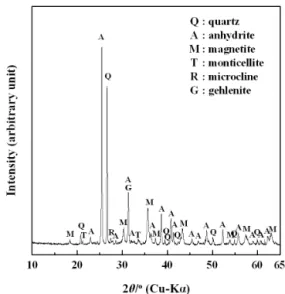
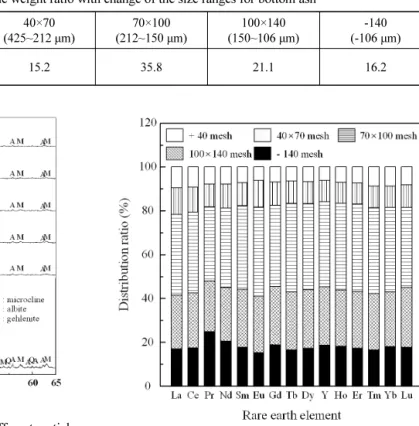
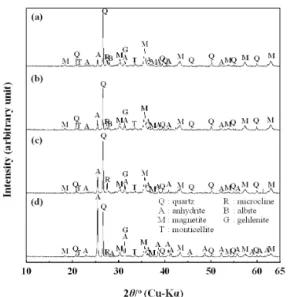
국내 순환유동층보일러형 발전소 석탄재의 주요 광물 및 희토류의 이동특성을 분석하여 석탄재 중 희토류 성분의 농축 가능성 검토를 위해 체 분리 및 침출을 통한 주요 광물의 분리 및 제거에 따른 희토류 성분의 이동특성을 평가하였다. 석탄재의 주요 광물로는 경석고, 자 철석 및 석영으로 확인되었으며, 세계 석탄재 희토류 평균값(404 ppm)의 30% 수준 함량으로 확인되었다(실험대상: 123 ppm). 석탄재에 포함된 희토류 성분 중 90% 이상은 주로 자철석과 함께 이동하는 특성을 보였고, 10% 이하의 성분이 석영과 함께 이동하는 것으로 확인 되었다. 이는 발전소 연소 방식 차이에 따라 발생된 석탄재 특성에 따른 영향으로 판단된다. 이에 국내 순환유동층보일러 석탄재로부터 희토류 성분 농축을 위해서는 자철석 분리가 필요하며, 이와 관련된 선별 기술 개발 및 확보가 요구된다고 판단된다.
주제어 : 순환유동층보일러, 석탄재, 희토류, 농축, 자철석
Abstract
Enrichment possibilities for recovering rare earth elements contained in coal bottom ash generated from domestic circulating fluidized bed combustion (CFBC) were identified. The transport characteristics of the REEs according to the separation and removal of major minerals were evaluated using sieving and leaching process. The main minerals of bottom ash were identified as anhydrite, magnetite, and quartz, and this was confirmed as a 30% of REE content of the world's average coal ash REE value (404 ppm) as a result of the difference in the combustion characteristics of power plants (REE contents in starting material: 123 ppm). More than 90% of the REEs contained in the bottom ash were found to move mainly with magnetite, and less than 10% of the components were found to move with the quartz. Therefore, In order to recover rare earth elements from coal bottom ashes generated from CFBC boiler, it is necessary to select the main rare elements such as magnetite and develop a pretreatment and concentration process.
Key words : Circulating fluidized bed combustion, Coal ash, Rare earth elements, Concentration, Magnetite
· Received : November 9, 2020 · Revised : December 1, 2020 · Accepted : December 7, 2020
§