Phonetics and Speech Sciences Vol. 6 No. 1 (March 31, 2014) www.speechsciences.or.kr
ISSN 2005-8063, pp. 11~19 http://dx.doi.org/10.13064/KSSS.2014.6.1.011
Perception of English Consonants in Different Prosodic Positions by Korean Learners of English
Jang, Mi
1)ABSTRACT
The focus of this study was to investigate whether there is a position effect on identification accuracy of L2 consonants by Korean listeners and to examine how Korean listeners perceive the phonetic properties of initial and final consonants produced by a Korean learner of English and an English native speaker. Most studies examining L2 learners' perception of L2 sounds have focused on the segmental level but very few studies have examined the role of prosodic position in L2 learners' perception. In the present study, an identification test was conducted for English consonants /p, t, k, f, ɵ, s, ʃ/ in CVC prosodic structures. The results revealed that Korean listeners identified syllable-initial consonants more accurately than syllable-final consonants. The perceptual accuracy in syllable initial consonants may be attributable to the enhanced phonetic properties in the initial consonants. A significant correlation was found between error rates and F2 onset/offset for stops and fricatives, and between perceptual accuracy and RMS burst energy for stops. However, the identification error patterns were found to be different across consonant types and between the different language speakers. In the final position, Korean listeners had difficulty in identifying /p/, /f/, /ɵ/, and /s/ when they were produced by a Korean speaker and showed more errors in /p/, /t/, /f/, /ɵ/, and /s/ when they were spoken by an English native speaker. Comparing to the perception of English consonants spoken by a Korean speaker, greater error rates and diverse error patterns were found in the perception of consonants produced by an English native speaker. The present study provides the evidence that prosodic position plays a crucial role in the perception of L2 segments.
Keywords: English stops and fricatives, perception of L2 consonants, initial and final consonants
1. Introduction
This study aims to investigate the effect of prosodic position on second language (L2) learners’ perception of L2 consonants. A great deal of research about the perception of vowels and consonants in L2 has shown that second language learners’
perception of L2 sounds differs from that of monolingual native speakers of the target L2. Most research on L2 learning has focused on the factors including the age of acquisition, the
1) Hanyang University, [email protected]
This work was supported by the research fund of Hanyang University (HY-2012-N).
Received: November 10, 2013 Revised: December 18, 2013 Accepted: March 5, 2014
duration of exposure to L2, the similarities and differences of the phonemic inventories between a native language (L1) and an L2, the amount of continued L1 usage, and the quantity and the quality of L2 input (Best, 1995; Best and Tyler, 2007; Flege, 1995). However, most studies examining L2 learners' perception of L2 sounds focused on a segmental level but the role of prosodic position in L2 learners' production and perception was overlooked.
It has been recognized that segmental properties are affected by prosodic structure. For example, the initial segments of prosodic domains were produced with longer duration comparing to prosodic domain-medial segments (Cho & Keating, 2001;
Fougeron & Keating, 1997; Keating et al., 2003; Jang, 2011).
Initial segments at the syllable and the word levels were also
found to be resistant to reduction or lenition processes regarding
synchronic and diachronic variants, relative to medial or final segments (Bell & Hooper, 1978).
In the perception of segments, it has been observed that initial and final consonants in a syllable and/or a word are perceived differently by listeners. In Quené (1992), a word-initial consonant in Dutch was perceptually more distinctive than a word-final consonant due to the lengthening of the initial consonant. In a study of perceptual confusion experiments with English consonants (/p/, /t/, /k/, /f/, /ɵ/, /s/, /ʃ/), Redford and Diehl (1999) examined the identifiability of initial and final consonants in CVC syllables. They noted that syllable-initial consonants were more accurately identified than syllable-final consonants by English native listeners. In addition, it was found that sibilant fricatives and stops were more accurately identified than nonsibilant fricatives. According to Redford and Diehl (1999), perceptual accuracy in the initial position was explained by the greater acoustic distinctiveness of initial consonants. A significant correlation was found between amplitude and error rate, and between the onset or offset of second formant frequency (F2) for initial and final consonants and error rate.
The results obtained in the previous studies suggested that there is perceptual advantage over initial position. However, the effect of prosodic position on the segmental properties and perception has been examined in the study with monolingual speakers and/or listeners. Evidence regarding how prosodic position plays a role in the perception of second language learners is relatively scant. Cho and Lee (2007) examined a category mapping of English obstruents (/p/, /b/, /f/, /v/, /ɵ/, /ð/, /t/, /d/, /s/, /z/) into Korean categories in terms of four different prosodic positions: onset position (CV), coda position (VC), intervocalic position before stress (VCVV), and intervocalic position after stress (VVCV). In the results of Cho and Lee (2007), Korean listeners tended to label English voiceless stops into Korean aspirated stops while the voiced counterparts were categorized as Korean plain stops. However, the general patterns were found in onset and intervocalic position before stress while diverse mapping patterns were shown in the prosodically weak position such as coda and intervocalic position after stress. In addition, for English fricatives that are not included in Korean phonemic inventory, the subjects showed various mapping patterns.
However, Cho and Lee (2007)’s study limited on the perceptual category mapping between English and Korean and they did not explain whether the perceptual accuracy is caused by prosodically driven properties in the production of English
consonants. In order to support the perceptual advantage over initial consonants, it is necessary to evaluate whether the perceptual results are related to positional difference found in the production of English consonants.
In order to find out the effect of prosodic position on the production of English consonants by Korean learners of English, Jang (2013) examined the phonetic properties of voiceless English consonants in the initial and the final positions in CVC structures spoken by Korean learners of English and native speakers of English. From this study, it was observed that Korean learners of English produced position dependent properties in the articulation of English consonants. However, the enhancing strategies in the initial position were found to be different across phonemic categories and language speakers. Native English speakers and Korean learners of English produced higher frequency at the onset/offset of F2 transition
2)for stops and fricatives in the initial position than in the final position. Root-mean-squared (RMS) amplitude
3)for stops was found to be greater in the initial position than in the final position. However, while native speakers of English showed enhanced centroid frequency
4)for fricatives in the initial position, Korean learners of English did not produce positional difference in the results of centroid frequency for fricatives. In the results of duration for stops, the position effect was found in the production by English native speakers. On the contrary, Korean speakers did not show the positional difference in the duration of stops. In the duration of fricatives, Korean learners showed longer duration in the final position than the initial position while English speakers did not show any positional difference in the duration of fricatives. To sum up, Korean English learners produced position dependent phonetic properties in the articulation of English consonants but they did not show a similar pattern as in the production by native English speakers. Since the position dependent properties were found to be different between Korean learners of English and English native speakers, it would be interesting to examine how Korean listeners perceive the initial and final consonants in CVC prosodic structure spoken by Korean English learners and English native speakers.
2) In order to measure the onset/offset of F2, the F2 was taken at the onset of F2 for the initial consonants or the offset of F2 for the final consonants.
3) In Jang(2013), RMS amplitude was measured for the energy present in 25 ms window at the onset of the release burst for stops.
4) Centroid values were taken from FFT spectra during the entire
constriction interval for fricatives.
In order to find out whether the position in a syllable affects Korean listeners' perception of English consonants, monosyllabic words which have CVC structure are presented in frame sentences. The English consonants /p, t, k, f, ɵ, s, ʃ/ are used to create the CVC syllables. Based on the results of the previous analyses, it is expected that initial consonants are more accurately perceived than final consonants. In addition, the results of the previous study (Jang, 2013) led us to predict that the different phonetic properties of initial and final consonants produced by Korean English learners and English native speakers might influence the perception of Korean listeners. It has been observed that speech produced by non-native talkers is as intelligible as or sometimes more intelligible to non-native listeners than the speech spoken by native talkers when the non-native talkers and non-native listeners share the same L1 (Bent and Bradlow, 2003).
Therefore, the speech from the speakers of different language background as well as position dependent properties of consonants could influence the perception of Korean listeners.
The organization of this paper is as follows. In section 2, the research methods are provided. The results of the experiment are seen in section 3. In section 4, the findings of the experiment are discussed. Section 5 concludes the paper.
2. Methods
2.1 Participants
21 Korean learners of English (11 males and 10 females) were recruited from Hanyang University. They were all enrolled in an English phonetics class or an advanced English writing class. The English proficiency level of the participants was determined by their average TOEIC scores. All the participants had official TOEIC scores and the TOEIC scores were between 750 and 850.
2.2 Stimuli and Procedure
The stimuli were the same as in my previous study in Jang (2013). The English consonants /p, t, k, f, ɵ, s, ʃ/ and /æ/ were used to create CVC prosodic structure. Each consonant appeared with every other consonant in the syllable initial and the final positions (7×7×2=98). For example, when /p/ was placed in the syllable initial position, all the target consonants including /p/
were placed in the syllable final position, respectively. The stimuli used for the experiment are presented in Appendix. Most CVCs were actual lexical items (e.g., “pap”, “pat”, “pack”, “paff”,
“path”, “pass”, “pash”) and the others were nonsense words (e.g.,
“thas, thash”). In order to ensure that the identification of each
consonant is due to the effect of prosodic position, the target consonants were placed in the same environment. Thus, the target syllables were placed in two frame sentences such as consonantal and vocalic contexts as in (1) and (2), yielding 196 tokens. The carrier sentences provided similar consonantal and vocalic contexts for the initial and final consonants of the target syllable.
(1) I said CVC definitively (2) Say CVC eight times.
5)The stimuli were produced by a Korean learner of English and an English native speaker who participated in the production study in Jang (2013). The English proficiency of the Korean learner of English was evaluated as intermediate through a prior interview by the author and her TOEIC score which was 780. To avoid /ɵ/ to be pronounced as voiced in the nonsense words (e.g., thas and thash), sample trials including the other English consonants were given prior to the recording. The RMS amplitude of each sentence was normalized between speakers.
In the identification test, subjects’ task was to listen to the CVC target syllables embedded in the two frame sentences and to select the closest sounds among English consonant category (/p/, /t/, /k/, /f/, /ɵ/, /s/, /ʃ/). Each of the 21 subjects responded to 196 trials thus the total responses were 4116. It took approximately 35 minutes per subject. All participants took practice trials before the actual experiment. Mean error rates were measured in the identification test. A repeated measures analysis of variance (RM ANOVAs) was performed with four within-subjects factors (segment, position, context, and different language speaker) using IBM SPSS Statistics 21.
3. Results
In the results using error rates as the dependent variable, the effects of segment, position and different language speaker were found to be significant (F(6, 120)=58.448, p<.000 for segment;
F(1, 20)=133.028, p<.000 for position; F(1, 20)=39.630, p<.000
5) One anonymous reviewer pointed that in the vocalic context,
the target consonant in coda position can be realized as an
onset of the following syllable. However, in the results of
production study, the target consonants in coda position were
not found to be resyllabified into the onset of the following
syllables. In addition, the target syllable was realized at the
end of accentual or intonational phrase as there was a phrase
boundary between target syllable and the following phrase,
eight times.
for speaker). However, the context effect was not significantly different (F(1, 20)=117.711, p=.498). There was significant interaction between segment and position (p<.000).
Identification error rates for the initial and final consonants from a Korean speaker and an English speaker are presented in
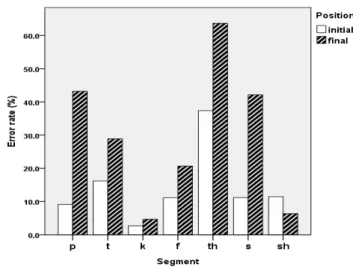
<Figure 1> and <Figure 2>, respectively. Results present that the initial consonants are less confusable than the final consonants for both stimuli that are produced by the Korean English learner and the English native speaker. In order to find out the perceptual difference between the initial consonants and the final consonants, planned comparison was performed. The results of planned comparisons revealed that subjects made significantly more errors in identifying the final consonants than the initial consonants that were produced by the Korean speaker and the English speaker (p<.000).
Figure 1. Identification error rate on initial and final consonants produced by a Korean learner of English
Figure 2. Identification error rate on initial and final consonants produced by an English native speaker
<Figure 3> and <Figure 4> indicate identification error rates across different English consonants produced by a Korean learner of English and an English native speaker. In the graph, <th> and
<sh> represent /ɵ/ and /ʃ/, respectively. Since the context effect is not found to be significant, <Figure 3> and <Figure 4> only show pooled mean error rates for target consonants in the initial and final positions regardless of context types. When the stimuli were spoken by the Korean learner of English, the perceptual accuracy associated with the initial position over the final position is observed for all English consonants except for /k/ and /ʃ/. For the stimuli produced by the English native speaker, initial consonants were more accurately identified than final consonants except for /ʃ/ and relatively small positional difference was found in the perception of /k/ and /ʃ/.
Figure 3. Identification error rates across different consonants produced by a Korean learner of English
Figure 4. Identification error rates across different consonants produced by an English native speaker
When the stimuli were produced by a Korean learner of
English, Korean listeners made errors in identifying English
consonants, /p/ (22.6%), /f/ (18.6%), and /s/ (37%) in the final
position. Korean listeners made great errors in the identification of /ɵ/ both in the initial (37%) and the final positions (47%). The results of post hoc tests also confirmed that Korean listeners showed significant difference in the identification of /p/ (p<.000), /f/ (p=.004), /ɵ/ (p=.003), and /s/ (p<.000) between the initial and final positions. For /t/, /k/, and /ʃ/, there was no significant difference in error rates between the two different positions.
Comparing to the results produced by a Korean speaker, Korean listeners had much difficulty in identifying consonants spoken by an English native speaker. For the stimuli produced by an English native speaker, greater error rates were found in the identification of /p/ (43%), /t/ (28.8%), /f/ (20.6%), and /s/ (42.1%) in the final position. As found in the results of the stimuli spoken by a Korean English learner, Korean listeners showed perceptual difficulty in the identification of /ɵ/ both in the initial (37%) and the final positions (63.6%). In the results of post hoc tests, significant perceptual difference was found for /p/ (p<.000), /t/
(p=.003), /f/ (p=.023), /ɵ/ (p<.000), and /s/ (p<.000) between the initial and the final positions. However, there was no significant difference of error rates between the two different positions for /k/ (p=.632) and /ʃ/ (p=.222).
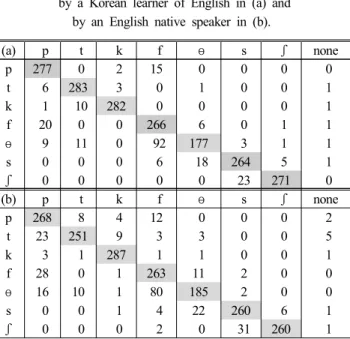
Confusion matrices are shown in <Table 1> for the initial consonants produced by a Korean learner of English (a) and an English native speaker (b), respectively. The target consonants are listed vertically and subjects’ response types for each target consonant are shown horizontally at the top of each matrix. The
‘none’ column represents the null answer for each stimulus. The correct responses are shaded for each target consonant category.
(a) p t k f ɵ s ʃ none
p 277 0 2 15 0 0 0 0
t 6 283 3 0 1 0 0 1
k 1 10 282 0 0 0 0 1
f 20 0 0 266 6 0 1 1
ɵ 9 11 0 92 177 3 1 1
s 0 0 0 6 18 264 5 1
ʃ 0 0 0 0 0 23 271 0
(b) p t k f ɵ s ʃ none
p 268 8 4 12 0 0 0 2
t 23 251 9 3 3 0 0 5
k 3 1 287 1 1 0 0 1
f 28 0 1 263 11 2 0 0
ɵ 16 10 1 80 185 2 0 0
s 0 0 1 4 22 260 6 1
ʃ 0 0 0 2 0 31 260 1
Table 1. Confusion matrices for initial consonants produced by a Korean learner of English in (a) and
by an English native speaker in (b).
In the results of error patterns in the identification of the initial consonants, Korean listeners showed a similar pattern in identifying the stimuli produced by a Korean English learner and an English native speaker. When the stimuli was spoken by a Korean English learner, the error rates for identifying stop categories in the initial position were relatively very small. /p/ in the initial position was misheard as /f/, and /t/ was misidentified as /p/ or /k/. /k/ in the initial position was misheard as /t/. When the stop consonants were produced by a native English speaker, slightly greater error rates and diverse error patterns were found in the identification of /p/ and /t/ in the intial position. Korean listeners misidentified /p/ as /f/, /t/, and /k/. /t/ was misheard as /p/, /k/, /f/, and /ɵ/.
In contrast to the perceptual accuracy for English stops, Korean listeners made more errors in identifying fricatives in the initial position. They showed similar error patterns in the perception of English fricatives that were produced by both language speakers. /f/ was misperceived as /p/ or /ɵ/. /f/ and /p/
were mutually confused since both have a similar lip gesture in the articulation
6). Even in the initial position, Korean listeners seem to have difficulty in identifying /ɵ/, which was misidentified as /f/ in 31 % of the instances when it was produced by a Korean English learner and in 27 % of the cases when it was spoken by an English native speaker. /ɵ/ was also labelled as /p/
and /t/ but the number of cases was very small. Since Korean listeners misidentified /f/ as /ɵ/ in a small number of cases, the mutual confusion between /f/ and /ɵ/ was not found in the initial position. Subjects made errors in identifying /s/ as /ɵ/. /ʃ/ was confused with /s/ but the error percentage was very small.
(c) p t k f ɵ s ʃ none
p 208 16 6 56 5 0 0 3
t 6 272 2 4 10 0 0 0
k 1 3 288 0 0 1 0 1
f 10 1 0 242 35 4 0 2
ɵ 9 15 1 74 152 41 2 0
s 1 1 0 0 64 222 5 1
ʃ 0 1 1 1 1 6 282 2
Table 2. Confusion matrices for final consonants produced by a Korean learner of English in (c) and
by an English native speaker in (d).
6) The identification pattern of /f/ was in accord with the findings in Cho and Lee (2007). In a study of category mapping of English consonants into Korean, they noted that /f/
was mostly labelled as a Korean aspirated stop /pʰ/ in onset
and coda positions.
(d) p t k f ɵ s ʃ none
p 184 16 26 56 9 0 1 2
t 5 210 52 7 18 2 0 0
k 0 10 278 3 0 2 0 1
f 35 3 3 227 25 1 0 0
ɵ 25 22 10 111 113 9 0 4
s 1 10 1 30 119 124 9 0
ʃ 1 0 0 2 8 9 273 1
<Table 2> displays confusion matrices for the final consonants produced by a Korean English learner and a native English speaker as in (c) and (d), respectively. Relative to the perception of the initial consonants, Korean listeners showed diverse responses in identifying the final consonants.
For the stimuli produced by a Korean learner of English, /p/
was labelled as /f/ (19%) and /t/
7). /t/ was misheard as /ɵ/ and /p/
in a small number of cases. In the identification of fricatives, /f/
was misperceived as /ɵ/ (12%), /p/, and /s/. Different from the results in the initial position, the bi-directional confusion between /p/ and /f/ was not found in the final position. /ɵ/ was misidentified as /f/ (25%), /s/ (14%), /t/, and /p/. Subjects tended to label /s/ as /ɵ/ (22%) and /ʃ/, and /ʃ/ was labelled as /s/ in a small number of cases. Although /ʃ/ is an allophone of /s/ in Korean, /s/ and /ʃ/ were not mutually confused in the perception.
With regard to the perception of final stops produced by an English native speaker, Korean listeners showed more various patterns in their responses. /p/ was labelled as /f/ (19%), /k/, /t/, and /ɵ/. While Korean listeners showed a small number of errors in perceiving /t/ that was produced by a Korean speaker, they made more errors in perceiving /t/ in the final position when it was produced by an English native speaker. /t/ was misheard as /k/ (18%), /ɵ/, /f/, and /p/. In the production study of English consonants by Korean English learners, Jang (2013) reported that there was no significant durational difference for English stops between the initial and the final positions in the production by Korean learners of English. On the other hand, English native speakers were found to produce much shorter duration for stops in the final position than in the initial position. In a native accented American English, stops were produced with a relatively small degree of release or deleted in the final position. For non-native listeners, it might be hard to detect the cues to the identity of final stops which are reflected in the phrase and discourse levels. Thus, Korean listeners might have much difficulty in identifying English stops in the final position when
7) Less than 10 % of mapping was not mentioned here.
they were produced by an English native speaker.
For the fricative categories in the final position spoken by an English native talker, much more various responses occurred. /f/
was misperceived as /p/ in 12% of the time and then /ɵ/. /ɵ/ was misperceived as /f/ in 38% of the cases and as /p/, /t/, /k/, and /s/ with less than 10 % of the time. In the final position, Korean listeners showed mutual confusion between /f/ and /ɵ/ when they were spoken by a Korean learner of English and a native English speaker. The mutual confusion between /f/ and /ɵ/ was found to be greater in the final position than in the initial position. In Lee (2011)’s discrimination test for English voiceless fricatives by advanced Korean learners of English, it was found that participants had difficulty in perceiving /f/-/ɵ/ contrast relative to /s/-/ʃ/ and /ɵ/-/s/ contrasts. It seems to be caused by the fact that the two categories are produced with low intensity and have similar location of spectral peaks. /f/ and /ɵ/ were also found to be confused with each other even among native English speakers (Edwards, 2003). /s/ was misheard as /ɵ/ in 40 %, /f/ in 10%, and /t/. Although there was a different degree of error percentage in the perception of /s/ into /ɵ/ depending on the position, /s/ is predominantly labelled as /ɵ/. However, Korean listeners did not identify /ɵ/ as /s/ in most cases. Korean listeners’ substitution of /ɵ/ for /s/ was also found in other studies (Sung, 2009; Lee, 2011). The results imply that Korean listeners tend to hypercorrect /s/ as /ɵ/ especially in the final position. Korean listeners misperceived /ʃ/ as /s/ and /ɵ/ with a relatively very small number of cases. As found in the results from Redford and Diehl (1999), /ʃ/ had the fewest identification errors among fricative categories.
In order to explain the different identification accuracy depending on the position, it is necessary to examine whether the difference in production could account for the perceptual difference in the initial consonants and the final consonants.
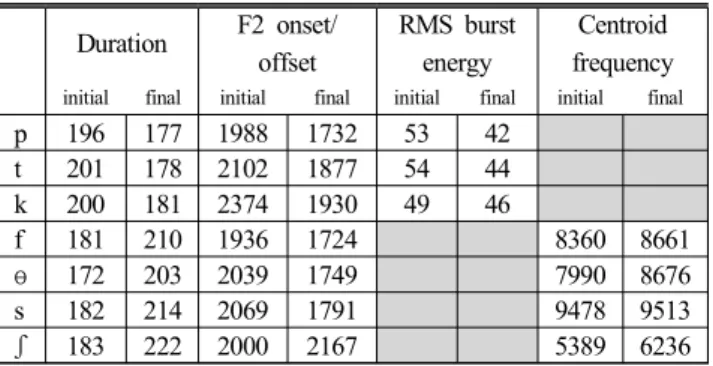
<Table 3> summarizes the result of each acoustic measurement
for the initial and the final consonants produced by Korean
learners of English (a) and English native speakers (b) in Jang
(2013). As noted before, both Korean English learners and
English native speakers produced enhanced phonetic properties in
the initial position in terms of F2 onest/offset for stops and
fricatives, and RMS burst energy for stops. However, while
English native speakers showed increased centroid frequency for
fricatives in the initial position, Korean learners of English did
not produce positional difference in the results of centroid
frequency for fricatives. In the duration for stops, only English
native speakers produced longer duration for stops in the initial
position than in the final position. In the duration of fricatives, Korean English learners showed longer fricative duration in the final position than in the initial position, but positional difference was not found in the duration of fricatives by native speakers of English.
(a) Mean values of acoustic measurements from English native speakers
Duration F2 onset/
offset
RMS burst energy
Centroid frequency
initial final initial final initial final initial final
p 205 135 2170 1859 57 52
t 202 143 2213 2046 55 49
k 183 141 2232 2227 50 46
f 170 177 2032 1921 8046 6871
ɵ 169 169 1951 1936 6435 6260
s 176 195 2110 1964 8459 8060
ʃ 188 192 2248 2094 5608 5176
(b) Mean values of acoustic measurements from Korean learners of English
Duration F2 onset/
offset
RMS burst energy
Centroid frequency
initial final initial final initial final initial final