• 검색 결과가 없습니다.

Image Fusion Methods for Multispectral and Panchromatic Images of Pleiades and KOMPSAT 3 Satellites

N/A
N/A
Protected

Academic year: 2021

Share "Image Fusion Methods for Multispectral and Panchromatic Images of Pleiades and KOMPSAT 3 Satellites"

Copied!
10
0
0

로드 중.... (전체 텍스트 보기)

전체 글

(1)

https://doi.org/10.7848/ksgpc.2018.36.5.413

Image Fusion Methods for Multispectral and Panchromatic Images of Pleiades and KOMPSAT 3 Satellites

Kim, Yeji

1)

· Choi, Jaewan

2)

· Kim, Yongil

3)

Abstract

Many applications using satellite data from high-resolution multispectral sensors require an image fusion step, known as pansharpening, before processing and analyzing the multispectral images when spatial fidelity is crucial. Image fusion methods are to improve images with higher spatial and spectral resolutions by reducing spectral distortion, which occurs on image fusion processing. The image fusion methods can be classified into MRA (Multi-Resolution Analysis) and CSA (Component Substitution Analysis) approaches. To suggest the efficient image fusion method for Pleiades and KOMPSAT (Korea Multi-Purpose Satellite) 3 satellites, this study will evaluate image fusion methods for multispectral and panchromatic images. HPF (High-Pass Filtering), SFIM (Smoothing Filter-based Intensity Modulation), GS (Gram Schmidt), and GSA (Adoptive GS) were selected for MRA and CSA based image fusion methods and applied on multispectral and panchromatic images.

Their performances were evaluated using visual and quality index analysis. HPF and SFIM fusion results presented low performance of spatial details. GS and GSA fusion results had enhanced spatial information closer to panchromatic images, but GS produced more spectral distortions on urban structures. This study presented that GSA was effective to improve spatial resolution of multispectral images from Pleiades 1A and KOMPSAT 3.

Keywords : Image Fusion, Pansharpening, Multispectral Images, Panchromatic Images

Original article

Received 2018. 10. 13, Revised 2018. 10. 21, Accepted 2018. 10. 24

1) Member, Dept. of Civil and Environmental Engineering, Seoul University (E-mail: [email protected])

2) Member, School of Civil Engineering, Chungbuk National University, Korea (E-mail: [email protected])

3) Corresponding Author, Member, Dept. of Civil Engineering, Dept. of Civil and Environmental Engineering, Seoul University (E-mail: [email protected])

1. Introduction

Satellites for high-resolution multispectral images mostly collect multispectral bands with a panchromatic band, because of the trade off of satellite sensors between spatial and spectral resolutions. Multispectral images usually have higher spectral resolution and lower spatial resolution comparing to panchromatic bands collected from same platform. For example, KOMPSAT (Korea Multi-Purpose Satellite) 3 and 3A collect multispectral images with 2.80 m and 2.20 m GSD (Ground Sample Distance) while panchromatic bands are collected with 0.70 m and 0.55 m GSD, respectively. Pleiades 1A and 1B collect multispectral images with 2 m GSD and a panchromatic band with 0.50 m GSD. This low spatial

resolution information of multispectral images, especially for high resolution satellite systems, usually cause mixed pixels, which have different substances in a single pixel, and this condition limits detailed analysis using high-resolution satellite images. Therefore, many applications using satellite images from high-resolution multispectral sensors require an image fusion step, known as pansharpening, before processing and analyzing the multispectral images when spatial fidelity is crucial.

Many previous studies classify image fusion methods into MRA (Multi-Resolution Analysis) and CSA (Component Substitution Analysis) approaches. ARSIS (Amelioration de laResolution Spatiale par Injection de Structures), the basic MRA based image fusion technique, enhances spatial

This is an Open Access article distributed under the terms of the Creative Commons Attribution Non-Commercial License (http://

(2)

resolution by adding spatial information while preserving multispectral image information (Ranchin et al ., 2000). For other MRA approaches, Chavez et al . (1991) proposed HPF (High-Pass Filtering), the simple scheme by box mask, and Liu (2000) proposed SFIM (Smoothing Filter-based Intensity Modulation) employing the high pass modulation injection.

Aiazzi et al . (2006) also suggested an image fusion technique using Gaussian filters closely matched to the sensor MTF (Modulation Transfer Function). For CSA based approaches, GS (Gram Schmidt), which is based on GS orthogonalization, is widely used, and GSA (adoptive GS) was suggested to improve existing GS image fusion technique (Aiazzi et al ., 2007). Choi et al . (2011) introduced the partial replacement of panchromatic band by a multispectral band for the image fusion method that estimated band-dependent fusion image.

The main purpose of the image fusion is to estimate an image with higher spatial and spectral resolutions and minimum occurrence of spectral distortion. As satellite markets and applications are growing with increasing earth observation satellite systems, demands of pansharpened data for satellite sensors with different spectral ranges are also increasing. Many studies evaluated fusion methods on widely used high-resolution multispectral images. Vivone et al . (2015) performed and evaluated different image fusion methods using image of IKONOS, WorldView 2, and Pleiades, and Aiazzi et al . (2017) evaluated GSA and À-Trous wavelet transform image fusion methods using images of GeoEye 1 and QuickBird. These studies presented that CSA approaches were robust on mis-registration between multispectral and panchromatic images with reduced computation costs and MRA approaches were effective for temporal and multi- sensor data fusion. Oh et al . (2012) evaluated HPF, modified IHS, and basic wavelet image fusion methods on KOMPSAT 2. Choi et al . (2013) introduced an image fusion method to improve spatial quality and evaluated it with QuickBird, Geoeye 1, and KOMPSAT 2. However, spectral ranges of optical sensors are different depending on satellite systems, and recent satellite systems also need to be evaluated to select efficient image fusion methods for remote sensing analysis.

Therefore, in this study, image fusion methods were evaluated for multispectral and panchromatic images of Pleiades 1A and KOMPSAT 3 satellites. After its launching

on 2012, images of KOMPSAT 3 were studied for various applications, such as building damage detection and crop growth analysis (Lee et al ., 2009; Dong et al ., 2013), and it has different spectral ranges comparing to existing satellite systems, such as Ikonos, QuickBird, GeoEye 1, WorldView, and Pleiades. As the Pleiades 1A image was evaluated previous studies and recently used for applications studies, it was also included to evaluate of image fusion methods and to compare with KOMPSAT 3. HPF, SFIM, GS and GSA were selected for MRA and CSA based image fusion methods and applied on multispectral and panchromatic images of the Pleiades 1A and KOMPSAT 3, and their performances were evaluated using visual and quality index analysis.

2. Methodology

2.1 Spectral ranges of multispectral and panchromatic images for satellites

(a) (b)

(c) (d) Fig. 1. Spectral responses of multispectral and panchromatic images from Digital Globe satellites: (a) IKONOS, (b) QuickBird, (c) GeoEye 1, (d) WorldView 3

(Digital Globe, 2013)

Spectral ranges of multispectral and panchromatic images

are distinct depending on satellite systems, and the difference

of spectral ranges between multispectral and panchromatic

(3)

images can cause the low quality of fusion results (Kim et al ., 2015). Fig. 1 shows different spectral responses of Digital Globe satellites (Digital Globe, 2013). Panchromatic bands of IKONOS and Quickbird cover entire wavelength ranges of NIR (Near Infrared) bands and blue bands while the panchromatic band of GeoEye 1 does not cover a NIR band and covers a blue band. The first and eighth bands among the eight multispectral bands are not covered by the panchromatic band in WorldView 3.

Besides the Digital Globe satellite sensors, Pleiades 1A and 1B of Pleiades constellation and KOMPSAT 3 also provide high resolution multispectral images with panchromatic bands. Fig. 2 presents the spectral ranges of multispectral and panchromatic bands for Pleiades 1A and KOMPSAT 3. The panchromatic band partially covers blue and NIR bands of Pleiades 1A and fully covers green and red bands. In case of KOMPSAT 3, all of the spectral ranges for multispectral bands were covered by the panchromatic band, but overlapping ratio between the panchromatic band and each multispectral band is lower than that of Pleiades 1A because spectral ranges for individual multispectral bands of KOMPSAT 3 are narrower than those of Pleiades 1A.

(a)

(b)

Fig. 2. Spectral ranges of multispectral and panchromatic bands of (a) Pleiades 1A and (b) KOMPSAT 3

2.2 Image fusion methods

Many previous studies presented image fusion methods can be classified into MRA and CSA based methods. MRA based image fusion is to extract high frequency from an image with

high spatial resolution and inject the extracted information to an image with low spatial resolution. This method is known as preserving spectral information of image with low spatial resolution (Aiazzi et al ., 2006; Vivone et al ., 2015). CSA based image fusion enhances spatial and spectral resolution by substituting the original spatial factor from a low spatial resolution data with the high spatial factor from a high spatial resolution data. IHS (Intensity-Hue-Saturation), basic CSA approach, substitutes intensity information of low spatial data with detailed spatial information, and PCA (Principal Component Analysis) and GS enhance spatial resolution of images by substituting spatial factors using PC and GS subspace transformations (Aiazzi et al ., 2009; Stathaki, 2011).

In this study, following MRA and CSA based image fusion methods were selected to perform the evaluation.

2.2.1. HPF and SFIM methods

HPF and SFIM methods focus to preserve the whole content of the multispectral image and to add information from the panchromatic image, based on the concept of ARSIS (Ranchin et al ., 2000). HPF method applies small size of high-pass filter, such as box mask, to the panchromatic band, and it is added to multispectral image (Chavez et al ., 1991).

SFIM method uses a ratio between panchromatic band and its smoothing filtered image to modulate spatial details. SFIM can be simply expressed as Eq. (1).

(1) where , , , and represent fusion result, multispectral image, panchromatic band, and the smoothing filtered panchromatic band.

2.2.2. GS and GSA methods

Image fusion methods using GS orthogonalization are

typical pansharpening techniques for processing high

resolution satellite images as the ENVI software, remote

sensing data processing program, has a tool named 'GS

spectral sharpening'. Basic GS method performs the GS

orthogonalization using the spatially degraded panchromatic

band and the original multispectral image and substitutes the

higher spatial resolution panchromatic band with the first band

(4)

in the GS orthogonalization. The higher spatial resolution panchromatic band is modified to match the statistics of the first band from the GS orthogonalization before the substitution. The fused image is estimated after inversing the GS orthogonalization. Eq. (2) presents the basic GS method.

(2)

where , , , , and I represent fusion result, multispectral image, panchromatic band, injection gain vector, and weighted multispectral image, respectively. GSA method is the improved version of GS by using a weighted average of the multispectral bands as Eq. (3).

(3) where , , and are a band number, a total band number of MS , and optimal weight for band, respectively. The optimal weights are calculated with the least square and the minimum mean square error solution. Estimated is used as I in Eq. (2) to produce a fusion result (Aiazzi et al ., 2007).

2.3 Quality indices for quantitative evaluation The ideal result of the image fusion of a multispectral image is to preserve the spatial information from a panchromatic band and to minimize the spectral distortion occurs in the fusion process. This study evaluated the quality of fusion results from the selected CS and MRA based image fusion methods. Q index, known as UIQI (Universal Image Quality Index), SAM (Spectral Angle Mapper), ERGAS (Erreur Relative Globale Adimensionnelle de Synthèse), and AG (Average Gradient) were used as statistical measurements for spectral and spatial qualities of the fusion results.

Q index models any image distortion between two images by considering the loss of correlation, luminance distortion, and contrast distortion, and it can be calculated by Eq. (4).

(4) where REF is a reference image, FIM is a fused result,

is the covariance between REF and FIM , and and are the standard deviations of REF and FIM . Q

index will be equal to 1 if REF and FIM are identical (Wang and Bovik, 2002).

SAM is well-known as a suitable index to characterize multispectral images. It represents the absolute value of the spectral angle between the two spectra, which are transformed into vectors. It is defined by Eq. (5).

(5)

where denotes the generic pixel vector element of the fusion result and denotes the generic pixel vector element of the reference. SAM is usually expressed in degrees. It is insensitivity on illumination because it uses the vector direction not the vector length. It is closer to zero as the pixel values of fusion result and the reference are close (Stathaki, 2011).

ERGAS is known for estimating the global quality of spectral information and is defined as Eq. (6).

(6) where is a mean value of an image , BN is the number of bands in an image, and is the spatial resolution ratio of multispectral and panchromatic images.

Idea value is zero (Wald, 2000).

AG is a spatial quality index, and the value of AG increases as an image has more pixel edge information.

(7) AG can be calculated using Eq. (7), where and are the edge information in and coordinate directions in band of a fusion result (Choi et al ., 2013).

3. Study Results and Discussion

3.1 Study data

In this study, multispectral and panchromatic images

from Pleiades 1A and KOMPSAT 3 satellites were used to

evaluate the fusion results of selected techniques. Pleiades

1A collected a panchromatic band of 0.5 m × 0.5 m GSD and

a multispectral image of 2.54 m × 2.26 m GSD for RGB and

(5)

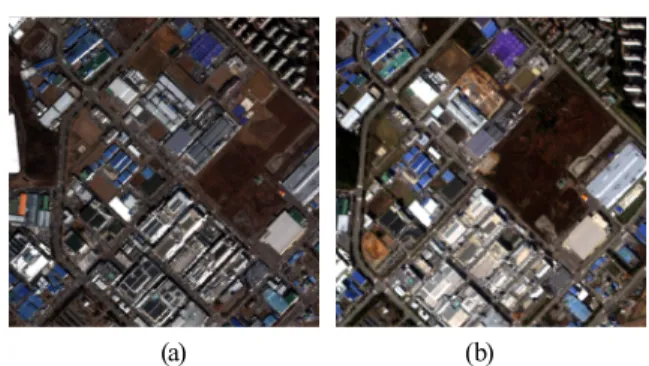
NIR bands. The multispectral image was resampled to 2 m × 2 m, and image size is 2800 × 2800 pixels with 0.5 m GSD. A panchromatic band and a multispectral image acquired from KOMPSAT 3 had spatial resolution of 0.7 m × 0.7 m and 2.8 m × 2.8 m GSD, respectively. The multispectral image of KOMPSAT 3 also had RGB and NIR bands, and the image size is 2000 × 2000 pixels with 0.7 m GSD. Pleiades 1A and KOMPSAT 3 image were collected on 2017/10/21 and 2014/10/25, respectively, from same study site selected from Ochang city in Chungcheongbuk-do. This study area includes general industrial buildings, factories, and residential area with tall buildings. Table 1 and Fig. 3 present the specifications and RGB scenes of study area for Pleiades 1A and KOMPSAT 3.

Two dataset were used for effective evaluation of image fusion results: degraded images of dataset 1 and original images of dataset 2. The dataset 1 includes spatially reduced original multispectral and panchromatic images to compare the fusion results with true reference data, which is original multispectral images, based on Wald’s protocol (Wald et al ., 1997). With the dataset 1, both of spectral and spatial

qualities can be evaluated. The dataset 2 used original input multispectral images as a reference for quality indices calculations; therefore, fusion results were degraded into the spatial resolution of input multispectral image for calculating quality indices. In the case of dataset 2, only spectral quality was estimated for quality indices. Detailed information about dataset 1 and 2 for Pleiades 1A and KOMPSAT 3 are presented on Tables 2 and 3.

Table 1. Specifications of study data

Data 1 Data 2

Satellite Pleiades 1A KOMPSAT 3

Acquisition date 2017.10.21. 2014.10.25.

Spatial resolution (m) MS: 2.54 × 2.26 / PAN: 0.5 × 0.5 MS: 2.8 × 2.8 / PAN: 0.7 × 0.7

Study area Ochang, Chungcheongbuk-do, Korea

Characteristics of study area Industrial buildings, factories, tall apartments vegetated area, and etc.

Resampling - MS: 2 m GSD - MS: 2.8 m GSD

Table 2. Specifications of dataset for Pleiades 1A

Dataset 1 Dataset 2

MS/PAN MS PAN MS PAN

Spatial resolution (m) 8.0 2.0 2.0 0.5

Reference MS (2.0 m GSD) MS (2.0 m GSD)

Evaluation target Original fusion results (2.0 m GSD) Spatially degraded fusion results (2.0 m GSD) (a) (b)

Fig. 3. The study sites of (a) Pleiades 1A and (b) KOMPSAT 3

(6)

3.2. Qualitative evaluation

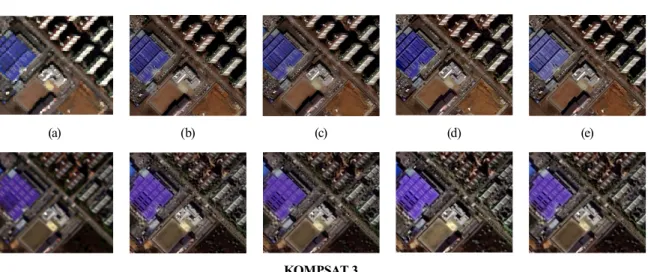
For qualitative evaluation, fusion results of HPF, SFIM, GS, and GSA are displayed in RGB and NIR-R-G for RGB channel. Fig. 4 presents the subset scenes of input data and fused multispectral bands of dataset 1, and upper and bottom scenes are the results of Pleiades 1A and KOMPSAT 3, respectively. Spatial details enhanced more on GS and GSA results comparing to HPF and SFIM results. Although GS and GSA improved spatial details, GS and GSA results presented spectral distortion and overestimated spatial details, respectively, on blue roof of study data of Pleiades 1A. In case of KOMPSAT 3, GS result had more spectral distortion on playing field and blue roof comparing to other results. Spatial

details on the vegetated area on the bottom of the displayed image were overestimated on results of all the methods.

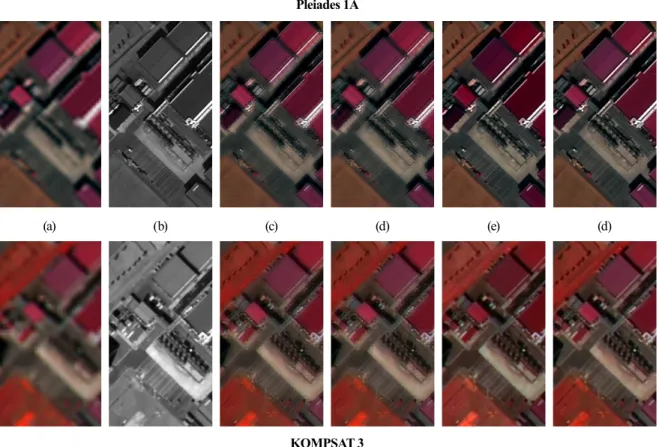
Fig. 5 displays the fusion results of dataset 2, which performed image fusion using original data. As the case of dataset 1, GS and GSA results presented more enhanced spatial information comparing to HPF and SFIM results.

Especially, spatial details of parking lot was effectively enhanced on GS and GSA results as the details on the input panchromatic bands, while parking lot of HPF and SFIM results were close to the input multispectral images. In the fusion results for Pleiades 1A and KOMPSAT 3 data, GS had more spectral distortion on building roofs, and other methods had spectral information close to input multispectral images.

Table 3. Specifications of dataset for KOMPSAT 3

Dataset 1 Dataset 2

MS/PAN MS PAN MS PAN

Spatial resolution (m) 11.2 2.8 2.8 0.7

Reference MS(2.8 m) MS(2.8 m)

Evaluation target Original fusion results (2.8 m GSD) Spatially degraded fusion results (2.8 m GSD)

Pleiades 1A

(a) (b) (c) (d) (e)

KOMPSAT 3

Fig. 4. Subscenes (in RGB) of input MS/PAN and fusion results of dataset 1: (a) reference, (b) HPF, (c) SFIM, (d) GS, and (e) GSA

(7)

GS and GSA fusion results presented better performances on the spatial detail enhancement comparing to HPF and SFIM. While GS improved spatial details, it produced more spectral distortion than other methods, especially on urban structures. HPF and SFIM had difficulties to preserve spatial details of panchromatic images because MRA approaches preserved spectral information of multispectral images.

3.3. Quantitative evaluation for entire and individual bands of fusion results

The quality indices were calculated for fusion results using the reference presented on Tables 2 and 3. The quality indices of each fusion method results are presented on Tables 4 and 5, and the highest scores of each index are displayed in bold text. For Pleiades 1A, the fusion results of dataset 1 presented the higher performance on GSA comparing to

other methods, and the fusion results of HPF and SFIM, which were MRA approaches, were best for dataset 2. For KOMPSAT 3, SFIM and GSA presented higher performance comparing to HPF and GS in case of the dataset 1, and MRA approaches presented high performance comparing to CSA approaches in case of dataset 2. The indices of dataset 2, which used the degraded fusion results due to the lack of the true reference, had higher scores comparing to the results of dataset 1, and MRA approaches had relatively higher scores comparing to CSA approaches for the dataset 2. It is because evaluations of spatial details were limited with the dataset 2 using Q, SAM, and ERGAS indices. For spatial quality, high values of AG indicated that fusion results of GSA included more edge information on pixels. Both AG indices and visual evaluations presented that GSA fusion results had more spatial information than other methods.

Pleiades 1A

(a) (b) (c) (d) (e) (d)

KOMPSAT 3

Fig. 5. Subscenes (in NIR-R-G) of input MS/PAN and fusion results of dataset 2: (a) input multispectral image, (b) input

panchromatic band, (c) HPF, (d) SFIM, (e) GS, and (f) GSA

(8)

HPF and SFIM fusion results of dataset 2 presented higher scores of Q, SAM, and ERGAS, but these presented the spectral qualities excluding spatial qualities of fusion results because of the lack of truth data. For the dataset 1 from Pleiades 1A, GSA results showed high scores for quality indices, meaning the GSA fusion results produced an image with the most similar spectral and spatial information of reference. For the dataset 1 from KOMPSAT 3, the performances of SFIM and GSA were best.

Overall evaluation of quality indices was slightly better on the fusion results of Pleiades 1A than fusion results of KOMPSAT 3. Since image fusion methods were performed on same study site for both satellites, overall quality differences could be caused from higher overlapping ratio between multispectral and panchromatic images of Pleiades 1A comparing to KOMPSAT 3. Other reasons for overall

Table 4. Quality indices of fusion results of Pleiades 1A

Quality Index HPF SFIM GS GSA

Dataset 1

Q 0.916 0.918 0.915 0.916

SAM 1.759 1.746 1.847 1.729

ERGAS 2.870 2.912 2.977 2.851

AG 49.627 49.727 48.324 54.708

Dataset 2

Q 0.978 0.979 0.877 0.877

SAM 0.422 0.419 0.913 0.741

ERGAS 1.048 1.076 2.751 2.557

AG 27.762 27.595 31.953 35.338

Table 5. Quality indices of fusion results of KOMPSAT 3

Quality Index HPF SFIM GS GSA

Dataset 1

Q 0.897 0.903 0.869 0.903

SAM 2.152 2.106 2.596 2.173

ERGAS 2.236 2.238 2.783 2.079

AG 206.361 206.745 198.499 211.136

Dataset 2

Q 0.966 0.969 0.877 0.883

SAM 0.542 0.539 0.741 0.728

ERGAS 0.827 0.841 2.557 1.582

AG 102.714 102.107 115.435 116.495

quality difference could be the selection of study sites and different spectral information from different temporal and sensor background. This analysis needs to be performed with various study sites and sensors for future study.

Low performance of spatial details on HPF and SFIM

results could be caused from mis-registration of pixels

between multispectral and panchromatic bands because

HPF and SFIM are MRA approaches that add the spatial

information to multispectral images and do not lose the

spectral information of multispectral images. CSA approaches

enhanced spatial information effectively, but these methods

could produce more spectral distortion by injecting spatial

information through GS transformation.

(9)

4. Conclusion

This study evaluated image fusion methods for multispectral and panchromatic images considering spectral ranges of Pleiades 1A and KOMPSAT 3 satellites. MRA and CSA based image fusion methods, which are GS, GSA, HPF, and SFIM, were applied on multispectral and panchromatic images of Pleiades 1A and KOMPSAT 3, and their performances were evaluated using visual and quality index analysis.

For dataset 1, quality indices presented that GSA fusion result produced an image with the closest spectral and spatial information of reference for Pleiades 1A. For KOMPSAT 3, the performances of SFIM and GSA were best. For dataset 2, HPF and SFIM fusion results higher scores of quality indices, but it presented the spectral qualities excluding spatial qualities of fusion results because of the lack of the truth data. GSA fusion results included more spatial information comparing to other methods. For the overall evaluation, this study presented that GSA fusion method was effective to improve spatial resolution of multispectral images using panchromatic bands for Pleiades 1A and KOMPSAT 3 collected from urban area.

Acknowledgment

This work was supported by Global Surveillance Research Center (GSRC) program funded by the Defense Acquisition Program Administration (SAPA) and Agency for Defense Development (ADD).

References

Aiazzi, B., Alparone, L., Baronti, S., Garzelli, A., and Selva, M.

(2006), MTF-tailored multiscale fusion of high-resolution MS and Pan imagery, Photogrammetric Engineering and Remote Sensing , Vol. 72, No. 5, pp. 591-596.

Aiazzi, B., Baronti, S., and Selva, M. (2007), Improving component substitution pansharpening through multivariate regression of MS + Pan data, IEEE Transactions on Geoscience and Remote Sensing , Vol. 45, No. 10, pp. 3230- 3239.

Aiazzi, B., Baronti, S., Lotti, F., and Selva, M. (2009), A comparison between global and context-adaptive pansharpening of multispectral images, IEEE Geoscience and Remote Sensing Letters , Vol. 6, No. 2, pp. 302-306.

Aiazzi, B., Alparone, L., Baronti, S., Carlà, R., Garzelli, A., and Santurri, L. (2017), Sensitivity of pansharpening methods to temporal and instrumental changes between multispectral and panchromatic data sets, IEEE Transactions on Geoscience and Remote Sensing, Vol. 55, No. 1, pp. 308-319.

Chavez, P., Sides, S.C., and Anderson, J.A. (1991), Comparison of three different methods to merge multiresolution and multispectral data- Landsat TM and SPOT panchromatic, Photogrammetric Engineering and Remote Sensing , Vol.

57, No. 3, pp. 295-303.

Choi, J., Yu, K., and Kim, Y. (2011), A new adaptive component-substitution-based satellite image fusion by using partial replacement, IEEE Transactions on Geoscience and Remote Sensing , Vol. 49, No. 1, pp. 295- 309.

Choi, J., Yeom, J., Chang, A., Byun, Y., and Kim, Y. (2013), Hybrid pansharpening algorithm for high spatial resolution satellite imagery to improve spatial quality, IEEE Geoscience and Remote Sensing Letters , Vol. 10, No. 3, pp.

490-494.

DigitalGlobe. (2013), Spectral response for DigitalGlobe earth imaging instruments, DigitalGlobe Technical Information,

https://dg-cms-uploads-production.s3.amazonaws.com/

uploads/ document/file/105/DigitalGlobe_Spectral_

Response_1.pdf (last date accessed: 9 September 2018).

Dong, L. and Shan, J. (2013), A comprehensive review of earthquake-induced building damage detection with remote sensing techniques, ISPRS Journal of Photogrammetry and Remote Sensing , Vol. 84, pp. 85-99.

Kim, Y., Choi, J., Han, D., and Kim, Y. (2015), Block- based fusion algorithm with simulated band generation for hyperspectral and multispectral images of partially different wavelength ranges, IEEE Journal of Selected Topics in Applied Earth Observations and Remote Sensing , Vol. 8, No. 6, pp. 2997-3007.

Lee, M.S., Kim, S.J., Shin, H.S., Park, J.K., and Park, J.H.

(2009), Extraction of agricultural land use and crop growth

(10)

information using KOMPSAT-3 resolution satellite image, Korean Journal of Remote Sensing , Vol. 25, No. 5, pp. 411- 421. (in Korean with English abstract)

Liu, J.G. (2000), Smoothing filter-based intensity modulation:

A spectral preserve image fusion technique for improving spatial details, International Journal of Remote Sensing , Vol. 21, No. 18, pp. 3461-3472.

Oh, K., Jung, H., and Lee, K. (2012), Comparison of image fusion method to merge KOMPSAT-2 panchromatic and multispectral images, Korea Journal of Remote Sensing , Vol. 28, No. 1, pp. 39-54. (in Korean with English abstract) Ranchin, T., and Wald, L. (2000), Fusion of high spatial and spectral resolution images: the ARSIS concept and its implementation, Photogrammetric Engineering and Remote Sensing , Vol. 66, No. 1, pp. 49-61.

Stathaki, T. (2011), Image Fusion: Algorithms and Applications , Elsevier, New York, USA.

Vivone, G., Alparone, L., Chanussot, J., Dalla Mura, M., Garzelli, A., Licciardi, G.A., Restaino, R., and Wald, L. (2015), A critical comparison among pansharpening algorithms., IEEE Transactions on Geoscience and Remote Sensing , Vol. 53, No. 5, pp. 2565-2586.

Wald, L. (2000), Quality of high resolution synthesized images: Is there a simple criterion?, International

Conference of Fusion Earth Data-2000 , SEE/URISCA, 26- 28, January, Sophia Antipolis, France, pp. 99-103.

Wald, L., Ranchin, T., and Mangolini, M. (1997), Fusion of satellite images of different spatial resolutions: assessing the quality of resulting images, Photogrammetric Engineering and Remote Sensing , Vol. 63, No. 6, pp. 691-699.

Wang, Z. and Bovik, A.C. (2002), A universal image quality index, IEEE Signal Processing Letters , Vol. 9, No. 3, pp. 81-

84.

수치

Fig. 2. Spectral ranges of multispectral and panchromatic  bands of (a) Pleiades 1A and (b) KOMPSAT 3
Table 2. Specifications of dataset for Pleiades 1A
Table 3. Specifications of dataset for KOMPSAT 3
Fig. 5. Subscenes (in NIR-R-G) of input MS/PAN and fusion results of dataset 2: (a) input multispectral image, (b) input  panchromatic band, (c) HPF, (d) SFIM, (e) GS, and (f) GSA
+2

참조

관련 문서

GDP impact of COVID-19 spread, public health response, and economic policies. Virus spread and public

Micro- and nano-sized pores were formed on the surface of the alloy using PEO and anodization methods, and the pore shape change according to the Zr

This same argument can be used to show that the complementary virtual work of redundant member forces is zero not only for truss elements but for members of any other

– Total project cost is not known before construction begins – Less owner input: Owner struggles to keep

– No dock facilities (major market Southeast Asia) – Lower construction cost (lower labor cost). – Closer to feedstock/raw materials

skeleton bond energy differences of monomer, oligomers, and polymer. Skeletal bond energy difference

For any axis—angle pair (AK, 0), there is another pair, namely, (_AK, —0), which results in the same orientation in space, with the same rotation matrix describing it.

 The use of cells and biological molecules or cellular and biomolecular processes to solve problems and make