• 검색 결과가 없습니다.

A Study of the impacts of control types on Tie strength and Project Performance - focus on field project organization of construction industry

N/A
N/A
Protected

Academic year: 2021

Share "A Study of the impacts of control types on Tie strength and Project Performance - focus on field project organization of construction industry"

Copied!
6
0
0

로드 중.... (전체 텍스트 보기)

전체 글

(1)

JKSCI

A Study of the impacts of control types on Tie strength and Project Performance – focus on field project organization of

construction industry

*

Won-Hee Lee*, Ho-Haeng Cho*

*Professor, Division of Business Administration, Kyungnam College of Information & Technology, Busan, Korea

*Professor, Division of Business Administration, Kyungnam College of Information & Technology, Busan, Korea

[Abstract]

In this paper, we an empirical study of the effects of control types on Tie strength and filed project performance of project participants in field project organization for Korean domestic construction industry.

In the study, we try to tell what significant impact output control, process control and tie strength among field project participants have on field project performance and features unique to field project organization for Korean construction industry through empirical analysis. And the findings of the empirical analysis are that output control appeared to have significant impacts on tie strength among the participants and process control, and process control also appear to have significant impact on field project performance.

▸Key words: Tie strength, Output control, Process control, Project performance, Structural equation model

[요 약]

본 연구는 국내 건설산업의 현장프로젝트조직 사업 참여자를 대상으로 프로젝트 참여자 간 통 제유형에 따라 유대 강도와 현장프로젝트 성과에 어떠한 영향을 주는지를 살펴보고자 하는 실증 연구이다 . 본 연구에서는 산출통제(Output Control), 과정통제(Process Control), 현장프로젝트 사업참 여자간 유대강도가 현장프로젝트성과에 어떠한 유의한 영향을 미치며 또한 한국 건설산업의 현장

프로젝트조직만이 가지는 특징을 실증분석을 통하여 알아보고자 하였다 . 실증분석결과 산출통제

(Output Control)는 사업참여자 간 유대강도와 과정통제(Process Control)에 유의한 영향을 주며 유 대강도는 과정통제 (Process Control)와 현장프로젝트 성과에 유의한 영향을 주었으며 과정통제 (Process Control) 역시 현장프로젝트 성과에 유의한 영향을 미치는 것으로 나타났다.

▸주제어: 유대강도, 산출통제, 과정통제, 프로젝트성과, 구조방정식모델

∙First Author: Won-Hee Lee, Corresponding Author: Ho-Haeng Cho

*Won-Hee Lee ([email protected]), Division of Business Administration, Kyungnam College of Information &

Technology

*Ho-Haeng Cho ([email protected]), Division of Business Administration, Kyungnam College of Information &

Technology

∙Received: 2021. 06. 23, Revised: 2021. 07. 28, Accepted: 2021. 07. 28.

∙This paper is an extension of the paper presented at the 63rd Winter Conference of the Korean Society of Computer and Information in 2021.(A Study on the Influence of control types on Tie strength and Project Performance – Focus on construction industry field project organization).

Copyright ⓒ 2021 The Korea Society of Computer and Information http://www.ksci.re.kr pISSN:1598-849X | eISSN:2383-9945
(2)

I. Introduction

Faced with the recent Korean government’s continued restrictive real estate policy to curb speculative housing price hikes, Korean domestic construction companies need efficient management system to improve technology, profitability, and competitiveness. So efficient business control improvement appears to be an alternative strategy for the survival and growth of [1] construction company. Business management system of [2]

construction industry is developing in various ways. Although the expert technology of each part, such as processes and cost control, has not changed, the roles and the partners of the participants are changing. We can frequently see merges of similar businesses for combined control or the emergence of complex business for the same purpose. So, futuristic strategy is necessary in such changing environment, and more versatile approaches for business projects and performance measurement have become one of the major objectives for future construction industry. In light of the importance that the performance of business projects results in the performance of the construction company, collaborative system for lasting competitive advantage is necessary with strengthened tie among the participants, as well as improved construction capability and technology, to achieve the basic objective of construction projects. There have been increasing efforts to analyze and interpret the management of organizations for which collaboration is prerequisite, from the perspective of social networks. Regarding the interpretation of the effects of social networks on organizations, variables, such as tie strength, in particular, are considered important.[3] Tie strength indicates the level of mutual solidarity and cohesiveness since frequent contracts and sense of closeness can be useful tool for mutual collaboration and dedication beyond mutual understanding. In the study, we try to figure out relationship between tie strength

among participants in construction field project organization and the performance of field project through causal relationship analysis by classifying the control types for tie strength as output control and process control.

II. Theoretical Background

It comes to important elements to consider for the objective of an organization, behavior of some members can be inconsistent with the objective of the organization even though the company has excellent members to achieve desirable outcome or preset organizational objective. In this case, one of desirable approaches can be motivation for its members to achievement its set objective.[4]

control can be employed to induce collaborations among the departs or individuals of the organization and efforts and challenge to achieve specified organizational objective. According to the empirical study of effects and roles of controls on the performance of international joint venture by [5], controls appear to have significant impact on mutual collaborations among the participants, and the types of process control and social control appear to have significant impact on joint venture performance. Control is defined as “a process that system components constitute predictable composition based on the set criteria”.[6]

seems That is, the purpose of control is to direct

behaviors toward the ultimate objective of the

organization as expected. Control is, therefore,

employed to make the achievement of the objective

of the company predictable, and the level of

conviction for expected result can be enhanced with

control.[7]. [8] said in his study of the cooperation

that “when business partners are able to control

each other with appropriate methods and laws,

acknowledged risk for their partners can be

mitigated and mutual trust can be improved, and

such trust can lead to synergy effect through

exchange and combination of their core potential

(3)

and resources”. Tie strength is one of the most used concepts in the study of social networks, and it measures the strength and stability of relationships with their partners of social networks. [9]

According to the study of the effects of tie strength between companies on knowledge attainment and integration and innovation performance by [10], it is confirmed that the interactions of strong tie and weak tie are both found to have positive impact on knowledge attainment and integration. According to the study of the role of formal and nonformal controls of strategic alliance between companies by [11], process control appears to have impacts on business performance. According to the empirical study of adjusting impact of control types on relationship between tie strength and joint venture performance by [12], tie strength with business partners has significant impacts on business performance; output control does not appear to regulate relationship between tie strength and business performance; process control does not appear to have adjusting role but does appear to have significant direct impact; and social control appears to have significant regulatory role for tie strength and business performance. The finding confirms that information sharing and tie strength between business participants, especially construction company field project organization where multiple companies participate in particular, are closely related with field project performance.

III. Research Method

1. Research Model and Hypotheses

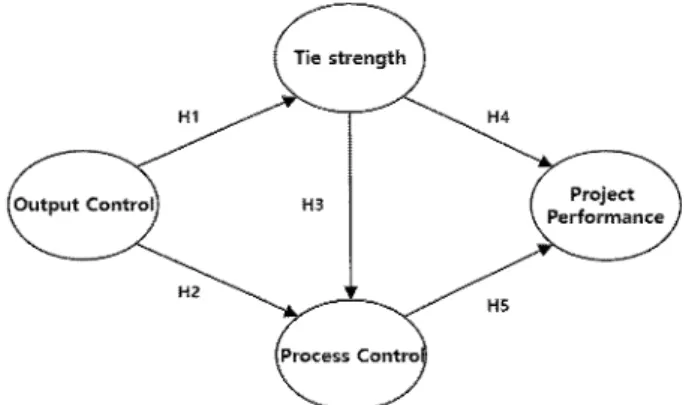
The purpose of the study is to empirically confirm how control types (output control, process control) among the participants in Korean domestic construction field project organization impact tie strength and field project performance.

In this study, making use of the existing findings, the hypotheses are as follows.

Hypothesis 1: output control will have positive impact on tie strength among the project participants.

Hypothesis 2: output control will have positive impact on process control.

Hypothesis 3: tie strength among project participants will have positive impact on process control.

Hypothesis 4: tie strength among the project participants will have positive impact on project performance.

Hypothesis 5: Process control will have positive impact on the project performance.

Fig. 1. Research model and Hypothesis

2. Sampling

Total 300 copies of questionnaires are distributed among the personnel who work at Korean domestic construction field project organizations for the study, and 287 questionnaires are collected in total for statistical analysis except for the irresponsible 13 questionnaires (collection ratio 95.6%).

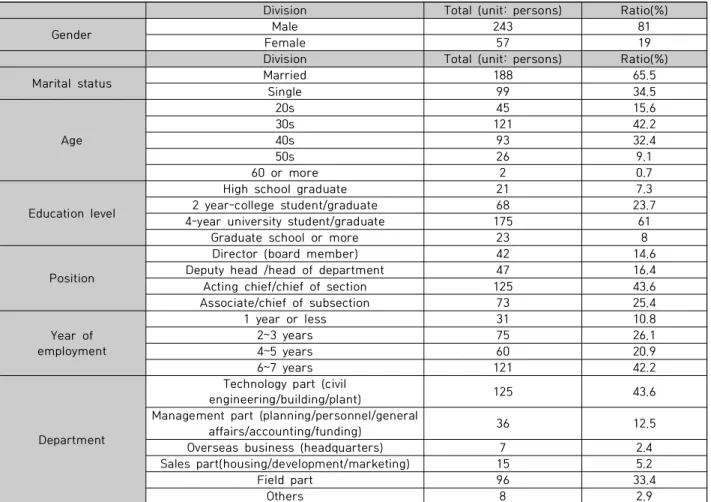
The findings of frequency analysis of the sample demographic are presented in the <Table 1> below.

Male respondents are 243(81%) and female respondents are 57(19%) of the total 287 respondents. Regarding the age distribution, the largest age bracket is 30s (42.2%) and the next largest age bracket are 40s (32.4%), 50s (9.1%) and 20s (15.6%), respectively. 30 ~ 40s takes up 74.6%

of the total personnel. 65.5% of the respondents

are married, with 34.5% single. Regarding their

education level, high school graduates are 21

(4)

Division Total (unit: persons) Ratio(%)

Gender Male 243 81

Female 57 19

Division Total (unit: persons) Ratio(%)

Marital status Married 188 65.5

Single 99 34.5

Age

20s 45 15.6

30s 121 42.2

40s 93 32.4

50s 26 9.1

60 or more 2 0.7

Education level

High school graduate 21 7.3

2 year-college student/graduate 68 23.7

4-year university student/graduate 175 61

Graduate school or more 23 8

Position

Director (board member) 42 14.6

Deputy head /head of department 47 16.4

Acting chief/chief of section 125 43.6

Associate/chief of subsection 73 25.4

Year of employment

1 year or less 31 10.8

2~3 years 75 26.1

4~5 years 60 20.9

6~7 years 121 42.2

Department

Technology part (civil

engineering/building/plant) 125 43.6

Management part (planning/personnel/general

affairs/accounting/funding) 36 12.5

Overseas business (headquarters) 7 2.4

Sales part(housing/development/marketing) 15 5.2

Field part 96 33.4

Others 8 2.9

Table 1. General charac tenistics of the sample

(7.3%), 2-year college graduates are 51(21.0%), 4-year university graduates are 156 (64.2%), and graduate school graduates or beyond are 13(5.3%), so that 4 university graduates or beyond were more than 64% of the total. When it comes to their position, the largest group is acting section chief/section chief as 125 (43.6%); subsection manager/chief group is 73 (25.4%); deputy department head/department head group was 47 (16.4%) and board member group is 42 (14.6%), the sample, therefore, shows even distribution across their positions. Regarding the years of employment, 6~7-year bracket is 121 (42.2%); 2~3-year bracket is 75(26.1%); 4~5-year bracket is 60 (20.9%); and 1 year or less bracket is 31 (10.8%).

Lastly, regarding their departments of employment, technology department (civil engineering/building/plant) is 125 (43.6%); field work is 96 (33.4%); management (planning, personnel, general affairs, accounting, funding) is

36 (12.5%); sales (housing/ development/marketing) is 15 (5.2%); others is 8 (2.9%); and overseas (headquarters) is 7(2.4%).

IV. Results

1. Exploratory Factor Analysis

For this study, Exploratory Factor Analysis is

carried out with SPSS Windows 23.0 and the

confidence interval is estimated with Cronbach`s

alpha>0.6. Principle Component Analysis is

employed for Factor extraction and Varimax

Rotation is used for the factor rotation. The

questionnaire items are modified in line with the

purpose of the study. Single dimensional factor

analysis is conducted for the Factor Loadings

(FL>0.6) that represents correlations between the

evaluation factors.

(5)

Item Factor1 Factor 2

Factor 3

Factor 4

Cronbach' s α

output control

.859      

0.92

.847      

.845      

.720      

.699      

.634      

.599    

tie strength

  .878    

0.935

  .845    

.839

  .752    

process control

    .896  

0.692

    .832  

.819 .791

project performance

      .899

0.952

      .892

.876 .849

      .774

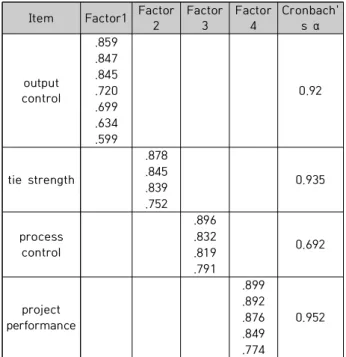
Table 2. Results of exploratory factor analysis

First, exploratory factor analysis is conducted for the questionnaire items, using the SPSS 23.0, and this has resulted in the extraction of the 4 factors that are output control, tie strength, process control, project performance.

2. Analysis of the Structural Model

Correlations are used to represent how the factors are related each other [13]. Covariance structure analysis is employed in the study to analyze their correlations between the 4 factors that are output control, tie strength, process control, project performance.

Fig. 2. Research Results

The structural model testing with AMOS 18.0 for the correlations between all the actors has resulted in c = 1.451(df=1), p = 0.000, 2 c /df = 1.451, GFI = 2 0.996, RMR = 0.018, NFI = 0.996, AGFI = 0.964, CFI

= 0.999, and general goodness-of-fit indicators, GFI, AGFI, RMR, CFI, RMSEA, etc. were confirmed to meet all of the standard values.

The <Table 2> and <Table. 3> show standardized coefficients and significance levels. According to the findings of the study, output control is found to have positive effects on the tie strength(H1) and process control(H2), tie strength is found to have positive effects on the process control(H3) and project performance(H4), process control(H5) is found to have positive effects on the project performance.

Hyp oth esis

Path FL t-

value p- value

Hypothesis Supported

H1

Output Control→

Tie Strength 0.637 11.648 0.000 **

H2

Output Control→

Process Control

0.434 6.95 0.000 **

H3 Tie Strength→

Process Control 0.378 6.054 0.000 **

H4 Tie Strength→

Project Performance

0.642 10.069 0.000 **

H5

Process Control→

Project Performance

0.128 1.999 0.046 *

*: P<0.05, **: P<0.01, ns: not significant Table 3. Results of hypotheses

V. Conclusions

The findings can be summarized as follows:

Output control has positive impact on tie strength (H1) among the business participants and process control (H2); tie strength has positive impact on process control (H3) and field project performance (H4); and process control has positive impact on project performance (H4).

These findings are in line with the existing

studies in which controls and tie strength among

(6)

the participants in field project organization have significant impact on the field project performance.

And the academical, empirical meaning lies with the confirmation that appropriate control system deems necessary among the business participants for successful execution of construction industry field projects and differentiated application of different control types to obtain or improve project performance. But there are some limitations with the study that the research data for the study of the controls and tie strength among the business participants for Korean domestic construction company field project organization are heavily skewed toward civil engineering (60.2%), while the ratios are 27.3%, 6.7%, 2.5% and 3.3% for housing and construction, plant, electricity and telecommunication, and others, respectively, so that they fall short of fair reflection of the characteristic of each business part of overall general construction industry field project organizations. For future studies, therefore, analyses of more data of broader range of fields are necessary for fair reflection of field characteristics of construction projects.

REFERENCES

[1] W. S. Yoo, "Communication tool for convergence of technology and knowledge in the construction industry / Decision model for predicting and analyzing project completion time," CHRIK Journal, pp. 30-32, 2010.

[2] Y. S. Kim, "A Study on the Achievement Analysis of Construction Project Management in the Domestic Private Sector," Hanyang University, 2010.

[3] G. A. McDermott and R. A. Corredoira, "Network corrpososition, collaborative ties, and upgrading in emerging-market firms:

Lessons from the Argentine autoparts sector," Journal of International Business Studies, Vol. 41, No. 2, pp. 308-329, 2009.

[4] Flamholtz, E. G., T. K. Das. and A. S. Tsui, “Toward an Integrative Framework of Organizational Control," Accounting, Organizations, and Society, Vol. 10, pp. 35-50, 1985.

[5] W. H. Lee, "The effects and role of control on the performance of International Joint Venture," Pukyong National University, 2017.

[6] R. Leifer and P. K. Mills, "An information processing approach

for deciding upon control strategies and reducing control loss in emerging organizations," Journal of Management, Vol. 22, pp.

113-137, 1996.

[7] T. K. Das and B. Teng, "Between trust and control: Developing confidence in partner cooperation in alliances," Academy of Management Review, Vol. 23, No. 3, pp. 491-512, 1998.

[8] H. S. Park, S. M. Choi, W. J. Jeong, S. H. Kang, "The Antecedents of Successful Inter-Firm Cooperation," Korean Management Review, Vol. 37, No. 5, pp. 1263-1285, 2008.

[9] H. S. Oh, "Social Networks, Social Capital, and Organizational Studies," Wisdomhouse, 2008.

[10] S. Y. Sim, "The Impact of Tie Strength on the Knowledge Acquisition, Knowledge Integration and Innovation Performance:

Focusing on Small and Medium Sized Enterprises in the Industrial Clustering," The Journal of Information Systems, Vol.

28, No. 2, pp. 53-72, 2019.

[11] S. Y. Lee and Z. W. Kim, "The complementary and substitutive roles of formal and informal controls in international strategic alliances," Korean Management Review, Vol. 42, No. 5, pp.

1377-1397, 2013.

[12] W. H. Lee, H. S. Yun, and C. W. Kim, "A The Moderating Roles of Control Types on Relationship between Tie Strength and International Joint Venture Performance," Korea Management Consulting Review, Vol. 17, No. 1, pp. 151-159, 2017.

[13] G. S. Kim, "AMOS Structural Equstion Model Analysis,"

Hannarae, 2006.

Authors

Won-Hee Lee received the M.B.A. and Ph.D.

degrees in International Commerce &

Logistics from Pukyong National University, Korea, in 2005 and 2017. Dr. Lee is currently a professor at Division of Business Administration Kyungnam College of Information &

Technology. He is interested in International Management, Business Statistics and International Business Environments, and International Enterprise.

Ho-Haeng Cho received the M.S. and Ph.D.

degrees in Department of Business Administration from National Korea Maritime

& Ocean University, Korea, in 2015. Dr.

Cho is currently a professor at Division of Business, Administration Kyungnam College of Information

& Technology. He is interested in Principles of Management

and Tax Law, Principles of Economics.

수치

Fig.  1.  Research  model  and  Hypothesis
Table  1.  General  charac  tenistics  of  the  sample
Table  2.  Results  of  exploratory  factor  analysis

참조

관련 문서

S.(2008), A study on the relationship between business plan components and corporate performance, International Journal of Entrepreneurship and Innovation Management,

The objective of the present study is to determine the relationship between the types of children's character according to Murphy-Meisgeier Type Indicator

This study is aimed at finding ways to get basic data about how Blood Lactate Concentration and physical strength and performance affect sports climbers by climbing for a total

The effects of recycling on the tensile bond strength of new and clinically used stainless steel orthodontic brackets: an in vitro study. Material testing of

The purpose of this study was to investigate the impact of social capital and positive psychology capital on the will of start-up according to experience

1 John Owen, Justification by Faith Alone, in The Works of John Owen, ed. John Bolt, trans. Scott Clark, &#34;Do This and Live: Christ's Active Obedience as the

Junior shooting player of 10 weeks anaerobic participation in exercise programs, body composition and physical fitness of significant effects on the (grip strength,

8.4.1 Two-phase equilibrium between the liquid and a solid solution (iii) Extension of tie line cannot intersect the vertex of triangle6. Exception : solubility