- 59 -
Antioxidant Activities of Various Solvent Extracts from Canola Meal
Hyun-Il Jun1, Dennis P. Wiesenborn2 and Young-Soo Kim1†
1Department of Food Science and Technology, Chonbuk National University, Jeonju 561-756, Korea
2Department of Agricultural and Biosystems Engineering, North Dakota State University, Fargo, ND 58102, USA
추출용매별 canola meal의 항산화 활성
전현일1․Dennis P. Wiesenborn2․김영수1†
1전북대학교 식품공학과, 2North Dakota State University
Abstract
This study was performed to investigate antioxidant activity of various solvent extracts (methanol, ethanol, acetone and water) from canola meal. As the concentration of all extracts increased, antioxidant activities increased gradually.
Among solvent extracts from canola meal, methanol extract showed the highest antioxidant activities with EC50
values of 0.9, 3.5, 1.3, and 8.5 mg/mL for DPPH radical scavenging ability, ABTS radical scavenging ability, reducing power, and chelating ability, respectively, and it had the highest total phenolics and total flavonoids contents.
Furthermore, methanol extract was fractionated into three fractions (MF 1, MF 2, and MF 3) using Sephadex LH-20 column. The highest antioxidant activity was found on MF 2 for DPPH radical scavenging ability, on MF 3 for ABTS radical scavenging ability and reducing power, and on MF 1 for chelating ability at the same concentration of 1.5 mg/mL. The results indicated that each fraction containing various antioxidant materials seemed to have different influence at each antioxidant activity.
Key words:antioxidant activity, canola meal, solvent extracts, total phenolics, total flavonoids
서 론
1)
식물 종실에는 종류와 처리방법에 따라 차이가 있으나, 노화와 암, 심장질환 및 당뇨 등 질병의 원인이 되는 활성산 소종과 free radical을 효과적으로 제거하는 phenolics (phenolic acids, flavonoids, tanins 등)이 상당량 함유되어 있어, 산업적으로 사용하고 남은 종실 가공부산물들을 이 용한 천연소재 항산화물질들이 새롭게 조명을 받고 있다 (1-3). 이 중 canola는 유채(Brassica napusL., rapeseed)에 많이 존재하는 유해물질인 erucic acid와 glucosinolate의 함 량이 낮도록 개량한 품종이다(4). 과거에는 반추동물용 단 백질 보충 사료로 주로 이용되었으나 최근에는 biodiesel과 식용으로 사용범위가 확대되고 있으며, 종실에서 기름을 추출하고 남은 가공부산물인 canola meal은 수분(11.4%), 조지방(2.8%), 조단백(36.1%), 조회분(6.3%) 및 조섬유
†Corresponding author. E-mail:[email protected], Phone:82-63-270-2569, Fax:82-63-270-2572
(11.5%) 등으로 구성되어져 있다(5,6).
또한 canola 종실자체는 물론 canola meal의 total phenolics 함량이 다른 종실류에 비해 높은 것으로 알려져 있다(7). Canola seed와 meal의 phenolic acids는 protocatechuic acid, vanillic acid, syringic acid, gallic acid, ρ-hydroxybenzoic acid, ρ-courmaric acid, caffeic acid, ferulic acid, sinapic acid 등으로 구성되어 있고, 이 중 주성분은 sinapic acid로서 free phenolic acid의 약 73% 이상을 차지하고 있다(7,8).
이와 같이 항산화물질의 함량이 높은 canola meal 추출물을 식물성 유지와 조리된 쇠고기, 닭고기, 돼지고기 등과 같은 동물성 식품에 첨가하면 제품의 산화를 감소시키거나 예방 효과가 있는 것으로 보고되어져 있어 항산화 물질로의 이용 가능성은 높다고 할 수 있다(9,10).
항산화 활성과 항산화 물질의 함량은 품종, 재배지역 및 수확시기 뿐만 아니라 추출용매에 따라서도 영향을 받기 때문에 효율적인 추출용매의 선별은 항산화 물질의 추출에 서 매우 중요할 수 있다. 따라서 본 연구에서는 기름을 제거
한 canola meal의 추출용매에 따른 추출물의 항산화 물질 (total phenolics와 total flavonoids) 수율 및 항산화 활성 (DPPH radical assay, ABTS radical assay, reducing power 및 ferrous ion chelating ability)을 측정하고, Sephadex LH-20 column을 이용하여 분리한 methanol 추출물 분획물의 항산 화 활성을 확인함으로서 천연 항산화 소재로서 이용 가능성 을 살펴보았다.
재료 및 방법
재 료
바이오디젤 생산에 사용되는 canola seed 품종중 하나인 Invigor 5550을 사용하였으며, 분말(100 g)을 hexane (1 L)에 침지하여 상온에서 각각 12시간, 6시간 및 6시간동안 교반 하여 지용성 물질을 제거하였다. 탈지한 canola seed는 10시 간 동안 fumehood에서 송풍건조하여 남아있는 hexane을 제거하였다. 이와 같이 바이오디젤 생산에 사용되는 oil을 추출하고 남은 가공부산물인 canola meal을 제조하였으며, 이를 100 mesh로 체질하여 시료로 사용하였다.
Canola meal의 용매별 추출 및 methanol 추출물의 분획
Canola meal은 J.T. Baker사의 HPLC grade인 methanol, ethanol, acetone 및 water를 사용하여 추출하였다. 추출조건 은 상온에서 시료(30 g)에 용매(400 mL, 3회)를 첨가하여 추출(12시간, 교반)하여 얻은 용액을 원심분리(10,000 g, 10분)와 여과(Whatman No. 4)하고 40℃에서 감압농축 및 동결건조 하여 분석시료로 사용하였다. 항산화 활성이 가 장 높은 methanol 추출물 200 mg을 methanol 2 mL에 용해시 켜 Sephadex LH 20 column (2.5×76 cm)을 이용하여 분획하 여 3개의 methanol fraction (MF 1: 12~23 fraction, MF 2:
24~38 fraction 및 MF 3: 39~54 fraction)을 순차적으로 얻었으며 40℃에서 감압농축 및 동결건조 하여 분석시료로 사용하였다. Column chromatogram의 분리 조건은 이동상 은 85% methanol, 유속은 0.5 mL/min, 주입량은 2 mL, 분획 은 10 mL/fraction이었다.
Total phenolics 및 total flavonoids 함량 측정
Total phenolics 함량은 Dewanto 등(11)의 방법을, total flavonoids는 Jia 등(12)의 방법을 이용하였다. Total phenolics 함량은 추출물 0.1 mL에 Folin-ciocalteu's phenol reagent 5 mL를 첨가하여 1분간 반응시킨 후에 5% Na2CO33 mL를 첨가하였다. 암소에서 1시간 동안 반응시켜 725 nm (UV-1650PC, Shimadzu Co, Kyoto, Japan)에서 측정하였으 며, 표준물질로는 trans-sinapic acid를 이용하였다. Total flavonoid 함량은 추출물 500 μL에 5% NaNO275 μL을 첨가
하여 상온에서 5분간 반응시킨 후에 10% AlCl3150 μL을 첨가하였다. 1 M NaOH 0.5 mL와 증류수 275 μL을 첨가하 여 510 nm에서 측정하였으며 표준물질로는 (±)- catechin을 이용하였다.
Scavenging ability by the DPPH radical assay
DPPH radical assay는 Williams 등(13)의 방법을 이용하 였다. 추출물 0.2 mL에 60 μM DPPH (2,2-diphenyl-1- picrylhydrazyl) 2.8 mL를 첨가하여 30분간 반응시켜 515 nm에서 측정하였으며 대조구는 butylated hydroxytoluene (BHT) 를 사용하였다. DPPH radical scavenging ability는 시료용액 의 첨가구와 무첨가구의 흡광도 차이를 백분율(%)로 나타 내었다.
Scavenging ability by the ABTS radical assay
ABTS radical assay는 Arts 등(14)의 방법을 이용하였다.
추출물 30 μL에 ABTS radical 용액 3 mL를 첨가하여 734 nm에서 측정하였으며 대조구로는 BHT를 사용하였다.
ABTS radical 용액은 7 mM ABTS [(2,2'-azino-bis(3- ethylbenzthiazoline-6-sulfonate) diammonium salt)]에 2.45 mM potassium persulfate를 첨가하여 최종농도가 2.45 mM ABTS radical cation (ABTS․+)의 용액을 만들어 암소에서 12시간이상 실온에서 보관하였다. 분석 시에는 5 mM PBS (phosphate buffer saline, pH 7.4)를 첨가하여 734 nm에서 흡광도가 0.70±0.02가 되도록 조절하여 사용하였다. ABTS radical scavenging ability는 시료용액의 첨가구와 무첨가구 의 흡광도 차이를 백분율(%)로 나타내었다.
Reducing power
Reducing power는 Oyaizu(15)의 방법을 이용하였다. 추 출물 1 mL에 0.2 M phosphate buffer (pH 6.6) 2.5 mL와 1% K2Fe(CN)6 2.5 mL를 첨가하여 water bath (50℃)에서 20분 반응시켰다. 10% trichloroacetic acid (TCA) 2.5 mL를 첨가하여 원심분리(2,200 g, 5분)한 후에 상등액을 취하였 다. 상등액 2.5 mL에 증류수 2.5 mL와 0.1% FeCl30.5 mL를 첨가하여 700 nm에서 측정하였으며 대조구로는 BHT를 사용하였다. Reducing power는 시료용액의 첨가구와 무첨 가구의 흡광도의 차이로 나타내었다.
Chelating ability on ferrous ions by metal chelating assay
Chelating ability는 Decker와 Welch(16)의 방법을 이용하 였다. 추출물 1 mL에 MeOH 3.7 mL, 2 mM FeCl20.1 mL 및 5 mM ferrozine 0.2 mL를 순서대로 첨가하여 10 분간 반응시켜 562 nm에서 측정하였으며, 대조구로는 EDTA- 2Na (ethylene diamine tetraacetic acid 2 sodium)를 사용하였 다. Chelating ability는 시료용액의 첨가구와 무첨가구의
흡광도 차이를 백분율(%)로 나타내었다.
통계분석
각 실험은 수율(n=2)을 제외한 모든 실험에서 3회 반복 실험을 통하여 결과를 얻어 평균±표준편차로 나타내었으 며, 각 시료간의 유의성 검증은 SAS 통계 프로그램(SAS Institute, Cary, NC, USA)을 이용하여 one way ANOVA로 분산분석 하였다. 유의성 검증(p<0.05)은 Duncan multiple range test로 비교하였다.
결과 및 고찰
용매별 canola meal 추출물의 total phenolics 및 total flavonoids 함량
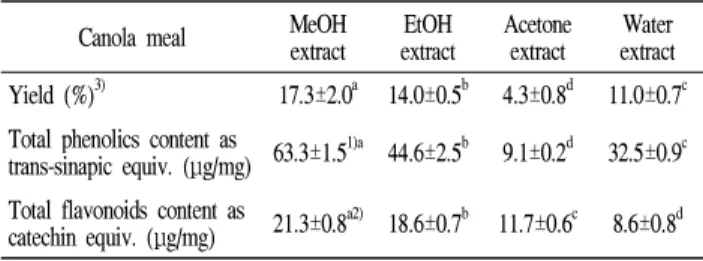
Canola meal 추출물의 수율과 항산화 성분은 추출용매에 대한 항산화 성분들의 용해도 차이에 따라 결정되므로 효과 적인 용매의 선정이 매우 중요하다. 용매별 canola meal 추출물들의 수율, total phenolics 및 total flavonoids 함량은 Table 1과 같다. 용매별 추출물의 수율은 methanol 추출물에 서 17.3%로 가장 높았으며, 다음으로 ethanol 추출물, water 추출물과 acetone 추출물 순으로 나타났다. 항산화 성분이 함유되어있는 total phenolics와 total flavonoids 함량도 각각 63.3 μg/mg extracts과 21.3 μg /mg extracts으로 methanol 추출물에서 가장 높았다. 한편 methanol, ethanol 및 water 추출물에서는 total phenolics 함량이 total flavonoids 함량보 다 높았으나, acetone 추출물에서는 total flavonoids의 함량 이 높게 나타나 추출용매에 따라서 수율, total phenolics 및 total flavonoids 함량이 다르게 나타났다.
Table 1. Yield, total phenolic contents and total flavonoid contents of various solvent extracts from canola meal
Canola meal MeOH
extract EtOH
extract Acetone extract Water
extract Yield (%)3) 17.3±2.0a 14.0±0.5b 4.3±0.8d 11.0±0.7c Total phenolics content as
trans-sinapic equiv. (μg/mg) 63.3±1.51)a 44.6±2.5b 9.1±0.2d 32.5±0.9c Total flavonoids content as
catechin equiv. (μg/mg) 21.3±0.8a2) 18.6±0.7b 11.7±0.6c 8.6±0.8d
1)Values are mean±SD (n=3).
2)Different letters in the same row are significantly different by Duncan's multiple test (p<0.05).
3)Yield are mean±SD (n=2).
Tamaindus indica seed coat의 용매별 추출물의 수율과 total phenols의 함량은 methanol 추출물에서 24.4%와 32.4 g/100 g, 70% acetone 추출물에서 13.8%와 26.3 g/100 g으로 methanol 추출물이 추출 수율과 total phenolics의 함량이 높다고 보고(5)하여 본 연구결과와 유사한 경향을 보였다.
Total phenolics 함량의 경우, Naczk 등(7)이 보고한 canola meal의 total phenolics 함량인 15.4~18.4 g/kg보다 다소 낮 은 함량(11.0 μg/mg meal)을 나타내었는데, 이는 추출용매 로 사용한 methanol의 농도에 의한 영향(17)으로 판단된다.
또한, Hass-Roudsari 등(18)이 보고한 canola meal ethanol 추출물의 수율은 14~15%로 본 연구결과와 유사하였으나 total phenolics 함량은 52.2~70.9 μg/mg extract로 본 연구결 과에서 얻은 ethanol 추출물보다 약간 높은 함량을 나타내 었다.
추출물에 phenolic hydroxyl group을 가진 phenolic compound의 함량이 높을수록 항산화 활성은 증가하므로 결과적으로 total phenolics와 total flavonoids의 함량이 높은 methanol 추출물의 항산화 활성이 가장 높을 것으로 예측할 수 있다.
용매별 canola meal 추출물의 항산화 활성
용매별 canola meal 추출물의 항산화 활성(DPPH radical scavenging ability, ABTS radical scavenging ability, reducing power 및 chelating ability)을 측정한 결과는 Table 2와 같다.
추출물의 농도가 증가할수록 강한 항산화 활성을 보였으 며, 용매별 추출물의 항산화 활성은 methanol 추출물에서 가장 높아서 total phenolics와 total flavonoids의 함량이 methanol 추출물에서 가장 높은 결과(Table 1)와 일치하였 다. 항산화 활성은 phenolics 성분에 의한 free radical 소거능 뿐만이 아니라 다른 항산화 활성(reducing agent와 metal chelator)을 보이기도 하므로 용매별 추출물의 항산화 활성 을 EC50으로 살펴보았다(Table 2). DPPH radical scavenging ability, reducing power 및 chelating ability 에서는 methanol
> ethanol > water > acetone 추출물 순으로 활성이 나타났으 며, DPPH radical scavenging ability는 methanol 추출물이 acetone 추출물보다 약 2.9배, reducing power는 methanol 추출물이 acetone 추출물보다 약 2.3배 높았으나 chelating ability는 acetone 추출물이 10 mg/mL의 농도에서는 측정되 지 않았다. 한편, ABTS radical scavenging ability에서는 methanol > water > ethanol > acetone 추출물 순으로 활성이 나타났으며, methanol 추출물이 acetone 추출물보다 약 2.1 배 높았다.
이와 같은 결과는 canola meal과 canola hull 추출물의 total phenolics 함량이 증가할수록 추출물의 DPPH radical scavenging ability, ABTS radical scavenging ability 및 reducing power의 항산화 활성은 증가하지만 추출물의 EC50은 감소하며, hot water 추출물보다 ethanol 추출물의 항산화 활성이 좋았다는 보고(19, 20)와 유사한 경향을 보였 다. 또한 Tamaindus indica seed coat의 용매별 chelating ability가 total phenolics의 함량이 높을수록 증가하며, methanol 추출물이 70% acetone 추출물이나 hot water 추출 물보다 높다는 보고(5)와도 유사하였다. 따라서 canola meal
의 추출용매로는 methanol이 효과적이며, 항산화 활성은 phenolic 화합물의 함량과 밀접한 관련성과 농도 의존성을 보였다.
Table 2. EC50values of various solvent extracts from canola meal Antioxidant properties EC503)values (mg/mL)
MeOHextract EtOH extract Acetone
extract Water extract Scavenging ability
on DPPH radicals
(BHT: 0.14 mg/mL) 0.9±0.01)d 1.1±0.0c 2.7±0.0a 1.9±0.0b Scavenging ability
on ABTS radicals
(BHT: 0.15 mg/mL) 3.5±0.1d2) 4.0±0.0b 7.2±0.1a 3.7±0.1c Reducing power
(BHT: 0.13 mg/mL) 1.3±0.0d 1.6±0.0c 3.0±0.0a 2.1±0.0b Chelating ability
on ferrous ions
(EDTA-2Na : 0.05 mg/mL) 8.5±0.10b 9.8±0.1a >10 >10
1)Values are mean±SD (n=3).
2)Different letters in the same row are significantly different by Duncan's multiple test (p<0.05).
3)EC50 values: effective concentration at which antioxidant activity using DPPH or ABTS radical were scavenged by 50%; and absorbance was 0.5 for reducing power;
ferrous ions were chelated by 50% respectively.
Methanol 추출물 분획물의 항산화 활성
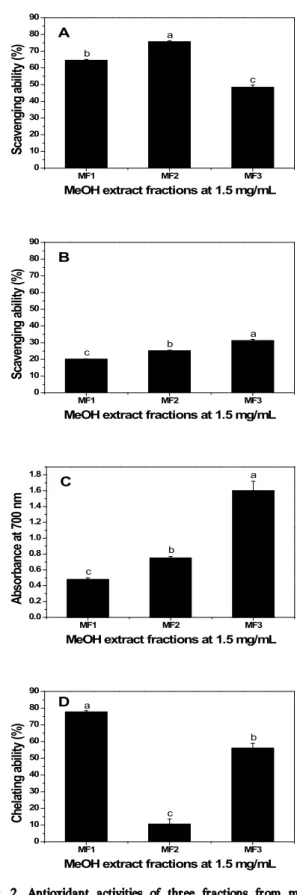
항산화 활성이 가장 우수한 methanol 추출물을 이동상은 85% methanol, 유속은 0.5 mL/min으로 하여 Sephadex LH-20 column (2.5×76 cm)으로 분획한 chromatogram은 Fig. 1과 같고, 이들의 항산화 활성을 측정한 결과는 Fig.
2와 같다. Methanol 추출물을 MF 1, MF 2 및 MF 3의 3개의 분획물로 분리하였으며, 수율은 각각 12.4%, 69.1% 및 1.3%
이었다. 동일한 농도(1.5 mg/mL)에서 항산화 활성은 DPPH radical scavenging ability는 MF 2에서 75.6%, ABTS radical scavenging ability와 reducing power는 MF 3에서 31.2%와 1.6, chelating ability는 MF 1에서 77.7%로 가장 높게 나타나 각각의 항산화 활성에 영향을 주는 분획이 다른 것으로 나타났다. 특히, MF 3의 reducing power와 MF 1의 chelating
60
Fig. 1. Sephadex LH-20 chromatogram of canola meal methanol extracts.
Sephadex LH-20 column (2.5×76 cm) eluted with 85% methanol at flow rate of 0.5 mL/min.
MF1 MF2 MF3
0 10 20 30 40 50 60 70 80 90
Scavenging ability (%)
MeOH extract fractions at 1.5 mg/mL A
c a
b
MF1 MF2 MF3
0 10 20 30 40 50 60 70 80 90
Scavenging ability (%)
MeOH extract fractions at 1.5 mg/mL B
a c b
MF1 MF2 MF3
0.0 0.2 0.4 0.6 0.8 1.0 1.2 1.4 1.6 1.8
b c
Absorbance at 700 nm
MeOH extract fractions at 1.5 mg/mL
C a
MF1 MF2 MF3
0 10 20 30 40 50 60 70 80 90
c
b
Chelating ability (%)
MeOH extract fractions at 1.5 mg/mL D a
Fig. 2. Antioxidant activities of three fractions from methanol extract.
A: DPPH radical assay, B: ABTS radical assay, C: Reducing power, D: Chelating ability. The vertical bars represent mean±SD (n=3) and letters marked by the same letter in the same figure are not significantly different (p<0.05) by Duncan's multiple test.
ability는 methanol 추출물과 비교하여 항산화 활성이 크게 증가하였다.
Amarowicz 등(19)은 80% methanol로 얻은 rapeseed 추출 물을 Sephadex LH-20 column을 이용하여 얻은 3개의 분획 물의 total phenolics 함량과 DPPH radical assay에 의한 항산 화 활성은 일치하였으나 reducing power에 의한 항산화 활 성은 total phenolics의 함량과 일치하지 않는다고 하였다.
또한 Amarowicz 등(20)도 canola hull의 acetone 추출물에서 얻은 5개의 분획물의 total phenolics의 함량과 DPPH radical assay에 의한 항산화 활성이 일치하지 않는다고 하였다.
Wanasundara 등(21)도 항산화 활성에 영향을 미치는 것은 total phenolics 함량이외에도 이들의 분자구조도 중요한 역 할을 한다고 강조하였다. 이와 같이 분획물의 다양한 항산 화 활성은 canola에 존재하는 다양한 항산화 물질들(tanic acid, sinapic acid, caffeic acid, ferulic acid, ρ-coumaric acid 등) 때문이며, 같은 phenolic acid라 할지라도 결합된 구조와 종류에 따라 각각의 항산화 활성에 미치는 영향이 다르기 때문인 것으로 추정된다.
요 약
본 연구에서는 용매별(methanol, ethanol, acetone 및 water)로 추출한 canola meal의 항산화 활성을 조사하였다.
모든 canola meal 용매 추출물들은 첨가 농도가 증가할수록 항산화 활성이 점진적으로 증가하였다. 추출물 중에서 methanol 추출물이 가장 낮은 EC50 (DPPH radical scavenging ability; 0.9 mg/mL, ABTS radical scavenging ability; 3.5 mg/mL, reducing power; 1.3 mg/mL and chelating ability; 8.5 mg/mL)과 가장 많은 항산화 물질 (total phenolics; 63.3 μg/mg, total flavonoids; 21.3 μg/mg)을 함유 하는 것으로 나타났다. 보다 정확한 canola meal의 항산화 활성을 조사하기 위하여 항산화 활성이 높은 methanol 추출 물을 sephadex LH-20 column을 이용하여 순차적으로 MF 1, MF 2 및 MF 3의 3개의 분획물을 얻었으며, 동일한 농도 (1.5 mg/mL)에서 측정한 항산화 활성에서 DPPH radical scavenging ability는 MF 2(75.56%)에서, ABTS radical scavenging ability와 reducing power는 MF 3(31.17% and 1.60)에서, chelating ability는 MF 1(77.72%)에서 가장 높게 나타났다.
감사의 글
이 논문은 2006년도 전북대학교 해외연구년제 연구비에 의하여 연구되었음.
참고문헌
1. Cevallos-Casals BA, Cisneros-Zevallos LCZ (2010) Impact of germination on phenolic content and antioxidant activity of 13 edible seed species. Food Chem, 119, 1485-1490
2. Siddhuraju P (2007) Antioxidant activity of polyphenolic compounds extracted from defatted raw and dry heated Tamarindus indica seed coat. Lebensmittel Wissenscaft und Technologie, 40, 982-990
3. Siddhuraju P, Manian S (2007) The antioxidant activity and free radical-scavenging capacity of dietary phenolic extracts from horse gram (Macrotyloma uniflorum(Lam.) Verdc.) seeds. Food Chem, 105, 950-958
4. Chung TY (1989) Nutritive values of canola meal and full-fat canola seed. Kor J Anim Feed, 13, 271-284 5. Roh KH, Park JS (2007) Biodiesel; oil-crops and
biotechnology. J Korean Soc Appl Biol Chem, 50, 137-146
6. Khattab RY, Arntfield SD (2009) Functional properties of raw and processed canola meal. Lebensmittel Wissenscaft und Technologie, 42, 1119-1124
7. Naczk M, Amarowicz R, Sullivan A, Shahidi F (1998) Current research developments on polyphenolics of rapeseed/canola: a review. Food Chem, 62, 489-502 8. Thiyam U, Kuhlmann A, StÖckmann H, Schwarz K
(2004) Prospects of fapeseed oil by-products with respect to antioxidative potential. C R Chimie, 7, 611-616 9. Shahidi F, Wanasundara U (1995) Effect of natural
antioxidant on the stability of canol oil. Developments in Food Sci, 37, 469-479
10. Brettonnet A, Hewavitarana A, Dejong S, Lanari MC (2010) Phenolic acids composition and antioxidant activity of canola extracts in cooked beef, chicken and pork. Food Chem, 927-933
11. Dewanto V, Wu X, Adonm KK, Liu, RH (2002) Thermal processing enhances the nutritional value of tomatoes by increasing total antioxidant activity. J Agric Food Chem, 50, 3010-3014
12. Jia Z, Tang M, Wu J (1999) The determination of flavonoid contents in mulberry and they scavenging effects on superoxide radicals. Food Chem, 64, 555-559 13. Williams WB, Cuvelier ME, Berset, C (1995) Use of a free radical method to evaluate antioxidant activity.
Lebensmittel Wissenscaft und Technologie, 28, 25-30 14. Arts MJTJ, Haenen GRMM, Voss HP, Bast A (2004) Antioxidant capacity of reaction products limits the
applicability of the trolox equivalent antioxidant capacity (TEAC) assay. Food Chem Toxicol, 42, 45-49 15. Oyaizu M (1986) Studies on products of browning
reaction-antioxidant activities of products of browning reaction prepared from glucoamin. Japanese J Nutr, 44, 307-315
16. Decker EA, Welch B (1990) Role of ferritin as a lipid oxidation catalyst in muscle food. J Agric Food Chem, 38, 674-677
17. Naczk M, Pegg RB, Zadernowski R, Shahidi F (2005) Radical scavenging activity of canola hull phenolics. J Am Oil Chem Soc, 82, 255-260
18. Hass-Roudsari M, Chang PR, Pegg RB, Tyler RT (2009) Antioxidant capacity of bioactives extracted from canola meal by subcritical water, ethanolic and hot water extraction. Food Chem, 114, 717-726
19. Amarowicz R, RAAB B, Shahidi F (2003) Antioxidant activity of phenolic fractions of rapeseed. J Food Lipids, 10, 51-62
20. Amarowicz R, Naczk M, Shahidi F (2000) Antioxidant activity of various fractions of non-tannin phenolics of cannola hulls. J Agric Food Chem, 48, 2755-2759 21. Wanasundara UN, Amarowicz R. Shahidi F (1996)
Partial characterization of natural antioxidants in canola meal. Food Res International, 28, 525-530
(접수 2010년 9월 16일, 수정 2011년 1월 6일 채택 2011년 1월 7일)