163
This is an Open-Access article distributed under the terms of the Creative Commons Attribution Non-Commercial License (http://creativecommons.org/licenses/by-nc/3.0) which permits unrestricted non-commercial use, distribution, and reproduction in any medium, provided the original work is properly cited.
J. Mushrooms 2014 June, 12(3):163-170 http://dx.doi.org/10.14480/JM.2014.12.3.163 Print ISSN 1738-0294, Online ISSN 2288-8853
© The Korean Society of Mushroom Science
*Corresponding author E-mail : [email protected]
Tel : +82-42-821-6733,Fax : +82-42-823-9241 Received September 4, 2014
Revised September 26, 2014 Accepted September 29, 2014
Effect of button mushroom compost on mobilization of heavy metals by sunflower
Ki-Cheon Kyeong
1, Yong-Gyun Kim
1, Chan-Jung Lee
2, Byung-Eui Lee
3, Heon-Hak Lee and Min-Ho Yoon*
Department of Bio-Environmental Chemistry, College of Agriculture and Life Sciences, Chungnam National University, Daejeon, 305- 764, Korea
1
Crop Research Division, Chungcheongnam-do Agricultural Research & Extension Services, Yesan 340-861, Korea
2
Mushroom Research Division, National Institute of Horticultural & Herbal Science, RDA, Eumseong 369-873, Korea
3
Department of Chemistry, College of Natural Sciences, Soonchunghyang University, Asan 336-745, Korea
ABSTRACT: The potential ability of Button mushroom compost (BMC) to solubilize heavy metals was estimated with metal contaminated soils collected from abandoned mines of Boryeong area in South Korea. The bacterial strains in BMC were isolated for investigating the mobilization of metals in soil or plant by the strains and identified according to 16S rRNA gene sequence analysis. When metal solubilization potential of BMC was assessed in a batch experiment, the BMC was found to be capable of solubilizing metals in the presence of metals (Co, Pb and Zn) and the results showed that inoculation of BMC could increase the concentrations of water soluble Co, Pb and Cd by 35, 25 and 45% respectively, than those of non-inoculated soils. BMC-assisted growth promotion and metal uptake in sunflower (Helianthus annuus) was also evaluated in a pot experiment. In comparison with non-inoculated seedlings, the inoculation led to increase the growth of H. annuus by 27, 25 and 28% respectively in Co, Pb and Zn contaminated soils. Moreover, enhanced accumulation of Co, Pb and Zn in the shoot and root systems was observed in inoculated plants, where metal translocation from root to the above-ground tissues was also found to be enhanced by the BMC.
The apparent results suggested that the BMC could effectively be employed in enhancing phytoextraction of Co, Pb and Zn from contaminated soils.
KEYWORDS: Mobilization, Button mushroom compost, Bioaugmentation, Sunflower
Introduction
Metal contamination of soils has become one of the most significant environmental problems today.
Excessive metal uptake by crop plants from the contaminated agricultural lands can result in decreased crop yield due to the inhibition of plant metabolic processes (Singh and Aggarwal, 2006). Apart from the metals with unknown biological functions (Cd, Cr, Pb,
Co, Ag, Se, and Hg), essential elements (Fe, Mn, Zn, Cu, Mg, Mo, and Ni) also keep accumulating in agricultural soils by means of wastewater irrigation, animal manures and sewage sludge application, use of fertilizer and agrochemicals (Thomas et al., 2012 ).
The remediation of metal contaminated soils receives
increasing attention (Cao et al, 2007) due to the fact
that metals are not easily degraded. Depending on the
resource availability and nature of metal contaminated
soil, different methods such as bioremediation and
physical/chemical remediation have been employed in
restoring the contaminated lands (Arunakumara et al,
2013; Luo, 2009). However, the physical and chemical
methods such as physical separation, acid leaching or
electrochemical processes, are considered to be ineffective
because of high cost, low efficiency, and destruction of
soil structure and fertility (Jing et al., 2007). In contrast,
phytoremediation, a method which uses plants to extract,
sequester and detoxify pollutants has received considerable
attention (Arunakumara, 2011). However, the wider
application of the technology has been restricted due to
the limitations such as low soil thickness that can be treated, low translocation rate of metals from roots to shoots, and the slowness of the treatment (Lebeau et al., 2008).
The amount of heavy metals uptake in plants varies with the mobility and the concentration of metals in soil (Chen et al., 2010) and the interface between soil microbes and plant roots (rhizosphere) is displayed to have a great influence on the uptake of nutrients as well as on the decrease of metal toxicity (McNear, 2013).
Since soil microbes could alter the metal status of the soil (Fazal and Bano, 2010), exploitation of such microbes to reduce the metal toxicity in plants is worth investigating (Rajkumar et al., 2008). It was known that some metal resistant bacterial strains were proved exceptional at enhancing the growth of the host plant through different mechanisms such as the production of plant growth promoting substances, nitrogen fixation and phosphate solubilization (Hemambika et al., 2013). As reported by Rajkumar et al. (2008), heavy metal tolerance of the microbes may be attributed to one or several mechanisms including exclusion, active removal, biosorption, and precipitation or bioaccumulation of metals both in external and intracellular spaces. Therefore, microbes having remarkable metal tolerance and plant growth- promoting abilities could play a significant role in remediation of metal-contaminated soils, because bioaugmentation with such microbes could promote phytoextraction of metals (Prapagdee et al., 2013).
In the present study, button mushroom(Agaricus bisporus) compost with bacterial strains was employed in assessing the potential of mobilization of Co, Pb and Zn in soils and it was estimated that the effect of inoculation with BMC on plant growth and uptake of Co, Pb and Zn by Helianthus annuus (sunflower).
Materials and Methods
Preparation of Button mushroon compost
The waste mushroom compost from Agaricus bisporus (button mushroom) collected in Buyeo area, South Korea was used for preparation of button mushroon compost (BMC). The waste mushroom bed was composted with pig and fowl manure as nitrogen sources and sawdust as carbon source, respectively. The BMC was prepared by mixing to the ratio of waste mushroom bed (4) : sawdust (8) : pig and fowl manure (1) and fermenting the mixture for 40 days at 30
oC.
Isolation of microorganisms from BMC
Heavy metal contaminated soils were collected from the sediment tailing in abandoned mines of Boryeong area, South Korea. Aliquots of serially diluted soil samples were spread on Tryptic soy broth (TSB, 30 g L
-1) agar media which was adjusted to pH 6.5 ±0.1. The colonies on agar plate were purely isolated by repeated sub culturing at 30
0C for 5 days. The preculture of each colony was inoculated in 50mL TSB containing 0.2g - 0.4 g L
-1of CoCl
2·6H
2O, 2PbCO
3·Pb(OH)
2, and Cd(NO)
3and cultured at 30
oC for 7 days on a horizontal shaker at 150 rpm. The heavy metals resistance cells were selected and used for estimating the solubilization ability of heavy metals.
Strain identification
The partial sequencing of 16S rRNA for the bacterial strain was done with the help of DNA sequencing service, SOLGENT, Daejeon, South Korea using universal primers, 27F (5’-AGAGTTTGATCCTGGCTCAG-3’) and 1492R (5’-GGTTACCTTGTTACGACTT-3’). The online program BLAST was used in identifying the related sequences with known taxonomic information available at the databank of NCBI (http://www.ncbi.nlm.nih.gov/BLAST).
A Phylogenetic tree was constructed using CLUSTAL X program (Thompson et al., 1997), which involved sequence alignment by neighbor joining method (Saitou and Nei, 1987) and maximum parsimony using the MEGA4 program (Kumar et al., 2001). Grouping of sequences was based on confidence values obtained by bootstrap analysis of 1,000 replicates. Gaps were edited in the BioEdit program and evolutionary distances were calculated using Kimura two parameter model. Reference sequences were retrieved from GenBank under the accession numbers indicated in the trees.
Mobility of the metals in soil
The impact of BMC inoculation on the mobility of
metals in soil was investigated under laboratory
conditions with 50 mL scaled polypropylene centrifuge
tubes. Artificially contaminated soil (5 g) in the centrifuge
tubes was inoculated with 10 ml TSB supplemented with
5 g BMC. After taking the weight of the tubes, they
were wrapped with brown paper and placed on an
orbital shaker at 200 rpm at 25
oC. At the end of the
period of 10 d, the weight of the tubes was recorded
and 10 ml of sterile water were added to each tube to
extract the soil water soluble heavy metals. The extracts
were centrifuged at 10000 ×g for 10 min and filtered through a 0.45 µm nylon syringe filter (Watman, England) and acidified with HNO
3to minimize an interference by organic matters. The metal contents (Co, Pb, and Zn) in the filtrate were determined using an ICP (Perkinelmer, Aanalyst 800, USA). Artificially contaminated soil without inoculation with the strain served as the control after centrifugation.
Effect of bioagumentation on growth and metal uptake by H. annuus
A pot experiment was conducted under green house conditions at the College of Agriculture, Chungnam National University in April 2014. Several locations of soils collected from abandoned mines of Boryeong-gun as contaminated soil and a button mushroom compost in Buyeo-gun area, Chungchungnam-do, South Korea, were respectively mixed with the ratio of 1:1, air dried and sieved (2 mm). Sterilized forest soil (by steaming at 100
oC for three consecutive days) was amended with aqueous solutions of different heavy metals (Co, Pb and Cd) to achieve the final concentrations of 200 mg/kg soil. They were then kept for 2 weeks in a greenhouse for metal stabilization and used in filling the plastic pots (25 cm diameter, 35 cm height). Seeds of Helianthus annuus were surface sterilized by immersing in alcohol (70%) for 40 s, NaClO (1.0%) for 15 min followed by rinsing several times with sterile distilled water. Seeds sown in germination trays containing sterilized non- contaminated soil were provided with 14/10 light/dark regime and kept at 25
oC for germination. Three weeks old seedlings were carefully uprooted from the germination bed and were transplanted into the plastic pots (five plants/pot) containing 300 g of metal contaminated or non-contaminated soil and allowed to grow at 25
oC and 14/10 light/dark regime. The average pH of soil at the time of planting was recorded as 6.8. Three weeks later,
the plants were carefully uprooted and cleaned the root surface thoroughly with distilled water. As growth parameters, fresh and dry biomass was measured and accumulation of metals in plant biomass was quantified as described by Freitas et al. (2004). Each treatment had three replicates.
Results
Microbial diversity of BMC
The number of microorganisms in BMC were higher in the fowl manure than those in the pig manure as nitrogen source. BMC compromised diverse microorganisms ranging of aerobic bacteria 3.8×10
7cfu g
-1, Gram negative bacteria 1.8×10
7cfu g
-1, genus Bacillus 3.0×10
6cfu g
-1, genus Pseudomonas 2.1×10
4cfu g
-1, actinomycetes 7.2 ×10
5cfu g
-1, and fungi 3.2 ×10
4cfu g
-1(Table 1). Besides actinomycetes and fungi, the microbial population in the process of composting was increased to the level of 1×10
1~1×10
2cfu g
-1after fermentation, compared with those of before fermentation.
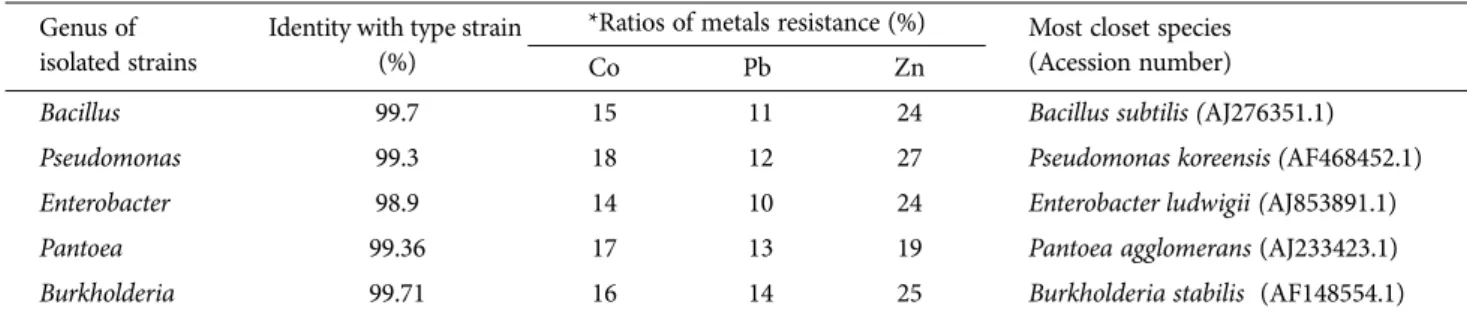
Isolation and identification of microorganisms The major group of bacterial strains from BMC were isolated and the strains with the potential ability to alleviate heavy metals were screened based on estimating the metal concerntration alleviated by each bacterium in medium supplemented with 3 different heavy metals (Co, Pb, Zn). The selected strains were identified by systematic analysis using phylogenetic tree according to 16S rRNA sequence analysis. The main bacteria were identified with the close promixsity to each type strains as Genus Bacillus, Pseudomonas, Pantoea, Burkholderia and Enterobacter (Table 2). In addition, to estimate the metal resistance potential of the bacterial strains isolated from BMC, the amount of metals remaining in Tryptic soy broth medium was Table 1. Change of microbial population in the compost prepared with spent mushroom from Agaricus bisporus. (cfu/g)
Treatments Aerobic
bacteria
Gram negative
Bacillus species
Fluorescence bacteria
Actiono-
mycetes Fungi
PiM+SD Before 1.3 × 10
77.6 × 10
71.2 × 10
64.8 × 10
38.0 × 10
31.6 × 10
5After 1.1 × 10
69.7 × 10
65.2 × 10
63.5 × 10
41.3 × 10
46.0 × 10
3ChM+SD Before 2.6 × 10
71.3 × 10
73.1 × 10
62.1 × 10
41.5 × 10
48.6 × 10
5After 7.5 × 10
72.7 × 10
77.0 × 10
63.5 × 10
49.6 × 10
36.0 × 10
3The compost was prepared by mixing to the ratio of waste mushroom bed (4) : sawdust (8) : pig or fowl manure (1).
PiM: Pig manure, Ch: Fowl manure, SD: Sawdust, M: Spent mushroom from Agaricus bisporus
estimated 5 days after the inoculation with each strain.
As was represented in Table 2, they showed the resistance of the range from 10% to 27% for heavy metals Co, Pb, and Zn, respectively. This result demonstrated that BMC with diverse microorganisms could be useful as microbial inoculant for bioremediation of metal contaminated soils.
Mobility of the metals in soil
To investigate the impact of BMC inoculation on the mobility of metals in soil, metal mobilization potential of BMC with the strains was assessed in a batch experiment with artificially contaminated soil. When alleviation effect of heavy metals was estimated by measuring the amount of metals remaining in the soil, BMC was shown to be capable of reducing the amount of metal in the order of Zn, Co and Zn. As was given
in Fig. 1, the inoculation of BMC could increase the contents of water soluble metals from the soil extract, representing that heavy metals could be solubilized by BMC inoculation. The mobilization of Co, Pb and Zn was respectively 35, 25 and 45% higher than those of the control soil.
Effect of bacterial strain on growth and metal uptake by H. annuus
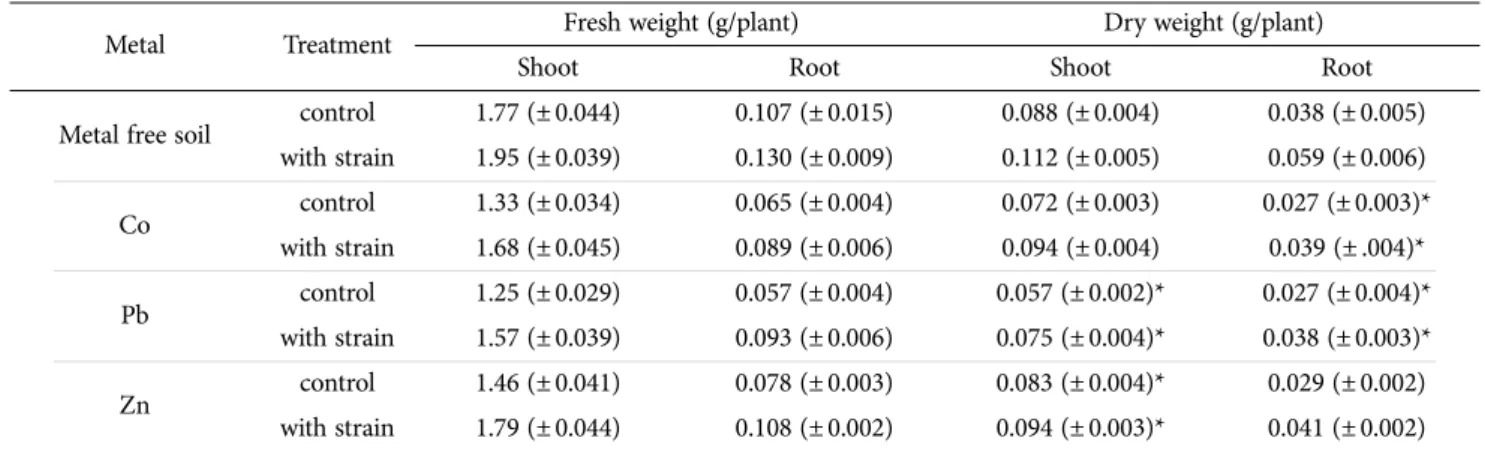
As showh in Table 1, inoculation with BMC into sunflower (Helianthus annuus) pots resulted in increased fresh and dry biomass of H. annuus plants compared to non-inoculated plants. In case of the non-inoculated plants exposed by heavy metal stress, the growth of plant was inhibited in a significant level with p < 0.05.
For instance, Pb toxicity caused 30 and 24% reductions in fresh and dry weight of the plant, respectively.
Inoculation however led to increase in plant fresh and dry weight in the presence of heavy metals. The fresh and dry weight of the plants grown in Co contaminated soils were respectively 26 and 31% higher than those of non-inoculated plants. Similarly, in Pb contaminated soil, the percent increments were recorded as 29 and 23%
respectively, and in Zn contaminated soil, the corresponding figures were 29 and 27%.
The amounts of Co, Pb and Zn accumulated in the roots and shoots of H. annuus grown under inoculated and non-inoculated conditions are given in Table 2.
Inoculation with BMC resulted in increased accumulation of metals both in the shoots and roots. The accumulations of Co, Pb and Zn in shoots were respectively 22, 16 and 25% higher than those of non- inoculated plants. The corresponding accumulations for Co, Pb and Zn in roots were 36, 42 and 15% higher than those of non-inoculated plants. Regardless of inoculation or non-inoculation, the accumulation of Table 2. Identification of metals resistance bacteria isolated from button mushroom compost
Genus of isolated strains
Identity with type strain (%)
*Ratios of metals resistance (%) Most closet species (Acession number)
Co Pb Zn
Bacillus 99.7 15 11 24 Bacillus subtilis (AJ276351.1)
Pseudomonas 99.3 18 12 27 Pseudomonas koreensis (AF468452.1)
Enterobacter 98.9 14 10 24 Enterobacter ludwigii (AJ853891.1)
Pantoea 99.36 17 13 19 Pantoea agglomerans (AJ233423.1)
Burkholderia 99.71 16 14 25 Burkholderia stabilis (AF148554.1)
*The amount of heavy metals alleviated by the strains in TSB medium supplemented with metals (Co, Pb and Zn) at the concentration of 200 mg L
-1. Values are the means of three replicates.
Fig. 1. Effect on mobilization of Co, Pb and Zn in soil by
inoculation with button mushroom compost. Soil without
inoculation of BMC served as the control. Values are the
means of three replicates. Error bars represent standard
deviation.
metals in root system was found to be considerably higher than that of in shoots, which has been further confirmed by the low translocation factor (TF) for all the metals. However, TF of Co was somewhat higher than that of the other two metals. Reversely low bioconcentration factor (BCF) was also recorded from Co and Pb, compared to Zn. However, the results showed a good agreement and demonstrated that inoculation of the bacterial strain led to increase both TF and BCF of the three metals distinctly.
Discussion
Generally microorganisms isolated from heavy metals contaminated soils possess the ability to withstand against multiple pollutants as they have adapted to such environments (Pal et al., 2005; Abou-Shanab et al., 2007). Remedation of heavy metal contaminated soil have been employed with both microorganism and
phytoextraction. The effectiveness of the strain for phytoextraction was assessed with Helianthus annuus (sunflower), was known to have an ability to accmulate biomass rapidly and take up substantial amounts of metals (Turgut et al., 2004; Prapagdee et al., 2013). As reported by Ouzounidou and Ilias (2005) and El-Tayeb et al. (2006), accumulation of plant biomass could be affected by excessive concentrations of heavy metals, which exert adverse impacts on growth and function of root system resulting in poor uptake of water and nutrients. As reported by Jiang et al. (2008), inoculation with Burkholderia sp. J62 led to increase shoot and root dry weights of corn and tomato plants. Inoculation with Pseudomonas fluorescens PsIA12 resulted in enhanced growth of Zea mays and its uptake of N, P and K (Egamberdiyeva et al., 2002). Most recently, Prapagdee et al. (2013) reported that growth of H. annuus could be enhanced by the inoculation of Micrococcus sp. MU1 and Klebsiella sp. BAM1 under Cd contaminated Table 3. Effect of inoculation with button mushroom compost on shoot and root weight of Helianthus annuus
Metal Treatment Fresh weight (g/plant) Dry weight (g/plant)
Shoot Root Shoot Root
Metal free soil control 1.77 (± 0.044) 0.107 (± 0.015) 0.088 (± 0.004) 0.038 (± 0.005) with strain 1.95 (± 0.039) 0.130 (± 0.009) 0.112 (± 0.005) 0.059 (± 0.006)
Co control 1.33 (± 0.034) 0.065 (± 0.004) 0.072 (± 0.003) 0.027 (± 0.003)*
with strain 1.68 (± 0.045) 0.089 (± 0.006) 0.094 (± 0.004) 0.039 (± .004)*
Pb control 1.25 (± 0.029) 0.057 (± 0.004) 0.057 (± 0.002)* 0.027 (± 0.004)*
with strain 1.57 (± 0.039) 0.093 (± 0.006) 0.075 (± 0.004)* 0.038 (± 0.003)*
Zn control 1.46 (± 0.041) 0.078 (± 0.003) 0.083 (± 0.004)* 0.029 (± 0.002) with strain 1.79 (± 0.044) 0.108 (± 0.002) 0.094 (± 0.003)* 0.041 (± 0.002) Values are means (n=3) ± standard deviation. Within each column, the means indexed by
*are not significantly different at p > 0.05 between inoculated and non-inoculated plants according to Duncan’s multiple range test.
Table 4. Effect of inoculation with button mushroom compost on accumulation and translocation of Co, Pb and Zn in Helianthus annuus
Metal Treatment Metal content (mg/kg dry weight) Bioconcentration Translocation
Shoot Root Factor (BCF)
aFactor (TF)
bCo control 19.93 (± 3.58) 53.82 (± 4.92) 0.269 0.370
with strain 25.46 (± 4.12) 84.56 (± 5.38) 0.423 0.301
Pb control 13.76 (± 0.69)* 44.68 (± 7.47) 0.223 0.308
with strain 16.42 (± 0.83)* 77.49 (± 6.53) 0.387 0.212
Zn control 21.84 (± 5.12) 88.47 (± 5.47)* 0.442 0.247
with strain 29.35 (± 8.41) 104.53 (± 6.27)* 0.522 0.281
a