Investigation of Ball Size Effect on Microstructure and Thermoelectric Properties of p-type BiSbTe by Mechanical Alloying
May Likha Lwin, Sang-min Yoon, Babu Madavali, Chul-Hee Lee, and Soon-Jik Hong *
Division of Advanced Materials Engineering, Kongju National University, 275, Budae-Dong, Cheonan City, Chungcheongnam-do 32588, Korea
(Received March 28, 2016; Revised April 18, 2016; Accepted April 20, 2016)
···
Abstract P-type ternary Bi
0.5Sb
1.5Te
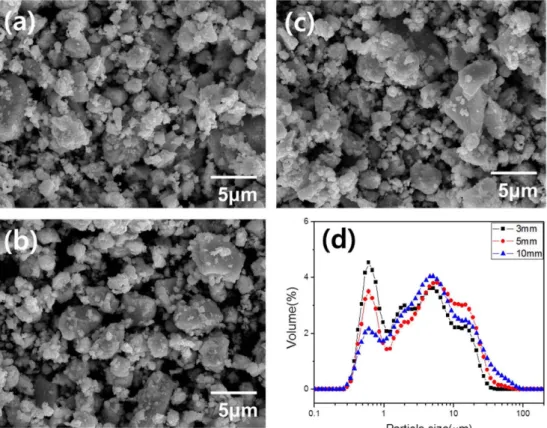
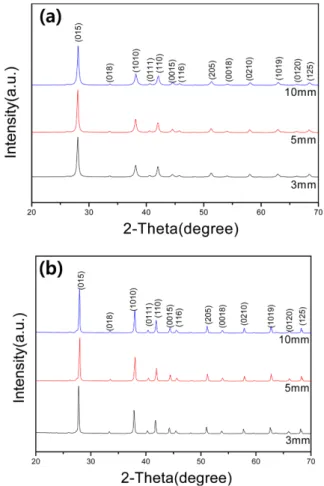
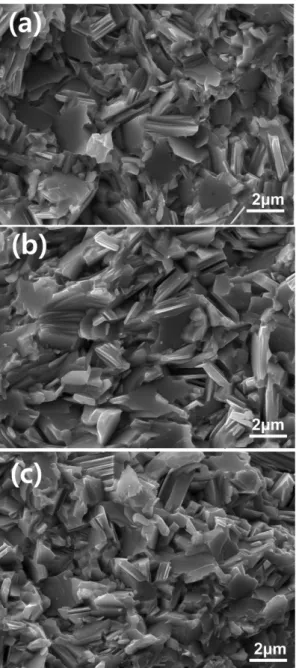
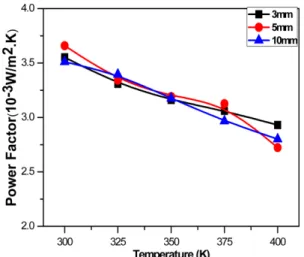
3alloys are fabricated via mechanical alloying (MA) and spark plasma sintering (SPS). Different ball sizes are used in the MA process, and their effect on the microstructure; hardness, and thermo- electric properties of the p-type BiSbTe alloys are investigated. The phases of milled powders and bulks are identified using an X-ray diffraction technique. The morphology of milled powders and fracture surface of compacted samples are examined using scanning electron microscopy. The morphology, phase, and grain structures of the samples are not altered by the use of different ball sizes in the MA process. Measurements of the thermoelectric (TE) transport prop- erties including the electrical conductivity, Seebeck coefficient, and power factor are measured at temperatures of 300- 400 K for samples treated by SPS. The TE properties do not depend on the ball size used in the MA process.
Keywords: Bi
0.5Sb
1.5Te
3alloys, Mechanical alloying, Spark plasma sintering, Thermoelectric properties
···
1. Introduction
Thermoelectric materials are solid-state devices that are used for refrigeration and power generation based on the thermoelectric effects. The performance of the thermo- electric materials is defined by the dimensionless figure of merit, ZT:
ZT = (α
2σ/κ) T (1)
Where α, σ, κ and T are the Seebeck coefficient, elec- trical conductivity, thermal conductivity and the absolute temperature [1-3]. High-efficiency thermoelectric materi- als should have large Seebeck coefficient, high electrical conductivity, and low thermal conductivity. However, there is no existence of such ascribed characteristics of the material in nature, so it is a central issue in thermo- electric research to increase ZT with balancing all TE properties each other [4].
Bismuth antimony telluride (BiSbTe) alloys have been used in thermoelectric modules that show excellent TE properties at ambient room temperature [5, 6], and much work has been done to enhance their ZT values. Rama et
al. reports a ZT >2.4 by creation of quantum dot superlat- tice of BiSbTe with low lattice thermal conductivity [7].
Though these materials exhibited the improved TE prop- erties, it is highly impossible for large-scale energy con- version applications due to limitations in both heat transfer and cost. Later, Ren and Chen et al. fabricated nanostruc- tured BiSbTe bulks and reported a peak ZT of 1.4 at 100ºC by mechanical alloying and hot pressing. Also, hot extrusion [8], and spark plasma sintering [9] are used to fabricate BiSbTe based alloys with improved perfor- mance. The substantial improvement of ZT in BiSbTe is attributed to the dramatic reduction in thermal conductiv- ity caused by severe phonon scattering by the numerous interfaces in nanostructured bulk samples [10, 11].
Mechanical alloying (MA) is an eminent process to fabri- cate nanopowder from the commercial ingots or elemen- tal chunks. MA allows the formation of extremely fine solid solutions of required alloys from the starting materi- als through a sequence of collision events inside ball mill [12]. In another hand, SPS is a low temperature sintering technique in which the grain growth can be prevented due to short sintering time than the conventional meth-
*Corresponding Author: Soon-Jik Hong, TEL: +82-41-521-9387, FAX: +82-41-568-5776, E-mail: [email protected]
<PM리뷰>