© Korean Powder Metallurgy Institute 1045
-1. Introduction
In the last decade, Mg alloys have been used in automotive and aerospace industries where weight reduction is an important requirement. Rapid solidification (RS) processing is suitable for the development of high strength Mg alloys, because the process realizes grain-refinement, increase in homogeneity, and so on. Recently, several nanocrystalline Mg-Zn-Y alloys with high specific tensile strength and large elongation have been developed by rapidly solidified powder metallurgy (RS P/M) processing [1]. The Mg-Zn-Y RS P/M alloys are characterized by long period ordered (LPO) structure and sub-micron fine grains. We have investigated the mechanical properties of ternary Mg97Zn1RE2 (RE=Y, La, Ce, Pr, Nd, Sm, Eu and Yb) melt-spun ribbons annealed at 573 K, in order to develop new alloy compositions for Mg-Zn-RE RS P/M alloys. The Mg97Zn1Y2 and Mg97Zn1Yb2 RS ribbons exhibited combination of high hardness and good ductility, and composed of LPO phase and fine Mg-Yb compound precipitations, respectively [2]. In this study, we have tried to develop high-strength RS P/M alloys for consolidation of Mg-Zn-Y-Yb system RS ribbons.
2. Experimental Procedure
An alloy composition for the synthesis of consolidated bulk alloy was selected based on the preliminary investigations where both the hardness and ductility of many Mg-Zn-Y-Yb melt spun ribbons were measured. These RS ribbons were prepared by a single-roller melt spinning method and thereafter these ribbons were annealed in a vacuum at 573 and 673 K for 1.2 ks. The annealing temperatures correspond to consolidation temperatures of RS
magnesium alloys [3]. The Mg-Zn-Y-Yb bulk alloy was produced by consolidation of RS ribbons. The RS ribbons were first cold pressed in a copper can with an inner diameter 20 mm and then degassed at 523 K for 900 s down to 10-2 Pa. In order to consolidate RS ribbons, hot extrusion was performed at an extrusion ratio 10 and at 623 K. Structure of RS ribbons, their annealed ribbons and their extruded bulk alloys were investigated by XRD and TEM. Mechanical properties of the extruded bulk alloys were measured with an Instron-type tensile testing machine.
3. Results and Discussion
Figure 1 shows the compositional dependence of Vickers hardness and bending ductility for the Mg99-xZn1(Y, Yb)x RS ribbons annealed at 673 K. The hardness increased with increasing Y and Yb contents. Overaddition of Yb (>1.0 at. %) brought about a decrease in ductility. Combinations of high hardness and good ductility were obtained in Mg95.75Zn1Y3Yb0.25, Mg95.5Zn1Y3Yb0.5 and Mg95.75Zn1Y2.5Yb0.75 alloys. On the basis of this result, we
selected a Mg95.75Zn1Y3Yb0.25 alloy for production of consolidated bulk alloys because this alloy exhibited the best-combined properties of hardness, ductility and lightweight. As a result of XRD, Mg95.75Zn1Y3Yb0.25 RS ribbons annealed at 673 K was consisted of α-Mg, Mg12ZnRE corresponding to LPO, and Mg5RE phases.
Figure 2 shows testing-temperature dependence of the tensile yield strength in the Mg95.75Zn1Y3Yb0.25 bulk alloy consolidated from RS ribbons. The tensile yield strength was 530 MPa at room temperature and 385 MPa at 473 K. The elevated-temperature strength of the bulk alloy was two times as high as that of the commercial WE 54-T6 alloys (200
2006 POWDER METALLURGY World Congress
PC02-W-13
Microstructure and Mechanical Properties of Mg-Zn-Y-Yb Alloys
Produced by Consolidation of Rapidly Solidified Ribbons
Yoshihito Sakamoto 1, a, Michiaki Yamasaki 2, b, and Yoshihito Kawamura 2, c 1
Graduate School of Science and Technology, Kumamoto University, Kumamoto 860-8555, Japan 2
Department of Materials Science and Engineering, Kumamoto University, Kumamoto 860-8555, Japan a
[email protected], b [email protected], c
[email protected] Abstract
Fabrication of Mg95.75Zn1Y3Yb0.25bulk alloy has been performed through the consolidation of rapidly solidified ribbons. The
Mg95.75Zn1Y3Yb0.25 bulk alloy exhibited excellent mechanical properties, high tensile yield strength of 530 MPa, and large
elongation of 3 %. Microstructure of the alloy was characterized by equiaxed fine grains that consist of -Mg, long period ordered (LPO) structure phase, and Mg5RE-type cubic compound. The strengthening of the alloys may be due to fine grains
with LPO structure phase and Mg5RE-type compound.
© Korean Powder Metallurgy Institute 1046 -MPa) at temperatures below 473 K.
As a result of XRD, Mg95.75Zn1Y3Yb0.25 bulk alloy consolidated from RS ribbons was consisted of α-Mg, LPO and Mg5RE phases.
←
M g (at %)←
Y (at % ) Zn(at%)→
97 95 96 98 99 1 0 4 0 3 2 2 1 3 4 Yb (at.%) Y (a t.%) Mg (a t.% )←
M g (at %)←
Y (at % ) Zn(at%)→
97 95 96 98 99 1 0 4 0 3 2 2 1 3 4 Yb (at.%) Y (a t.%) Mg (a t.% ) 97 95 96 98 99 1 0 4 0 3 2 2 1 3 4 Yb (at.%) Y (a t.%) Y (a t.%) Mg (a t.% ) Mg (a t.% ) 129 134 147 133 108 106 118 127 124 116 119 127 129 109 141 118 116 105 106 81 Yb (at.%) → ← Y (a t.% ) 0 1 2 3 4 0 1 2 3 4 ductile D/B brittle ← Mg (at. %) 99 98 97 96 95←
M g (at %)←
Y (at % ) Zn(at%)→
97 95 96 98 99 1 0 4 0 3 2 2 1 3 4 Yb (at.%) Y (a t.%) Mg (a t.% )←
M g (at %)←
Y (at % ) Zn(at%)→
97 95 96 98 99 1 0 4 0 3 2 2 1 3 4 Yb (at.%) Y (a t.%) Mg (a t.% ) 97 95 96 98 99 1 0 4 0 3 2 2 1 3 4 Yb (at.%) Y (a t.%) Y (a t.%) Mg (a t.% ) Mg (a t.% ) 129 134 147 133 108 106 118 127 124 116 119 127 129 109 141 118 116 105 106 81 Yb (at.%) → ← Y (a t.% ) 0 1 2 3 4 0 1 2 3 4 ductile D/B brittle ← Mg (at. %) 99 98 97 96 95Fig. 1. Compositional dependence of Vickers hardness and bending ductility in Mg99-xZn1(Y, Yb)x RS ribbons
annealed at 673 K for 1.2 ks. 0 100 200 300 400 500 600 300 350 400 450 500 550 T e ns ile Y ie ld S tr e ngt h , σ 0.2 /M Ps Testing Temperature, T/K Mg 95.75Zn1Y3Yb0.25 alloys Degassing 523 K (1.2 ks) Extrusion 623 K (R10) ε. = 5 x 10⁻⁴ s-1
Fig. 2. Testing-temperature dependence of the tensile yield strength in Mg95.75Zn1Y3Yb0.25 bulk alloys.
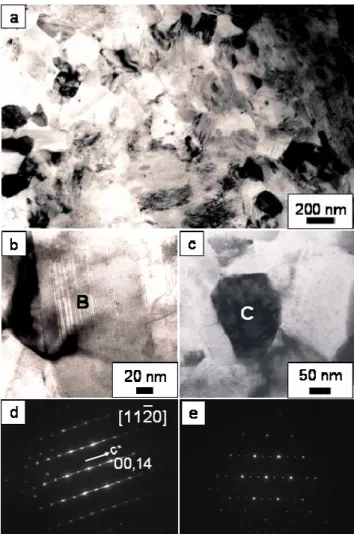
Figure 3 shows a blight-field TEM image of the extruded bulk alloy. The alloy consists of equiaxed grains about 200 nm in average diameter as shown in Figure 3 (a). Fine lamellar phase and compounds were observed (Figure 3 (b) and 3 (c)). The electron diffraction pattern obtained from the fine-lamellar grain is shown in Figure 3 (d). The electron
diffraction pattern shows that fine-lamellar phase is 14 H type LPO structure. Figure 3(e) shows electron diffraction pattern from the compound which was shown Figure 3(c). We don’t finish characterization of this big cubic structured compound. However, we consider this compound corresponds to Mg5RE phase. The high strength is due to the fine structure consisted of LPO and Mg5RE phases.
Fig. 3. (a) TEM micrograph of a Mg95.75Zn1Y3Yb0.25 bulk
alloy consolidated from RS ribbons, (b) fine lamellar grain and (c) Mg5RE-type compound. Electron diffraction
patterns taken from (d) fine-lamellar grain and (e) Mg5RE-type compound.
4. Summary
1) In the preliminary investigations, Mg95.75Zn1Y3Yb0.25 RS ribbon annealing at 673 K had the best combination of high hardness and good ductility.
2) Mg95.75Zn1Y3Yb0.25 alloy consolidated from RS ribbons exhibited high tensile yield strength (530 MPa) and good ductility (3 %). The alloy had fine grains about 200 nm that consisted of α-Mg, LPO and Mg5RE phases.
© Korean Powder Metallurgy Institute 1047
-5. Acknowledgement
This study is partially conducted as a part of the project, “Civil Aviation Fundamental Technology Program-Advanced Materials & Process Development for Next-Generation Aircraft Structures” under contract from RIMCOF, founded by the Ministry of Economy, Trade and Industry (METI) of Japan.
6. References
1. Y. Kawamura et al., :Mater. Trans., 42 (2002) 1172-1176. 2. Y. Kawamura et al., Mater. Sci. Forum, 419-422 (2003)
751-756.
3. F.H. Froes et al., ed., Processing of Structural Metals by Rapid Solidification, (Metals Park, Ohio, ASM International, 1987) 367-415.