• 검색 결과가 없습니다.

Change of Glycosaminoglycan Distribution and Collagen Fibers Arrangement on Temporomandibular Joint Following Anterior Disc Displacement of the Rabbits

N/A
N/A
Protected

Academic year: 2021

Share "Change of Glycosaminoglycan Distribution and Collagen Fibers Arrangement on Temporomandibular Joint Following Anterior Disc Displacement of the Rabbits"

Copied!
7
0
0

로드 중.... (전체 텍스트 보기)

전체 글

(1)

Original Article

RECEIVED April 13, 2012, REVISED April 30, 2012, ACCEPTED May 4, 2012 Correspondence to Uk-Kyu Kim

Department of Oral and Maxillofacial Surgery, Pusan National University Yangsan Hospital, Pusan National University School of Dentistry Beomeo-ri, Mulgeum-eup, Yangsan 626-770, Korea

Tel: 82-55-360-5112, Fax: 82-55-360-5104, E-mail: [email protected]

CC

This is an open access article distributed under the terms of the Creative Commons Attribution Non-Commercial License (http://creativecommons.org/licenses/

by-nc/3.0) which permits unrestricted non-commercial use, distribution, and reproduction in any medium, provided the original work is properly cited.

Change of Glycosaminoglycan Distribution and Collagen Fibers Arrangement on

Temporomandibular Joint Following Anterior Disc Displacement of the Rabbits

Uk-Kyu Kim, In-Kyo Chung, Kyu-Cheon Kim 1

Departments of Oral and Maxillofacial Surgery,

1

Oral Anatomy, Pusan National University School of Dentistry

Abstract

Purpose: This study was to determine the effects of surgical induction of anterior disc displacement (ADD) on the distribution of glycosaminoglycan (GAG) and collagen fiber arrangement in the rabbit temporomandibular joint (TMJ) tissues including articular cartilage of condyle, disc, retrodiscal tissue, and articular eminence.

Methods: We used van Gieson staining and Alcian blue critical electrolyte concentration (CEC) method to observe change of collagen fibers on disc and to measure GAG up to 10 weeks in TMJ tissues after surgical induction of ADD on 25 rabbits.

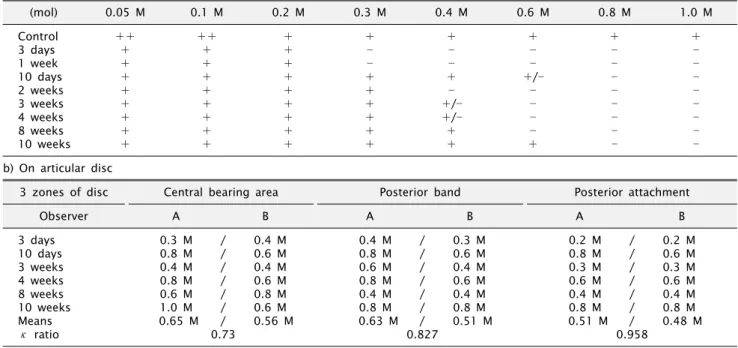
Results: CEC measurements for GAG showed 0.3 M, 0.4 M, 0.6 M, and 0.8 M at 1 week, 2 weeks, 3, 4, and 8 weeks, 10 weeks, respectively. This result indicated that GAGs shifted to highly sulphated ones as time passed. Disruption of collagen fiber arrangement in the disk occurred at 10 days and aggravated at 3 weeks.

Conclusion: Our study showed degenerative osteoarthritis changes in rabbit TMJ following surgical induction of ADD up to 10-week period.

Key words: Temporomandibular joint, Glycosaminoglycans, TMJ Disc displacement, Osteoarthritis

Introduction

Anterior disc displacement (ADD) is a major form of internal derangement (ID), which can be defined as an abnormal relationship of the disc to the articular condyle[1].

The etiology of ADD is multifaceted and unclear yet but the symptoms can be similar including clicking sound, pain, and limitations on mouth opening. One retrospective study suggested that ADD in young patient can lead to

osteoarthritis in older age[2]. Other study also showed high probability of degenerative bone changes present in 180 temporomandibular joint (TMJ) patients with disk displace- ment[3].

In earlier days, one of the treatment modality for ID

has been a reduction surgery to restore the normal relation

between the disc and condyle. Since the new development

of TMJ arthroscopy in 1990, people found that simple lav-

age at the joint cavity can lead to the relief of symptoms.

(2)

Clinicians reported that some groups of patients with ID do not suffer from the symptoms for their whole life and do not develop to osteoarthritis. Recent study demonstrated the disc mobility is important for improving clinical signs and symptoms even though ADD is not restored. The clini- cians treated their patients with splint, pumping method, arthrocentesis, arthroscope surgery[4].

There is still confusion on pathogenesis of ADD and selection of treatment modality to symptoms of ADD.

The recent immunohistochemical studies have been fo- cused on glycosaminoglycan (GAG) among extracellular matrix (ECM). The significant increase in keratin sulphate, highly sulphated GAG was reported in synovial fluid of osteoarthrosis patients[5].

In this study, the distribution of GAG and collagen fiber arrangement in the rabbit TMJ tissues including articular cartilage, disc, retrodiscal, and articular eminence tissue were studied up till 10 weeks period to elucidate TMJ change after the surgical induction of ADD.

Throughout observing the distribution change of various GAGs on TMJ tissue by critical electrolyte concentration (CEC) method, disruption of collagen fibers on the disc by histopathology, degenerative change of TMJ after ADD was reviewed.

Materials and Methods

1. Experimental design

Twenty five adult New Zealand rabbits weighing around 2.5 kg were included in this study. Eight experimental groups (3 days, 1 week, 10 days, 2 weeks, 3 weeks, 4 weeks, 8 weeks, 10 weeks following ADD) and one control group were prepared for GAG study. Three rabbits on each experimental group were allocated. Left side condyles were used for experiment and right side ones for sham-op- erated control. Both side condyles from control group were used as non-operated control. All experiments according to ethics guideline were processed & approved by IRB committee of Pusan National University.

2. Surgical induction of anterior disc displacement

Each rabbit was deeply anesthetized by inhalation of Ether and intramuscular injection of Ketamine (50 mg/kg).

On left TMJ, a 2 cm vertical incision was made 1 cm next to the outer canthus of eye and elevator was used to expose the zygomatico-squamous suture. Anterior, lateral, and me- dial cuts were made to free disc without inducing the dam- age on retrodiscal tissue and disc itself. A hole was made in the zygomatic arch anterior to the mandibular condyle using a small round bur. A 4-0 Vicryl suture was passed through the disc and the hole in the zygomatic arch and tied tightly to position the disc anteriorly. Skin and subcuta- neous tissue were sutured back after the proper position of retrodiscal tissue between the condyle and articular emi- nence was verified. The sham operation was performed on right TMJ using the same approach technique. TMJ disc on sham control group wasn't displaced. Food intake and weight were monitored daily.

3. GAG study

Each group of three rabbits was sacrificed at 3 days, 1 week, 10 days, 2, 3, 4, 8, 10 weeks following ADD surgery by injecting 5 mL air in subcutaneous vein. Six micron sections were prepared for the study. Staining solution was prepared by mixing 100 mL of 0.05% alcian blue in pH 5.8 0.2 M acetate buffer and another 100 mL of varying concentration of magnesium chloride in distilled water (0.05 M: 1.01 g MgCl

2

in 100 mL of distilled water, 0.1 M: 2.03 g/100 mL, 0.2 M: 4.06 g/100 mL, 0.3 M: 6.09 g/100 mL, 0.4 M: 8.12 g/100 mL, 0.6 M: 12.18 g/100 mL, 0.8 M: 16.24 g/100 mL, 1.0 M: 20.33 g/100 mL). Sections were incubated with staining solution for 18 hours at room temperature, washed with buffer/magnesium chloride sol- ution three times for 5 minutes each. CEC measurements on GAG were repeated with two different examiners in different time and place with same microscope and magnification. Blue staining was marked as "+" and "++"

depending on the chroma and "󰠏" was used to report red

(no blue) staining. CEC was determined as the first (lowest)

MgCl

2

concentration which show "󰠏" on reading. CEC

measurements were performed on mandibular condyle,

disc, retrodiscal tissue and articular eminence tissue. Disc

was further divided into central bearing area, posterior

band, and posterior attachment and CEC measurements

were carried out. The analysis of reproducibility between

examiners was performed using κ ratio.

(3)

Table 1. Critical electrolyte concentrations of glycosaminoglycan a) On entire TMJ tissue

(mol) 0.05 M 0.1 M 0.2 M 0.3 M 0.4 M 0.6 M 0.8 M 1.0 M

Control 3 days 1 week 10 days 2 weeks 3 weeks 4 weeks 8 weeks 10 weeks

++

++

󰠏

󰠏

󰠏

󰠏

󰠏

+/󰠏

+/󰠏

󰠏

󰠏

+/󰠏

󰠏

󰠏

󰠏

󰠏

󰠏

󰠏

󰠏

󰠏

󰠏

󰠏

󰠏

󰠏

󰠏

󰠏

󰠏

󰠏

󰠏

󰠏

󰠏

󰠏 b) On articular disc

3 zones of disc Central bearing area Posterior band Posterior attachment

Observer A B A B A B

3 days 10 days 3 weeks 4 weeks 8 weeks 10 weeks Means κ ratio

0.3 M / 0.4 M 0.8 M / 0.6 M 0.4 M / 0.4 M 0.8 M / 0.6 M 0.6 M / 0.8 M 1.0 M / 0.6 M 0.65 M / 0.56 M

0.73

0.4 M / 0.3 M 0.8 M / 0.6 M 0.6 M / 0.4 M 0.8 M / 0.6 M 0.4 M / 0.4 M 0.8 M / 0.8 M 0.63 M / 0.51 M

0.827

0.2 M / 0.2 M 0.8 M / 0.6 M 0.3 M / 0.3 M 0.6 M / 0.6 M 0.4 M / 0.4 M 0.8 M / 0.8 M 0.51 M / 0.48 M

0.958 TMJ, temporomandibular joint; 󰠏, no blue staining; +/󰠏, weak staining; +, moderate staining; ++, strong staining.

Fig. 1. Normal mandibular condyle in the rabbit. Proliferation zone, hypertrophic zone (square area) were mainly stained with alcian blue. Arrows on the pericelluarity indicate location of glycosaminoglycan (Alcian blue, with 0.05 M of MgCl

2

, ×200).

4. Collagen fiber study

The collagen fibers on the disc were stained with van Gieson stain and the changes of collagen fiber arrangement and morphology were investigated on control and ex- perimental groups (3 days, 10 days, 3 weeks, 8 weeks, and 10 weeks following surgical induction of ADD) using microscope (Olympus BH60, Olympus Company, Tokyo, Japan).

Results

1. GAG study

CEC study results at 3 days, 1 week, 10 days, 2, 3, 4, 8, 10 weeks period following ADD surgery on entire TMJ tissues are summarized on Table 1a. CECs at 3 days and 1 week periods were 0.3 M magnesium chloride concentration. CECs at 10 days were 0.6 M and one at 2 weeks was 0.4 M. CECs at 3, 4, 8 weeks periods were 0.6 M. CEC at 10 weeks was 0.8 M. The results showed increasing sulphation on GAG as time passed after surgical induction of ADD. The CEC results on central bearing area, posterior band, and posterior attachment of disc over the

periods of 3 days, 10 days, 3 weeks, 4 weeks, 8 weeks, and 10 weeks are summarized on Table 1b. CEC changes over the periods on posterior band showed similar pattern with ones on central bearing area (Table 1, Fig. 1∼6).

2. Collagen fiber study

Disruption of collagen fiber arrangement in the disc oc-

curred at 10 days period after ADD and aggravated at three

week period. The horizontal arrangement of collagen fibers

(4)

Fig. 6. Post-operative 10 weeks, The central bearing area of the disc reveals diffuse, distinct blue staining indicating the glycosaminoglycan especially around chondrocyte-like cells (arrow) in the matrix (Alcian blue, 0.05 M of MgCl

2

, ×100).

Fig. 4. Sham post-operative 10 weeks. The condylar cartilage is similar to normal condylar portion except mild thickening of proliferation zone (Alcian blue, 0.05 M of MgCl

2

, ×200).

Fig. 5. Post-operative 10 days, Posterior band and attachment portions of the disc reveal thickening (open arrowhead) and degeneration (closed arrowhead) of collagen matrices (H&E,

×100).

Fig. 2. Post-operative 10 weeks. A portion of the condyle cartilage reveals depression of fibrous layer (Alcian blue, 0.05 M of MgCl

2

,

×200).

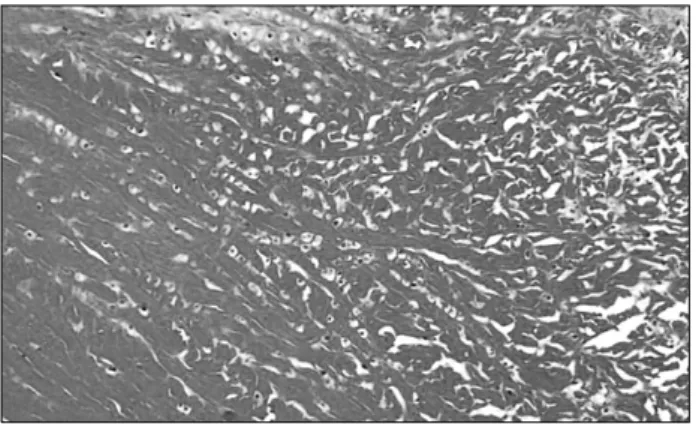
Fig. 7. Central bearing area of normal temporomandibular joint disc in the rabbit. Thick bundles of collagen fibers (small arrow) are horizontally distributed. Chondrycyte-like cells (arrowhead) and elastic fibers (large arrow) are also seen (van Gieson, ×200).

Fig. 3. Post-operative 10 weeks. Other portion of the condylar

cartilage reveals cartilaginous matrix thickening of proliferation

zone (Alcian blue, 0.05 M of MgCl

2

, ×200).

(5)

Fig. 8. Post-operative 10 days. Accoring to the transition from central area to peripheral area, the disc shows increasing haphazard arrangement (van Gieson, ×200).

in the central bearing area of disc changed into haphazard arrangement (Fig. 7, 8).

Discussion

The end results of ID of TMJ are still uncertain[6].

Especially, the interrelationship of ID and osteoarthritis has been studied profoundly for recent years[7-9]. ADD of TMJ might induce abnormal stress distribution on TMJ tissue and influence the motion of joints[2,10]. The affecting fac- tors on adaptation or remodeling following by abnormal stress on TMJ are aging, hormone, the tone change of sympathetic nerve fiber, physical injury, hypoxia-re- perfusion injury, neurogenic inflammation. Overload of ret- rodiscal tissue after ADD provocates releasing of neuro- peptide, substance P and calcitonin generelated peptide into the TMJ. The neuropeptide also stimulates inter- leukin-1, 6, tumor necrosis factor-α, endothelin-1, which interact with proteinase, collagenases, gelantinases, etc.

Cytokines like proteinase, Fas, capase-8, Bcl-2, Bax are known modulators of metabolism turnover as well as scav- enger of ECM[11-13]. This study observed whether TMJ tissues after ADD adapt or not.

There are a few studies on neurogenic cytokines of TMJ disease, but researches for ECM are rarely reported so far[14,15]. Our study has focused on ECM behaviors in TMJ after ADD. Throughout the distributional changes of GAG and collagen on TMJ, we could identify the change of TMJ tissue after ADD in experimental study. Articular cartilage on TMJ tissue is susceptible to be changed into osteoarthritis because the nutrition route is only diffusion

pattern on cartilage. The interacting metabolic factors for the cartilage are ECM and chondrocyte. ECM supplies elas- ticity and stiffness for TMJ tissue. Chondrocytes also have a capacity to synthesize and dissolve the components of ECM. ECM consists of water, collagen, GAG, fibronectin, laminin, lipid, gycoprotein including proteinase, etc. The collagen fibers dominantly consist of dry weight 60% of articular cartilage, hold glycoproteins, like as fibronectin, chondronectin and counteract against an expansion pres- sure of hydrophilic GAG. Extracellular matrices have roles to occupy the intercellular spaces, to act with cells and to support the cell metabolism[12,15].

GAG is long-chain compounds of repeated disaccharide units. The four main types consist mainly of heparan sul- phate/heparin, chondroitin sulphate/dermatan, keratan sul- phate, hyaluronic acid. These proteoglycans make roles of biological modulator for growth factors, cell induction for healing and improving of cellular activity[16]. The in- formation about GAG change can be useful for assessment of healing on the level of cell. Scott and Dorling[17] showed in their study that hyaluronic acid initially appeared in 3 days after tissue injury, then, decreased on 5 days, but chondroitin sulphate and dermatan sulphate were in- creased on 5 days. Depending on tissue injury-lapsed day, different GAGs appeared. The large anionic weight mole- cules, GAGs could be observed by application of different concentration of cationic dye materials for immunochemistry.

Scott and Dorling[17] adapted the concept of CEC for the observation of change of GAG. At first, they used the dye cation material- alcian blue for binding the GAG, then, added the competitive non-dye, electrolyte cation M, e.g.

Mg

. As the concentration of non-dye, cation M was in-

creasing, dye-polyanion GAG complex was separating. The

separating concentration was called as CEC. By introducing

this concept, they could notice the distribution of GAG

according to cation M, MgCl

2

. Hyaluronate till 0.2 M MgCl

2

,

chondroitin sulphate till 0.4 M MgCl

2

, heparan sulphate

between 0.4 M and 0.8 M MgCl

2

and keratan sulphate

till 1.0 M MgCl

2

could bind with alcian blue. Blaustein

and Scapino[18] and Mills et al. [19] also reported the CEC

study. He suggested that the hyaluronate can be presented

in less 0.15 M and larger molecular GAG can be emerged

in more 0.25 M concentration. Page and Ashhurst[16] ap-

plied CEC concept for their study of rabbit fracture healing.

(6)

They observed that mechanical unstable fragments of bone contained chondroitin 4, 6-sulphate and keratan sulphate, in the other hand, stabled fragments showed less sulphated GAG. Axelsson et al. [20], Poole et al. [21] compared the normal disc with osteoarthritis involving disc by histo- chemical study. Normal disc contained chondroitin sul- phate, dermatan sulphate in contrary to heparan sulphate on disease disc. Typically the total dry weight % of osteo- arthritic disc was decreased into 33% of normal weight.

Kopp[22] also applied the CEC concept in the autopsy study of of TMJ disc. He found the displaced retrodiscal tissue had more sulphated GAGs, chondroitin sulphate and kera- tan sulphate. Blaustein and Scapino[18] observed the hu- man TMJ disc specimens by application of CEC concept.

The anterior positioned retrodiscal tissues, posterior band represented more prominent production of sulphated GAG than central area of disc.

Throughout the CEC concept, we also could utilize to identify the change of GAG in TMJ tissue after ADD. In our study, the GAG change in the articular cartilage, emi- nence, disc, retrodiscal tissue after ADD on rabbit TMJ was observed (Fig. 2∼4). During our study critical electrolyte concentrations of all TMJ tissues were extracted. The con- centrations on 3 days, 1 week were 0.3 M. That meant the formation of hyaluronic acid in early stage of ADD.

The CECs on 10 days, 2 weeks were manifested as 0.4 to 0.6 M, which were assumed to be related with chondroitin sulphate forming. As the period after ADD goes far as 3 weeks, 4 weeks, 8 weeks, the CEC was increased till 0.6 M. It was regarded as the appearance of keratan sulphate.

On 10 weeks the CEC finally was reached into 0.8 M, which indicated the product of heavy weight sulpher GAG mole- cule as a result of ADD on TMJ tissues (Table 1). The heavy GAG molecules were found in inflammatory events in body[8,10,16].

For the findings of articular disc, the CEC was temporary elevated till on 10 days, then it was decreased as 0.4 to 0.6 M range on 3 weeks, 4 weeks, 8 weeks and finally, it was set as 0.8 M on 10 weeks. The averages of CEC on central bearing area, posterior band and posterior attach- ment were calculated as 0.65 M, 0.63 M and 0.51 M. In comparing the CEC of central bearing area of disc with that of posterior band, the CEC level was similar typically. It seemed as the remodeling change of posterior band like

central bearing area of TMJ disc after ADD. In addition, the GAG staining reactions of the condylar hyperplasia layer, proliferative layer of rabbit were manifested in alcian blue stain. Chondroblast like cells in the articular disc was ob- served (Fig. 7, 8).

The interrelationships of proteoglycan, fibronectin and collagen are important to maintain the extracellular matrix's function. GAG, a family of proteoglycan provides articular cartilage with the elasticity, self-lubriation in cooperating with collagen fibers[23]. GAG and collagen also can make a role to reduce a friction during TMJ function. As early stage of osteoarthritis, interruption of collagen arrangement in articular cartilage, disc can be observed with the loss of proteoglycan. We also observed the change of collagen fibers of the disc with GAG change under microscopy. The horizontal arrangement of the collagen fibers changed into haphazard irregular pattern on 10 days after ADD. The dif- fuse degeneration on collagen was observed on 8 weeks (Fig. 5, 6). Our study on the collagen fibers of disc showed consistent haphazard patterns comparably. It was thought as constant degenerative change of TMJ tissues after ADD[24].

The change of distribution of GAG on TMJ tissue after ADD showed the more sulphated GAG molecules were ap- peared as 4, 8, 10 weeks in the process. With combined result of collagen fiber change, these GAG change findings showed that rabbit TMJ tissue after ADD might be changed into the state of degeneration. If the clinical application could be available, the measurement of the amounts of the content of GAG from synovial joint as well as TMJ tissue would be expected as a useful tool to elucidate the osteo- arthritic state of TMJ patients with ADD. Recent other study showed similar degenerative change in TMJ with ADD that degree of metalloproteinase-2 and -9 in synovial fluid of TMJ without disc reduction in 38 patients were increased[25].

The treatment for the ADD without disc reduction would

be determined according to ECM content of TMJ tissue with

radiographic findings whether the reduction of disc after

ADD or scavenge therapy with joint lavage for removal of

ECM breakdown products is proper to prevent the osteo-

arthritic change of TMJ tissues. This experimental study con-

firmed osteoarthritic change of TMJ after ADD by ob-

servation of changes of GAG, collagen fibers in TMJ tissues.

(7)

Conclusion

This study showed degenerative change of TMJ tissues if TMJ disc at rabbits was displaced anteriorly.

Tissue changes like the appearance of highly sulphated glycosmaminoglycans in 8, 10 weeks and disruption of hori- zontal arrangement of collagen fibers in the disc indicate initial osteoarthritic change of TMJ at rabbits with the disc displacement.

References

1. Salo L, Raustia A, Pernu H, Virtanen K. Internal derange- ment of the temporomandibular joint: a histochemical study.

J Oral Maxillofac Surg 1991;49:171-6.

2. Westesson PL, Bronstein SL, Liedberg J. Internal derange- ment of the temporomandibular joint: morphologic descrip- tion with correlation to joint function. Oral Surg Oral Med Oral Pathol 1985;59:323-31.

3. Cortés D, Exss E, Marholz C, Millas R, Moncada G.

Association between disk position and degenerative bone changes of the temporomandibular joints: an imaging study in subjects with TMD. Cranio 2011;29:117-26.

4. Ohnuki T, Fukuda M, Nakata A, et al. Evaluation of the po- sition, mobility, and morphology of the disc by MRI before and after four different treatments for temporomandibular joint disorders. Dentomaxillofac Radiol 2006;35:103-9.

5. Israel HA, Saed-nejad F, Ratcliffe A. Early diagnosis of os- teoarthrosis of the temporomandibular joint: correlation be- tween arthroscopic diagnosis and keratan sulfate levels in the synovial fluid. J Oral Maxillofac Surg 1991;49:708-11.

6. Dolwick MF. Intra-articular disc displacement. Part I: its questionable role in temporomandibular joint pathology. J Oral Maxillofac Surg 1995;53:1069-72.

7. Fujisawa T, Kuboki T, Kasai T, et al. A repetitive, steady mouth opening induced an osteoarthritis-like lesion in the rabbit temporomandibular joint. J Dent Res 2003;82:731-5.

8. Israel HA, Saed-Nejad F, Ratcliffe A. Early diagnosis of os- teoarthrosis of the temporomandibular joint: correlation be- tween arthroscopic diagnosis and keratan sulfate levels in the synovial fluid. J Oral Maxillofac Surg 1991;49:708-11.

9. Stegenga B, de Bont LG, Boering G. Osteoarthrosis as the cause of craniomandibular pain and dysfunction: a unifying concept. J Oral Maxillofac Surg 1989;47:249-56.

10. Kantomaa T, Pirttiniemi P, Tuominen M, Poikela A.

Glycosaminoglycan synthesis in the mandibular condyle dur- ing growth adaptation. Acta Anat (Basel) 1994;151:88-96.

11. Wu M, Gu Z, Xiao J, Feng J. Differential expression of apoptosis-associated proteins in chondrocytes of the man- dibular condyles of rabbits with anterior disk displacement.

Cranio 2008;26:144-9.

12. Milam SB, Klebe RJ, Triplett RG, Herbert D. Characterization of the extracellular matrix of the primate temporomandibular joint. J Oral Maxillofac Surg 1991;49:381-91.

13. de Bont LG, Boering G, Liem RS, Eulderink F, Westesson PL.

Osteoarthritis and internal derangement of the tempor- omandibular joint: a light microscopic study. J Oral Maxillofac Surg 1986;44:634-43.

14. Dijkgraaf LC, De Bont LG, Boering G, Liem RS. Function, biochemistry, and metabolism of the normal synovial mem- brane of the temporomandibular joint: a review of the literature. J Oral Maxillofac Surg 1996;54:95-100.

15. Paegle DI, Holmlund AB, Hjerpe A. Matrix glycosaminoglycans in the temporomandibular joint in patients with painful clicking and chronic closed lock. Int J Oral Maxillofac Surg 2003;32:397-400.

16. Page M, Ashhurst DE. The effects of mechanical stability on the macromolecules of the connective tissue matrices pro- duced during fracture healing. II. The glycosaminoglycans.

Histochem J 1987;19:39-61.

17. Scott JE, Dorling J. Differential staining of acid glyco- saminoglycans (mucopolysaccharides) by alcian blue in salt solutions. Histochemie 1965;5:221-33.

18. Blaustein DI, Scapino RP. Remodeling of the tempor- omandibular joint disk and posterior attachment in disk dis- placement specimens in relation to glycosaminoglycan content. Plast Reconstr Surg 1986;78:756-64.

19. Mills DK, Daniel JC, Scapino R. Histological features and in-vitro proteoglycan synthesis in the rabbit craniomandibular joint disc. Arch Oral Biol 1988;33:195-202.

20. Axelsson S, Holmlund A, Hjerpe A. Glycosaminoglycans in normal and osteoarthrotic human temporomandibular joint disks. Acta Odontol Scand 1992;50:113-9.

21. Poole AR, Webber C, Pidoux I, Choi H, Rosenberg LC.

Localization of a dermatan sulfate proteoglycan (DS-PGII) in cartilage and the presence of an immunologically related species in other tissues. J Histochem Cytochem 1986;34:

619-25.

22. Kopp S. Topographical distribution of sulphated glyco- saminoglycans in human temporomandibular joint disks. A histochemical study of an autopsy material. J Oral Pathol 1976;5:265-76.

23. Pereira FJ, Lundh H, Eriksson L, Westesson PL. Microscopic changes in the retrodiscal tissues of painful tempor- omandibular joints. J Oral Maxillofac Surg 1996;54:461-8.

24. Ali AM, Sharawy M, O'Dell NL, al-Behery G. Morphological al- terations in the elastic fibers of the rabbit craniomandibular joint following experimentally induced anterior disk displacement.

Acta Anat (Basel) 1993;147:159-67.

25. Tanaka A, Kumagai S, Kawashiri S, et al. Expression of ma- trix metalloproteinase-2 and -9 in synovial fluid of the tempor- omandibular joint accompanied by anterior disc displacement.

J Oral Pathol Med 2001;30:59-64.

수치

Fig. 1. Normal mandibular condyle in the rabbit. Proliferation  zone, hypertrophic zone (square area) were mainly stained with alcian blue
Fig. 7. Central bearing area of normal temporomandibular joint disc in the rabbit. Thick bundles of collagen fibers (small arrow) are horizontally distributed
Fig. 8. Post-operative 10 days. Accoring to the transition from central area to peripheral area, the disc shows increasing  haphazard arrangement (van Gieson, ×200).

참조

관련 문서

The purpose of this study was to examine the effect of the transformationa l leadership of a dance leader on the empowerment of professional dancers and

The purpose of this study was to investigate the effects of a disability awareness program on improving the attitudes of regular elementary school

The purpose of this study was to examine the effect of shadowing using English movies on listening and speaking skills, learning interest, and attitudes

The purpose of this study is to analyze the effects of word- recording on learning vocabulary, reading and listening of English. control groups to answer

The purpose of this study is to verify whether The mediating effects of planned happenstance skills on the relationship between perceived social support

The purpose of this study is to analyze the effects of sports marketing strategy fit on organizational attitude and organizational citizenship behavior

The purpose of this study was to examine the effects of 8 weeks of Zumba dance exercise for obese middle-aged women on blood lipid index and vascular aging.. The subjects of

The purpose of this study was to investigate the impact of social capital and positive psychology capital on the will of start-up according to experience