• 검색 결과가 없습니다.

Evaluation of Flexural strength and surface porosity of three indirect composite resins

N/A
N/A
Protected

Academic year: 2021

Share "Evaluation of Flexural strength and surface porosity of three indirect composite resins"

Copied!
8
0
0

로드 중.... (전체 텍스트 보기)

전체 글

(1)

http://doi.org/10.14347/kadt.2017.39.1.9

3종의 간접수복용 복합레진의 굴곡강도 비교 및 표면관찰

김준태, 박진영*, 김웅철, 김지환

고려대학교 대학원 보건과학과 치의기공전공, 고려대학교 보건과학연구소

*

Evaluation of Flexural strength and surface porosity of three indirect composite resins

Jun-Tae Kim, Jin-Young Park*, Woong-Chul Kim, Ji-Hwan Kim

Department of Dental Laboratory Science & Engineering, College of Health Science, Korea University Institute for Health Science, College of Public Health Science, Korea University*

[Abstract]

Purpose: The purpose of this study was to evaluate flexural strength, composite surface and fractured surface of three different indirect composite resins.

Methods: Fifteen bar-shaped specimens (25mm x 2mm x 2mm) were fabricated for each FL group (Flow type and Light curing) and PLP group (Putty type and Light, Pressure curing) and PL group (Putty type and Light curing) according to manufacturer’s instructions and ISO 10477. Fabricated specimens were stored in the distilled water for 24 hours at the temperature of 37 ℃. Three-point bending strength test was performed to measure flexural strength using universal testing machine at a crosshead speed of 1mm/min (ISO 10477). Surface and fractured surface of specimens were observed by digital microscope. Results were analyzed with Kruskal-wallis tests (α = 0.05).

Results: Mean (SD) of three different indirect composite resins were 83.38 (6.67) MPa for FL group, 139.90(16.53) MPa for PLP group and 171.72(16.74) MPa for PL group. Flexural strength were statistically significant (p<0.05). Differences were not observed at fractured surface among three groups. However, many pores over 100㎛ were observed at PL group in observing surface of specimen.

Conclusion: Flexural strength of composite resins was affected by second polymerization method and content of inorganic filler.

Key words: composite resins, flexural strength, heat curing, light curing, inorganic filler.

교신저자 성 명 김 지 환 전 화 010-6270-0341 E-mail [email protected]

주 소 서울시 성북구 안암로 145 고려대학교 보건과학대학 치기공학과

접 수 일 2016. 10. 29 수 정 일 2017. 3. 7 확 정 일 2017. 3. 17

(2)

Ⅰ. 서론

구강 내 기능 회복을 우선으로 하던 과거와 달리, 사 회/경제가 발전함에 따라 환자들의 요구가 증가됨으로 써 치아색조와 관련된 재료들의 개발과 발전이 이루어 지고 있다. 대표적인 치과용 심미수복재는 글레스아이 오노머, 복합레진 그리고 세라믹 등이 있다. 이 중에서 복합레진은 높은 중합수축으로 인하여 미세누출을 야기 하고 이로 인해 2차 우식증을 유발시키는 문제점이 있 었다(Thordrup et al, 1994). 또한 우수한 마모저항성 과 기계적 성질을 요구하는 구치부수복에 한계가 있다 (강현숙 and 최호영). 따라서 구강 외에서 중합 및 제작 을 통하여 우수한 적합도와 강도, 마모저항성을 가진 복 합레진 인레이에 대한 개념이 도입되었다(Leinfelder 1988; Hasegawa et al, 1989).

1930년대에 개발된 자가중합 아크릴릭 레진은 높은 색소침착, 높은 중합수축, 낮은 마모저항성 등과 같은 단점(Optec; Shinohara et al, 1989)을 보완하여, 1962 년에 Bis-GMA를 이용한 광중합 복합레진이 Bowen에 의하여 개발되었다. 하지만 Bowen에 의하여 개발된 1 세대 복합레진은 충전재의 함량이 적어서 낮은 굴곡강 도, 낮은 탄성율 그리고 낮은 마모저항성 등의 좋지 못 한 기계적 특성을 나타냈다(Bertolotti 1997). 이에 따라 무기질 충전재의 함량을 30%에서 70%로 높이고 입자 의 크기 및 형태를 개선하여 중합수축은 감소시키고 굴 곡강도는 증가된 2세대 복합레진이 개발되었다(Touati and Aidan 1997).

복합레진의 기계적 성질에 영향을 미치는 요소로 Mandikos등(Mandikos et al, 2001)은 레진의 중합정도, 충전재의 함량, 크기, 형태 등이 있다고 하였고, Condon 등(Condon and Ferracane, 1997)은 충전재의 함량과 복합레진의 강도는 비례한다고 보고하였다. Shinkai 등

가적인 열중합이 가능하기 때문에 복합레진의 직접 수복 의 한계였던 중합수축을 줄이고 기계적 강도를 증가시킬 수 있다고 하였다. 복합레진은 중합 후 남은 잔존 이중결 합으로 인해 불충분한 강도와 마모저항성 등을 나타내는 데(ASMUSSEN 1982), 이러한 현상들은 1차 중합 후 열 중합과 같은 부가적인 중합을 통하여 개선 할 수 있다고 보고하였다(Wendt 1986; Wendt Jr 1987).

이처럼 임상에서 적용되고 있는 간접수복용 복합레진 은 충전재의 함량과 크기, 조성에 따라 큰 영향을 많이 받고 있다. 또한 중합방법은 간접수복용 복합레진의 굴 곡강도, 마모저항성 등에 많은 영향을 끼치고 있다. 하 지만 임상에서 적용되고 있는 간접수복용 복합레진의 종류가 다양하고 중합방법 또한 차이가 있음에도 불구 하고 이에 대한 연구가 미흡한 실정이다. 따라서 본 연 구의 목적은 3종의 간접수복용 복합레진의 굴곡강도를 비교하고, 표면관찰을 통하여 기포의 함유 정도를 확인 함으로써 각각 재료들의 임상적용을 위한 가이드를 제 시하고자 한다.

Ⅱ. 연구 방법 1. 연구재료

본 연구에서는 임상에서 사용되는 3종의 복합레진인 Sinfony, Tescera, Twiny을 사용하였다(Table 1).

2. 시편제작

굴곡강도의 측정을 위하여 국제표준규격(ISO 10477) (DIN 2004)에 근거하여 길이 25mm, 폭 2mm, 두께

Table. 1. Information on the composite resins investigated in this study

Group Brand Name Product Manufacturer Type First

Polymerization

Second Polymerization

FL Sinfony Dentine 3M-ESPE (USA) Flow Light -

PLP Tescera Dentine Bisco (USA) Putty Light, Pressure Heat curing

PL Twiny Dentine Yamakin (Japan) Putty Light Heat curing

(3)

2mm의 막대모양 시편을 제작하였다. 시편을 제작하 기 위하여 규격에 맞게 설계된 Teflon mold에 제작된 Teflon zig에 복합레진을 전입하고 기포의 함입을 차단 하기 위하여 레진의 위/아래에 플라스틱 비닐을 위치 시킨 후, 유리판을 이용해 압접을 시행하였다(Fig 1). 이 후 압접으로 인하여 발생된 여분의 복합레진을 제거한 후 각각 제조사의 중합법에 따라 중합을 진행하였다. 중 합이 완료된 시편은 Teflon zig에서 조심스럽게 제거 한 후 규격에 맞게 핸드피스와 SiC 600 grit (Daesung Abrasive CO, Seoul, Korea)을 이용하여 연마하였다.

시편의 규격은 Digital caliper(ABSOLUTE digimatic caliper, Mitutoyo Corp., Tokyo, Japan)를 이용하여 측정하였고 최종 연마 후 37℃의 증류수에서 24시간 보 관하였다(Fig 2).

Fig. 1. Composite resin specimen and Teflon zig

Fig. 2. Verification of specimen using digital caliper

3. 굴곡강도의 측정

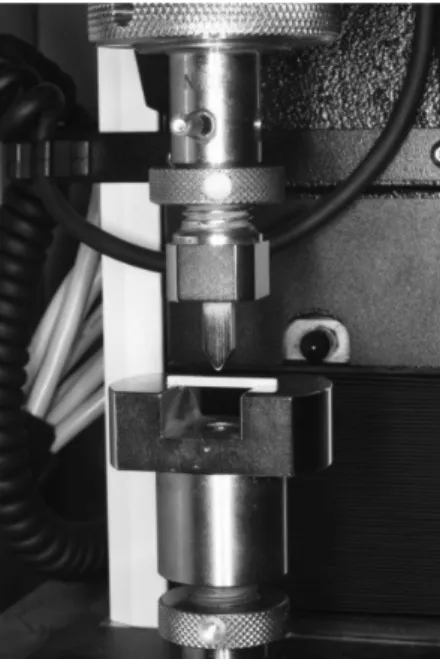
제조사의 지시대로 제작된 시편들은 만능재료 시험기 (Instron 3345; Instron, Canton, MA, USA)를 이용하 여 3점 굽힘시험법으로 굴곡강도를 측정하였다. 하중속 도는 1.00mm/min이고, 지지 스팬의 폭은 20.00mm 로 설정하였으며, 얻어진 굽힘 data는 ISO 10477에 따

라 아래공식을 이용하여 측정하였다(Fig 3)

σ

B

= 3Fl 2bh

2

Where

F is the maximum applied load, in newtons;

l is the distance, in millimetres, between the supports, i.e. 20 mm;

b is the width of the test specimen, in millimetres;

h is the height of the test specimen, in millimetres.

Fig. 3. Universal testing machine for flexural strength test

4. 파절면 및 표면 관찰

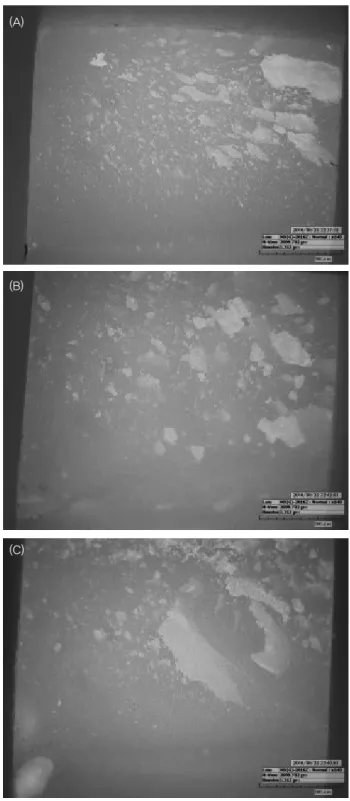
파절면 및 표면은 굴곡강도 측정 후 발생된 시편의 파 편을 이용하여 관찰하였다. 파절 후 발생된 시편의 파 절면은 15개의 시편 중 임의로 선택하여 디지털 현미경 (KH-7700, HITOX, Japan)으로 140배 확대하여 관찰 하였고, 시편의 표면은 120배로 확대하여 관찰하였다.

5. 통계분석

(4)

고 정규성 분포 가정을 만족하지 못하였다(p<0.05). 따 라서 복합레진의 종류에 따른 굴곡강도의 차이를 평가 하기 위하여 비모수 검정인 Kruskal-wallis test를 시 행하였다. 통계적 판단을 위하여 통계적 유의수준은 0.05로 설정하였고, 통계분석은 IBM SPSS Statistics 24.0 (IBM Co., Armonk, NY, USA)을 이용하였다.

Ⅲ. 결 과 1. 굴곡강도

본 실험에서 사용된 3종의 복합레진에 대한 굴곡강도 의 평균과 표준편차는 Table 2와 같다. 3종의 복합레진 중 가장 높은 굴곡강도를 나타내는 것은 PL였고 FL가 가장 낮은 것으로 나타났다. 각 재료간의 굽힘 강도 유 의한 차이를 보였다(p<0.05).

Table 2. Result of Flexural Strength of composite resins

Group N Mean SD

(MPa) (MPa) P

FL 15 83.38 6.67

<0.05

PLP 15 139.90 16.53

PL 15 171.72 16.74

FL group (Flow type and Light curing), PLP group (Putty type and Light, Pressure curing), PL group (Putty type and Light curing)
2. 표면관찰

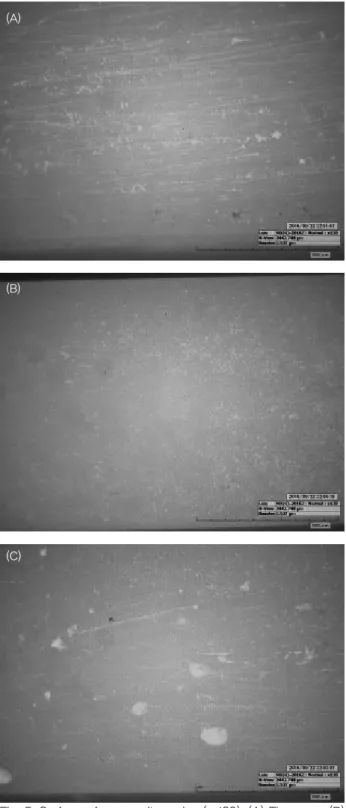
디지털 현미경을 이용하여 관찰한 복합레진의 파절면 과 표면의 모습은 Fig. 4와 Fig. 5에 각각 나타냈다. 각 재료를 140배 확대하여 관찰한 파절면의 모습에서는 세 재료간의 큰 차이를 확인 할 수 없었다. 120배를 확대하 여 관찰한 표면의 모습에서는 세 재료간의 차이가 존재 하였다. FL와 PLP그룹의 표면에서는 100㎛ 이상의 기 포가 관찰되지 않았으나 PL그룹의 표면에서는 다수가 관찰되었다.

Fig. 4. Fracture surface of composite resins (x 140). (A) FL group. (B) PLP group. (C) PL group.

(A)

(B)

(C)

(5)

Fig. 5. Surface of composite resins (x 120). (A) FL group. (B) PLP group. (C) PL group.

Ⅳ. 고 찰

치과분야에서 성공적인 치료를 위해선 수복되는 재료 의 우수한 기계적 성질이 매우 중요한 요소 중 하나이

다. 구강 내에서는 복잡한 응력들이 작용하기 때문에 다 양한 기준과 시험들이 치과용 수복물의 기계적 특성 평 가에 적용되어야 한다(Junior et al, 2008; Jun et al, 2013). 치과용 복합레진은 ISO 4049과 ISO 10477에 의 하여 평가되고 있는데 (ISO 1988, DIN 2004), 그 중 기 계적 강도 측면에서 3점 굴곡강도가 재료의 강도를 나 타내는 척도로써 가장 빈번하게 사용되고 있다. 또한 복 합레진은 직접법을 통하여 치료에 이용될 수 있을 뿐 아 니라 국제표준규격에 따라 간접법으로도 이용되고 있다 (Kim et al, 2007).

간접수복용 복합레진의 3점굴곡 강도 시험결과 PL, PLP, FL 순으로 강도가 낮아졌다. 실험에 사용된 세 그 룹 모두 ISO 10477에서 제시한 굴곡강도 50MPa를 상 회하였다. 하지만 FL 그룹에서는 수복용 복합레진에 관한 기준인 ISO 4049의 굴곡강도 기준 80MPa을 간 신히 만족시키는 수준이었다. 이는 PLP가 FL보다 높 은 굴곡강도 값을 나타냈다고 보고한 선행연구들과 일 치한다(Kim et al, 2007; Geum and Kim, 2013). 이 러한 결과들은 복합레진에 첨가된 무기질 충전재의 함 량에 영향을 받았을 것으로 추정된다. Callaghau 등 (Callaghan et al, 2006)은 무기질 충전재의 함량이 높 을수록 강도는 증가된다고 보고하였으며 Ikejima 등 (Ikejima et al, 2003)은 충전재가 차지하는 비율이 최 대 52.5%까지는 충전재의 함량이 증가할수록 굴곡강도 도 증가한다고 보고하였다. 본 연구 결과, PL>PLP>FL 순의 높은 굴곡강도 값을 보였으며, 본 연구에 사용된 재료인 PLP와 FL 그룹의 무기질 충전재 함량은 각각 70%와 45% 이고, 제조사에서 제시한 PL 그룹의 무기 질 충전재 함량은 76.5%이다. 이는 앞에서 언급한대로 복합레진의 무기질 함량이 클수록 굴곡강도가 증가한다 는 것을 알 수 있었다.

복합레진의 기계적 특성에 영향을 미치는 또 하나의 중요한 요소는 복합레진의 중합방법과 중합정도이다.

본 연구에서 사용된 PL와 PLP 그룹은 광중합 이후에 열중합을 통하여 부가적인 중합을 해주는 반면에, FL 그룹에서는 부가적인 열중합은 시행하지 않도록 제조사 는 지시하고 있다. 그러나 복합레진에 남아 있는 미중 합 레진층은 표면에서 분해되고 착색을 일으키는 등 악

(A)

(B)

(C)

(6)

al, 2005). 그러기에 부가적인 중합은 필요하다. 부가적 인 중합은 복합레진이 체내안정성, 용해저항성 그리고 우수한 기계적, 물리적 성질과 같은 특성들을 얻을 수 있도록 중합을 최대화 하기 위하여 시행한다(Freiberg and Ferracane, 1998). 부가적인 중합은 빛이나 열 중합을 통해 1차 중합을 완료한 복합레진 내에 자유기 의 활성도를 높여 줌으로써 비중합층 간에 충돌가능성 을 높여준다(Cook and Johannson, 1987; Ho et al, 2001). 복합레진은 유리전이 이상의 온도를 받게 되면, 분자의 이동성이 증가하게 된다. 그러므로 이러한 현상 은 잔존하는 자유기의 분자 이동성을 증가시킴으로써 남아있는 다른 비중합체들과 화학적 반응을 가능하게 한다(Ferracane and Condon 1992). 부가적인 열중합 의 효과에 대하여 조성아(조성아 외, 1996), Ferracane 등(Ferracane and Condon, 1992) 그리고 Inoue 등 (Inoue et al, 1988)은 광중합으로만 제작한 복합레진보 다 광중합 이후 열중합을 추가로 시행하여 제작한 복합 레진에서 우수한 기계적 성질을 얻는다고 보고하였다.

또한 Reinhardt등 (Reinhardt et al, 1994)은 부가중합 을 통하여 굴곡강도를 11%정도 향상 시킬 수 있었다고 보고하였다. 이러한 선행연구는 광중합만 시행한 FL그 룹이 광중합 이후 부가적으로 열중합까지 시행한 PL과 PLP그룹보다 굴곡강도에서 낮은 수치를 나타낸 본 연 구와 일치한다.

3종의 복합레진을 디지털 현미경으로 관찰한 결과 파 절면에서는 큰 차이를 발견할 수 없었지만, 표면에서는 큰 차이를 발견 할 수 있었다. 디지털 현미경 상으로 FL 와 PLP군은 매끈한 표면을 보였지만 PL군에서는 100

㎛ 이상의 큰 기포를 관찰 할 수 있었다. FL그룹은 간단 한 1차 중합 이후 2차 중합에서 빛과 가압을 가하여 중 합을 하는 방식이고 PLP그룹은 1차 중합 시 빛과 가압 을 이용하여 제작하는 방식이다. 따라서 FL와 PLP그룹 에서는 제작과정 중에 가압을 이용하기 때문에 조작 중 이나 제조과정 중에 함유되었을 수 있는 기포들을 사전 에 제거하고 최종 중합을 진행하게 된다. 이렇게 가압환 경에서 중합을 하게 되면 압력을 받은 복합레진 내의 기 포들은 작아지게 되고 이는 매끈한 표면을 띄는 복합레

만 가압의 과정이 없는 PL 군은 함유된 기포를 제거할 수 있는 과정이 없기 때문이 본 연구와 같은 결과를 보 인 것으로 사료된다.

연구의 한계점으로는 ISO 규격에 근거하여 실험을 진 행했음에도 불구하고 각 3그룹의 제조사에서 제시한 굴 곡강도보다 낮은 결과값을 얻었다. 이는 술자가 복합레 진을 이용하여 시편을 제작하는 과정에서 기기사용 방 법의 미숙과 부족한 테크닉으로 인하여 발생된 것으로 보인다. 특히 PL 그룹에서는 제조사에서 제시한 굴곡강 도 240에 크게 밑돌았는데 이는 PL를 독점으로 수입하 고 있는 재료상에서 수입단가와 국내 시장가격을 고려 하여 PL 제조사의 열중합기가 아닌, 자체적으로 제작한 열중합기를 제공하고 있기 때문에 이를 기초로 실험을 진행하여 발생된 오차일 것으로 생각된다. 또한 기포를 다량 함유하고 있음에도 불구하고 PL그룹에서 가장 높 은 굴곡강도를 나타냈다는 점 또한 추후 연구가 필요할 것으로 보인다.

Ⅴ. 결 론

제한된 조건에서 국내에서 가장 많이 사용되고 있는 간접수복용 복합레진 3종에 대하여 굴곡강도를 비교하 고 디지털 현미경으로 표면을 관찰하였으며, 결론은 다 음과 같다.

1. ISO 10477 규격에 따라 실험한 복합레진의 굴곡강 도는 PL군에서 가장 높게 나타났고 PLP군, FL군 순으로 나타났다(p<0.05).

2. 디지털 현미경으로 관찰한 복합레진의 파절면에서 는 큰 차이를 관찰 할 수 없었다.

3. 디지털 현미경으로 관찰한 복합레진의 표면에서 PLP군과 FL군에서는 큰 차이를 관찰할 수 없었지 만, PL군에서는 100㎛이상의 큰 기포를 다수 관찰 할 수 있었다.

이는 굴곡강도가 함량의 비율 순과 비례한다고 볼 수

있으며, FL이 가장 낮은 굴곡강도를 보인 것은 PL군과

PLP군과 다르게 광중합만을 한 중합방법의 차이로 나

(7)

타났다. 따라서 간접수복용 복합레진으로는 우수한 굴 곡강도를 나타낸 PL 그룹의 적용을 권장하고, 추후 표 면 기포를 제거할 수 있도록 후 처리가 필요할 것으로 사료된다.

REFERENCES

Asmus sen E. Restorative resins: hardness and strength vs. quantity of remaining double bonds. Eur J Oral Sci, 90(6), 484-489, 1982.

Bertolo tti RL. A new polymer glass utilized for modification and repair of fixed partial dentures. Quintessence Int 28(7), 437-439, 1997.

Callagh an DJ, Vaziri A, Nayeb-Hashemi H. Effect of fiber volume fraction and length on the wear characteristics of glass fiber- reinforced dental composites. Dent Mater, 22(1), 84-93, 2006.

Chee W W, Donovan TE, Daftary F, Siu T. The effect of vacuum-mixed autopolymerizing acrylic resins on porosity and transverse strength. J Prosthet Dent, 60(4), 517-519, 1988.

Condo n JJ. Ferracane. In vitro wear of composite with varied cure, filler level, and filler treatment. J Dent Res, 76(7), 1405-1411, 1997.

Cook W D, Johannson M. The influence of postcuring on the fracture properties of photo‐cured dimethacrylate based dental composite resin. J Biomed Mater Res A, 21(8), 979-989, 1987.

DIN E. 1 0477, Dentistry–Polymer-based crown and bridge materials, Beuth Verlag, Berlin, 2004.

Ferrac ane J, Condon J. Post-cure heat

treatments for composites: properties and fractography. Dent Mater, 8(5), 290-295, 1992.

Freiber g R, Ferracane J. Evaluation of cure, properties and wear resistance of Artglass dental composite. Am J Dent, 11(5), 214- 218, 1998.

Geum Y H, Kim B. Flexural strength of indirect c o m p o s i t e r e s i n w i t h d i f f e r e n t polymerization conditions. J Kor Aca Dent Tec, 35(4), 333-341, 2013.

Haseg aw a E, Boyer D, Chan DC. Microleakage of indirect composite inlays. Dent Mater, 5(6), 388-391, 1989.

Ho CT, V ijayaraghavan T, Lee SY, Tsai A, Huang HM, Pan LC. Flexural behaviour of post

‐cured composites at oral‐simulating temperatures. J Oral Rehabil, 28(7), 658- 667, 2001.

Ikejim a I , Nomoto R, McCabe JF. Shear punch strength and flexural strength of model composites with varying filler volume fraction, particle size and silanation. Dent Mater, 19(3), 206-211, 2003.

Inou e K, Terachi M, Utsumi S. A study on composite resin inlay. J Dent Res, 67, 222, 1988.

ISO, E . 4049, Dentistry-Polymer-based filling, restorative and luting materials.

I n t e r n a t i o n a l O r g a n i z a t i o n f o r Standardization, Geneva, Switzerland, 1988.

Jun S K , Kim DA, Goo HJ, Lee HH. Investigation of the correlation between the different mechanical properties of resin composites.

Dent Mater J, 32(1), 48-57, 2013.

Junior SAR, Ferracane JL, Della Bona Á.

Flexural strength and Weibull analysis of

(8)

a microhybrid and a nanofill composite evaluated by 3-and 4-point bending tests.

Dent Mater, 24(3), 426-431, 2008.

Kim K S, Yoon TH, Song KY, Ahn SG. Comparison of mechanical properties in 4 indirect composite resin. J Korean Acad Prosthodont, 45(1), 21-33, 2007.

Leinfel der KF. Posterior composite resins. J Am Dent Accoc, 117(4), 21E-26E, 1988.

Shinka i MN, McGivney GP, Davis E, Bush PJ, Carter JM. A comparison of the wear resistance and hardness of indirect composite resins.

J Prosthet Dent, 85(4), 386-395,2001.

Neves AD, Discacciati JAC, Oréfice RL, Jansen WC.

Correlation between degree of conversion, microhardness and inorganic content in composites. Braz Oral Res, 16(4): 349-354, 2002.

Optec H. Laboratory techniques manual.

Wallingford, Conn: Jeneric/Pentron, l-24.

Reinha rdt JW, Boyer D, Stephens N. Effects of secondary curing on indirect posterior composite resins. Oper Dent, 19, 217-217, 1994.

Satsu kawa H, Koizumi H, Tanoue N, Nemoto M, Ogino T, Matsumura H. Properties of an indirect composite material polymerized with two different laboratory polymerizing systems. Dent Mater J, 24(3), 377-381, 2005.

Shinka i K, Suzuki Sm, Leinfelder KF, Katoh Y.

How heat treatment and thermal cycling affect wear of composite resin inlays. J Am Dent Assoc, 125(11), 1467-1472, 1994.

Shinoh ara N, Minesaki Y, Mukoyoshi N, Moriyama H, Jimi T. The effect of the cementing material on the strength of the all ceramic crown. Nihon Hotetsu Shika Gakkai Zasshi, 33(2), 416-421, 1989.

Thordr up M, Isidor F, Hörsted-Bindslev P. Comparison of marginal fit and microleakage of ceramic and composite inlays: an in vitro study. J Dent, 22(3), 147- 153, 1994.

Touati B, Aidan N. Second generation laboratory composite resins for indirect restorations. J Esthet Restor Dent, 9(3), 108-118, 1997.

Wendt JrS. The effect of heat used as a secondary cure upon the physical properties of three composite resins. I. Diametral tensile strength, compressive strength and marginal dimensional stability. Quintessence Int, 18, 265-271, 1987.

Wendt S. Effect of heat on the physical-properties of composite resins. J Dent Res, 1986.

강현숙, 최호영. 와동 복합레진 인레이 충전 후 변연누 출에관한 연구. 대한치과보존학회지 17, 191- 205, 1992.

조성아, 조영곤, 문주훈. 중합방법에 따른 복합레진 인

레이의 물리적 성질에 관한 연구. 구강생물학연

구, 20(2), 73-87, 1996.

수치

Fig. 1. Composite resin specimen and Teflon zig
Table 2. Result of Flexural Strength of composite resins
Fig. 5. Surface of composite resins (x 120). (A) FL group. (B)  PLP group. (C) PL group

참조

관련 문서

그러므로 본 연구에서는 심미성 향상을 위해 PMMA 아 크릴 의치상 레진에 사용하는 3종의 GS 복합 레진의 굽힘 강도(flexural strength, FS), 굽힘 탄성계수(flexural

Within the limitations in this study, it can be concluded that flexural strength of relined TDBRs was affected by the flex- ural strength of the original denture base resins and the

The article ‘The effect of various sandblasting conditions on surface changes of dental zirconia and shear bond strength between zirconia core and indirect composite resin’

Material and method: In this study four indirect composite material (Adoro LC, BelleGlass HP, Tescera, Synfony) were tested for flexural strength, wear resistance, hardness and

Study on shear bond strength of various composite resins to artificial denture

(2011) Flexural Strength of Composite HSB Hybrid Girders in Positive Moment, Journal of Korean Society of Steel Construction, KSSC,

The experimental test results showed that the proposed prestressed composite beam had greater flexural strength and stiffness than the ordinary non-prestressed

Keywords : Steel Plate-Concrete Composite Beam, Shear connector, Shear strength ratio, Partially composite beam, Flexural capacity.. 본 논문은