Biomaterials Research (2007) 11(2) : 83-86
83 *Corresponding author: [email protected]
Biomaterials
Research
CThe Korean Society for Biomaterials
Flexural Strength and Physical Changes of Dental Composite Resins
after Extract Treatments
Hyeok Park1, Thomas Chae2, Kyoung-Nam Kim1, and Kwang-Mahn Kim1*
1Department and Research Institute of Dental Biomaterials and Bioengineering, BK 21 Project, Yonsei University College
of Dentistry, Seoul, Korea
2Department of Biological Sciences, College of Agriculture and Life Sciences, Cornell University, Ithaca, NY USA
(Received May 14, 2007/Accepted May 17, 2005)
Recently introduced composite resins for anterior or posterior tooth may improve physical strength and polymeriza-tion. It is also becoming important that biocompatible or biodegradable materials are used. In order to get a Korean admission for making or selling any dental resin’s material, the tests include flexural strength of composite resin and quantitative analysis after extract treatment. The purpose of this study was to test the effect of extract conditions such as extract time and temperature on the composite resins and then evaluate them by flexural strength, UV absorbance, and potassium permanganate consumption. Four commercial products, AELITETM Universal Light-Cured
(Bisco, Schaumberg, IL USA), GRADIA DIRECT ANTERIOR (GC Corp., Tokyo, Japan), DenFilTM (Vericom, Anyang,
Korea), and FiltekTM Z350 (3M ESPE, St. Paul, MN USA), were used for this study. Four conditions of the extract
treatment were (121 ± 2oC, 1 ± 0.2 hr), (70 ± 2oC, 24 ± 2 hr), (50 ± 2oC, 72 ± 2 hr), and (37 ± 2oC, 72 ± 2 hr),
respectively. The cured samples were examined using a Universal Testing Machine (Instron 3366, Instron Engineer-ing Corporation, Canton, MA USA). After treatment, the elution for the quantitative analysis was measured usEngineer-ing a UV-vis spectrophotometer (WPA S2100, Biochrom Ltd., Cambridge, UK). To quantify chemically reduced materials, the test of potassium permanganate reduction material (KMnO4-test) was required. From the present study, we
con-cluded that the results indicated both extraction time and temperature affected the flexural strength, UV absor-bance, and KMnO4-test of the dental composite resins. Overall, increasing extraction time weakened the composite
resins while increasing extraction temperature heightened the flexural strength of the composite resins. The UV absorbance was higher when the extract conditions were high temperature and short time duration then compared to low temperature and long time duration. In certain cases, KMnO4-test showed the extract time was more
impor-tant than the extract temperature. These are cautiously expected that both extract temperature and time influence flexural strength; extract temperature is more significant to UV absorbed materials and extract time is more impor-tant in terms of chemically reduced materials.
Key words: Composite resin, Extraction treatment, Flexural strength, UV Absorbance, Potassium permanganate
con-sumption
Introduction
ental resin-based composites generally consist of a matrix that is formed by a plastic resin material, fillers which are reinforcing particles and/or fibers dispersed in the matrix, and a coupling agent between filler and resin matrix. Matrix has two partitions such as oligomers like bisphenol A-glycidyl methacrylate (bis-GMA), bisphenol A-polyethylene glycol diether dimethacrylate (bis-EMA), or urethane dimethacrylate (UDMA) and viscosity controllers like methyl methacrylate (MMA), ethylenedimethacrylate (EDMA), or triethyleneglycol dimethacrylate (TEGDMA). The strength and the range of use depend on the ratio of resin materials and fillers. Light-acti-vated resins also need a photosensitizer like camphorquinone
(CQ) and an amine initiator and/or electron donor like dime-thylaminoethyl methacrylate (DMAEMA). In addition to the dimetlyacrylates, other multifunctional resins have been intro-duced to dentistry as dentin bonding agents like dipen-taerythiol penta-acrylate monophosphate (PENTA-P) or poly acrylic acid (PAA) which hydroxyethyl methacrylate (HEMA) has been grafted from.1)
Recently introduced composite resins for anterior or poste-rior tooth may improve physical strength and polymerization. As the use of biocompatible or biodegradable materials is becoming more important, the chemical degradation of meth-acylate monomers has been a subject of research to clarify the hydrolytic degradation behavior of ester linkages in polymer networks.2-4) Degradation of dental resins in human saliva,
which lead to decrease in mechanical strength and surface hardness, have been also reported in in vitro studies.5-8)
84 Hyeok Park, Thomas Chae, Kyoung-Nam Kim, and Kwang-Mahn Kim
Biomaterials Research 2007
To get a Korean admission for making or selling any dental resin’s material, the tests include ISO and Korean Pharmaco-poeia.10-12) ISO 4049 requires the tests like sensitivity to
ambi-ent light, depth of cure, flexural strength, water sorption and solubility, shade and color stability after irradiation and water sorption, and radio-opacity as light-activated composite resins. Since resin medical materials depend on the extract condi-tions, and Korean Pharmacopoeia requires the tests such as appearance, pH, heavy metal, potassium permanganate con-sumption (KMnO4-test), residue after evaporation, and UV
absorbance.
The purpose of this study was to test the effect of extract condition such as extract time and temperature on the com-posite resins and evaluate them by flexural strength, UV absor-bance, and potassium permanganate consumption.
Materials and Methods
Five composite resin specimens which were 25 mm × 2
mm × 2 mm in dimension were light-cured for 20 seconds on
each side as indicated by the respective manufacturers for each of the four composite resin types (classified Class 2, Group 1 of Type 2 by ISO 4049:2000(E)): AELITETM Universal
Light-Cured (Bisco, Schaumberg, IL USA (AELITE)), GRADIA DIRECT ANTERIOR (GC Corp., Tokyo, Japan (GRADIA)), Den-FilTM (Vericom, Anyang, Korea (DenFil)), and FiltekTM Z350
(3M ESPE, St. Paul, MN USA (Filtek)). These resin specimens made up one temperature and time experimental group; (121 ± 2oC, 1 ± 0.2 hr), (70 ± 2oC, 24 ± 2 hr), (50 ± 2oC, (72 ±
2 hr), and (37 ± 2oC, 72 ± 2 hr), respectively. Control group
was stored in distilled water at 37 ± 1oC for 24±2 hours, and
experimental group resin specimens were stored in distilled water at four different temperatures and times. After treat-ment, loads were applied (cross-head speed of (0.75 ± 0.25) mm/min) using Universal Testing Machine (Instron 3366, Instron Engineering Corporation, Canton, MA USA) until breaking point and the results were statistically analyzed by the Friedman Test and Kruskal-Wallis Test (p <0.05, n=5).
Composite-resin specimens which were 15 ± 0.1 mm in diameter and 1.0 ± 0.1 mm in thickness were light-cured for 20 seconds on each side as indicated by the manufacturers for each of upper four composite resins. Each group of speci-mens was stored in distilled water (20 ml/4 g) at the four dif-ferent temperatures and times. For UV-vis spectroscopy, absorbance was measured using a UV-vis spectrophotometer (WPA S2100, Biochrom Ltd., Cambridge, UK). The control Table 1. General resin degradation processes
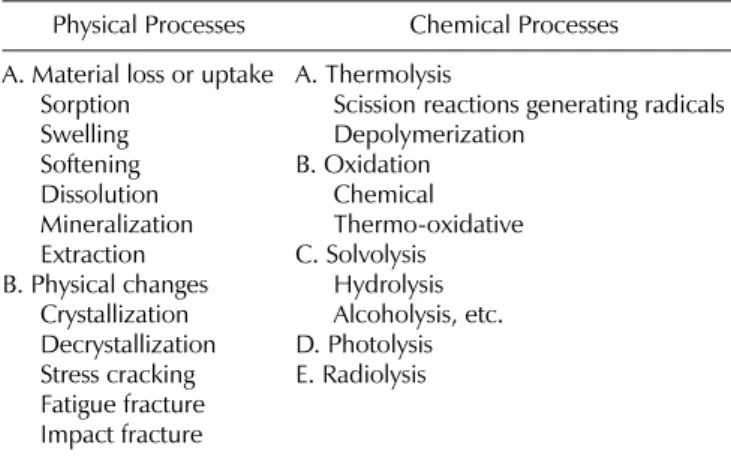
Physical Processes Chemical Processes A. Material loss or uptake
Sorption Swelling Softening Dissolution Mineralization Extraction B. Physical changes Crystallization Decrystallization Stress cracking Fatigue fracture Impact fracture A. Thermolysis
Scission reactions generating radicals Depolymerization B. Oxidation Chemical Thermo-oxidative C. Solvolysis Hydrolysis Alcoholysis, etc. D. Photolysis E. Radiolysis
Flexural Strength and Physical Changes of Dental Composite Resins after Extract Treatments 85
Vol. 11, No. 2 consisted of distilled water instead of the eluted extract
statis-tically analyzed by Friedman Test and Kruskal-Wallis Test
(p<0.05, n=5).
For KMnO4-test, 20 ml resin extract was added to 20 ml
0.002 M KMnO4 and 1 ml dil. H2SO4. This mixture was
boiled for 3 minutes, and KI was added. The mixture was then back-titrated with 0.01 M sodium thiosulfate. The differ-ences of titrated solution of sodium thiosulfate between exper-imental and control groups were calculated. The control consisted of distilled water instead of the eluted extract statis-tically analyzed by Friedman Test and Kruskal-Wallis Test
(p>0.05, n=5).
Results and Discussion
The results indicated that both extraction time and temper-ature affected the flexural strength of the dental composite resins (Table 2). Nevertheless, under the tested extraction con-ditions, all composite resins were able to withstand substan-tially more than 50 MPa as specified by ISO 4049. Overall, increasing extraction time weakened the composite resins while increasing extraction temperature heightened the flex-ural strength of the composite resins. Although the Filtek Z350 flexural strength did not increase significantly as temperature increased/decreased and as time increased, the Filtek Z350 resin composite consistently showed the greatest flexural strength except for the control. DenFil had the largest MPa value, but the difference was not significant. GRADIA compos-ite resin also did not fluctuate much in flexural strength under
different extraction conditions. However, even when the GRA-DIA composite provided near linear values, GRAGRA-DIA consis-tently produced the lowest flexural strength values. The significant difference in flexural strength values among the composite resins is clearly evident in the control test group. Low flexural strength would be less-than-ideal in practice. Per-haps these low values can be explained by the fact that GRA-DIA was specifically made for anterior tooth surfaces where resin strength would have less emphasis than it would have on occlusal surfaces. Thus, Filtek Z350 seemed to offer the most consistent set of high flexural strength values. DenFil and AEL-ITE produced the next highest set of strength values respec-tively, although there was greater time and temperature dependence for these two resins. As a whole, the Filtek Z350, DenFil, and AELITE resins produced significantly higher flexural strength values than GRADIA. This can be related to the fact that these three kinds of resins were made for both anterior and posterior tooth surfaces.
The results indicated that extraction temperature affected the UV absorbance of the dental composite resins (Table 3). Although the GRADIA UV absorbance did not increase signif-icantly as temperature increased, there was a noticeable trend in increased absorbance as increased temperature. All absor-bencies of extracts from GRADIA produced the lowest peaks at below 0.100 which was favorable. Since GRADIA was made for only anterior tooth surface, it would consist of more polymer than the other composite resins. Next to GRADIA, DenFil was extracted the smallest volume and AELITE was the largest volume among the three composite resins for both of Table 2. Flexural strength of dental composite resins after extract treatments (MPa)
Control Group 121 ± 2oC, 1 ± 0.2 hr 70 ± 2oC, 24 ± 2 hr 50 ± 2Experimental GroupsoC, 72 ± 2 hr 37 ± 2oC, 72 ± 2 hr AELITE 110.22 (15.01)A,c 102.91 (6.62)B,c 195.62 (4.10)C,c 188.58 (17.01)D,a 177.83 (5.27)E,d
GRADIA 183.36 (4.21)A,d 195.41 (8.64)A,d 186.73 (4.29)A,d 186.00 (7.49)A,a 185.76 (4.30)A,c
DenFil 118.42 (7.57)A,a 106.56 (2.85)B,b 104.20 (6.80)C,b 101.31 (5.56)D,a 195.42 (9.11)E,b
Filtek Z350 115.40 (12.63)A,b 108.05 (2.73)A,a 106.79 (6.98)A,a 106.40 (2.49)A,a 103.45 (9.36)A,a
( ): Standard deviation.
A,B,C,D, and E: Significant difference in the row by Kruskal-Wallis Test (p<0.05). a,b,c,d, and e: Significant difference in the column by Friedman Test (p<0.05).
Table 3. UV absorbance of dental composite resins after extract treatments
121 ± 2oC, 1 ± 0.2 hr 70 ± 2oC, 24 ± 2 hr 50 ± 2oC, 72 ± 2 hr 37 ± 2oC, 72 ± 2 hr
AELITE 1.362 (0.64)A,a 1.284 (0.59)B,a 0.644 (0.05)C,a 0.489 (0.02)D,a
GRADIA 0.023 (0.01)A,d 0.022 (0.01)A,d 0.019 (0.01)A,d 0.009 (0.01)A,d
DenFil 0.277 (0.04)A,c 0..268 (0.05)B,c 0.233 (0.08)C,b 0.131 (0.02)D,b
Filtek Z350 0.677 (0.07)A,b 0.669 (0.07)B,b 0.182 (0.12)C,c 0.129 (0.10)D,c
( ): Standard deviation
A,B,C, and D: Significant difference in the row by Kruskal-Wallis Test (p<0.05) a,b,c, and d: Significant difference in the column by Friedman Test (p<0.05)
86 Hyeok Park, Thomas Chae, Kyoung-Nam Kim, and Kwang-Mahn Kim
Biomaterials Research 2007
anterior and posterior tooth surfaces. Extraction temperature was more important than extraction time. Because their com-positions from each company were made of different resin matrix and fillers, there were probably distinctions between results.
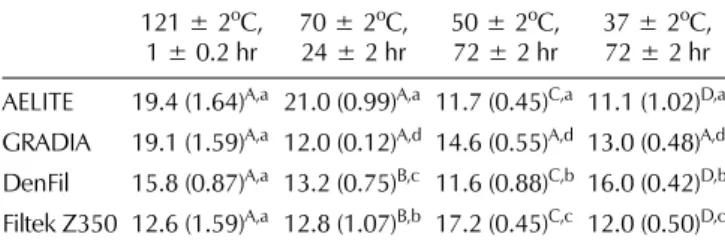
The results indicated that extraction temperature and time affected the chemically reduced material of the dental com-posite resins (Table 4). The consumption of the control group was 20 to 23 ml. The larger the difference between the con-trol and the experimental groups, the higher the value of KMnO4-test’s result. The extract condition of high temperature
and short time duration usually showed higher difference than that of low temperature and long time duration. The extract time, in certain cases, was more important than the extract temperature because 70 ± 2oC, 24 ± 2 hr and 121 ± 2oC,
1 ± 0.2 hr produced variable results. From these reasons, there was no significantly difference between conditions.
Conclusions
Both extract temperature and time influenced composite resin’s flexural strength, UV absorbance and KMnO4-test.
Increasing extraction time weakened the composite resins while increasing extraction temperature heightened the flex-ural strength of the composite resins. The extract condition of high temperature and short time duration showed higher UV absorbance than that of low temperature and long time. Sometimes, KMnO4-test showed the extract time was more
important than the extract temperature. These are cautiously
expected that both extract temperature and time influence flexural strength; extract temperature is more significant to UV absorbed materials and extract time is more important in terms of chemically reduced materials.
Acknowledgements
This work was supported by the Korea Science and Engi-neering Foundation (KOSEF) grant funded by the Korea gov-ernment (MOST) (No. R13-2003-013-01001-0).
References
1. K. J. Anusavice, “Phillips’ science of dental materials,” 11th ed.
Saunders, (2003).
2. T. A. Bean, W. C. Zhuang, P. Y. Tong, J. D. Eick, and D. M. Your-tee, “Effect of esterase on methacrylates and methacrylate
poly-mers in an enzyme simulator for biodurability and biocom-patibility testing,” J. Biomed. Mater. Res., 28, 59-63 (1994).
3. J. P. Santerre, L. Shajji, and B. W. Leung, “Relation of dental
composite formulations to their degradation and the release of hydrolyzed polymeric-resin-derived products,” Crit. Rev. Oral.
Biol. Med., 12, 136-151 (2001).
4. M. Freund and E. C. Munksgaard, “Enzymatic degradation of
BISGMA/TEGDMA-polymers causing decreased microhardness and greater wear in vivo,” Scand. J. Dent. Res., 98, 351-355
(1990).
5. E. C. Munksgaard and M. Freund, “Enzymatic hydrolysis of
(di)methacrylates and their polymers,” Scand. J. Dent. Res., 98,
261-267 (1990).
6. I. B. Larsen and E. C. Munksgaard, “Effect of human saliva on
surface degradation of composite resins,” Scand. J. Dent. Res., 99, 254-261 (1991).
7. Y. Finer and J. P. Santerre, “Salivary esterase activity and its
asso-ciation with the biodegradation of dental composites,” J. Dent.
Res., 83, 22-26 (2004).
8. M. Hagio, M. Kawaguchi, W. Motokawa and K. Miyazaki, “
Deg-radation of methacrylate monomers in human saliva,” Dent.
Mater. J., 25, 241-246 (2006).
9. J. P. Santerre, L. Shajji, and H. Tsang, “Biodegradation of
com-mercial dental composites by cholesterol esterase,” J. Dent. Res., 78, 1459-1468 (1999).
10. ISO 4049:2000 Dentistry − Polymer-based filling, restorative and
luting materials.
11. ISO 10993-12:1996 Biological evaluation of medical devices −
Part 12: Sample preparation and reference materials Korean Pharmacopoeia 8th Edition.
Table 4. KMnO4-test of dental composite resins after extract
treatments (ml)
121 ± 2oC,
1 ± 0.2 hr 70 ± 224 ± 2 hroC, 50 ± 272 ± 2 hroC, 37 ± 272 ± 2 hroC, AELITE 19.4 (1.64)A,a 21.0 (0.99)A,a 11.7 (0.45)C,a 11.1 (1.02)D,a
GRADIA 19.1 (1.59)A,a 12.0 (0.12)A,d 14.6 (0.55)A,d 13.0 (0.48)A,d
DenFil 15.8 (0.87)A,a 13.2 (0.75)B,c 11.6 (0.88)C,b 16.0 (0.42)D,b
Filtek Z350 12.6 (1.59)A,a 12.8 (1.07)B,b 17.2 (0.45)C,c 12.0 (0.50)D,c