• 검색 결과가 없습니다.

Study on shear bond strength of various composite resins to artificial denture teeth

N/A
N/A
Protected

Academic year: 2021

Share "Study on shear bond strength of various composite resins to artificial denture teeth"

Copied!
7
0
0

로드 중.... (전체 텍스트 보기)

전체 글

(1)

수복용 레진과 인공치아간의 결합강도 연구

박 경 모

부산가톨릭대학교 치기공학과 (치과기공기재분과학회 회원)

Study on shear bond strength of various composite resins to artificial denture teeth

Kyung-Mo Park

Department of Dental Laboratory Science, Catholic University of Pusan

Purpose: The dental medicine has been preparing the custom-made service to meet the requirements of the aged society, while the average span of human life is growing more and more, and the full denture is a representative of them. It is causing great concern in these atmosphere of society, and demands for it are expected to increase. The full denture is a uniform combination of denture base and artificial teeth using polymerization, and is most influenced by change of physical properties of denture base and bonding strength with artificial teeth.

Methods: In this study, the samples were made of composite resin combined with occlusion surface of artificial teeth undergone mechanically surface treatment to evaluate the bonding strength of composite resin for repairing artificial teeth. The resin teeth used in this study are 3 types artificial teeth. And 3 types of composite resins are used that are various polymerization resin . The shear strength of composite resins made in various polymerization ways to resin teeth was measured to evaluate bonding strength of artificial teeth to each composite resins.

Results: Surface hardness’s results on Trubyte Biotone(74.58Hv), Biotone IPN(70.06Hv), Endura Posterio (64.48Hv). Results of bonding strength of artificial teeth to composite resins on ES samples(8.73 ), IF(4.37 ) and IZ(3.84 ).

Conclusion: 1. The Trubyte Biotone(74.58Hv) was first, followed by Biotone IPN(70.06Hv), and Endura Posterio(64.48Hv) in surface hardness’s results of worn sides using hardness test.

2. The ES samples(8.73 ) showed significant differences with IF(4.37 ) and IZ(3.84 ) (p<0.05), but not other samples(p>0.05) in results of bonding strength of artificial teeth to composite resins.

[Abstract]

성 명 박 경 모 전 화 051-510-0594 E-mail [email protected] 교신저자

Key words :bonding strength, artificial teeth, composite resins, hardness test

(2)

Ⅰ. 서 론

총의치는 레진소재의 의치상에 인공치아를 배열하여 중 합에 의해 결합하는 방식으로 제작된다. 이러한 총의치는 의치상의 물성변화와 인공치아와의 결합력이 총의치의 유지・관리에 있어 중요한 요소이므로 의치상 재료와 인 공치아 재료, 의치상과 인공치아 간의 결합력에 관한 연 구가 활발하게 이루어지고 있다.

의치상용 고분자 재료는 현재 PMMA(polymethyl methacrylate)를 널리 사용하고 있다.

열중합 방식의 의치상 레진은 강도, 색조 안정성, 심미 성, 조직 친화성 등에서 양호한 것으로 보고되고 있다 (Takamata와 Setcos, 1989). 하지만 수분 또는 타액에 의한 팽창과 중합과정에서 일어나는 변형으로 인한 의치 의 적합성 저하가 발생된다(황승우와 정문규, 1993). 열중 합 방식의 의치상 레진의 적합성 저하 문제는 체적변화가 원인인 것으로 판단되는데, 의치상 제작시 의치상의 레진 을 중합하기 위한 과정에서 매몰과 온성(heat cure) 그리 고 의치상 레진의 주입 및 중합과정에서 이러한 변형이 야기되는 것으로 보고되었다(Smith 등, 1962).

인공치아로 사용되는 레진치아 중 종래의 아크릴릭 레 진치아는 의치상 레진과 우수한 결합력을 가지고 있으나, 구조상 PMMA로 되어 있어 낮은 마모저항성을 가지고 있다. 이러한 단점 때문에 최근에는 가교결합(cross- linking)을 통한 레진의 강화방법과 미세 입자형 복합레 진 인공치가 소개되었다.

가교결합을 이용하여 레진치아를 강화하는 방법은 MMA와 소량의 dimethylmethacrylate를 PMMA 분말 존재 하에서 중합시키는 방법과, 고도로 가교결합된 아크 릴릭 중합체에 PMMA 분말 대신 colloidal silica를 첨가 하는 방법이 있다. 이러한 가교결합에 의해 강화된 레진 치아는 마모저항이 높고 심미성이 우수하며 중합 방법이 간편하고 화학결합의 파괴 없이는 분해되지 않는 장점과 (Ogle, 1985), 가교결합으로 인한 과도한 마모저항성 증 가와 균열 발생시 화학적 결합에 문제가 일어나는 단점을 가지고 있다

의치상과 인공치아 간의 결합력 강화는 임상에서 요구 하는 요소로(Cuningham, 1993) 의치상과 인공치아의

법에 따른 결합강도 비교(Clancy와 Boyer, 1989;

Clancy 등, 1991) 그리고 높은 경도의 인공치아와 결합에 대한 연구(Saito, 1990; Hasegawa, 1990; Tachii 등;

1999) 등 많은 연구가 이루어져 왔다.

의치상과 인공치아의 중합물인 총의치는 수요 증가에 따라 의치상의 파절이나 인공치아 탈락 그리고 인공치아 마모 등으로 인한 수리의 요구도도 높아지고 있다 (Cunningham와 Benington, 1999). 이에 대한 내용으 로 최근에는 결합재와 수복용 레진에 관한 연구(Vergani 등, 2000)와 인공치아의 표면처리에 따른 수복용 레진과 의 결합강도에 관한 연구가 보고 되고 있다(방몽숙, 1999;

김미리 등, 2002). 하지만 현재 사용되는 의치상, 인공치 아 그리고 수복용 복합레진의 종류는 다양하며 각각의 소 재 및 중합방법 또한 달라 적절한 결합방법 및 결합강도 에 대한 연구는 미흡한 것으로 사료된다. 그래서 본 연구 에서는 소재가 다른 인공치아 3종과 중합방법이 다른 수 복용 복합레진 3종을 선택하여 중합을 통해 결합시킨 후 전단파절강도를 측정하여 각각의 인공치아와 수복용 복 합레진간의 결합력을 평가하고 총의치에 사용되는 인공 치아의 수리를 위한 수복용 복합레진의 결합성능을 평가 하고자 하였다.

Ⅱ. 연구 방법

1. 실험 재료

총의치의 인공치아의 수리 및 보강을 위하여 사용되는

수복용 복합레진간의 결합성능을 평가하기 위하여 3종의

인공치아와 3종의 수복용 복합레진을 선택하여 각각의

결합성능을 관찰하였다. 실험을 위한 인공치아는

Trubyte Biotone(Dentsply, USA), Biotone

IPN(Dentsply, USA), Endura Posterio(Shofu, Japan)

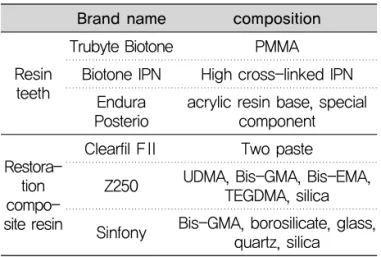
의 3종을 선택하였으며, 수복용 복합레진은 ClearfilTM

FⅡ(Kuralay, Japan), FiltekTM Z250(3M ESPE AG,

Germany), SinfonyTM(3M ESPE AG, Germany)의 3

종을 선택하였다(Table 1).

(3)

2. 시편 제작

표면관찰 및 전단파절강도를 측정하기 위한 마모인공치 아 시편을 제작하기 위하여 3종의 인공치아 교두를 denture bur를 이용하여 약 2㎜ 삭제하고 고정용 레진을 이용하여 직경 15㎜, 길이 30㎜의 고정용 block으로 고정 을 실시하고, 교합면을 N0. 400, No. 1000 silicon carbide sand paper로 연마, 표면에 의한 결합력의 변수 를 배제한 기계적 표면처리가 동일한 마모인공치아 시편 을 제작하였다(Fig. 1).

준비된 마모 인공치아 시편의 수복을 위하여 직경이 3.5㎜, 높이가 3㎜인 몰드를 사용하여 수복용 복합레진과 결합 시켰다. 수복용 복합레진 3종은 <Table 2>와 같이 각각의 방법에 따라 결합을 실시하였다. ClearfilTM FⅡ 는 bonding agent 도포 후 수복용 복합레진을 혼합하여 몰드를 이용하여 축성하여 실온에서 자가중합을 실시하 였고, FiltekTM Z250은 AdperTM Single Bond 2를 도 포하고 광중합기(EliparTM Freelight 2 LED Curing Light, 3M ESPE AG, Germany)로 10초간 광중합하고 몰드를 이용하여 1.5㎜씩 두 번에 걸쳐서 20초씩 광중합

을 실시하였다. 그리고 SinfonyTM는 Activator liquid 도포 후 VisioTM alfa에서 10초간 중합 한 뒤 몰드를 이 용하여 레진을 축성하고 VisioTM beta Vario에서 15분 간 광중합을 실시하여 결합하여 각각의 전단파절강도 시 험용 시편을 제작하였다.

3. 실험 방법 1) 경도측정

시험에 사용된 인공치아 표면의 기초 물성 관찰을 위하 여 경도를 측정하였다. 시편 분류에 따라 Mounting Press(MOT-FTA2 (주)에프텍기기)와 AM1133 (ALPHA, USA)을 이용하여 고정 (Molding)을 실시하고 Phoenix Beta Grinder / Polihser (BUEHLER

, USA) 를 이용하여 경면연마를 실시하였다. 경면연마가 끝난 시 편은 Micro Vicker’ s hardness tester (Future-Tech Co. Tokyo, Japan)를 사용하여 Test load: 100 gf, Dwell time: 15 sec 조건으로 경도를 측정하였다. 측정값 은 임의의 위치에 시편 당 5회씩 측정하여 평균으로 산출 하였다.

2) 전단결합강도 시험

준비된 전단파절강도 시험용 시편을 이용하여 결합성능 을 관찰하기 위해 만능시험기(UTM, Instron, USA)로 전 단력 측정을 위한 전단시험용 jig의 lower jig는 고정한 상태에서 upper jig에서 load를 가하였고 displacement 는 하부에서 상부로 인장하였다. 전단 이동 속도는 0.5㎜

/min으로 하였다. 시험 결과 data는 초당 5개를 load와 Table 2. Classification of experimental group Specimens

BF BZ BS IF IZ IS EF EZ ES

Trubyte Biotone Trubyte Biotone Trubyte Biotone

Biotone IPN Biotone IPN Biotone IPN Endura Posterio Endura Posterio Endura Posterio

Clearfil FⅡ Filtek Z250 Sinfony Clearfil FⅡ Filtek Z250 Sinfony Clearfil FⅡ Filtek Z250 Sinfony

Artificial teeth Restoration resin Table 1. Materials used in this study

Brand name

Resin teeth

Restora- tion compo- site resin

Trubyte Biotone Biotone IPN

Endura Posterio Clearfil FⅡ

Z250

Sinfony

PMMA High cross-linked IPN acrylic resin base, special

component Two paste

UDMA, Bis-GMA, Bis-EMA, TEGDMA, silica Bis-GMA, borosilicate, glass,

quartz, silica

composition

Fig. 1. Shape of specimens

(4)

전단파절강도 결과의 최대파절 강도 값을 이용하여 인공 치아와 수복용 복합레진간의 결합력을 식 1을 이용하여 산출하였다.

Ⅲ. 결 과

1. 경도측정 결과

시험에 사용된 인공치아 표면의 기초 물성 관찰을 위하 여 마모인공치아 시편의 마모면의 경도를 측정하였다. 그 결과 3종의 인공치아 중 Trubyte Biotone는 74.58Hv, Endura Posterio는 64.48Hv, 그리고 Biotone IPN은 70.06Hv로 측정되어 Trubyte Biotone의 표면경도 값이 가장 높게 나타났으며, Endura Posterio가 가장 낮게 나 타났다(Table 4) (Fig. 3).

2. 인공치아와 수복용 레진의 전단결합강도

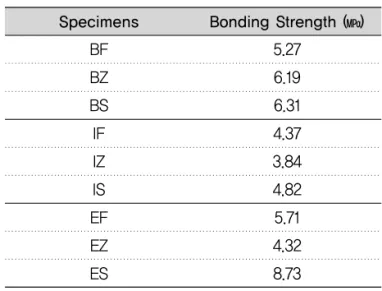
3종의 마모인공치아 시편의 마모 처리한 부위를 3종의 수복용 복합레진으로 수복하여 전단파절강도 시험을 통 하여 얻은 전단파절강도 값을 이용하여 인공치아와 수복 용 복합레진간의 결합력을 산출하였다. 그 결과 Trubyte Biotone 인공치아에 수복을 실시한 시험군인 BF시편은 5.27㎫, BZ시편은 6.19㎫, BS시편은 6.31㎫로 측정되었 으며, Biotone IPN 인공치아에 수복을 실시한 시험군인 IF시편은 4.37㎫, IZ시편은 3.84㎫, IS시편은 4.82㎫로 측정되었다. 그리고 Endura Posterio 인공치아에 수복 을 실시한 시험군인 EF시편은 5.71㎫, EZ시편은 4.32㎫,

Ⅳ. 고 찰

생활수준의 향상과 더불어 신체적, 정신적, 사회적 건강 과의 관계석이 날로 높아지는 구강보건을 위한 가철성 의 치의 실용성 및 심미성에 대한 욕구를 해소시키는 하나의 수단으로 주로 사용되는 레진 인공치아는 우수한 파절 저 항성과 레진 의치상과의 결합력, 교합조정의 용이성 등의 장점으로 인해 현재 대부분의 가철성 보철물의 인공치아 로 널리 사용되어지지만, 구치부 교합면에서의 낮은 마모 저항성은 아직까지 단점으로 지적되고 있다(최유성, 2007).

급격한 인공치의 마모는 교합고경과 교합관계에 심각한 영향을 끼침으로써 측방력을 증가시키고, 이에 따른 많은 부작용이 발생된다. 이러한 이유 때문에 레진 인공치아가 개발된 이후로 마모저항성에 대한 수많은 연구가 계속 진 행되고 있다(Khan 등, 1984; Khan 등, 1985; Whitman 등, 1987; von Fraunhofer 등, 1988).

본 연구에서 사용한 Biotone IPN과 Endura Posterio 는 고도로 가교결합된 아크릴릭 레진과 복합레진으로 제 작된 마모저항성 레진치아로써 아크릴릭 레진치아의 단 점을 최소화시키고 성질을 강화시켜 만든 제품이다 (Whitman 등, 1987; 이주희 등, 1996; Abe 등, 1997).

1986년 Caswell과 Norling은 마모저항성을 갖는 치아 τ= --- (식1) F

A

shear bonding strength = F(load)/A(area)

Table 4. Micro hardness of artificial teeth specimens Artificial teeth Micro hardness (Hv)

Trubyte Biotone

Endura Posterio Biotone IPN

74.58 64.48 70.06

Table 5. Bonding Strength of Specimens Specimens Bonding Strength (㎫)

BF BZ BS IF IZ IS EF EZ ES

5.27 6.19 6.31 4.37 3.84 4.82 5.71 4.32 8.73
(5)

의 의치상과의 접착부분을 삭제한 후 의치상과 접착시 더 높은 결합강도를 나타낸다고 보고하였고, 1991년 Clancy 등은 마모저항성을 갖는 치아를 광중합형 레진과 열중합 형 레진에 부착시 광중합형 레진과의 결합강도가 낮게 나 타났다고 하였다. 레진치아의 교합면을 복합레진으로 수 복할 때 결합력에 영향을 주는 요소는 레진치의 화학조성 과 가교결합정도, 수복용 레진의 젖음성과 점주도, 레진 치의 오염정도 등이 있다(Caswell와 Norling, 1986;

Kawara 등, 1991). 그 외에 기계적 유지를 위해 유지구를 형성하거나, sandblasting 또는 carbide paper 연마, chloroform이나 단량체를 도포하는 등의 표면처리를 함 으로서 개선될 수 있다(김미리 등, 2002). 표면처리에 의 해 형성된 미세 요철은 표면적을 크게 하고 분자간 인력 (van der Waals attraction)을 증진시켜 결합 강도를 증 가 시킨다고 보고하였으며(Shen 등, 1984; Fletcher 등, 1985), Chloroform를 이용한 표면처리는 연마 후에 생긴 미세 잔사를 제거하고 거칠어진 표면을 매끄럽게 함으로 써 보다 효과적으로 접합될 수 있는 결합부위를 제공하여 결합강도를 증가시키는 것으로 보고하였다(Shen 등, 1984; Weiner 등, 1987; Vergani 등, 1997; Papazoglou 와 Vasilas, 1999).

결합을 위해서는 단량체에 의한 부풀림 작용이나 침투 가 필요하지만 잔류 단량체가 거의 없는 종류의 광중합 레진에서는 자가중합 레진이나 열중합 레진에 비해 결합 이 약하다고 생각되고 있다(방몽숙, 1999). Cleafil FⅡ는 two paste 타입으로 혼합과 동시에 중합이 시작된다. 초 기흐름성은 광중합 복합레진보다 좋지만 작업시간이 짧 아 레진치아 표면과의 접촉이 술자의 조작에 따라 많이 달라질 수 있을 거라고 생각된다. 김미리 등(2002)은 No.

1000 silicon carbide sand paper로 처리한 IPN 레진치 아와 복합레진치아의 교합면에 50㎛ Al

2

O

3

sandblasting, No. 100 carbide paper, Chloroform(99.95%), 4개의 retentive holes, 무처리로 표면처리를 한 뒤 2종의 수복 용 복합레진인 Clearfil FⅡ와 Z100을 축성 하고 결합강 도를 측정하였다. 그 결과 무처리시 IPN 레진치아에 대해 서 Clear FⅡ는 7.53㎫, Z100은 5.98㎫로 나타났고, Endura 레진치아에 대해서는 Clear FⅡ가 11.20㎫, Z100이 6.73㎫로 나타났다. 본 연구에서도 IPN 레진치

아에 대해서 Clear FⅡ는 4.37㎫, Z250은 3.84㎫로 나타 났고, Endura 레진치아에 대해서 Clear FⅡ는 5.71㎫, Z250은 4.32㎫으로 나타났다. 이처럼 자가중합형인 Cleafil FⅡ 시편에서 광중합 레진인 Z100과 Z250에서 보다 더 많은 값의 차이를 나타냈다. 이러한 차이는 Cleafil FⅡ레진이 작업시간이 짧아 금방 중합이 끝나버 린 이유 때문에 레진치아와 접촉 정도의 차이로 생각되며 이것은 술자의 조작성 차이 때문인 것으로 사료된다. 또 한 두 연구에서 모두 자가중합 레진이 광중합 레진보다 더 높은 결합강도를 나타냈다. 이것은 위에서 언급했듯이 자가중합 레진의 잔류 단량체가 레진치아의 표면에 부풀 림 작용이나 침투현상 때문인 것으로 생각된다. 인공치아 의 부착면에 단량체의 도포가 결합에 미치는 영향에 대한 연구가 시도되었고, Spratley(1987)는 중합시 치아면에 단량체를 도포하는 것만으로는 결합을 개선시킬 수 없다 고 보고하였다.

Clancy와 Boyer(1989)는 경질 레진치아와 자가중합 레 진, 열중합 레진, 광중합 레진과의 결합강도를 비교한 결 과 열중합 레진과 경질 레진치아 사이에 가장 강한 결합 력이 나타났다고 보고하였고, Clancy 등(1991)과 Kawara 등(1991)은 광중합 레진의 경우 결합력이 가장 낮게 나타났다고 보고하였다. 본 연구에서도 경질레진치 아인 IPN 레진치아와 Endura 레진치아에서 광중합 레진 인 Z250 시편에서 가장 낮은 결합강도 값을 나타냈고, 광 중합과 함께 열이란 요소도 중합과정에 함께 작용하는 Sinfony 시편에서는 가장 높은 결합강도 값을 나타내 위 의 보고와 유사한 결과가 나타나는 것을 알 수 있다.

본 연구에서 측정된 결합강도 값은 BF시편이 5.27㎫,

BZ시편이 6.19㎫, BS시편이 6.31㎫, IF시편이 4.37㎫,

IZ시편이 3.84㎫, IS시편이 4.82㎫, EF시편이 5.71㎫,

EZ시편이 4.32㎫, ES시편이 8.73㎫으로 나타났다. 모든

레진치아군에서 Sinfony 레진과 결합된 시편의 강도 값

이 높게 나타났다. 또한 SEM을 이용하여 관찰한 결과,

초기 흐름성은 좋지만 작업시간이 짧아 빨리 중합이 되는

Clearfil FⅡ 레진에서 많은 다공성이 관찰되었지만 BF

시편, IF시편, EF시편의 계면에서는 틈 (gap)이 관찰되지

는 않았다. Z250 레진에서는 약간의 다공성이 관찰되었

고 IZ시편(≒ 0.5㎛), EZ시편(≒ 0.8㎛)의 계면에서는 틈

(6)

반대로 흐름성이 좋은 Sinfony 레진에서는 다공성이 거 의 관찰되지 않았고 BS시편(≒ 0.3㎛)의 계면에서는 틈이 관찰되었지만 IS시편, ES시편에서는 틈이 관찰되지 않았 다. 특히 결합강도가 가장 높게 나왔던 ES시편은 인공치 아와 수복용 복합레진과의 경계부에서 계면에서의 차이 가 거의 나지 않는 것으로 관찰되었다. 이것은 Sinfony 레진이 다른 복합레진에 비해 흐름성이 가장 좋기 때문에 레진치아 표면의 미세 요철부위에 잘 침투한 결과로 생각 된다. 또 다른 하나의 이유로는 Sinfony 레진이 전용의 VisioTM beta Vario란 기계에서 중합될 때 빛과 함께 열 에 의한 요인이 작용했을 것으로 생각된다. 따라서 이후 연구에서는 레진의 흐름성과 중합시 열적 요인이 미치는 영향에 대한 연구가 필요하다고 생각된다. 따라서 수복용 복합레진, 그리고 인공치아, 의치상 각각의 소재 및 중합 방법에 따른 결합방법 및 결합강도에 관한 연구는 총의치 의 성공적인 수리를 위한 자료로 활용될 것으로 사료된다.

Ⅴ. 결 론

본 연구에서는 인공치아의 수리를 위한 수복용 복합레 진의 결합성능을 평가하기 위해 중합방법이 다른 수복용 복합레진을 레진치아에 결합시켜 중합하고 전단파절강도 를 측정하여 각각의 인공치아와 수복용 복합레진간의 결 합력을 평가하여 총의치에 사용되는 인공치아의 수리를 위한 수복용 복합레진의 결합성능을 평가하고자 하였다.

그 결과 다음과 같은 결론을 얻을 수 있었다.

1. 경도 측정결과 마모면의 표면경도는 Trubyte Biotone(74.58Hv), Biotone IPN(70.06Hv), Endura Posterio(64.48Hv) 순으로 높게 나타났다.

2. 인공치아와 수복용 복합레진의 결합력을 관찰한 결 과 ES시편(8.73㎫)이 IF시편(4.37㎫)과 IZ시편(3.84㎫), 그리고 EZ시편(4.32㎫)과 유의차(p<0.05)를 나타내었고, 나머지 군에서는 유의차(p>0.05)가 나타나지 않았다.

REFERENCES

Kim ML, Jeong CM, Jeong YC, Lim JS. Shear bond strengths between abrasion-resistant denture teeth and composite resins. The Korean Academy of Prosthodontics, 40⑵, 201-212, 2002.

Kim YS, Kim CH, Jo IH. Prosthodontic treatment for edentulous patients, 1995.

Vang MS. Bond strength of various resins to denture teeth by surface treatment. The Korean Academy of Prosthodontics, 37⑴, 42- 50, 1999.

Lee JH, Kim CW, Kim YS. An experiment al study of the bond strength of denture teeth bonded to denture base materials. The Korean Academy of Prosthodontics, 34⑶, 464-474, 1996.

Choi YS. A comparative study on wear resistance and hardness of several artificial resin teeth.

Department of prosthodontics graduate school, Dankook university, 2007.

Hwang SW, Jong MG. Comparative tensile bond strength of heat-cured cold-cured and light cured denture base resins bonded to continuous-pressure injection type denture base resin, The Korean Academy of Prosthodontics. 31⑶, 385-393, 1993.

Abe Y, Sato Y, Akagawa Y, Ohkawa S. An in vitro study of high-strength resin posterior denture tooth wear. Int J Prosthodont, 10, 28-34, 1997.

Caswell CW, Norling BK. Comparative study of the bond strengths of three abrasion resistant plastic denture teeth bonded to a cross- linked denture base material. J Prosthet Dent, 55, 701-708, 1986.

Clancy JMS, Boyer DB. Comparative bond strength

(7)

of light cure, Heat-cured, and autopolymerizing denture resins to denture teeth. J Prosthet Dent, 61, 457-462, 1989.

Clancy JMS, Hawkins LF, Keller JC, et al. Bond strength and failure analysis of light-cured denture resins bonded to denture teeth. J Prosthet Dent, 65, 315, 1991.

Cuningham JL. bond strength of denture teeth to acrylic bases. J Dent, 21, 274-280, 1993.

Fletcher AM et al. A method of improving the bonding between artificial teeth and PMMA.

J Prosthet Dent, 13, 102-108, 1985.

Hasegawa J. The Endura anterio high-strength denture teeth. Dental Diamond, 3, 104-105, 1990.

Kawara M, Carter JM, Ogle RE, Johnson RR.

Bonding of plastic teeth to denture base resins. J Prosthet Dent, 66, 566-571, 1991.

Khan Z, Morris JC, VonFraunhofer JA. Wear of anatomic acrylic resin denture teeth. J Prosthet Dent, 53, 550-551, 1985.

Khan Z., Morris JC, VonFraunhofer JA. Wear of nonanatomic(monoplane) acrylic resin denture teeth. J Prosthet Dent, 52, 172-174, 1984.

Ogle RE, David LJ, Ortman HR. Clinical wear study of a new tooth material. Part Ⅱ. J Prosthet Dent, 54, 67-75. 1985.

Papazoglou E, Vasilas AI. Shear Bond strengths for composite and autopolymerized acrylic resins bonded to acrylic resin denture teeth. J Prosthet Dent, 82, 573-578, 1999.

Shen C, Colaizzi FA, Birns B. Strength of denture repairs as influenced by surface treatment. J Prosthet Dent, 52, 844-848, 1984.

Smith DC. Recent developments and prospects in dental polymers. J Prosthet Dent, 12, 1066- 1078, 1962.

Spratley MH. An investigation of the adhesion of acrylic resin denture base materials. J Prosthet Dent, 58, 389-392, 1987.

Spretley MH. An investigation of the adhesion of acrylic resin teeth to dentures. J Prosthet Dent, 58, 389-392, 1987.

Tachii D, Takahashi Y, Habu T. Bond strength on Occlusal surface of composite resin tooth and composite resin. QDT, 24, 71-77, 1999.

Takamata T, Setcos JC. Resin Denture bases : Review of accuracy and methods of polymerization. Int J Prosthodont, 2, 555- 562, 1989.

Vergani CE, Giampaolo ET, Cucci ALM. Composite occlusal surfaces for acrylic resin denture teeth. J Prosthet Dent, 77, 328-331, 1997.

Vergani CE, Machado AL, Giampaolo ET. Pavarina AC. Effect of surface treatments on the bond strength between composite resin and acrylic resin denture teeth. The international journal of prosthodontics, 13⑸, 383-386, 2000.

von Fraunhofer JA, Razavi R, Khan Z. Wear characteristics of high strength denture teeth. J Prosthet Dent, 59, 173-175, 1988.

Weiner S, Krause AS, Nicholas W. Esthetic modification of removable partial denture teeth with light-cured composites. J Prosthet Dent, 57, 381-384, 1987.

Whitman DJ, Mckinney JE, Hinman RW, Hesby RA, Pelleu GB. In vitro wear rates of three types of commercial denture tooth materials.

J Prosthet Dent, 57, 243-246, 1987.

수치

Fig. 1. Shape of specimens
Table 4. Micro hardness of artificial teeth specimens Artificial teeth Micro hardness (Hv) Trubyte Biotone Endura Posterio Biotone IPN 74.58 64.4870.06

참조

관련 문서

The objective of this study is to analyze the shear bond strength of orthodontic buttons according to light tip distance and optic fiber diameter when an extended optic

The effects of recycling on the tensile bond strength of new and clinically used stainless steel orthodontic brackets: an in vitro study. Material testing of

Longitudinal study on torque transmitted from a denture base to abutment tooth of a distal extension removable partial denture with circumferential clasps..

Within the limitations of this study, it is concluded that pretreatment of desensitizing agent (Seal&amp;Protect) reduced the bond strength of two-step self-etch adhesive

Within the limitation of this study, it can be concluded that pretreatment with EDTA or phosphoric acid have negative effect in apical part on push out bond strength of fiber

On the artificial waterway that stretches on in the middle of the park, various water leisure sports activities are taking place, such as water taxi available at the West

The purpose of this study was to evaluate the microleakage of composite resins(Filtek ™ Z250), resin-reinforced glass ionomer cements (Fuji II LC ® ), and traditional

▶ See lecture note P99-104 and P108 for the flexural and shear strengths of composite slab-on- stringer deck.... ▶ Transverse Stiffeners and Shear-Dominant Failure