백악기 경상분지 구산동응회암의 SHRIMP 저콘 연대
김종선1·조형성1·김홍균2·손 문1*
1부산대학교 지구환경시스템학부, 2한국건설기술연구원 Geo-인프라연구실
SHRIMP U-Pb Zircon Ages of the Gusandong (Kusandong) Tuff in the Cretaceous Gyeongsang Basin
Jong-Sun Kim1, Hyeongseong Cho1, Hong-Gyun Kim2, and Moon Son1*
1Department of Geological Sciences, Pusan National University, Busan, 609-735, Korea
2Geotechnical Engineering Research Division in KICT, Goyang, Korea
요 약: 백악기 경상분지의 대표적 건층인 구산동응회암은 화도를 달리하는 세 개의 응회암체인 북부구산동 응회암, 남부구산동응회암 그리고 신수도응회암으로 구분된다. 이 연구는 이들 세 응회암에 대한 저콘 SHRIMP U-Pb 연대측정을 통해 더욱 신뢰할 수 있는 분출 연령을 제시하여 경상분지의 층서확립에 기여하고자 하였 다. 연대측정 결과 북부구산동응회암과 남부구산동응회암에서는 각각 103.0±1.2 Ma와 104.1±1.3 Ma로 매우 유사한 연령을 얻어 이들 응회암의 주 분출 시기는 103~104 Ma 사이로서 거의 동시에 분출된 것으로 해석 된다. 한편, 신수도응회암에서 얻어진 연령은 103.4±2.1 Ma와 95.79±0.98 Ma의 두 종류로 구분된다. 오래된 연령을 보이는 저콘들과 구별되는, 젊은 저콘들이 가지는 음극선 발광영상과 저콘들의 형태는 103 Ma 이후 다른 시기의 저콘이 포함되어 있다는 것을 의미하며 이는 구산동응회암 분출 이후, 또 다른 화산활동의 분출 결과로 해석된다.
핵심어: 백악기, 경상분지, 구산동응회암, SHRIMP, 신수도응회암
Abstract:
The Gusandong Tuff (Kusandong Tuff), known as a very significant key bed in the Cretaceous Gyeongsang Basin, is divided into (1) Northern Gusandong Tuff (NKT), (2) Southern Gusandong Tuff (SKT), and (3) Sinsudo Tuff, which were derived from different vents. In order to suggest their more accurate eruption times and to contribute to establishing stratigraphy of the basin, SHRIMP U-Pb zircon ages were determined from the three tuffs. As a result, the virtually same ages of 103.0±
1.2 Ma and 104.1±
1.3 Ma were obtained from NKT and SKT, respectively, which mean that they simultaneously erupted during 103~104 Ma. The zircon ages obtained from the Sinsudo Tuff are however divided into two groups i.e. 103.4±
2.1 and 95.79±
0.98 Ma. Based on distinctive morphology and cathodoluminescence image of the younger zircons, the younger age, 95.79±
0.98 Ma, is much more reasonable as the eruption time of the Sinsudo Tuff.Key words:
Cretaceous, Gyeongsang Basin, Gusandong Tuff (Kusandong Tuff), SHRIMP, Sinsudo Tuff서 언
한반도의 백악기 지층은 호남과 옥천대 일부 지역 에 소규모로 분포하는 것을 제외하면 대부분 한반도
남동부의 경상분지에 집중되어 분포한다(Fig. 1a). 경 상분지는 암상과 층서적 차이에 근거하여 다시 밀양 지괴, 의성(도평)지괴, 영양지괴 그리고 낙동곡분으로 나누어진다(Chang, 1975). 이들 지괴(일명 소분지)간 의 지층대비와 퇴적시기의 차이, 퇴적환경의 차이, 상 대적 구조운동 특성 그리고 그 원인에 대한 규명은 한반도 백악기의 지사와 분지발달사를 밝히는데 있어
*Corresponding author Tel: 051-510-2248
E-mail: [email protected]
Fig. 1. (a) Distribution map of the Cretaceous basins in South Korea. (b) Simplified geological map of the western
part of the Gyeongsang Basin slightly modified from Jeong et al. (2005) with distribution of Gusandong Tuff
(Kusandong Tuff) and sampling sites.
중요한 연구과제이다.
경상분지의 지층들은 측방으로 상변화가 심하고, 층 서대비에 필요한 건층(key bed)의 불연속성과 화석의 부족으로 인해 지층들의 층위확립과 지괴간의 층서대 비가 명확하게 이루어지지 못하고 있다. 또한, 분지충 전물이 대부분 비화산성 퇴적층들로 구성되어 있어 지층의 정확한 절대연령이 밝혀지지 못해 인접대륙과 의 비교에도 어려움이 있다. 최근 이러한 문제점을 극복하기 위해, 경상분지 퇴적층의 화산기원 물질들 을 대상으로 절대연령 측정에 의한 층서대비 연구가 활발히 진행되고 있다(Chang et al., 1998, 2003;
Kim et al., 2005; Jwa et al., 2009; Lee, T.H. et al., 2010, 2011, 2012; Lee, Y.I. et al., 2010; Cho et al., 2011; Kim et al., 2011; Zhang et al., 2012).
층서적으로 구산동응회암은 의성지괴에서는 하양층 군의 사곡층과 춘산층의 경계에서 나타나며, 밀양지 괴에서는 함안을 기점으로 북쪽으로는 진동층과 함안 층의 경계에서 그리고 남쪽으로는 함안층의 중상부에 출현한다(Chang et al., 1998; Jeong et al., 2005;
Fig. 1b). 경상분지의 층서 대비에서, 절대연령 연구결 과들의 직·간접적인 해석을 살펴보면 가장 중요한 건층으로 구산동응회암(Fig. 1b)의 절대연령을 이용하 고 있다(Chang et al., 1998; Kim et al., 2005;
Jwa et al., 2009; Lee, T.H. et al., 2010; Kim et al., 2011). 따라서 구산동응회암의 정확한 분출연령은 경상분지의 층서확립에 매우 중요한 의미를 가진다고 할 것이다. 현재까지 보고된 구산동응회암의 연령결 과를 살펴보면, Chang et al. (1998)은 저콘 CHIME 연대측정으로 114±10 Ma를 보고하였으며, Jwa and Jeong (2002)은 K-Ar 전암연대측정을 통해 창녕 북 쪽과 남쪽의 응회암의 연령을 각각 97.4~103.4 Ma와 81.9~88.1 Ma로 보고하였다. 한편, Jwa et al. (2009) 은 같은 응회암층으로부터 분리한 저콘에 대해 LA(Laser Ablation)-ICP-MS 분석을 실시하여 북쪽과 남쪽의 응회암 연령을 각각 97.1±2.0 Ma와 97.3±
1.8 Ma로 거의 일치된 U-Pb 연대를 구하였다.
이와 같이 구산동응회암에 대한 CHIME, K-Ar 그 리고 LA-ICP-MS 저콘 U-Pb 연대 측정이 수행된 바 있지만, 보다 신뢰도가 높은 것으로 알려져 있는 고분해능 이차이온 질량분석기(SHRIMP: Sensitive High Resolution Ion Micro Probe)를 이용한 연령측 정은 수행된 바 없다. 한편, 최근 연구(Jwa and Jeong, 2002; Jeong et al., 2005; Sohn et al.,
2005, 2009)에 따르면 구산동응회암은 대구시 달성군 현풍 지역을 기준으로 북부구산동응회암(NKT:
Northern Gusandong Tuff)과 남부구산동응회암(SKT:
Southern Gusandong Tuff)으로 구분될 수 있다.
SKT의 경우에는 두 번 이상의 분출로 만들어진 화쇄 류와 화쇄난류 기원의 복합층(multiple bed)으로 해석 되고 있으며(Jeon and Sohn, 2003; Jeong et al., 2005; Sohn et al., 2005, 2009), 또한 NKT, SKT 그리고 신수도 지역 구산동응회암(신수도응회암)은 각 각 근원화구를 달리하는 마그마로부터 기원되었을 가 능성이 제기된 바 있다(Jeong, 2006). 따라서 본 연 구는 이들 세 지역의 구산동응회암을 대상으로 SHRIMP를 이용한 저콘 U-Pb 연대 측정을 통해 구 산동응회암의 새로운 분출연령을 제시하여, 경상분지 의 층서확립에 기여하는데 목적이 있다.
지질학적 배경
백악기 한반도에는 동아시아 대륙 아래로 고태평양 판(proto-Pacific or Izanagi plate)이 섭입됨에 따라 다수의 비해성 퇴적분지들이 형성되었다(Chough et al., 2000). 이들 중 가장 규모가 큰 경상분지에는 (Fig. 1) 비해성 퇴적층과 후기에 다양한 화산물질들 이 두껍게 퇴적되었다. 이들 분지충전물은 야외 산상 과 화산성 물질의 상대적인 함량에 따라 세 층군 즉, 하부로부터 신동층군, 하양층군, 유천층군으로 나누어 진다. 비화산성 퇴적층으로 구성되는 신동층군은 일 부 화산물질을 포함하는 하양층군에 의해 피복되며, 이후 대부분 화산성 물질로 구성되는 유천층군이 부 정합 또는 갑작스럽게 이들을 피복하였다(Chang, 1975; Choi, 1986; Chough and Sohn, 2010). 신동 과 하양층군은 분지의 북부와 서부에 주로 노출되어 있으며(Fig. 1b), 대부분 충적에서 호성 퇴적환경에서 퇴적된 것으로 알려져 있다(Choi, 1986; Rhee et al., 1998; Jo and Chough, 2001; Houck and Lockley, 2006; Paik and Kim, 2006). 한편, 분지의 남동부에 주로 분포하는 유천층군과 이를 관입하고 있는 불국사화강암류에 대한 암석학적 연구들은 이들 화성암의 기원이 화산호 환경과 밀접히 관련되어 있 음을 보고하고 있다(Min et al., 1982; Yun, 1988, 1998; Kim et al., 1991; Kim and Lee, 1993;
Hwang and Kim, 1994; Sung et al., 1999; Kim et al., 2012).
경상분지의 대표적인 건층으로 알려진 구산동응회 암은 두께가 대부분 약 1~4 m임에도 불구하고 200 km 이상 측방으로 연장되어 나타나며, 결정편의 함량은 높은데(26~91 vol.%) 반해 부석편은 거의 포 함하고 있지 않은 특이한 화쇄류암(ignimbrite)이다 (Jeong, 2006). 최근의 연구들(Jeon and Shon, 2003;
Jeong et al., 2005; Sohn et al., 2009)은 내부구조 와 입자조성에 따라 이 응회암을 수직적으로는 기저 층상층(BLD: Basal Layered Division), 괴상층(MD:
Massive Division), 상부층상층(SUD: Stratified Upper Division)으로 구분하였다(Fig. 2). 일반적으로 SKT에
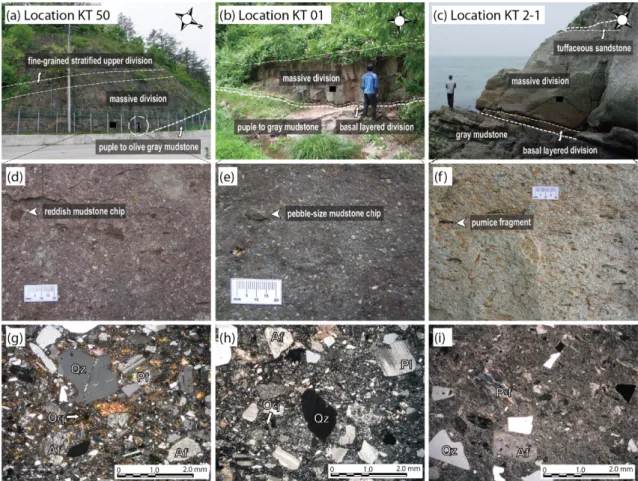
서는 BLD가 하위의 이암을 정합적으로 피복하고 그 위에 MD가 나타나는 반면, NKT에서는 BLD가 없 고 MD가 직접 하위의 퇴적암을 침식적으로 덮고 있 으며 다시 MD 상부를 15~100 cm 두께의 SUD가 피 복한다(Jeon and Sohn, 2003; Fig. 2a, b). NKT의 MD는 SKT의 MD에 비해 결정편과 암편의 함량이 높으며, 골격입자의 크기 역시 NKT의 MD가 더 크 게 나타난다. 결정편(사장석, 알칼리 장석, 석영, 흑운 모, 불투명광물 그리고 저콘 등)과 암편을 포함한 총 골격입자의 함량은 SKT의 BLD가 59.6~91.6 vol.%, MD가 26.5~55.0 vol.%, 그리고 NKT의 MD는 43.4~
Fig. 2. (a) Outcrop of the NKT at locality KT 50, consisting of massive division (MD) and overlying stratified upper division (SUD). A person within dotted circle is 1.7 m tall (for scale). (b) Outcrop of the SKT at locality KT 01, consisting of basal layered division (BLD) and overlying MD. (c) Outcrop of the Sinsudo Tuff at locality KT 02-1, consisting of BLD and MD overlain by tuffaceous sandstone. (d, e, and f) Enlarged photos of the massive divisions of the Gusandong Tuff from the NKT at locality KT 50 (d), the SKT at locality KT 01 (e), and the Sinsudo Tuff at locality KT 02-1 (f). (g) Photomicrograph under crossed nicols of the MD of the NKT at locality KT 50 which is composed of coarse sand- to granule-size grains of crystals and mudstone chips. (h) Photomicrograph of the MD of the SKT at locality KT 01, showing crystal grains within fine-grained ash matrix. (i) Photomicrograph of the MD of the Sinsudo Tuff at locality KT 02-1, showing predominant fine-ash matrix accompanying with pumice fragments.
Quartz (Qz), alkali feldspar (Af), plagioclase (Pl), opaque minerals (Oq), pumice fragment (P-f).
78.4 vol.%이다(Jeong, 2006; Fig. 2d-f). 이 중 암편 과 외래 결정편의 함량은 SKT가 0~2.6 vol.%인 반 면, NKT는 1.9~16.9 vol.%이다. 사장석과 알칼리 장 석의 함량을 비교해 보면 SKT의 BLD와 NKT의 MD는 사장석이 더 많은 반면, SKT의 MD는 알칼리 장석이 더 많이 포함되어 있다. 또한, 기질의 화학조 성 분석결과 SKT는 유문암에 도시되는 반면, NKT 는 유문암과 데사이트 또는 조면암의 영역에 도시된 다(Jeong et al., 2005). 대자율이방성(AMS) 및 골격 입자배열 측정결과 구산동응회암은 현재 노출된 노두 의 동쪽에 위치한 여러 개의 화구로부터 분출하여 분 지의 경계부 또는 서쪽을 향해 70 km 이상 흘러간 것으로 해석된다(Sohn et al., 2005, 2009). 이상의 결과를 종합해보면, NKT와 SKT는 성인이 다른 둘 이상의 마그마로부터 분출하였으며, SKT는 두 번의 강력한 폭발과 화산재 분출로 화쇄난류 기원의 BLD 와 화쇄류 기원의 MD를 형성시킨 것으로 해석된다 (Jeong, 2006; Sohn et al., 2009).
한편, 구산동응회암의 노두가 노출되는 지점 중 가 장 남쪽에 위치한 신수도와 창선도(신수도응회암; KT 02; Figs. 1b & 2c, f, i)에는 퇴적상, 불투명광물의 유무, 입자크기, 골격입자의 종류와 함량 그리고 기질 의 화학조성에서 일반적인 SKT와는 큰 차이를 보이 는 응회암이 출현한다. Jeong (2006)은 이 신수도응 회암에는 북쪽의 SKT와 달리 NKT의 SUD와 유사 한 응회질 퇴적암이 MD를 피복하고 있어 퇴적상이 특이함을 보고하였다(Fig. 2c). 또한 이 응회암에는 북쪽의 SKT에서 흔히 관찰되는 불투명 광물들이 갑 작스럽게 나타나지 않으며, MD의 골격 입자 함량 (26.5~28.6 vol.%)이 북쪽 것들에 비해 현저히 낮고 (Fig. 2i) BLD와 MD 내의 석영 함량이 상대적으로 높은 특징을 보인다. 이와 함께 기질의 화학조성에서 도 북쪽의 SKT와는 현격한 차이가 있음이 보고되었 다(Jeong et al. 2005). 이를 통해 Jeong (2006)은 SKT가 기원이 다른 두 마그마가 서로 다른 화구를 통해 분출하여 만들어진 혼성(composite) 분출단위일 가능성을 제시한 바 있다.
분석방법
SHRIMP U-Pb 연대측정을 위하여 NKT(KT 50), SKT(KT 01) 그리고 신수도응회암(KT 02-1)을 대표 하는 노두에서 MD를 대상으로 시료를 채취하였다
(Figs. 1b & 2). 각각의 응회암들을 파쇄한 뒤 조분 쇄기(jaw crusher)에서 분쇄한 후, 표준망체를 이용하 여 120 메쉬를 통과하고 180 메쉬를 통과하지 못한 시료를 비커를 이용한 팬닝으로 중광물이 농축된 부 분을 회수하고, 회수된 시료로부터 저콘을 실체현미 경을 이용하여 선별하였다. 선별된 저콘 입자들은 표 준물질과 함께 에폭시로 마운트를 제작하였다. 저콘 마운트는 입자가 반쯤 노출될 때까지 연마한 후, 금으 로 표면을 코팅하였다.
저콘 마운트는 한국기초과학지원연구원의 주사전자 현미경(JEOL JSM-6610LV)을 이용하여 음극선발광 (cathodoluminescence, CL) 영상과 후방산란전자 (backscattered electron, BSE) 영상을 얻어 저콘 내 부구조를 관찰하고 분석 위치를 선정하였다. 저콘의 U-Pb 연령측정은 한국기초과학지원연구원의 SHRIMP- IIe/MC를 이용하여 실시하였다. 이온빔의 직경은 25µm이며, 분석절차는 Williams (1998)과 Ireland and Williams (2003)의 방법을 적용하였다. 분석에 사용한 저콘 표준물질은 FC-1과 SL-13이며, 측정 자 료는 SQUID 2.5와 ISOPLOT 3.7 프로그램(Ludwig, 2008, 2009)을 이용하여 처리하였다. U 농도는 SL- 13(238 ppm U; Claoué-Long et al., 1995)을 이용 하여 보정하였고, U/Pb 연대보정을 위해 3점의 미지 시료 분석마다 저콘 표준물질 FC-1(1,099 Ma;
Paces and Miller, 1993)을 한 번씩 분석하였다.
분석결과
연대측정이 이루어진 저콘 입자들은 대부분 진동 누대구조를 잘 보이며(Fig. 3), 1개를 제외한 모든 분 석점들의 Th/U 비율이 0.2를 초과하고 있어 얻어진 연령 값은 대부분 마그마로부터 정출된 화성기원 저 콘의 연령임을 지시한다(Table 1; Hoskin and Schaltegger, 2003). 선별한 저콘 입자들은 대부분 투 명하고 연황색 내지 연녹황색을 띤다. 또한, 대부분 파편상(fragmental)에서 자형의 작은 주상(prismatic) 결정을 이루고 있지만, 일부 장주상(long prismatic)과 단주상(short prismatic)의 것도 있다. 분리는 되었으 나 분석에 포함되지 않은 시료들에서 파편상의 저콘 이 많이 관찰되는데, 이는 이들이 강력한 폭발에 의 한 화쇄류 응회암에서 유래되었기 때문으로 추정된다.
NKT(KT 50)에서 획득된 저콘 중 분석된 것은 21 개로 각 1점씩을 분석하여 99 Ma에서 111 Ma까지
Fig. 3. Cathodoluminescence images and apparent ages of zircons analyzed from (a) the Northern Gusandong
Tuff, (b) Southern Gusandong Tuff, and (c) Sinsudo Tuff in the Gyeongsang Basin. Ellipses and numbers indicate
the locations and SHRIMP
207Pb-corrected
206Pb/
238U ages of analyzed spots. All scale bars are 50 µm in length.
비교적 좁은 범위의 연령들을 얻어냈다(Fig. 3a;
Table 1). 이들 분석치는 일치곡선 상에 놓이거나 가 까운 위치에 놓이지만 다소 분산되어, 207Pb에 보정해 통계적으로 계산하여 103.0±1.2 Ma의 206Pb/238U 가중 평균연령을 얻었다(Fig. 4). 가중평균을 계산할 때 분 석 값의 취사여부는 통계적 처리(t-test)를 수행한 결 과, 보통납의 함량, 분석오류 여부 등을 바탕으로 수 행하였다. 이 과정에서 21개 자료 중 보통납의 함량 이 특이하게 높은 분석점 5.1의 값은 제외되었다 (Table 1).
SKT(KT 01)의 분석 저콘도 21개로 각 1점씩을
분석하였으며, 92 Ma에서 114 Ma 사이의 비교적 좁 은 범위의 연령들이 구해졌다(Table 1). 이들도 일치 곡선 상에 놓이거나 가까운 위치에 놓이지만 다소 분 산되어 있어 207Pb에 보정해 통계적으로 계산하여
206Pb/238U 가중평균연령 104.1±1.3 Ma를 획득하였다 (Fig. 5). 이 과정에서 Th/U의 비가 3.14로 예외적으 로 높은 분석점 2.1과 불일치연령을 보이는 분석점 6.1이 제외되고 통계적 처리(t-test) 과정에서 2개(12.1, 16.1; Table 1)가 더 제외되어 총 17개 값이 가중평 균연령 계산에 사용되었다(Fig. 5).
신수도응회암 연령측정을 위해 총 17개 입자에서
Fig. 3. Continued
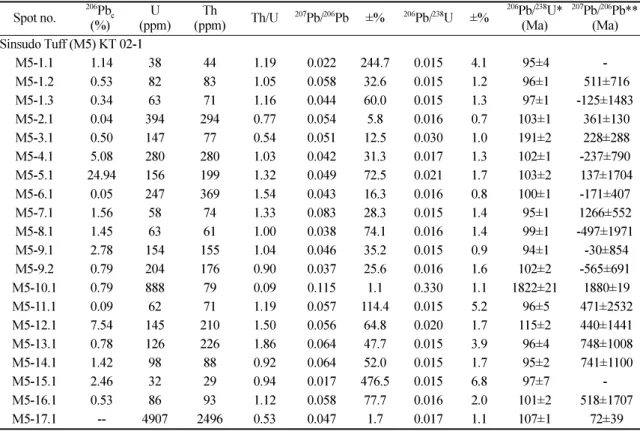
Table 1. SHRIMP U-Pb zircon data from the Gusandong (Kusandong) Tuff in the Gyeongsang Basin
Spot no. 206Pbc (%)
U (ppm)
Th
(ppm) Th/U 207Pb/206Pb ±% 206Pb/ 238U ±% 206Pb/238U*
(Ma)
207Pb/206Pb**
(Ma) Northern Gusandong Tuff (M6) KT 50
M6-1.1 0.07 219 282 1.33 0.050 22.1 0.016 2.8 104±3 197±513 M6-2.1 0.29 352 617 1.81 0.050 15.4 0.016 1.7 104±2 189±358 M6-3.1 0.13 251 313 1.29 0.058 17.7 0.016 1.6 103±2 518±388 M6-4.1 0.35 170 175 1.06 0.042 28.1 0.017 1.8 106±2 -249±712 M6-5.1 14.39 553 480 0.90 0.031 57.1 0.020 1.5 111±2 -1025±1701 M6-6.1 0.40 518 344 0.68 0.050 9.5 0.016 1.8 103±2 196±222 M6-7.1 0.39 231 415 1.86 0.034 35.8 0.016 1.3 103±1 -764±1008
M6-8.1 -- 837 989 1.22 0.048 6.8 0.016 1.1 105±1 98±160
M6-9.1 -- 297 325 1.13 0.064 11.6 0.016 1.7 105±2 739±246 M6-10.1 0.05 418 467 1.16 0.050 10.6 0.016 2.0 101±2 201±246 M6-11.1 0.28 744 881 1.22 0.050 6.0 0.016 1.2 101±1 195±140 M6-12.1 -- 291 469 1.66 0.047 16.1 0.016 1.2 102±1 57±383 M6-13.1 0.24 167 140 0.87 0.060 21.5 0.017 1.3 108±1 599±466 M6-14.1 -- 295 397 1.39 0.040 18.1 0.016 1.6 104±2 -348±467 M6-15.1 -- 184 152 0.85 0.047 25.5 0.017 1.3 107±1 71±607 M6-16.1 0.61 188 150 0.82 0.060 19.6 0.016 1.8 101±2 596±425 M6-17.1 0.21 205 159 0.80 0.044 26.8 0.016 1.3 99±1 -131±661 M6-18.1 1.17 212 341 1.66 0.050 27.5 0.016 1.8 100±2 180±642 M6-19.1 0.04 153 129 0.87 0.037 50.5 0.016 2.4 105±3 -536±1353 M6-20.1 0.46 224 249 1.15 0.040 24.0 0.016 2.9 103±3 -363±620 M6-21.1 0.24 337 289 0.89 0.046 17.3 0.016 1.2 100±1 -2±418 Southern Gusandong Tuff (M8) KT 01
M8-1.1 0.14 1765 1968 1.15 0.048 3.1 0.016 1.4 105±1 117±73 M8-2.1 0.05 732 2222 3.14 0.045 7.3 0.016 1.2 103±1 -32±176 M8-3.1 0.48 200 198 1.02 0.041 29.8 0.016 1.3 103±1 -273±757 M8-4.1 0.80 264 334 1.31 0.054 13.2 0.016 1.6 101±2 356±298
M8-5.1 -- 271 293 1.12 0.035 24.5 0.016 1.2 105±1 -713±681
M8-6.1 0.79 211 175 0.86 0.066 12.3 0.017 2.5 111±3 789±257
M8-7.1 -- 311 391 1.30 0.040 16.3 0.016 2.3 102±2 -380±424
M8-8.1 -- 197 273 1.43 0.052 19.5 0.017 2.6 107±3 298±446
M8-9.1 0.04 227 215 0.98 0.065 14.6 0.017 2.9 107±3 781±307 M8-10.1 0.37 480 568 1.22 0.052 9.2 0.016 1.2 101±1 263±211 M8-11.1 1.07 149 115 0.80 0.058 18.6 0.016 1.3 102±1 536±407
M8-12.1 -- 91 130 1.48 0.032 67.9 0.018 1.5 114±2 -993±2010
M8-13.1 -- 255 314 1.27 0.045 19.2 0.016 1.2 105±1 -51±467
M8-14.1 0.37 301 317 1.09 0.040 21.8 0.016 1.4 106±1 -384±568 M8-15.1 3.15 245 270 1.14 0.031 43.8 0.017 1.2 108±1 -1027±1306 M8-16.1 10.79 2230 2964 1.37 0.047 11.1 0.016 1.2 92±1 25±267
M8-17.1 -- 526 428 0.84 0.053 9.1 0.017 1.2 108±1 312±208
M8-18.1 -- 119 118 1.03 0.075 32.6 0.016 3.6 104±4 1079±655
M8-19.1 1.06 418 436 1.08 0.049 16.6 0.016 2.0 101±2 141±390 M8-20.1 0.12 1900 1390 0.76 0.046 4.3 0.016 1.3 104±1 11±104
M8-21.1 -- 136 169 1.29 0.061 47.7 0.016 2.2 101±2 623±1029
Table 1. Continued
Spot no. 206Pbc (%)
U (ppm)
Th
(ppm) Th/U 207Pb/206Pb ±% 206Pb/238U ±% 206Pb/238U*
(Ma)
207Pb/206Pb**
(Ma) Sinsudo Tuff (M5) KT 02-1
M5-1.1 1.14 38 44 1.19 0.022 244.7 0.015 4.1 95±4 - M5-1.2 0.53 82 83 1.05 0.058 32.6 0.015 1.2 96±1 511±716 M5-1.3 0.34 63 71 1.16 0.044 60.0 0.015 1.3 97±1 -125±1483 M5-2.1 0.04 394 294 0.77 0.054 5.8 0.016 0.7 103±1 361±130 M5-3.1 0.50 147 77 0.54 0.051 12.5 0.030 1.0 191±2 228±288 M5-4.1 5.08 280 280 1.03 0.042 31.3 0.017 1.3 102±1 -237±790 M5-5.1 24.94 156 199 1.32 0.049 72.5 0.021 1.7 103±2 137±1704 M5-6.1 0.05 247 369 1.54 0.043 16.3 0.016 0.8 100±1 -171±407 M5-7.1 1.56 58 74 1.33 0.083 28.3 0.015 1.4 95±1 1266±552 M5-8.1 1.45 63 61 1.00 0.038 74.1 0.016 1.4 99±1 -497±1971 M5-9.1 2.78 154 155 1.04 0.046 35.2 0.015 0.9 94±1 -30±854 M5-9.2 0.79 204 176 0.90 0.037 25.6 0.016 1.6 102±2 -565±691 M5-10.1 0.79 888 79 0.09 0.115 1.1 0.330 1.1 1822±21 1880±19 M5-11.1 0.09 62 71 1.19 0.057 114.4 0.015 5.2 96±5 471±2532 M5-12.1 7.54 145 210 1.50 0.056 64.8 0.020 1.7 115±2 440±1441 M5-13.1 0.78 126 226 1.86 0.064 47.7 0.015 3.9 96±4 748±1008 M5-14.1 1.42 98 88 0.92 0.064 52.0 0.015 1.7 95±2 741±1100 M5-15.1 2.46 32 29 0.94 0.017 476.5 0.015 6.8 97±7 - M5-16.1 0.53 86 93 1.12 0.058 77.7 0.016 2.0 101±2 518±1707 M5-17.1 -- 4907 2496 0.53 0.047 1.7 0.017 1.1 107±1 72±39
- Errors are 1-sigma; Pb
cindicate the common portions.
- *Common Pb corrected by assuming
206Pb/
238U-
207Pb/
235U age-concordance - **Common Pb corrected using measured
204Pb.
- Isotopic ratios and apparent
206Pb/
238U ages>1,000 Ma were calculated on the basis of
204Pb correction method, but apparent ages<1,000 Ma were calculated on the basis of
207Pb correction method (Williams, 1998).
Fig. 4. Concordia diagrams for the SHRIMP zircon U-Pb analyses from the Northern Gusandong Tuff (KT 50). (a)
Mean age of coherent group (n=20). (b) Tera-Wasserburg plots for zircons; Calculation of weighted mean age
included only spot analyses in linear ellipses, not in dotted one. Error ellipses are at 2σ level and the calculated
ages are at 95% confidence. Dotted ellipse is outlier noted by statistical t-test in the calculation of weighted mean
age.
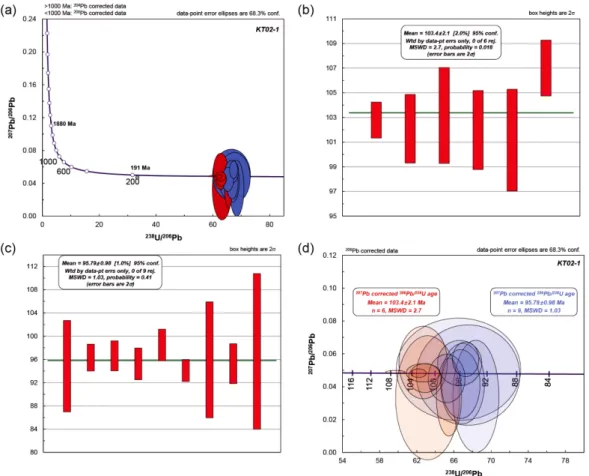
총 20점을 분석하여 94 Ma에서 1,880 Ma까지 매우 넓은 범위의 연령 값을 얻어냈다(Table 1; Fig. 6a).
이들 중 상속핵 연령으로 판단되는 1,880 Ma와 191 Ma 자료를 제외하면, 분석 연령은 94~115 Ma의 범위를 가진다. 이들 연령은 통계적으로 두 개의 그 룹으로 구분할 수 있는데(Fig. 6b-d), 이들의 가중평 균연령은 각각 103.4±2.1 Ma와 95.79±0.98 Ma이다.
가중평균연령 계산에서 총 20개 분석자료 중 상속핵 의 연령으로 추정되는 2개(3.1, 10.1; Table 1)와 통 계처리 과정에서 3개(12.1, 13.1, 15.1; Table 1)가 제외되었다.
토 의
Jwa et al. (2009)은 LA-ICP-MS를 통한 U-Pb 저콘 연령을 SKT는 97.3±1.8 Ma 그리고 NKT는 97.1±2.0 Ma로 보고하였다. 또한 NKT에는 특이하게 평균 107.9±3.0 Ma의 연령을 가지는 더 고기의 저콘 들도 함께 존재함을 보고하였으나, 이들 저콘은 구산 동응회암의 분출 이전의 옛 저콘인 것으로 해석하였 다. 따라서 이번 연구에서 제시된 구산동응회암의 저 콘 연령 103~104 Ma는 광물 분리과정에서 다수의 옛 저콘이 포함되어 얻어진 하나의 오류로 취급될 수 있다. 그러나 이번 연구에서 Jwa et al. (2009)에 의해 옛 저콘들이 전혀 발견되지 않았던 SKT에서도 NKT 에서 얻어진 103.0±1.2 Ma와 오차범위 내에서 일치
하는 104.1±1.3 Ma가 도출되고 있어, 제시된 연령이 옛 저콘의 분석에 의한 오류가 아님을 방증하고 있다.
저콘의 형태는 온도, 냉각속도, 모암의 산성도와 알 칼리 활동도(Si, Na+K/Al) 등에 의해 달라지므로 (Pupin, 1980; Speer, 1982; Belousova et al., 2006), 암석 형성 시의 물리화학적 조건을 유추할 수 있는 중요 지시자로 활용된다(Cho, 2004). Chang et al.
(1998)에 의하면 구산동응회암의 저콘 결정들의 형태 지수가 서로 유사하고 훌륭한 우라늄-납 등시선을 보 이는 등 그 결정들이 동원 마그마 기원임을 보여주고 있으며, 관찰된 결정들은 대개가 마모되지 않은 결정 형태를 보이고 있어 화성기원의 일차적 결정들로 추 정하였다. 또한, 저콘 결정의 폭, 높이, 주면지수, 추면 지수, 신장지수, 편평지수의 평균치와 표준편차 및 저 콘 지수와 결정의 폭을 이용한 PPEF(prism, pyramid, elongation, flatness index)도에서 한 지점에 집중되는 양상을 보여주고 있어 이들 결정들이 동일 마그마 기 원일 가능성이 높음을 보고하였다. 이번 연구에서도 분석된 총 42개의 자료들 중 자료처리 과정에서 제외 된 5개를 제외하면, NKT와 SKT의 각 저콘들은 서 로 잘 일치하는 연령을 보이고 있어 각각의 동원 마 그마 기원으로 해석된다. 따라서 이번 연구에서 제안 되는 저콘 연령 103~104 Ma는 옛 저콘에 의한 오류 가 아니라 구산동응회암의 분출 시기를 직접 지시하 는 것으로 판단된다.
신수도의 응회암(KT 02-1)에서는 103.4±2.1 Ma와
Fig. 5. Concordia diagrams for the SHRIMP zircon U-Pb analyses from the Southern Gusandong Tuff (KT 01). (a)
Mean age of coherent group (n=17). (b) Tera-Wasserburg plots for zircons. Calculation of weighted mean age
included only spot analyses in linear ellipses, not in dotted ones. Error ellipses are at 2 σ level and the calculated
ages are at 95% confidence. Dashed ellipses are outliers noted by statistical t-test in the calculation of weighted
mean age.
95.79±0.98 Ma의 두 평균 연령이 얻어졌다(Table 1;
Fig. 6). 저콘은 일반적으로 열수변질이 없을 경우 저 온~중온에서 반응을 하지 않으며, 부분용융이 일어나 기 직전인 상부 각섬암상 이상부터 과성장이 시작된 다(Vavra et al., 1999; Williams, 2001). Table 1에 서 시료들의 207Pb에 보정 후 계산된 206Pb/238U의 겉 보기 연령과 Th/U의 비를 살펴보면, 99 Ma를 기준 으로 젊은 그룹과 오래된 연령을 보이는 그룹 사이에 큰 차이가 인지되지 않는다. 또한 신수도응회암 내 저어콘의 U, Th 함량은 구산동응회암들에 비해 뚜렷 하게 낮은 농도(Table 1; Fig. 7)를 보이며, 더 젊은 연령에 집중되어 분포한다. 이는 변질의 영향이라기 보다는 구산동응회암과는 분화과정 등 성인적으로 독 립된 다른 시기에 분출된 응회암일 가능성을 뒷받침
한다.
한편, Jeong and Sohn (2005)은 구산동응회암 내 장석의 알바이트화 작용에 대한 연구를 통해, 구산동 응회암의 사장석의 현재 조성은 대부분 알바이트이지 만 본래 조성은 올리고클레스(oligoclase)에서 안데신 (andesine)의 조성범위(Ab62.5-Ab83.3)를 가졌을 것으로 해석하였다. 그러나 다른 구산동응회암에 비해 신수 도의 응회암의 경우는 가장 낮은 알바이트화 작용을 받아 사장석의 원래 조성이 보존되어 있거나 부분적 으로 알바이트화되어 있음을 보고하였다. 이는 속성 과정 또는 열수작용의 영향을 신수도응회암이 가장 적게 받았음을 의미한다. 그럼에도 불구하고 NKT와 SKT에는 신수도응회암에 비해 젊은 연령을 지시하는 저콘이 체계적으로 산출되지 않는다.
Fig. 6. Concordia diagrams for the SHRIMP zircon U-Pb analyses from the Sinsudo Tuff (KT 02-1). (a) Tera- Wasserburg plots for zircons from all samples. Red ellipses: older group, blue ellipses: younger group (b) Mean age of coherent older group (n=6). (c) Mean age of coherent younger group (n=9). (d) Tera-Wasserburg plots for zircons from older and younger groups. Error ellipses are at 2σ level and the calculated ages are at 95%
confidence. Most concordia diagrams were plotted using the estimation of common lead with
208Pb-corrected ratios
of
206Pb/
238U and
206Pb/
207Pb, while that of 10.1 was presented by
204Pb-corrected ratios.
신수도응회암의 젊은 연령(평균 95.79±0.98 Ma)과 오래된 연령(평균 103.4±2.1 Ma)을 보이는 저콘들은 음극선발광영상과 형태에서 뚜렷한 차이를 보인다(Fig.
3c). 후자는 대부분 파편상의 형태를 보이고 중심부에 짙은 검은색 영상으로 U 함량이 높은 영역(high-U)이 뚜렷하게 관찰된다. 반면에 전자는 대부분 자형의 결 정형과 뚜렷한 누대조직과 상대적으로 낮은 U 함량 의 영상을 보인다. 이러한 특징들은 젊은 연령과 오 래된 연령의 저콘들은 서로 다른 기원임을 지시한다.
한편, 분석치 9.1과 9.2는 동일한 저콘 입자에서 서로 다른 지점을 분석한 것(Table 1; Fig. 3c)으로 신수도 응회암에서 얻어진 두 평균 연령과 오차범위 내에서 일치하는 서로 다른 연령이 산출되고 있어, 구별되는 두 연령이 저콘의 덧 성장에 원인이 있을 가능성을 시사하고 있다. 이상의 결과들을 종합하면, 신수도응 회암의 분출 시기를 결정함에 있어 얻어진 두 평균 연령 중 95.79±0.98 Ma가 보다 의미 있는 연령으로 판단된다. 한편, 103.4±2.1 Ma는 신수도응회암의 분출 이전의 화산활동으로부터 유래된 저콘 연령으로 판단 되며, 이 연령이 SKT와 NKT 연령과 오차범위 내에 서 일치하고 있어 103~104 Ma 사이의 경상분지 내 광범위한 화산활동에 의해 유래된 저콘이 보다 후기 의 신수도응회암 내로 유입되었을 가능성을 시사한다.
한편, So et al. (2007)은 신수도 지역에서 신수도 응회암의 하위층인 함안층 상부 퇴적층에 대비되는 (Chi et al., 1983) 윤회퇴적층의 연구에서, 이 퇴적층 은 함안층의 일반적인 특성인 붉은색 층이 부재하며 상위층인 진동층과 유사한 호수주변부 퇴적층으로 구
성되어 있음을 인정하면서도 이 지층의 상위에 구산 동응회암이 산출됨에 따라 함안층에 대비된다고 하였 다. 또한 이 지역 호수주변부 퇴적층의 주요 구성암 상은 평행 내지 사엽층리가 발달한 중립 내지 세립사 암상(사질평원 퇴적층), 세립사암 내지 실트스톤과 셰 일의 교호암상(이질평원 퇴적층), 석회질의 실트질 이 암상(고토양 기원 이질평원 퇴적층), 인트라클라스트 역을 포함한 조립사암 내지 역암상(사질평원-이질평 원 퇴적층) 등으로 이루어져 있으며, 그 외 다양한 특징들이 함안층 상위의 진동층 호수퇴적층에서 나타 나는 윤회퇴적층의 발달양상과 유사하다고 하였다. 따 라서 이번에 측정된 신수도응회암의 연령(95.79±0.98 Ma), 다른 SKT와는 구별되는 신수도응회암의 특이한 암상(Jeong, 2006), 상·하부의 퇴적환경(So et al., 2007) 등을 고려한다면, 신수도응회암은 진동층의 하 부층이 퇴적되는 동안 분출한 것으로 판단된다.
결 론
한반도 백악기 경상분지의 대표적 건층인 구산동응 회암은 조직과 구성 물질 그리고 화학 조성의 차이에 의해 북부구산동응회암, 남부구산동응회암 그리고 신 수도응회암으로 구분된다. 이들 각각에서 추출된 저 콘을 대상으로 SHRIMP U-Pb 연대측정을 실시하여 다음과 같은 결론을 얻어내었다.
(1) 북부구산동응회암에서 총 21개 분석자료 중 20 개를 207Pb에 보정해 통계적으로 계산하여 103.0±1.2 Ma, 그리고 남부구산동응회암에서는 총 21개 분석자 료 중 17개에서 104.1±1.3 Ma의 206Pb/238U 가중평균 연령을 획득하였다. 이들 두 연령은 오차범위 내에서 일치하는 것으로 103~104 Ma 사이 거의 동시에 두 응회암이 분출된 것으로 해석된다.
(2) 신수도응회암에서는 총 20개 분석자료 중 기반 암의 것으로 추정되는 2개와 통계처리 과정에서 3개 가 제외되어 15개 연령자료가 확보되었다. 이들은 두 개의 그룹으로 구분할 수 있는데, 각각에서 103.4±
2.1 Ma와 95.79±0.98 Ma의 가중평균연령을 획득하였 다. 젊은 연령을 보이는 저콘들의 형태와 음극선 발 광영상 그리고 U, Th 함량에서 낮은 값을 보여주고 있어 더 젊은 연령인 95.79±0.98 Ma가 신수도응회암 의 분출연령으로 판단된다. 따라서 신수도응회암은 북 부와 남부구산동응회암의 분출 이후의 또 다른 젊은 화산활동의 결과로 해석된다.
Fig. 7. Variation diagram of U (ppm) vs.
206Pb/
238U
*apparent ages for the zircons from the Gusandong and Sinsudo Tuff. *Common Pb corrected by assuming
206
Pb/
238U-
207Pb/
235U age-concordance.
사 사
이 논문은 2013년도 정부(미래창조과학부) 재원의 (재)한국이산화탄소포집및처리연구개발센터 지원(No.
2013M1A8A1035887)과 함께 2012년도 정부(교육부) 재원의 한국연구재단 기초과학연구사업(No. 2012R1- A1A4A01009929)의 일부 지원을 받아 수행된 연구결 과이다. 논문의 심사과정에서 유익한 조언을 해주신 부경대학교 박계헌 교수님과 익명의 심사자께 감사드 린다.
References
Belousova, E.A., Griffin, W.L. and O’Reilly, S.Y., 2006, Zircon morphology, trace element signatures and Hf-iso- tope composition as a tool for petrogenetic modeling:
examples from Eastern Australian granitoids. Journal of Petrology, 47, 329-353.
Chang, K.H., 1975, Cretaceous stratigraphy of southeast Korea. Journal of Geological Society of Korea, 11, 1-23.
Chang, K.H., Lee, Y.J., Suzuki, K. and Park, S.O., 1998, Zircon morphology, CHIME age and geological signifi- cance of Kusandong Tuff (Cretaceous). Journal of Geo- logical Society of Korea, 34, 333-342 (in Korean with English abstract).
Chang, K.H., Suzuki, K.S., Park, S.O., Ishida, K. and Uno, K., 2003, Resent advances in the cretaceous stratigraphy of Korea. Journal of Asian Earth Science, 21, 937-948.
Chi, J.M., Kim, H.S, Oh, I.S. and Kim, H.C, 1983, Geolog- ical report of the Samcheonpo sheet (1:50,000), Korea.
Korea Institute of Energy and Resources, 30p.
Cho, D.L., 2004, Mineral separation and sample preparation methods efficient for subgrain zircon analyses. Journal of Petrological Society of Korea, 3, 126-132 (in Korean with English abstract).
Cho, H., Kim, J.S., Son, M. and Kim, I.S., 2011, Petrogra- phy and
40Ar/
39Ar ages of volcanic rocks in the Creta- ceous Dadaepo Basin, Busan: Accumulation time and correlation of the Dadaepo Formation. Journal of the Geological Society of Korea, 47, 1-18 (in Korean with English abstract).
Choi, H.I., 1986, Sedimentation and evolution of the Creta- ceous Gyeongsang Basin, southeast Korea. Journal of the Geological Society of London, 143, 29-40.
Chough, S.K., Kwon, S.T., Ree, J.H. and Choi, D.K., 2000, Tectonic and sedimentary evolution of the Korean penin- sula: a review and new view. Earth-Science Reviews, 52, 175-235.
Chough, S.K. and Sohn, Y.K., 2010, Tectonic and sedimen- tary evolution of a Cretaceous continental arc-backarc
system in the Korean peninsula: New view. Earth-Science Reviews, 101, 225-249.
Claoué-Long, J.C., Compston, W., Roberts, J. and Fanning, C.M., 1995, Two Carboniferous ages: a comparison of SHRIMP zircon dating with conventional zircon ages and
40