• 검색 결과가 없습니다.

Subclinical Renal Insufficiency Range of Estimated Glomerular Filtration Rate and Microalbuminuria Are Independently Associated with Increased Arterial Stiffness in Never Treated Hypertensives

N/A
N/A
Protected

Academic year: 2022

Share "Subclinical Renal Insufficiency Range of Estimated Glomerular Filtration Rate and Microalbuminuria Are Independently Associated with Increased Arterial Stiffness in Never Treated Hypertensives"

Copied!
6
0
0

로드 중.... (전체 텍스트 보기)

전체 글

(1)

Korean Circulation Journal

Introduction

Assessment of subclinical target organ damage is a key element

http://dx.doi.org/10.4070/kcj.2013.43.4.255 Print ISSN 1738-5520 • On-line ISSN 1738-5555

Subclinical Renal Insufficiency Range of Estimated Glomerular Filtration Rate and Microalbuminuria Are Independently Associated with Increased Arterial Stiffness in Never Treated Hypertensives

Deuk-Young Nah, MD 1 , Chang Geun Lee, MD 2 , Jun-Ho Bae, MD 1 , Jin-Wook Chung, MD 1 , Moo-Yong Rhee, MD 2 , Ji-Hyun Kim, MD 2 , Yong-Seok Kim, MD 2 , Young-Kwon Kim, MD 2 , and Myoung-Mook Lee, MD 2

1

Division of Cardiology, Department of Internal Medicine, Dongguk University College of Medicine, Seoul,

2
Cardiovascular Center, Department of Internal Medicine, Dongguk University Ilsan Hospital, Goyang, Korea

Background and Objectives: Microalbuminuria (MAU) and decreased estimated glomerular filtration rate (eGFR) are risk factors for car- diovascular disease (CVD) in patients with hypertension. However, in hypertensive patients with normal or minimally reduced eGFR (≥60 mL/

min/1.73 m

2

) and with normo- or MAU, the value of combined estimation of eGFR and urine microalbumin for the risk assessment has not been widely reported. We evaluated the association between arterial stiffness and the combined estimation of eGFR and urine microalbumin.

Subjects and Methods: Subjects with never treated hypertension and normal or minimally reduced eGFR were evaluated (n=491, 50.1±

10.4 years). eGFR was calculated by the simplified Modification of Diet in Renal Disease formula. Urinary albumin-to-creatinine ratio (UACR) was assessed with spot urine. Arterial stiffness was assessed with heart-femoral pulse wave velocity (hfPWV). All subjects were divided into four groups; group 1, eGFR ≥90 mL/min/1.73 m

2

(normal eGFR) and normo-albuminuria (NAU); group 2, eGFR 89.9-60 mL/min/1.73 m

2

(mini- mally reduced eGFR) and NAU; group 3, normal eGFR and MAU; group 4, minimally reduced eGFR and MAU.

Results: Group 1 had the lowest hfPWV (964.6±145.4; group 2, 1013.5±168.9; group 3, 1058.2±238.0; group 4, 1065.8±162.9 cm/sec).

Analysis adjusting age, sex, body mass index, heart rate and mean arterial pressure showed significantly lower hfPWV of group 1 compared to group 2 (p=0.032) and 3 (p=0.007). Multiple regression analysis showed a significant association of hfPWV with logUACR {beta=0.096, 95% confidence interval (CI) 8.974-60.610, p=0.008} and eGFR (beta=-0.069, 95% CI -1.194 - -0.005, p=0.048).

Conclusion: Minimally reduced eGFR or MAU is independently associated with increased arterial stiffness, indicating greater CVD risk.

(Korean Circ J 2013;43:255-260)

KEY WORDS: Glomerular filtration rate; Renal insufficiency; Arterial stiffness.

Received: December 28, 2012 Revision Received: February 18, 2013 Accepted: February 20, 2013

Correspondence: Moo-Yong Rhee, MD, Cardiovascular Center, Depart- ment of Internal Medicine, Dongguk University Ilsan Hospital, 27 Dongguk- ro, Ilsandong-gu, Goyang 410-773, Korea

Tel: 82-31-961-7125, Fax: 82-31-961-7785 E-mail: [email protected]

• The authors have no financial conflicts of interest.

This is an Open Access article distributed under the terms of the Creative Commons Attribution Non-Commercial License (http://creativecommons.

org/licenses/by-nc/3.0) which permits unrestricted non-commercial use, distribution, and reproduction in any medium, provided the original work is properly cited.

in the evaluation of patients with primary hypertension.

1-3)

Microal- buminuria (MAU) and reduced estimated glomerular filtration rate (eGFR) has been proposed as a useful integrated marker of subclini- cal target organ damage and increased cardiovascular (CV) risk. How- ever, routine evaluation of MAU and eGFR is not recommended by international guidelines as part of the diagnostic work-up of every hypertensive patient, so its independent assessment power has not been fully exploited in clinical practice.

1-3)

Increased arterial stiffness predicts cardiovascular disease (CVD) in patients with primary hypertension.

4)

Thus, the recently publish- ed guidelines for the management of hypertension have adopted measurement of arterial stiffness by pulse wave velocity (PWV) to ev- aluate subclinical target organ damage.

5)

Many studies demonstrated the combined predictive power of

MAU and eGFR on arterial stiffness in primary hypertensives,

1-3)

but

(2)

not their independent association with arterial stiffness.

1-3)

There is increased risk of CVD in eGFR less than 60 mL/1.73 m

2

, but very little research exists on arterial stiffness in minimally reduced eGFR (60≤

eGFR<90 mL/1.73 m

2

) according to National Kidney Foundation Ki- dney Disease Outcomes Quality Initiative (NKF KDOQI

TM

) guideline.

6)

To address this, we conducted this study with measurements of eGFR, MAU and arterial stiffness in never-treated hypertensives with normal or minimally reduced kidney function {i.e. eGFR (>60 mL/

min/1.73 m

2

) plus no macroalbuminuria}. All subjects were catego- rized to four groups based on eGFR and MAU. To measure arterial stiffness, we used heart-femoral pulse wave velocity (hfPWV), which has a close correlation with aortic stiffness.

7)

The aim of the present study was to investigate the independent predictive power of MAU and minimally reduced range of eGFR (60≤eGFR<90 mL/1.73 m

2

) on subclinical target organ damage, namely arterial stiffness in never treated hypertensive patients.

Subjects and Methods

Study subjects and design

Enrolled were 491 untreated hypertensive patients. They under- went a routine medical history, anthropometry (including measu- rement of height and weight), a physical examination, and CVD risk assessment including blood and urine examination and measure- ment of the hfPWV. The blood samples for laboratory analyses were obtained after overnight fasting. The serum creatinine mea- surement was conducted in the laboratory with a single method (Jaffe method). eGFR was calculated using the Modification of Diet in Renal Disease (MDRD) equation {eGFR (mL/min/1.73 m

2

)=186×

(serum creatinine in mg/dL)

-1.154

×(Age)

-0.203

×(0.742 if female)}.

A single morning voided urine sample at the baseline examina- tion was used to measure the urinary albumin-to-creatinine ratio (UACR). Urinary creatinine concentration was measured using a mo- dified Jaffe method (kinetic colorimetric assay, Roche Diagnostics).

Urinary albumin concentration was assessed using immunoturbim- etry (Tina-quant Albumin assay, Roche Diagnostics).

Urinary albumin-to-creatinine ratio was divided in two catego- ries like a normal albuminuria: men <25 μg/mg creatinine, women

<35 μg/mg creatinine and MAU: men 25≤UACR<300 μg/mg cre- atinine, women 35≤UACR<300 μg/mg creatinine. On the other hand, normal eGFR was divided in two categories like a minimally reduced eGFR: 89.9-60 mL/min/1.73 m

2

and normal eGFR: ≥90 mL/min/1.73 m

2

according to NKF KDOQI

TM

guideline.

6)

Participants were categorized into four groups based on the presence or absence of minimally reduced eGFR and/or MAU as a Group 1; eGFR ≥90 mL/

min/1.73 m

2

(normal eGFR) and normo-albuminuria (NAU), Group 2;

eGFR 89.9-60 mL/min/1.73 m

2

(minimally reduced eGFR) and NAU,

Group 3; normal eGFR and MAU, Group 4; minimally reduced eGFR and MAU.

Cardiovascular disease and risk factors assessment

Hypertension was defined as a systolic blood pressure of 140 mm Hg or higher and diastolic blood pressure of 90 mm Hg or higher.

The mean of the two readings taken by an examining physician was used for the systolic and diastolic blood pressure measurements.

Current smoking was defined as current smoking or cessation of smoking less than one year before the study visit. Body mass index (BMI) was calculated by the formula; BMI=weight (kg)/height (m

2

).

Mean arterial pressure (MAP) was calculated by the formula; MAP=

{(2×diastolic blood pressure)+systolic blood pressure}/3.

Heart-femoral pulse wave velocity

Pulse wave velocity was performed in the supine position after 5 minutes of bed rest using an automatic wave form analyzer (VP- 2000; Colin Co., Komaki, Japan), which simultaneously records pulse waves, blood pressure, electrocardiogram (ECG), and heart sounds.

Cuffs with an oscillometric pressure sensor were applied to the ex- tremities, ECG electrodes were attached to both wrists, and a mi- crophone for phonocardiography was placed at the second inter- costal space on the left border of the sternum. Pressure waveforms of carotid and femoral arteries were recording using multiple ele- ment tonometry sensors placed at the left carotid and left femoral arteries. The wave form analyzer measures time interval between S2 and the dicrotic notch of the carotid pulse (ΔThc) and the foot of the carotid pulse and the foot of the femoral pulse (ΔTcf), The sum of ΔThc and ΔTcf is the time for pulse waves to travel from the heart (aortic orifice) to the femoral artery (ΔThf). Also, the wave form an- alyzer automatically determines the distances between the two re- cording sites on the basis of the subject’s height using the following formulas; the distance from the heart to the femoral artery (Lhf)=

0.5643×height (cm)-18.381. PWVs were calculated automatically according to the following equations: hfPWV=Lhf/ΔThf.

Exclusion criteria

Subjects with the following conditions were considered ineligible.

1) Patients with macroalbuminuria; 2) more than moderate renal dy- sfunction as assessed by eGFR values of <60 mL/min/1.73 m

2

; 3) secondary hypertension; 4) angina pectoris; 5) myocardial infarc- tion; 6) heart failure (New York Heart Association class III and IV);

7) stroke 8) significant arrhythmia.

Statistical analyses

Quantitative values were expressed as mean±SD. Analysis of

variance (ANOVA) test and chi-square tests were used for the evalu-

(3)

ation of differences in mean values of four groups. For comparison of the four groups of hfPWV, estimates were adjusted by age, gen- der, BMI, heart rate, MAP, level of total cholesterol and current smok- ing status. Null hypotheses of no difference were rejected if p were less than 0.05.

We used multivariate linear regression analysis to examine the association of eGFR, UACR and arterial stiffness (hfPWV). UACR was log-transformed to normalize its skewed distribution. Three multiple linear regression models were fitted (all subjects, normoalbuminuria group, and normal GFR group). The coefficients (beta) were calcu- lated by Pearson chi-square. The association between the eGFR and hfPWV was assessed by analysis of covariance controlling for age, gender, BMI, heart rate, MAP, level of total cholesterol and current smoking status in each three models. On the same method, the as- sociation between the logUACR and hfPWV was assessed in three models. All analyses were conducted using the Statistical Package for the Social Sciences (SPSS) software (11.0J for Windows, SPSS, Chicago, IL, USA).

Results

Baseline characteristics of the subjects

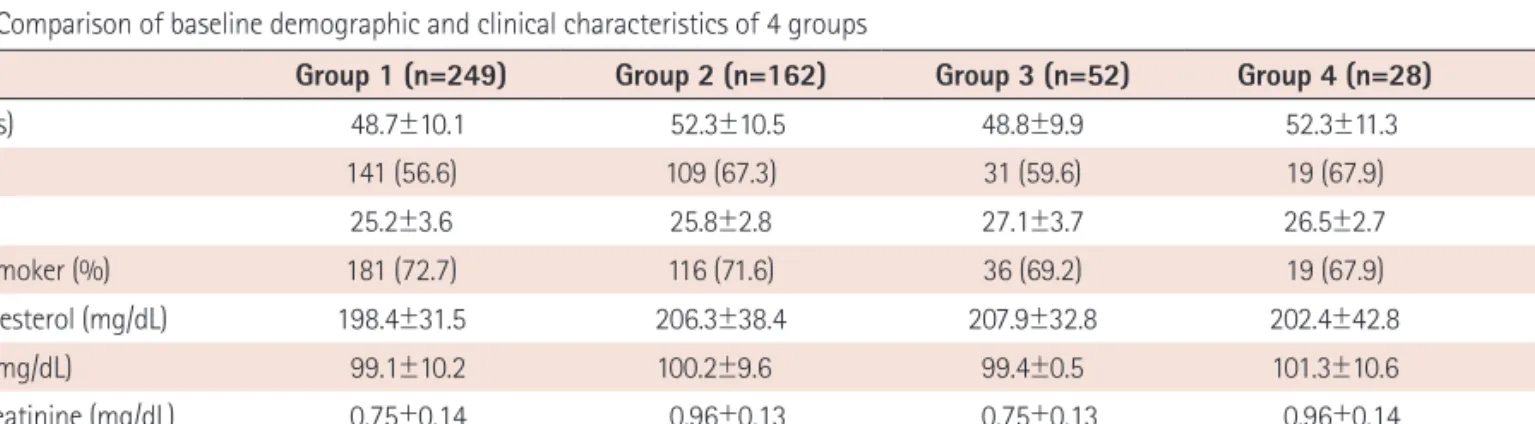
The demographic and baseline characteristics of the subjects are

summarized in Table 1. Enrolled in this study were 491 participants.

There were 249 (50.7%) in group 1, 162 (32.9%) in group 2, 52 (10.5%) in group 3 and 28 (5.7%) patients in group 4. The mean age was 50.1±10.4 years (group 1, 48.7±10.1; group 2, 52.3±10.5; group 3, 48.8±9.9; group 4, 52.3±11.3). 60.1% (300/491) were men. Other baseline characteristics (BMI, current smoker, total cholesterol, glu- cose level, serum creatinine, UACR, eGFR) of four groups are sum- marized in Table 1.

Comparison of blood pressure, heart rate and heart-femoral pulse wave velocity

Of the 491 subjects, MAP was 118.9±12.6 mm Hg (group 1, 117.7±

11.9; group 2, 117.9±11.7; group 3, 126.8±18.8; group 4, 126.5±

17.2). Mean heart rate was 69.2±10.8 beats per minute (group 1, 69.2±10.6; group 2, 66.9±10.2; group 3, 71.2±11.7; group 4, 67.1±

9.2). Mean hfPWV value was 995.8±169.2 cm/s and group 1 show- ed lowest hfPWV (964.6±145.4 cm/s) (cf. group 2, 1013.5±168.9;

group 3, 1058.2±238.0; group 4, 1065.8±162.9). Analysis adjusting age, sex, BMI, heart rate and MAP showed significantly lower hfPWV was found in group 1 compared to group 2 (p=0.032), 3 (p=0.007) and 4 (p=0.087). There was no difference of hfPWV in group 2 and 3 (p=0.423) (Table 2).

Table 1. Comparison of baseline demographic and clinical characteristics of 4 groups

Group 1 (n=249) Group 2 (n=162) Group 3 (n=52) Group 4 (n=28) p

Age (years) 48.7±10.1 52.3±10.5 48.8±9.9 52.3±11.3 0.002

Male (%) 141 (56.6) 109 (67.3) 31 (59.6) 19 (67.9) 0.152

BMI 25.2±3.6 25.8±2.8 27.1±3.7 26.5±2.7 0.001

Current smoker (%) 181 (72.7) 116 (71.6) 36 (69.2) 19 (67.9) 0.923

Total cholesterol (mg/dL) 198.4±31.5 206.3±38.4 207.9±32.8 202.4±42.8 0.086

Glucose (mg/dL) 99.1±10.2 100.2±9.6 99.4±0.5 101.3±10.6 0.574

Serum creatinine (mg/dL) 0.75±0.14 0.96±0.13 0.75±0.13 0.96±0.14 <0.001

UACR (μg/mg creatinine) 9.3±6.3 8.3±6.2 74.3±43.0 77.3±57.0 <0.001

eGFR (mL/min) 108.3±17.8 80.7±6.6 107.2±14.1 80.6±6.2 <0.001

BMI: body mass index, UACR: urinary albumin-to-creatinine ratio, eGFR: estimated glomerular filtration rate Table 2. Comparison of blood pressure and hfPWV

Group 1 (n=249)

Group 2 (n=162)

Group 3 (n=52)

Group 4

(n=28) p p

1 vs. 2

p 1 vs. 3

p 2 vs. 3

p 1 vs. 4

SBP (mm Hg) 150.8±18.3 151.1±14.5 162.2±24.0 161.0±20.8 <0.001 0.849 0.002 0.003 0.006

DBP (mm Hg) 95.4±9.9 94.0±9.2 100.5±13.9 103.6±14.5 <0.001 0.159 0.014 0.002 0.007

MAP (mm Hg) 117.7±11.9 117.9±11.7 126.8±18.8 126.5±17.2 <0.001 0.923 0.001 0.002 0.013

HR (bpm) 69.2±10.6 66.9±10.2 71.2±11.7 67.1±9.2 0.039 0.033 0.230 0.013 0.329

hfPWV (cm/sec) 964.6±145.4 1013.5±168.9 1058.2±238.0 1065.8±162.9 <0.001 0.003 (0.032)

0.008 (0.007)

0.214 (0.423)

0.001

(0.087)

SBP: systolic blood pressure, DBP: diastolic blood pressure, MAP: mean arterial pressure, HR: heart rate, bpm: beats per minute, hfPWV: heart femoral pulse

wave velocity

(4)

Independent factors affecting heart-femoral pulse wave velocity

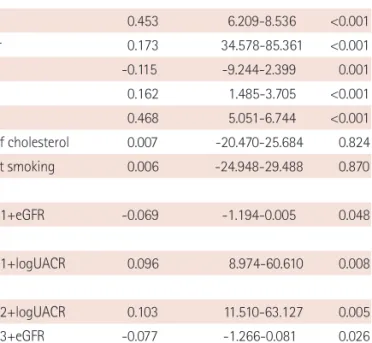
Multiple regression analysis of all subjects (Table 3) showed that hfPWV was independently associated with logUACR {beta=0.096, 95% confidence interval (CI)=8.974-60.610, p=0.008} and eGFR

(beta=-0.069, 95% CI=-1.194 - -0.005, p=0.048). The association was not changed by mutual adjustment with eGFR and logUACR. Se- parate analysis for the NAU alone group (Table 4) and normal eGFR alone group (Table 5), yielded the same results. eGFR was indepen- dent risk factor of arterial stiffness in NAU group (beta=-0.099, 95%

CI -1.408 - -0.154, p=0.015) and logUACR was significantly corre- lated with arterial stiffness in normal eGFR group (beta=0.159, 95%

CI 26.273-90.233, p<0.001). In conclusion, a strong association of MAU and/or minimally reduced eGFR with arterial stiffness was not- ed in all subjects, NAU group, and the normal eGFR group.

Discussion

The present study provides an independent evaluation of the rel- ationship between increased arterial stiffness and minimally reduc- ed eGFR and/or MAU in never treated primary hypertensives. Our re- sults indicate that arterial stiffening is independently associated with minimally reduced eGFR and MAU. These results agree with previ- ous studies of high risk patients with moderate or severe renal dys- function patients.

8-10)

However, our results are important because patients with more than moderate renal dysfunction as assessed by eGFR values of <60 mL/min/1.73 m

2

were excluded and we assessed the independent impact of MAU and eGFR on arterial stiffness.

Many reports find increased risk of CVD when eGFR is less than 60 mL/1.73 m

2

, but few studies have investigated arterial stiffness in minimally reduced eGFR (60≤eGFR<90 mL/1.73 m

2

).

8-11)

Bian’s stu- Table 3. Multiple linear regression analysis to assess independent relation-

ship of hfPWV on eGFR and UACR in all subjects

Coefficients (β) 95% CI p

Model 1

Age 0.453 6.209-8.536 <0.001

Gender 0.173 34.578-85.361 <0.001

BMI -0.115 -9.244-2.399 0.001

HR 0.162 1.485-3.705 <0.001

MAP 0.468 5.051-6.744 <0.001

Level of cholesterol 0.007 -20.470-25.684 0.824

Current smoking 0.006 -24.948-29.488 0.870

Model 2

Model 1+eGFR -0.069 -1.194-0.005 0.048

Model 3

Model 1+logUACR 0.096 8.974-60.610 0.008

Model 4

Model 2+logUACR 0.103 11.510-63.127 0.005

Model 3+eGFR -0.077 -1.266-0.081 0.026

hfPWV: heart femoral pulse wave velocity, eGFR: estimated glomerular fil- tration rate, UACR: urinary albumin-to-creatinine ratio, BMI: body mass in- dex, HR: heart rate, MAP: mean arterial pressure, CI: confidence interval Table 4. Multiple linear regression analysis to assess independent rela- tionship of hfPWV on eGFR and UACR in subjects with normoalbuminuria

Coefficients (β) 95% CI p

Model 1

Age 0.468 5.797-8.280 <0.001

Gender 0.185 31.967-86.414 <0.001

BMI -0.123 -9.599 - -2.138 0.002

HR 0.180 1.496-3.883 <0.001

MAP 0.378 3.987-6.041 <0.001

Level of cholesterol -0.037 -26.184-24.039 0.933

Current smoking 0.001 -29.103-29.746 0.983

Model 2

Model 1+eGFR -0.099 -1.408-0.154 0.015

Model 3

Model 1+logUACR 0.069 -6.905-76.157 0.102

Model 4

Model 2+logUACR 0.082 -0.018-83.032 0.050

Model 3+eGFR -0.108 -1.487 - -0.228 0.008

hfPWV: heart femoral pulse wave velocity, eGFR: estimated glomerular fil- tration rate, UACR: urinary albumin-to-creatinine ratio, BMI: body mass in- dex, HR: heart rate, MAP: mean arterial pressure, CI: confidence interval

Table 5. Multiple linear regression analysis to assess independent relation- ship of hfPWV on eGFR and UACR in subjects with normal eGFR

Coefficients (β) 95% CI p

Model 1

Age 0.435 5.812-8.695 <0.001

Gender 0.130 13.282-75.289 0.005

BMI -0.166 -11.485 - -3.794 <0.001

HR 0.164 1.204-3.896 <0.001

MAP 0.482 4.849-6.923 <0.001

Level of cholesterol -0.004 -29.646-26.845 0.922

Current smoking 0.062 -10.580-57.050 0.177

Model 2

Model 1+eGFR -0.063 -1.425-0.192 0.135

Model 3

Model 1+logUACR 0.159 26.273-90.233 <0.001 Model 4

Model 2+logUACR 0.163 27.854-91.691 <0.001

Model 3+eGFR -0.071 -1.489-0.096 0.085

hfPWV: heart femoral pulse wave velocity, eGFR: estimated glomerular filtra-

tion rate, UACR: urinary albumin-to-creatinine ratio, BMI: body mass index,

HR: heart rate, MAP: mean arterial pressure, CI: confidence interval

(5)

dy showed that carotid-femoral PWV and Augmentation index in- creased on going from the top to the bottom eGFR tertile in Chinese women with normal kidney function.

8)

Astor et al.

11)

also noted that both lower eGFR and MAU increased CV mortality, but they compar- ed moderately decreased eGFR (eGFR <60 mL/1.73 m

2

) with normal eGFR (>90 mL/1.73 m

2

). Recent several large studies have consider- ed CV risk associated with early kidney disease. In the community- based Prevention of Renal and Vascular End-Stage Disease Study, a study of over 40000 participants conducted in the Netherlands, uri- nary albumin concentrations as low as 10-20 mg/liter were associat- ed with a higher risk of CV mortality than were urinary albumin con- centrations less than 10 mg/liter.

12)

Another study found that very low levels of MAU were associated with increased risk of coronary heart disease. In that study, urinary albumin excretion in the upper quartile (>4.8 μg/minute, approximately equivalent to 7.2 mg/g) was associated with a two-fold higher risk of coronary heart disease than urinary albumin excretion in the lowest quartile (<2.1 μg/minute).

13)

But they examined only change of MAU, not considered eGFR. Our study provides more detailed information about arterial stiffness and early kidney dysfunction in never treated hypertensives.

There are several potential mechanisms to explain the link be- tween arterial stiffness and kidney functions.

14-17)

Chronic inflamm- ation, increased oxidative stress, disorders of calcium-phosphate metabolism, activation of the renin-angiotensin system, and volume retention are some of the putative mechanisms for increased arte- rial stiffness in advanced kidney disease.

14)15)

The increased plasma levels of asymmetric dimethylarginine and of homocysteine in in- dividuals with mild renal insufficiency may increase arterial stiffness via endothelial dysfunction.

16)17)

The development of subclinical CV organ damage is a powerful independent predictor of CV prognosis.

3)

Thus, early detection of CV organ damage in clinical practice is important in primary hyperten- sion patients.

3)

Arterial stiffness is an established, independent pre- dictor of subclinical organ damage and CV mortality.

4)

It can be as- sessed noninvasively by measurement of PWV, a simple and repro- ducible method.

7)

Some studies directly demonstrated that PWV was an independent predictor of all-cause and CV mortality in patients with primary hypertension.

4)

Boutouyrie et al.

18)

reported recently that in a cohort of 1045 hypertensives, PWV remained an independent predictor of CV events after adjustment for coronary risk scores. Se- veral mechanisms explain the association between increased arte- rial stiffness and CV events.

18-20)

Arterial stiffness is correlated with atherosclerosis, probably through the effects of cyclic stress on ar- terial wall thickening.

19)

It is also associated with left ventricular hy- pertrophy, a risk factor of coronary events in hypertensive patients.

18)19)

It is a cause of premature return of reflected waves in late systole, in- creasing central pulse pressure and load on the ventricle, reducing

ejection fraction.

18)

Some studies noticed a more pronounced increase in PWV with increasing age.

21-24)

Several studies found a significant interaction with arterial stiffness and eGFR differed by age.

21-24)

In younger sub- jects, all measures of eGFR are associated with risk of CV events.

25)

In contrast, in the elderly, no measures of eGFR calculated by esti- mating equations are independently associated with CV risk. For example Raymond et al.

23)

have shown that the relative risk of mor- tality for decreasing eGFR lessens with increasing age (at age >75 years). Tomiyama et al.

26)

reported that the age-related increase in arterial stiffness increased by severity of hypertension. Our study subjects were diagnosed as hypertensives but not treated (MAU groups had higher blood pressure level than NAU groups) and mean age was 50.1±10.4 years. It mean relative younger patient was en- rolled our study, so eGFR and MAU were a significant interaction with arterial stiffness. Future studies may be focus on interplay be- tween arterial stiffness and early kidney disease differs from age.

This study has some limitations. First, we had only one time mea- surement of arterial stiffness and were not able to longitudinally as- sess the relationship between changes in arterial stiffness and kid- ney function. Second, there may be misclassification of individuals with eGFR close to 60 mL/min/1.73 m

2

, because the MDRD study equation used in our study underestimates GFR in individuals wi- thout chronic kidney disease. Finally, in our study, there was a differ- ence of sample size among groups. So we calculated ANOVA one- way power analysis to test whether the statistically difference was really significant. In a one-way ANOVA study, sample sizes of 248, 162, 52, and 28 are obtained from the each 4 groups and we achieve 100% power to detect differences among the each groups (power should be close to one. hfPWV power calculation: group 1 vs. group 2; 0.99815, group 1 vs. group 3; 0.99024, group 2 vs. group 3; 0.98493, group 1 vs. group 4; 0.80628). Our sample size calculations gave us adequate power to detect modest associations.

In this study, we observed independent interaction between MAU

and minimally reduced eGFR with arterial stiffness. Higher urinary

microalbumin excretion only was associated with a higher risk with-

in each category of eGFR, and, similarly, minimally reduced eGFR

was associated with a higher risk for arterial stiffness among pa-

tients with and without MAU. These elevated risks remained strong

even after adjustment for numerous factors, including with age,

gender, BMI, heart rate MAP, total cholesterol level and current

smoking status. Our study has important clinical and research im-

plications. The presence of minimally reduced eGFR or MAU is in-

dependently associated with increased arterial stiffness, indicating

greater CVD risk. Thus, simultaneous measurement of eGFR and

urine microalbumin is needed in the risk assessment of hyperten-

sive patients, although they have normal kidney function.

(6)

References

1. Viazzi F, Leoncini G, Conti N, et al. Combined effect of albuminuria and estimated glomerular filtration rate on cardiovascular events and all- cause mortality in uncomplicated hypertensive patients. J Hypertens 2010;28:848-55.

2. Chronic Kidney Disease Prognosis Consortium, Matsushita K, van der Velde M, et al. Association of estimated glomerular filtration rate and albuminuria with all-cause and cardiovascular mortality in general population cohorts: a collaborative meta-analysis. Lancet 2010;375:

2073-81.

3. Leoncini G, Sacchi G, Ravera M, et al. Microalbuminuria is an integrat- ed marker of subclinical organ damage in primary hypertension. J Hum Hypertens 2002;16:399-404.

4. Laurent S, Boutouyrie P, Asmar R, et al. Aortic stiffness is an indepen- dent predictor of all-cause and cardiovascular mortality in hyperten- sive patients. Hypertension 2001;37:1236-41.

5. Mancia G, De Backer G, Dominiczak A, et al. 2007 Guidelines for the management of arterial hypertension: The Task Force for the Manage- ment of Arterial Hypertension of the European Society of Hyperten- sion (ESH) and of the European Society of Cardiology (ESC). Eur Heart J 2007;28:1462-536.

6. National Kidney Foundation. K/DOQI clinical practice guidelines for chronic kidney disease: evaluation, classification, and stratification. Am J Kidney Dis 2002;39(2 Suppl 1):S1-266.

7. Rhee MY, Lee HY, Park JB. Measurements of Arterial Stiffness: Method- ological Aspects. Korean Circ J 2008;38:343-50.

8. Bian SY, Guo HY, Ye P, et al. Association of glomerular filtration rate with arterial stiffness in Chinese women with normal to mildly impair- ed renal function. J Geriatr Cardiol 2012;9:158-65.

9. Hermans MM, Henry R, Dekker JM, et al. Estimated glomerular filtra- tion rate and urinary albumin excretion are independently associated with greater arterial stiffness: the Hoorn Study. J Am Soc Nephrol 2007;18:1942-52.

10. Kawamoto R, Kohara K, Tabara Y, et al. An association between de- creased estimated glomerular filtration rate and arterial stiffness. Intern Med 2008;47:593-8.

11. Astor BC, Hallan SI, Miller ER 3rd, Yeung E, Coresh J. Glomerular filtra- tion rate, albuminuria, and risk of cardiovascular and all-cause mortal- ity in the US population. Am J Epidemiol 2008;167:1226-34.

12. Hillege HL, Fidler V, Diercks GF, et al. Urinary albumin excretion predicts cardiovascular and noncardiovascular mortality in general popula- tion. Circulation 2002;106:1777-82.

13. Klausen K, Borch-Johnsen K, Feldt-Rasmussen B, et al. Very low levels of microalbuminuria are associated with increased risk of coronary

heart disease and death independently of renal function, hypertension, and diabetes. Circulation 2004;110:32-5.

14. Blacher J, Guerin AP, Pannier B, Marchais SJ, Safar ME, London GM.

Impact of aortic stiffness on survival in end-stage renal disease. Circul- ation 1999;99:2434-9.

15. Pannier B, Guérin AP, Marchais SJ, Safar ME, London GM. Stiffness of capacitive and conduit arteries: prognostic significance for end-stage renal disease patients. Hypertension 2005;45:592-6.

16. Kielstein JT, Böger RH, Bode-Böger SM, et al. Marked increase of asym- metric dimethylarginine in patients with incipient primary chronic re- nal disease. J Am Soc Nephrol 2002;13:170-6.

17. Chauveau P, Chadefaux B, Coudé M, et al. Hyperhomocysteinemia, a risk factor for atherosclerosis in chronic uremic patients. Kidney Int Suppl 1993;41:S72-7.

18. Boutouyrie P, Tropeano AI, Asmar R, et al. Aortic stiffness is an inde- pendent predictor of primary coronary events in hypertensive patients:

a longitudinal study. Hypertension 2002;39:10-5.

19. Benetos A, Adamopoulos C, Bureau JM, et al. Determinants of acceler- ated progression of arterial stiffness in normotensive subjects and in treated hypertensive subjects over a 6-year period. Circulation 2002;

105:1202-7.

20. Emoto M, Nishizawa Y, Kawagishi T, et al. Stiffness indexes beta of the common carotid and femoral arteries are associated with insulin re- sistance in NIDDM. Diabetes Care 1998;21:1178-82.

21. Lajemi M, Labat C, Gautier S, et al. Angiotensin II type 1 receptor-153A/

G and 1166A/C gene polymorphisms and increase in aortic stiffness with age in hypertensive subjects. J Hypertens 2001;19:407-13.

22. Koenig W. Update on integrated biomarkers for assessment of long- term risk of cardiovascular complications in initially healthy subjects and patients with manifest atherosclerosis. Ann Med 2009;41:332-43.

23. Raymond NT, Zehnder D, Smith SC, Stinson JA, Lehnert H, Higgins RM.

Elevated relative mortality risk with mild-to-moderate chronic kidney disease decreases with age. Nephrol Dial Transplant 2007;22:3214- 20.

24. Avolio AP, Deng FQ, Li WQ, et al. Effects of aging on arterial distensibil- ity in populations with high and low prevalence of hypertension: com- parison between urban and rural communities in China. Circulation 1985;71:202-10.

25. van der Velde M, Bakker SJ, de Jong PE, Gansevoort RT. Influence of age and measure of eGFR on the association between renal function and cardiovascular events. Clin J Am Soc Nephrol 2010;5:2053-9.

26. Tomiyama H, Arai T, Koji Y, et al. The age-related increase in arterial stiffness is augmented in phases according to the severity of hyper- tension. Hypertens Res 2004;27:465-70.

수치

Table 1. Comparison of baseline demographic and clinical characteristics of 4 groups
Table 5. Multiple linear regression analysis to assess independent relation- relation-ship of hfPWV on eGFR and UACR in subjects with normal eGFR

참조

관련 문서

The cucumber sprouts pre-treated with all seven rhizobacterial strains at concentration of 5.0×10 6 cfu/ml were significantly increased plant height and

Null hypotheses of this study was there is no difference in root canal length determination between conventional and heat-treated Ni-Ti files by 2

With these results, we can suggest the hypothesis that increased cardiac output in the patients who administered ketamine increased muscle blood flow, and this is the

Mean arterial plasma concentration-time profiles of 4-hydroxytamoxifen after an oral administration of tamoxifen (10 mg/kg) to rats in the presence or absence

In this regard, to overcome the limitations associated with quantitative evaluation of ECT using the bobbin probe and to consider the field requirements in terms of scanning

In the present study we investigated the proliferation effect of human oral cancer KB cell treated with pulsatilla koreana extract.. We analyzed the effects of this

1) If the fluid is real (viscous fluid) and if no energy is being added, then the energy line may never be horizontal or slope upward in the direction of flow.. 2) Vertical

In the present study, the behavior of Mg sheet with strain rates will be observed and the effect of microstructure, texture and PB treatment on high rate tensile