• 검색 결과가 없습니다.

An Unusual Type of Hypertrophic Cardiomyopathy

N/A
N/A
Protected

Academic year: 2022

Share "An Unusual Type of Hypertrophic Cardiomyopathy"

Copied!
4
0
0

로드 중.... (전체 텍스트 보기)

전체 글

(1)

213 CASE REPORT

DOI 10.4070 / kcj.2009.39.5.213

Print ISSN 1738-5520 / On-line ISSN 1738-5555 Copyright ⓒ 2009 The Korean Society of Cardiology

An Unusual Type of Hypertrophic Cardiomyopathy

Hye-Sun Seo, MD

1

, Dong Hun Kim, MD

2

, Eun Jung Kim, MD

1

, Hee Yong Yoo, MD

1

, Chul Kim, MD

1

, Chan Hyun Lee, MD

1

, Bo Yeon Kim, MD

1

, Chul Ho Chung, MD

1

, Jon Suh, MD

1

, Yoon Haeng Cho, MD

1

and Nae-Hee Lee, MD

1

1

Division of Cardiology, Department of Internal Medicine,

2

Department of Radiology, Soonchunhyang University Hospital, Bucheon, Korea

ABSTRACT

An unusual type of hypertrophic cardiomyopathy was diagnosed in a 17-year-old girl who presented with dyspnea on exertion. The hypertrophied myocardium was localized to the anterior portion of the left ventricle from the base to the apex without left ventricular outflow tract obstruction. On cardiac magnetic resonance imaging (MRI), patchy and linear delayed hyperenhancement was shown in the anterior and inferior mid-wall, which is not con- cordant with the coronary artery territory. (Korean Circ J 2009;39:213-216)

KEY WORDS: Cardiomyopathy, hypertrophic; Magnetic resonance imaging.

Introduction

Hypertrophic cardiomyopathy is a very heterogenous disease entity. Ventricular basal septal hypertrophy is by far the most common type of asymmetrical hypertrophy, with midventricular, apical, right ventricular, and rarer types of asymmetrical hypertrophy being far less com- mon.

1-3)

We present a case of an uncommon type of hy- pertrophy diagnosed by echocardiography and cardiac MRI.

Case

A 17-year-old girl was admitted for evaluation of dys- pnea on exertion during 5 months. She had no history of diabetes, hypertension, or family members with sud- den cardiac death. A 12-lead electrocardiogram (ECG) showed a sinus rhythm with ST segment elevation in leads III/aVF/aVR, ST depression in I/aVL/V

5-6

, and T inversion in leads V

1-4

(Fig. 1).

Transthoracic echocardiography showed a significant asymmetric hypertrophy of the basal anterior wall which extended to the level of the apex. The maximal wall thi- ckness was 21 mm and this hypertrophy was localized to the anterior wall (Fig. 2); the echogenecity was similar to

other areas of the myocardium. There was no turbulent flow through the left ventricular outflow tract (LVOT) and the maximal pressure gradient was <30 mmHg at rest.

Although the systolic function, as measured by the ejec- tion fraction was within the normal range, deformation analysis using 2-dimensional strain echocardiography, which can detect early functional abnormalities, showed decreased circumferential and radial strain (Fig. 3). The patient was referred for cardiac MRI for further evalua- tion of myocardium.

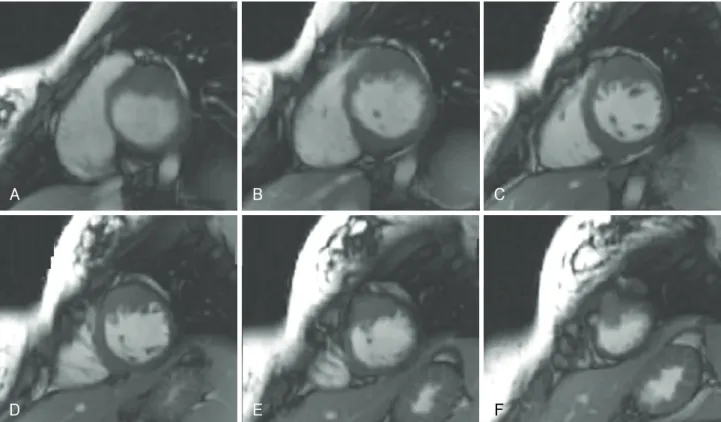
On consecutive static images of short axis cines {steady- state free precession (SSFP)} in diastole, asymmetric hy- pertrophy of the anterior wall extended progressively from the base to the apex with a maximal thickness of 25 mm, which had an isointense signal compared with the surrounding myocardium (Fig. 4). The systolic mo- tion of that part was normal and perfusion was good at the full thickness. Delayed contrast-enhanced MRI showed patch and linear hyperenhancement in the anterior and inferior mid-wall, which is not concordant with the coronary artery territory (Fig. 5). Based on the diagnosis of an unusual type of hypertrophic cardiomyopathy, she was treated with beta-blockers and she has been well with minimal symptoms and without any adverse cardiac events.

Discussion

Hypertrophic cardiomyopathy (HCM) is a primary ge- netic heart disorder caused by sarcomere mutations and may account for up to 60% of unexplained left ventri- cular hypertrophy, making HCM the most common genetic cardiovascular disorder.

4)5)

The histopathologic

Received: November 26, 2008 Revision Received: January 16, 2009 Accepted: January 19, 2009

Correspondence: Hye-Sun Seo, MD, Division of Cardiology, Department of Internal Medicine, Soonchunhyang University Hospital, Jung-dong, Wonmi- gu, Bucheon 420-767, Korea

Tel: 82-32-621-5138, Fax: 82-32-621-5016

E-mail: [email protected]

(2)

214 · Unusual Type of HCMP

hallmarks of HCM are myocyte hypertrophy with disarray and increased cardiac fibrosis; the phenotype of HCM is variable and involves myocardial thickening and obst- ruction of the ventricular outflow tract.

6)

Clinical pro-

gression can be indolent or more rapidly result in refrac- tory symptoms and heart failure. So, it is very important to identify preclinical individuals and to treat with tar- geting preventive therapy.

Fig. 1. Twelve-lead ECG showing sinus rhythm with ST segment elevation in leads III/aVF/aVR, ST depression in I/aVL/V

5-6

, and T in- version in leads V

1-4

. ECG: electrocardiogram.

Fig. 2. Parasternal short axis view of transthoracic echocardiography. Hypertrophic myocardium was (white arrows) localized to the an- terior wall from base (A), mid-level (B), to the apex (C).

A B C

B A

Fig. 3. Two-dimensional strain analysis. Each color represents each mid-LV segment as described in the left side of the images. The hy-

pertrophied anterior segment, expressed as sky blue, decreased systolic deformation (strain) compared with other segments. A: circum-

ferential strain. B: radial strain. LV: left ventricle.

(3)

Hye-Sun Seo, et al.

·

215

Echocardiography had been used to diagnose HCM, evaluate the myocardial function, and predict the prog- nosis. Nagueh et al.

7)

described the decreased systolic, early diastolic, and late diastolic tissue Doppler velocities in HCM patients, and predicted HCM in subclinical patients using tissue Doppler images.

8)

Two-dimensional strain images can also reliably analyze myocardial defor- mation. Circumferential and radial strains decreased in all myocardial segments in the patients with HCM com- pared with physiologic hypertrophy.

9)

In the patient pre- sented herein, only involved myocardial segments decreas- ed circumferential and radial strain, showing normal tissue Doppler velocities and normal strain values in the

other myocardium. Therefore, this case may be an early change of progressive HCM or a benign subgroup of unusual HCM.

The significance of MRI on HCM has been much more investigated over the past 20 years. The microvascular dysfunction by first-pass stress perfusion MRI images and fibrotic lesions in the myocardium by delayed cont- rast hyperenhancement (DCE) are useful to predict ven- tricular arrhythmia and sudden cardiac death. The extent of hyperenhancement is associated with progressive ven- tricular dilation, cardiac function, and markers of sudden death.

10)11)

Therefore, another component of the cardiac MRI examination may have an important role to evaluate A

D

B

E

C

F

Fig. 4. Consecutive static images of short axis cines {steady-state free precession (SSFP)} in diastole (A-F). Asymmetric hypertrophy of the anterior wall extended progressively from the base (A) to the apex (F) and iso-signal intensity of hypertrophied tissue compared with sur- rounding myocardium was seen.

A B C

Fig. 5. Delayed contrast-enhanced MR (A-C) showed patch and linear hyperenhancement (arrows) in anterior and inferior mid-wall (dif-

ferent coronary artery territories).

(4)

216 · Unusual Type of HCMP

patients with HCM, not only by increased myocardial wall thickness.

12)

In the patient reported herein, the asymmetrical hy- pertrophy was limited to the anterior wall extending from the base to the apex; this type of HCM is the first case. The systolic strain decreased in the thickened myo- cardium; however, the delayed hyperenhancement on MRI was not massive, localized, and spotty. Follow-up examinations will be needed to evaluate disease progres- sion and prognosis.

REFERENCES

1) Maron BJ. Hypertrophic cardiomyopathy: a systematic review.

JAMA 2002;287:1308-20.

2) Wigle ED, Rakowski H, Kimball BP, Williams WG. Hypertrophic cardiomyopathy: clinical spectrum and treatment. Circulation 1995;92:1680-92.

3) Jeong JW. Hypertrophic cardiomyopathy. Korean Circ J 2002;

32:7-14.

4) Maron BJ, Gardin JM, Flack JM, Gidding SS, Kurosaki TT, Bild DE. Prevalence of hypertrophic cardiomyopathy in a general pop- ulation of young adults: echocardiographic analysis of 4111 sub- jects in the CARDIA study. Circulation 1995;92:785-9.

5) Richard P, Charron P, Carrier L, et al. Hypertrophic cardiomyo- pathy: distribution of disease genes, spectrum of mutations, and

implications for a molecular diagnosis strategy. Circulation 2003;

107:2227-32.

6) Klues HG, Schiffers A, Maron BJ. Phenotypic spectrum and patterns of left ventricular hypertrophy in hypertrophic cardio- myopathy. J Am Coll Cardiol 1995;26:1699-708.

7) Nagueh SF, Bachinski LL, Meyer D, et al. Tissue Doppler imag- ing consistently detects myocardial abnormalities in patients with hypertrophic cardiomyopathy and provides a novel means for an early diagnosis before and independently of hypertrophy.

Circulation 2001;104:128-30.

8) Nagueh SF, McFalls J, Meyer D, et al. Tissue Doppler imaging predicts the development of hypertrophic cardiomyopathy in subjects with subclinical disease. Circulation 2003;108:395-8.

9) Richand V, Lafitte S, Reant P, et al. An ultrasound speckle tracking ( two-dimensional strain ) analysis of myocardial deformation in professional soccer players compared with healthy subjects and hypertrophic cardiomyopathy. Am J Cardiol 2007;100:128-32.

10) Teraoka K, Hirano M, Ookubo H, et al. Delayed contrast enhance- ment of MRI in hypertrophic cardiomyopathy. Magn Reson Imag- ing 2004;22:155-61.

11) Moon JC, McKenna WJ, McCrohon JA, Elliott PM, Smith GC, Pennell DJ. Toward clinical risk assessment in hypertrophic car- diomyopathy with gadolinium cardiovascular magnetic resonance.

J Am Coll Cardiol 2003;41:1561-7.

12) Reichek N, Gupta D. Hypertrophic cardiomyopathy: cardiac mag-

netic resonance imaging changes the paradigm. J Am Coll Car-

diol 2008;52:567-8.

수치

Fig. 2. Parasternal short axis view of transthoracic echocardiography. Hypertrophic myocardium was (white arrows) localized to the an- an-terior wall from base (A), mid-level (B), to the apex (C)
Fig. 4. Consecutive static images of short axis cines {steady-state free precession (SSFP)} in diastole (A-F)

참조

관련 문서