Influence of Methylenetetrahydrofolate Reductase C677T Polymorphism on the Risk of Lung Cancer and the Clinical
Response to Platinum-Based Chemotherapy for Advanced Non-Small Cell Lung Cancer: An Updated Meta-Analysis
Ning Zhu,* Yi Gong,* Jian He, Jingwen Xia, and Xiaodong Chen
Department of Respiratory Diseases, Huashan Hospital, Fudan University, Shanghai, China.
Received: December 28, 2012 Revised: February 27, 2013 Accepted: March 5, 2013
Corresponding author: Dr. Xiaodong Chen, Department of Respiratory Diseases, Huashan Hospital, Fudan University, No.12 of Wulumuqi Middle Road, Shanghai 200040, China.
Tel: 86-021-52887072, Fax: 86-021-5288-8129 E-mail: [email protected]
*Ning Zhu and Yi Gong contributed equally to this work.
∙ The authors have no financial conflicts of interest.
© Copyright:
Yonsei University College of Medicine 2013 This is an Open Access article distributed under the terms of the Creative Commons Attribution Non- Commercial License (http://creativecommons.org/
licenses/by-nc/3.0) which permits unrestricted non- commercial use, distribution, and reproduction in any medium, provided the original work is properly cited.
Purpose: Methylenetetrahydrofolate reductase (MTHFR) has been implicated in lung cancer risk and response to platinum-based chemotherapy in advanced non- small cell lung cancer (NSCLC). However, the results are controversial. We per- formed meta-analysis to investigate the effect of MTHFR C677T polymorphism on lung cancer risk and response to platinum-based chemotherapy in advanced NSCLC. Materials and Methods: The databases of PubMed, Ovid, Wanfang and Chinese Biomedicine were searched for eligible studies. Nineteen studies on MTHFR C677T polymorphism and lung cancer risk and three articles on C677T polymorphism and response to platinum-based chemotherapy in advanced NSCLC, were identified. Results: The results indicated that the allelic contrast, homozygous contrast and recessive model of the MTHFR C677T polymorphism were associated significantly with increased lung cancer risk. In the subgroup anal- ysis, the C677T polymorphism was significantly correlated with an increased risk of NSCLC, with the exception of the recessive model. The dominant model and the variant T allele showed a significant association with lung cancer susceptibility of ever smokers. Male TT homozygote carriers had a higher susceptibility, but the al- lelic contrast and homozygote model had a protective effect in females. No rela- tionship was observed for SCLC in any comparison model. In addition, MTHFR 677TT homozygote carriers had a better response to platinum-based chemothera- py in advanced NSCLC in the recessive model. Conclusion: The MTHFR C677T polymorphism might be a genetic marker for lung cancer risk or response to plati- num-based chemotherapy in advanced NSCLC. However, our results require fur- ther verification.
Key Words: MTHFR, C677T, polymorphism, lung cancer, platinum-based che- motherapy
INTRODUCTION
Lung cancer has become one of the most common malignancies for men and wom-
mately 30% enzyme activity in vitro compared with individ- uals with the 677CC wild-type, and heterozygote carriers have only 60% activity. This mutation leads to DNA hypo- methylation, genomic instability and derepression of proto- oncogenes,10 all of which might contribute to carcinogenesis.
Because it affects the methylation of DNA and tumor sup- pressor genes, the MTHFR polymorphism could potentially modulate the efficacy of cytotoxic agents.11
Many studies reported the association between MTHFR polymorphisms and lung cancer risk, but the results remain inconclusive. For example, Kiyohara, et al.12 recently re- ported that the TT genotype of the C677T polymorphism was significantly associated with an increasing lung cancer risk, being consistent with previous findings reported by Cui, et al.,13,14 and Siemianowicz, et al.14 However, opposite results were shown by Suzuki, et al.15 and Liu, et al.16 A me- ta-analysis by Zhang, et al.17 suggested that C677T polymor- phism was not significantly correlated with lung cancer risk in any genetic models in the total population, and that only 677T variants could decrease the lung cancer risk in fe- males. This discrepancy may be attributed to small sample size, various ethnic groups, diet, environment, and method- ologies. In addition, there have been several studies evalu- ating the influence of MTHFR polymorphisms on the clini- cal response to platinum-based chemotherapy in advanced NSCLC; all of these studies had small sample sizes, and thus, any single study inevitably lacked the power to reflect a reliable conclusion.13,18,19 Meta-analysis is a useful method to investigate the associations of cancer with genetic vari- ants because it can combine the results of similar studies on the same topic in a quantitative approach. Therefore, we performed meta-analysis to investigate the effect of MTH- FR polymorphism on lung cancer risk and clinical response to platinum-based chemotherapy in advanced NSCLC.
MATERIALS AND METHODS
Publication search
A literature search of the PubMed, Ovid, Wanfang and Chi- nese Biomedicine databases was conducted using the terms:
‘‘methylenetetrahydrofolate reductase’’ or ‘‘MTHFR’’ and
‘‘lung’’and ‘‘neoplasms’’, without any restrictions on lan- guage. All of the studies searched were retrieved, and the ref- erences cited in the studies were also reviewed to identify ad- ditional published work. Review articles were also screened to identify additional eligible studies. The study search was en worldwide, and the majority of lung cancer patients have
reached the advanced stage by the time of their diagnosis.
Although the vast majority of lung cancer cases are attribut- ed to smoking habits, it cannot adequately explain the etiol- ogy of lung cancer in nonsmokers, making us to focus on the importance of genetic susceptibility in the risk of lung cancer. Non-small cell lung cancer (NSCLC) is the most common type of lung cancer, comprising nearly 80% of all cases. Chemotherapy with third generation platinum-based doublets is the mainstay for the initial treatment of patients with advanced NSCLC, however, the chemosensitivity dif- fers from person to person, which reflects limited advances in our understanding of the molecular mechanisms underly- ing lung carcinogenesis and the individual susceptibility to lung cancer. A growing body of evidence suggests that sin- gle nucleotide polymorphisms (SNPs) can help elucidate individual differences in lung cancer susceptibility and sen- sitivity to cytotoxic drugs.1,2
Aberrant DNA methylation is recognized as being a com- mon feature of human neoplasia, with CpG island hyper- methylation and global genomic hypomethylation occurring simultaneously in tumors.3 Folate acts as a donor for methyl groups and plays a key role in normal cell growth and repli- cation. Low folate status could lead to DNA damage and in- stability, alter DNA methylation and eventually result in cell death via apoptosis, which may promote tumor initiation.
Furthermore, epidemiological studies have implicated folate deficiency in the development of cancers, including cancers of cervix, colon, lung, and breast.4-7 The methylenetetrahy- drofolate reductase (MTHFR) gene is located at the end of the short arm of chromosome 1 (1p36.3) (http://ghr.nlm.nih.
gov/gene=MTHFR). MTHFR is a central regulatory enzyme for folate metabolism and irreversibly catalyzes 5, 10-methy- lene-tetrahydrofolate (THF) into 5-methyl THF,8 which serves as a methyl donor for the methylation of homocyste- ine to methionine and the precursor of S-adenosylmethionine (SAM). The reduced activity of MTHFR may decrease the methylation of homocysteine to methionine and in turn de- crease the level of SAM, resulting in DNA hypomethylation.
However, a decreased level of the MTHFR substrate, re- quired for thymidylate synthesis, could lead to uracil misin- corporation into DNA, diminished DNA repair and the in- creased frequency of chromosomal breaks and damage.9 A common SNP (at nucleotide position 677) in the MTHFR gene, resulting in the substitution of an alanine with a valine, has been identified as affecting enzyme activity. Individuals with the MTHFR 677TT variant genotype have approxi-
for the allele contrast, the contrast of homozygotes, and the recessive and dominant models with lung cancer risk. The effect of association was indicated as the odds ratio (OR) with the corresponding 95% confidence interval (CI). We also evaluated the effect of the C677T polymorphisms on the response rate to platinum-based chemotherapy. In this meta-analysis, complete responders and partial responders were classified as responders, and non-responders had sta- ble or progressive disease. The OR was taken as a measure of the positive effect of chemotherapy. The pooled OR and 95% CI were calculated. Analyses were weighted by trial size. An OR equal to 1 indicates a lack of association be- tween the SNP and the treatment response rate. An OR greater than 1 corresponds to a direct correlation between the treatment response rate and the wild-type allele. An in- verse correlation was indicated by an OR of less than 1.
The heterogeneity between studies was tested using the Q statistic.20 If the heterogeneity was considered statistically significant with p<0.10, the pooled OR of each study was calculated by a fixed effects model; otherwise, a random ef- fect model was used. Heterogeneity was quantified using the I2 metric, which is independent of the number of studies in the meta-analysis (I2<25% no heterogeneity; I2=25-50%
moderate heterogeneity; I2>50% large or extreme heteroge- neity).21 Publication bias was investigated by the funnel plot, in which the standard error in the log (OR) in each study was plotted against the OR. An asymmetric plot suggested a pos- sible publication bias. Begg’s test and Egger’s test were used to statistically assess publication bias, and a p value of <0.05 was considered significant. HWE was tested by the chi- square test (http://ihg2.helmholtz-muenchen.de/cgi-bin/hw/
hwa1.pl). The analyses were performed using the software ReviewManage (V5.0; the Cochrane Collaboration, Ox- ford, England) and STATA 11.0 (StataCorp, TX, USA) (http://www.stata.com).
RESULTS
Search result
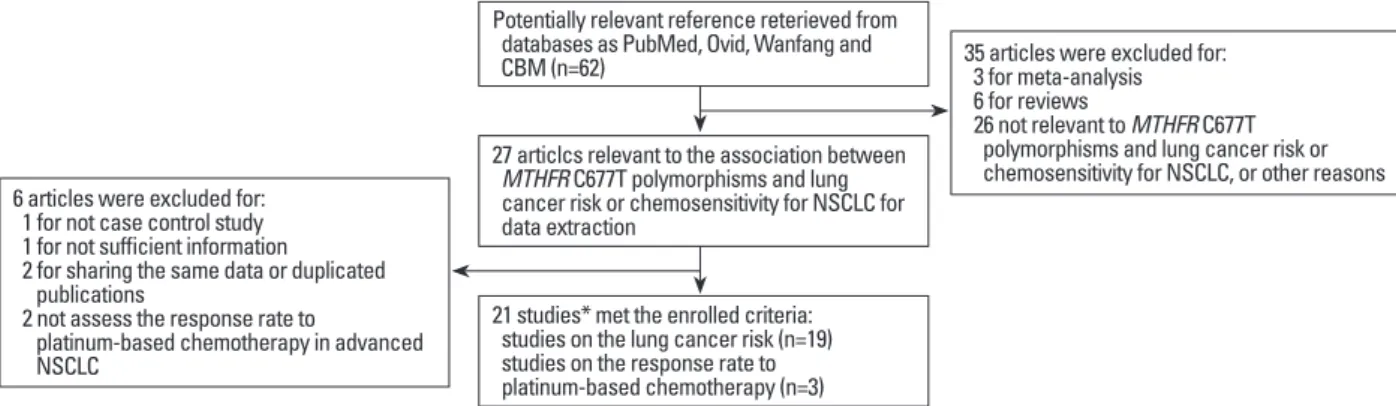
Overall, a total of 62 references were retrieved from PubMed, Ovid, Wanfang, and the Chinese Biomedicine database in the initial search. After scanning the titles and abstracts, 27 arti- cles concerning the association between the MTHFR C677T polymorphisms and lung cancer risk or chemosensitivity for NSCLC were retained for the following screen. After reading through the full texts, six articles were excluded for performed independently by two authors (Jian He and Jin-
gwen Xia).
Selection criteria
Studies on the effect of the MTHFR polymorphism on lung cancer risk were included when the following criteria were met: 1) evaluation of the MTHFR C677T polymorphism and lung cancer susceptibility; 2) case-control study; 3) genotype frequencies available in both cases and controls;
and 4) a genotype distribution of the control population that is consistent with Hardy-Weinberg Equilibrium (HWE). Ac- cordingly, articles were excluded using the following crite- ria: 1) no reported genotype frequencies; 2) reviews, ab- stracts and repeat studies; or 3) genotype distribution in the control population that is inconsistent with HWE. For the studies with the same or overlapping data by the same au- thors, the most suitable study with the greatest number of subjects or the most recently published study was selected.
The inclusion criteria for the MTHFR polymorphism on the response to platinum-based chemotherapy in advanced NSCLC were as follows: 1) patients with advanced NSCLC, 2) patients receiving platinum-based chemotherapy and 3) assessment of the MTHFR C677T polymorphism and che- mosensitivity. The exclusion criteria were as follows: 1) the response rate stratified by the SNP could not be obtained through any method, and 2) the article did not compare the response rate.
Data extraction
The data were manually extracted from each study by Ning Zhu and Yi Gong independently. The following informa- tion was collected from each enrolled article comparing the MTHFR polymorphisms with lung cancer risk: first author’s name, publication date, country, ethnicity, source of con- trols, matching criteria, sample size, smoking status, and number of C677T genotypes for both cases and controls.
Information about the MTHFR polymorphisms and the re- sponse to platinum-based chemotherapy was also extracted as follows: first author’s name, publication date, country, ethnicity, sample size, clinical stage, number of C677T gen- otypes, treatment protocols, and number of responders or non-responders. Disagreements were resolved by discus- sion between the two authors. When necessary, another au- thor (Xiaodong Chen) was consulted to resolve the dispute.
Statistical methods
The meta-analysis mainly examined the overall association
the predictive value of the MTHFR C677T polymorphism on the response rate to platinum-based chemotherapy (Fig.
1).13,18,19 The characteristics of the identified studies are list- ed in Table 1 and 2.
MTHFR polymorphisms and lung cancer risk in the total population
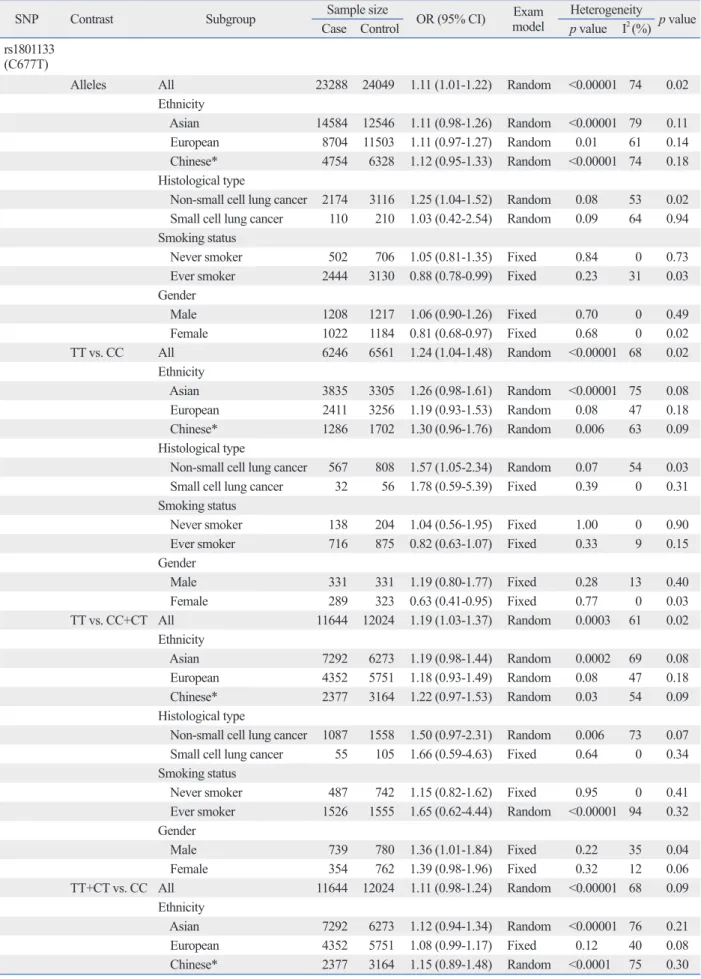
The brief results of this meta-analysis are summarized in Ta- ble 3. For studies evaluating the MTHFR C677T polymor- phism in the total population, the overall OR for the 677T al- the following reasons: one was not a case-control study,22
one did not have sufficient information,23 two were dupli- cate publications or shared the same data,24,25 and two did not assess the response rate to platinum-based chemothera- py in advanced NSCLC.26,27 Finally, nineteen studies, in- cluding 11644 cases and 12024 controls that assessed the relationship between the MTHFR C677T polymorphism and lung cancer risk, were determined to be eligible for the meta-analysis.10,12-16,28-38 Three studies including 406 patients with advanced NSCLC were eventually enrolled to evaluate
Table 1. Characteristics of the 19 Case-Controls Included in the Meta-Analysis First author Country Ethnicity Genotyping
methods
Sample size Genetic models for C677T HWE of controls No. of
cases No. of control
No. of cases No. of controls
CC CT TT CC CT TT C677T
Shen, et al.10 USA Asian PCR-RFLP 550 554 241 252 57 245 252 57 0.508 Heijmans, et al.28 Netherlands European PCR-RFLP 44 793 23 17 4 399 329 65 0.806 Jeng, et al.29 Taiwan Asian PCR-RFLP 59 232 36 22 1 123 95 14 0.438 Siemianowicz, et al.14 Poland European PCR-RFLP 146 44 38 60 48 18 20 6 0.906 Zhang, et al.32 China Asian PCR-RFLP 505 500 120 230 155 160 231 109 0.138 Shen, et al.30 China Asian Real-time PCR 119* 113* 33 65 18 53 42 16 0.117 Shi, et al.31 USA European PCR-RFLP 1051 1141 483 468 100 498 519 124 0.516 Gemignani, et al.33 European European PCR 247 259 104 107 36 131 103 25 0.473 Hung, et al.34 USA European Real-time PCR 2250 2899 1009 929 231 1397 1147 259 0.288 Jin, et al.25 China Asian PCR 100 100 24 52 24 39 48 13 0.767 Suzuki, et al.15 Japan Asian Real-time PCR 515 1030 182 256 77 379 474 177 0.17 Liu, et al.35 China Asian Illumina
genotyping 500 517 157 245 98 149 265 103 0.449 Liu, et al.16 Taiwan Asian PCR 358 716 205 124 29 362 291 63 0.679 Yang, et al.40 China Asian PCR 120 165 49 52 19 62 75 28 0.516 Arslan, et al.36 Turkey European Real-time PCR 64 61 30 27 7 29 29 3 0.206 Cheng, et al.38 China Asian PCR 178 180 49 58 71 47 88 45 0.767 Cui, et al.37 Korean Asian PCR-RFLP 3938 1700 1361 1909 668 540 862 298 0.148 Cui, et al.37 China Asian Real-time PCR 438 641 58 240 140 121 325 195 0.483 Kiyohara, et al.12 Japan Asian PCR-RFLP 462 379 153 201 108 158 170 51 0.624 HWE, Hardy-Weinberg Equilibrium; RFLP, restriction fragment length polymorphism; PCR, polymerase chain reaction.
*Any disparity in total number of patients is due to missing genotypes.
Fig. 1. Flow chart of the reterived steps of our meta-analysis. NSCLC, non-small cell lung cancer; CBM, Chinese Biomedicine.
Potentially relevant reference reterieved from databases as PubMed, Ovid, Wanfang and
CBM (n=62) 35 articles were excluded for:
3 for meta-analysis 6 for reviews
26 not relevant to MTHFR C677T polymorphisms and lung cancer risk or chemosensitivity for NSCLC, or other reasons 6 articles were excluded for:
1 for not case control study 1 for not sufficient information
2 for sharing the same data or duplicated publications
2 not assess the response rate to
platinum-based chemotherapy in advanced NSCLC
27 articlcs relevant to the association between MTHFR C677T polymorphisms and lung cancer risk or chemosensitivity for NSCLC for data extraction
21 studies* met the enrolled criteria:
studies on the lung cancer risk (n=19) studies on the response rate to platinum-based chemotherapy (n=3)
*One study assess the association between MTHFR C677T polymorphism and the lung cancer risk or response rate to platinum-based chemotherapy
that the dominant model and the variant T allele of the MTHFR C677T polymorphism showed a significant associ- ation with the lung cancer susceptibility of ever smokers (the dominant model: OR=0.83; 95% CI, 0.72-0.97; p=0.02;
677T allele vs. 677C allele: OR=0.88; 95% CI, 0.78-0.99;
p=0.03), however, that the results of other genetic models were negative. In addition, three studies assessed the rela- tionship according to gender.31,36,38 We found that male TT homozygote carriers had a 36% higher risk (OR=1.36; 95%
CI, 1.01-1.84; p=0.04), but a protective effect of lung cancer susceptibility was observed in females in the allelic contrast and homozygote models (677T allele vs. 677C allele:
OR=0.81; 95% CI, 0.68-0.97; p=0.02; TT homozygote vs.
CC homozygote: OR=0.63; 95% CI, 0.41-0.95; p=0.03). Oth- er genetic models showed null results in either males or fe- males.
MTHFR 677 C→T polymorphism on the response to platinum-based chemotherapy for advanced NSCLC The number of variant TT homozygote carriers was 71, and the number of CC homozygote or CT heterozygote carriers was 318. The overall response rate of the TT carriers was 46.5%, and that of the CC or CT carriers was 33.7%. The results concerning the overall response rates showed no het- erogeneity among the trials (p=0.31, I2=16%). The pooled OR was 1.72 (95% CI, 1.01-2.93, p=0.04), which indicated that patients with the MTHFR 677TT genotype showed a better response to platinum-based chemotherapy in advanced NSCLC in the recessive model (Fig. 2).
Publication bias
Publication bias was assessed by Begg’s funnel plot and Egger’s test. The shape of the funnel plots appeared sym- metrical in the MTHFR 677T allele versus C allele for lung cancer risk, suggesting the absence of publication bias (Fig.
3). Then, Egger’s test was used to provide statistical evi- dence of funnel plot asymmetry (t=1.37, p=0.187), which lele vs. the 677C allele was 1.11 (95% CI, 1.01-1.22;
p=0.02). There was high heterogeneity (p<0.00001) among the 19 studies, and thus, a random-effect model was used.
The overall OR for variant-type TT homozygote vs. wild- type CC homozygote was 1.24 (95% CI, 1.04-1.48; p=0.02) in the random-effect model. This analysis showed that the TT homozygote was significantly correlated with lung cancer risk in the recessive model (TT homozygote vs. CC homozy- gote and CT heterozygote) (OR=1.19; 95% CI, 1.03-1.37; p=
0.02). However, the dominant model (TT homozygote and CT heterozygote vs. CC homozygote) produced a negative result (OR=1.11; 95% CI, 0.98-1.24; p=0.09).
Subgroup analysis
The enrolled studies were stratified for further analysis by ethnicity, histological type, smoking status and gender. The results are listed in Table 3. Twelve studies evaluated the MTHFR C677T polymorphism and lung cancer risk in Asia- ns.12,13,15,16,29,30,32,35,37-40 Among them, nine studies assessed the association in the Chinese population.13,16,29,30,32,35,38-40 Six stud- ies reported the association in European populations.10,14,28,31, 33,34,36 However, when stratified by ethnicity, there was no significant association observed in any genetic model of the MTHFR C677T polymorphism. In the subgroup analysis by histological type, data on the MTHFR C677T polymor- phism in NSCLC were obtained from five studies,13-15,36,38
and data on SCLC were reported by only two studies.14,36 We found that the genetic models of the MTHFR C677T polymorphism were significantly correlated with increasing risk of NSCLC (677T allele vs. C allele: OR=1.18; 95% CI, 1.06-1.33; p=0.004; TT homozygote vs. CC homozygote:
OR=1.57; 95% CI, 1.05-2.34; p=0.03; the dominant model:
OR=1.28; 95% CI, 1.02-1.60; p=0.03), with the exception of the recessive model (OR=1.50; 95% CI, 0.97-2.31;
p=0.07). No relationship was observed in small cell lung cancer for any comparison model. Five studies evaluated the relationship with smoking status.12,16,31,36,38 We found
Table 2. The Characteristics of the 3 Studies Which Assessed the Response Rate and MTHFR C677T Polymorphism First author Publication
yr Cases Clinical stage Detection method
Response to chemotherapy
Responder (CR+PR) Nonresponder (SD+PD)
CC CT TT CC CT TT
Alberola, et al.18 2004 208 IIIB-IV PCR - 67* 11 - 98* 15
Shi, et al.19 2006 97 IIIB-IV PCR-RFLP 12 18 8 21 31 7
Cui, et al.13 2011 101 IIIB-IV Real-time PCR 3 14 14 11 43 16
MTHFR, methylenetetrahydrofolate reductase; CR, complete responders; PR, partial responders; RFLP, restriction fragment length polymorphism; PCR, polymerase chain reaction; SD, stable disease; PD, progressive disease.
*Number of CT and CC.
Table 3. Stratified Analysis Results of MTHFR C677T on Lung Cancer Risk
SNP Contrast Subgroup Sample size OR (95% CI) Exam
model Heterogeneity p value
Case Control p value I2 (%)
rs1801133 (C677T)
Alleles All 23288 24049 1.11 (1.01-1.22) Random <0.00001 74 0.02
Ethnicity
Asian 14584 12546 1.11 (0.98-1.26) Random <0.00001 79 0.11 European 8704 11503 1.11 (0.97-1.27) Random 0.01 61 0.14 Chinese* 4754 6328 1.12 (0.95-1.33) Random <0.00001 74 0.18 Histological type
Non-small cell lung cancer 2174 3116 1.25 (1.04-1.52) Random 0.08 53 0.02 Small cell lung cancer 110 210 1.03 (0.42-2.54) Random 0.09 64 0.94 Smoking status
Never smoker 502 706 1.05 (0.81-1.35) Fixed 0.84 0 0.73 Ever smoker 2444 3130 0.88 (0.78-0.99) Fixed 0.23 31 0.03 Gender
Male 1208 1217 1.06 (0.90-1.26) Fixed 0.70 0 0.49
Female 1022 1184 0.81 (0.68-0.97) Fixed 0.68 0 0.02
TT vs. CC All 6246 6561 1.24 (1.04-1.48) Random <0.00001 68 0.02
Ethnicity
Asian 3835 3305 1.26 (0.98-1.61) Random <0.00001 75 0.08 European 2411 3256 1.19 (0.93-1.53) Random 0.08 47 0.18 Chinese* 1286 1702 1.30 (0.96-1.76) Random 0.006 63 0.09 Histological type
Non-small cell lung cancer 567 808 1.57 (1.05-2.34) Random 0.07 54 0.03 Small cell lung cancer 32 56 1.78 (0.59-5.39) Fixed 0.39 0 0.31 Smoking status
Never smoker 138 204 1.04 (0.56-1.95) Fixed 1.00 0 0.90 Ever smoker 716 875 0.82 (0.63-1.07) Fixed 0.33 9 0.15 Gender
Male 331 331 1.19 (0.80-1.77) Fixed 0.28 13 0.40
Female 289 323 0.63 (0.41-0.95) Fixed 0.77 0 0.03
TT vs. CC+CT All 11644 12024 1.19 (1.03-1.37) Random 0.0003 61 0.02 Ethnicity
Asian 7292 6273 1.19 (0.98-1.44) Random 0.0002 69 0.08 European 4352 5751 1.18 (0.93-1.49) Random 0.08 47 0.18 Chinese* 2377 3164 1.22 (0.97-1.53) Random 0.03 54 0.09 Histological type
Non-small cell lung cancer 1087 1558 1.50 (0.97-2.31) Random 0.006 73 0.07 Small cell lung cancer 55 105 1.66 (0.59-4.63) Fixed 0.64 0 0.34 Smoking status
Never smoker 487 742 1.15 (0.82-1.62) Fixed 0.95 0 0.41 Ever smoker 1526 1555 1.65 (0.62-4.44) Random <0.00001 94 0.32 Gender
Male 739 780 1.36 (1.01-1.84) Fixed 0.22 35 0.04
Female 354 762 1.39 (0.98-1.96) Fixed 0.32 12 0.06
TT+CT vs. CC All 11644 12024 1.11 (0.98-1.24) Random <0.00001 68 0.09 Ethnicity
Asian 7292 6273 1.12 (0.94-1.34) Random <0.00001 76 0.21 European 4352 5751 1.08 (0.99-1.17) Fixed 0.12 40 0.08 Chinese* 2377 3164 1.15 (0.89-1.48) Random <0.0001 75 0.30
p=0.206).
DISCUSSION
As a cruial enzyme, MTHFR could regulate folate metabo- lism, which affects DNA synthesis, repair and methylation.
Several diseases have been associated with the MTHFR C677T polymorphism, including acute lymphocytic leuke- mia, colon cancer, cervical cancer and probable cardiovascu- lar disease.41-44 Although previous studies have assessed the predictive value of the MTHFR polymorphisms on lung can- cer risk, the results are still inconclusive and unreliable. Sev- eral meta-analyses had been reported on the lung cancer risk associated with the MTHFR C677T polymorphism,17,45,46 all of which suggested no significantly elevated lung cancer risk in any genetic models in the total population. There- fore, we performed this meta-analysis to clarify the actual association between the MTHFR C677T polymorphism and lung cancer risk or chemosensitivity.
We found that the allelic contrast, homozygous contrast and recessive model of the MTHFR C677T polymorphism were significantly associated with increased lung cancer indicated a lack of publication bias of the current meta-anal-
ysis. Other results also did not suggest any evidence of pub- lication bias (TT homozygote vs. CC homozygote, t=1.30, p=0.211; TT homozygote vs. CC homozygote+CT hetero- zygote, t=1.32, p=0.204; TT homozygote+CT heterozygote vs. CC homozygote: t=1.00, p=0.334). Similarly, no publi- cation bias was detected for the association between the re- cessive model for the MTHFR C677T polymorphism and the response rate to platinum-based chemotherapy (t=-2.98, Table 3. Continued
SNP Contrast Subgroup Sample size OR (95% CI) Exam
model Heterogeneity p value
Case Control p value I2 (%)
Histological type
Non-small cell lung cancer 1087 1558 1.28 (1.02-1.60) Fixed 0.28 22 0.03 Small cell lung cancer 55 105 8.47 (0.21-345.80) Random 0.01 83 0.26 Smoking status
Never smoker 251 353 1.08 (0.77-1.50) Fixed 0.63 0 0.67
Ever smoker 1222 1565 0.83 (0.72-0.97) Fixed 0.27 23 0.02
Gender
Male 604 610 1.04 (0.83-1.30) Fixed 0.92 0 0.76
Female 511 592 0.80 (0.63-1.01) Fixed 0.66 0 0.06
SNP, single nucleotide polymorphisms; OR, odds ratio; CI, confidence interval.
*Include Chinese mainland and Taiwan island.
Fig. 2. Meta-analysis for the association between the recessive model of MTHFR C677T polymorphism and response to platinum-based chemotherapy in advanced NSCLC. CI, confidence interval; NSCLC, non-small cell lung cancer.
TT CC+CT Odds ratio Odds ratio
Study of subgroup Events Total Events Total Weight (%) M-H, Fixed, 95% CI M-H, Fixed, 95% CI
Alberola,et al.18 11 25 67 165 52.0 1.07 [0.46, 2.48]
Shi, et al.19 8 15 30 82 21.4 1.98 [0.65, 6.01]
Cui, et al.37 14 30 17 71 26.6 2.78 [1.13, 6.84]
Total (95% CI) 71 318 100.0 1.72 [1.01, 2.93]
Total events 33 114
Heterogeneity: Chi2=2.37, df=2 (p=0.31); I2=16%
Test for overall effect: Z=2.01 (p=0.04) 0.1 Favours TT0.2 0.5 1 Favours CC+CT2 5 10
Fig. 3. Funnel plot of MTHFR C677T ploymorphism and lung cancer (T allele vs. C allele).
-0.5 0 0.5
LogOR
0 0.1 0.2 0.3
s.e. of logOR
Begg’s funnel plot with pseudo 95% confidence limits
Several potential limitations should be taken into consid- eration when interpreting these results. First, the heteroge- neity among the nineteen studies was extreme. To eliminate heterogeneity, we stratified the nineteen studies according to ethnicity, but the heterogeneity still existed. In the sub- group analysis of the histology subtype, the heterogeneity remarkably decreased and was even removed in some of the genetic models. Thus, the histology subtype may par- tially contribute to the high heterogeneity. Other possible reasons are as follows. 1) An Asian or European ethnicity is a rough classification, and there is a wide variation in the MTHFR 677T allele frequency across different populations.
2) The allele frequency is different in different histological subtypes. Arslan, et al.36 reported that the MTHFR 677T al- lele frequency was higher in the NSCLC group. 3) The con- trols and genotyping methods are not uniform. Second, our sample size was relatively small, especially in some strati- fied analyses. Thus, most of the associations which we have described may be due to chance. In the meta-analysis of chemosensitivity, the data for the recessive model could be obtained from three enrolled studies,13,18,19 but the data for the other genetic models could be extracted only from two of the three studies.13,19 A sample size that is too small could weaken the power of the conclusion. Thus, we just evaluat- ed the association between the recessive model of the MTH- FR C677T polymorphism and the response to platinum- based chemotherapy. Third, because of the lack of a unified grading standard of folate intake, alcohol consumption, or age in the available studies, the role of these risk factors in the MTHFR C677T polymorphism and lung cancer could not be addressed in this meta-analysis.
In conclusion, our meta-analysis suggests that the MTHFR C677T polymorphism might be a genetic marker for an in- creased risk of lung cancer, and that MTHFR 677TT geno- type carriers could have a better response to platinum-based chemotherapy in advanced NSCLC in the recessive model.
Therefore, we believe that these findings will benefit a sub- stantial number of lung cancer patients, especially those with advanced NSCLC. However, our results still need to be con- firmed by additional, larger case-control studies, especially with respect to chemotherapy in advanced NSCLC.
ACKNOWLEDGEMENTS
This work was funded by the Chinese National Natural Sci- ence Youth Fundation Project (No. 81201835).
risk in the total population. It is well known that the patho- genesis of lung cancer is complex: several factors, includ- ing ethnicity, environmental factors and gene-gene and gene- environment interactions, are all involved in this process and contribute to the genesis of lung cancer. In the subgroup analysis by ethnicity, we observed that no significantly ele- vated lung cancer risk was found in any genetic models in Asian, European or Chinese populations. When stratified by histological type, we found that the genetic models of the MTHFR C677T polymorphism showed a significant as- sociation with an increasing risk of NSCLC, except for the recessive model, and that no genetic model of the MTHFR C677T polymorphism was significantly correlated with the risk of SCLC; these results were consistent with the results of a recent meta-analysis by Hou, et al.47 Because smoking is the predominant risk factor for lung cancer, the interaction between the MTHFR genotype and individual smoking habits was also analyzed by stratifying the individual smok- ing status. The dominant and allelic contrast models showed a notably protective value on lung cancer suscepti- bility for ever smokers. In addition, the recessive model of C677T had a higher risk in males, and the variant TT ho- mozygote and the T allelic contrast had a protective value in females.
As mentioned above, the MTHFR C677T polymorphism might be a genetic marker for an increased risk of NSCLC, but what about the C677T polymorphism for the response to platinum-based chemotherapy in advanced NSCLC?
Platinum-based chemotherapy is still the standard chemo- therapy for the treatment of advanced NSCLC patients, but the chemotherapy response rate is well known to vary from person to person. It’s indicated that SNPs could partly ex- plain inter-individual differences in drug response and toxic- ity. Moreover, the association between MTHFR 677 C→T polymorphism and NSCLC risk was investigated by sever- al studies, the results are still controvential. A study by Al- berola, et al.18 indicated no differences in the response rate in association with the MTHFR genotype. However, our meta-analysis found that MTHFR 677TT genotype patients could have a better response to platinum-based chemother- apy in the recessive model, which was in agreement with the result reported by Cui, et al.13 Thus, the MTHFR 677TT genotype might influence the treatment outcome of clinical response to platinum-based chemotherapy in advanced NSCLC. Both positive and negative studies have been pub- lished, and formal testing revealed no evidence of publica- tion bias in this meta-analysis.
smoking habit in Taiwanese lung cancer patients. Cancer Genom- ics Proteomics 2009;6:325-9.
17. Zhang Y, Chen GQ, Ji Y, Huang B, Shen WS, Deng LC, et al.
Quantitative assessment of the effect of MTHFR polymorphisms on the risk of lung carcinoma. Mol Biol Rep 2012;39:6203-11.
18. Alberola V, Sarries C, Rosell R, Taron M, de las Peñas R, Camps C, et al. Effect of the methylenetetrahydrofolate reductase C677T polymorphism on patients with cisplatin/gemcitabine-treated stage IV non-small-cell lung cancer. Clin Lung Cancer 2004;5:360-5.
19. Shi M, Gao C, Wu J, Feng J, Cao H, Lu J, et al. [Genetic polymor- phisms in methylenetetrahydrofolate reductase and clinical re- sponse to chemotherapy in non-small cell lung cancer]. Zhongguo Fei Ai Za Zhi 2006;9:519-24.
20. Zintzaras E, Ioannidis JP. Heterogeneity testing in meta-analysis of genome searches. Genet Epidemiol 2005;28:123-37.
21. Higgins JP, Thompson SG. Quantifying heterogeneity in a meta- analysis. Stat Med 2002;21:1539-58.
22. Takehara A, Kawakami K, Ohta N, Oyama K, Ota Y, Oda M, et al. Prognostic significance of the polymorphisms in thymidylate synthase and methylenetetrahydrofolate reductase gene in lung cancer. Anticancer Res 2005;25:4455-61.
23. Vineis P, Veglia F, Garte S, Malaveille C, Matullo G, Dunning A, et al. Genetic susceptibility according to three metabolic pathways in cancers of the lung and bladder and in myeloid leukemias in nonsmokers. Ann Oncol 2007;18:1230-42.
24. Zhou QF, Chen SQ, Ma L, Li ZB, Li WD, Chen WS, et al. The associations of MTHFR polymorphism and lung cancer risk (chi- nese). Chin J Cancer Res Prev Treat 2006;8:572-4.
25. Jin C, Zhang YH, Peng MF, Li WD, Ma L, Chen WS. The associ- ation between MTHFR polymorphism and lung cancer (chinese).
Chin J Cancer Prev Treat 2007;12:888-91.
26. de las Peñas R, Sanchez-Ronco M, Alberola V, Taron M, Camps C, Garcia-Carbonero R, et al. Polymorphisms in DNA repair genes modulate survival in cisplatin/gemcitabine-treated non- small-cell lung cancer patients. Ann Oncol 2006;17:668-75.
27. Matakidou A, El Galta R, Rudd MF, Webb EL, Bridle H, Eisen T, et al. Prognostic significance of folate metabolism polymorphisms for lung cancer. Br J Cancer 2007;97:247-52.
28. Heijmans BT, Boer JM, Suchiman HE, Cornelisse CJ, Westen- dorp RG, Kromhout D, et al. A common variant of the methylene- tetrahydrofolate reductase gene (1p36) is associated with an in- creased risk of cancer. Cancer Res 2003;63:1249-53.
29. Jeng YL, Wu MH, Huang HB, Lin WY, You SL, Chu TY, et al.
The methylenetetrahydrofolate reductase 677C-->T polymor- phism and lung cancer risk in a Chinese population. Anticancer Res 2003;23:5149-52.
30. Shen M, Rothman N, Berndt SI, He X, Yeager M, Welch R, et al.
Polymorphisms in folate metabolic genes and lung cancer risk in Xuan Wei, China. Lung Cancer 2005;49:299-309.
31. Shi Q, Zhang Z, Li G, Pillow PC, Hernandez LM, Spitz MR, et al.
Sex differences in risk of lung cancer associated with methylene- tetrahydrofolate reductase polymorphisms. Cancer Epidemiol Biomarkers Prev 2005;14:1477-84.
32. Zhang XM, Miao XP, Tan W, Qu SN, Sun T, Zhou YF, et al. [As- sociation between genetic polymorphisms in methylentetrahydro- folate reductase and risk of lung cancer]. Zhongguo Yi Xue Ke Xue Yuan Xue Bao 2005;27:700-3.
33. Gemignani F, Landi S, Szeszenia-Dabrowska N, Zaridze D, Lis- sowska J, Rudnai P, et al. Development of lung cancer before the age of 50: the role of xenobiotic metabolizing genes. Carcinogen-
REFERENCES
1. Ulrich CM, Robien K, McLeod HL. Cancer pharmacogenetics:
polymorphisms, pathways and beyond. Nat Rev Cancer 2003;3:
912-20.
2. Loktionov A. Common gene polymorphisms, cancer progression and prognosis. Cancer Lett 2004;208:1-33.
3. Vaissière T, Hung RJ, Zaridze D, Moukeria A, Cuenin C, Fasolo V, et al. Quantitative analysis of DNA methylation profiles in lung cancer identifies aberrant DNA methylation of specific genes and its association with gender and cancer risk factors. Cancer Res 2009;69:243-52.
4. Männistö S, Smith-Warner SA, Spiegelman D, Albanes D, Ander- son K, van den Brandt PA, et al. Dietary carotenoids and risk of lung cancer in a pooled analysis of seven cohort studies. Cancer Epidemiol Biomarkers Prev 2004;13:40-8.
5. Jatoi A, Daly BD, Kramer G, Mason JB. Folate status among pa- tients with non-small cell lung cancer: a case-control study. J Surg Oncol 2001;77:247-52.
6. Kim YI. Folate and carcinogenesis: evidence, mechanisms, and implications. J Nutr Biochem 1999;10:66-88.
7. Voorrips LE, Goldbohm RA, Brants HA, van Poppel GA, Stur- mans F, Hermus RJ, et al. A prospective cohort study on antioxi- dant and folate intake and male lung cancer risk. Cancer Epidemi- ol Biomarkers Prev 2000;9:357-65.
8. Shimamoto T, Ohyashiki JH, Hirano T, Kato H, Ohyashiki K. Hy- permethylation of E-cadherin gene is frequent and independent of p16INK4A methylation in non-small cell lung cancer: potential prognostic implication. Oncol Rep 2004;12:389-95.
9. Sohn KJ, Croxford R, Yates Z, Lucock M, Kim YI. Effect of the methylenetetrahydrofolate reductase C677T polymorphism on chemosensitivity of colon and breast cancer cells to 5-fluorouracil and methotrexate. J Natl Cancer Inst 2004;96:134-44.
10. Shen H, Spitz MR, Wang LE, Hong WK, Wei Q. Polymorphisms of methylene-tetrahydrofolate reductase and risk of lung cancer: a case-control study. Cancer Epidemiol Biomarkers Prev 2001;10:
397-401.
11. Maring JG, Groen HJ, Wachters FM, Uges DR, de Vries EG. Ge- netic factors influencing pyrimidine-antagonist chemotherapy.
Pharmacogenomics J 2005;5:226-43.
12. Kiyohara C, Horiuchi T, Takayama K, Nakanishi Y. Methylenetet- rahydrofolate reductase polymorphisms and interaction with smoking and alcohol consumption in lung cancer risk: a case-con- trol study in a Japanese population. BMC Cancer 2011;11:459.
13. Cui LH, Yu Z, Zhang TT, Shin MH, Kim HN, Choi JS. Influence of polymorphisms in MTHFR 677 C→T, TYMS 3R→2R and MTR 2756 A→G on NSCLC risk and response to platinum-based chemotherapy in advanced NSCLC. Pharmacogenomics 2011;12:797-808.
14. Siemianowicz K, Gminski J, Garczorz W, Slabiak N, Goss M, Machalski M, et al. Methylenetetrahydrofolate reductase gene C677T and A1298C polymorphisms in patients with small cell and non-small cell lung cancer. Oncol Rep 2003;10:1341-4.
15. Suzuki T, Matsuo K, Hiraki A, Saito T, Sato S, Yatabe Y, et al. Im- pact of one-carbon metabolism-related gene polymorphisms on risk of lung cancer in Japan: a case control study. Carcinogenesis 2007;28:1718-25.
16. Liu CS, Tsai CW, Hsia TC, Wang RF, Liu CJ, Hang LW, et al. In- teraction of methylenetetrahydrofolate reductase genotype and
41. Tong SY, Kim MK, Lee JK, Lee JM, Choi SW, Friso S, et al.
Common polymorphisms in methylenetetrahydrofolate reductase gene are associated with risks of cervical intraepithelial neoplasia and cervical cancer in women with low serum folate and vitamin B12. Cancer Causes Control 2011;22:63-72.
42. Xuan C, Bai XY, Gao G, Yang Q, He GW. Association between polymorphism of methylenetetrahydrofolate reductase (MTHFR) C677T and risk of myocardial infarction: a meta-analysis for 8,140 cases and 10,522 controls. Arch Med Res 2011;42:677-85.
43. Yan J, Yin M, Dreyer ZE, Scheurer ME, Kamdar K, Wei Q, et al.
A meta-analysis of MTHFR C677T and A1298C polymorphisms and risk of acute lymphoblastic leukemia in children. Pediatr Blood Cancer 2012;58:513-8.
44. Jokić M, Brčić-Kostić K, Stefulj J, Catela Ivković T, Božo L, Gamulin M, et al. Association of MTHFR, MTR, MTRR, RFC1, and DHFR gene polymorphisms with susceptibility to sporadic colon cancer. DNA Cell Biol 2011;30:771-6.
45. Mao R, Fan Y, Jin Y, Bai J, Fu S. Methylenetetrahydrofolate re- ductase gene polymorphisms and lung cancer: a meta-analysis. J Hum Genet 2008;53:340-8.
46. Boccia S, Boffetta P, Brennan P, Ricciardi G, Gianfagna F, Matsuo K, et al. Meta-analyses of the methylenetetrahydrofolate reductase C677T and A1298C polymorphisms and risk of head and neck and lung cancer. Cancer Lett 2009;273:55-61.
47. Hou XH, Huang YM, Mi YY. Methylenetetrahydrofolate reduc- tase gene C677T polymorphism and lung cancer: an updated me- ta-analysis. Asian Pac J Cancer Prev 2012;13:2025-9.
esis 2007;28:1287-93.
34. Hung RJ, Hashibe M, McKay J, Gaborieau V, Szeszenia-Dab- rowska N, Zaridze D, et al. Folate-related genes and the risk of to- bacco-related cancers in Central Europe. Carcinogenesis 2007;28:
1334-40.
35. Liu H, Jin G, Wang H, Wu W, Liu Y, Qian J, et al. Association of polymorphisms in one-carbon metabolizing genes and lung cancer risk: a case-control study in Chinese population. Lung Cancer 2008;61:21-9.
36. Arslan S, Karadayi S, Yildirim ME, Ozdemir O, Akkurt I. The as- sociation between methylene-tetrahydrofolate reductase gene polymorphism and lung cancer risk. Mol Biol Rep 2011;38:991-6.
37. Cui LH, Shin MH, Kim HN, Song HR, Piao JM, Kweon SS, et al.
Methylenetetrahydrofolate reductase C677T polymorphism in pa- tients with lung cancer in a Korean population. BMC Med Genet 2011;12:28.
38. Cheng Z, Wang W, Song YN, Xia J, Kang Y, Dai LL, et al. The relationship between MTHFR C677T polymorphism and lung cancer risk (chinese). Chin J Tuberc Respir Dis 2011;34:57-8.
39. Jin C, Zhang YH, Peng MF, Li WD, Ma L, Chen WS. The rela- tionship between MTHFR C677T and A1298C polymorphism and lung cancer risk (chinese). Lin Chuang Zhong Liu Xue Za Zhi 2007;9:671-5.
40. Yang XX, Li FX, Yi JP, Li X, Sun JZ, Hu NY. The relationship between MTHFR C677T polymorphism and gastric cancer, colon cancer or lung cancer risk (chinese). Guangdong Med J 2010;31:
2375-8.