Numerous new laser techniques have been introduced into clinical practice in an attempt to reduce severe problems that are associated with transurethral resection of the prostate (TURP). The technique of high-power (80 W) potassium-titanyl- phosphate (KTP) laser vaporization of the prostate is rapidly gaining significance.1-16 Strongly absorbed by hemoglobin, the 532 nm-based KTP laser energy penetrates
Impact of Prostate Volume on the Efficacy of High-Power Potassium-Titanyl-Phosphate Photoselective Vaporization
of the Prostate: A Retrospective, Short-Term Follow-Up Study on Evaluating Feasibility and Safety
Ja Hyeon Ku, Soo Woong Kim, and Jae-Seung Paick
Department of Urology, Seoul National University College of Medicine, Seoul, Korea.
Purpose: We determined the impact of prostate volume on the efficacy of the high-power (80 W) potassium-titanyl-phosphate (KTP) photoselective laser vaporization of the prostate in men with lower urinary tract symptoms (LUTS).
Materials and Methods:Patients were stratified into 3 groups according to prostate volume: ‘< 40 g’ (n = 49) and ‘40-59 g’ (n = 49) and ‘≥ 60 g’ (n = 22).
Median follow-up was 9 months (range 6 to 21). Results:No differences in age and follow-up duration were observed in the three groups. At baseline, no signi- ficant differences were noted in the three groups in terms of the International Prostate Symptom Score (IPSS) (21.4, 19.4 and 19.1; p = 0.412) as well as the maximum flow rate (Qmax) (10.2, 9.2, and 8.6 mL/s; p = 0.291) and post-void residual (PVR) (66.2, 80.4, and 71.5 mL; p = 0.856). The mean operative times were 30.9, 46.9, and 58.6 minutes (p < 0.001) and total median energy deliveries for each group were 62.3, 97.6, and 135.9 kJ, respectively (p < 0.001). No severe intraoperative complication was observed. At the last follow-up, these parameters improved significantly regardless of prostate volume, and the IPSS (11.1, 9.4, and 12.3; p = 0.286) as well as Qmax (15.9, 15.9, and 14.2 mL/s; p = 0.690) and PVR (33.7, 28.4, and 14.2 mL; p = 0.395) were not significantly different among the groups. Conclusion:Although a larger prostate requires more time and energy delivery, photoselective laser vaporization of the prostate is safe and efficacious for patients with LUTS regardless of prostate volume.
Key Words: Prostate, benign prostatic hyperplasia, vaporization, KTP, laser surgery
Received: November 26, 2009 Revised: February 26, 2010 Accepted: March 3, 2010
Corresponding author: Dr. Jae-Seung Paick, Department of Urology, Seoul National University College of Medicine, 101 Daehak-ro, Jongno-gu, Seoul 110-744, Korea.
Tel: 82-2-2072-2422, Fax: 82-2-742-4665 E-mail: [email protected]
∙The authors have no financial conflicts of interest.
© Copyright:
Yonsei University College of Medicine 2010 This is an Open Access article distributed under the terms of the Creative Commons Attribution Non- Commercial License (http://creativecommons.org/
licenses/by-nc/3.0) which permits unrestricted non-
INTRODUCTION
a high volumetric power density inside the superficial tissue layers is obtained and creates a very efficient vapori- zation effect.17,18Recently, a new higher powered laser de- vice, the lithium triborate laser, has been introduced. This device offers an increased generator output power of 120 W and is thought to provide speedier tissue removal for enhanced treatment efficacy.19A short-term follow-up study suggested that 120 W PVP is safe and effective for treating benign prostatic hyperplasia (BPH).20In addition, data on holmium laser enucleation of the prostate (HoLEP) pro- vide a high grade of scientific evidence to indicate that this therapeutic modality is a recommended alternative to TURP and open prostatectomy.21Even in the large prostate gland, HoLEP provides a satisfactory outcome with low morbidity.22
For several decades, TURP has been considered to be the gold standard for men with lower urinary tract symp- toms (LUTS) secondary to BPH. However, TURP is asso- ciated with intraoperative morbidity, especially bleeding and perforation. HoLEP is a challenging technique be- cause at least 50 patients are estimated to be needed to complete the initial learning curve.23In contrast to HoLEP, KTP laser vaporization is a technique that is relatively easy to learn. In addition, evidence shows that KTP laser vapori- zation has been favored over TURP due to significantly lower intraoperative and early postoperative complication rates.15,24-26In addition, vaporization of very large prostates is feasible.3Thus, KTP laser vaporization would be ideal for large glands, thus promising as the preferred prostatec- tomy procedure for the treatment of BPH. In the present study, we determined the impact of prostate volume on the efficacy of the high-power KTP photoselective laser vapori- zation of the prostate in men with LUTS secondary to BPH.
Inclusion criteria
This study was approved by the Institutional Review Board of the Seoul National University Hospital. Patients with LUTS due to BPH underwent photoselective vaporization (PVP) with an 80 W KTP laser at our institution. Inclusion criteria were ages older than 50 years, maximum flow rate (Qmax) < 10 mL/sec, and moderate or severe LUTS [Inter- national Prostate Symptom Score (IPSS) > 8]. Men who failed previous medical therapy were also included in this study.
Participants
From September 2004 to May 2006, a total of 120 conse- cutive patients, with 50-88 years of age (median age 69.0) underwent high-power KTP photoselective laser vaporiza-
tion of the prostate for LUTS due to BPH. In patients with a corresponding prostate-specific antigen (PSA) value > 4 ng/mL or digital rectal examination (DRE) suspicious of prostate cancer, transrectal ultrasound (TRUS)-guided prostate biopsy was performed. If biopsy results were nega- tive for prostate cancer, the patients were included in this study. Patients on antiplatelets or anticoagulants were ins- tructed to withhold their medication prior to surgery. After the surgery, they were instructed to resume their medica- tion as soon as possible.
Preoperative evaluation
Preoperative evaluation included a history, physical exami- nation including DRE, the IPSS, Qmax, post-void residual (PVR) urine volume, serum PSA, and determination of prostate volume and appearance by TRUS. Mean serum PSA level and prostate volume were 3.1 ng/mL (range 0.2 to 19.0) and 46.4 mL (range 16 to 116), respectively.
Method of treatment
The treatment was performed by an experienced single surgeon (J.S.P.) and carried out under spinal as well as general anesthesia depending on the clinical discretion of the anesthesiologist. Laser vaporization was performed with an 80 W KTP laser using a Greenlight PVP system (Laserscope, San Jose, CA, USA). The fiber was inserted through a 23F continuous flow cystoscope. Irrigation fluid was normal saline at room temperature. Vaporization was accomplished by keeping the fiber 1 to 2 mm away from the target tissue. At the beginning, prostate vaporization was performed from the bladder neck to the apex of the prostate using a sweeping technique.
Lasing time ranged from 8 to 130 minutes (median 42.5 minutes). The total applied energy ranged from 10.0 to 305.6 kJ with a median of 90.4 kJ. Once the procedure was complete, the cystoscope was removed. A Foley catheter was inserted in all patients and removed the next morning within 24 hours without complications. The operative time was measured from the time of cystoscope insertion into the urethra to transurethral catheterization after the pro- cedure.
Follow-up
Follow-up examinations were carried out in our outpatient department at 1, 3, 6 and 12 months later. The IPSS, Qmax, PVR, and any complication were recorded at 1, 3, 5, and 12 month postoperative visits. Median follow-up was at 9 months (range 6 to 21).
Statistical analysis
Data were presented as means ± standard errors in the interquartile range (25th-75th percentiles) or numbers (%).
MATERIALS AND METHODS
The variables were evaluated for statistically significant differences between the preoperative and postoperative values using the paired t test. For statistical analysis, patients were stratified into 3 groups according to prostate volume:
‘< 40 g’ (n= 49) and ‘40-59 g’ (n = 49) and ‘≥ 60 g’ (n = 22).
The one-way ANOVA test was used to determine statisti- cal significance among the groups. We considered p < 0.05 to be statistically significant. Statistical software SPSS ver- sion 10.0 (SPSS, Chicago, IL, USA) was adopted for stati- stical analysis.
Patient characteristics
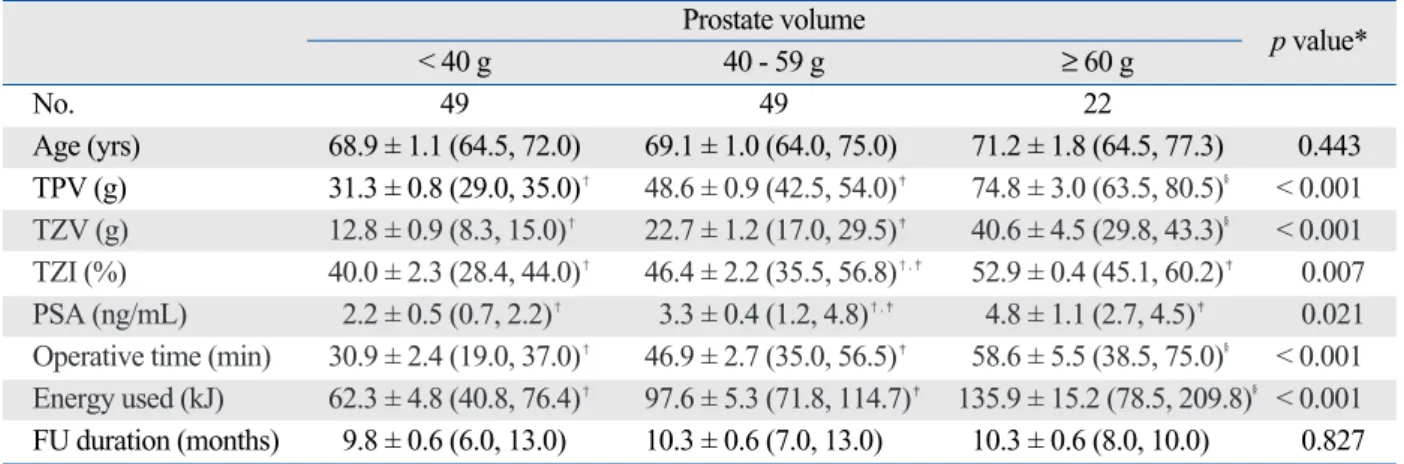
Table 1 shows the patients characteristics. No differences in age and follow-up duration were observed in the three groups. As the prostate volume increased, transition zone volume (TZV) (p < 0.001), transition zone index (TZI) (p
= 0.007) and serum PSA levels (p = 0.021) increased. The mean operative times were 30.9 minutes for the ‘< 40 g’
group, 46.9 minutes for the ‘40-59 g’ group, and 58.6 minutes for the ‘≥ 60 g’ group (p < 0.001). Total median energy delivery for each group was 62.3, 97.6, and 135.9 kJ, respectively (p < 0.001).
Baseline and post-treatment data
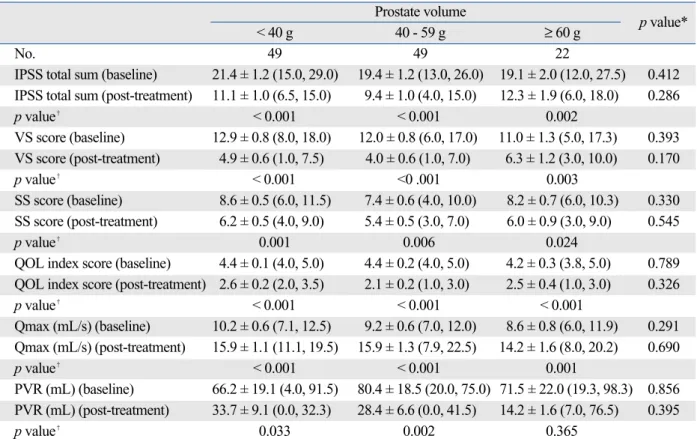
At baseline, no significant differences in IPSS scores and uroflowmetry parameters were noted between the three groups. After treatment, these parameters were also not significantly different among the three groups. The IPSS scores and uroflowmetry parameters improved significan- tly regardless of prostate volume after surgery, although the PVR in the > 60 g patient group did not significantly im- prove. The baseline and post-treatment data in each group
are shown in Table 2.
Difference of data from baseline to post-treatment Table 3 shows the changes in IPSS scores and uroflow- metry parameters that occurred between post-treatment and baseline according to prostate volume, showing no differences in the change of parameters among the groups.
Intraoperative complications
There were no complications during the procedure and no blood transfusions were required. However, the irrigation solution was temporarily replaced and homeostasis was achieved by electrocoagulation using a transurethral resec- tion loop in three patients because it was difficult to achi- eve homeostasis.
Postoperative complications
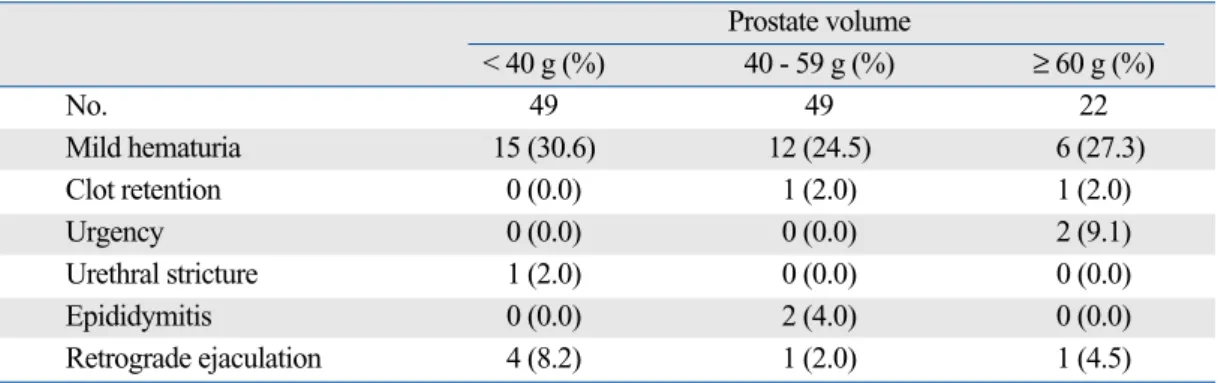
The complication rates within the observation period are shown in Table 4. Mild hematuria was noted in 33 patients (27.5%), but this was generally transient and clinically insi- gnificant. Six patients (5.0%) developed retrograde ejacula- tion. Two patients (1.7%) experienced clot retention posto- peratively, which necessitated catheterization; the catheter was successfully removed after 2 weeks in both patients.
Two patients (1.7%) had postoperative transient urgency, which was resolved without medical intervention. Acute epididymitis was seen in 2 patients (1.7%) after surgery, and one (0.8%) had a urethral stricture. No other surgery- related complications developed in the follow-up period.
The new generation of high-power KTP lasers can create a cavity almost bloodlessly, with added benefit of an easier
DISCUSSION RESULTS
Table 1. Patient Characteristics
Prostate volume
< 40 g 40 - 59 g ≥ 60 g p value*
No. 49 49 22
Age (yrs) 68.9 ± 1.1 (64.5, 72.0) 69.1 ± 1.0 (64.0, 75.0) 71.2 ± 1.8 (64.5, 77.3) 0.443 TPV (g) 31.3 ± 0.8 (29.0, 35.0)� 48.6 ± 0.9 (42.5, 54.0)� 74.8 ± 3.0 (63.5, 80.5)§ < 0.001 TZV (g) 12.8 ± 0.9 (8.3, 15.0)� 22.7 ± 1.2 (17.0, 29.5)� 40.6 ± 4.5 (29.8, 43.3)§ < 0.001 TZI (%) 40.0 ± 2.3 (28.4, 44.0)� 46.4 ± 2.2 (35.5, 56.8)�,� 52.9 ± 0.4 (45.1, 60.2)� 0.007 PSA (ng/mL) 2.2 ± 0.5 (0.7, 2.2)� 3.3 ± 0.4 (1.2, 4.8)�,� 4.8 ± 1.1 (2.7, 4.5)� 0.021 Operative time (min) 30.9 ± 2.4 (19.0, 37.0)� 46.9 ± 2.7 (35.0, 56.5)� 58.6 ± 5.5 (38.5, 75.0)§ < 0.001 Energy used (kJ) 62.3 ± 4.8 (40.8, 76.4)� 97.6 ± 5.3 (71.8, 114.7)� 135.9 ± 15.2 (78.5, 209.8)§ < 0.001 FU duration (months) 9.8 ± 0.6 (6.0, 13.0) 10.3 ± 0.6 (7.0, 13.0) 10.3 ± 0.6 (8.0, 10.0) 0.827 TPV, total prostate volume; TZV, transition zone volume; TZI, transition zone index; PSA, prostate-specific antigen; FU, follow-up.
Data presented are means ± standard errors (25th, 75th percentiles).
learning curve. Histopathological studies after laser pros- tatectomy have shown that there is only a very thin rim of coagulative necrosis (1 to 2 mm), with no evidence of fib- rosis or necrosis outside the prostate or any neurovascular bundle damage.17,18In contrast to the vaporization Nd:YAG laser-induced small (1.4 cm) cavity, which is walled by much collagenous scar tissue, KTP laser vaporization results in a larger (2.4 cm), practically collagen-free un- scarred prostatic channel. These findings suggest that creat-
ing a larger cavity and generating less necrotic tissue also reduce the duration required for postoperative urethral catheterization. Nd:YAG laser treatment removes prostate glandular tissue but leaves at least a portion of the stromal component in the coagulated tissue intact, whereas KTP laser vaporization removes both the stromal and the glan- dular components.17In order to improve the speed of vapori- zation, a quasi-continuous-wave KTP/532 laser that emits an average power of 80 W was developed. It is postulated Table 2. Data at Baseline and Post-Treatment
Prostate volume
< 40 g 40 - 59 g ≥ 60 g p value*
No. 49 49 22
IPSS total sum (baseline) 21.4 ± 1.2 (15.0, 29.0) 19.4 ± 1.2 (13.0, 26.0) 19.1 ± 2.0 (12.0, 27.5) 0.412 IPSS total sum (post-treatment) 11.1 ± 1.0 (6.5, 15.0) 9.4 ± 1.0 (4.0, 15.0) 12.3 ± 1.9 (6.0, 18.0) 0.286
p value� < 0.001 < 0.001 0.002
VS score (baseline) 12.9 ± 0.8 (8.0, 18.0) 12.0 ± 0.8 (6.0, 17.0) 11.0 ± 1.3 (5.0, 17.3) 0.393 VS score (post-treatment) 4.9 ± 0.6 (1.0, 7.5) 4.0 ± 0.6 (1.0, 7.0) 6.3 ± 1.2 (3.0, 10.0) 0.170
p value� < 0.001 <0 .001 0.003
SS score (baseline) 8.6 ± 0.5 (6.0, 11.5) 7.4 ± 0.6 (4.0, 10.0) 8.2 ± 0.7 (6.0, 10.3) 0.330 SS score (post-treatment) 6.2 ± 0.5 (4.0, 9.0) 5.4 ± 0.5 (3.0, 7.0) 6.0 ± 0.9 (3.0, 9.0) 0.545
p value� 0.001 0.006 0.024
QOL index score (baseline) 4.4 ± 0.1 (4.0, 5.0) 4.4 ± 0.2 (4.0, 5.0) 4.2 ± 0.3 (3.8, 5.0) 0.789 QOL index score (post-treatment) 2.6 ± 0.2 (2.0, 3.5) 2.1 ± 0.2 (1.0, 3.0) 2.5 ± 0.4 (1.0, 3.0) 0.326
p value� < 0.001 < 0.001 < 0.001
Qmax (mL/s) (baseline) 10.2 ± 0.6 (7.1, 12.5) 9.2 ± 0.6 (7.0, 12.0) 8.6 ± 0.8 (6.0, 11.9) 0.291 Qmax (mL/s) (post-treatment) 15.9 ± 1.1 (11.1, 19.5) 15.9 ± 1.3 (7.9, 22.5) 14.2 ± 1.6 (8.0, 20.2) 0.690
p value� < 0.001 < 0.001 0.001
PVR (mL) (baseline) 66.2 ± 19.1 (4.0, 91.5) 80.4 ± 18.5 (20.0, 75.0) 71.5 ± 22.0 (19.3, 98.3) 0.856 PVR (mL) (post-treatment) 33.7 ± 9.1 (0.0, 32.3) 28.4 ± 6.6 (0.0, 41.5) 14.2 ± 1.6 (7.0, 76.5) 0.395
p value� 0.033 0.002 0.365
IPSS, International Prostate Symptom Score; VS, voiding symptoms; SS, storage symptoms; QOL, quality of life; Qmax, maximum flow rate; PVR, post-void residual.
Data presented are mans ± standard errors (25th, 75th percentiles).
*one-way ANOVA test.
�Paired t test.
Table 3. Difference of Data from Post-Treatment to Baseline
Prostate volume
< 40 g 40 - 59 g ≥ 60 g p value*
No. 49 49 22
IPSS total sum - 10.3 ± 1.4 (- 17.0, - 4.0) - 9.7 ± 1.5 (- 18.8, - 3.5) - 6.6 ± 1.9 (- 10.0, -2.0) 0.330 VS score - 7.9 ± 0.9 (- 13.0, - 3.5) - 7.8 ± 1.0 (- 12.8, - 3.0) - 4.5 ± 1.3 (- 3.0, - 1.0) 0.094 SS score - 2.3 ± 0.7 (- 4.5, 0.5) - 1.9 ± 0.7 (- 5.0, 0.0) - 2.1 ± 0.9 (- 7.0, 0.0) 0.894 QOL index score - 1.8 ± 0.2 (- 3.0, - 1.0) - 2.3 ± 0.3 (- 3.8, -1.0) 1.7 ± 0.4 (- 5.0, 0.0) 0.238 Qmax (mL/s) 6.0 ± 1.1 (2.3, 8.9) 7.4 ± 1.3 (1.3, 13.3) 6.7 ± 1.7 (1.7, 13.4) 0.721 PVR (mL) - 33.6 ± 15.2 (- 60.0, 0.0) - 50.2 ± 15.4 (- 47.0, - 4.0) - 25.4 ± 26.3 (- 60.0, 21.0) 0.622 IPSS, International Prostate Symptom Score; VS, voiding symptoms; SS, storage symptoms; QOL, quality of life; Qmax, maximum flow rate; PVR, post-void residual.
Data presented are means ± standard errors (25th, 75th percentiles).
*one-way ANOVA test.
that by providing more power, the KTP laser can quickly and efficiently vaporize prostate adenoma.
However, the results of laser prostatectomy with the KTP laser are dependent directly on a number of factors, including wavelength, power, duration and technique. In addition, Monoski, et al.13 recently showed that preopera- tive urodynamic parameters could predict the outcome of KTP laser vaporization. In their study, patients with de- trusor overactivity had more voiding symptoms than those without detrusor activity and were almost twice as likely to require anticholinergics. Men without impaired detrusor contractility had better IPSS, Qmax, and PVR urine volumes compared to those with impaired detrusor con- tractility. Furthermore, Te, et al.14demonstrated that there was a significant difference in the efficacy of KTP laser vaporization related to serum PSA level and total prostate volume (TPV), although the overall results achieved with KTP laser vaporization were very positive and lasted for 3 years.
With increasing use of medical therapy, patients are presenting for definitive surgical therapy later and with larger prostates. Sandhu, et al.3suggested that high-power KTP laser vaporization is safe and efficacious, with dura- ble results for men with symptomatic BPH and large- volume prostates. In the study by Sandhu, et al.,3the average TPV was found to be 101.3 g, and the resection time 122.9 minutes. Generally, homeostasis of vaporiza- tion is more effective than TURP, while vaporization is more time-consuming.27Therefore, Te, et al.2 demonstrated that the amount of tissue vaporization would not exceed 0.5 g/min. In the present study, however, there was no difference in the outcomes of KTP laser according to prostate volume, although more time and energy delivery were required as prostate volume increased. The present study showed that patients with LUTS secondary to BPH and undergoing high-power KTP laser vaporization had a significant improvement in both symptoms and objective variables.
risk5,6,16because of the lack of fluid absorption and bleeding during the procedure. None of the patients had any signifi- cant blood loss and required blood transfusions.
Some limitations of our study should be mentioned. First of all, our study was not a prospective, randomized one.
Therefore, the number of patients in each group was not evenly distributed. Prospective randomized trials are, therefore, required to confirm these findings. Second, the follow-up time of our study was less than 1 year. Therefore, there is some question as to whether our results are durable.
Additional studies with a longer follow-up period are required to verify our findings. Third, in this study, serum PSA and prostate volume after KTP laser vaporization were not evaluated. Fourth, the number of patients was small because this study was a single-center experience.
Finally, in our study, the incidence of retrograde ejaculation after KTP laser vaporization was lower than that of other series. As described previously,28our methods of evaluation (questioning) may interfere with the accuracy of assess- ment since only a small portion of Korean men tell their sexual problems to a medical doctor.
In conclusion, the present results show that high-power KTP photoselective laser vaporization of the prostate is safe and efficacious for patients with LUTS regardless of prostate volume, although a larger prostate requires more time and energy delivery. Despite these early promising results, longer follow-up and a larger cohort of patients are nevertheless needed to validate this technique further, since long term data from randomized studies are still needed to assess the results for KTP photoselective laser vaporization of the prostate.29
1. Hai MA, Malek RS. Photoselective vaporization of the prostate:
initial experience with a new 80 W KTP laser for the treatment of benign prostatic hyperplasia. J Endourol 2003;17:93-6.
REFERENCES
Table 4. Postoperative Complications
Prostate volume
< 40 g (%) 40 - 59 g (%) ≥ 60 g (%)
No. 49 49 22
Mild hematuria 15 (30.6) 12 (24.5) 6 (27.3)
Clot retention 0 (0.0) 1 (2.0) 1 (2.0)
Urgency 0 (0.0) 0 (0.0) 2 (9.1)
Urethral stricture 1 (2.0) 0 (0.0) 0 (0.0)
Epididymitis 0 (0.0) 2 (4.0) 0 (0.0)
Retrograde ejaculation 4 (8.2) 1 (2.0) 1 (4.5)
Data presented are numbers (%).
et al. Photoselective vaporization of the prostate for the treatment of benign prostatic hyperplasia: 12-month results from the first United States multicenter prospective trial. J Urol 2004;72:1404-8.
3. Sandhu JS, Ng C, Vanderbrink BA, Egan C, Kaplan SA, Te AE.
High-power potassium-titanyl-phosphate photoselective laser va- porization of prostate for treatment of benign prostatic hyperplasia in men with large prostates. Urology 2004;64:1155-9.
4. Sulser T, Reich O, Wyler S, Ruszat R, Casella R, Hofstetter A, et al. Photoselective KTP laser vaporization of the prostate: first experiences with 65 procedures. J Endourol 2004;18:976-81.
5. Sandhu JS, Ng CK, Gonzalez RR, Kaplan SA, Te AE. Photo- selective laser vaporization prostatectomy in men receiving anti- coagulants. J Endourol 2005;19:1196-8.
6. Reich O, Bachmann A, Siebels M, Hofstetter A, Stief CG, Sulser T. High power (80 W) potassium-titanyl-phosphate laser vapori- zation of the prostate in 66 high risk patients. J Urol 2005;173:
158-60.
7. Kumar SM. Photoselective vaporization of the prostate: a volume reduction analysis in patients with lower urinary tract symptoms secondary to benign prostatic hyperplasia and carcinoma of the prostate. J Urol 2005;173:511-3.
8. Malek RS, Kuntzman RS, Barrett DM. Photoselective potassium- titanyl-phosphate laser vaporization of the benign obstructive prostate: observations on long-term outcomes. J Urol 2005;174:
1344-8.
9. Bachmann A, Ruszat R, Wyler S, Reich O, Seifert HH, Müller A, et al. Photoselective vaporization of the prostate: the basel experience after 108 procedures. Eur Urol 2005;47:798-804.
10. Volkan T, Ihsan TA, Yilmaz O, Emin O, Selcuk S, Koray K, et al. Short term outcomes of high power (80 W) potassium-titanyl- phosphate laser vaporization of the prostate. Eur Urol 2005;48:
608-13.
11. Sarica K, Alkan E, Lüleci H, Tasci AI. Photoselective vaporiza- tion of the enlarged prostate with KTP laser: long-term results in 240 patients. J Endourol 2005;19:1199-202.
12. Barber NJ, Zhu G, Donohue JF, Thompson PM, Walsh K, Muir GH. Use of expired breath ethanol measurements in evaluation of irrigant absorption during high-power potassium titanyl phos- phate laser vaporization of prostate. Urology 2006;67:80-3.
13. Monoski MA, Gonzalez RR, Sandhu JS, Reddy B, Te AE.
Urodynamic predictors of outcomes with photoselective laser va- porization prostatectomy in patients with benign prostatic hyper- plasia and preoperative retention. Urology 2006;68:312-7.
14. Te AE, Malloy TR, Stein BS, Ulchaker JC, Nseyo UO, Hai MA.
Impact of prostate-specific antigen level and prostate volume as predictors of efficacy in photoselective vaporization prostatec- tomy: analysis and results of an ongoing prospective multicentre study at 3 years. BJU Int 2006;97:1229-33.
15. Bouchier-Hayes DM, Anderson P, Van Appledorn S, Bugeja P, Costello AJ. KTP laser versus transurethral resection: early results of a randomized trial. J Endourol 2006;20:580-5.
16. Fu WJ, Hong BF, Wang XX, Yang Y, Cai W, Gao JP, et al.
Evaluation of greenlight photoselective vaporization of the pros- tate for the treatment of high-risk patients with benign prostatic hyperplasia. Asian J Androl 2006;8:367-71.
17. Kuntzman RS, Malek RS, Barrett DM, Bostwick DG. Potassium- titanyl-phosphate laser vaporization of the prostate: a comparative functional and pathologic study in canines. Urology 1996;48:575- 83.
18. Kuntzman RS, Malek RS, Barrett DM, Bostwick DG. High- power (60-watt) potassium-titanyl-phosphate laser vaporization prostatectomy in living canines and in human and canine cada- vers. Urology 1997;49:703-8.
19. Lee R, Saini R, Zoltan E, Te AE. Photoselective vaporization of the prostate using a laser high performance system in the canine model. J Urol 2008;180:1551-3.
20. Spaliviero M, Araki M, Wong C. Short-term outcomes of Green- light HPS laser photoselective vaporization prostatectomy (PVP) for benign prostatic hyperplasia (BPH). J Endourol 2008;22:
2341-7.
21. Rieken M, Ebinger Mundorff N, Bonkat G, Wyler S, Bachmann A. Complications of laser prostatectomy: a review of recent data.
World J Urol 2010;28:53-62.
22. Krambeck AE, Handa SE, Lingerman JE. Holmium laser enucl- eation of the prostate for prostates larger than 175 grams. J En- dourol 2010;24:433-7.
23. Du C, Jin X, Bai F, Qiu Y. Holmium laser enucleation of the prostate: the safety, efficacy, and learning experience in China. J Endourol 2008;22:1031-6.
24. Shingleton WB, Terrell F, Renfroe DL, Kolski JM, Fowler JE Jr.
A randomized prospective study of laser ablation of the prostate versus transurethral resection of the prostate in men with benign prostatic hyperplasia. Urology 1999;54:1017-21.
25. Shingleton WB, Renfroe LD, Kolski JM, Fowler JE Jr. A rando- mized prospective study of transurethral electrovaporization vs.
laser ablation of the prostate in men with benign prostatic hyper- trophy. Scand J Urol Nephrol 1998;32:266-9.
26. Bachmann A, Schürch L, Ruszat R, Wyler SF, Seifert HH, Mül- ler A, et al. Photoselective vaporization (PVP) versus transure- thral resection of the prostate (TURP): a prospective bi-centre study of perioperative morbidity and early functional outcome. Eur Urol 2005;48:965-71.
27. Reich O, Bachmann A, Schneede P, Zaak D, Sulser T, Hofstetter A. Experimental comparison of high power (80 W) potassium titanyl phosphate laser vaporization and transurethral resection of the prostate. J Urol 2004;171:2502-4.
28. Paick JS, Um JM, Kim SW, Ku JH. Influence of high-power potassium-titanyl-phosphate photoselective vaporization of the prostate on erectile function: a short-term follow-up study. J Sex Med 2007;4:1701-7.
29. Naspro R, Bachmann A, Gilling P, Kuntz R, Madersbacher S, Montorsi F, et al. A review of the recent evidence (2006-2008) for 532-nm photoselective laser vaporization and holmium laser enucleation of the prostate. Eur Urol 2009;55:1345-57.