ON COMBINATORICS OF KONHAUSER POLYNOMIALS
DONGSU KIM
1.
Introduction
Let L be a linear functional on the vector space of polynomials in x.
Let w(x) be a polynomial in x of degree d, for some positive integer d.
We consider two sets of polynomials, {Rn(x)}n>O, {Sn(x)}n>O' such that Rn(x) is a polynomial in x of degree n and S n( x) is a, poiYnomial in w(x) of degree n. (So Sn(x) is a polynomial in x of degree dn.) These two sets of polynomials are said to be biorthogonal with respect to a linear functional L if
L(Rm(x)Sn(x))
=0 if and only if m
=1= n.DEFINITION
1.1. Polynomials {Rn(x)}n?O, {Sn(x)}n?O satisfying the above condition are called biorthogonal polynomials.
IT w(x) = x then biorthogonal polynomials become ordinary orthog- onal polynomials [4]. IT the linear functional L is given by the integral with respect to a weight function ,.,,(x) over an interval [a,.8]' the above orthogonality condition can be written as
l
PRm(x)Sn(x),.,,(x)dx = 0 if and only if m
=1=n.
When w(x) = x
dand the linear functional L is given by the weight function xae-
xon (0,00), which is the weight function of Laguerre
Received May 7, 1995.
1991 AMS Subject Classification: 05A10, 33C45.
Key words: Konhauser polynomials.
Partially supported by KOSEF-RCAA and KOSEF : 95-0701-02-01-3.
polynomials, the biorthogonal polynomials determined by L are called Konhauser polynomials, denoted {y~
a>c
X )}n~O and {Z~
a) (X )}n~O, where
where
a;k)n = n?:ol(a + ik). Konhauser polynomials are introduced in [2], [8], [9].
Combinatorial properties of orthogonal polynomials are studied ex- tensively by many people. Laguerre, Hermite, Charlier, and their
q-versions are given combinatorial interpretations [5], [6],[10],[12], [13], [14].
A combinatorial model for general biorthogonal polynomials based on the recurrence relations is given in [7]. The model, however, does not contain 'good' structures, because it depends on the recurrence relations alone.
The purpose of this paper is to give a combinatorial interpretation of Konhauser polynomials, proving their orthogonality by using a weight- preserving sign,-reversing involution. Note that an involution
'ljJdefined on a weighted set S with weight function
wis called weight-preserving sign-reversing if w(.,p(a» = -w(a) for all a
ES s.t. w(a) =J. a. This paper uses the following well-known lemma several times.
LEMMA
1.2. If.,p is
aweight-preserving sign-reversing involution on S and F is the set {a
ES '''''(a) = a}, then
Lw(a) = L w(a).
OIES OIEF
Proof We partition S into orbits of .,p, i.e. into distinct fa,.,p( a)} 'so
IT .,p(a) =J. a, then w( {a, .,p(a)})
=w(a) +w(.,p(a))
=o. Hence the sum
in the left leaves only the orbits consisting of one element, i.e. {a }'s
with .,p(a) = a.
In this paper, (a; k)n, (a)n, [a]n denote rr:::-ol(a + ik), rr~:ol(a + i), rr~:ol(a - i) respectively. Note that [a]n = (_l)n( -a)n. We also use the notation [n] for the set {1,2, ... ,n}.
2. Konhauser polynomials
The weight function for Konhauser polynomials is p(x) = xae- X and the n-th moment m n = (a)n. It is known [3] that yJa)(x, d) has a generating function
Ly~a)(x,d)wn
= = (1- w)-(I+a)/dex-X(l-w)-l/d
n=O
The biorthogonality relation is
(y~a)(x,d),zia>Cx,d)) = { domm!(a)dm if
m= n
otherwise where (f,g) denotes the integral Io= f(x)g(x)xae- Xdx.
We begin with some properties of Konhauser polynomials. Let
L~a) = (-1)nt(-1)i(7)(a+i)n_i xi.
1=0
L~a) is the Laguerre polynomial, which is equal to y~a)(x,1) or zia)(x, 1) [4].
PROPOSITION
2.1. y~a)(x,d) = :L:~=o ciL~a) where Ci is the follow- ing expression independent of a:
C.
= (_l)n+i ~ (_l)t(
-t;d)n
1
L....J t! (i - t)!
t=o
C·I
We can evaluate the inside double sum by using the difference iden- tity [po 103][1],
We choose F(x) = (a+x;d)n. and evaluate at x = -a - t. Since
(a + t)n
=(_1)n[-a - t]n, we get the expression for Ci.
PROPOSITION
2.2. Z~a)(x, d)nd
=~f~n biL~a) where b
iis the fol- lowing expression:
Proof. This is similar to the previous proof and is omitted.
To interpret Konhauser polynomials combinatorially, we :first inter- pret moments (a)n as in [Prop. 1.3.4, p. 19], 11], and generalize it to interpret (a +
s~d)n. Any permuta.tion of [n] can be represented uniquely as a product of disjoint cycles. For a permutation
qof [n], define p and
ras follows:
p(q)
=the number of cycles in q r( q)
=n - (the number of cycles in q).
LEMMA
2.3. Let Sn be tbepermutations of[n]
={1,2, ... ,n}.
Assume that permutations are represented by disjoint cycles. Tben (a)n
=.2: aP(u).
uESn
Proof. We use induction on n. When n
=1, it is obvious. Assume that it holds for n - 1. We divide the set Sn into two groups: one group contains permutations
qwhere
nforms a cycle of length 1, i.e.
q(n) = n, and the other contains. permutations where n is contained
in a cycle with at least two numbers, Le. q(n) =f n. In the latter case,
there are n - 1 choices for q(n). Since (a)n = (a)n-l(a + n - 1) =
(a)n-l . a + (a)n-l . (n -1), it holds for n.
LEMMA
2.4.
(a; d)n = L aP(tT)dT(tT).
tTeSn
Proof. We use induction on n as in the previous proof. When we add n to a permutation of [n -1], if n forms a cycle by itself, then a factor a is multiplied and if n is added to a cycle, then a factor
dis multiplied.
So it agrees with the product (a; d)n = (a; d)n-l(a + den -1)).
We consider an element of
Bnas a labeled directed graph, consisting of directed cycles. For example, a permutation (12)(345)(6789) in disjoint cycle notation can be represented by the following directed graph:
6 9
D
7 8
Figure 1: A directed cycle: (12)(345)(6789)
To deal with (a + s; d)n for a nonnegative integer s, we consider more general objects for which labeled directed cycles are a special case. Let n, s be nonnegative integers. Consider a E
Bnas a set of directed cycles. We imagine that we have s labeled boxes. Put some of the cycles of
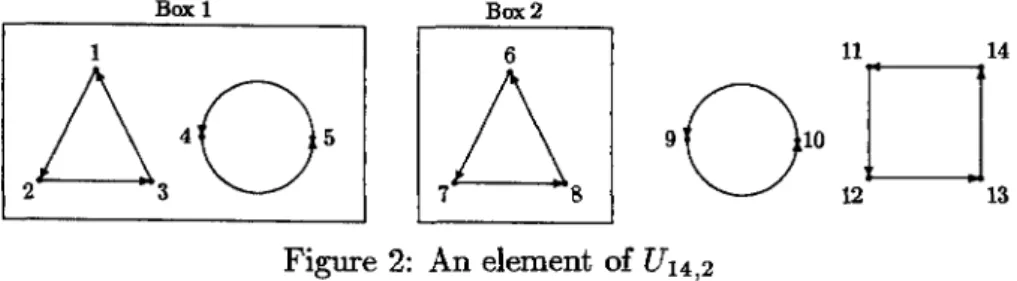
ain some boxes. Define Un,s to be the set of these objects. An element of U
14 ,2is shown below:
Box 1 Box 2
Figure 2: An element of U
14 ,2As we can see, if we ignore boxes then any element of Un,s is an
element of Bn, so that we can define the weight on elements of Un,s to
be the weight of elements after ignoring the boxes. A precise definition of weight is given below. We show as before that:
LEMMA
2.5.
(a +
Sjd)n = L aP(u')dT(u"),
. uEUn ,.
where u' denotes .the object after deleting boxes and their contents, and u" denotes the set of cycles in the object. (The element in Figure 2 has weight a
2d
9.)Proof. Similar to the previous case.
We now interpret YJa)(x, d) as a generating function of some objects.
For convenience' sake, we first interpret (-l)nnlYJa)(x, d) instead of YJa)(x, d).
DEFINITION
2.6. For a permutation
1rof a subset of [n], let fr denote the underlying set of
1r,i.e. subset consisting of elements in
1r.Let An be the set of all ordered pairs (1r, u), where
1ris a permutation of a subset of [n] and u is an element in Un,s for some s, 0 ::; s ::; n - Ifrl,
where the boxes in u are labeled by some integers in [n] \ fr. The weight of (1r, u) is given by (_l)sxn-I1i'laP(u')dT(u"), where u' denotes the object after deleting boxes and their contents, and u" denotes the set of cycles in the object.
LEMMA
2.7. The weight generating function of An is (-l)nnlyJa) (x, d), i.e.
Proof. The factor [n]n-r counts permutations
1rof an r element
subset of [n] and (:) counts the number of different sets oflabels chosen
from [n] \
fr.So we can show that the sum is the weight generating
function of An. We omit the details.
The weighted set
Anadmits a weight-preserving sign-reversing in- volution. The involution is described as follows:
Among labels of empty boxes and the integers which are in [n] \ ir but not chosen for labels, one chooses the smallest integer, say k. If k is the label of an empty box, then delete that box and make it 'unchosen', otherwise create an empty box with label k.
This operation fixes an element or changes only the number of boxes in
(J'by 1, so that it is weight-preserving sign-reversing. From the definition of this operation, it is clearly an involution. The fixed points of this involution are (7r,
(J') .E Ansuch that
(J'has no empty box and the number of boxes in
(J'is equal to
n -lirl. So we get the following:
(-l)nn!y~a)(x;d) is equal· to the weight generating function of the set consisting of "( 7r,
(J')'s, where 7r is a permutation of a subset of [n] and
dE Un,n-lirlhas no empty box and the boxes in
(J'are labeled by [n] \ ir.
Since the fixed set·consists of all the elements (7r,
(J')where
(J'has exactlyn-lirl boxes none of which is empty, we can interpret (_l)ny~a) (x, d) directly, trimming the factor n! from the above set. If we just ignore 7r and labels in
(J',then we don't have the factor n! and the boxes in
(J'will De distinguished only by their contents. The precise definition follows:
DEFINITION
2.8. Let Y
nbe the set of partitioned permutations. A permutation
(J'is a partitioned permutation if its cycles are divided into several blocks, at most one of which is empty. We distinguish a block, called the principal block, from other blocks, called secondary blocks.
Secondary blocks are assumed to be indistinguishable, i.e. they are distinguished by their contents only. Assume that only the principal block may be empty but none of the secondary blocks can be empty.
The weight of an element in Y
nis (_x)ka'd
rn,where k denotes the number of secondary blocks and 1 denotes the number of cycles in the principal block and m denotes n minus the number of cycles in all blocks (Figure 3).
THEOREM
2.9. (_l)ny~a)(x, d) is equal to the weight generating
function of the set Y
n .Proof Let a be an element in Y
n .Suppose a has r secondary blocks.
Then we can make n! objects in An from
aby choosing
71",a permuta- tion of
n - relements, and labeling
rsecondary blocks. These objects are counted by (_l)nn!y~a)(x,d). Hence (_l)ny~a)(x, d) is the gener- ating function of Y
n .Figure 3: An element of Y
14with two secondary blocks with weight (_1?x
2a
2d
9•We now express (_l)nz~a)(x, d) as a weight generating function of a certain weighted set. There are nd colored boxes, d boxes for each color i, i
=1,2, ... , n. We choose t colors and make permutations
71"with den - t) boxes of unchosen colors. Distribute some of the cycles in
71"among dt boxes of chosen colors. Let Zn be the set of all these objects.
Put a weight w on a E Zn by w(a)
=(_l)t
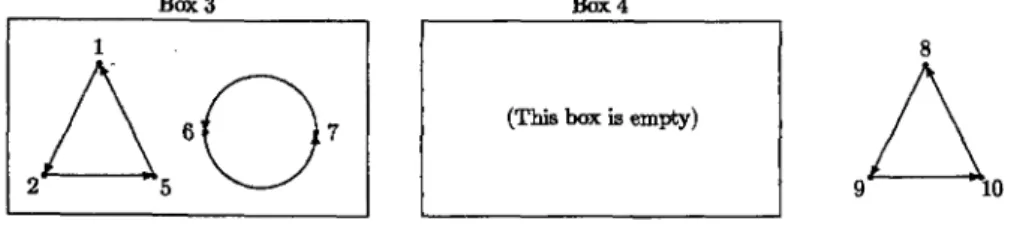
a'x dt , where t is the number of the chosen colors and 1 is the number of cycles outside boxes. Then the weight generating function of Zn is equal to (-l)nzi a )(x, d). We draw an element of Zn below (Figure 4). Let n
=5 and d = 2. We use labels 1,2; 3, 4; 5, 6; 7, 8; 9,10 to represent 10 colored boxes, two boxes for each color. Assume that only the second color, Color 2, is chosen, i.e. the boxes 3 and 4 are chosen. We distribute some of the cycles made with 1,2,5,6,7,8,9,10 into boxes of the chosen colors.
Box 3 Box4
(This boxisempty)
.6,
8Figure 4: An example of Zn of weight -ax
2(n = 5, d = 2, t = 1).
Color 2 is chosen. Boxes 3 and 4 are two boxes of Color 2.
Using these combinatorial interpretati6ns for y~a\x, d) and zi a )(x, d) and a suitable weight-preserving sign-reversing involution, one can es- tablish the orthogonality relation of these two polynomials combinato- rially.
THEOREM
2.10. {y~a)(x, d)}n>o and {Z~a) (x, d)}n>o are orthogo- nal with respect to weight [unctio; fl(X) = xae-
X -Proof. Let Sn,m be the set of all triples (A, B, C) where A
EYn, B
EZm, and C is an appropriate disjoint cycle described below. IT A has
usecondary blocks and B has t chosen colors, then C
ESu+dt. C is given the weight defined in Lemma 2.3. Since secondary blocks in A are distinguished.by their contents and dt boxes with chosen colors in B are labeled, C is regarded as a permutation of
u+ dt distinct boxes.
Define the weight of (A, B, C) to be the product of the weight of each component. It is clear that the weight of the set Sn,m is the integral (y~a)(x,d), zia»)(x, d) [12].
We define an involution 'ljJ on Sn,m such that
(1) if 'ljJ((A, B, C)) i= (A, B, C) then w('ljJ((A, B, C))) ::: -w((A, B, C)), i.e. 'ljJ is a weight-preserving sign-reversing involution, (2) if n
=rn, then the fixed set has weight dnn!(
a)dn,
(3) if n i= rn, then the fixed set is empty.
Note that the sign of the weight of (A, B, C) is ( -1)
u+t.So the first condition says that if (A, B, C) is not fixed by 'ljJ then the parity of the quantity u+t is changed. We will achieve this objective in seven steps.
Step 1: We partition the set Sn,m into
Uu,tTu,twhere Tu,t denotes the set of all elements (A, B, C)
ESn,m such that A has
usecondary blocks and B has t chosen colors. The weight of Tu,t has a factor (a +
dt)dm-dt(a)u+dt, which can be rearranged to give the factor (a)dm(a+
dt)uo We can easily describe this rearrangement combinatorially. We omit this description. After fadoring out, we are left with the factor (a + dt)u'
We now regard this as the weight of the set of all objects obtained
by distributing cycles in a permutation of [u], representing u secondary
blocks in A, into one principal box and
tsecondary boxes, representing
t chosen colors, where the weight of each cycle in the principal box is
aand the weight of each cycle in a secondary box is d.
Step 2: The set Tu,t can be regarded as the set of all objects (1r, E, F) where 1r is a permutation of dm boxes of all colors and E is an element in Y
nwith u secondary blocks and F is an element in the set described above whose weight is (a + dt)u, where [u] represents the u secondary blocks in E and t is the number of chosen colors. We define an invo- lution "pIon Uu,tTu,t (Figure 5). Let (1r, E, F) be an element in Tu,t.
H all m colors are chosen and none of them is empty, i.e. each color is used at least once, then set "pI(1r, E, F)
=(1r, E, F). Otherwise find the least integer k among the labels of m - t unchosen colors in F and the labels of chosen colors which are not used in F. H integer k comes from an unused chosen color, then make color k chosen, otherwise make color k unchosen. Let "pI(1r, E, F) be the result of this change. This is certainly a weight preserving involution and changes the parity of t for elements not in the fixed set of "pI.
Color2 Color4
(This box is empty)
Figure 5: The F component in an element (1r,E,F) in Tu,t.
Integers 1 through
~represent 8 secondary blocks in E.
"pI will make Color 1 chosen in this case. (m
=5, t
=2,
u =8)
Step 3: We now examine the fixed set of "pI. An element (1r, E, F) E
Tu,t is in the fixed set of1/JI iff t
=m and all m colors are chosen in
F and each of the secondary boxes representing m chosen colors is
nonempty. Since the first component 1r is arbitrary, we let F~I) denote
the set of all (E,F) such that (1r,E,F) is a fixed point of "pI in Tu,m
for any permutation 1r of dm boxes. The weight of Sn,m is the product
of (a)dm and the weight of F~I). Recall that E has one principal block
and
usecondary blocks and F has one principal box and m secondary
boxes none of which is empty. We identify the
usecondary blocks of
E with integers in [u] used in F. Then the element (E, F) E F~l) will
be represented as (P, Q, R) where P is the principal block in E which
consists of cycles with elements in [n] and Q is the principal box of F
which consists of cycles formed with
usecondary blocks in E and R is the set of m secondary boxes of F :filled with cycles formed with u secondary blocks in E.
Color 1 Color 2
2 1
0 <
11
3~'
Q §..D~
•
~ ;!• •
Figure 6: An element (P,Q,R) in F2).
Integers 1 through
~represent 9 secondary blocks in Q.
Secondary blocks are filled with cycles with elements {5, ... , 15}.
(m
=2,
n =15,
u =9)
Note that we can describe F~l) directly (Figure 6). We begin with a permutation of [n]. Distribute the cycles of the permutation among one principal block and
usecondary blocks. The principal block may be empty but none of the secondary blocks is empty. The secondary blocks are not labeled. They are distinguished by the contents in the blocks. Form a permutation with u secondary blocks. Distribute the cycles of the permutation among the principal box and m secondary boxes. The principal box may be empty but none of the m secondary boxes is empty. Let F~l) be the object made in this way. Let P, Q, R denote the principal block, the principal box and the m secondary boxes, respectively. The weight of (P,Q,R) E F~l) is (_l)u+rn
akd' where k is the sum of the number of cycles in P and the number of cycles in Q, cycles of blocks, and 1 is the sum of n - a where a is the number of cycles in (P, Q, R) when we ignore boxes and blocks and the number of cycles in R, cycles of
usecondary blocks.
Step 4: We now describe an involution 'l/J2 on UuF~l). Let CP, Q, R)
be an element in F~l). We order the cycles with [n] by the maximal
integer contained in it. We will call a I-cycle in Q 'lonely' if its only
second block consists of exactly one cycle formed with [n]. IT P is not
empty or Q has any 'lonely' I-cycles, then choose the smallest cycle C
among the cycles in
Pand the cycles contained in secondary blocks in
'lonely' I-cycles of Q. IT C comes from P, then form a new block with
C alone and put it inside Q as a 'lonely' I-cycle. If C comes from a secondary block in a 'lonely' I-cycle in Q, then delete the 'lonely' 1- cycle from Q and add C to P as a new cycle. If P is empty and Q has no 'lonely' I-cycles, then we do nothing. Let the result of this operation be 'l/J2(P, Q, R). Let F~2) be the set of all element (P, Q, R)
EF~l) which are fixed by 'l/J2 (Figure 7).
Itis clear that 'l/J2 is an weight preserving involution and the parity of
uchanges for elements not in the fixed set
UuF~2).BloCk!
2
,6.
Color 1
Q 1.
• •
Color2
Figure 7: An element (0, Q, R) in F~2).
Integers 1 through 10 represent 10 secondary blocks in Q.
Secondary blocks 2. through 10 are filled with cycles with elements {5, ... , 15}. (m = 2, n = 15,
U= 10)
Step 5: The fixed set UtLF~2) consists of elements (P, Q, R)
EUuF~l) such that P is empty and each 1-cycle of secondary blocks in Q consists of a secondary block which contains more than one cycles formed with [n], i.e. each cycle in Q contains at least two cycles formed with [n].
This fixed set is still too large for our purpose. We now define an involution 'l/Ja on UuF~2). Let (P, Q, R) be an element of UuF~2). If there exists a cycle C in Q or R such that either the secondary block containing C has more than one cycles, or C forms a secondary block alone which belongs to a cycle of length greater than one, then choose the largest cycle (: among such cycles; otherwise define 'l/Ja(P, Q, R) =
(P, Q, R). Let fJ be the secondary block containing C. IffJ contains
only (:, then contract the cycle containing fJ by adding (: to the next
block after (; in the cycle and deleting the secondary block (; from
the cycle; otherwise delete the cycle (: from fJ and form a secondary
block consisting of (: alone and insert it in the cycle before the block
fJ (Figure 8). Let the result ofthis operation be 'l/Ja(P, Q, R). The map
'tfJ3 is a weight preserving involution and the parity of
uchanges for the elements not in the fixed set. Let F~3) be the set of all element (P, Q, R) E F~2) which are fixed by 'tfJ3'
0
I---6
1 1
0
1---+. . .
06
1 1
0 - . . .
Figure 8: A correspondence for 'tfJ3. The 3-cycle is assumed to be the largest cycle that can be moved.
Step 6: The fixed set U'UF~3) consists of (P, Q, R) such that P is empty and each of the cycles in Q and R formed with the secondary blocks is a l-cycle and each secondary block consists of exactly one cycle. Note that then (P, Q, R) E F~3) implies that Q is empty as well, because if (P, Q, R) is in U'UF~2) then each cycle of secondary blocks in Q should contain at least two cycles of [n]. So U'UF~3) consists of (P, Q, R) such that P and Q are empty and each of the cycles in R formed with the secondary blocks is a l-cycle and each secondary block consists of exactly one cycle.
Calor c Calor c
Figure 9: A correspondence for'tfJ4'
ilis the largest and
i3is the smallest in Color c.
Finally we define one more involution 'l/J4 on UuF~3). Let (P,Q,R)
EF~3). IT each of m secondary box consists of exactly one cycle which in turn consists of exactly one cycle of length one, i.e. each secondary box contains exactly one integer, then define 'l/J4(P,Q,R)
=(P,Q,R);
otherwise let Cl! be the largest integer in [n] such that the secondary box containing the integer Cl! contains other integers also. Let Z be the secondary box containing Cl!. Let 13 be the smallest integer contained in Z. If 13 is in the cycle containing Cl!, say (Cl!, ••• ,x, 13, ... ,y), then we split the cycle into two cycles (Cl!, ••. , x) and (13, ... , y) and make two secondary blocks with each of them and make two I-cycles with each of the two blocks; otherwise we combine two cycles (Figure 9). Let the result of this operation be 'l/J4(P, Q, R). The map 'l/J4 is a weight preserving involution on (P, Q, R)
EF~3) and the parity of
u"changes for elements not in the fixed set. The fixed set Vn,m for 'l/J4·consists of all the elements (P, Q, R) such that P and Q are empty and each of m secondary boxes contains exactly one integer chosen from [n]." Since each integer in [n] must appear in some secondary box in R, the fixed set is empty unless n = m. H n
=m then Vn,n corresponds to the set of all permutation of [n] where the weight is
dnfor each element. So we get
{
dnn!, ifn = m, the weight of Vn,m = .../.
o ifn
Tm.
Step 7: By combining the steps, we can actually define an involution 'l/J which satisfies the properties in the beginning of the proof. The weight of the fixed set of 'l/J, equivalently the weight of Sn,m, is the product of (a)dm and the weight of V"n,m' Hence we get
ifn
=m, ifn =I m.
This shows that YJa)(x,d)'s and Z~a)(x,d)'s are orthogonal.
3. Remarks
In this section we write the results of our experiments done in Maple.
Combinatorial interpretations of Laguerre polynomials give the lin-
earization coefficients of the product of L~a)(x)'s [6]. The polynomials
y}::)(x, d)'s and zia)(x, d)'s have combinatorial interpretations and the linearization coefficients can be computed. We find, in experiments, that zia)(x, d)'s have interesting linearization coefficients.
Assume that L denote the linear functional for Konhauser polyno- mials.
• (Conjecture) Let Z~~)(x,d)Zi~)(x,d)··· Z~~)(x,d) = L: AnZ~a)(x, d).
Then An is a polynomial in
aof constant sign.
• (Conjecture) Let Y~~)(x,d)Y~:)(x,d)··· Y~:)(x,d) = L:Bny~a)(x, d).
Then B
nis a polynomial in a of constant sign for all n
~no, for some no. What is no? For small n's, even for k = 2, Bn's are not a polynomial in
aof constant sign.
• (Guess) L(Z~~'>(x,dl)Zi~)(x,d
2 ) · · ·zi~)(x,d
k» is a polynomial in
awith nonnegative coefficients.
• (Guess) L(Y~~)(x,dl)Y~:)(x,d
2 ) · · ·Y~:)(x,d
k» is a polynomial in a with nonnegative coefficients, for
di ~2.
• (Guess) L(YJ:)(x, d1)YJ:>cx, d
2 ) · · ·YJ:)(x, d
k» is a polynomial in
awith nonnegative coefficients. Even though we assume that d is a positive integer, we can substitute -d for d since d appears in only the coefficients of the polynomials.
Any proof, analytic or combinatorial, of the above will be interest- ing. Orthogonality of y~a)(x, d)'s and zia)(x, d)'s follows from Propo- sitions 2.1 and 2.2 and the orthogonality of Laguerre polynomials. But the proofs of the propositions are not combinatorial. Combinatorial proofs of them will be interesting.
References
1. M. Aigner., Combinatorial Theory, Springer-Verlag, Berlin, 1979.
2. W. A. Al-Salam and A. Verma.,q-Konhauser polynomials, PacificJ. Math. 108 (1983), 1-7.
3. L. Carlitz., A note on certain biorthogonal polynomials, Pacific J. Math 24 (1968), 425-430.
4. T. S. Chihara.,An Introduction to Orthogonal Polynomials, Gordon and Breach, New York, 1978.
5. A. de Medicis, D. Stanton, and D. White., The combinatorics of q-Charlier polynomials,J. of Comb. Theory A 69 (1995), 87-114.
6. M. de Sainte-Catherine and G. Viennot., Combinatorial interpretation of inte- grals of products of H ermite, Laguerre and Tchebycheff polynomials., Polynomes
Orthogonaux et Applications, 1171 of Lecture Notes in Math. (1985), 120-128, Springer-Verlag.
7. D. Kim.,A combinatorial approach to biorthogonal polynomials, SIAM J. Disc.
Math. 5 (1992), 413-421.
8.J. D. E. Konhauser., Some properties of biorthogonal polynomials., J. Math.
Anal. Appl. 11 (1965), 242-260.
9.J. D. E. Konhauser., Biorthogonal polynomials suggested by the Laguerre poly- nomials., Pacific J. Math. 21 (1967), 303-314.
10. J. Labelle and Y. N. Yeh., The combinatorics of Laguerre, Charlier and Her- mite polynomials, Studies in Applied Math. 80 (1989), 25-36.
11. R. P. Stanley., Enumerative Combinatorics, Vol. I, Wadsworth & Brooks/Cole, Monterey, California, 1986.
12. G. Viennot., Une Theorie Combinatoire des Polynomes Orthogonaux, Lecture Notes, Publications du LACIM, UQAM, Montreal, 1983.
13. G. Viennot., Combinatorial theory for general orthogonal polynomials with ex- tensions and applications., Polynomes Orthogonaux et Applications, 1171 of Lecture NotesinMath. (1985), 139-157. Springer-Verlag.
14.J. Zeng., Weighted derangements and the linearization coefficients of orthogo- nal Sheffer polynomials., Proc. London Math. Soc. 65 (1992), 1-22.