Vol.22, No.2, (2020), pp.7~11 https://doi.org/10.9714/psac.2020.22.2.007
1. INTRODUCTION
Turbid water can be produced from natural sources and industrial fields. Common natural sources are water stream such as river and lake. Turbidity of the stream water depends on the geological characteristics and water velocity of the area. However most of the natural sources contains soil minerals, sand, silt, and clay.
Those suspended particle usually has no serious adverse effect on environment and human. Some of the natural sources can contain toxic minerals such as heavy metals.
Turbid water produced from industrial area usually have toxic minerals and some toxic organic particles too. Fine particles originated from automobiles and industrial activities including combustion will be settled down on surface with dry and wet deposition and those particles can be introduced into water body when it is rainy. Fine particles have bigger specific surface area which could adsorb environmental contaminants like heavy metals, and toxic organic solvents. The fine particle adsorbing contaminants can be transported through stream water and some of the particles would be settled on river bottom or on the bottom of lakes when the velocity of water stream become slow. Some fine portion can be reach ocean and precipitated on the big water body. As the water environment changed, contaminants could be
desorbed from the particles and introduced into water ecosystem with adverse effects. It is the best to prevent the release of the toxic fine particle into environment, However, it is impossible to protect all of the toxic particle from several sources. There are several efforts to minimize toxic turbid water. Characteristics and control of non-point source pollution in urban areas during the initial period of rainfall have been studied and practiced [1]. Reduced water velocity at water retention area or wet-land allow particles precipitate before the water reach at the conflux with bigger stream or drinking water resource. In the spite of many efforts to collect the particle and prevent the contaminated water reaching bigger water body, there are contaminated sediments on the river, lakes and sea. After precipitation of the particles on the bottom of water bodies, environmental engineers try to block the contaminants from water ecosystem with many engineered ways such as capping and dredging. Capping technique is covering the contaminated sediments with media which block the release of contaminants into water by physical and chemical mechanism. Sand and activated carbon are common media for the capping process [2-3]. This is not a permanent technology for the contaminated sediment because the covering media can be drifted away by water stream and the media can be saturated with the contaminants. One of the permanent technique is
Magnetic force assisted settling of fine particles from turbid water
H. P. Hong
a, H. W. Kwon
a, J.J. Kim
b, D.W. Ha
c, and Young-Hun Kim
*,aa
Department of Environmental Engineering, Andong National University, Andong, Korea
b
Department of Earth and Environmental Sciences, Andong National University, Andong, Korea
c
Korea Electrotechnology Research Institute, Changwon, Korea
(Received 21 May 2020; revised or reviewed 26 June 2020; accepted 27 June 2020)
Abstract
When rivers and lakes are contaminated with numerous contaminants, usually the contaminants are finally deposited on the sediments of the waterbody. Many clean up technologies have been developed for the contaminated sediments. Among several technologies dredging is one of the best methods because dredging removes all the contaminated sediments from the water and the contaminated sediments can be completely treated with physical and chemical methods. However the most worried phenomenon is suspension of fine particles during the dredging process. The suspended particle can release contaminants into water and resulted in spread of the contaminants and the increase of risk due to the resuspension of the precipitated contaminants such as heavy metals and toxic organic compounds. Therefore the success of the dredging process depends on the prevention of resuspension of fine particles. Advanced dredging processes employ pumping the sediment with water onto a ship and release the turbid water pumped with sediment into waterbody after collection of sediment solids. Before release of the turbid water into lake or river, just a few minutes allowed to precipitate the suspended particle due to the limited area on a dredging ship. However the fine particle cannot be removed by the gravitational settling over a few minutes. Environmental technology such as coagulation and precipitation could be applied for the settling of fine particles. However, the process needs coagulants and big settling tanks. For the quick settling of the fine particles suspended during dredging process magnetic separation has been tested in current study. Magnetic force increased the settling velocity and the increased settling process can reduce the volume of settling tank usually located in a ship for dredging.
The magnetic assisted settling also decreased the heavy metal release through the turbid water by precipitating highly contaminated particles with magnetic force.
Keywords: suspended particle, heavy metal, settling, environmental application, magnetic separation
* Corresponding author: [email protected]
dredging which is removing the sediment by physical methods. Dredging methods usually induce resuspension of the particle making turbid water around the area during taking out the sediment with suction or mechanical digging out. The resuspension is the disadvantage of the environmental dredging because the suspended particle can be transported and exposed to aquatic lives with toxic effect. Quick precipitation or filtering of the turbid water are required for a successful dredging process and conservation of aquatic lived around the area. The dredging process is conducted on a boat or a barge which cannot supply enough area for conventional precipitation process. Conventional coagulation/precipitation need a long time like several ours or a day and a huge volume of reactors are needed for giving the precipitation time. Current dredging process cannot give enough time for precipitation, therefore the technique often are not accepted by environmentalist. However, the public ask to remove the toxic sediment from lake and sea bottom. One of the way to shorten the precipitation is using coagulant which adhere on the particle surface and conglomerate them.
Coagulated particle mass can settled down with higher speed but the coagulant need cost and the coagulant is a chemical which also has some moderate adverse effect on water environment.
It is good to accelerate the precipitation by adding a physical force to the particles with gravity. Then we can shorten the precipitation time without adding chemicals in the turbid water. There are many precipitation process in environmental engineering area including water and waste water treatments and hazardous waste managements. If the velocity of settling of particle is slower, a bigger reactor is necessary to give enough settling time. Magnetic force would be the force to accelerate the particle’s precipitation if the particle is a magnetic body. Magnetic separation has been applied several environmental areas [4-11]. Magnetic adsorbents have been synthesized and applied for environmental applications for removal of heavy metals and organics from water and soil [5-6]. A few previous studies reported magnetic separation of contaminated sediment particles out of less contaminated or just soil particles [7-9]. There are some publications that magnetic separation technique could enrich valuable metals such as nickel and copper [10-11].
The objective of current study is to shorten the precipitation time of suspended sediment particles in water without using coagulant. By the magnetic force
the resuspended particle from sediments can be settled in a short time and the treatment of turbid water could be possible on a small space of barge which has been used for environmental dredging.
2. EXPERIMENTAL METHODS
2.1. Chemicals
Heavy metal (Fe, Cd, As, and Ni) standard solution (1,000 mg/L) was obtained from Kanto Chemical and used for determination of heavy metal concentration.
Acids (nitric acid, sulfuric acid, and hydrochloric acid) were obtained from Merck. All chemicals were used without further purification.
2.2. Analytical Methods
Turbidity of turbid water was measured by a turbid meter (HI-98703, Hanna) before and after the magnetic separation. The precipitated and suspended particles were analyzed for the heavy metal concentration using an ICP-MS (7800, Agilent). Analyzed heavy metal species were Ni, As, Cd, Cr, Cu, Fe, Hg, Pb, and Zn.
Magnetic property of the suspended particle was analyzed by a VSM (Model 7404, Lake Shore Cryotronics, Inc.). The accuracy and precision of the analysis of heavy metal were verified against certified reference samples (BAM-U112a). The particle size distribution of suspended and precipitated particles was analyzed with a particle size analyzer (Mastersizer 2000, Malvern).
2.3. Synthesis of turbid water
Sediment samples were collected from Andong-dam in Korea. The Sediment were sampled with a grab- sampler. Turbid water was made by strong mechanical stirring of sediments in distilled water. After the stirring the turbid water was gravitationally settled for 5 min and the supernatant of the turbid solution, which is settling resistant, was used for magnetic precipitation experiments. The turbidity of supernatant was measured before and after the magnetic precipitation. The synthetic process was shown in Fig. 1. and contamination level of the sediment was evaluated.
2.4. Magnetic precipitation
Magnetic precipitation was conducted with a
permanent magnet and a high gradient magnetic
separator (HGMS) with superconducting magnet. The
Fig. 1. Preperation of turbid water from sediments.
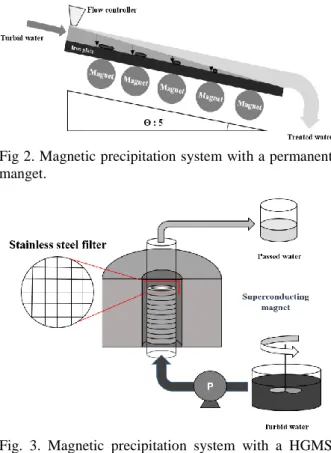
permanent magnetic precipitation system was consisted of 10 cm x 30 cm iron plate (0.5mm thickness) over 1 T of Neodymium magnet (NS magnet, Korea). The iron plate was installed at 5 degree slop for turbid water flow down. Turbid water was pumped with a peristatic pump on the top of iron plate. The turbidity and suspended solid of treated water was measured and heavy metal contents also compared before and after the magnetic precipitation.
A HGMS system equipped with a 6-Tesla cryo- cooled Nb-Ti superconducting magnet was used for the magnetic precipitation. The bore size of the magnet was 100 mm in diameter and an acryl pipe was fitted into the bore as a flow channel of turbid water.
Suspended particles could be caught by the magnetic moment generated per unit volume of the fine sediment particle. The magnetic force in the particles is given by following equation [6]:
F
m= (1/µ
0)ρχVB∇B (1)
Where µ
0is permeability in vacuum (4π × 10
-7) (H m
-1), χ is the specific magnetic susceptibility (m
3/kg), ρ is the specific gravity (kg/m
3), V is the volume of particle (m
3), B is magnetic induction (T).
The magnetic precipitation experiments were conducted in batch tests manner by pumping the turbid water into the pipe. The turbidity of water was measured before and after the HGMS process. The caught sediment particles were collected and analyzed for heavy metal contents. The precipitation experiments were repeated in variable magnetic field of 1 T, 3 T and 6 T. The flow velocity of turbid water was 0.1 L/min.
3. RESULTS AND DISCUSSION
3.1. Precipitation of turbid water assisted by permanent magnet
After flowing on the iron plate, the removal rate of suspended solid was about 15.6% and the turbidity decreased from 840 NTU to 674 NTU (turbidity decrease rate=19.8%). The collected turbid water was pumped up to the top of iron plate and run again on the plate over ten times. As the number of flowing increase, turbidity decrease and precipitated mass increase as shown in Fig 4. The removal rate of suspended solid was 99.9% and the turbidity was decreased from 840 NTU to 212 NTU (turbidity decrease rate=74.8%). The removal rate increase gradually up to 8 times of separation but the removal rate was mimimal at 9
thand 10
thseparation. This can be related with the magnetic properties of the particle. This result showed that the precipitation time could be shorten by a simple permanent magnet with about 1 T. The particles run down over the plate was analyzed for the heavy metal contents (Table 1). The heavy metal contents decrease from 2.1% for Cr to 41.7% for Cd. This showed that the precipitated particle has relatively higher heavy metal contents indicating this process has clean up effect for the suspended particle. As the number of flowing increase the pollution loading decrease as shown in Fig.
5 for major metals.
Fig 2. Magnetic precipitation system with a permanent manget.
Fig. 3. Magnetic precipitation system with a HGMS magnet.
Number of seaparation
0 2 4 6 8 10
R em ov al r at e of su spe n de d sol id (% )
0 20 40 60 80 100
T u rbi di ty (N T U )
0 200 400 600 800 1000
Suspended solid
Accumulation of removal rate Turbidity
Fig. 4. Decrease of suspended solid and turbidity after the magnetic force assisted precipitation process (permanent magnet), Flow velocity=0.1 L/min.
3.2. Precipitation of turbid water assisted by HGMS.
Magnetic assisted precipitation of turbid water was conducted with a HGMS for the synthesized turbid water. Turbid water was synthesized in the same method as shown in figure 1, but the used sediment was different from previous experiment. The precipitated solid was about 56.7%, 77.5%, and 96.2% at the magnetic field of 1, 3, and 6 T respectively as shown in Fig. 6. The turbidity removal also proportional to the magnetic field and the turbidiry of 200 NTU was obtained at 6 T which is almost same value as permanent magnetwas used with iron plate and after the 10
thflow.
Magnetic properties of precipitated and settling
resistant particle were analyzed with a VSM and the
result is showed in Fig. 7. The precipitated particle has
TABLE I
C
ONCENTRATION OF HEAVY METAL BEFORE AND AFTER THE PRECIPITATION PROCESS(mg/kg).
Number of separation
0 2 4 6 8 10
W t. ( g)
0 5 10 15 20 25 30
Cd Pb As
Fig. 5. Decrease of pollution loading after the magnetic force assisted precipitation process.
Magnetic field (T)
0 1 2 3 4 5 6
S ep ar at ed r at io of su spe n de d sol id (% )
0 20 40 60 80 100
T u rbi di ty (N T U )
0 200 400 600 800 1000
Suspended solid
Turbidity
Fig. 6. Decrease of suspended solid and turbidity by HGMS, Flow velocity=1.0 L/min.
Magnetic field (G)
-15000 -10000 -5000 0 5000 10000 15000
M o me n t (e mu /g )
-8 -6 -4 -2 0 2 4 6
8
Captured particlePassed particle