논문 2011-48TC-5-5
두 명의 사용자를 위한 무선 통신에서 유동적인 전송률 Back-off를 이용하는 지연 Time Reversal 기술
( Shifted Time Reversal Technique for Two-user Wireless Communication Using Variable Rate Back-off )
씨 깃*, 최 승 규*, 이 충 용***
( Sigit Aryo Pambudi, Seungkyu Choi, and Chungyong Lee )
요 약
두명의 사용자를 위한 무선 통신에서 심볼 간 간섭 및 다중 접속 간섭을 최소화하는 유동적인 전송률 back-off 적용 지연 time reversal (TR) 기법의 성능을 평가하였다. 지연 TR 기법의 성능을 기존 full-rate TR 과 full back-off TR의 성능과 비교하였으며, guard interval이 1보다 큰 경우 비트오차율 측면에서 지연 TR 기법의 성능이 full-rate TR이나 full back-off TR보다 우수함을 확인하였다.
Abstract
We studied the performance of a two-user time reversal multiple input single output scheme combined with the shifted transmission technique in a variable rate back-off scenario, called shifted time reversal (TR), that minimizes both intersymbol interference and multiuser interference. We compare the bit error rate performance of the shifted TR scheme to both full-rate TR and full back-off TR schemes and demonstrate its superiority to shifted zero forcing scheme when the guard interval is larger than one.
Keywords : frequency selective fading, time reversal, shifted transmission technique, variable rate back-off
Ⅰ. Introduction
Recently, there have been increasing interests in applying time reversal (TR) to wireless communica- tion system[1~2]. TR scheme offers a low-complexity transmission technique by employing a complex con- jugate, time reversed version of the channel impulse
* 학생회원, 연세대학교 (Yonsei University)
** 정회원, 연세대학교 (Yonsei University)
※ 이 논문은 2010년도 정부(교육과학기술부)의 재원으 로 한국연구재단의 기초연구사업지원을 받아 수행 된 것임(No. 2010-0025659).
접수일자: 2011년2월9일, 수정완료일: 2011년5월17일
response (CIR) at transmitter. The perfect channel state information at transmitter (CSIT) required is readily available in wireless sensor network employ- ing ultra wideband (UWB), especially when the channel is stationary throughout a relatively long transmission period. TR technique offers temporal compression, shortening the effective channel length, and spatial focusing, which reduces the probability of detection at location other than the intended receiver.
Thus, we can deploy a single-tap receiver, alleviating the need of complex equalizer.
In UWB systems, there is more than one user that accesses the channel simultaneously, causing inter-
ference to other users known as multi-user inter- ference (MUI)[3]. Moreover, CSIT to interfered users is not readily available such that it cannot be used to mitigate MUI. Several studies have quantified the performance of TR in multi-user environment[3], while others attempted to alleviate MUI problems by using the shifted transmission technique[2, 4~5]. However, most schemes assume that full back-off data transmission is employed. Additionally, previous studies only expresses the performance of multi-user TR scheme in terms of signal-to-interference ratio (SIR)[2~3, 5], while others studies its BER performance[4] without providing comparisons to other existing schemes, such as zero forcing (ZF).
We study a two-user multiple-input single-output (MISO) TR scheme in a variable rate back-off scenario that minimizes the effect of ISI and MUI by using the shifted transmission technique. We show that in variable rate back-off setups, shifted TR offers some performance gain, compared to conven- tional TR, which becomes larger as the guard inter- val is increased. We also compare the performance of the shifted TR scheme to that of ZF employing similar shifting technique. We show that throughout a finite SNR range under certain guard interval value, this scheme outperforms shifted ZF. Finally, the result can also be used to determine a minimum guard interval value required by shifted TR to outperform shifted ZF for a given SNR value.
In this paper, plain symbol, bold lower case letter, and bold upper case letter represent scalar, vector, and matrix quantities, respectively; the operators ⊗,
⋅, ⋅, ⋅, ⌊⋅⌋, and ∥⋅∥ indicate convolution, complex conjugation, transpose, Hermitian transpose, flooring, and norm operators, respectively; denotes the element in the -th row and the -th column of matrix ; and
∼ indicates a complex Gaussian random variable with mean and variance .
Ⅱ. Conventional Two-user TR-MISO with Shifted Transmission Technique
We consider a frequency selective multiple-antenna wireless system as in Fig. 1. There are two transmitters, each equipped with antennas, that send data to their respective single-antenna receiver.
Each transmitter knows the instantaneous channel state information (CSI) to its respective receivers perfectly, while the channel to the interfered user is unknown.
The received signal at receiver is given by
⊗
× ⊗ ≠
(1) The variable , , and denote received signal at the -th receiver, transmitted signal intended for the -th receiver, and transmitted signal intended for the -th receiver, respectively.
Both , the equivalent CIR between transmitter
and receiver , and , the equivalent CIR between transmitter and receiver , have the length of . Variable denotes the length of
, the CIR between the -th antenna of transmitter and receiver . The factor
defines the large scale attenuation between transmitter and receiver , while
∼ is a complex Gaussian noise at receiver . In the following discussions, can be either equal or not equal to , unless ≠ is declared.
Both and can only take the values of or .
We express in its vector form as
(2)
where is the -th tap of the equivalent CIR
. The variable is the filter at transmitter
, given by
(3)
where is the -th tap of , the filter coefficient at the -th antenna of transmitter .
Similar to , have the length of . The variable in (2) represents the ×
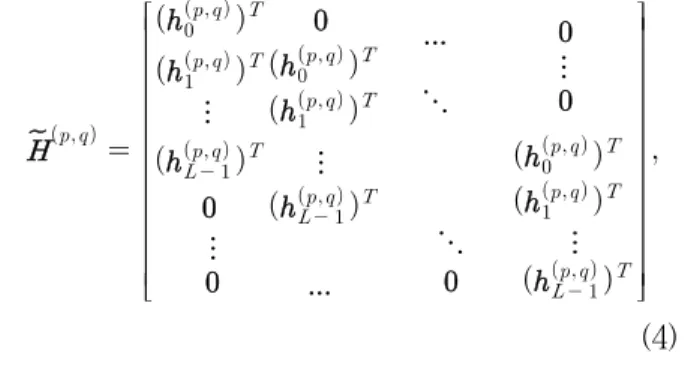
⋅ discrete-time CIR between the -th antenna of transmitter and receiver given by
⋮⋮ ⋮ ⋱… ⋮
…
⋱ ⋮
(4)
where . The variable
is the -th tap of , where the variance of each tap is modeled as an exponentially decaying power delay profile[6].
For the TR-based scheme, we apply a time-reversed and complex-conjugated CIR given by
(5) known as the TR filter. We refer the scheme that only employs this filter as conventional TR. The variable is a power normalization factor to
그림 1. 다중 사용자 frequency-selective 시스템의 구성 도
Fig. 1. Block diagram of the frequency-selective multi-user system.
maintain the transmitted signal’s power to unity.
The conventional TR has been proven to maximize the power at the center tap and minimize ISI.
The maximized center tap power comes from the fact that TR filter is a spatial-temporal matched filter at transmitter[1]. The equivalent CIR in conventional TR scheme is also decaying faster than the original CIR , providing delay spread compression[6] that significantly reduces ISI.
Since there are more than one user, MUI occurs and impairs overall BER performance. When both pair of users send signals at the same time instance, the maximum MUI power imposed by for
≠ happens at the symbol detection instance.
To minimize the effect of MUI, we can use the shifted transmission technique[2,4,5], in which the transmission instance of one user is delayed such that other user's received signal is not affected by the maximum MUI power. By shifting the transmission using a small value, e.g. by one tap, MUI power can be reduced significantly because its average power decays exponentially as the channel taps go further away from the center tap.
We can transmit data in full-rate mode, in which the data rate is maximized by transmitting the data at every channel sampling instance , or using full back-off mode, where ISI is totally eliminated by transmitting data at every total channel length period
. Previous works have studied the performance of MISO TR schemes using shifted transmission technique in full back-off case[2,4,5].
Ⅲ. Proposed Two-user Shifted TR in Variable Rate Back-off Data Transmission
To simplify analysis, we introduce the term , called guard interval, to our system model. We use a frequency-selective channel model sampled every ∆
time instance whose transmission data rate is given by . Variable represents the symbol period denoted as × ∆. We can see that
the full-rate and the full back-off scenarios are the special cases where and , respectively.
In practice, operating the system in full-rate mode is not preferable due to its high ISI power. Systems in full back-off mode is also impractical because it wastes the transmission bandwidth by transmitting data at a much slower rate. Thus, we concentrate our discussion to the system operating at neither of these modes, referred as variable rate back-off. In this mode, the guard interval can be set to any integer value inside the range of .
In this paper, we examine the performance of TR using the shifted transmission technique in a variable rate back-off setup, referred as shifted TR. We apply the TR filter in (5), with its original length of , to both users. The transmitters send their next respective data after the period of . Additionally, user shifts its data transmission instance with the period of , relative to the other user for
≠ . The data transmission timing arrangements for , , and is given in Fig. 2, which is illustrated in terms of the original CIR power ∥ ∥ for simplicity.
By assuming that transmitter 1 sends signals before transmitter 2, we restate the equivalent CIRs in (1) as follows:
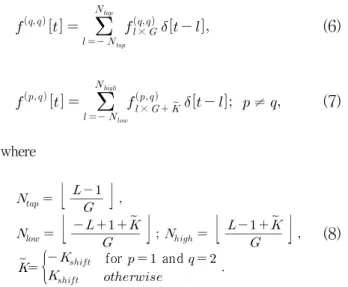
× (6)
× ≠ (7) where
⌊
⌋
⌊
⌋⌊
⌋
for and
(8)
The proposed shifted TR can improve BER performance by simultaneously reducing ISI and MUI.
그림 2. 지연 TR 기법의 CIR 예시
Fig. 2. CIR illustration for the shifted TR scheme.
그림 3. (a) Full-rate TR 기법의 CIR. (b) 지연 기법 적 용 후의 Full-rate TR 기법의 CIR. (c) 유동적 전 송률 적용 후 Shifted TR 기법의 CIR.
Fig. 3. (a) CIR for full-rate TR scheme. (b) CIR for full-rate TR with shifted transmission technique.
(c) CIR for shifted TR.
To illustrate this, we separate (6) into
≠
× (9)
where the first term represents the desired signal and the second term indicates ISI. Since in the case of variable rate back-off will decrease, ISI power will also be reduced. Similarly, because the total number of taps from for ≠ in (7) is smaller, MUI power will be reduced too.
For full back-off scheme, it has already been proven that the optimal value of shifting for a two-user scenario is given by [2], since in this condition MUI to both the current and next detected symbol is minimized. Because the maximum amount of shifting in our scheme is , instead of ;
due to the fact that the average power of the equivalent interfering CIR for ≠ is symmetric; and following the same principle as in full back-off scheme[2], we set our shift value to
to minimize both ISI and MUI in the shifted TR scheme.
Fig. 3 (a) illustrates the CIR of a two-user scheme that only employs TR filter in full-rate scenario. The intended signal achieves its peak power at the detection time instance. However, the influence of ISI and MUI are very severe, indicated by high inter- ference power at the symbol detection instance. In Fig. 3 (b), we apply the guard interval value of
to the full-rate conventional TR scheme.
Although MUI power remains the same, ISI power is significantly reduced. Finally, in Fig. 3 (c) we apply the shifted TR scheme with and . Here, both the ISI and MUI power are relatively low, indicating the superiority of the shifted TR scheme.
Ⅳ. Simulation Results
In this section, we use a quasi-static block transmission, where the channel is assumed to be constant throughout symbol transmissions. We employ BPSK modulation with simple single-tap detector[2] at receiver and perform simulation over
channel realizations.
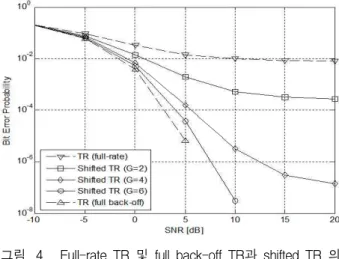
Fig. 4 shows BERs of the shifted TR, full-rate TR, and full back-off TR. For the full-rate scheme, shifted transmission technique cannot be applied so that it exhibits the worst performance. In full back-off TR scheme, we applied the shifted transmission technique with . This scheme exhibits the best performance, with the trade-off of bandwidth inefficiency. The shifted TR exhibits higher BER performance than the full-rate TR, where the performance gap becomes larger as is increased. Unfortunately, the proposed shifted TR cannot mitigate the error flooring effect induced by ISI. At large , the shifted TR approaches the
performance of full back-off TR, which serves as the performance upper bound of the shifted TR scheme.
In contrast to shifted TR, we can combine the shifted transmission technique with ZF filter, resulting to a scheme called shifted ZF, to force the ISI terms to zero. However, ISI cancellation happens at the expense of reduced center tap’s power at the detection instance . The ZF filter is given by
(10) where the index is selected such that
is minimized[7] and is a power normalization factor to set the transmit power to unity. To apply the shifting transmission technique to ZF, we plug the following into (7):
for and
(11) The variables and are the indices of in (10) at transmitter and , respectively. These terms occur because the detection instance of ZF scheme could happen in any channel tap index.
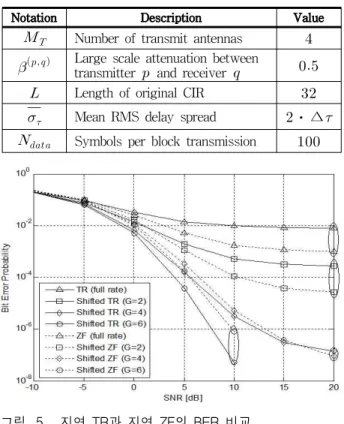
From Fig. 5, for all values of , the shifted TR scheme always outperforms shifted ZF at a very low SNR region and then performs oppositely in high
그림 4. Full-rate TR 및 full back-off TR과 shifted TR 의 BER 성능 비교
Fig. 4. BER comparison between full-rate TR, full back-off TR, and the shifted TR.
Notation Description Value
Number of transmit antennas
Large scale attenuation between
transmitter and receiver
Length of original CIR
Mean RMS delay spread ⋅∆
Symbols per block transmission
표 1. 실험 변수
Table 1. Simulation parameters.
그림 5. 지연 TR과 지연 ZF의 BER 비교
Fig. 5. BER comparison between the shifted TR and the shifted ZF.
SNR region. Interestingly, the crossing point, where both the shifted TR and shifted ZF graphs intersect each other, occurs at a higher SNR value whenever the guard interval is increased. In the case of
and , crossing point occur at the SNR value of 1dB and 17dB, respectively. This means that below the SNR value of 1dB, shifted TR minimally requires to outperform shifted ZF, while for SNR between 1dB and 17dB, it requires . Although we cannot observe the crossing point for the case of , we can predict that it will occur at a very high SNR region. These results indicate that the shifted TR scheme is beneficial when employed in a variable rate back-off condition.
The shifted ZF scheme needs to perform (10) that involves inversion of a × ⋅ matrix.
With a high order of , e.g. 32 as in our simulations, the matrix inversion is hard, if not impossible, to implement into practical devices. On the contrary, the shifted TR scheme only requires sequence reversion
and complex conjugation operations to an
⋅ × vector as in (5). Thus, the calculation simplicity of the shifted TR makes it much more practical to implement than shifted ZF.
V. Conclusion
We investigated a low complexity two-user TR-based transmission scheme in a variable rate back-off condition using the shifted transmission technique. We compare its performance to both full- rate TR and full back-off TR schemes and show that it outperforms shifted ZF over certain SNR range.
참 고 문 헌
[1] Z. Chenming, et al., “Time-Reversed Ultra- wideband (UWB) Multiple Input Multiple Output (MIMO) Based on Measured Spatial Channels,”
Vehicular Technology, IEEE Transactions on, vol. 58, pp. 2884-2898, 2009.
[2] N. Hung Tuan, et al., “Time reversal technique for multi-user wireless communication with single tap receiver,” in Mobile and Wireless Communications Summit, 2007. 16th IST, 2007, pp. 1-5.
[3] N. Hung Tuan, “Partial one bit time reversal for UWB impulse radio multi-user communications,”
in Communications and Electronics, 2008. ICCE 2008. Second International Conference on, 2008, pp. 246-251.
[4] I. H. Naqvi, et al., “Multiuser time reversal UWB communication system: A modified transmission approach,” in Personal, Indoor and Mobile Radio Communications, 2009 IEEE 20th International Symposium on, 2009, pp. 2671-2675.
[5] I. H. Naqvi, et al., “Performance Enhancement of Multiuser Time Reversal UWB Communication System,” in Wireless Communication Systems, 2007. ISWCS 2007. 4th International Symposium on, 2007, pp. 567-571.
[6] N. Hung Tuan, et al., “Time reversal in wireless communications: a measurement-based investigation,” Wireless Communications, IEEE Transactions on, vol. 5, pp. 2242-2252, 2006.
[7] P. Kyritsi, et al., “Time Reversal and Zero-Forcing Equalization for Fixed Wireless
저 자 소 개 Sigit Aryo Pambudi(학생회원)
2009년 Institut Teknologi Ban- dung (ITB), Indonesia 전기공학과 학사 졸업.
2000년∼현재 연세대학교 전기 전자공학과 석사 과정.
<주관심분야 : 통신 신호처리, MIMO, 멀티홉 시 스템>
최 승 규(학생회원)
2002년 연세대학교 전기전자 공학과 학사 졸업.
2009년 연세대학교 전기전자 공학과 석사 졸업.
2009년∼현재 연세대학교 전기 전자공학과 박사 과정.
<주관심분야 : 통신신호처리, 레이더, MIMO>
이 충 용(정회원) 대한전자공학회논문지
48권 TC편 제4호 2011년 참조 Access Channels,” in Signals, Systems and
Computers, 2005. Conference Record of the Thirty-Ninth Asilomar Conference on, 2005, pp.
1297-1301.