Vol. 15 No. 2, 92-106, October, 2018 https://doi.org/10.16952/pns.2018.15.2.92
저소득층 학령기 아동 ․ 청소년 대상 건강관련 중재에 관한 체계적 문헌고찰
황 지 혜 · 최 현 지 · 정 효 진 · 김 초 롱 · 우 윤 정
서울대학교 간호대학 대학원생
A Systematic Review of Interventions with Low-Income School-Age Children and Adolescents
Hwang, Ji-hye · Choi, HyunJee · Jeong, Hyo Jin · Kim, Chorong · Woo, YunJung
Graduate Student, College of Nursing, Seoul National University, Seoul, Korea
Purpose: The purpose of this study was to review health-related interventions in nursing studies for low-income
school-age children and adolescents. Methods: Searches among CINAHL, MEDLINE, PubMed, EMBASE, DBpia, and RISS identified 27 intervention studies published from January 2000 to April 2018. Results:
Twenty-seven intervention studies were identified: 12 included psychosocial adaptations and 15 included the healthy lifestyle promotion and disease prevention. The settings were mainly schools and community welfare centers. Many studies were based on social cognitive theory and interventions were provided in a group format.
Depression, self-esteem, resilience, self-efficacy for vegetable and fruit consumption, physical activity, and health-related knowledge improved significantly after the health-related interventions. However, the findings were inconsistent with regard to anxiety, peer relationships, body mass index (BMI), blood pressure, cholesterol, and glucose. Conclusion: There is potential for enhancing outcomes for psychosocial, physical health, and health-re- lated knowledge among low-income school-age children and adolescents. Integrated interventions addressing the physical as well as psychological health of low-income children and adolescents should be conducted. It would be prudent to consider the ethnicity and family background of the child or adolescent. However, rigorous study designs and scientific validation are needed for further evidence.
Key Words: Poverty, Child, Adolescent, Health, Review
주요어: 저소득, 아동, 청소년, 건강, 체계적 문헌고찰 Corresponding author: Hwang, Ji-Hye
College of Nursing, Seoul National University, 103 Daehak-ro, Jongno-gu, Seoul 03080, Korea.
Tel: +82-2-740-8851, Fax: +82-2-766-1852, E-mail: [email protected] Received: Sep 14, 2018 / Revised: Sep 27, 2018 / Accepted: Oct 4, 2018
서 론
1. 연구의 필요성
대한민국의 저소득층에 해당하는 차상위계층은 중위소득 의 50% 이하의 금액으로 생활하는 사람으로 명시되어 있다.1) 2018년 우리나라 4인 가구 기준 중위소득은 4,519,202원2)으로 4인 가구 기준 중위소득 50%에 해당하는 금액은 2,259,601원
이다. 2015년 2자녀 가정에서의 평균 양육비용이 1,286,000원3) 이고 2015년부터 2018년까지의 물가 상승률을 고려해 볼 때, 저소득층은 기준 중위소득의 50% 이하의 금액으로 자녀를 양 육하기에는 턱없이 부족한 실정이다.
빈곤으로 인해 아동은 부모의 부재를 경험하기도 하며 부모 의 불안정한 양육 방식 및 양육 형태로 인해 불량한 영양 섭취 및 불규칙한 일상과 같은 건강 위협 행동에 노출될 위험성이 있다.4) 또한 이러한 환경은 아동의 행동 및 감정 문제를 일으킬
저소득층 학령기 아동·청소년 대상 건강관련 중재에 관한 체계적 문헌고찰
수 있어 아동은 어려운 상황에 놓이게 된다.5)
빈곤의 문제가 아동 및 청소년기에 중요한 이유는 일생을 살아가는 생활기술을 습득하는데 가장 중요한 시기이며, 성인 기 및 노인기에 영향을 미치는 건강행태인 식습관 및 생활습관 이 형성되기 때문이다.6) 빈곤은 특히 학령기 아동에게 있어 신 체적 건강 수준7)은 물론 학업 및 학교 생활문제8)와 정서적 측 면9)에서 부정적인 요인이 된다. 따라서 저소득층 가정의 아동 의 경우 발달 및 건강 측면에서 비추어 볼 때 고위험군으로 분 류할 수 있다.10)
최근 아동 대상으로 시행된 건강관리 사업은 과거의 단순한 질병 치료, 건강 유지, 예방 접종 등의 업무에서 벗어나, 아동의 성장과 발달에 관심을 가지고 문제의 조기 발견 및 조기 중재 에 중점을 두고 있다.11,12) 아동기에 질병에 대한 1차 예방을 함 으로써 성인기에 발생할 수 있는 질병으로 인한 후유증 및 손 실비용을 낮출 수 있기 때문에 이에 대한 중재 프로그램 개발 연구가 늘어나고 있다.
저소득층 학령기 아동 ․ 청소년 대상 건강관련 중재에 관한 국내 ․ 외의 선행연구를 살펴보면 심리학, 사회복지, 교육학 등 의 여러 학문 분야에서 미술치료, 음악치료, 삼림치료, 인지행 동치료 등의 중재를 제공하였으나 이러한 연구들을 체계적으 로 고찰하여 중재 연구의 특성 및 효과를 확인한 연구는 드문 편이다.
따라서 본 연구에서는 국내 ․ 외에서 저소득층 학령기 아동 ․ 청소년의 성장발달을 돕고 성장과정 중 발생할 수 있는 여러 건강관련 문제의 예방을 돕기 위한 중재연구를 체계적으로 고 찰하여 향후 국내 실정을 고려한 저소득층 아동 ․ 청소년의 건 강관련 문제 예방을 위한 간호중재 프로그램을 개발하기 위한 기초 근거를 마련하고자 한다.
2. 연구목적
본 연구의 목적은 2000년 이후에 저소득층 학령기 아동 ․ 청 소년을 대상으로 시행된 국내 ․ 외 건강관련 중재연구를 분석 하고, 그 특성과 효과를 비교하고 확인하기 위함으로 구체적 인 목적은 다음과 같다.
저소득층 학령기 아동 ․ 청소년의 건강관련 중재 프로그램 을 실시한 연구를 체계적으로 비교, 분석한다.
이를 바탕으로 향후 국내 실정을 고려한 저소득층 아동 ․ 청소년을 대상으로 한 건강관련 중재 프로그램 개발을 위 한 기초 근거를 마련한다.
연 구 방 법 1. 연구설계
본 연구는 2000년부터 2018년 4월 27일까지 저소득층 학령 기 아동 ․ 청소년을 대상으로 국내 및 국외에서 시행된 중재연 구를 분석하고 연구의 특성과 효과를 확인하기 위한 체계적 문 헌고찰 연구이다.
2. 연구대상 논문
연구는 체계적 문헌고찰을 기술하기 위한 핵심질문인 연구 대상(Participants), 중재(Intervention), 비교중재(Compari- sons), 중재결과(Outcomes) 곧, ‘PICO’에 따라 문헌을 선정 하였다.13) 본 연구의 대상(P)은 건강한 저소득층 학령기 아동 ․ 청소년이며, 중재(I)는 저소득층 학령기 아동 ․ 청소년을 위해 이루어진 중재, 비교중재(C)는 단일군 사전사후 연구도 포함 하여 비교중재를 제한하지 않았으며, 중재결과(O)는 저소득 층 학령기 아동 ․ 청소년 대상 건강관련 중재의 효과로 설정하 였다.
문헌의 선정기준과 배제기준은 다음과 같다. 선정기준은 첫 째, 2000년 1월부터 2018년 4월 27일까지 국내 ․ 외에서 발표된 영어와 한국어로 된 학술논문이다. 둘째, 연구대상은 저소득층 학령기 아동 ․ 청소년을 대상으로 한 연구이다. 셋째, 국내 ․ 외 학위논문, 무작위 대조군 연구, 대조군 사전사후 연구, 단일군 사전사후 연구, 예비조사도 포함하였다. 배제기준은 첫째, 부모 및 영 ․ 유아 ․ 학령전기 아동, 질환아동(천식, 당뇨, 에이즈, 정 신건강 문제), 위기청소년(가출 청소년, 미혼모, 약물남용, 아 동 학대)을 대상으로 한 연구이며, 단, 아동을 포함한 가족 대상 프로그램으로 아동 ․ 청소년의 중재 결과를 살펴본 연구는 포함 하였다. 둘째, 연구설계가 서술 연구, 질적 연구, 효과성 연구, 문헌고찰 연구일 경우 배제하였다. 셋째, 국가, 시, 도, 주(州) 가 주도하는 대규모 연구, 지역사회가 주도하는 연구 중 다수 (7개 이상)의 학교나 시설들이 참여한 연구, 국제개발협력 사 업의 일환으로 개발도상국이나 저개발 국가의 아동 ․ 청소년 대상 연구는 배제하였다. 넷째, 학습 관련 중재는 배제하였다.
3. 자료수집
문헌검색은 미국 국립의학도서관(National Library of Medicine, NLM)이 제시한 COSI (Core, Standard, Ideal) 모
Pubmed (n=767)
DBpia, RISS (n=60) Medline
(n=707) CINAHL
(n=128) EMBASE
(n=575)
Total (N=2,237)
Excluded after full text review (N=30)
․ No intervention study (n=7)
․ No full text (n=1)
․ No targeted population (n=9)
․ Government or community-led large scale study (n=8)
․ Official development assistance (ODA) study (n=1)
․ Learning-related study (n=4) Remain after duplicate
(n=1,355)
Remain after screening of titles and abstracts (n=57)
Research used for analysis (n=27)
Excluded after screening of titles and abstracts (n=1,298) Duplicate (n=882)
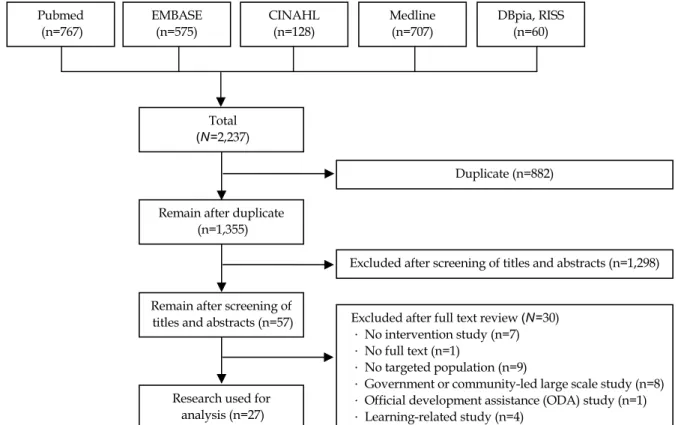
Fig. 1. Flowchart of studies included from database search.
델에서 제시된 기준13)에 따라 국외 데이터 베이스 Pubmed, EMBASE, CINAHL, Medline을 포함하였고, 국내 데이터 베 이스는 DBpia, 학술연구정보서비스(RISS)를 포함하여 검색 하였다. 국내 문헌 검색 시 출판되지 않은 학위논문도 포함하 였다. 출판 시기는 2000년 이후로 제한하였으며, 검색기간은 2018년 4월 20일부터 2018년 4월 27일까지였다.
검색에 사용된 주제어는 “빈곤 AND 아동 AND 중재”였 다. MeSH를 통해 주제어의 검색단어, 유의어, 대안어를 확 인하였고 모든 검색어를 조합하여 검색하였다. 문헌검색에 사용된 검색어는 다음과 같다. (1) Poverty, Indigents, Indi- gent, Indigency, Low-Income Population, Low-Income Popula- tions, Population, Low-income, Populations, Low-Income, Low income population, Low income Populations, Popula- tion, Low Income, Populations, Low Income (in title or abst- ract), (2) Child, Children, Adolescent, Adolescents, Adoles- cence, Teens, Teen, Teenagers, Teenager, Youth, Youths, Pediatric, Paediatric (in title or abstract), (3) Education, Workshops, Workshop, Programs, Program, Interventions, Intervention, Head Start Program, Head Start Programs, Program, Head start, Camp, Adaptation, Support, Counsel, Therapy, Strategy (in title). PICO의 Population에 해당하
는 검색어는 title과 abstract으로 검색하였으며, Intervention 에 해당하는 검색어는 title로 검색하였다. 또한 Population 과 Intervention은 and로 연결하여 검색하였다. 국내 데이터 베이스에서는 주제어를 ‘빈곤’과 ‘저소득’, ‘아동’과 ‘청소년’
그리고 ‘중재’와 ‘프로그램’을 조합하여 검색하였다.
확정된 검색어를 활용하여 국외 데이터 베이스에서 검색한 결과 Pubmed (767편), EMBASE (575편), CINAHL (128편), Medline (707편)으로 총 2,177편, 국내 데이터 베이스에서 검 색한 결과 DBpia와 RISS에서 60편이 검색되어 총 2,237편의 문헌이 1차 문헌으로 추출되었다. 이중 다른 데이터 베이스에 서 추출된 중복 문헌 882편을 제거한 1,355편의 문헌이 선별되 었다. 이 1,355편의 논문은 연구자 2명씩 짝을 지어 각각 제목 과 초록을 검토하여 포함기준에 부합하지 않는 문헌 1,298편 을 제외하였다. 제목과 초록만으로 선정된 57편의 문헌을 검 토한 결과 원문을 구할 수 없는 연구 1편, 중재 연구가 아닌 경 우 7편, 국가 및 지역사회가 주도하는 대규모 연구 8편, 개발도 상국을 대상으로 한 국제개발협력 사업 연구 1편, 연구참여자 가 배제기준에 해당하는 연구 9편(부모대상 1편, 정신건강 문 제를 가진 아동 3편, 위기청소년 4편, 저소득층이 아닌 연구 1 편), 학습 관련 중재연구 4편으로 총 30편이 추가로 제외되어 최종 27개의 문헌이 분석 대상으로 선정되었다(Fig. 1).
저소득층 학령기 아동·청소년 대상 건강관련 중재에 관한 체계적 문헌고찰
연 구 결 과
27편의 연구(학술지 논문 27편)가 포함기준을 충족하였다.
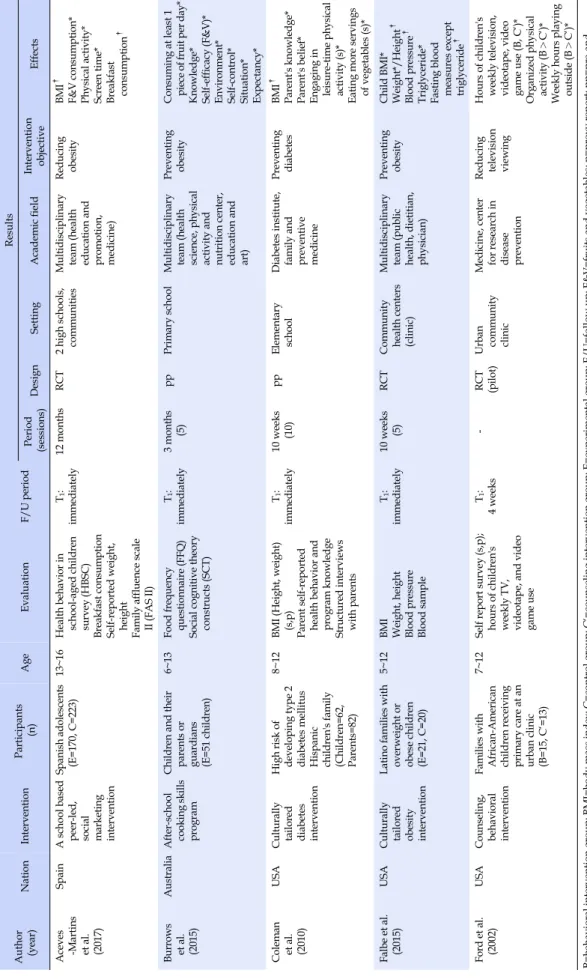
중재 목표에 따라 심리사회적 적응 12편(Table 1)과 건강한 생 활습관 형성 및 질병예방 15편(Table 2)으로 분류하였고, 선정 된 연구의 주요한 특성은 Table 1, 2에 제시하였다.
1. 대상논문의 일반적 특성
본 연구에서 선정된 연구들은 2000-2017년 사이에 출판되었 고, 출판 국가는 한국 10편(1-10), 미국 15편(11-25), 호주, 스페 인이 각 1편씩(26,27)이었다. 연구설계는 단일군 사전-사후 연 구가 12편(1,8,11,12,18-24,26), 비동등성 대조군 전후 연구가 7 편(2,3-6,16,17), 무작위 대조군 연구(randomized controlled trials)가 8편이었다(7,9,10,13-15,25,27).
연구 장소는 국내연구는 지역아동센터가 주를 이루었고, 국 외연구는 학교가 주를 이루었다. 전체 논문 27편 중 학교가 12편 (44.4%)으로 가장 많았고 초등학교 7편(11,15-17,23,24,26), 중 ․ 고등학교 5편(4,12,21,25,27)으로 확인되었다. 다음으로는 저소 득층 아동복지를 위한 지역복지센터가 7편(25.9%) (1,2,3, 7,9, 10,22), 숲 3편(5,6,19), 병원 2편(13,14)이었고, 도시 농장(18), 공공주택개발지(20), 멘토(mentor)와 멘티(mentee)가 함께 모 일 수 있는 공간(8)에서도 각 1편씩의 연구가 진행되었다.
연구대상자 수는 5~380명이었고, 대상자의 연령대는 5~19 세로 다양하였으며, 저소득층 아동 ․ 청소년과 함께 가족을 포 함한 연구는 6편(22.2%)이었으며 모두 국외에서 시행된 연구 였다(11,13,14,17,23,26). 중재 제공 형태는 1편(14)을 제외한 26편이 그룹 및 집단을 이용한 프로그램이었으며 4~24회기로 진행되었다.
2. 대상논문의 중재 목표
중재의 목적에 따라 나누어 살펴보면 건강한 식습관 형성 3 편(15,23,26), 신체활동 증진 3편(14,21,25), 심리사회적 적응 12 편(1-10,12,19), 앞서 언급한 세 가지 중재와 건강교육 등을 포함 한 통합적인 중재 연구가 9편이었다(11,13,16-18,20,22,24,27).
이 중 국내연구 10편은 모두 저소득층 학령기 아동 ․ 청소년의 심리사회적 적응을 돕는 중재였고, 국외연구는 주로 비만, 당 뇨 예방을 위한 건강한 생활습관 형성을 위한 중재였다.
3. 대상논문의 중재방법
선정논문들은 저소득층 학령기 아동 ․ 청소년 중재를 위해 여러 이론적 기틀을 근거로 사용하였는데 가장 많이 사용된 이론적 기틀은 건강 행위 변화를 목표로 하는 사회인지이론 (social cognitive theory)으로 9편의 연구에서 사용되었다 (9,10,12,14,20-23,26). 이외에 3단 모델(three-tiered model) (17), 계획된 행동 이론(23), 표현치료(1,2)와 희망이론(4) 등이 사용되었다.
저소득층 학령기 아동 ․ 청소년 대상 건강관련 중재를 시행 한 학문분야를 살펴보면, 의학 6편(11,13-17), 공중보건 4편 (13,17,20,23), 심리학 4편(9,16,20,25)이었고 이 외에도 사회 복지학, 교육학, 영양학, 아동가족학 등에서 중재에 참여하였 으며, 간호분야에서는 3편(8,12,17)의 연구가 시행되었는데, 1편(12)은 간호사가 단독으로 주도한 연구였고 나머지 2편 (8,17)은 다학제팀에 일원으로 참여한 연구였다. 선정된 연구 중 다학제팀에 의해 주도된 연구는 총 27편 중에 9편(33.3%)었 으며, 저소득층 학령기 아동 ․ 청소년 대상 건강관련 중재연구 에 의학, 공중보건, 영양, 운동 등 다양한 학문분야의 참여가 이 루어지고 있음을 확인할 수 있었다(8,13,15,17,18,20,25-27).
4. 대상논문의 중재 내용
저소득층 학령기 아동 ․ 청소년의 심리사회적 적응을 돕기 위 한 중재에는 음악치료(1), 문학치료(7), 인지행동치료(9,10), 멘 토링(4,8), 캠프(5,6,19), 마음챙김명상(10), 청소년 자살예방을 위한 생명존중 프로그램(3)이 있었고, 이외에도 청소년 대인간 폭력(interpersonal violence) 예방중재(12)가 있었다. 다음으 로, 건강한 식습관을 위한 중재로는 학교기반의 조합(co-op)을 통한 정기적인 채소, 과일 공급 및 건강 교육(23), 방과 후 요리 교실(26), 원예 활동을 병행한 요리 중재(15) 등이 있었으며, 신 체활동 증진 중재로는 힙합 춤(21), 행동중재(14) 등이 있었다.
통합적인 건강관련 중재로는 식이, 운동과 함께 의사소통 기술 (20), 자존감(22), 정신과 의사와 함께 하는 소그룹 수업(17), 요 가 ․ 명상(18)과 같은 저소득층 아동 ․ 청소년의 심리사회 건강을 돕는 프로그램이 포함되었다. 저소득층 아동 ․ 청소년 건강관련 중재는 한 가지의 특정 중재가 아니라 신체 및 심리사회 건강과 관련된 다양한 중재가 시행되었음을 확인할 수 있었다.
5. 대상논문의 중재 효과
저소득층 학령기 아동 ․ 청소년 대상의 건강관련 중재 효과 는 심리사회 건강, 신체건강, 건강관련 지식 범주로 분류하여
Table 1. Description of the Study and Intervention Results: Targeting Psychosocial Adaptation Author (year)NationInterventionParticipants (n)Age (year)EvaluationF/U periodResults Period (sessions)DesignSettingAcademic fieldIntervention objectiveEffect Ahn & Park (2016)KoreaLife respect programLow-income adolescents receiving services of community children center (E=10, C=10) 14~16Sense of life respect scale Ego-resiliency scale
T1: immediately5 weeks (10)ct, ppCommunity children center
Social welfarePsychosocial adaptationSense of life respect* Ego-resilience* Baek & Oh (2012)KoreaGroup mentoring program
Low-income adolescents (E=10, C=9) 14Hope scale Resilience scale for adolescents(RSA) Goal orientation scale T1: immediately T2: after 1 month 4 weeks (8)ct, ppMiddle schoolEducation Psychosocial adaptationHope(T0~T1)* Resilience(T0~T1)* Goal orientation† Cho et al. (2011)KoreaForest experience program
Elementary school children of low-income families (E=308) 8~12Sociality scale Children's depression inventory(CDI) State-trait anxiety inventory for children(STAI-C) T1: immediately1~3 daysct, ppForest training centerForest therapyPsychosocial adaptationSociality level(3 days)* Depression(3 days)* Trait anxiety(2, 3 days)* State anxiety† Cho et al. (2011)KoreaForest experience program
Elementary school children of low-income families (E=120, C=120) 8~12Sociality scale Children's depression inventory(CDI)
T1: immediately3 daysct, ppForest training centerForest therapyPsychosocial adaptationSociality* Depression* Choi & Kim (2011)KoreaLiterature therapy program
Elementary school children attending to after school academy (E=8, C=8) 11~13Berkeley expressivity questionnaire(BEQ) Emotional regulation checklist(ERC) Inventory of parent and peer attachment-revised (IPPA-R) T1: immediately T2: after 1 month 8 weeks (15)RCTAfter-school academyLiterature therapy & child family studies
Psychosocial adaptationEmotional expression* Emotional control* Peer relationships* Enriquez et al. (2012)
USAInterpersonal violence prevention intervention Low-income Midwestern Hispanic- American high school teens (C=51)
16~17Short acculturation scale for Hispanics (SASH) CDC's compendium of assessment tools for measuring violence-related attitudes, behaviors and influences among youths T1: immediately14 weeks (14)pp (pilot)High schoolNursingPsychosocial adaptationEthnic pride/identity* Self-efficacy for self-control† Gender attitude† Physical fighting† Incidence of dating violence† C=control group; CDC=centers for disease control and prevention; ct=controlled trial; E=experimental group; F/U=follow up; pp=pre-and post-intervention assessment; RCT=randomized controlled trial; T1=post test 1; T2=post test 2. *Significant improvement in the desired direction compared with control/pre-assessment; †No significant difference between intervention and control group or no significant change from pre-to post-assessment.
저소득층 학령기 아동·청소년 대상 건강 관련 중재에 관한 체계적 문헌고찰
Table 1. Description of the Study and Intervention Results: Targeting Psychosocial Adaptation (Continued) Author (year)NationInterventionParticipants (n)Age (year)EvaluationF/U periodResults Period (sessions)DesignSettingAcademic fieldIntervention objectiveEffect Kim (2009)KoreaSinging programChildren with withdrawal behaviors (E=5) 10~13Youth self report (YSR)(s) Teacher report form (TRF)(p) Musical and non-musical behaviors T1: immediately6 weeks (11)ppCommunity children center
Music therapyPsychosocial adaptationWithdrawal scales(s)* Withdrawal scales(p)* Frequency of eye contact, tone, volume of subjects' voices(p)* Kim & Chung (2011)
KoreaGroup art therapyElementary school children, single- parent family (E=13, C=13) 9~11Self-esteem questionnaire Peer-relationship questionnaire T1: immediately12 weeks (24)ct, pp2 community children center
Art therapyPsychosocial adaptationSelf esteem* Peer relationship† Kim et al. (2012)KoreaMentoring programsElementary school children (E=193)
8~13School learning motivation scale Rosenberg self esteem scale T1: immediately6 monthsppCommunity roomMultidisciplinary team(social welfare, nursing, early childhood education) Improve learning motivation, psychosocial adaptation
Academic motivation* Self-esteem* Kim & Kim (2016)KoreaCognitive behavioral therapy
Elementary school children (E=28, C=30)
11~13Depression scale for children(CES-DC) Korean children's automatic thoughts scale(K-CATS) Friendship quality questionnaire (FQQ) T1: immediately T2: after 8 weeks 10 weeks (10)RCTComprehensive social welfare center
PsychologyPsychosocial adaptationDepression(T1, T2)* Automatic thought (T1, T2)* The quality of peer relationship† Park et al. (2014)KoreaCognitive -behavioral group therapy
Middle school students receiving services of community children center (E=10, C=10) 14~16State-trait anxiety inventory(STAI) Ego-resiliency scale (ER) T1: immediately5 weeks (10)RCTCommunity children center Youth counselling & welfare
Psychosocial adaptationAnxiety* Ego-resilience* Readdick & Schaller (2005)
USASummer campChildren from low-income areas from New York city (E=68) 6~12Piers-Harris children's self-concept scale Child interview
T1: at 9~10 days12 days (4)ppForestFamily & child sciencesPsychosocial adaptationTotal self concept* C=control group; ct=controlled trial; E=experimental group; F/U=follow up; pp=pre-and post-intervention assessment; RCT=randomized controlled trial; T1=post test 1; T2=post test 2. *Significant improvement in the desired direction compared with control/pre-assessment; †No significant difference between intervention and control group or no significant change from pre-to post-assessment.
Table 2. Description of the Study and Intervention Results: Targeting Healthy Lifestyle and Disease Prevention Author (year)NationInterventionParticipants (n)AgeEvaluationF/U periodResults Period (sessions)DesignSettingAcademic fieldIntervention objectiveEffects Aceves -Martins et al. (2017) SpainA school based peer-led, social marketing intervention Spanish adolescents (E=170, C=223) 13~16Health behavior in school-aged children survey(HBSC) Breakfast consumption Self-reported weight, height Family affluence scale II(FAS II) T1: immediately12 monthsRCT2 high schools, communitiesMultidisciplinary team(health education and promotion, medicine)
Reducing obesityBMI† F&V consumption* Physical activity* Screen time* Breakfast consumption† Burrows et al. (2015)
AustraliaAfter-school cooking skills program Children and their parents or guardians (E=51 children) 6~13Food frequency questionnaire(FFQ) Social cognitive theory constructs(SCT) T1: immediately3 months (5)ppPrimary schoolMultidisciplinary team(health science, physical activity and nutrition center, education and art)
Preventing obesityConsuming at least 1 piece of fruit per day* Knowledge* Self-efficacy(F&V)* Environment* Self-control* Situation* Expectancy* Coleman et al. (2010)
USACulturally tailored diabetes intervention High risk of developing type 2 diabetes mellitus Hispanic children's family (Children=62, Parents=82) 8~12BMI(Height, weight) (s,p) Parent self-reported health behavior and program knowledge Structured interviews with parents T1: immediately10 weeks (10)ppElementary schoolDiabetes institute, family and preventive medicine
Preventing diabetesBMI† Parent's knowledge* Parent's belief* Engaging in leisure-time physical activity(s)* Eating more servings of vegetables(s)* Falbe et al. (2015)USACulturally tailored obesity intervention
Latino families with overweight or obese children (E=21, C=20) 5~12BMI Weight, height Blood pressure Blood sample T1: immediately10 weeks (5)RCTCommunity health centers (clinic) Multidisciplinary team(public health, dietitian, physician)
Preventing obesityChild BMI* Weight*/Height† Blood pressure† Triglyceride* Fasting blood measures except triglyceride† Ford et al. (2002)USACounseling, behavioral intervention
Families with African-American children receiving primary care at an urban clinic (B=15, C‘=13) 7~12Self report survey(s,p); hours of children's weekly TV, videotape, and video game use T1: 4 weeks-RCT (pilot)Urban community clinic Medicine, center for research in disease prevention Reducing television viewing
Hours of children's weekly television, videotape, video game use(B, C‘)* Organized physical activity(B>C‘)* Weekly hours playing outside(B>C‘)* B=behavioral intervention group; BMI=body mass index; C=control group; C‘=counseling intervention group; E=experimental group; F/U=follow up; F&V=fruits and vegetables; p=proxy report; pp=pre-and post-intervention assessment; RCT=randomized controlled trial; s=self report; T1=post test 1. *Significant improvement in the desired direction compared with control/pre-assessment; †No significant difference between intervention and control group or no significant change from pre-to post-assessment.