INTRODUCTION
Rhinitis is a chronic inflammatory disease of the upper respi- ratory airways characterized by the cardinal symptoms of nasal congestion, rhinorrhea, sneezing, and nasal itching.1-3 The prevalence of rhinitis in Korean elementary school students in- creased from 15.5% in 1995 to 28.5% in 2006.4,5 According to data gathered via a questionnaire from the International Study of Asthma and Allergies in Childhood (ISSAC), in 2010 the
prevalences of rhinitis were 28.5%, 38.0%, 38.5%, and 35.9% in children 0 to 3 years of age, 4 to 6, 7 to 9, and 10 to 13, respec-
Comorbidities and Phenotypes of Rhinitis in Korean Children and Adolescents: A Cross-sectional, Multicenter Study
Kyung Suk Lee,
1Hye Yung Yum,
2Youn Ho Sheen,
3Yong Mean Park,
4Yong Ju Lee,
5Bong Seok Choi,
6Hye Mi Jee,
1Sun Hee Choi,
7Hyun Hee Kim,
8Yang Park,
9Hyo-Bin Kim,
10Yeong-Ho Rha
11*; on behalf of the Korean Academy of Pediatric Allergy and Respiratory Disease (KAPARD) Work Group on Rhinitis
1Department of Pediatrics, CHA Bundang Medical Center, CHA University School of Medicine, Seongnam, Korea
2Department of Pediatrics, Seoul Medical Center, Seoul, Korea
3Department of Pediatrics, CHA Gangnam Medical Center, CHA University School of Medicine, Seoul, Korea
4Department of Pediatrics, Konkuk University Medical Center, Konkuk University School of Medicine, Seoul, Korea
5Department of Pediatrics, Hallym University Kangnam Sacred Heart Hospital, Seoul, Korea
6Department of Pediatrics, Kyungpook National University School of Medicine, Daegu, Korea
7Departments of Pediatrics, Kyung Hee University Hospital at Gangdong, Kyung Hee University School of Medicine, Seoul, Korea
8Department of Pediatrics, The Catholic University of Korea College of Medicine, Seoul, Korea
9Department of Pediatrics, Wonkwang University Sanbon Hospital, Wonkwang University College of Medicine, Gunpo, Korea
10Department of Pediatrics, Inje University Sanggye Paik Hospital, Seoul, Korea
11Department of Pediatrics, Kyung Hee University Hospital, Kyung Hee University School of Medicine, Seoul, Korea
This is an Open Access article distributed under the terms of the Creative Commons Attribution Non-Commercial License (http://creativecommons.org/licenses/by-nc/4.0/) which permits unrestricted non-commercial use, distribution, and reproduction in any medium, provided the original work is properly cited.
Purpose: Rhinitis is a nasal inflammatory disease in children and adolescents. However, little is known about the phenotypes and characteristics of allergic rhinitis (AR) in Korean children and adolescents. The objective of this study was to analyze the symptoms and comorbidities of rhinitis, to compare AR to non-allergic rhinitis (NAR), and to reveal the phenotypes and features of AR in a Korean pediatric population. Methods: Patients un- der 18 years of age with rhinitis symptoms were recruited from January 2013 to January 2015 by pediatric allergists. We analyzed symptoms, phe- notypes, comorbidities, and allergen sensitization in this cross-sectional, multicenter study. Results: Medical records were collected from 11 hospi- tals. The AR group has 641 (68.3%) patients, with 63.2% of boys and 7.5 (±3.4) years of mean age. The NAR group has 136 (14.5%) patients, with 55.1% of boys and 5.5 (±2.9) years of mean age. Moderate-severe persistent AR affected 41.2% of AR patients. Nasal obstruction was more com- mon in NAR patients (P<0.050), whereas AR patients sneezed more (P<0.050) and more commonly had conjunctivitis, asthma, and otitis media (P<0.050). Sinusitis was the most common comorbidity in both groups. Allergen sensitization was caused by house dust mites (HDMs) (90.2%), pol- len (38.7%), and animal dander (24.8%) in AR patients. Pollen and animal dander sensitization significantly increased age-dependently (P<0.050), but 91.9% of AR patients were already sensitized to HDMs before 5 years old. Conclusions: Our study revealed that AR was more prevalent than NAR and that 41.2% of AR presented with moderate-severe disease in Korean pediatric populations. Sinusitis was the most common comorbidity, and sleep disturbance was associated with the severity of rhinitis. The majority of AR patients were sensitized to HDMs in preschool ages. Further studies, including nationwide and longitudinal data, will help understand the relationship between these diseases.
Key Words: Rhinitis; allergic rhinitis; children; comorbidity; phenotype
Correspondence to: Yeong-Ho Rha, MD, PhD, Department of Pediatrics, Kyung Hee University Hospital, Kyung Hee University School of Medicine, 23, Kyungheedae-ro, Dongdaemun-gu, Seoul 02447, Korea.
Tel: +82-2-958-8306; Fax: +82-2-958-8304; E-mail: [email protected] Received: February 13, 2016; Revised: July 11, 2016; Accepted: July 18, 2016
•Kyung Suk Lee and Hye Yung Yum contributed equally to this work.
•There are no financial or other issues that might lead to conflict of interest.
Editorial Review
Original Article Case Report
Brief Communication
Allergy Asthma Immunol Res. 2017 January;9(1):70-78.
https://doi.org/10.4168/aair.2017.9.1.70 pISSN 2092-7355 • eISSN 2092-7363
tively.6 Allergic rhinitis (AR) is classified as a type of rhinitis and defined as rhinitis symptoms plus positive allergen sensitiza- tion.2 The prevalence of AR is combined with measures of over- all rhinitis’ prevalence, and it is difficult to differentiate AR from other types of rhinitis in most data sets.7
Rhinitis has a harmful influence on the physical, social, and psychological health of children and adolescents.3,8,9 Comor- bidities of rhinitis are common and also have a significant influ- ence on quality of life and health.3 These comorbidities, which affect both children and adolescents, include asthma, conjunc- tivitis, otitis media, rhinosinusitis, and pollen-food syndrome, and can be used as markers of possible rhinitis.3,7 Sleep distur- bance is a comorbidity that often results in impaired school performance and has negative effects on the quality of life of adolescents.3,10 Moreover, some of the principal allergic diseas- es in children often coexist with rhinitis.6,11
Therefore, the impacts and costs associated with comorbidi- ties of rhinitis should be considered in the management of rhi- nitis in the pediatric population. However, there are few studies on the comorbidities of rhinitis in children. In addition, little is known about the phenotypes, characteristics, and epidemiolo- gy of rhinitis, including AR, in Korean children and adolescents.
We sought to analyze the comorbidities and phenotypes of rhinitis in Korean children and adolescents and to investigate sensitized allergens and their variety according to age through a cross-sectional, multicenter study design based on a physi- cian-targeted questionnaire.
MATERIALS AND METHODS Study design and population
This is an epidemiological, cross-sectional, multicenter study intended to evaluate the comorbidities and phenotypes of rhi- nitis in children and adolescents. Data were collected retro- spectively from patients aged less than 18 years who were diag- nosed with rhinitis between January 2013 and January 2015 by pediatric allergy specialists from 11 hospitals in South Korea.
We analyzed symptoms, classification according to the Allergic Rhinitis and its Impact on Asthma (ARIA) guideline, comorbid- ities, and allergen sensitization. This study was approved by the Institutional Review Board of all participating hospitals.
Study outcomes NAR and AR
If the patients had more than one of the symptoms of rhinitis, such as sneezing, rhinorrhea, nasal obstruction, and nasal itch- ing, they were diagnosed with rhinitis.2 AR was diagnosed by doctors if the patient tested positive for sensitization to inhaled allergens.2 Rhinitis without sensitization to any of the allergens tested was defined as NAR.2 Using the ARIA guideline, AR was classified into intermittent/persistent and mild/moderate-se- vere types. Duration of AR was classified as intermittent (symp-
toms <4 days a week or for <4 consecutive weeks) or persistent (symptoms lasting more than 4 days a week and for more than 4 consecutive weeks).2 Severity of AR was classified as mild or moderate/severe depending on sleep disturbance; impairment of daily activities, leisure, sport, school, and/or work; and trou- blesome symptoms.2
Definition of comorbidities
Rhinitis in children and adolescents can frequently present with associated comorbidities, such as conjunctivitis, asthma, sinusitis, sleep disturbance, atopic dermatitis, otitis media, and oral allergy syndrome. Conjunctivitis was defined by symptoms (i.e., red, itchy, watery eyes and eye rubbing) and signs.3 Asth- ma was defined by symptoms (cough, wheeze, and exercise-in- duced bronchospasm) and spirometry results for those >6 years of age.3 Atopic dermatitis was diagnosed by doctors ac- cording to the criteria proposed by Hanifin and Rajka13 and the Korean diagnostic criteria.12 Otitis media was diagnosed after ear examination by physicians.14 Rhinosinusitis was defined as prolonged symptoms of nasal obstruction, purulent rhinorrhea or postnasal drainage, and complaints, such as headache, facial pain, or cough.3 Sleep problems comprised a history of dis- turbed sleep, snoring, apnea, tiredness, and irritability.3 Oral al- lergy syndrome (OAS, pollen–food syndrome) was defined as oral pruritus or swelling that occurred due to cross-reactivity between aeroallergens, such as birch pollen, and fruits and veg- etables, such as apples.15
Allergic sensitization
Allergic sensitization was defined as a positive skin prick test (SPT) and/or positive specific IgE test for house dust mites (HDMs), animal dander (mostly cat and dog), and pollens by a multiple antigen simultaneous test (MAST) or an Immuno- CAP. In SPT, common environmental allergens as well as posi- tive and negative controls (histamine and saline, respectively) are introduced into the skin by a needle, and any immediate re- action (wheal and erythema) were read after 15 to 20 min- utes.2,16 Result of the SPT is considered positive when the wheal size of allergen (A) is larger than that of histamine (H) (A/H ra- tio ≥1), the grade higher than 3+, and ≥3 mm in average of the longest and the shortest diameters.16-18 A specific IgE level of 0.35 kUA/L or greater on the Immuno-CAP system19 or more than class 3 by MAST was defined as a positive result.20
Statistical analysis
We investigated the relationship among symptoms, comor- bidities, allergen sensitization, and severity and/or duration of NAR and AR in children and adolescents. All data are present- ed as number (n) and frequencies (%) for categorical variables, and mean and standard deviation (SD) for quantitative vari- ables. Non-test patients were excluded when we compared the NAR and AR groups.
Pearson’s χ2 test was used to evaluate 2×2 cross-table analy- ses. For 2×N cross-table analyses, the linear to linear χ2 test was used. All statistical analyses were performed using IBM SPSS ver. 22.0 (IBM Co., Armonk, NY, USA).
RESULTS
Demographic characteristics of subjects
Eleven hospitals participated and 939 patients were recruited.
Seven hospitals located in Seoul enrolled 645 patients, 3 hospi- tals located in Gyeonggi-do enrolled 203 patients, and 1 hospi- tal located in Deagu enrolled 91 patients. All participating hos- pitals were located in an urban area. The patients consisted of 14.5% with NAR, and 68.3% with AR. The majority of the pa- tients were boys (61.4% overall, 55.1% NAR and 63.2% AR). The mean age at presentation was higher in the AR than in the NAR group (7.5±3.4 vs 5.5±2.9 P<0.001; see Table 1). The peak age was 5 years old (126 patients, 13.4%) (Fig. 1A). A history of aller- gic disease in the family was reported for 681 patients (72.9%) and significantly more patients with a familial history had NAR (P=0.014) (Table 1). Twelve patients (1.3%) presented in infan- cy, and 514 (54.7%) patients were less than 6 years old (Fig. 1A).
There were more AR patients even among those less than 1 year old (Fig. 1B). Most patients presented during the winter (December 9.2%, January 18.7% vs July 4.2%, August 4.8%) (Fig.
1C), and the distribution of AR and NAR did not vary by season (Fig. 1D).
Clinical characteristics of rhinitis
Nasal obstruction was the most common symptom in both NAR and AR, but significantly more patients with NAR (93.4%) than AR (86.7%) were affected (P=0.031) (Table 1). The num- ber of patients who complained of sneezing was significantly larger in the AR (63.5%) than in the NAR group (52.2%) (P=
0.014) (Table 1). The frequency of rhinorrhea and nasal itching was not different between the NAR and AR groups. Multiple symptoms were present in most rhinitis patients. Two hundred and five (32.2%) AR patients and 48 (36.4%) NAR patients com- plained of all symptoms, including rhinorrhea, sneezing, nasal obstruction, and nasal itching (Fig. 2A and B).
Classification of AR
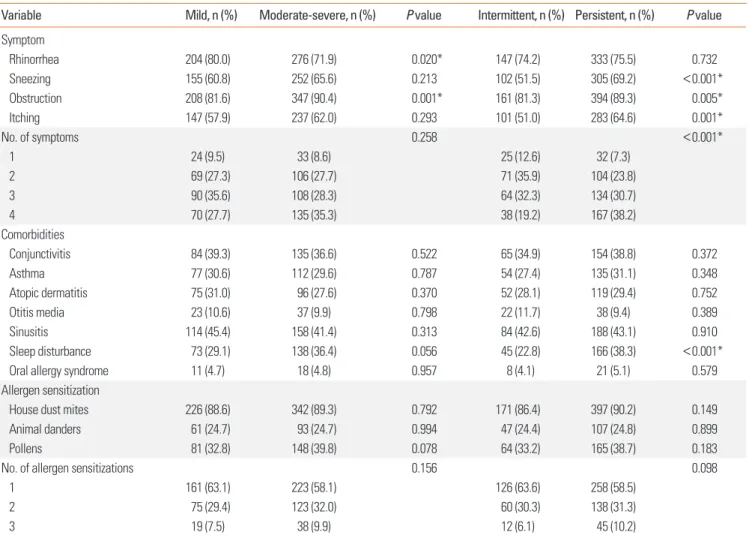
According to the ARIA classification, the most frequent type of AR was moderate-severe persistent AR (41.2%), followed by mild persistent (27.9%), moderate-severe intermittent (18.9%), and mild intermittent (12.1%) (Table 1). Sneezing and itching were more common in persistent rhinitis than in intermittent rhinitis (P<0.001 and P=0.001, respectively) (Table 2). Nasal obstruction was more common in both moderate-severe cases (P=0.001) and persistent cases (P<0.005) (Table 2). Patients with persistent AR had significantly more symptoms than those with intermittent AR (P<0.001) (Table 2).
Comorbidities of rhinitis
The most frequent comorbidity for patients with AR was rhi- nosinusitis (42.8%), followed by conjunctivitis (37.5%), sleep disturbance (33.4%), asthma (29.9%), atopic dermatitis (29.1%), otitis media (10.1%), and oral allergy syndrome (4.8%) (Table 1).
In patients with NAR, sinusitis (38.2%) was also the most fre- quent comorbidity, followed by sleep disturbance (27.2%), con- junctivitis (11.2%), atopic dermatitis (35.1%), asthma (10.3%), and otitis media (3.8%) (Table 1). Conjunctivitis, asthma, and otitis media were significantly more common in the AR group than in the NAR group, but there was no difference between the groups in the other comorbidities (Table 1). In patients with AR, Table 1. Characteristics of the subjects (N=939)
Characteristics Total AR NAR P value
Numbers 939 641 (68.3) 136 (14.5)
Boys, n (%) 577 (61.4) 405 (63.2) 75 (55.1) 0.080 Age mean (SD), (yr) 6.7 (3.4) 7.5 (3.4) 5.5 (2.9) <0.001*
Familial history of allergic disease, n (%)
681 (72.9) 436 (68.0) 107 (79.3) 0.014*
ARIA classification, n (%) Mild
Intermittent 77 (12.1)
Persistent 178 (27.9)
Moderate-severe
Intermittent 121 (18.9)
Persistent 263 (41.2)
Rhinitis symptoms, n (%)
Rhinorrhea 725 (77.2) 480 (74.9) 99 (72.8) 0.612 Sneezing 583 (62.1) 407 (63.5) 71 (52.2) 0.014*
Nasal obstruction 837 (89.1) 556 (86.7) 127 (93.4) 0.031*
Nasal itching 591 (62.9) 385 (60.3) 89 (65.4) 0.268 Rhinitis comorbidities, n (%)
Conjunctivitis 266 (31.6) 219 (37.5) 11 (11.2) <0.001*
Asthma 223 (24.1) 189 (29.9) 14 (10.3) <0.001*
Atopic dermatitis 238 (29.7) 172 (29.1) 46 (35.1) 0.171 Otitis media 98 (11.5) 60 (10.1) 4 (3.8) 0.041*
Sinusitis 449 (48.4) 272 (42.8) 52 (38.2) 0.324 Sleep disturbance 357 (38.6) 211 (33.4) 37 (27.2) 0.162
Oral allergy syndrome 29 (4.8)
Atopic sensitization, n (%)
House dust mites 570 (73.1) 570 (89.1) Animal danders 155 (20.3) 155 (24.8)
Pollens 230 (30.3) 230 (37.0)
Number (%) or Mean (SD); The number in the non-test group is 162 patients (17.3%); Eight patients of oral allergy syndrome did not have a specific allergen test result.
ARIA, allergic rhinitis and its impact on asthma; AR, allergic rhinitis; NAR, non- allergic rhinitis.
*P value <0.05.
sleep disturbances were more common in moderate-severe rhinitis than in intermittent rhinitis (P<0.001). There was no significant relationship between severity and duration of AR and any other comorbidities, such as conjunctivitis, asthma, atopic dermatitis, otitis media, and sinusitis (Table 2).
Allergen sensitization in AR
The proportions of children and adolescents sensitized to HDMs, pollen, animal dander, and allergens increased signifi- cantly from less than 5 years old to more than 12 years old (Fig.
3, 4A and B). However, it was noteworthy that the proportion of patients sensitized to HDMs peaked in 6 to 11 year olds. Fur- thermore, in the AR group, the proportion sensitive to HDMs decreased in the older children (P=0.027) (Fig. 4B).
DISCUSSION
There have been few large-scale investigations of clinical manifestations, including comorbidities and phenotypes, of rhinitis in Korean children and adolescents. Moreover, research including Korean adolescents is rare. As far as we know, this is the first multicenter study that showed a difference in comor- bidities between NAR and AR in Korean children and adoles- cents. Patients with AR had more conjunctivitis (37.5%), asth- ma (29.9%), and otitis media (10.1%). Sleep disturbance was a critical comorbidity related to the persistence of AR in Korean children and adolescents. Moderate-severe persistent AR was the most common type of AR (using the ARIA classification) in our patients, and nasal obstruction was the most common Fig. 1. Frequency distribution of rhinitis in Korean children and adolescents. (A) The mean age of rhinitis patients is 6.7 (±3.4) at the time of presentation. The peak age is 5. The number of children who visit hospitals between ages 4 to 8 is higher than for other ages. (B) The number of patients with AR is higher than NAR at all ages. AR represents more than 70% of all cases ≥6 years. AR is also higher among those ≤1 year old. (C) Rhinitis patients visit mainly in the winter, and the peak month is January with fewer in the summer (June-August). (D) The percentage of patients with AR is higher than 50% regardless of season.
Patients (N)Patients (N) Patients (%)Patients (%)
0 1 2 3 4 5 6 7 8 9 10 11 12 13 14 15 16 17
Jan Feb Mar Apr May Jun Jul Aug Sep Oct Nov Dec
0 1 2 3 4 5 6 7 8 9 10 11 12 13 14 15 16 17
Jan Feb Mar Apr May Jun Jul Aug Sep Oct Nov Dec Age (yr)
Month
Age (yr)
Month 140
120 100 80 60 40 20 0
200 180 160 140 120 100 80 60 40 20 0
100 80 60 40 20 0
100 80 60 40 20 0 A
C
B
D AR NAR non-test
AR NAR non-test
symptom of AR in Korean children. We also found a significant association between age and inhalant allergens, which suggests the necessity of early diagnosis and intervention.
It is difficult to distinguish between AR and NAR through use of the ISAAC questionnaire because its diagnosis is not sup- ported by specific IgE tests. In our study, AR and NAR were clearly defined by specific IgE tests. AR was more common, af- fecting 641 (68.3%) patients as compared to 135 (14.5%) pa- tients with NAR, a trend that existed across most of the age groups. A Norwegian study reported a 72.8% prevalence of AR and 27.2% of NAR in 10 year-olds.7 A Korean study reported 76.9% AR vs 23.1% NAR.21 The prevalence reported in our study may be different those in from other studies due to not having inhalant allergen test data from all patients, particularly ≤5 years old. However, all adolescents more than 14 years old were examined with allergy tests, and 100% were positive in the 14 to 17 years old group. Considering that AR increased and NAR un- derwent remission with advancing years,22 our results are simi- lar to other studies.
Until now, there has been little research into the comorbidi- ties of AR in children in Korea. A recent investigation of comor-
bidities of AR from the Korea National Health and Nutrition Ex- termination Survey (KNHANES) reported the prevalence, risk factors, and comorbidities of rhinitis in an adult population.23 They reported asthma, chronic rhinosinusitis, and olfactory dysfunction were more prevalent in the AR group, and asthma was correlated to severity and atopic dermatitis. According to a study of a birth cohort of 2,024 children from Sweden, AR and NAR were associated with asthma, eczema, and food hypersen- sitivity, and 25% of 8-year-olds with AR also had oral allergy syndrome.22 A cross-sectional population survey in Korea found the percentage of patients with AR and asthma, and those with AR and atopic dermatitis were 4.7% and 8.7%, re- spectively, among 31,201 children between 0 and 13 years of age.6 Atopic dermatitis, asthma, and oral allergy syndrome were found in 29.7%, 24.1%, and 4.6%, respectively, of our patients.
These high rates of comorbidities are probably due to the study’s hospital-based design. A position paper from the Euro- pean Academy and Allergy Clinical Immunology Taskforce on Rhinitis in Children recognized comorbidities of rhinitis, in- cluding conjunctivitis, asthma, impaired hearing, rhinosinus- itis, sleep problems, and pollen-food syndrome.3
Fig. 2. Frequency of rhinitis symptoms. (A) Presence of all symptoms (rhinorrhea, sneezing, nasal obstruction, and nasal itching) is the most common pattern in chil- dren with AR (32.2%). Sneezing only is the least common AR patients’ symptom (0.3%). (B) Presence of all symptoms (rhinorrhea, sneezing, nasal obstruction, and nasal itching) is also the most common pattern in children with NAR (36.4%). 4 AR and 4 NAR patients were excluded due to absence of symptoms’ description.
0 50 100 150 200 250
0 20 40 60
Sneezing Nasal itching Nasal itching+Sneezing Rhinorrhea+Nasal itching Rhinorrhea+Sneezing Rhinorrhea Nasal obstruction+Sneezing Rhinorrhea+Nasal itching+Sneezing Nasal itching+Nasal obstruction Nasal obstruction Rhinorrhea+Nasal itching+Nasal obstruction Nasal itching+Nasal obstruction+Sneezing Rhinorrhea+Nasal obstruction+Sneezing Rhinorrhea+Nasal obstruction All symptoms
Rhinorrhea Sneezing Rhinorrhea+Nasal itching+Sneezing Nasal obstruction+Sneezing Rhinorrhea+Nasal obstruction+Sneezing Nasal itching+Nasal obstruction+Sneezing Nasal obstruction Nasal itching+Nasal obstruction Rhinorrhea+Nasal itching+Nasal obstruction Rhinorrhea+Nasal obstruction All symptoms
2 (0.3%) 3 (0.5%) 6 (0.9%) 11 (1.7%) 16 (2.5%) 19 (3.0%) 22 (3.5%) 27 (4.2%) 34 (5.3%) 35 (5.5%) 42 (6.6%) 57 (8.9%) 72 (11.3%) 86 (13.5%)
205 (32.2%)
1 (0.8%) 1 (0.7%) 3 (2.3%) 5 (3.8%) 6 (4.5%) 8 (6.1%) 9 (6.8%) 10 (7.6%)
20 (15.2%) 21 (15.9%)
48 (36.4%) A
B
In our study, most rhinitis patients had one or more comor- bidities, and patients with AR had significantly more comorbid- ities than patients with NAR. One study reported 11.8% of chil- dren with rhinitis had conjunctivitis, asthma, or atopic dermati- tis.7 Although there was no significant association between con- junctivitis and age or severity of AR in our study, conjunctivitis was the most common comorbidity, affecting more than half of the children with AR in several European studies.7,24
Bronchial eosinophilic inflammation could be associated with an increase in nasal eosinophilic chemotactic factors and bronchial hyper-responsiveness (BHR), which are significantly related to AR.7,25 Our findings support the concept that AR and asthma are one airway disease.26 If allergen exposure in the na- sopharynx is associated with secretion of histamine and aller- gic mediators, the Eustachian tube could be obstructed and se- quentially cause middle ear effusion.27,28 Allergic inflammation also contributes to the hypertrophy of lymphoid tissues, such as the adenoids and tonsils,27 explaining how AR could contrib- ute to the development of otitis media and rhinosinusitis.7 Table 2. Analysis of the relationship between nasal symptoms, comorbidities, allergen sensitization, and ARIA classification in Korean children
Variable Mild, n (%) Moderate-severe, n (%) P value Intermittent, n (%) Persistent, n (%) P value
Symptom
Rhinorrhea 204 (80.0) 276 (71.9) 0.020* 147 (74.2) 333 (75.5) 0.732
Sneezing 155 (60.8) 252 (65.6) 0.213 102 (51.5) 305 (69.2) <0.001*
Obstruction 208 (81.6) 347 (90.4) 0.001* 161 (81.3) 394 (89.3) 0.005*
Itching 147 (57.9) 237 (62.0) 0.293 101 (51.0) 283 (64.6) 0.001*
No. of symptoms 0.258 <0.001*
1 24 (9.5) 33 (8.6) 25 (12.6) 32 (7.3)
2 69 (27.3) 106 (27.7) 71 (35.9) 104 (23.8)
3 90 (35.6) 108 (28.3) 64 (32.3) 134 (30.7)
4 70 (27.7) 135 (35.3) 38 (19.2) 167 (38.2)
Comorbidities
Conjunctivitis 84 (39.3) 135 (36.6) 0.522 65 (34.9) 154 (38.8) 0.372
Asthma 77 (30.6) 112 (29.6) 0.787 54 (27.4) 135 (31.1) 0.348
Atopic dermatitis 75 (31.0) 96 (27.6) 0.370 52 (28.1) 119 (29.4) 0.752
Otitis media 23 (10.6) 37 (9.9) 0.798 22 (11.7) 38 (9.4) 0.389
Sinusitis 114 (45.4) 158 (41.4) 0.313 84 (42.6) 188 (43.1) 0.910
Sleep disturbance 73 (29.1) 138 (36.4) 0.056 45 (22.8) 166 (38.3) <0.001*
Oral allergy syndrome 11 (4.7) 18 (4.8) 0.957 8 (4.1) 21 (5.1) 0.579
Allergen sensitization
House dust mites 226 (88.6) 342 (89.3) 0.792 171 (86.4) 397 (90.2) 0.149
Animal danders 61 (24.7) 93 (24.7) 0.994 47 (24.4) 107 (24.8) 0.899
Pollens 81 (32.8) 148 (39.8) 0.078 64 (33.2) 165 (38.7) 0.183
No. of allergen sensitizations 0.156 0.098
1 161 (63.1) 223 (58.1) 126 (63.6) 258 (58.5)
2 75 (29.4) 123 (32.0) 60 (30.3) 138 (31.3)
3 19 (7.5) 38 (9.9) 12 (6.1) 45 (10.2)
ARIA, allergic rhinitis and its impact on asthma.
*P value <0.05.
Fig. 3. Frequency of allergen sensitization. Many allergic rhinitis patients have multiple allergen sensitizations. Some patients are sensitive to all kinds of al- lergens, which are house dust mites, animal dander, and pollen (9.0%). Sensiti- zation to house dust mites only is the most common pattern (50.7%). The least is the co-occurrence of sensitization to animal dander and pollen (1.7%).
House dust mite
325 (50.7%)
(10.6%)68 119
(8.6%) (9.0%)58
11 (1.7%) 18
(2.8%) 42
(6.6%)
Animal dander Pollen
The higher prevalence of moderate-severe persistent patients in our study may be the result of selection bias, as patients were recruited from secondary or tertiary hospitals. Unlike our re- sults, intermittent AR was more prevalent in a population- based study in Spain.24
In our study, the most common AR symptom was nasal ob- struction (86.7%), and the presence of nasal obstruction was significantly associated with both the severity and persistence of AR (Table 2). The importance of nasal obstruction is also not- ed in the Pediatric Allergies in an American survey as the main symptom in children.29 The authors collected information in on symptom burden, quality of life, productivity, disease manage- ment, and medication, and concluded that its burden on chil- dren in the United States has been significantly underestimat- ed.29 Because nasal congestion is associated with sleep-disor- dered breathing and seems to be a major cause of sleep impair- ment in patients with AR, treatment to reduce nasal congestion has a positive influence on sleep.30
Like other chronic diseases, AR affects the quality of life in children by causing bothersome symptoms and comorbidities and by requiring medication use. There have been some trials to assess the quality of life in Korean children with AR by ques- tionnaires.31,32 Contents of the questionnaire involved the de- gree of discomfort caused by main symptoms, daily activity or sleep disturbance, and psychosocial problems. A substantial proportion of subjects (38.6%) complained of sleep disturbanc- es, which can be caused by nasal obstruction.30 Sleep distur-
bance was the only comorbidity that was significantly associat- ed with the persistence of AR (P<0.001) and marginally signifi- cantly associated with severity (P=0.056) in our study. The oth- er comorbidities were not significantly related to AR classifica- tions according to the ARIA guideline (Table 2).
The nose is anatomically and physiologically linked to the pa- ranasal sinuses, pharynx, middle ear, larynx, and lower airway.
Therefore, presentation of AR may be associated with mouth breathing and snoring with sleep problems, and chronic cough.33 First-generation H1 antihistamines can also cause sleep problems and performance impairment.33-36 In our study, a sleep disturbance questionnaire was filled out by patients and/or their parents, but objective tests, such as polysomnog- raphy, should be performed for accurate evaluation of sleep disturbance.
We identified an age-dependent increase in sensitization to inhalant allergens, but there was no significant correlation be- tween the severity of AR and allergen sensitization. An Italian multicenter study comprising 1,360 children with AR showed that 84.9% were sensitized to more than 3 allergens and that there was a strong association between pollen induced AR du- ration and severity.17 Young children, including those less than 1 year of age, already had allergic rhinitis due to sensitization to HDMs (7 children, 58.3%) and pollen (3 children, 25%). HDM sensitization occurred from less than 1 year of age and in- creased until 6-11 years of age. The rate of HDM sensitization was 73.1% in all rhinitis patients, and 89.1% in AR patients. Sen- Fig. 4. Change of the prevalence of allergen sensitization in AR patients. (A) This graph contains all cases, including NAR and non-test groups. Types of sensitized allergens vary according to the ages of the children. For house dust mites, 64.1% of children ≤5 years old are sensitized and there is a plateau of the sensitized rate at 6-11 years old (P<0.05). The percentage sensitized to pollen rapidly increases in patients ≥12 years old (16.6% to 54.9%) (P<0.050). The number sensitive to animal dander gradually increases at 6-11 years old (P<0.05). There is an increase in the number of all-allergen sensitized patients from ≤5 years old to ≥12 years old (P<0.050). (B) This graph only includes the AR group. Types of sensitized allergens varies according to the ages of the children. For house dust mites, 91.9% of patients ≤5 years old are sensitized. The number then significantly decreases to 82.6% for patients ≥12 years old (P<0.050). The number of patients sensitized to pollen swiftly increases to 55.5% among those ≥12 years old (P<0.050). There is also an increase in numbers for sensitivity to animal dander, but the percentage reaches a plateau at 6-11 years old (P<0.05). The number of all-allergen sensitized patients increases from ≤5 years old to ≥12 years old (P<0.050).
*P<0.005.
Patients (%) Patients (%)
≤5 6-11 ≥12 ≤5 6-11 ≥12
Years old Years old
* *
* *
* *
* *
100 80 60 40 20 0
100 80 60 40 20
0
A B
House dust mite Pollen Animal dander All allergen
sitization rates to pollen or animal dander increased signifi- cantly with advancing age. The prevalence and changing pat- terns of allergen sensitization in our study are similar to those in other Korean studies.21 Although sensitization to pollen is re- ported to be related to AR, we did not confirm this finding in our study.37,38
Atopic sensitization may be influenced by several environ- mental exposures occurring after infancy.39 The National Health and Nutrition Examination Survey (NHANES) in the USA announced that atopic sensitization to dust mites, plant- related allergens, or pets (dog or cat) affected 20.3%, 27.1%, and 15.7% of children, respectively.40 This implies that there is a big difference in the allergen sensitization rate and pattern in chil- dren between Korea and the USA, not surprising if the environ- ment is supposed to be an important factor. On the basis of our study, both HDMs and pollen allergens should be evaluated in all Korean children even if less than 1 year old when doctors suspect the child has allergic sensitization.
Our study might be influenced by some limitations. First, 10 of the 11 hospitals are located in Seoul metropolitan area includ- ing Gyeonggi-do, and the geographic distribution of patients was biased toward Seoul. Therefore the study population is not truly representative of the Korean general population.
Secondly, there might be some heterogeneity across the methods of skin prick tests or serologic tests for specific IgE due to its multicentricity, and some patients were not evaluated by allergy tests, so that we could not confirm AR or NAR. Thirdly, a cross-sectional study design cannot clarify the role of risk fac- tors in the natural course of a disease. However, our study in- vestigated comorbidities of rhinitis and allergic sensitization from less than 1 year to 18 years old, and was a multicenter study. Therefore, it can be used as representative data in aller- gic rhinitis in children and adolescents in Korea.
In conclusion, this study revealed that AR was more prevalent than NAR and that moderate-severe persistent AR was the most frequent type in Korean pediatric populations. Nasal obstruc- tion was an important symptom associated with the severity and persistence of AR. Sinusitis was the most common comor- bidity, and sleep disturbance was associated with the severity of rhinitis. These findings may be helpful in developing a plan for the prevention and treatment of rhinitis and in improving the quality of life of Korean children and adolescents suffering from AR. Further nationwide and longitudinal studies will help understand the relationship between these diseases.
ACKNOWLEDGMENTS
This study was supported by a 2011-Grant from Korean Acad- emy of Medical Sciences. The study was presented in 2015 at the KAPARD Spring Conference (Oral Presentation Number:
15S-033).
REFERENCES
1. Seo JH, Kim HY, Jung YH, Lee E, Yang SI, Yu HS, et al. Interactions between innate immunity genes and early-life risk factors in aller- gic rhinitis. Allergy Asthma Immunol Res 2015;7:241-8.
2. Bousquet J, Khaltaev N, Cruz AA, Denburg J, Fokkens WJ, Togias A, et al. Allergic Rhinitis and its Impact on Asthma (ARIA) 2008 up- date (in collaboration with the World Health Organization, GA(2) LEN and AllerGen). Allergy 2008;63 Suppl 86:8-160.
3. Roberts G, Xatzipsalti M, Borrego LM, Custovic A, Halken S, Hellings PW, et al. Paediatric rhinitis: position paper of the Europe- an Academy of Allergy and Clinical Immunology. Allergy 2013;68:
1102-16.
4. Hong SJ, Ahn KM, Lee SY, Kim KE. The prevalences of asthma and allergic diseases in Korean children. Korean J Pediatr 2008;51:343- 50.
5. Jee HM, Kim KW, Kim CS, Sohn MH, Shin DC, Kim KE. Prevalence of asthma, rhinitis and eczema in Korean children using the Inter- national Study of Asthma and Allergies in Childhood (ISAAC) Questionnaires. Pediatr Allergy Respir Dis 2009;19:165-72.
6. Hong S, Son DK, Lim WR, Kim SH, Kim H, Yum HY, et al. The prev- alence of atopic dermatitis, asthma, and allergic rhinitis and the comorbidity of allergic diseases in children. Environ Health Toxi- col 2012;27:e2012006.
7. Bertelsen RJ, Carlsen KC, Carlsen KH. Rhinitis in children: co-mor- bidities and phenotypes. Pediatr Allergy Immunol 2010;21:612-22.
8. Silva CH, Silva TE, Morales NM, Fernandes KP, Pinto RM. Quality of life in children and adolescents with allergic rhinitis. Braz J Oto- rhinolaryngol 2009;75:642-9.
9. Roberts G, Hurley C, Lack G. Development of a quality-of-life as- sessment for the allergic child or teenager with multisystem aller- gic disease. J Allergy Clin Immunol 2003;111:491-7.
10. Walker S, Khan-Wasti S, Fletcher M, Cullinan P, Harris J, Sheikh A.
Seasonal allergic rhinitis is associated with a detrimental effect on examination performance in United Kingdom teenagers: case- control study. J Allergy Clin Immunol 2007;120:381-7.
11. Kim HY, Kwon EB, Baek JH, Shin YH, Yum HY, Jee HM, et al. Preva- lence and comorbidity of allergic diseases in preschool children.
Korean J Pediatr 2013;56:338-42.
12. Kim KH. Overview of atopic dermatitis. Asia Pac Allergy 2013;3:79- 87.
13. Hanifin JM, Rajka G. Diagnostic features of atopic dermatitis. Acta Derm Venereol 1980;60 Suppl 92:44-7.
14. Spector SL. Overview of comorbid associations of allergic rhinitis. J Allergy Clin Immunol 1997;99:S773-80.
15. Webber CM, England RW. Oral allergy syndrome: a clinical, diag- nostic, and therapeutic challenge. Ann Allergy Asthma Immunol 2010;104:101-8.
16. Hamilton RG. Clinical laboratory assessment of immediate-type hypersensitivity. J Allergy Clin Immunol 2010;125:S284-96.
17. Dondi A, Tripodi S, Panetta V, Asero R, Businco AD, Bianchi A, et al. Pollen-induced allergic rhinitis in 1360 Italian children: comor- bidities and determinants of severity. Pediatr Allergy Immunol 2013;24:742-51.
18. Kwon SE, Lim DH, Kim JH, Son BK, Park YS, Jang HJ, et al. Preva- lence and allergens of allergic rhinitis in children and adolescents in Gwangju. Allergy Asthma Respir Dis 2015;3:54-61.
19. Peters RL, Allen KJ, Dharmage SC, Tang ML, Koplin JJ, Ponsonby AL, et al. Skin prick test responses and allergen-specific IgE levels
as predictors of peanut, egg, and sesame allergy in infants. J Allergy Clin Immunol 2013;132:874-80.
20. Wolthers OD, Staberg M. The usefulness of the multiple allergen si- multaneous test-chemiluminescent as compared to the Phadia Immunocap IgE test panel system in children and adolescents. Re- cent Pat Inflamm Allergy Drug Discov 2013;7:96-9.
21. Kim JS, Kang HS, Jang HJ, Kim JH, Lim DH, Son BK. Clinical fea- tures of allergic rhinitis in Korean children. Allergy Asthma Respir Dis 2015;3:116-23.
22. Westman M, Stjärne P, Asarnoj A, Kull I, van Hage M, Wickman M, et al. Natural course and comorbidities of allergic and nonallergic rhinitis in children. J Allergy Clin Immunol 2012;129:403-8.
23. Rhee CS, Wee JH, Ahn JC, Lee WH, Tan KL, Ahn S, et al. Prevalence, risk factors and comorbidities of allergic rhinitis in South Korea:
the Fifth Korea National Health and Nutrition Examination Survey.
Am J Rhinol Allergy 2014;28:e107-14.
24. Ibáñez MD, Valero AL, Montoro J, Jauregui I, Ferrer M, Dávila I, et al. Analysis of comorbidities and therapeutic approach for allergic rhinitis in a pediatric population in Spain. Pediatr Allergy Immu- nol 2013;24:678-84.
25. Bonay M, Neukirch C, Grandsaigne M, Leçon-Malas V, Ravaud P, Dehoux M, et al. Changes in airway inflammation following nasal allergic challenge in patients with seasonal rhinitis. Allergy 2006;61:
111-8.
26. Bachert C, Vignola AM, Gevaert P, Leynaert B, Van Cauwenberge P, Bousquet J. Allergic rhinitis, rhinosinusitis, and asthma: one airway disease. Immunol Allergy Clin North Am 2004;24:19-43.
27. Hadley JA, Derebery MJ, Marple BF. Comorbidities and allergic rhi- nitis: not just a runny nose. J Fam Pract 2012;61:S11-5.
28. Skoner DP, Doyle WJ, Fireman P. Eustachian tube obstruction (ETO) after histamine nasal provocation--a double-blind dose-re- sponse study. J Allergy Clin Immunol 1987;79:27-31.
29. Meltzer EO, Blaiss MS, Derebery MJ, Mahr TA, Gordon BR, Sheth KK, et al. Burden of allergic rhinitis: results from the Pediatric Al- lergies in America survey. J Allergy Clin Immunol 2009;124:S43-70.
30. Craig TJ, Sherkat A, Safaee S. Congestion and sleep impairment in allergic rhinitis. Curr Allergy Asthma Rep 2010;10:113-21.
31. Kim JH, Ahn YM, Kim HJ, Lim DH, Son BK, Kang HS, et al. Devel- opment of a questionnaire for the assessment of quality of life in Korean children with allergic rhinitis. Allergy Asthma Immunol Res 2014;6:541-7.
32. Jin JY, Yang HJ, Jeon YH, Kim KW, Kim WK, Park YM, et al. Develop- ment and validation of the questionnaire for quality-of-life specific to allergic rhinitis in Korean children (QQOL-ARK): a multicenter study. Korean J Asthma Allergy Clin Immunol 2009;29:242-8.
33. Muliol J, Maurer M, Bousquet J. Sleep and allergic rhinitis. J Inves- tig Allergol Clin Immunol 2008;18:415-9.
34. Qidwai JC, Watson GS, Weiler JM. Sedation, cognition, and antihis- tamines. Curr Allergy Asthma Rep 2002;2:216-22.
35. Craig TJ, McCann JL, Gurevich F, Davies MJ. The correlation be- tween allergic rhinitis and sleep disturbance. J Allergy Clin Immu- nol 2004;114:S139-45.
36. Craig TJ, Hanks CD, Fisher LH. How do topical nasal corticoste- roids improve sleep and daytime somnolence in allergic rhinitis? J Allergy Clin Immunol 2005;116:1264-6.
37. Bousquet J, Annesi-Maesano I, Carat F, Léger D, Rugina M, Pribil C, et al. Characteristics of intermittent and persistent allergic rhinitis:
DREAMS study group. Clin Exp Allergy 2005;35:728-32.
38. Warm K, Hedman L, Lindberg A, Lötvall J, Lundback B, Ronmark E.
Allergic sensitization is age-dependently associated with rhinitis, but less so with asthma. J Allergy Clin Immunol 2015;136:1559- 1565.e1-2.
39. Weiland SK, von Mutius E, Hirsch T, Duhme H, Fritzsch C, Werner B, et al. Prevalence of respiratory and atopic disorders among chil- dren in the East and West of Germany five years after unification.
Eur Respir J 1999;14:862-70.
40. Salo PM, Arbes SJ Jr, Jaramillo R, Calatroni A, Weir CH, Sever ML, et al. Prevalence of allergic sensitization in the United States: re- sults from the National Health and Nutrition Examination Survey (NHANES) 2005-2006. J Allergy Clin Immunol 2014;134:350-9.