• 검색 결과가 없습니다.

Antioxidant Activity of Manno-oligosaccharides Derived from the Hydrolysis of Polymannan by Extracellular Carbohydrase of Bacillus N3

N/A
N/A
Protected

Academic year: 2021

Share "Antioxidant Activity of Manno-oligosaccharides Derived from the Hydrolysis of Polymannan by Extracellular Carbohydrase of Bacillus N3"

Copied!
9
0
0

로드 중.... (전체 텍스트 보기)

전체 글

(1)

Introduction

Bacillus spp. are Gram-positive bacteria found di- versely in nature. They can establish endospores to sur- vive in incompatible conditions such as high temper- ature, inappropriate light and harsh chemical reagents [1]. Therefore, seeking and screening a novel strain pro- ducing unique enzymes have been performed for several decades. Amongst, cellulase is a name of the group of enzymes which act together to catalyze the cellulose into soluble sugars [2,3]. Cellulose is most abundant, linear, crystalline homo-polymer of repeating cellobioside units

in which two anhydrous D-glucose residues are con- nected through β -1,4-linked glucose units. In order to expand the applications of such precious material in var- ious research fields, cellulases have been used for wide applications in pulp, paper, pharmaceutical, textile, food processing and detergent productions [4]. Microbial cel- lulases are chosen over animal and plant cellulases be- cause they have lower production costs, no specific sea- sons, and rapid development [5]. Subsequently, purifica- tion and characterization of unique enzymes are there- fore critically necessary as it plays a vital role in the development of effective applications of enzyme at in-

* Corresponding author

Phone: +82-31-750-4763 Fax: +82-31-750-8573 E-mail: [email protected]

This is an open-access journal distributed under the terms of the Creative Commons Attribution Non-Commercial License

(http://creativecommons.org/licenses/by-nc/4.0/)

https://doi.org/10.15433/ksmb.2018.10.1.009 ISSN 2383-5400 (Online)

Antioxidant Activity of Manno-oligosaccharides Derived from the Hydrolysis of Polymannan by Extracellular

Carbohydrase of Bacillus N3

Kashif Shaheen Amna, So Yeon Park, Min Choi, Sang Yeon Kim, Ah Young Yoo, Jae Kweon Park

*

Department of Biomedical Sciences, Gachon University, Seongnamdaero 1342, Seongnam-si, Gyeonggi-do 461-701, Republic of Korea

(Received 30 April 2018, Revised 5 June 2018, Accepted 7 June 2018)

Abstract The aim of this study is to elucidate the biochemical properties of man- no-oligosaccharides (MOS) hydrolyzed by extracellular enzyme of Bacillus N3. We strived to characterize the biochemical properties of MOS since N3 can effectively hydrolyzed natural poly- mannans such as galactomannan (GM) and konjac (glucomannan, KM), respectively. The hydrol- ysis of GM and KM was applied by the strain N3 in terms of reducing sugars and the highest production of reducing sugars was estimated to be about 750 mg/L and 370 mg/L respectively, which were quantified after 7 days of cultivation in the presence of both substrates. Hydrolysates derived from the hydrolysis of KM showed the significant antioxidant activity based on DPPH and ABTS radical scavenging activity with increasing of tyrosinase inhibitory activity. On the other hand, hydrolysates derived from the hydrolysis of GM showed only ABTS radical scavenging activity without showing significant changes on tyrosinase inhibitory activity. Our data suggest that those biological characteristics may be depend on the primary structure and the size of MOS, which may be useful as potent additives for diet foods.

Keywords : Manno-oligosaccharides, Bacillus, Glucomannan, Anti-oxidants, Extracellular proteins,

Algal lytic enzymes

(2)

dustrial scale. Thus far, enzyme characterizations have been carried out to find the best enzymatic activities for enhanced efficiency of the process.

Beside glucose based carbohydrates, man- no-oligosaccharides (MOS) consisting mainly of man- nose or galactose derived from the hydrolysis of gal- actomannans or glucomannans by endo-b-1,4 man- nanases have been focused as functional additives for human beneficial intestinal microflora as non-nutri- tional foods. Endo-b-1,4 mannanases have been used in various industrial processes such as bioconversion of biomass to fermentable sugars, and reduce the vis- cosity of coffee extracts [6]. However, the initial inter- est in using MOS was to protect gastrointestinal health from the Salmonella infections. As earlier studies dem- onstrated that Salmonella can bind to mannose unit via type-1-fimbriae which is known as finger-like projections. Binding of type-1-fimbriae to mannose re- sulted in decreasing the risk of pathogen colonization inside the intestinal tract [7]. Not only for human bene- ficial intestinal microflora, but also MOS can be used in diets for various animals such as dogs, horses, cats and birds due to its benefits for their health to protect gastrointestinal health [8]. As described above, many studies on the supplementary food, diet, and pathogen colonization inside the intestinal tract were presented, less is known about the antioxidant activity of MOS and other biochemical properties. In this regard we aimed to characterize the antioxidant activity of the MOS derived from GM and PM which were consisting of mainly mannose with extracellular enzyme of the isolated strain Bacillus N3.

Materials and Methods

Materials

Sulfuric acid (H

2

SO

4

), 1,1-diphenyl-2-picryl-hy-drazyl (DPPH), 2,2’-Azino-bis (3-ethylbenzothiazoline-6-sulfonic acid) di-ammonium salt (ABTS), 2,4,6-tri (2-pyridyl)-s-tri- azine (TPTZ), ferric chloride, potassium persulfate, so- dium hydroxide and L-ascorbic acid were purchased from Sigma Chemical Co. (St. Louis, MO, USA).

Galactomannan (GM) and konjac (glucomannan, KM) were also purchased from Sigma Chemical Co. (St.

Louis, MO, USA). Sodium hydroxide (NaOH) and 4-Hydroxy-benxhydrazid (PHABAH) were used for quantification of reducing sugar and was obtained from Junsei Chemical Co. (Tokyo, Japan). pNP-gluco- sae, pNP-mannose, pNP-cellobioside, LB media and tyrosinase from mushroom were purchased by Sigma Chemical Co. (St. Louis, MO, USA). TLC plates (Silica gel 60F254; Merck, Germany) were used to monitor the hydrolysates by enzyme activity. All other reagents were used of the highest grade available.

Microorganisms and culture conditions

Bacillus N3, isolated and named based on preliminary study for the screening study (unpublished data) was culti- vated in LB medium at 37 °C supplemented with 20−30 μg/㎖ of kanamycin when necessary. To induce ex- tracellular enzyme production including protease, strain N3 was cultured at 37 °C with constant agitation of 200 rpm in the seed medium containing (w/v) 1.0 % tryptone, 1.0

% beef extract and 0.5 % NaCl, at pH 7.0. After two days of cultivation, the crude broth was centrifuged at 13,000 rpm for 10 min and the supernatant was collected and used as the crude extracellular enzyme to elucidate the basal level of enzyme activity using artificial substrates such as pNP-glucose, pNP-mannose, pNP-cellobioside, and etc.

Manno-oligosaccharide production

Scheme 1. shows the production of MOS, brief- ly, the strain N3 was incubated in 200 ㎖ poly- mannan solution (0.5 % Polymannan in 1/20 di- luted LB) for about 7 days at 30 °C. Culture me- dium was then centrifuged and culture supernatant was collected and heated at 100 °C for 7 min.

After centrifugation of this mixture, supernatant

containing active hydrolysates was collected and

used as MOs for further studies. Bacillus N3 was

incubated in 200 ㎖ GM or KM (0.5% as poly-

mannan in 1/20 LB) for 7 days at 30 oC,

respectively. Culture supernatants were collected,

heated at 100 oC for 7 min, and centrifuged to

(3)

remove denatured or insoluble materials. After centrifugation, supernatants of the hydrolysis of

GM or KM were collected and used as GMOS or KMOS for further studies, respectively.

Scheme 1. Manno-oligosaccharides (MOS) production.

Reducing sugar contents

This method was perform with slight modifications to previous method [9], briefly, 16 mM PHABAH (4-Hydroxy-benxhydrazid) solution was used to quantify the concentration of reducing sugars in the testing samples. The prepared solution was mixed with samples in an appropriate ratio and resulting mixture was then heated at 100 °C for 5 min. Sample mixture was then centrifuged at 13,000 rpm for 5 min to remove the insoluble matters. Amount of re- ducing sugars of the sample was determined after normaliz- ing with wide range of glucose, used as control. Afterwards sample’s absorbance was read at 405 nm using UV-spec- trophotometer (Infinite M200 Pro Nano-quant, TECAN, and Austria) and reducing sugar of sample was quantified after normalizing with control (mannose).

Tyrosinase inhibitory activity

The method used for the detection of tyrosinase inhibitory activity is briefly described as [10]; 1 mM L-tyrosine was added in 25 mM Phosphate butter (pH 6.8) and then was mixed with 24 ㎕ of enzyme solution consisting of 100 µg/

㎖ tyrosinase from mushroom in the presence or absence of testing samples (30 ㎕). The mixed solution was then incubated at room temperature for 30 min, and the absorb- ance was monitored at 405 nm using a UV-spectropho- tometer (Infinite M200 Pro Nano-quant, TECAN, and Austria).

TLC analysis

Chemical composition and basic properties of GMOS obtained from the hydrolysis of polymannans were ana-

lyzed by TLC analysis, with slight modification based on the previous study [11]. A chemical mobile solvent mixture consisting of N-propanol: NH

4

OH: H

2

O = 7:

1.5: 1.5 (v/v) was prepared in fresh. GMOS were sepa- rated on TLC plate were visualized under baking at 180

°C by providing sufficient time for the appearance of sugars in dark-spots, using a developing solution con- sisting of 3 % phosphoric acid and 8 % copper sulfate (v/v), which is reliable to observe sugar containing materials.

DPPH radicals scavenging activity

The DPPH radical scavenging assay was performed ac- cording to this procedure [12-13]: 1 mM DPPH solution was mixed with test samples in 3:1 (v/v) ratio and the reaction was carried out in dark at room temperature for about 20 min. Samples were then read at 517 nm wave- length using a UV-spectrophotometer (Infinite M200 Pro Nano-quant, TECAN, and Austria). The scavenging rela- tive activity (%) was calculated as: RA (%) = [1-(As)/Ac]

* 100, where, As = absorbance of the sample, Ac = absorb- ance of control.

ABTS-radicals scavenging assay

ABTS-radicals scavenging activity was determined

by this method [14], briefly, ABTS (7 mM) and po-

tassium persulfate (7.35 mM) were dissolved in dis-

tilled water, and the resulting solution was kept for

16 h at room temperature in dark. Afterward the

ABTS solution was mixed in a ratio of 10:1 with

testing sample. The reaction mixture was left at room

(4)

temperature for 6 min. Absorbance of samples was taken at 734 nm using a UV spectrophotometer (Infinite M200 Pro Nanoquant, TECAN, and Austria). The ABTS radical scavenging relative activ- ity was calculated: RA (%) = [1-(As)/Ac] * 100, where, As = absorbance of the sample, Ac = absorb- ance of control.

Ferric reducing antioxidant power (FRAP) assay FRAP reagent was prepared by mixing TPTZ (40 mM 2, 4, 6-tri (2-pyridyl)-s-triazine), 20 mM ferric chloride and 0.3 M acetate solution, with slight modification based on the previous study [14].

Resulting mixture was mixed with testing sample solution and water in 33:1:14 ratio, and the reaction was carried out at 37 °C for 4 min. The absorbance was taken at 595 nm using a UV spectrophotometer (Infinite M200 Pro Nanoquant, TECAN, and Austria) to calculate the reducing power percentage of WSP: RA (%) = [1-(Ac/As)] * 100, where, Ac

= the absorbance of the control, and As = the ab- sorbance of the sample.

Statistical analysis

Each sample contained three replicates and all ex- periments performed in this study were repeated at least three times. Results were presented as the mean value ± standard deviation (S.D.) with statistical sig- nificance (p ≤0.05).

Results and Discussion

Carbohydrate analysis

Bacterial strain N3 isolated from soil with colony morphology of large, dry, white color with wavy, lobed margins was selected to sub-culture and confirmed by the Gram’s stain and partial 16S rDNA gene sequenc- ing and hence named as Bacillus N3 (unpublished data which will be reported in separate paper). Upon testing in preliminary study, we found that the culture super- natant of Bacillus N3 has shown the significant enzyme activity toward pNP-glucose, pNP-cellobioside and pNP-mannose, respectively (data not shown). In recent, we have focused on making hydrogels using several natural polysaccharides such as alginate, chitosan, and konjac (mainly consisting of glucomannan) as a food model. Amongst konjac is well known as less calorie diet food. Therefore, we have focused on the activity of enzyme toward pNP-mannose rather than other sub- strates, indicating that N3 may have multi-potent en- zymes corresponding to the environmental conditions.

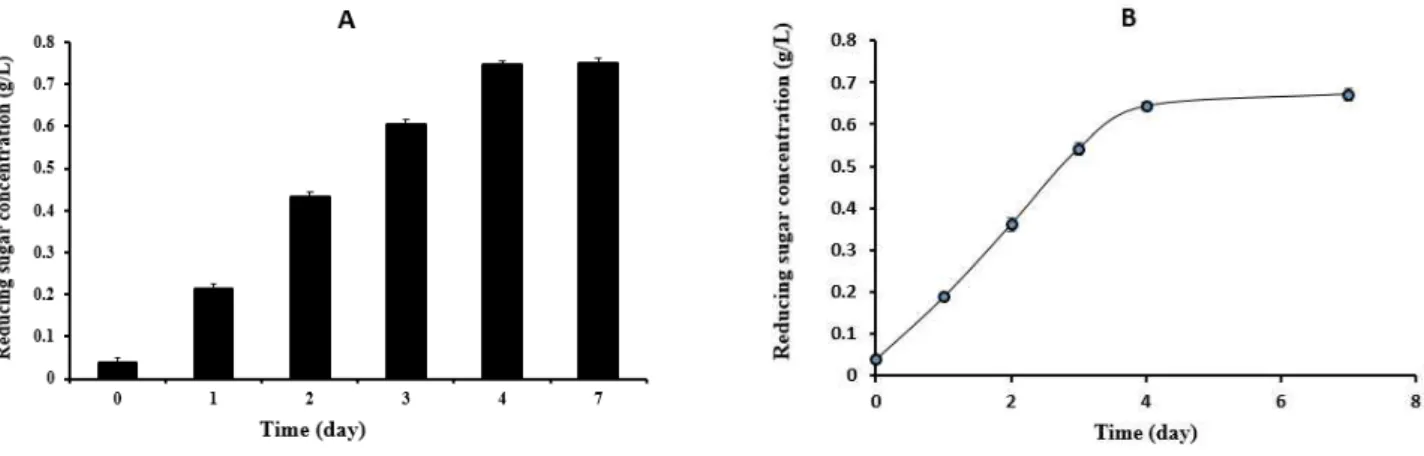
Afterwards we directly applied the strain N3 on the hydrolysis of polymannans such as GM and KM to characterize the bacterial strain and its of products. As the results we found that the strain N3 was stably able to hydrolyze GM (Fig. 1) and KM to the same pattern in terms of increasing reducing sugars (data not shown). With increasing time, the concentration of re- ducing sugar from the hydrolysis of GM and KM in- creased and reached to maximum 750 mg/L and 370 mg/L, respectively, after 7 days at 30 °C. Fig. 1 shows only the results for GM because of the similar pattern observed from the hydrolysis of KM.

Figure 1. Reducing sugar quantification of GMOS (A) and KMOS (B). Bacillus N3 was incubated in 200 ㎖ GM or KM

(0.5 % GM/KM in 1/20 diluted LB) for 7 days at 30 °C. The contents of hydrolysates named hereafter GMOS or KMOS

in the culture supernatant were quantified by reducing sugar assay. Mannose was used as standard.

(5)

Antioxidant activity of MOs

The central goal of this study was to evaluate the anti- oxidant activities related to the hydrolysates designated to GMOS derived from the parental polysaccharides GM.

GMOS were further characterized to investigate their an- tioxidant activities on DPPH radical scavenging effect.

Scavenging activity of DPPH radical slightly increased with the increasing of the days of incubation when com- pared to control, ascorbic acid. DPPH is one of the com- pounds that possessed a proton free radical with a charac- teristic absorption, which decreases significantly on ex- posure to proton radical scavengers [12]. Further it is well accepted that the DPPH free radical scavenging by anti- oxidants is due to their hydrogen-donating ability [13].

Thus, scavenging of DPPH free radical was directly af- fected by the amount of oligosaccharides molecules.

However, the significant DPPH free radical scavenging activity of MOS derived from the hydrolysis of GM was not observed during the test (data not shown). This results suggest that GMOS consisting of a mannose backbone with galactose side groups are neutral sugars that may not be able to a proton donor to the molecule of DPPH under the neutral pH. Besides activity toward DPPH, our results have not shown significant change in color with FRAP assay with increase in time of incubation until peri-

od of 7 days. This result also can be explained as the structural base of sugars which may not be able to reduce metal ions. Therefore, GMOS from GM are not the potent proton donor or reducing power of metal ions.

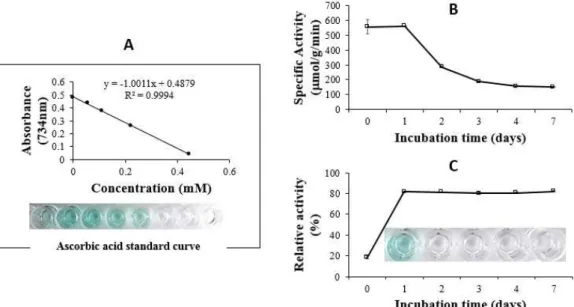
The 2,2′-azino-bis-(3-ethylbenzthiazoline-6-sulphonic acid) radical (ABTS•+) can be generated by the enzymatic system formed by hydrogen peroxide and horseradish per- oxidase in an organic medium [14]. In this experiment, ABTS radical scavenging activity was higher than DPPH and FRAP scavenging activities. In most cases, ABTS radi- cal cation (ABTS•+) is reactive t owards most antioxidants, and it is applicable to determine lipophilic and hydrophilic antioxidant capacities over a wide pH range [14]. Relative ABTS activity was found to be around 80 % after 1 day of incubation and remained constant up to 7 days. Whereas specific ABTS activity reduced over 7 days of time period based on the fact that decreased total carbohydrate content and increase in reducing sugar contents (Fig. 2). Based on these results we suggest that GMOS derived from the parental polysaccharide GM may interact with ABTS•+

in hydrophobic attraction together. As increasing the con- centration of reducing sugars after 2-days culture, although it is not able to determine the average molecular weight of GM, probably certain size of molecules can be involved in ABTS radical scavenging activity.

Figure 2. ABTS radical cation scavenging activity of GMOS. Bacillus N3 was incubated in 200 ㎖ consisting of 0.5 % GM

in 1/20 diluted LB for 7 days at 30 °C. Culture supernatant was collected and heated (100 °C, 7 min) and centrifuged. After

centrifugation, supernatant was collected and used as GMOS for ABTS assay. A: control, B: specific activity (mmol/g/min),

C: relative activity (%).

(6)

Tyrosinase inhibitory activity of MOs

As described in the Fig. 2, we found that GMOS showed significant ABTS radical scavenging activity, which is quite related with the whitening effect by inhibiting tyrosinase activity. Therefore, we applied these GMOS derived from the hydrolysis of GM for tyrosinase inhibitory activity. The enzyme tyrosinase is a metalloenzyme group of polyphenol oxidases that occurs in various organisms and perform some specific functions in melanogenesis [15] converted to dopaquinone (diphenolase activity is the second step of tyrosinase reaction). Furthermore, tyrosinase catalyzes the oxidation of 5,6-di-hydroxyindole to form indole-5,6-quinone of the melanin precursors [16]. Compounds, which cause inhibition of tyrosinase, could be effective as depigmenting agents.

Tyrosinase is an enzyme widely distributed in nature containing copper and catalyzes key reactions in the melanin pathway. Its inhibition is the major goal in developing new whitening agents now days. However, unfortunately we cannot detect any specific tyrosinase inhibitory activity/whitening activity from GMOS from GM (data not shown). Many tyrosinase inhibitors are polyphenol derivatives of flavonoids or of trans-stilbene so this can be the reason we were not able to detect any activity [17,18]. On the other hand, all testants showed higher changes of absorbance compared to the control.

Biological applications of MOS derived from the hydrolysis of KM

We next find the biological activities of Bacillus N3 and in this regard we firstly focused on the ability of N3 to hydrolyze konjac as glucomannan (KM). The KM is made up of 1,4-linked β-D- mannose residues and a branched chain structure joined through C3 of the hexose residues of the main chain. KMOS has been implicated as a glucomanno-protein complex which is derived by enzymatic hydrolysis of the inner cell wall of the fungi Aspergillus [19]. The outer portion of the fungal cell wall contains another functional

carbohydrate-glucomanno-protein, which can bind to mycotoxins [20]. Furthermore, it is worthy to note that KMOS can be phosphorylated to increase pathogenic binding capacity, it can effectively bind and adsorb various pathogens including bacteria (Escherichia coli, Pseudomonas spp., Staphylococcus aureus, Salmonella spp., Shigella spp. and Vibrio spp.) and ultimately reduce growth of these microbes [21].

Thin layer chromatography (TLC) is routinely used by synthetic organic chemists and natural products chemists working on a variety of types of molecules.

Carbohydrate biochemists in the past largely relied on paper chromatography for rapid analysis.

Carbohydrates are highly polar molecules and often require derivation to be analyzed by TLC. Fig. 3 shows that in all the bands remained at the bottom line corresponding to each sample from 0-6 which correspond to the incubation time of each sample. As compared to standard galactose and mannose which upon baking of TLC plate separated and segregated, however all samples stay at origin that may be due to relatively high molecular weight and this is why samples cannot be separated on TLC plate. Although there were no significant migration changes, intensity of samples taken at time difference increased that corresponds to the results of Fig. 1. Herewith we hypothesized that Bacillus N3 may hydrolyze GM/KM randomly and use smaller size of molecules as nutrients like mono- or dimeric glucans derived from the function of endo and exo-enzymes.

Therefore, it is hard to detect sort of smaller size of molecules in the culture supernatant with microorganism. Instead of high production of enzyme, in this study we focused on the biological activity of the products GMOS and KMOS. Nevertheless, we were able to get increasing amounts of reducing sugar from the hydrolysis based on time-dependence (Fig.

1). As the results it was found that it might be

mannohaxoses or higher molecular weight that it

cannot travel higher along the silica gel plate of TLC

as compared to control.

(7)

Figure 3. TLC development of KMOS derived from the hydro lysis of KM. Bacillus N3 was incubated in 200 ㎖ medium consisting of 0.5 % KM in 1/20 diluted LB for 7 days at 30 °C. Culture supernatant was collected and heated at 100

°C for 5min. Then, KMOS in the supernatant derived from the time-dependent hydrolysis were developed on TLC plate.

G: Galactose; M: Mannose; 0: KMOS-0; 1: KMOS-1; 2: KM OS-2; 5: KMOS-5; 6: KMOS-6. Numbers indicate the time (day) of incubation as shown in Scheme 1, as shown in the Materials and Methods section.

Furthermore, we applied KMOS from KM to determine antioxidant activity of these samples (Table 1). The chronic exposure of human skin to ultraviolet radiation has several effects such as inflammatory response, erythema, pigmentation, immunosuppression and hyperplasia. The use of sunscreen and related products is the main purpose of cosmetics for the skin protection against the harmful effects of UV rays.

Antioxidants prevent the formation of free radicals and help to repair the damage caused by them. Natural antioxidant compounds are capable of absorbing energy in the UV rays. In this regard we apply the KMOS for the for 3 different antioxidant assays that are DPPH, ABTS and FRAP antioxidants assays (Table 1). As we hypothesized that KMOS from KM will show higher antioxidant activity but unfortunately no activity was observed in case of DPPH and FRAP,

whereas specifically ABTS antioxidant activity was obtained and highest relative activity was observed up to 60 % of relative activity for KO-5. The reason behind non detection of DPPH and FRAP relative activity might include the pH dependence nature of these chemicals, as described in other section. Next, we apply KMOS for tyrosinase inhibitory activity also called as whitening activity. Tyrosinase catalyzes the oxidation of 5,6-di-hydroxyindole to form indole-5,6-quinone of the melanin precursors [22].

Because tyrosinase participates in at least three stages of melanogenesis, tyrosinase inhibition would serve to block melanin biosynthesis and would be important as a base of formulations used for the treatment of skin blemishes [22]. However, all KMOS were unable to inhibit tyrosinase activity which can be linked to its inability to inhibit the production tyrosine in the melatonin pathway. The outcomes of this study elaborate that MOS produced from GM or KM by N3 has only potent antioxidant activity against ABTS radical scavenging effect, respectively.

Table 1. Detection of antioxidant activity.

Relative activity (%)*

ABTS

KMOS-0 32.1

KMOS-1 39.8

KMOS-2 42.8

KMOS-5 61.3

KMOS-6 57.9

*Relative activity (%): (1-Abs of sample/Abs of negative control) x 100. Glucose, Mannose and DW were used as negative control.

As described in the previous study [23], an

alkalophilic a-1,3 D-mannosidase purified

Pseudomonas species and characterized that this

enzyme has shown significant algal-lytic activities

against Alexandrium tamarense, Akashiwo sanguine,

Gymnodinium catenatum, Gymnodinium mikimotoi,

Prorocentrum dentatum and Cochlodinium

polykrikoides known as harmful algal species based

(8)

on the substrate specificity of enzyme. Screening and characterization of new bacterial strains are always attracting our attention to elucidate the enzymatic function toward many different types of substrates described above. Initially, therefore, Bacillus N3 was isolated as one of candidates producing algal lytic enzymes against microalgal biomasses to develop biological and environmental friendly conditions for biodiesel production. Instead of finding significant hydrolysis activity toward microalgal biomasses (data not shown), we found that Bacillus N3 can degrade polymannans used in this as substrates to produce highly hydrophilic low molecular oligosaccharides that can be utilized as a potent dietary food additive.

Further study on the purification and kinetic properties of enzyme is undergoing. In conclusion, our preliminary data demonstrate that those biological characteristics of derived from the hydrolysis of polymannans by Bacillus N3 probably be depending on the primary structure and the size of them.

Acknowledgments

This research was financially supported by a grant from Marine Biotechnology Program funded by Ministry of Oceans and Fisheries, Korea.

Conflicts of Interest

The authors report no conflicts of interest in this work.

References

1. Ding, J., Zhu, H., Ye, Y., Li, J., Han, N., Wu, Q., Huang, Z., and Zee, M. 2018. A thermostable and alkaline GDSL- motif esterase from Bacillus sp. K91: crystallization and X-ray crystallographic analysis. Acta Crystallogr F. Struc t. Biol. Commun,. 74 (Pt 2), 117-121.

2. Lisdiyanti, P., Suyanto, E., Gusmawati, N., and Rahayu, W. 2012. Isolation and characterization of cellulose produ ced by cellulolytic bacteria from peat soil of ogan komeri ng Ilir, South Sumatera. Int. J. Environ. Bioen., 3(3), 145- 153.

3. Sajith, S., Sreedevi, S., Priji, P., Unni, K. N., and Benjami n, S. 2014. Production and partial purification of cellulase from a novel fungus, Aspergillus flavus BS1. Annals Micr obiol., 64(2), 763-771.

4. Paz, A., Carballo, J., Perez, M. J., and Dominguez, J. M.

2016. Bacillus aryabhattai BA03: a novel approach to the production of natural value-added compounds. World J.

Microbiol Biotech., 32, 159-165.

5. Chawla, P. R., Bajaj, I. B., Survase, S., and Singhal, R.

S. 2009. Microbial cellulose: Fermentative production and application. Food Technol. Biotechnol., 47, 107-124 6. Parab, P., Khandeparker, R., Amberkar, U., and Khodse,

V. 2017. Enzymatic saccharification of seaweeds into fer mentable sugars by xylanase from marine Bacillus sp. stra in BT21. Biotech., 7(5), 291-296.

7. Rodrigues, D. F., and Elimelech, M. 2009. Role of type 1 fimbriae and mannose in the development of Escherichi a coli K12 biofilm: from initial cell adhesion to biofilm formation. Biofouling, 25(5), 401-411.

8. StOnge, M. P., Salinardi, T., Herron-Rubin, K., and Black, R.M. 2012. A weight-loss diet including coffee-derived mannooligosaccharides enhances adipose tissue loss in ov erweight men but not women. Obesity, 20(2), 343-348.

9. Nelson, N. 1944. A photometric adaptation of the somogyi method for the determination of glucose. J. Biol. Chem., 153(2), 375-380.

10. Pomerantz, S. H. 1966. The tyrosine hydroxylase activity of mammalian tyrosinase. J. Biol. Chem., 241(1), 161-168.

11. Amna, S., Lee, B. M., Lee, C. G., Hwang, Y. J., and Park, J. K. 2016. Degradation of polysaccharide in fenton oxidative cleavage reaction and their antioxidant activity.

J. Chitin Chitosan, 21(1), 20-25.

12. Amir, R. M., Anjum, F. M., Khan, M. I., Khan. M. R., Pasha, I., and Nadeem, M. 2013. Application of fourier transform infrared (FTIR) spectroscopy for the identificatio n of wheat varieties. J. Food Sci. Tech., 50(5), 1018-1023.

13. Chen, C. W., and Ho, C.T. 1995. Antioxidant properties of polyphenols extracted from green and black teas. J.

Food Lipids, 2(1), 35-46.

14. Cano, A., Acosta, M., and Arnao, M. B. 2000. A method to measure antioxidant activity in organic media: applicati on to lipophilic vitamins. Redox. Rep., 5(6), 365-370.

15. Videira, I. F., Moura, D. F., and Magina, S. 2013. Mechan isms regulating melanogenesis. An. Bras. Dermatol., 88 (1), 76-83.

16. Kamkaen, N., Mulsri, N., and Treesak, C. 2007. Screenin g of some tropical vegetables for anti-tyrosinase activity.

J. Thail. Pharm. Health Sci., 2(1), 15-19.

17. Briganti, S., Camera, E., and Picardo, M. 2003. Chemical and instrumental approaches to treat hyperpigmentation.

Pigment Cell Res., 16(2), 101-110.

18. Khatib, S., Nerya, O., Musa, R., Shmuel, M., and Tamir,

zS. 2005. Vaya JChalcones as potent tyrosinase inhibitors:

(9)

the importance of a 2,4-substituted resorcinol moiety. Bio organic & Medicinal Chem., 13(2), 433-441.

19. Horn, S. J., Vaaje-Kolstad, G., Westereng, B., and Eijsink, V. G. H. 2012. Novel enzymes for the degradation of cellulose. Biotech. Biofuels, 5, 45-45.

20. Devreese, M., Girgis, G. N., Tran, S. T., DeBaere, S., DeBacker, P., Croubels, S., and Smith, T. K. 2014. The effects of feed-borne Fusarium mycotoxins and glucoman nan in turkey poults based on specific and non-specific parameters. Food Chem. Toxicol., 63, 69-75.

21. Shibata, N., Kobayashi, H., Takahashi, S., Okawa, Y., Hisamichi, K., Suzuki, S., and Suzuki, S. 1991. Structural study on a phosphorylated mannotetraose obtained from the phosphomannan of Candida albicans NIH B-792 strai n by acetolysis. Arch. Biochem. Biophys., 290(2), 535-54 2.

22.Chang, T. S. 2012. Natural melanogenesis inhibitors acting through the down-regulation of tyrosinase activity. Materi als, 5(9), 1661-1685.

23. Park, J. K. 2013. Purification and characterisation of a

novel alkalophilic α-D-mannosidase from Pseudomonas

fluorescens. Biocontrol Sci.Technol., 23, 1324-1335.

수치

Figure  1.  Reducing  sugar  quantification  of  GMOS  (A)  and  KMOS  (B).  Bacillus  N3  was  incubated  in  200  ㎖  GM  or  KM  (0.5  %  GM/KM  in  1/20  diluted  LB)  for  7  days  at  30  °C
Figure  2.  ABTS  radical  cation  scavenging  activity  of  GMOS.  Bacillus  N3  was  incubated  in  200  ㎖ consisting  of  0.5  %  GM  in  1/20  diluted  LB  for  7  days  at  30  °C
Table  1.    Detection  of  antioxidant  activity.

참조

관련 문서

To measure antioxidant effects of the yuzu seed oil, DPPH radical scavenging and lipid peroxidation were investigated... DPPH radical scavenging

Hesperetin belongs to the class of flavonoids, called flavanones, which are abundant in Citrus fruits. Hesperetin is derived from the hydrolysis of its

Fresh samples were immediately tested for antioxidant activity, and antioxidant activity was compared according to gestational age and measured the difference

It considers the energy use of the different components that are involved in the distribution and viewing of video content: data centres and content delivery networks

After first field tests, we expect electric passenger drones or eVTOL aircraft (short for electric vertical take-off and landing) to start providing commercial mobility

1 John Owen, Justification by Faith Alone, in The Works of John Owen, ed. John Bolt, trans. Scott Clark, "Do This and Live: Christ's Active Obedience as the

The initial rate of the hydrolysis reaction is much larger than the sum of the rates of the condensation reactions so that [SiOH] equals the consumption of H 2 O by hydrolysis.

DPPH radical scavenging radical activity of jelly products added with different levels of Tribeli paprika powder.. ABTS radical scavenging radical activity of