ISSN: 2233-601X (Print) ISSN: 2093-6516 (Online)
Received: August 21, 2017, Revised: October 13, 2017, Accepted: October 20, 2017, Published online: April 5, 2018
Corresponding author: Kyung Hwan Kim, Department of Thoracic and Cardiovascular Surgery, Seoul National University Hospital, Seoul National University College of Medicine, 101 Daehak-ro, Jongno-gu, Seoul 03080, Korea
(Tel) 82-2-2072-2342 (Fax) 82-2-764-3664 (E-mail) [email protected]
© The Korean Society for Thoracic and Cardiovascular Surgery. 2018. All right reserved.
This is an open access article distributed under the terms of the Creative Commons Attribution Non-Commercial License (http://creativecommons.org/
licenses/by-nc/4.0) which permits unrestricted non-commercial use, distribution, and reproduction in any medium, provided the original work is properly cited.
Early Clinical Outcomes of Tricuspid Valve Repair with a Tri-Ad Annuloplasty Ring in Comparison
with the Outcomes Using an MC
3Ring
Woohyun Jung, M.D., Jae Woong Choi, M.D.,
Ho Young Hwang, M.D., Ph.D., Kyung Hwan Kim, M.D., Ph.D.
Department of Thoracic and Cardiovascular Surgery, Seoul National University Hospital, Seoul National University College of Medicine
Background: We evaluated the early clinical outcomes of tricuspid valve annuloplasty (TAP) with the Tri-Ad annuloplasty ring for functional tricuspid regurgitation (TR). Methods: From January 2015 to March 2017, 36 patients underwent TAP with a Tri-Ad ring for functional TR. To evaluate the early clinical outcomes of TAP with the Tri-Ad ring, we conducted a propensity score-matched analysis comparing the Tri-Ad and MC3 tri- cuspid annuloplasty rings (n=34 in each group). The follow-up duration was 11.0±7.07 months. Results:
There was 1 case of operative mortality (2.8%) and no cases of late mortality. Postoperative complications occurred in 15 patients (41%), including acute kidney injury in 6 patients (16%), bleeding requiring reopera- tion in 4 patients (11%), and low cardiac output syndrome in 4 patients (11%). There were no ring-related complications, such as atrioventricular block or ring dehiscence. The TR grade decreased significantly (from 2.03±1.06 to 1.18±0.92, p<0.01), as did the systolic pulmonary artery pressure (from 43.53±13.84 to 38.00±9.72 mm Hg, p=0.03). There were no cases of severe residual TR, but moderate TR was observed in 3 patients, all of whom had severe TR preoperatively. Severe preoperative TR was also associated with mod- erate in the univariate analysis (p<0.01). In the propensity score-matched analysis comparing the Tri-Ad and MC3 rings, there was no significant difference in early clinical outcomes. Conclusion: TAP with the Tri-Ad ring corrected functional TR effectively and provided good early clinical and echocardiographic results with- out ring-related complications. However, severe preoperative TR was associated with moderate or severe re- sidual TR in the immediate postoperative period. A follow-up study is necessary to confirm the stability of this procedure.
Key words: 1. Tricuspid valve
2. Tricuspid valve insufficiency 3. Cardiac valve annuloplasty
Introduction
Functional tricuspid regurgitation (TR) is usually associated with left-sided valvular disease. It in- creases the dimensions of the right ventricle (RV)
and right atrium (RA) and distorts the norm al geo- metrical relationships of the tricuspid leaflets, chords, and papillary muscles, which results in tethering of the tricuspid leaflets and incomplete coaptation. If left untreated, the progression of functional TR can ag-
https://doi.org/10.5090/kjtcs.2018.51.2.92
gravate clinical outcomes, regardless of its severity [1].
Functional TR can be treated with suture or ring annuloplasty. Notably, tricuspid annuloplasty (TAP) with an Edwards MC3 annuloplasty ring (MC3; Edwards LifeScience, Irvine, CA, USA) demonstrated better mid- and long-term outcomes than Non-surgi- cal tgreatment [2]. In comparison, the recently re- leased Tri-Ad Adams tricuspid ring (Tri-Ad;
Medtronic, Minneapolis, MN, USA), consists of a large open area to protect the conduction system , flexible ends combined with a 3-dimensional (3D) semi-rigid mid-portion, and a short septal lateral dimension to allow optimal correction of the main lesion while protecting the delicate tissue around the tricuspid valve (TV) [3].
The purpose of our study was to investigate the early outcom es of TAP with the Tri-Ad ring and to demonstrate its safety and efficacy in comparison to the MC3 ring.
Methods
1) Patient characteristics
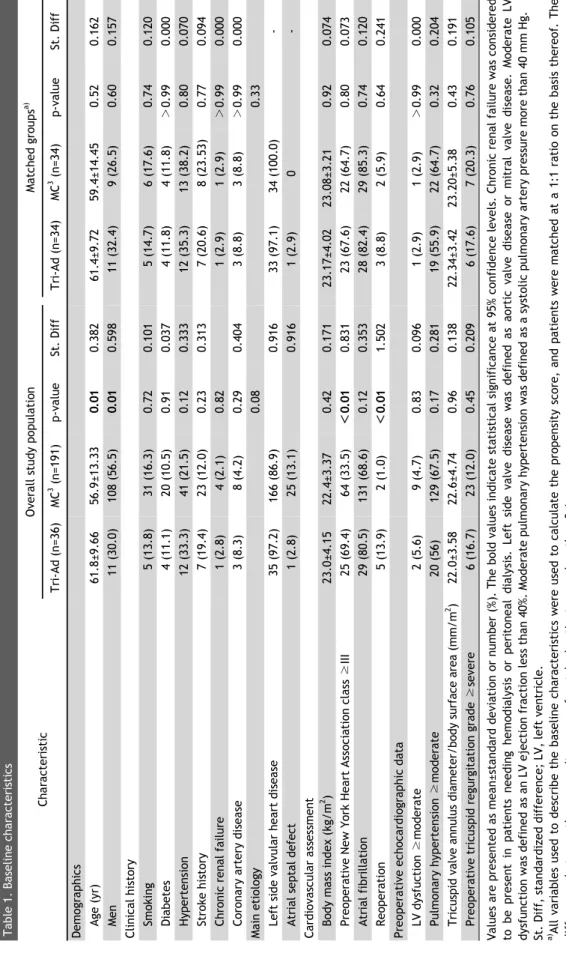
From January 2015 to March 2017, 36 patients with functional TR underwent TV repair with a Tri-Ad ring by 1 surgeon at Seoul National University Hospital. The control group, who underwent TAP with an MC3 ring for functional TR from January 2007 to February 2015, comprised 193 patients (the MC3 group). Clinical data were assessed retro- spectively, and follow-up information (e.g., survival, clinical status, and echocardiography) was acquired from the patients’ electronic medical records. The clinical follow-up period ended on May 31, 2017, with an average duration of 10.39±7.24 months (range, 1.3 to 27 months). Table 1 presents patients’
baseline characteristics. Operative mortality was de- fined as any death within 30 days after surgery or during the same hospital admission. All patients were followed up in the outpatient clinic (follow-up period, 10.39±7.24 months; range, 1.3 to 27 months). The study was approved by the Institutional Review Board of Seoul National University Hospital (SNUH IRB no., 1708-067-877) and written informed consent was obtained from the patients for publication of this study and any accompanying images.
2) Surgical technique
A full sternotomy was performed in all patients.
After cardiopulmonary bypass was instituted, left-sid- ed valvular heart disease was corrected first. In pa- tients with a history of atrial fibrillation, the Cox maze procedure was performed by cryothermal abla- tion (n=27, 75%). A mitral valve operation was per- formed in 29 patients (82% for mitral valve repair, 18% for replacement). Other concomitant procedures included aortic valve replacement (n=8, 22.2%) and atrial septal defect closure (n=1, 2.8%) (Table 2).
Next, a right oblique atriotomy parallel to the atrio- ventricular (AV) groove was performed, and the TV was analyzed to confirm type I dysfunction (i.e., an- nular dilatation) in all patients. The annular diameter and size of the Tri-Ad annuloplasty ring was de- term ined by m easuring the distance between the an- teroseptal and posteroseptal commissures using a tri- cuspid ring annuloplasty sizer. Annular dilatation was assumed to be present if the annulus of the TV was larger than the ring sizer. The indications for TAP were (1) TR of grade 1 or greater with annular dila- tation, or (2) pulmonary hypertension (systolic pul- monary artery pressure >50 m m Hg on preoperative echocardiography) with annular dilatation, irre- spective of the TR grade. The size of the Tri-Ad ring implanted for TV repair ranged from 26 to 32 mm: 5 patients (13.9%) had a 26-mm ring, 29 (80.6%) had a 28-mm ring, 1 (2.8%) had a 30-mm ring, and 1 (2.8%) had a 32-m m ring.
3) Echocardiographic evaluation
Two-dimensional echocardiography and Doppler color-flow imaging were performed in all patients be- fore and after surgery (pre-discharge echocardio- graphic follow-up). Pre-discharge follow-up echo- cardiography was available for all patients (n=35, ex- cluding 1 case of early mortality). The time interval between surgery and pre-discharge echocardiography was 9.94±10 days (range, 5 to 26 days).
Echocardiographic evaluations were performed by experienced echocardiographers according to the American Society of Echocardiography guidelines [4].
TR was graded as none, trivial, mild, moderate, or severe. The TV annulus diameter of all patients was measured in the transthoracic apical 4-chamber view in late diastole at the time of maximal tricuspid opening [5].
Table 1. Baseline characteristics CharacteristicOverall study populationMatched groupsa) Tri-Ad (n=36)MC3 (n=191)p-valueSt. DiffTri-Ad (n=34)MC3 (n=34)p-valueSt. Diff Demographics Age (yr)61.8±9.6656.9±13.330.010.38261.4±9.7259.4±14.450.520.162 Men11 (30.0)108 (56.5)0.010.59811 (32.4)9 (26.5)0.600.157 Clinical history Smoking5 (13.8)31 (16.3)0.720.1015 (14.7)6 (17.6)0.740.120 Diabetes4 (11.1)20 (10.5)0.910.0374 (11.8)4 (11.8)>0.990.000 Hypertension12 (33.3)41 (21.5)0.120.33312 (35.3)13 (38.2)0.800.070 Stroke history7 (19.4)23 (12.0)0.230.3137 (20.6)8 (23.53)0.770.094 Chronic renal failure1 (2.8)4 (2.1)0.821 (2.9)1 (2.9)>0.990.000 Coronary artery disease3 (8.3)8 (4.2)0.290.4043 (8.8)3 (8.8)>0.990.000 Main etiology0.080.33 Left side valvular heart disease35 (97.2)166 (86.9)0.91633 (97.1)34 (100.0)- Atrial septal defect1 (2.8)25 (13.1)0.9161 (2.9)0- Cardiovascular assessment Body mass index (kg/m2 )23.0±4.1522.4±3.370.420.17123.17±4.0223.08±3.210.920.074 Preoperative New York Heart Association class ≥III25 (69.4)64 (33.5)<0.010.83123 (67.6)22 (64.7)0.800.073 Atrial fibrillation29 (80.5)131 (68.6)0.120.35328 (82.4)29 (85.3)0.740.120 Reoperation5 (13.9)2 (1.0)<0.011.5023 (8.8)2 (5.9)0.640.241 Preoperative echocardiographic data LV dysfuction ≥moderate2 (5.6)9 (4.7)0.830.0961 (2.9)1 (2.9)>0.990.000 Pulmonary hypertension ≥moderate20 (56)129 (67.5)0.170.28119 (55.9)22 (64.7)0.320.204 Tricuspid valve annulus diameter/body surface area (mm/m2 )22.0±3.5822.6±4.740.960.13822.34±3.4223.20±5.380.430.191 Preoperative tricuspid regurgitation grade ≥severe6 (16.7)23 (12.0)0.450.2096 (17.6)7 (20.3)0.760.105 Values are presented as mean±standard deviation or number (%). The bold values indicate statistical significance at 95% confidence levels. Chronic renal failure was considered to be present in patients needing hemodialysis or peritonealdialysis. Left side valve disease was defined as aortic valve disease or mitral valve disease. Moderate LV dysfunction was defined as an LV ejection fraction less than 40%. Moderate pulmonary hypertension was defined as a systolic pulmonary artery pressure more than 40 mm Hg. St. Diff, standardized difference; LV, left ventricle. a) All variables used to describe the baseline characteristics were used to calculate the propensity score, and patients were matched at a 1:1 ratio on the basis thereof. The differences between the propensity scores of matched patients were less than 0.1.
Table 2. Operative data and clinical outcomes Variable
Overall study population Matched groupsa)
Tri-Ad MC3 p-value Tri-Ad MC3 p-value
Basic operative data
No. of patients 36 191 34 34
Cardiopulmonary bypass time (min) 234.5±64.15 225.8±66.80 0.46 237.56±64.69 241.88±57.88 0.77 Aortic cross-clamping time (min) 156.1±55.07 148.0±50.70 0.41 158.21±55.98 162.53±43.06 0.72 Concomitant procedure
Coronary artery bypass graft surgery 0 6 (3.1) 0.28 0 2 (5.9) 0.16
Aortic valve operation 8 (22.2) 48 (25.1) 0.71 8 (23.5) 9 (26.5) 0.59
Mitral valve operation 29 (80.6) 153 (80.1) 0.95 27 (79.4) 28 (82.4) 0.76
Cox maze procedure 27 (75.0) 118 (61.8) 0.13 26 (76.5) 26 (76.5) >0.99
Atrial septal defect closure 1 (2.8) 31 (16.2) 0.03 1 (2.9) 0 0.32
Mortality
Early mortality (≤30 day) 1 (2.8) 6 (3.1) 0.91 1 (2.9) 3 (8.8) 0.48
Morbidity
Bleeding requiring reoperation 4 (12.0) 11 (5.8) 0.20 4 (11.8) 2 (5.9) 0.68
Acute renal failure 6 (18.0) 13 (6.8) 0.04 6 (17.6) 6 (17.6) 0.72
Stroke 1 (2.8) 4 (2.1) 0.58 1 (2.9) 1 (2.9) 0.48
LCOS 4 (12.0) 11 (5.8) 0.25 4 (11.8) 4 (11.8) 0.68
Postoperative echocardiographic resultsb)
No. of patients 35 185 31 31
LV dysfuction ≥moderate 3 (8.6) 29 (15.7) 0.43 2 (5.9) 6 (3.2) 0.29
Pulmonary hypertension ≥moderate 8 (22.9) 44 (23.8) >0.99 7 (25.5) 11 (41.9) 0.39 Tricuspid regurgitation grade ≥moderate 3 (8.3) 3 (1.6) 0.05 3 (9.7) 1 (6.5) >0.99 Values are presented as mean±standard deviation or number (%), unless otherwise stated. The bold values indicate statistical significance at 95% confidence levels. LCOS was defined as being present in patients who needed mechanical support postoperatively to maintain cardiac output. Moderate LV dysfunction was defined as an LV ejection fraction less than 40%. Moderate pulmonary hypertension was defined as a systolic pulmonary artery pressure more than 40 mm Hg.
LCOS, low cardiac output syndrome; LV, left ventricle.
a)All variables used to describe the baseline characteristics were used to calculate the propensity score, and patients were matched at a 1:1 ratio on the basis thereof. The differences between the propensity scores of matched patients were less than 0.1. b)Echocardio- graphic data from a case of early mortality were not included.
4) Statistical analysis
Statistical analysis was performed using IBM SPSS ver. 19.0 (IBM Corp., Armonk, NY, USA). Continuous and categorical data were expressed as the mean±
standard deviation and median with range or pro- portion, respectively. The predicted probability ac- quired from the logistic equation and all the varia- bles describing the baseline characteristics in Table 1 were used to calculate the propensity score for each case. Using the propensity score, patients who under- went TAP with a Tri-Ad ring were matched on a 1:1 basis with those in the MC3 group. The maximum al- lowable difference in the propensity score for match- ing was 0.1. Com parisons between the 2 groups were made using the Wilcoxon signed-rank test for con- tinuous variables and the McNemar test for catego-
rical variables. Risk factor analysis for residual TR was performed using the chi-square test (Pearson chi-square and Fisher exact tests) for categorical var- iables and the Mann-Whitney test for continuous variables. All p-values <0.05 were considered to in- dicate statistical significance.
Results
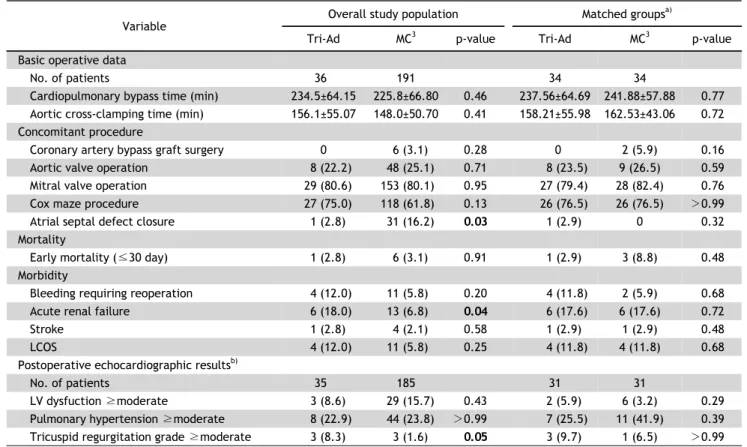
Table 2 presents the operative and postoperative outcomes of TAP with a Tri-Ad ring. There was 1 case (2.8%) of operative mortality, and the cause of death was unidentified bleeding and hypovolemic shock. There were no late deaths. Postoperative com- plications occurred in 15 patients (41%), including acute renal failure in 6 patients (16%), bleeding re-
Fig. 1. Serial changes of TR grade (A) and SPAP (B). TR, tricuspid regurgitation; SPAP, systolic pulmonary artery pressure.
Fig. 2. Changes in tricuspid regurgitation (TR) severity before and after the procedure using the Tri-Ad ring. TR severity was classi- fied as mild, moderate, or severe.
quiring reoperation in 4 patients (11%), low cardiac output syndrome in 4 patients (11%), and stroke in 1 patient (2.8%). No reoperations were performed for residual TR or permanent pacemaker insertion. In the propensity score-matched analysis, there was no significant difference in operative mortality and mor- bidity between the 2 groups.
After surgery with a Tri-Ad ring, the TR grade sig- nificantly decreased (from 2.03±1.06 to 1.18±0.92, p<
0.01), as did the systolic pulmonary artery pressure (from 43.53±13.84 to 38.00±9.72 mm Hg, p=0.03) (Fig. 1). Moderate TR was observed in 3 patients (8.3%) (Fig. 2) and the incidence of residual moder- ate or severe TR was significantly greater than in the MC3 group before matching. However, this difference was not observed in the matched analysis.
An analysis conducted to assess the factors asso- ciated with postoperative residual TR after TAP with a Tri-Ad ring demonstrated that patients with moder- ate or severe residual TR had more severe pre- operative TR and a larger preoperative TV annulus and body surface area (Table 3).
Discussion
This study had 2 m ain findings. First, TAP with the new 3D prosthesis, the Tri-Ad Adams TAP ring, dem- onstrated good early clinical and echocardiographic outcomes that were comparable to those of the MC3 ring. Second, severe preoperative TR was associated with moderate or severe residual TR in the immedi- ate postoperative period when using a Tri-Ad ring for TAP.
The tricuspid annulus has a 3D nonplanar structure. Hence, the ideal annuloplasty device should take into account its geometric characteristics and re- store the innate 3D shape of the annulus to reduce leaflet stress and tethering. It should also rem odel the RV along the area of maximal annular dilation and the RV free wall margin, while having an ‘open’
design to protect the conduction system as much as possible [6]. A ring device that is also flexible may provide good initial leaflet coaptation by preserving the dynam ic m otion of the annulus during the car- diac cycle [7]. More durable repair, however, may be better achieved by using a rigid annuloplasty ring [8,9]. McCarthy and colleagues analyzed 790 patients who underwent TV repair with either a suture or ring annuloplasty. They found that the incidence of TR increased gradually with the flexible Cosgrove- Edwards band, while it remained constant after im- plantation of the rigid Carpentier-Edwards ring [1].
The unique 3D design of the Tri-Ad ring, with its large open area, flexible ends, and rigid mid-portion, theoretically addresses all of the above necessities of an ideal annuloplasty ring. The Tri-Ad and MC3 rings
Table 3. Findings of patients with moderate or severe residual TR Predischarge TR grade
Tri-Ad ring (n=35)
≤Mild (n=32) ≥Moderate (n=3) p-value Rhythm status
Preoperative status 0.53
Normal sinus rhythm 7 (100.0) 0
Atrial fibrillation 25 (78.1) 3 (10.7)
Postoperative status >0.99
Normal sinus rhythm 22 (91.7) 2 (8.3)
Atrial fibrillation 10 (90.9) 1 (9.1)
Preoperative tricuspid valve annulus diameter/body surface area (mm/m2) 22.46±3.70 24.27±0.95 0.05
Preoperative pulmonary hypertension 0.57
SPAP ≤40 mm Hg 13 (86.7) 2 (13.3)
SPAP >40 mm Hg 19 (95.0) 1 (5.0)
Preoperative TR grade
≤Moderate 29 (100.0) 0 <0.01
Severe 3 (50.0) 3 (50.0)
Values are presented as number (%) or mean±standard deviation, unless otherwise stated. The bold values indicate statistical significance at 95% confidence levels.
TR, tricuspid regurgitation; SPAP, systolic pulmonary artery pressure.
Table 4. Characteristics of patients who underwent an add-on DeVega tricuspid valve annuloplasty maneuver
Sex Age (yr)
Preoperative characteristics Postoperative characteristics
Ring
size Etc.
TR grade
TVA Ø (mm)
TVA Ø/BSA (mm/m2)
SPAP (mm Hg)
TR grade
TVA Ø (mm)
TVA Ø/BSA (mm/m2)
SPAP (mm Hg)
M 72 Moderate 46 24 31 Trivial 34 18 37 28 Severe annular dilatation
M 50 Moderate 42 26 41 Mild 34 20 50 28 Severe annular dilatation
F 68 Severe 52 31 36 None 44 26 32 26
F 62 Severe 39 25 35 Trivial 32 20 28 28
F 75 Severe 32 22 33 Trivial 27 18 37 28
F 84 Severe 35 25 26 Moderate 32 23 56 28 Preoperative RV dysfunction
F 69 Severe 36 23 64 Moderate 32 21 66 32
F 49 Severe 37 24 22 Moderate 32 21 38 28 Preoperative RV dysfunction
TR, tricuspid regurgitation; TVA Ø, tricuspid valve annulus diameter (mm); BSA, body surface area; SPAP, systolic pulmonary artery pressure; M, male; F, female; RV, right ventricle.
both have a 3D design, a rigid portion, and a config- uration to accommodate the saddle shape of the annulus. The rigid component of the Tri-Ad ring is located in the region corresponding to the RV free wall aspect of the annulus, and therefore functions as a remodeling ring. In contrast to the MC3 ring, both ends of the Tri-Ad ring are completely flexible, with a more open design that allows 3D movement and wider accommodation of the conduction system to reduce iatrogenic injuries [3]. Pfannmuller et al. [10]
reported an 8.7% risk of TAP dehiscence in a large series using a rigid annuloplasty ring, compared to a
0.9% risk using a flexible band. In our study, no cas- es of immediate postoperative annuloplasty ring de- hiscence were reported. None of the patients who underwent TV repair with a Tri-Ad ring reported a conduction block that required pacemaker implanta- tion following surgery. In com parison, 2 of 193 patients (1.04%) in the MC3 group required pacemaker im- plantation after surgery for com plete AV block during the follow-up. Although those cases of AV block might also be attributed to the Cox maze procedure or other concomitant surgery, the wider open area of the Tri-Ad ring m ay provide a protective effect on
the conduction system compared to the MC3 ring.
Moderate TR was observed in 3 patients (8.3%) after surgery with a Tri-Ad ring. The incidence of moderate or severe residual TR was significantly greater than in the MC3 group before matching, but this difference was not observed in the matched analysis (after propensity score matching, moderate or severe residual TR was found in 3 of the 31 pa- tients [9.6%] in the Tri-Ad group and 2 of the 31 [6.5%] patients in the MC3 group). In the literature, the factors associated with residual TR after TV re- pair include atrial fibrillation, greater TR severity, higher pulmonary artery pressure, larger annular size, poorer left or right ventricular function, and the presence of intra-annular pacemaker leads [1,9,11-14].
In our study, patients with moderate or severe re- sidual TR after TAP with a Tri-Ad ring had more se- vere preoperative TR and a larger preoperative TV annulus diameter and body surface area (Table 3).
In a sub-analysis of the patients with severe pre- operative TR, moderate or severe residual TR was observed in 3 of the 6 patients in the Tri-Ad group (Fig. 2) and 2 of the 33 patients in the MC3 group.
This finding m ay suggest that the TR correction ef- fect of the Tri-Ad ring in the im m ediate post- operative period was weaker than that of the MC3 ring in the setting of severe TR. Com pared to the MC3 ring, the Tri-Ad ring has a wider open area to reduce conduction injury and a shorter septal lateral dimension to allow more aggressive remodeling of the dilated RV and right atrium. Conversely, the Tri-Ad ring has relatively narrow coverage of the TV annulus, which may explain the higher incidence of residual TR in patients with severe TR preopera- tively. Considering this, we performed an additional DeVega TAP procedure if the preoperative TR grade was severe, or if very severe annular dilatation was observed in the operative field (Table 4). This addi- tional enforcem ent m ay explain why there was no significant residual TR in patients with very severe annular dilatation. Thus, in situations where severe annular dilatation is a concern, additional procedures such as DeVega TAP, pericardial patch enlargement of the tricuspid leaflets [15], or the edge-to-edge
‘clover’ technique [16] may be helpful in reducing re- sidual TR. However, even with extra precautions, moderate residual TR was observed in 3 patients.
When further investigated, 2 patients had pre-
operative RV dysfunction and 1 patient had a rela- tively high systolic pulmonary artery pressure pre- operatively that did not diminish after surgery.
Therefore, attention should be paid to the use of the Tri-Ad ring in patients with severe TR, especially when accompanied by RV dysfunction or high sys- tolic pulmonary artery pressure. Even though TAP with a Tri-Ad ring did not result in significant TR, it would be prudent to evaluate the mid- and long-term outcom es of the Tri-Ad ring in term s of the in- cidence of residual TR in patients with severe pre- operative TR.
In this study, several efforts were m ade to m ini- mize selection bias. We only included patients with functional TR without any evidence of organic pathology. Due to the small number of cases, we com pared the clinical outcom es of the Tri-Ad ring to those of patients who underwent TAP with an MC3 ring, which has well-established early and long-term clinical outcomes, and we chose to analyze the pa- tients using matched propensity scores to minimize selection bias. This study was conducted at a single center and the procedures were performed by a sin- gle surgeon. Furthermore, we collected preoperative and predischarge echocardiographic data of all pa- tients and investigated other relevant characteristics.
Although this is the first study presenting the early clinical outcomes of the Tri-Ad ring, the retrospective study design and its small sample size, limited by the novelty of the Tri-Ad ring, could be lim itations of this study.
In conclusion, TAP with the Tri-Ad ring corrected functional TR effectively and provided good early clinical and echocardiographic outcomes that were com parable to those obtained using the MC3 ring, with the absence of residual significant TR. However, care should be taken when using this product in pa- tients with severe preoperative TR, and a follow-up study is necessary to confirm the stability of this procedure.
Conflict of interest
No potential conflict of interest relevant to this ar- ticle was reported.
Acknowledgments
This study was supported by a Grant of the Samsung Vein Clinic Network (Daejeon, Anyang, Cheongju, Cheonan; Fund no. KTCS04-099).
References
1. McCarthy PM, Bhudia SK, Rajeswaran J, et al. Tricuspid valve repair: durability and risk factors for failure. J Thorac Cardiovasc Surg 2004;127:674-85.
2. Jeong DS, Kim KH. Tricuspid annuloplasty using the MC3 ring for functional tricuspid regurgitation. Circ J 2010;74:
278-83.
3. Milla F, Castillo JG, Varghese R, Chikwe J, Anyanwu AC, Adams DH. Rationale and initial experience with the Tri-Ad Adams tricuspid annuloplasty ring. J Thorac Cardiovasc Surg 2012;143(4 Suppl):S71-3.
4. Zoghbi WA, Enriquez-Sarano M, Foster E, et al. Recommen- dations for evaluation of the severity of native valvular regurgitation with two-dimensional and Doppler echo- cardiography. J Am Soc Echocardiogr 2003;16:777-802.
5. Van de Veire NR, Braun J, Delgado V, et al. Tricuspid annu- loplasty prevents right ventricular dilatation and pro- gression of tricuspid regurgitation in patients with tricus- pid annular dilatation undergoing mitral valve repair. J Thorac Cardiovasc Surg 2011;141:1431-9.
6. Ton-Nu TT, Levine RA, Handschumacher MD, et al.
Geometric determinants of functional tricuspid regur- gitation: insights from 3-dimensional echocardiography.
Circulation 2006;114:143-9.
7. Minato N, Itoh T. Direct imaging of the tricuspid valve an- nular motions by fiberoptic cardioscopy in dogs with tri- cuspid regurgitation: II. does flexible ring annuloplasty preserve the annular motions? J Thorac Cardiovasc Surg 1992;104:1554-60.
8. Izutani H, Nakamura T, Kawachi K. Flexible band versus rigid ring annuloplasty for functional tricuspid regurgi- tation. Heart Int 2010;5:e13.
9. Navia JL, Nowicki ER, Blackstone EH, et al. Surgical man- agement of secondary tricuspid valve regurgitation: annu- lus, commissure, or leaflet procedure? J Thorac Cardiovasc Surg 2010;139:1473-82.
10. Pfannmuller B, Doenst T, Eberhardt K, Seeburger J, Borger MA, Mohr FW. Increased risk of dehiscence after tricuspid valve repair with rigid annuloplasty rings. J Thorac Cardiovasc Surg 2012;143:1050-5.
11. Fukuda S, Gillinov AM, McCarthy PM, Matsumura Y, Thomas JD, Shiota T. Echocardiographic follow-up of tricuspid an- nuloplasty with a new three-dimensional ring in patients with functional tricuspid regurgitation. J Am Soc Echocar- diogr 2007;20:1236-42.
12. Fukuda S, Gillinov AM, McCarthy PM, et al. Determinants of recurrent or residual functional tricuspid regurgitation after tricuspid annuloplasty. Circulation 2006;114(1 Suppl):
I582-7.
13. Min SY, Song JM, Kim JH, et al. Geometric changes after tricuspid annuloplasty and predictors of residual tricuspid regurgitation: a real-time three-dimensional echocardiog- raphy study. Eur Heart J 2010;31:2871-80.
14. Kim HK, Kim YJ, Kim KI, et al. Impact of the maze oper- ation combined with left-sided valve surgery on the change in tricuspid regurgitation over time. Circulation 2005;112(9 Suppl):I14-9.
15. Dreyfus GD, Raja SG, John Chan KM. Tricuspid leaflet aug- mentation to address severe tethering in functional tri- cuspid regurgitation. Eur J Cardiothorac Surg 2008;34:
908-10.
16. Lai YQ, Meng X, Bai T, Zhang C, Luo Y, Zhang ZG.
Edge-to-edge tricuspid valve repair: an adjuvant techni- que for residual tricuspid regurgitation. Ann Thorac Surg 2006;81:2179-82.