• 검색 결과가 없습니다.

한국 남성 불임환자에서 Protamine 1과 2 유전자의 Single Nucleotide Polymorphism에 관한 연구

N/A
N/A
Protected

Academic year: 2021

Share "한국 남성 불임환자에서 Protamine 1과 2 유전자의 Single Nucleotide Polymorphism에 관한 연구"

Copied!
7
0
0

로드 중.... (전체 텍스트 보기)

전체 글

(1)

大 韓 不 妊 學 會 誌 : 第 32 卷 第 3 號 2005 Kor. J. Fertil. Steril., Vol. 32, No. 3, 2005, 9

한국 남성 불임환자에서 Protamine 1과 2 유전자의 Single Nucleotide Polymorphism에 관한 연구

성균관대학교 의과대학 삼성제일병원 생식생물학 및 불임연구실

1

, 비뇨기과학교실

2

, 산부인과학교실

3

이형송

1

·최혜원

1

·박용석

1

·서주태

2

·궁미경

3

·전진현

1*

Screening of the Single Nucleotide Polymorphisms in the Protamine 1 and 2 Genes of Korean Infertile Men

Hyoung-Song Lee1, Hye Won Choi1, Yong-Seog Park1, Ju Tae Seo2, Mi Kyoung Koong3, Jin Hyun Jun1*

1Laboratory of Reproductive Biology and Infertility, 2Department of Urology,

3Department of Obstetrics and Gynecology, Samsung Cheil Hospital and Women's Healthcare Center, Sungkyunkwan University School of Medicine, Seoul, Korea

Objective: Although several genetic factors have been associated with defects in human spermatogenesis, the unambiguous causative genes have not been elucidated. The male infertility by haploinsufficiency of PRM1 or PRM2 has been reported in mouse model. The aim of this study was to identify the single nucleotide polymorphisms (SNPs) of PRM1 and PRM2, related to the genotype of Korean infertile men.

Methods: Genomic DNAs were extracted from peripheral bloods of infertile men with oligozoospermia or azoospermia, and analyzed using polymerase chain reaction (PCR) and direct sequencing. We carried out the direct sequencing analysis of amplified fragments in PRM1 (557 nucleotides from -42 to 515) and PRM2 (599 nucleotides from 49 to 648) genes, respectively.

Results: Three SNPs of coding region in the PRM1 gene was found in the analysis of 130 infertile men. However, the SNPs at a133g (aa 96.9%, ag 3.1% and gg 0.0%), c160a (cc 99.2%, ca 0.8% and aa 0.0%) and c321a (cc 56.9%, ca 35.4% and aa 7.7%) coded the same amino acids, in terms of silence phenotypes. On the other hand, as results of the PRM2 gene sequencing in 164 infertile men, only two SNPs, g398c (gg 62.2%, gc 31.1% and ga 6.7%) and a473c (aa 63.4%, ac 29.9% and cc 6.7%), were identified in the intron of the PRM2 gene.

Conclusions: There was no mutation and significant SNPs on PRM1 and PRM2 gene in Korean infertile men. These results suggest that the PRM1 and PRM2 genes are highly conserved and essential for normal fertility of men.

Key Words: Protamine 1 and 2 (PRM1 and PRM2), Single nucleotide polymorphism (SNP), Fertility, Haploinsufficiency, Spermatogenesis

책 임 저 자: 이형송, 우) 100-380 서울특별시 중구 묵정동 1-19, 삼성제일병원 생식생물학 및 불임연구실 Tel: (02) 2000-7635, Fax: (02) 2265-5621, e-mail: [email protected] r

주관책임자: 전진현, 우) 100-380 서울특별시 중구 묵정동 1-19, 삼성제일병원 생식생물학 및 불임연구실 Tel: (02) 2000-7592, Fax: (02) 2265-5621, e-mail: [email protected]

(2)

근래의 보고에 의하면 정상 부부의 약 10% 정도 가 불임을 겪고 있으며, 이들 중 40% 정도는 남성 불임이 주된 원인으로 알려져 있다. 현재까지 이러 한 남성 불임의 원인으로 주로 정자형성과정에서의 문제나 정자 이상에 관여하는 여러 가지 유전적, 환경적 요인들이 보고되었지만 많은 요인들은 아직 도 확실히 밝혀지지 않고 있다. 또한, 여러 연구자 들에 의해 보고가 된 중요한 요인들도 정자형성과 정 이상을 보이는 환자들의 일부에서만 그 이상이 확인되어 여러 유전자가 복합적으로 관여하는 정자 형성과정을 완벽하게 설명하지는 못하고 있다.

1

정자형성과정 중 정자성숙 단계 동안 정자의 핵 은 histones 단백질이 사라지고 주로 transition pro- tein이나 protamines 단백질 같은 양성전하를 갖는 여러 가지 핵 단백질로 대체되는 변화과정을 겪게 된다.

2,3

이때 인간 정자의 DNA는 주로 protamine 1 (PRM1)과 protamine 2 (PRM2)에 의해 정자 두부에 응축 (condensation)된다. PRM1은 50개의 아미노산 으로 이루어진, arginine과 cysteine이 많은 단백질 이며, PRM2는 단일유전자로부터 61-101개의 아미 노산 잔기의 전구물질로부터 합성된 적어도 2개 이 상의 다른 형태, 즉 57개의 아미노산 또는 54개의 아미노산의 단백질로 존재하는 것으로 보고되고 있다.

4~6

최근 들어 생쥐에서 PRM1 mRNA의 premature translation이 비정상적인 핵 응축을 일으키고, sper- matid의 분화 장애를 유발한다고 보고됨에 따라 정 자에서의 핵 응축 (nuclear condensation) 이상이 불 임을 유발할 가능성이 제시되었다.

7

또한, 정상인 보다 불임환자에서 PRM2의 양이 현저히 감소된다 는 보고가 있었으며, 일부 남성 불임환자에서는 정 자의 핵 안에 PRM2가 전혀 없는 경우도 보고된 바 있다.

8~10

이는 멧돼지와 황소의 경우와는 다르게

PRM2 유전자의 돌연변이에 의한 것이 아니고,10,11

PRM2 전구물질의 불완전한 processing에 의해 일 부 불임환자에서 PRM2가 감소된 것이라고 알려진 바 있다.

12

근래에는 생쥐를 대상으로 한 연구에서 PRM1이나 PRM2의 결핍 시 haploinsufficiency 때 문에 불임을 유발한다는 보고가 있었다.

13

본 연구에서는 한국 남성 불임환자를 대상으로 정자 핵 응축에서 중요한 역할을 하는 PRM1과

PRM2 유전자의 돌연변이나 single nucleotide poly- morphisms (SNPs)를 확인하기 위해 각각의 유전자 를 중합효소연쇄반응법 (PCR)으로 증폭시킨 후 염 기서열을 확인하였다.

연구 대상 및 방법

1. 연구 대상

일차적으로 본원에 내원한 130명의 무정자증이나 희소정자증의 남성 불임환자를 대상으로 PRM1의 염기서열을 확인하였고, 이후 164명에서 PRM2의 염기서열을 분석하여 돌연변이나 SNPs의 유무를 조사하였다.

2. Genomic DNA의 추출 및 중합효소연쇄반응 (PCR)

각 대상 환자의 혈액으로부터 AquaPure Genomic DNA kit (Bio-Rad Laboratories, Hercules, CA, USA)을 이용하여 genomic DNA를 추출한 후 사용 전까지 -20℃에 보관하였다. PCR 방법을 이용하여 PRM1 유전자를 증폭시키기 위해서 PRM1-For (cccctggc- atctataacaggccgc)와 PRM1-Rev (tcaagaacaaggagagaa- gagtgg)을 사용하였고, PRM2 유전자는 PRM2-For (ctccagggcccactgcagcctcag)와 PRM2-Rev (gaattgctatg- gcctcacttggtg) primer 쌍을 이용하여 증폭시켰다 (Fi- gure 1과 2). PCR 반응조건은 각각 10 pmol 씩의 primer, 10 mM Tris-HCl (pH 8.3), 50 mM KCl, 1.5 mM MgCl

2

, 각 0.2 mM dNTPs, 1 unit Taq DNA polyme- rase (JMR Holdings, London, UK)를 혼합한 후 전체 반응액이 20 µl가 되게 하였다. PCR은 DNA thermal cycler (ABI 2700, Applied Biosystems, Foster City, CA, USA)에서 수행하였으며, 94℃에서 2분, 94℃에서 40초, 66℃ 또는 67℃에서 40초, 72℃에서 1분의 cycle을 35회 수행한 후 최종적으로 72℃에서 10분 간 반응시켰으며, 그 산물은 2% agarose gel 전기 영동법으로 확인하였다.

3. DNA 염기서열 확인

DNA 염기서열 확인을 위해 먼저 PCR 산물을

PCR Product Purification Kit (Bioneer, Daejeon, Korea)

를 이용하여 정제하였다. Sequencing 반응은 8 µl의

(3)

Terminator Ready Reaction Mix (BigDye Terminator Reaction Kit; Applied Biosystems, Foster City, CA, USA), 10~20 ng의 DNA template, 1.6 pmol의 해당

sequencing primer와 3차 증류수를 혼합하여 최종 20 µl로 만들었으며 96℃에서 30초, 50℃에서 15초, 그리고 60℃에서 4분의 cycle을 25회 반복 수행하

Table 1. Frequency of single nucleotide polymorphisms of protamine 1 gene in Korean and Japanese men

Position Number of SNP (%)

Nucleotide Amino acid Genotype

This study

Tanaka et al. (2003)

Infertile

Infertile Fertile

a/a

126 (96.9)

220 (97.3) 168 (99.3)

133 14 R

a/g

4 ( 3.1)

6 ( 2.7) 2 ( 0.7) c/c

129 (99.2)

226 (100.0) 269 (99.6)

160 23 R

c/a

1 ( 0.8)

0 ( 0.0) 1 ( 0.4) c/c

74 (56.9)

125 (55.3) 129 (47.8) c/a

46 (35.4)

86 (38.1) 117 (43.3) Protamine 1

321 47 R

a/a

10 ( 7.7)

15 ( 6.6) 24 ( 8.9)

Total

130

226 270

A

B

Figure 1. (A) Schematic representation for the protamine 1 genes (PRM1) including the position of primers and the

SNPs. The sequences of the amplified fragments were determined by direct sequencing with the same primers (horizontal

arrows) used in PCR analysis. The vertical arrows indicate SNP positions, and the numbers indicate the nucleotide

numbers from the +1 that is the transcription start site of PRM1. (B) Direct sequencing results showing the flanking

region of the SNPs in the protamine 1 gene.

(4)

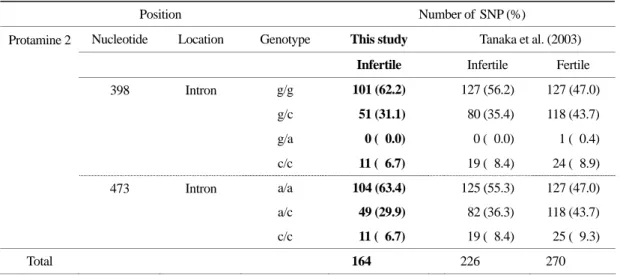
Table 2. Frequency of single nucleotide polymorphisms of protamine 2 gene in Koearn and Japanese men

Position Number of SNP (%)

Nucleotide Location Genotype This study Tanaka et al. (2003)

Infertile

Infertile Fertile

g/g

101 (62.2)

127 (56.2) 127 (47.0) g/c

51 (31.1)

80 (35.4) 118 (43.7)

g/a

0 ( 0.0)

0 ( 0.0) 1 ( 0.4)

398 Intron

c/c

11 ( 6.7)

19 ( 8.4) 24 ( 8.9)

a/a

104 (63.4)

125 (55.3) 127 (47.0) a/c

49 (29.9)

82 (36.3) 118 (43.7) Protamine 2

473 Intron

c/c

11 ( 6.7)

19 ( 8.4) 25 ( 9.3)

Total 164 226 270

A

B

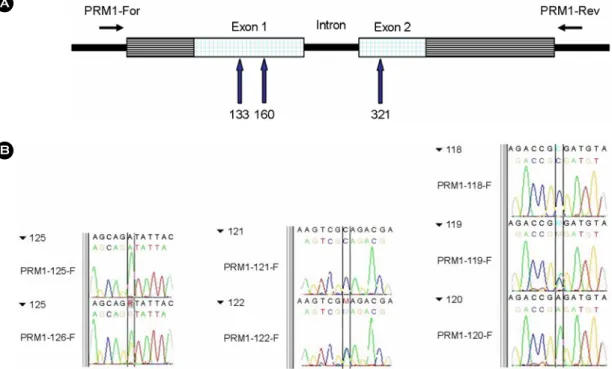
Figure 2. (A) Schematic representation for the protamine 2 genes (PRM2) including the position of primers and the

SNPs. The sequences of the amplified fragments were determined by direct sequencing with the same primer (horizontal

arrows) used in PCR analysis. The vertical arrows indicate SNP positions, and the numbers indicate the nucleotide

numbers from the +1 that is the transcription start site of PRM2. (B) Direct sequencing results showing the flanking

region of the SNPs in the protamine 2 gene.

(5)

였다. Sequencing 반응산물에 2 µl의 3M sodium ace- tate (pH 4.6)와 50 µl의 ethanol을 넣어 섞은 후 상온 에서 15분간 방치하였다. 그 후 12,000 rpm에서 15 분간 원심분리하고 그 침전물을 다시 70% ethanol 로 세척한 후 건조시킨 다음 20 µl의 Hi-Di forma- mide (Applied Biosystems, Foster City, CA, USA)로 융해시켰다. 그 다음 90℃에서 5분 동안 denaturation 시킨 후 automatic genetic analyzer (ABI Prism3100- Avant, Applied Biosystems, Foster City, CA, USA)를 이용한 capillary electrophoresis와 Seqscape software (Applied Biosystems, Foster City, CA, USA)를 사용하 여 DNA 염기서열을 분석하였다.

결 과

1. PRM1 유전자의 분석 결과

PRM1 유전자에 대한 중합효소연쇄반응을 수행

하여 transcription start site 앞쪽의 -42번째 nucleotide 부터 poly A signal 뒤쪽의 515번째 nucleotide까지 증폭된 557 bp의 증폭산물을 얻을 수 있었다. 총 130명의 남성 불임환자를 대상으로 PRM1 유전자의 DNA 염기서열을 분석한 결과 PRM1 coding 부위 에서 3개의 SNPs를 확인할 수 있었으며 돌연변이 는 발견되지 않았다 (Figure 1). 이들 SNPs는 133, 160 그리고 321번째 nucleotide에서 확인되었으며, 이들의 유전자형 (genotype)은 a133g, c160a, c321a 로 각각 14, 23 그리고 47번째 아미노산을 coding하 지만 아미노산 서열의 변화는 나타나지 않는 silent SNPs였다. 각각의 SNP 유전자형의 빈도는 a133g의 경우 a/a homozygous type과 a/g heterozygous type이 각각 96.9%와 3.1%로 나타났으며, c160a에서는 c/c homozygous SNP와 c/a heterozygous SNP 빈도가 각 각 99.2%와 0.8%, 그리고 c321a SNP의 경우 c/c major homozygous, c/a heterozygous, 그리고 a/a minor homozygous SNP의 빈도가 각각 56.9%, 35.4%, 그 리고 7.7%로 확인되었다 (Table 1).

2. PRM2 유전자의 분석 결과

PRM2의 경우 24번째 nucleotide부터 647번째
nucleotide까지 증폭된 599 bp의 증폭산물을 얻을 수 있었다. 총 164명의 불임환자를 대상으로 PRM2

유전자의 SNP를 조사한 결과 아미노산을 변화시키 는 돌연변이는 찾을 수 없었으며 PRM2 유전자의 intron에서 2개의 SNPs (g398c와 a473c)를 확인할 수 있었다 (Figure 2). 각 SNP에 대한 유전자형을 분석해 본 결과 g398c의 경우 g/g major homozy- gous, g/c heterozygous 그리고 c/c minor homozygous type의 빈도가 각각 62.2%, 31.1% 그리고 6.7%로 조사되었다. 또한 a473c의 경우 a/a homozygous, a/c heterozygous 그리고 c/c homozygous type의 빈도는 각각 63.4%, 29.9%, 6.7%로 관찰되었다 (Table 2).

고 찰

정자형성과정의 장애로 인한 남성 불임이 성인 남성의 2%를 차지하고 있는 것으로 보고되고 있으 며, 이들의 불임 원인으로 감염, 면역학적 요인, 해 부학적 기형, 또는 화학적 요인 등이 알려져 있다.

최근 무정자증이나 희소정자증의 원인 관련 유전자 의 돌연변이 또는 이상 발현에 대한 연구들이 활발 하게 진행되고 있다. 이러한 원인으로 Y 염색체의 미세결실,

14

methylene tetrahydrofolate reductase 유전 자의 돌연변이,

15

mitochondrial DNA polymerase 부 위의 돌연변이,

16

androgen receptor의 CAG repeat,

17,18

그리고 cytochrome P450-1A1 유전자의 polymor- phism

19

등이 보고되었지만, 이들 중 그 어느 것도 확실한 남성 불임 원인인자나 모든 원인불명의 남 성 불임을 설명할 수 있는 유전인자는 규명되지 않 아 앞으로도 이에 대한 계속적인 연구가 필요하다.

정자성숙과정 동안 정자의 핵 응축을 위해 여러

단계의 과정을 통해 기존의 histone 단백질을 tran-

sition protein과 protamine 같은 염기성 단백질로 대

체하는 과정을 수행하게 된다.

2,3,20

이 과정의 첫 단

계는 round spermatids에서 일어나며 histone 단백질

이 transition nuclear protein (TP1과 TP2)으로 바뀌

는 과정이며 그 이후 elongating spermatids에서 TP1

과 TP2 단백질이 protamines 단백질로 바뀌게 되어

핵 응축이 완성되게 된다.

21

Lee 등 (1995)의 핵 응

축 과정에 이상이 생길 경우 남성 불임을 유발한다

는 주장 이전에도 여러 연구자들에 의해 불임환자

에서 protamine이 감소되거나 전혀 발현되지 않는

현상이 보고되었다.

9,10

정자의 두부가 크고 모양이

(6)

원형인 정자만이 생성되는 불임환자 (round-headed sperm syndrome)의 경우 PRM2가 결핍되어 있다는 보고가 있었고,

8

DNA와 결합하는 PRM1과 PRM2 의 상대적 비율이 임신과 관계가 있다는 보고 외에

22,23

Lee 등의 주장을 뒷받침하는 많은 연구가 있

었다. 그러나 이러한 연구 결과들 중에는 protamine 단백질의 이상 발현과 유전자의 돌연변이는 남성 불임과 직접적인 관련성이 없다는 결론을 내리고

있으며,

10,11

일부 기형정자에 의한 남성 불임환자의

정자 중에도 형태학상으로 정상인 정자가 발견된다 는 보고가 있으므로

22

이에 대한 더 많은 연구가 필 요한 것으로 생각된다.

근래에 Tanaka 등

24

이 226명의 불임환자와 270명 의 정상 일본인을 대상으로 연구한 결과에 의하면

PRM1 유전자의 coding region에서는 4개 (a133g,

c160a, g320a, c321a) 그리고 non-coding region에서 는 1개의 SNP (a431g)를 찾아냈으며 PRM2 유전 자에서는 translation termination을 일으키는 1개의 돌연변이 (c248t)와 intron에서 2개의 SNP (g398c, a473c)를 찾아냈다고 보고하였다. 이 중에서 gluta- mine 잔기가 stop codon으로 바뀌게 되어 PRM2 단 백질의 변화를 일으킬 것으로 생각되는 c248t 돌연 변이의 경우 전체 153명의 무정자증 환자 중 1명 (0.65%)에서만 발견되었다. 이 돌연변이가 hemizy- gous 상태로 존재하지만 Cho 등

13

이 생쥐 실험에서 밝힌 바와 같이 protamine haploinsufficiency로 인해 사람에서도 불임이 올 수 있다면 c248t 돌연변이가 무정자증의 원인이라고 주장할 수 있을 것이다.

본 연구에서는 한국 불임남성을 대상으로 PRM1 과 PRM2 유전자를 조사한 결과 PRM1 유전자의 coding region에서 3개의 SNPs (a133g, c160a, c321a) 를 찾아내었으며, 일본인에서 발견되었던 g320a와 a431g SNPs는 발견할 수 없었다 (Figure 1). 하지만 한국인에서 발견되었던 3개의 SNPs의 유전형 빈도 를 조사해 본 결과 일본인을 대상으로 한 실험과 유사한 것으로 나타났다 (Table 1). 또한 PRM2 유 전자의 경우 c248t 돌연변이는 발견되지 않았으며 다른 2개의 SNPs는 일본인에서 발견되었던 것과 같은 SNPs가 발견되었다. 각 환자의 유전형도 Ta- naka 등

24

의 실험 결과와 비슷하였다 (Table 2).

이상의 결과로부터 PRM1과 PRM2 유전자는 정

자형성과정에 필수적인 단백질로서 돌연변이가 거 의 없이 매우 잘 보존되어 있는 유전자임을 알 수 있었다. 또한 이들의 발현이 비정상적일 경우 남성 불임을 유발하는 것으로 보아 유전자 자체 돌연변 이에 기인한 비정상적 발현이라기보다 protamine 유 전자의 transcription이나 translation 단계 혹은 post- translation processing 단계에서의 비정상적인 조절, 즉 이 단백질을 조절하는 많은 regulatory protein의 이상으로 인한 비정상적인 발현이 정자의 수나 운 동성 등에 영향을 미치게 되며 결국 남성 불임을 유발시키는 것으로 생각된다. 따라서 앞으로 본 연 구에서 확인하지 못한 protamine 유전자의 promoter 부위에 대한 조사가 필요하며, 이와 함께 protamine 단백질의 발현을 조절하는 여러 조절인자에 대한 연구가 이루어져야 할 것으로 생각된다.

참 고 문 헌

1. Cram DS, O'Bryan MK, de Kretser DM. Male infer- tility genetics-the future. J Androl 2001; 22: 738-46 2. Wouters-Tyrou D, Martinage A, Chevaillier P, Sau-

tiere P. Nuclear basic proteins in spermiogenesis.

Biochimie 1998; 80: 117-28.

3. Sassone-Corsi P. Unique chromatin remodeling and transcriptional regulation in spermatogenesis. Science 2002; 296: 2176-8.

4. McKay DJ, Renaux BS, Dixon GH. Rainbow trout protamines. Amino acid sequences of six distinct proteins from a single testis. Eur J Biochem 1986;

158: 361-6.

5. Krawetz SA, Herfort MH, Hamerton JL, Pon RT, Dixon GH. Chromosomal localization and structure of the human P1 protamine gene. Genomics 1989;

5: 639-45.

6. Reeves RH, Gearhart JD, Hecht NB, Yelick P, John- son P, O'Brien SJ. Mapping of PRM1 to human chromosome 16 and tight linkage of Prm-1 and Prm-2 on mouse chromosome 16. J Hered 1989; 80:

442-6.

7. Lee K, Haugen HS, Clegg CH, Braun RE. Prema-

ture translation of protamine 1 mRNA causes pre-

(7)

cocious nuclear condensation and arrests spermatid differentiation in mice. Proc Natl Acad Sci USA 1995; 92: 12451-55.

8. Balhorn R, Reed S, Tanphaichitr N. Aberrant pro- tamine 1/protamine 2 ratios in sperm of infertile human males. Experientia 1988; 44: 52-5.

9. Belokopytova IA, Kostyleva EI, Tomilin AN, Vorob'ev VI. Human male infertility may be due to a decrease of the protamine P2 content in sperm chromatin.

Mol Reprod Dev 1993; 34: 53-7.

10. de Yebra L, Ballesca JL, Vanrell JA, Bassas L, Oliva R. Complete selective absence of protamine P2 in humans. J Biol Chem 1993; 268: 10553-57.

11. Schlicker M, Schnulle V, Schneppel L, Vorob'ev VI, Engel W. Disturbances of nuclear condensation in human spermatozoa: search for mutations in the genes for protamine 1, protamine 2 and transition protein 1. Hum Reprod 1994; 9: 2313-7.

12. de Yebra L, Ballesca JL, Vanrell JA, Corzett M, Bal- horn R, Oliva R. Detection of P2 precursors in the sperm cells of infertile patients who have reduced protamine P2 levels. Fertil Steril 1998; 69: 755-9.

13. Cho C, Willis WD, Goulding EH, Jung-Ha H, Choi YC, Hecht NB, et al. Haploinsufficiency of prota- mine-1 or -2 causes infertility in mice. Nature Genet 2001; 28: 82-6.

14. Lee HS, Choi HW, Park YS, Koong MK, Kang IS, Yoon JM, et al. Relationship between Microdele- tions on the Y chromosome and defect of spermato- genesis. Kor J Fertil Steril 2002; 29: 303-10.

15. Bezold G, Lange M, Peter RU. Homozygous methy- lenetetrahydrofolate reductase C677T mutation and male infertility. N Engl J Med 2001; 344: 1172-3.

16. Rovio AT, Marchington DR, Donat S, Schuppe HC,

Abel J, Fritsche E, et al. Mutations at the mitochon- drial DNA polymerase (POLG) locus associated with male infertility. Nature Genet 2001; 29: 261-2.

17. Dowsing AT, Yong EL, Clark M, McLachlan RI, de Kretser DM, Trounson AO. Linkage between male infertility and trinucleotide repeat expansion in the androgen-receptor gene. Lancet 1999; 354: 640-3.

18. De Meyts RE, Leffers H, Petersen JH, Andersen AG, Carlsen E, Jorgensen N, et al. CAG repeat length in androgen-receptor gene and reproductive variables in fertile and infertile men. Lancet 2002; 359: 44-6.

19. Fritsche E, Schuppe HC, Dohr O, Ruzicka T, Glei- chmann E, Abel J. Increased frequencies of cyto- chrome P4501A1 polymorphisms in infertile men.

Andrologia 1998; 30: 125-8.

20. Oliva R, Dixon GH. Vertebrate protamine genes and the histone-to-protamine replacement reaction. Prog Nucleic Acid Res Mol Biol 1991; 40: 25-94.

21. Dadoune JP. The nuclear status of human sperm cells. Micron 1995; 26: 323-45.

22. Bench G, Corzett MH, de Yebra L, Oliva R, Balhorn R. Protein and DNA contents in sperm from an in- fertile human male possessing protamine defects that vary over time. Mol Reprod Dev 1998; 50: 345 -53.

23. Aoki VW, Liu L, Carrell DT. Identification and eval- uation of a novel sperm protamine abnormality in a population of infertile males. Hum Reprod 2005;

20: 1298-306.

24. Tanaka H, Miyagawa Y, Tsujimura A, Matsumiya K,

Okuyama A, Nishimune Y. Single nucleotide poly-

morphisms in the protamine-1 and -2 genes of fer-

tile and infertile human male populations. Mol Hum

Reprod 2003; 9: 69-73.

수치

Figure 1. (A) Schematic representation for the protamine 1 genes (PRM1) including the position of  primers and the  SNPs
Figure 2. (A) Schematic representation for the protamine 2 genes (PRM2) including the position of  primers and the  SNPs

참조

관련 문서

Objective : This study is to identify factors related to performance of hand washing in daily life for emergency Medical Technology students.. Methods : The study subjects

Purpose: The aim of this study is to identify the relationship between knowledge and awareness of radiation department students and their intent in

The purpose of this study was to identify the frequency and related factors of advanced airway management for patients with cardiac arrest by the

The aim of this study is to identify some effective actual culture teaching methods or techniques through analyzing the cultural contents and materials of

The purpose of this study was to provide primary material in discussing methods to activate the treatment effects of diabetes and reduce the rate of

To understand the current status of education, this study compared the 2015 Curriculum to the 2009 Curriculum whose teaching methods and evaluation standards

The aim of this study was to determine the serum levels of the prohormone form of hepcidin, pro-hepcidin, and its relations with iron status and its

The aim of this study was to evaluate the sealing ability in Type II root canal obturation by comparing the presence of voids between single cone technique using Endoseal MTA