CASE REPORT
Sunitinib으로 치료 중인 전이성 신세포암 환자에서 발생한 급성 무결석담낭염 1예
최세웅, 이정민1, 김동균2, 노명환2
좋은강안병원 내과, 삼육부산병원 내과1, 동아대학교 의과대학 소화기내과학교실2
Acute Acalculous Cholecystitis Associated with Sunitinib Treatment for Renal Cell Carcinoma
Se Woong Choi, Jeong Min Lee1, Dong Gyun Kim2 and Myung Hwan Noh2
Department of Internal Medicine, Good Gang-An Hospital; Department of Internal Medicine, Samyook Busan Hospital1; Division of Gastroenterology, Department of Internal Medicine, Dong-A University College of Medicine2, Busan, Korea
A 64-year-old man was treated with sunitinib as a first-line therapy for metastatic renal cell carcinoma. He was given oral sunitinib in cycles of 50 mg once daily for 2 weeks followed by a week off. During the 5th week of treatment right upper quadrant pain de- veloped, but this resolved spontaneously during the 6th week (off treatment). However, on the 8th week of treatment, he was ad- mitted to hospital because the acute right upper quadrant pain recurred with nausea, vomiting, and fever. Acute acalculous chol- ecystitis was then diagnosed by ultrasonography and CT. In addition, his laboratory findings indicated disseminated intravascular coagulation. Accordingly, sunitinib therapy was discontinued and broad-spectrum antibiotics initiated. He subsequently recovered after emergent percutaneous cholecystostomy. His Naranjo Adverse Drug Reaction Probability Scale score was 7, indicaing a probable association of the event with sunitinib. Suspicion of sunitinib-related acute cholecystitis is required, because, although uncommon, it can be life-threatening. (Korean J Gastroenterol 2020;75:103-107)
Key Words: Acalculous cholecystitis; Sunitinib; Renal cell carcinoma
Received October 2, 2019. Revised October 29, 2019. Accepted November 20, 2019.
CC This is an open access article distributed under the terms of the Creative Commons Attribution Non-Commercial License (http://creativecommons.org/licenses/
by-nc/4.0) which permits unrestricted non-commercial use, distribution, and reproduction in any medium, provided the original work is properly cited.
Copyright © 2020. Korean Society of Gastroenterology.
교신저자: 노명환, 49201, 부산시 서구 대신공원로 32, 동아대학교 의과대학 소화기내과학교실
Correspondence to: Myung Hwan Noh, Division of Gastroenterology, Department of Internal Medicine, Dong-A University College of Medicine, 32 Daesingongwon-ro, Seo-gu, Busan 49201, Korea. Tel: +82-51-240-2862, Fax: +82-51-240-2087, E-mail: [email protected], ORCID: https://orcid.org/0000-0003-3460-2264 Financial support: None. Conflict of interest: None.
서 론
Sunitinib은 다중표적 티로신키나아제 억제제(multi tar- geted tyrosine kinase inhibitor)로 전이성 신세포암과 위장 관 기질종양(gastrointestinal stromal tumor)의 치료에 사용 되는 항악성종양제 중의 하나이다. 부작용으로는 피로감, 고 혈압, 설사, 식욕 감퇴, 구역, 구토, 구내염, 수족증후군(hand-foot syndrome) 및 갑상선 기능 저하 등이 있다. 대부분 가역적이 지만 부작용으로 인한 약물의 감량 및 휴약 기간이 길어질수 록 치료 성적은 떨어지게 된다.1 대개 4주 복용 후 2주 휴약하
는 용법(4주/2주 용법)으로 치료하나 앞에서 서술한 부작용을 줄이기 위하여 2주 복용 후 1주 휴약하는 용법(2주/1주 용법) 이 사용되기도 하는데, 4주/2주 용법과 비교하여 치료 성적이 저하되지 않음이 보고되었다.2 최근 sunitinib을 4주/2주 용 법으로 복용하여 발생된 급성 무결석담낭염의 발생 보고는 세 계적으로 8건 보고되었으나,3-8 부작용을 줄이기 위하여 시행 되는 2주/1주 용법에서의 사례 보고는 국내뿐 아니라 전 세계 적으로도 아직 없다. 이에 저자들은 전이성 신세포암 환자에 서 sunitinib을 2주/1주 용법으로 투약 중 발생된 천공을 동 반한 급성 무결석담낭염을 경험하였기에 보고하는 바이다.
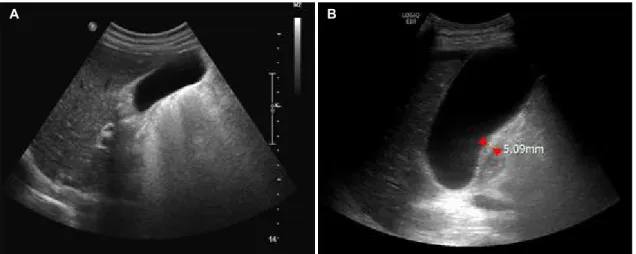
Fig. 1. Abdominal US. (A) US obtained before taking sunitinib showing a normal GB without stones. (B) US obtained after taking sunitinib for 8 weeks showing mild GB wall thickening (red arrowheads), GB hydrops (10×5 cm), sludges, and a small amount of ascites. US, ultrasonography; GB, gallbladder.
Fig. 2. (A) Abdominal CT image obtained before initiating sunitinib therapy showing a normal GB without stones and a 3×3.4 cm sized renal mass (black arrow) on the left kidney. (B, C) CT image obtained after taking sunitinib for 8 weeks showing mild GB wall thickening, subserosal edema (red arrows), hydrops (11×5 cm), a GB wall defect (white arrow), and pericholecystic inflammatory stranding (red arrowheads). (D) Contrast medium depicted bile leakage during percutaneous transhepatic gallbladder drainage (blue arrow). CT, computed tomography; GB, gallbladder.
증 례
64세 남성이 3일 전부터 발생한 발열과 우상복부 통증으로 응급실로 내원하였다. 환자는 간, 담도계 기저 질환이 없었으
며, 최근 뼈로 전이된 육종성 신세포암(sarcomatoid renal cell carcinoma)으로 진단받은 후 타 병원에서 sunitinib 50 mg을 2주 복용 후 1주 휴약하는 2주/1주 용법으로 복용 중에 있었다.
복용 5주째에 우상복부 통증이 발생되었으나 1주 휴약 기간
A B
A B
C D
Fig. 3. Histopathological findings showing an epithelial defect with a few necrotic (arrow) and degenerated epithelial cells (arrowheads) (H&E, ×100).
동안에 증상 호전이 있었으며, 이후 복용 8주째에 발열과 함께 심한 우상복부 통증이 다시 발생되어 본원 응급실로 방문하 였다.
방문 당시 활력징후는 혈압 110/80 mmHg, 맥박 65회/분, 호흡수 20회/분, 체온 38.0°C였다. 전신 상태는 급성 병색을 보였으며, 복부 진찰은 우상복부에 심한 압통이 있었다. 말초 혈액 검사에서 백혈구 9,700/mm3 (호중구 86%), 혈색소 9.5 g/dL, 혈소판 72,000/mm3였다. 혈청 생화학 검사에서 AST 42 IU/L, ALT 12 IU/L, ALP 734 IU/L, LDH 533 IU/L, total bilrir- ubin 0.62 mg/dL, amylase 22 IU/L, lipase 20 IU/L, CRP 25.56 mg/dL, PT 16.2 sec (INR: 1.48)였다. 복부 초음파 및 컴퓨터단층촬영에서 담낭벽의 경미한 비후와 장막하 부종 (subserosal edema), 담낭의 팽만, 담즙오니, 담낭 주변의 염 증성 선상음영(inflammatory stranding) 및 담낭벽의 결손이 관찰되어(Fig. 1, 2), 천공을 동반한 급성 무결석담낭염으로 진단하였다. 이후 sunitinib 복용 중단과 금식 및 광범위 항생 제 투여를 시작하였다. 또한 응급으로 초음파 유도하 복수천 자 및 경피적 카테터 배액술을 시행한 후 경피경간적 담낭 배액술을 하였다. 복수천자에서도 혼탁한 담즙이 보였으며, 담낭조영술에서도 조영제의 누출이 관찰되어(Fig. 2D) 담낭 의 천공을 확인하였다. 담즙 및 혈액 세균배양 검사에서 Klebsiella pneumoniae subsp. pneumoniae가 검출되었다.
3주 후 복강경하 담낭절제술을 시행하였으며, 조직 검사에서 는 급성 무결석담낭염에서 흔히 관찰되는 상피세포의 변성 (degeneration) 및 결손이 관찰되었다(Fig. 3).9 이후 환자는 호전되어 퇴원하였으며, sunitinib 37.5 mg을 2주/1주 용법 으로 재복용 중에 있다.
고 찰
기존의 혈관에서 새로운 혈관이 자라나는 혈관신생 (angiogenesis)은 암세포 증식과 전이에 있어서 매우 중요한 역할을 하며, 이에 종양세포들은 다양한 혈관신생 전달물질 (proangio-genic factors)인 vascular endothelial growth factor receptor (VEGF) 및 platelet derived growth factor (PDGF) 등을 분비하여 혈관 내피세포(endothelial cell)의 분 화를 촉진시킨다. VEGF는 내피세포의 증식(proliferation)과 이주(migration)의 중요한 자극제로 작용하며, PDGF는 혈관 주위세포(pericytes) 및 평활근 세포(smooth muscle cells)의 이동과 증식을 촉진하여 신생혈관의 성숙(maturation)과 안 정성(stability)에 중요한 역할을 한다. 다중표적 티로신키나 아제 억제제인 sunitinib은 이러한 VEGF 및 PDGF의 수용체 의 작용을 저해함으로써,10혈관신생 및 종양 성장을 억제하는 경구용 캡슐제로 미국 Food and Drug Administration에서 2006년과 2008년에 gastrointestinal stromal tumor와 전이 성 신세포암 치료에 승인되어 사용 중이다.
일반적으로 하루 50 mg을 4주 복용 후 2주 휴약하며, CYP3A4에 의하여 대사되어 담즙으로 배출되고, 반감기가 41-86시간으로 매우 길다. 체중과 관계없이 하루 50 mg으로 복약 시 치료 5일째부터 치료적 약물 농도(therapeutic range)인 50-100 ng/mL를 유지하게 되지만, 25%를 감량하 여 37.5 mg을 매일 복용하는 경우 치료적 약물 농도에 도달 하지 못하여 치료 효과가 떨어지며, 25%를 증량하여 75 mg 을 매일 복용하면 치료적 약물 농도를 넘어서 심각한 부작용 이 발생한다.10 또한 분자량이 적어서 50 mg을 지속 복용 시 3주째부터 약물의 체내 축적이 증가하게 되는데, 복용 28일째 는 복용 첫날과 비교하여 sunitinib은 3-5.5배, 그의 대사 산 물인 SU-12662는 7-15배 이상 축적된다.11 이러한 약물의 체내 축적으로 grade 3-4 (National Cancer Institute Common Terminology Criteria for Adverse Events, version 4.0.)의 부작용이 발생하기 때문에 2주 휴약이 필요하며, 2주 휴약 후 에는 sunitinib의 체내 축적이 치료 전 수준까지 떨어지면서 부작용도 같이 호전된다. 그래서 sunitinib은 체중과 관계없 이 50 mg, 4주/2주 용법으로 사용되고 있다.
최근에는 3-4주째부터 시작되는 약물의 축적과 부작용을 줄이기 위하여 2주/1주 용법으로 치료하기도 하며, 그 결과 부작용은 낮으면서 치료 성적은 동등한 것으로 보고되고 있 다. 그중 국내 임상 연구인 RESOTRE trial2에서는 6개월 시 점에서 치료에 실패하지 않은 환자들의 생존율(failure-free survival rate)이 기존 4주/2주 용법이 44%로 나타난 반면, 2주/1주 용법에서는 63%로 오히려 더 높게 나타났다.
부작용으로는 피로감 및 수족증후군이 가장 흔하며, 그 외
고혈압, 설사, 구역, 구토, 혈소판 및 백혈구감소증, 갑상선기 능저하증, 좌심실 박출량 감소 등이 나타날 수 있다. 드물게는 장벽기종, 장천공이 발생할 수도 있다. 최근에는 sunitinib 50 mg, 4주/2주 용법으로 투여 후 급성 무결석담낭염이 발생 한 사례가 전 세계적으로 총 8건 보고되었으며, sunitinib 외의 티로신키나제 억제제에서도 sorafenib 5건,12 axitinib 1건,13 cediranib 1건, imatinib 1건, montesanib 3건14이 보고되었다.
급성 무결석담낭염이 발생하는 기전은 명확히 밝혀진 바는 없으나 티로신키나아제 억제제의 담관세포(cholangiocyte)의 증식 억제 효과, 항 혈관 형성 작용(antiangiogenic activity) 및 동맥혈전(arterial thrombosis) 형성 등으로 추정하고 있
다.15-17 Gaudio 등15은 담관세포의 증식 억제로 인한 담즙의
정체로 설명하고 있으며, Faivre 등11은 항 혈관 형성 작용과 담즙배설(biliary excretion)로 인하여 담낭에 약물이 농축 (accumulation)되며, 이로 인하여 담낭이 자극되어 sludge 형성과 일시적인 허혈 및 담즙 정체 등으로 담낭염이 발생하 는 것으로 설명하였다. Elice 등17은 sunitinib이 혈관 내피세 포의 손상을 유발하여 von wille-brand factor 및 혈소판의 응집(aggregation)으로 인한 동맥혈전과 혈류 감소로 발생하 는 것으로 추정하고 있다.
이전 8건의 사례 중 6건은 sunitinib 50 mg/day, 4주/2주 용법에서 발생되었으며, 치료 시작 3-4주에 발생되었다. 조기 에 진단된 3건의 경우 sunitinib의 중단 및 항생제 정주만으 로도 호전되었으며, 나머지 5건은 담낭절제술을 시행하였으 며 이후 sunitinib을 재복용하였다. 담낭염이 치료 3-4주째에 발생하는 이유는 다른 부작용과 마찬가지로 약물의 체내 축적과 관련이 있을 것으로 판단된다. 왜냐하면 sunitinib 50 mg/day, 4주/2주 용법에서 2주까지는 약물의 복용과 혈중 농도가 같이 상승하지만 복용 3, 4주부터는 혈중 농도가 50-100 ng/mL로 더 이상 오르지 않으면서 그 나머지가 체내 축적이 되어 grade 3-4의 부작용이 발생하기 때문이다.18
이번 증례의 환자에서는 sunitinib 50 mg을 2주/1주 용법 으로 복용한 5주째에 우상복부의 통증이 지속되었으나 1주 휴약 기간 동안 복통은 다소 호전되었다. 하지만 복용 8주째 에 심한 우상복부 통증을 다시 호소하였다. 이후 복부 초음파 및 컴퓨터단층촬영에서 급성 무결석담낭염으로 진단되었으 며, Naranjo scale19에서도 7점으로 sunitinib 복용과 담낭염 발생 사이에 관련성이 있음을 추정할 수 있었다.
부작용 발생이 더 낮은 2주/1주 용법에서 담낭염이 발생한 이유는 2주 복용 후 11.5일이 지나서야 sunitinib과 SU-12662 의 체내 축적이 완전히 소실되는데, 1주 휴약 후에도 소량의 약물이 체내에 일부 남아있기 때문이다.16 또한 4주/2주 용법 으로 복용한 사례들보다 4-5주가 지나서 담낭염이 발생하였 는데, 이러한 이유는 소량의 약물 축적으로는 담낭염이 발생
할 정도로 축적되는데 시간이 좀 더 걸렸을 것으로 추정된다.
Rosen 등14은 sunitinib 외의 티로신키나아제 억제제인 motesanib으로 치료한 49명의 고형암 환자 대부분에서 담낭 의 부피는 치료 전 기저치 38.6 mL보다 평균 22.2 mL의 증가 가 있었으며, 박출계수(ejection fraction)는 기저치 61.3%에 서 평균 19.2%의 감소가 있음을 초음파 및 cholecystokinin- hepato-biliary iminodiacetic acid scan으로 확인하였다.
이는 약물의 용량 및 용법과 관계없이 관찰되었으며, 약물 치 료 중단 이후에는 회복되었음을 보고하였다. 또한 49명의 환 자 중 3명은 담낭염으로 진단되었으며, 조기 진단된 2명은 약 물 중단만으로도 호전되었다. 즉 티로신키나아제 억제제의 담 낭 독성은 알려진 것보다 훨씬 더 흔하며, 진단이 늦어질 경우 큰 위험이 될 수 있는 담낭염이 발생하므로 조기 진단이 중요 하다. 담낭염의 조기 진단에 있어서는 암성 통증 또는 항암제 관련 통증과의 감별을 위하여 영상학적 검사가 필요하며, 다 른 원인의 급성 무결석담낭염과 마찬가지로 담낭벽의 비후, 담낭 팽만, 담즙오니, 담낭 주변에 액체 및 염증성 선상음염, 담낭 점막의 조영증강 등의 소견을 보인다.8
본 증례는 2주/1주 용법으로 투약 중인 환자에게 부작용으 로 발생한 급성 무결석담낭염의 첫 사례이다. 4주/2주 용법보 다 부작용의 발생 가능성이 낮은 2주/1주 용법에서도 드물긴 하나 급성 무결석담낭염이 발생할 수 있음을 염두에 두고 약 물 투여 중 복부 통증을 호소하는 환자는 조기에 복부 초음파 등을 시행하여 담낭천공을 동반한 생명을 위협하는 담낭염으 로의 진행을 방지할 수 있어야 하겠다.
REFERENCES
1. Houk BE, Bello CL, Poland B, Rosen LS, Demetri GD, Motzer RJ.
Relationship between exposure to sunitinib and efficacy and tol- erability endpoints in patients with cancer: results of a pharma- cokinetic/pharmacodynamic meta-analysis. Cancer Chemother Pharmacol 2010;66:357-371.
2. Lee JL, Kim MK, Park I, et al. RandomizEd phase II trial of sunitinib four weeks on and two weeks off versus two weeks on and one week off in metastatic clear-cell type REnal cell carcinoma:
RESTORE trial. Ann Oncol 2015;26:2300-2305.
3. de Lima Lopes G Jr, Rocha Lima CM. Emphysematous chol- ecystitis in a patient with gastrointestinal stromal tumor treated with sunitinib. Pharmacotherapy 2007;27:775-777.
4. Gomez-Abuin G, Karam AA, Mezzadri NA, Bas CA. Acalculous cholecystitis in a patient with metastatic renal cell carcinoma treated with sunitinib. Clin Genitourin Cancer 2009;7:62-63.
5. Nakano K, Suzuki K, Morita T. Life-threatening acute acalculous cholecystitis in a patient with renal cell carcinoma treated by su- nitinib: a case report. J Med Case Rep 2012;6:69-72.
6. da Fonseca LG, Barroso-Sousa R, Sabbaga J, Hoff PM. Acute acalculous cholecystitis in a patient with metastatic renal cell
carcinoma treated with sunitinib. Clin Pract 2014;4:635.
7. Furubayashi N, Negishi T, Hirata Y, Taguchi K, Nakamura M. Acute acalculous cholecystitis in patients with clear cell renal cell carci- noma treated with sunitinib: report of two cases. J Clin Med Res 2014;6:302-304.
8. Tirumani SH, Krajewski KM, Shinagare AB, Jagannathan JP, Ramaiya NH. Gallbladder complications associated with molec- ular targeted therapies: clinical and imaging features. Clin Imaging 2014;38:50-55.
9. Laurila JJ, Ala-Kokko TI, Laurila PA, et al. Histopathology of acute acalculous cholecystitis in critically ill patients. Histopathology 2005;47:485-492.
10. Gotink KJ, Verheul HM. Anti-angiogenic tyrosine kinase inhibitors:
what is their mechanism of action? Angiogenesis 2010;13:1-14.
11. Faivre S, Delbaldo C, Vera K, et al. Safety, pharmacokinetic, and antitumor activity of SU11248, a novel oral multitarget tyrosine kinase inhibitor, in patients with cancer. J Clin Oncol 2006;24:
25-35.
12. Aihara Y, Yoshiji H, Yamazaki M, et al. A case of severe acalculous cholecystitis associated with sorafenib treatment for advanced hepatocellular carcinoma. World J Gastrointest Oncol 2012;4:
115-118.
13. Kameda T, Nakano K, Yamazaki M, Koshimizu T, Morita T.
Axitinib-induced pneumatosis intestinalis and acute acalculous cholecystitis in a patient with renal cell carcinoma. Urology 2017;
101:e7-e8.
14. Rosen LS, Lipton L, Price TJ, et al. The effect of different dosing regimens of motesanib on the gallbladder: a randomized phase 1b study in patients with advanced solid tumors. BMC Cancer 2013;13:242.
15. Gaudio E, Barbaro B, Alvaro D, et al. Vascular endothelial growth factor stimulates rat cholangiocyte proliferation via an autocrine mechanism. Gastroenterology 2006;130:1270-1282.
16. Britten CD, Kabbinavar F, Hecht JR, et al. A phase I and pharmaco- kinetic study of sunitinib administered daily for 2 weeks, followed by a 1-week off period. Cancer Chemother Pharmacol 2008;
61:515-524.
17. Elice F, Rodeghiero F, Falanga A, Rickles FR. Thrombosis asso- ciated with angiogenesis inhibitors. Best Pract Res Clin Haematol 2009;22:115-128.
18. Di Paolo A, Bracarda S, Arrigoni E, Danesi R. Sunitinib in meta- static renal cell carcinoma: the pharmacological basis of the al- ternative 2/1 schedule. Front Pharmacol 2017;8:523.
19. Naranjo CA, Busto U, Sellers EM, et al. A method for estimating the probability of adverse drug reactions. Clin Pharmacol Ther 1981;30:239-245.