ABSTRACT
Objective: We compared the effects of high-intensity statin monotherapy versus moderate- intensity statin and ezetimibe combination therapy on major adverse cardiovascular events (MACE) in patients with acute myocardial infarction (AMI).
Methods: Using the Korean National Health Insurance Service database, we screened 82,941 patients with AMI who underwent percutaneous coronary intervention (PCI) between 2013 and 2016. Among them, we identified 9,908 patients treated with atorvastatin 40 mg (A40, n=4,041), atorvastatin 20 mg + ezetimibe 10 mg (A20+E10, n=233), rosuvastatin 20 mg (R20, n=5,251), or rosuvastatin 10 mg + ezetimibe 10 mg (R10+E10, n=383). The primary outcome was MACE, a composite of all-cause death, non-fatal myocardial infarction undergoing PCI, repeat revascularization, and ischemic stroke. Multivariable analyses were performed using the inverse probability of treatment weighting method.
Results: The incidence rate of MACE in the overall population was 42.97 cases per 1,000 person-years. There was no significant difference in the risk of composite outcomes of MACE between the groups. However, the R10+E10 group showed a higher risk of all-cause death (hazard ratio, 2.07; 95% confidence interval, 1.08–3.94) than the A40 group (reference group) in the weighted multivariable model.
Conclusions: In this study, there was no significant difference in the composite outcome of MACE between high-intensity statin monotherapy and moderate-intensity statin and ezetimibe combination therapy.
Keywords: Ezetimibe; Statin; Cardiovascular diseases; Myocardial infarction
Original Article
Received: Feb 1, 2021 Revised: Mar 17, 2021 Accepted: Mar 31, 2021 Correspondence to Hyemoon Chung
Cardiovascular Division, Department of Internal Medicine, Kyung Hee University Medical Center, Kyung Hee University, 23 Kyungheedae-ro, Dongdaemun-gu, Seoul 02447, Korea.
E-mail: [email protected]
*Jung Myung Lee and Hyemoon Chung equally contributed this work.
Copyright © 2021 The Korean Society of Lipid and Atherosclerosis.
This is an Open Access article distributed under the terms of the Creative Commons Attribution Non-Commercial License (https://
creativecommons.org/licenses/by-nc/4.0/) which permits unrestricted non-commercial use, distribution, and reproduction in any medium, provided the original work is properly cited.
ORCID iDs Kihyun Kim
https://orcid.org/0000-0001-9047-4485 Woo-Dae Bang
https://orcid.org/0000-0002-1734-2627 Kyungdo Han
https://orcid.org/0000-0002-6096-1263 Bongseong Kim
https://orcid.org/0000-0002-1022-3553 Jung Myung Lee
https://orcid.org/0000-0002-1904-5335 Hyemoon Chung
https://orcid.org/0000-0002-5615-6245
Kihyun Kim ,1 Woo-Dae Bang ,2 Kyungdo Han ,3 Bongseong Kim ,3 Jung Myung Lee ,4,* Hyemoon Chung 4,*
1Department of Cardiology, Gangneung Dong-in Hospital, Gangneung, Korea
2Department of Cardiology, Pyeongtaek St. Mary's Hospital, Pyeongtaek, Korea
3Department of Statistics and Actuarial Science, Soongsil University, Seoul, Korea
4 Cardiovascular Division, Department of Internal Medicine, Kyung Hee University Medical Center, Kyung Hee University, Seoul, Korea
Comparison of the Effects of High- intensity Statin Therapy with
Moderate-Intensity Statin and
Ezetimibe Combination Therapy on Major Adverse Cardiovascular Events in Patients with Acute Myocardial
Infarction: a Nationwide Cohort Study
Funding
This study was supported by a big data analysis grant from the Korean Society of Lipid and Atherosclerosis.
Conflict of Interest
The authors have no conflicts of interest to declare.
Author Contributions
Conceptualization: Kim K, Bang WD, Lee JM, Chung H; Data curation: Han K, Kim B; Formal analysis: Han K, Kim B; Funding acquisition:
Kim K; Methodology: Bang WD, Han K, Kim B, Lee JM, Chung H; Project administration: Kim K; Software: Han K, Kim B; Supervision: Bang WD, Lee JM, Chung H; Writing - original draft:
Kim K; Writing - review & editing: Bang WD, Lee JM, Chung H.
INTRODUCTION
Patients who present with acute coronary syndrome (ACS) have an increased risk of experiencing recurrent cardiovascular events.1,2 A large meta-analysis showed that there was a 22% proportional reduction in the risk of major adverse cardiovascular events (MACE) for each 1 mmol/L reduction in the low-density lipoprotein cholesterol (LDL-C) level.3 The 2019 European Society of Cardiology and European Atherosclerosis Society guidelines emphasize that the treatment goal is to reach a 50% LDL-C reduction from the baseline level and an LDL-C level <1.4 mmol/L (<55 mg/dL) in these high-risk patients.2 To achieve that goal, a high-intensity statin therapy, defined as the dose of statin that reduces the LDL-C level by
≥50%, on average, has been recommended.1,2 However, it was reported that the success rate of achieving the LDL-C goal was only 67%, even in high-risk patients.4 Therapeutic choices for these patients include increasing the statin dose or the combined use of statin and ezetimibe.5 It has been observed that doubling the statin dose above the minimal effective dose decreases the serum LDL-C concentrations by an additional 6%.6 Clinical evidence demonstrates that this “rule of six” is a characteristic of all statins.7 However, the up-titration of the statin dose might increase the incidence rate of statin-related adverse effects, such as myalgia, hepatotoxicity, and new-onset diabetes.8,9
Ezetimibe is a novel cholesterol absorption inhibitor that effectively and potently prevents the absorption of cholesterol by inhibiting the passage of dietary and biliary cholesterol across the intestinal wall.10 The IMProved Reduction of Outcomes: Vytorin Efficacy International Trial (IMPROVE-IT) demonstrated that the addition of ezetimibe to statin not only lowered the LDL-C level, but also reduced the incidence of MACE by 6.4% in patients with ACS.11 Furthermore, combining ezetimibe and moderate-intensity statins reduced the LDL-C level and other lipid parameters more than doubling the dose of statin.12-15 However, it remains unclear whether the efficacy of ezetimibe combination therapy in LDL-C reduction could lead to a further reduction of the incidence of MACE than doubling the dose of statin.
A few retrospective observational cohort studies reported that high-intensity statin therapy (either atorvastatin or rosuvastatin) was associated with a lower incidence of MACE than combination therapy with statin and ezetimibe.16,17 However, these studies have limitations, since the statins used in the ezetimibe combination therapy group differed from those used in the high-intensity statin group.
Therefore, we aimed to compare the effects of high-intensity statin monotherapy (atorvastatin 40 mg, [A40] or rosuvastatin 20 mg [R20]) and moderate-intensity statin (atorvastatin 20 mg [A20] or rosuvastatin 10 mg [R10]) combined with ezetimibe 10 mg (E10) on MACE in patients with myocardial infarction (MI) using the Korean National Health Insurance Service (KNHIS) database.
MATERIALS AND METHODS
1. Data sources and ethics
This study used data from the National Health Claims Database established by the KNHIS.
KNHIS is a mandatory universal health insurance service that provides comprehensive medical care coverage for up to 97% of the Korean population (up to 50 million people). The medical care of the remaining 3% of the Korean population with low income is covered by
the Medical Aid program, which has been incorporated into a single KNHIS database since 2006. The database includes the diagnoses, procedures, prescription records of inpatient and outpatient services, and demographic information, such as age, sex, and socioeconomic status, of each patient. The database is based on the Korean Classification of Disease 7 modification of the International Classification of Disease-10th Revision (ICD-10) codes.
This study was approved by the Institutional Review Board of the GangNeung Asan Hospital (GNAH 2019-06-031). An exemption from informed consent was granted by the board because all data were analyzed anonymously.
2. Study cohort
We included patients with MI (ICD-10 codes I21 and I22) who underwent percutaneous coronary intervention (PCI) (codes M6551, M6552, M6561-4, M6571, or M6572) for the first time between January 2013 and December 2016 using the KNHIS database. Subcategorical codes I21.0, I21.1, I21.2, and I21.3 indicate ST-segment elevation myocardial infarction (STEMI), and I21.4 represents non-ST-segment elevation myocardial infarction (NSTEMI).
The remaining codes represent unspecified MI. Among 82,941 patients with AMI, we identified 9,908 patients who were prescribed any of our 4 pre-specified statin therapies: A40 (40.7%, n=4,041), A20+E10 (2.4%, n=233), R20 (53.0%, n=5,251), or R10+E10 (3.9%, n=383);
the patient enrollment flow is described in Fig. 1. We excluded patients who were aged below 20 years or had missing health examination data performed within 2 years prior to the index PCI. We also excluded patients with diagnoses of atrial fibrillation, thromboembolism, or stroke, which indicated potential for oral anticoagulation treatment. Patients with cancer or those who were followed up for less than 1 year were also excluded.
We divided the study population into the following 4 groups and analyzed the effect of each statin therapy: A40 and R20, the high-intensity statin monotherapy groups, and A20+E10 and R10+E10, the combination therapy groups of moderate-intensity statin and ezetimibe.
The study subjects were included if they had been prescribed one of the above medications Patients who underwent PCI for acute MI
from January 2013 to December 2016 (n=82,941)
Excluded if:
Age <20 years (n=166)
Missing health examination within 2 years of index PCI (n=40,937)
History of AF or thromboembolism (n=5,771) History of cancer (n=2,051)
History of stroke (n=5,389) Follow-up period <1 year (n=3,565) Other statins were prescribed (n=14,657) Missing data (n=497)
2.1.
3.4.
5.6.
8.7.
Final study population (n=9,908)
Atorvastatin 40 mg (n=4,041)
Atorvastatin 20 mg +Ezetimibe 10 mg
(n=233)
Rosuvastatin 20 mg (n=5,251)
Rosuvastatin 10 mg +Ezetimibe 10 mg
(n=383) Fig. 1. Patient enrollment flowchart of the study cohort.
PCI, percutaneous coronary intervention; MI, myocardial infarction; AF, atrial fibrillation.
for, at least, 4 weeks. If a patient had a record of both high-intensity statin therapy and ezetimibe combination therapy because the statin regimen was changed during follow-up, the patient was classified into the ezetimibe combination therapy group. Additionally, if a study subject had a record of having received two or more statin prescriptions due to a change in the regimen during follow-up, the subject was classified based on the drug that had been prescribed for the longest period. The study population was followed up for up to 5 years or until the study outcome developed after PCI.
3. Study variables
Demographic, socioeconomic, and health-related variables, such as age, sex, smoking history, alcohol consumption, regular exercise, low-income status, and body mass index (BMI), were considered. ICD-10 codes were used to identify comorbidities, such as diabetes, hypertension, end-stage renal disease on hemodialysis, and history of coronary artery bypass graft (CABG) surgery. The Charlson comorbidity index (CCI) was also calculated to categorize and measure the burden of comorbid diseases, following a previous study by Quan et al.18 The prescription records for angiotensin-converting enzyme inhibitors (ACEIs), angiotensin receptor blockers (ARBs), beta-blockers, calcium channel blockers (CCBs), and statins were examined based on the time of discharge after index PCI. In addition, the total duration of statin therapy until the end of the study period was recorded.
4. Study outcomes
The primary outcome of the study was the incidence of MACE, which comprised of all-cause death, non-fatal MI undergoing PCI, repeat revascularization, and ischemic stroke. The secondary outcome was the incidence of individual MACE components. As a study endpoint, repeated revascularization only included those that were performed after 30 days of index PCI to exclude the staged PCI cases. Ischemic stroke was defined as the diagnosis of ICD-10 codes I63 or I64 with hospitalization and concomitant brain imaging studies, including computed tomography or magnetic resonance imaging using prescription records.
Patients were followed from the beginning of cohort entry, defined as the date of index PCI for MI, and censored at the earliest date of whichever came first: the occurrence of the main study outcome or the final study date (December 31, 2018).
5. Statistical analyses
Categorical variables are presented as numbers and relative frequencies. Continuous variables are presented as mean±standard deviation (SD). The chi-squared test was used to evaluate non-random associations between categorical variables, and analysis of variance was used to compare continuous variables among the four groups. The risk of outcomes over time for each group was compared with the atorvastatin 40 mg group (reference), using survival analysis, Kaplan-Meier method and log-rank test for univariate analysis, and Cox proportional hazards regression for multivariable analysis. To adjust for differences in the baseline characteristics between groups, we used an inverse probability of treatment weighted (IPTW) Cox proportional hazards (PH) model for different statin treatment groups, where the weights were derived from propensity score modeling of MACE incidence.
Subgroup analyses were performed according to the age (≥65 years), sex, and type of MI at the index PCI. Statistical significance was defined as a p<0.05. All statistical analyses were performed using SAS (version 9.4; SAS Institute Inc., Cary, NC, USA).
RESULTS
1. Baseline characteristics
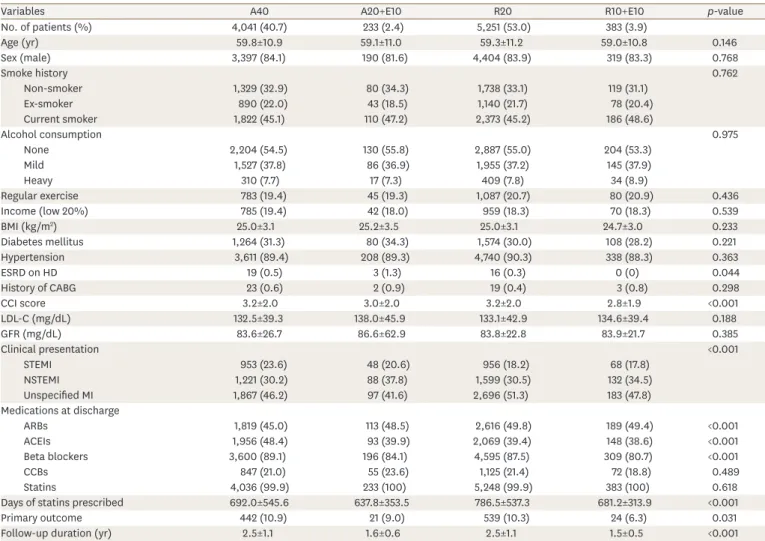
The baseline characteristics, potential confounders, and prescription records of the medications in the study population are presented in Table 1. The subjects were predominantly male (83.9%), and their mean age was 59.5 years. All the 4 groups showed similar distributions for most study variables, except for the proportion of STEMI at the index PCI, prescription rates of ACEIs and beta-blockers, and CCI score. The subjects in the A40 group had the highest proportion of STEMI (23.58%), as well as the prescription rates of ACEIs (48.4%) and beta-blockers (89.09%) among the groups. They also had the longest follow-up duration (2.5±1.1 years) and the highest incidence rate of the primary outcome (n=442/4,041, 10.94%). On the other hand, CCI score was the highest in the R20 group (3.24±1.98).
Table 1. Baseline characteristics of the study subjects
Variables A40 A20+E10 R20 R10+E10 p-value
No. of patients (%) 4,041 (40.7) 233 (2.4) 5,251 (53.0) 383 (3.9)
Age (yr) 59.8±10.9 59.1±11.0 59.3±11.2 59.0±10.8 0.146
Sex (male) 3,397 (84.1) 190 (81.6) 4,404 (83.9) 319 (83.3) 0.768
Smoke history 0.762
Non-smoker 1,329 (32.9) 80 (34.3) 1,738 (33.1) 119 (31.1)
Ex-smoker 890 (22.0) 43 (18.5) 1,140 (21.7) 78 (20.4)
Current smoker 1,822 (45.1) 110 (47.2) 2,373 (45.2) 186 (48.6)
Alcohol consumption 0.975
None 2,204 (54.5) 130 (55.8) 2,887 (55.0) 204 (53.3)
Mild 1,527 (37.8) 86 (36.9) 1,955 (37.2) 145 (37.9)
Heavy 310 (7.7) 17 (7.3) 409 (7.8) 34 (8.9)
Regular exercise 783 (19.4) 45 (19.3) 1,087 (20.7) 80 (20.9) 0.436
Income (low 20%) 785 (19.4) 42 (18.0) 959 (18.3) 70 (18.3) 0.539
BMI (kg/m2) 25.0±3.1 25.2±3.5 25.0±3.1 24.7±3.0 0.233
Diabetes mellitus 1,264 (31.3) 80 (34.3) 1,574 (30.0) 108 (28.2) 0.221
Hypertension 3,611 (89.4) 208 (89.3) 4,740 (90.3) 338 (88.3) 0.363
ESRD on HD 19 (0.5) 3 (1.3) 16 (0.3) 0 (0) 0.044
History of CABG 23 (0.6) 2 (0.9) 19 (0.4) 3 (0.8) 0.298
CCI score 3.2±2.0 3.0±2.0 3.2±2.0 2.8±1.9 <0.001
LDL-C (mg/dL) 132.5±39.3 138.0±45.9 133.1±42.9 134.6±39.4 0.188
GFR (mg/dL) 83.6±26.7 86.6±62.9 83.8±22.8 83.9±21.7 0.385
Clinical presentation <0.001
STEMI 953 (23.6) 48 (20.6) 956 (18.2) 68 (17.8)
NSTEMI 1,221 (30.2) 88 (37.8) 1,599 (30.5) 132 (34.5)
Unspecified MI 1,867 (46.2) 97 (41.6) 2,696 (51.3) 183 (47.8)
Medications at discharge
ARBs 1,819 (45.0) 113 (48.5) 2,616 (49.8) 189 (49.4) <0.001
ACEIs 1,956 (48.4) 93 (39.9) 2,069 (39.4) 148 (38.6) <0.001
Beta blockers 3,600 (89.1) 196 (84.1) 4,595 (87.5) 309 (80.7) <0.001
CCBs 847 (21.0) 55 (23.6) 1,125 (21.4) 72 (18.8) 0.489
Statins 4,036 (99.9) 233 (100) 5,248 (99.9) 383 (100) 0.618
Days of statins prescribed 692.0±545.6 637.8±353.5 786.5±537.3 681.2±313.9 <0.001
Primary outcome 442 (10.9) 21 (9.0) 539 (10.3) 24 (6.3) 0.031
Follow-up duration (yr) 2.5±1.1 1.6±0.6 2.5±1.1 1.5±0.5 <0.001
Study population were divided into the 4 groups: patients with atorvastatin 40 mg monotherapy (A40); combination therapy of atorvastatin 20 mg and ezetimibe 10 mg (A20+E10); rosuvastatin 20 mg monotherapy (R20); combination therapy of rosuvastatin 10 mg and ezetimibe 10 mg (R10+E10). Values are presented as number of patients (%) or mean±standard deviation.
BMI, body mass index; ESRD, end-stage renal disease; HD, hemodialysis; CABG, coronary artery bypass graft; CCI, Charlson comorbidity index; LDL-C, low- density lipoprotein cholesterol; GFR, glomerular filtration rate; STEMI, ST elevation myocardial infarction; NSTEMI, non-ST elevation myocardial infarction; MI, myocardial infarction; ARB, angiotensin receptor blocker; ACEI, angiotensin-converting enzyme inhibitors; CCBs, calcium channel blockers.
2. Clinical outcomes
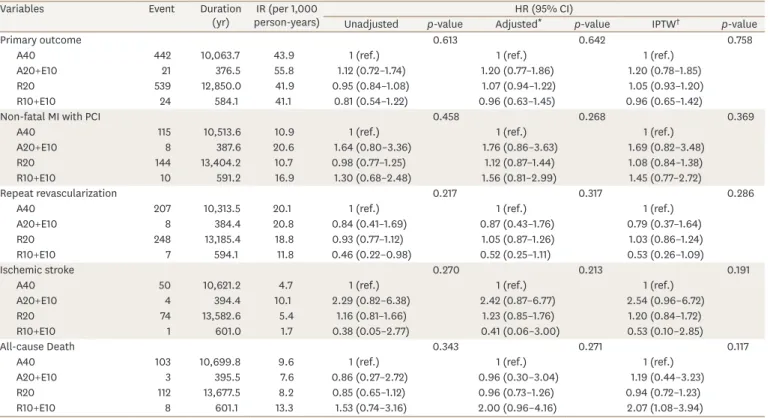
The associations between statin therapy and the risk of primary and secondary outcomes are summarized in Table 2 and Supplementary Table 1 (including those who were followed up for less than 1 year). The incidence rate (IR) of the primary outcome was 42.97 cases per 1,000 person-years in the overall population. The risk of the primary outcome was comparable between the four groups before and after adjusting for confounding variables. Kaplan-Meier curves and log-rank test showed that there were no significant differences in the rates of primary outcomes between the four groups (Fig. 2).
When we assessed the risks of all-cause death, non-fatal MI undergoing PCI, repeat
revascularization, and ischemic stroke, there were no significant differences between the four groups (Table 2). In the weighted multivariable model, however, the R10+E10 group showed a higher risk of all-cause death (hazard ratio [HR], 2.07; 95% confidence interval [CI], 1.08–3.94) than the A40 group (reference). Following IPTW, there was good balance across all covariates, with no statistically significant differences remaining.
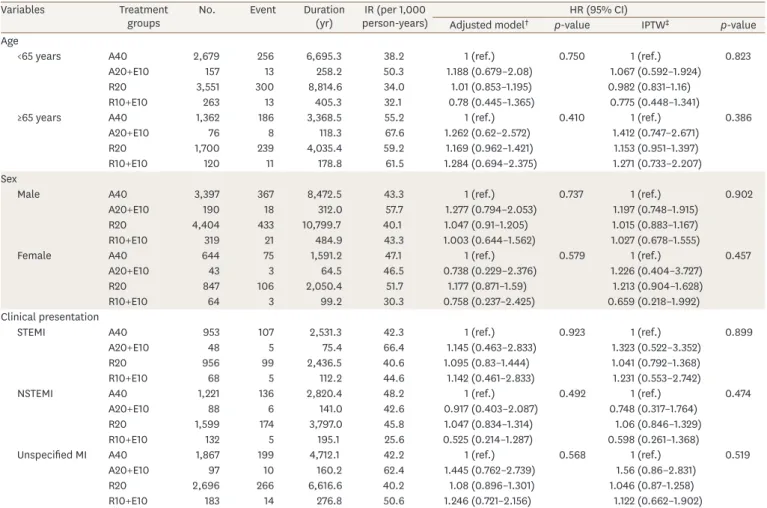
In the subgroup analyses, the primary outcome did not differ between groups (Table 3), but the secondary outcomes showed differences between groups in the weighted multivariable model (Supplementary Tables 2–5). The risk of non-fatal MI undergoing PCI was higher in the A20+E10 group than the A40 group among patients aged 65 years or older (HR, 3.05;
95% CI, 1.05–8.90), in the A20+E10 group (HR, 5.05; 95% CI, 1.41–18.12), and in the R10+E10
Table 2. Incidence rate and hazard ratios for primary and secondary outcomes, according to different statin treatment groups
Variables Event Duration
(yr) IR (per 1,000
person-years) HR (95% CI)
Unadjusted p-value Adjusted* p-value IPTW† p-value
Primary outcome 0.613 0.642 0.758
A40 442 10,063.7 43.9 1 (ref.) 1 (ref.) 1 (ref.)
A20+E10 21 376.5 55.8 1.12 (0.72–1.74) 1.20 (0.77–1.86) 1.20 (0.78–1.85)
R20 539 12,850.0 41.9 0.95 (0.84–1.08) 1.07 (0.94–1.22) 1.05 (0.93–1.20)
R10+E10 24 584.1 41.1 0.81 (0.54–1.22) 0.96 (0.63–1.45) 0.96 (0.65–1.42)
Non-fatal MI with PCI 0.458 0.268 0.369
A40 115 10,513.6 10.9 1 (ref.) 1 (ref.) 1 (ref.)
A20+E10 8 387.6 20.6 1.64 (0.80–3.36) 1.76 (0.86–3.63) 1.69 (0.82–3.48)
R20 144 13,404.2 10.7 0.98 (0.77–1.25) 1.12 (0.87–1.44) 1.08 (0.84–1.38)
R10+E10 10 591.2 16.9 1.30 (0.68–2.48) 1.56 (0.81–2.99) 1.45 (0.77–2.72)
Repeat revascularization 0.217 0.317 0.286
A40 207 10,313.5 20.1 1 (ref.) 1 (ref.) 1 (ref.)
A20+E10 8 384.4 20.8 0.84 (0.41–1.69) 0.87 (0.43–1.76) 0.79 (0.37–1.64)
R20 248 13,185.4 18.8 0.93 (0.77–1.12) 1.05 (0.87–1.26) 1.03 (0.86–1.24)
R10+E10 7 594.1 11.8 0.46 (0.22–0.98) 0.52 (0.25–1.11) 0.53 (0.26–1.09)
Ischemic stroke 0.270 0.213 0.191
A40 50 10,621.2 4.7 1 (ref.) 1 (ref.) 1 (ref.)
A20+E10 4 394.4 10.1 2.29 (0.82–6.38) 2.42 (0.87–6.77) 2.54 (0.96–6.72)
R20 74 13,582.6 5.4 1.16 (0.81–1.66) 1.23 (0.85–1.76) 1.20 (0.84–1.72)
R10+E10 1 601.0 1.7 0.38 (0.05–2.77) 0.41 (0.06–3.00) 0.53 (0.10–2.85)
All-cause Death 0.343 0.271 0.117
A40 103 10,699.8 9.6 1 (ref.) 1 (ref.) 1 (ref.)
A20+E10 3 395.5 7.6 0.86 (0.27–2.72) 0.96 (0.30–3.04) 1.19 (0.44–3.23)
R20 112 13,677.5 8.2 0.85 (0.65–1.12) 0.96 (0.73–1.26) 0.94 (0.72–1.23)
R10+E10 8 601.1 13.3 1.53 (0.74–3.16) 2.00 (0.96–4.16) 2.07 (1.08–3.94)
Study population were divided into the 4 groups: patients with atorvastatin 40 mg monotherapy (A40); combination therapy with atorvastatin 20 mg and ezetimibe 10 mg (A20+E10); rosuvastatin 20 mg monotherapy (R20); combination therapy of rosuvastatin 10 mg and ezetimibe 10 mg (R10+E10).
IR, incidence rate; HR, hazard ratio; CI, confidence interval; IPTW, inverse probability of treatment weighting; BMI, body mass index; CCI, Charlson comorbidity index; LDL-C, low-density lipoprotein cholesterol; GFR, glomerular filtration rate; MI, myocardial infarction; ACEI, angiotensin-converting enzyme inhibitor.
*Adjusted model and †IPTW: age, sex, income (low 20%), CCI, diabetes mellitus, hypertension, smoke history, alcohol consumption, regular exercise, BMI, LDL-C, GFR, ACEIs, beta-blockers, days of statins prescribed.
p-value=0.244
0.25 0.10 0 0253
0.20 Incidence probability
Duration of follow-up, yr No. at risk 4,0411 233A40 A20+E100 5,2511 393
3,921 217 4,954 365
1,399 2 1,699 4
427 1 566 1R20 R10+E100
2,505 60 3,172 64
A 14
0.15 0.05 p-value=0.612
A20+E10A40 R10+E10R20
Primary outcome 0.05 0.02 0 0253
0.04 Incidence probability
Duration of follow-up, yr No. at risk 4,0411 233A40 A20+E100 5,2511 393
4,011 231 5,212 377
1,550 2 1,979 4
497 1 640 1R20 R10+E100
2,703 64 3,425 69
B 14
0.03 0.01 p-value=0.336
A20+E10A40 R10+E10R20
All-cause death 0.08 0.04 0 0253
Incidence probability
Duration of follow-up, yr No. at risk 4,0411 233A40 A20+E100 5,2511 393
3,994 224 5,050 373
1,457 2 1,778 4
457 1 602 1R20 R10+E100
2,579 61 3,272 66
D 14
0.06 0.02 p-value=0.201
A20+E10A40 R10+E10R20
Repeat revascularization 0.15 0.10 0 0253
Incidence probability
Duration of follow-up, yr No. at risk 4,0411 233A40 A20+E100 5,2511 393
3,995 230 5,199 377
1,526 2 1,955 4
474 1 625 1R20 R10+E100
2,679 64 3,396 69
E 14
0.05
A20+E10A40 R10+E10R20
Ischemic stroke
0.08 0.04 0 0253
Incidence probability
Duration of follow-up, yr No. at risk 4,0411 233A40 A20+E100 5,2511 393
3,952 224 5,130 369
1,510 2 1,914 4
466 1 614 1R20 R10+E100
2,651 63 3,343 66
C 14
0.06 0.02 p-value=0.450
A20+E10A40 R10+E10R20
Non-fatal MI with PCI Fig. 2. Kaplan-Meier curves for primary and secondary outcomes in patients with myocardial infarction undergoing percutaneous coronary intervention, according to different statin treatment groups. Study population were divided into the 4 groups: patients with atorvastatin 40 mg monotherapy (A40); combination therapy of atorvastatin 20 mg and ezetimibe 10 mg (A20+E10); rosuvastatin 20 mg monotherapy (R20); combination therapy of rosuvastatin 10 mg and ezetimibe 10 mg (R10+E10). PCI, percutaneous coronary intervention; MI, myocardial infarction.
group (HR, 4.54; 95% CI, 1.45–14.24) among the patients with STEMI at the index PCI.
However, the risk of ischemic stroke was higher in A20+E10 group than the A40 group among male patients (HR, 3.25; 95% CI, 1.21–8.72) and among patients with STEMI at the index PCI (HR, 5.03; 95% CI, 1.08–23.6). The risk of all-cause death was higher in the R10+E10 group among male patients (HR, 2.14; 95% CI, 1.03–4.43) and among patients with STEMI at the index PCI (HR, 3.11; 95% CI, 1.00–9.65).
DISCUSSION
This is the first nationwide cohort study to compare the effect of doubling the dose of moderate-intensity statin and adding ezetimibe to study MACE in patients with AMI. In this study, there was no significant difference in the risk of composite outcomes of MACE.
However, the risk of all-cause death was higher in the R10+E10 group (HR, 2.07; 95% CI, 1.08–3.94) than in the A40 group (reference).
Table 3. Subgroup analyses of primary outcome*, according to the different statin treatment groups stratified by age, sex, and clinical presentation
Variables Treatment
groups No. Event Duration
(yr) IR (per 1,000
person-years) HR (95% CI)
Adjusted model† p-value IPTW‡ p-value
Age
<65 years A40 2,679 256 6,695.3 38.2 1 (ref.) 0.750 1 (ref.) 0.823
A20+E10 157 13 258.2 50.3 1.188 (0.679–2.08) 1.067 (0.592–1.924)
R20 3,551 300 8,814.6 34.0 1.01 (0.853–1.195) 0.982 (0.831–1.16)
R10+E10 263 13 405.3 32.1 0.78 (0.445–1.365) 0.775 (0.448–1.341)
≥65 years A40 1,362 186 3,368.5 55.2 1 (ref.) 0.410 1 (ref.) 0.386
A20+E10 76 8 118.3 67.6 1.262 (0.62–2.572) 1.412 (0.747–2.671)
R20 1,700 239 4,035.4 59.2 1.169 (0.962–1.421) 1.153 (0.951–1.397)
R10+E10 120 11 178.8 61.5 1.284 (0.694–2.375) 1.271 (0.733–2.207)
Sex
Male A40 3,397 367 8,472.5 43.3 1 (ref.) 0.737 1 (ref.) 0.902
A20+E10 190 18 312.0 57.7 1.277 (0.794–2.053) 1.197 (0.748–1.915)
R20 4,404 433 10,799.7 40.1 1.047 (0.91–1.205) 1.015 (0.883–1.167)
R10+E10 319 21 484.9 43.3 1.003 (0.644–1.562) 1.027 (0.678–1.555)
Female A40 644 75 1,591.2 47.1 1 (ref.) 0.579 1 (ref.) 0.457
A20+E10 43 3 64.5 46.5 0.738 (0.229–2.376) 1.226 (0.404–3.727)
R20 847 106 2,050.4 51.7 1.177 (0.871–1.59) 1.213 (0.904–1.628)
R10+E10 64 3 99.2 30.3 0.758 (0.237–2.425) 0.659 (0.218–1.992)
Clinical presentation
STEMI A40 953 107 2,531.3 42.3 1 (ref.) 0.923 1 (ref.) 0.899
A20+E10 48 5 75.4 66.4 1.145 (0.463–2.833) 1.323 (0.522–3.352)
R20 956 99 2,436.5 40.6 1.095 (0.83–1.444) 1.041 (0.792–1.368)
R10+E10 68 5 112.2 44.6 1.142 (0.461–2.833) 1.231 (0.553–2.742)
NSTEMI A40 1,221 136 2,820.4 48.2 1 (ref.) 0.492 1 (ref.) 0.474
A20+E10 88 6 141.0 42.6 0.917 (0.403–2.087) 0.748 (0.317–1.764)
R20 1,599 174 3,797.0 45.8 1.047 (0.834–1.314) 1.06 (0.846–1.329)
R10+E10 132 5 195.1 25.6 0.525 (0.214–1.287) 0.598 (0.261–1.368)
Unspecified MI A40 1,867 199 4,712.1 42.2 1 (ref.) 0.568 1 (ref.) 0.519
A20+E10 97 10 160.2 62.4 1.445 (0.762–2.739) 1.56 (0.86–2.831)
R20 2,696 266 6,616.6 40.2 1.08 (0.896–1.301) 1.046 (0.87–1.258)
R10+E10 183 14 276.8 50.6 1.246 (0.721–2.156) 1.122 (0.662–1.902)
Study population were divided into the 4 groups: patients with atorvastatin 40 mg monotherapy (A40); combination therapy with atorvastatin 20 mg and ezetimibe 10 mg (A20+E10); rosuvastatin 20 mg monotherapy (R20); combination therapy of rosuvastatin 10 mg and ezetimibe 10 mg (R10+E10).
IR, incidence rate; HR, hazard ratio; CI, confidence interval; IPTW, inverse probability of treatment weighting; STEMI, ST-elevation myocardial infarction; NSTEMI, non-ST-elevation myocardial infarction; MI, myocardial infarction; PCI, percutaneous coronary intervention.
*Primary outcome: composite of all-cause death, non-fatal MI undergoing PCI, repeat revascularization, and ischemic stroke. †Adjusted model and ‡IPTW: age, sex, income (low 20%), CCI, diabetes mellitus, hypertension, smoking history, alcohol consumption, regular exercise, BMI, LDL-C, GFR, ACEIs, beta-blockers, days of statins prescribed.
The IMPROVE-IT trial demonstrated that adding ezetimibe 10 mg to simvastatin 40 mg resulted in an incremental lowering of the LDL-C levels and improved MACE in patients with ACS.11 Furthermore, several studies have demonstrated that adding ezetimibe 10 mg to atorvastatin 20 mg was more effective than doubling the dose of atorvastatin to 40 mg in lowering the levels of LDL-C and other lipid parameters.12,14,15 However, there have been few studies that have attempted to elucidate whether the combination of ezetimibe, which is more effective at lowering LDL-C, is more effective in reducing MACE than doubling the statin dose. A retrospective study using the United Kingdom General Practice Research Database reported that the use of high-potency statins (atorvastatin or rosuvastatin) in survivors of MI was associated with a lower mortality risk (HR, 0.72; 95% CI, 0.59–0.88, p<0.001) compared with simvastatin monotherapy.16 However, there was no mortality benefit observed in the simvastatin/ezetimibe combination group (HR, 0.96; 95% CI, 0.64–1.43; p=0.85), despite the effective reduction in LDL-C observed, as in the high-potency statin group. A nationwide cohort study using the Korea Acute Myocardial Infarction Registry compared the clinical outcomes of simvastatin/ezetimibe and high-intensity statin therapy (atorvastatin 40–80 mg daily or rosuvastatin 20–40 mg) in patients with AMI.17 After propensity score matching analysis, simvastatin/ezetimibe was associated with a higher incidence of MACE (HR, 3.090;
95% CI, 1.715–5.566; p<0.001) and repeat revascularization (HR, 3.935; 95% CI, 2.043–7.582;
p<0.001) than high-intensity statin therapy. At 1 year of follow-up, there was no significant difference in the mean LDL-C levels between the two groups. These effects seen in the high-intensity statin groups might be due to the multiple “pleiotropic” effects of statins that are independent of the decrease in LDL-C level. Statins reduce the synthesis of cholesterol in the liver by inhibiting 3-hydroxy-3-methylglutaryl coenzyme A reductase, which inhibits the production of isoprenoids in the cholesterol biosynthetic pathway. Since the binding of isoprenoids to signaling proteins, such as Rho and Rac promotes inflammatory signaling pathways, statins have beneficial effects, including improving the function of vascular endothelial cells, stabilizing atherosclerotic plaques, reducing the levels of proinflammatory cytokines, reactive oxygen species, and clot formation, and limiting cardiac fibrosis and hypertrophy.19,20 A recent retrospective study on patients who achieved the LDL-C goal after PCI reported that high-intensity statins were associated with a lower risk of MACE compared with non-high-intensity statins (4.1% vs. 9.9%; HR, 0.42; 95% CI, 0.23–0.79; p<0.01), despite a small difference in the LDL-C level achieved (59±13 vs. 61±12 mg/dL; p=0.04).21 From these studies, we can conclude that high-intensity statin therapy might be associated with additional effects on MACE beyond what may be achieved by targeting LDL-C alone.
The aforementioned studies have limitations in that they compared the effects of simvastatin/
ezetimibe combination therapy with high-intensity statin therapy with the statins having different doses.16,17 Therefore, we tried to directly compare each group by subdividing the type and dose of statin as follows: A40, R20, A20+E10, and R10+E10. Atorvastatin and rosuvastatin are the most popular and potent statins used. To make the study cohort homogeneous and to minimize the drawbacks of a retrospective study in the selection of the study cohort, we included only patients with MI who underwent PCI for ACS. Although patients in the four groups generally did not show significant differences in each study variable, we performed Cox multivariable analysis and IPTW test, including CCI score, to maximally adjust the differences of variables between the groups. In the weighted multivariable model, the incidence rate of the primary outcome was comparable among the four groups, but the all-cause death rate was higher in the R20+E10 group than in A40 group (reference). Although there are interpretation limitations, in the subgroup analyses, the risks of secondary outcomes, except for repeat revascularization, were higher in the
ezetimibe combination group than in the high-intensity statin alone group. These results suggest that, as in previous studies,16,17 high- intensity statin monotherapy might be better at lowering the risk of MACE, even though it is not more effective in reducing LDL-C than ezetimibe combination therapy. In this study, especially in STEMI patients, the ezetimibe combination group showed a higher risk of non-fatal MI, ischemic stroke, and all-cause death than the high-dose statin group. STEMI is the most serious type of ACS, and microvascular obstruction (MVO) is known to be a predictor of adverse outcomes in patients with STEMI.22 A previous study showed that administration of high-dose statin before primary PCI improved angiographic MVO, compared with low-dose statin.23 Although the analysis is limited, the involvement of this mechanism may be the reason that high-dose statin showed a more favorable tendency in STEMI patients compared to other subgroups.
There are several limitations to our study. First, this was a retrospective observational study and suffers from potential selection and ascertainment bias, as well as residual confounding factors. Although we performed Cox multivariable analyses and IPTW with adjustments to overcome these limitations, unmeasured potential confounders still remained. In addition, statin therapy might have been influenced by patient demographics, clinical presentation, baseline cholesterol level, and physician preference. Second, the data we used from the KNHIS database might be prone to coding errors related to the diagnoses. The dosing and maintenance of statins were based on prescription data because data on drug compliance were not available. Third, there was a much smaller number of patients in the ezetimibe combination therapy group compared to the high-intensity statin group. This weakened the statistical power of the analyses. Fourth, we did not analyze the achieved LDL-C level during the follow-up period due to the limitation of the dataset. If the achieved LDL-C level was different among groups, it could affect the results. Despite these limitations, this study is significant, since it is the first study using real-world data to compare the effects of high- intensity statin therapy with moderate-intensity statin and ezetimibe combination therapy on MACE in patients with MI who underwent PCI.
In conclusion, there was no significant difference in the composite outcome of MACE between high-intensity statin monotherapy and moderate-intensity statin and ezetimibe combination therapy. A large, well-designed prospective study will be required to
demonstrate which of the statin treatment groups are superior in reducing MACE in patients with AMI.
SUPPLEMENTARY MATERIALS
Supplementary Table 1
Incidence rate and HRs for primary and secondary outcomes, according to different statin treatment groups (including those who were followed up for less than 1 year)
Click here to view
Supplementary Table 2
Subgroup analyses of non-fatal MI with PCI according to different statin treatment groups stratified by age, sex, and clinical presentation
Click here to view
Supplementary Table 3
Subgroup analyses of repeat revascularization according to different statin treatment groups stratified by age, sex, and clinical presentation
Click here to view
Supplementary Table 4
Subgroup analyses of ischemic stroke according to different statin treatment groups stratified by age, sex, and clinical presentation
Click here to view
Supplementary Table 5
Subgroup analyses of all-cause death according to different statin treatment groups stratified by age, sex, and clinical presentation
Click here to view
REFERENCES
1. Grundy SM, Stone NJ, Bailey AL, Beam C, Birtcher KK, Blumenthal RS, et al. 2018 AHA/ACC/AACVPR/
AAPA/ABC/ACPM/ADA/AGS/APhA/ASPC/NLA/PCNA Guideline on the Management of Blood Cholesterol:
executive summary: a report of the American College of Cardiology/American Heart Association Task Force on Clinical Practice Guidelines. J Am Coll Cardiol 2019;73:3168-3209.
PUBMED | CROSSREF
2. Mach F, Baigent C, Catapano AL, Koskinas KC, Casula M, Badimon L, et al. 2019 ESC/EAS Guidelines for the management of dyslipidaemias: lipid modification to reduce cardiovascular risk. Eur Heart J 2020;41:111-188.
PUBMED | CROSSREF
3. Cholesterol Treatment Trialists' (CTT) Collaboration, Baigent C, Blackwell L, Emberson J, Holland LE, Reith C, et al. Efficacy and safety of more intensive lowering of LDL cholesterol: a meta-analysis of data from 170,000 participants in 26 randomised trials. Lancet 2010;376:1670-1681.
PUBMED | CROSSREF
4. Waters DD, Brotons C, Chiang CW, Ferrières J, Foody J, Jukema JW, et al. Lipid treatment assessment project 2: a multinational survey to evaluate the proportion of patients achieving low-density lipoprotein cholesterol goals. Circulation 2009;120:28-34.
PUBMED | CROSSREF
5. Dujovne CA, Williams CD, Ito MK. What combination therapy with a statin, if any, would you recommend? Curr Atheroscler Rep 2011;13:12-22.
PUBMED | CROSSREF
6. Knopp RH. Drug treatment of lipid disorders. N Engl J Med 1999;341:498-511.
PUBMED | CROSSREF
7. Stein E. Results of phase I/II clinical trials with ezetimibe, a novel selective cholesterol absorption inhibitor. Eur Heart J Suppl 2001;3:E11-E16.
CROSSREF
8. Stroes ES, Thompson PD, Corsini A, Vladutiu GD, Raal FJ, Ray KK, et al. Statin-associated muscle symptoms: impact on statin therapy-European Atherosclerosis Society Consensus Panel Statement on Assessment, Aetiology and Management. Eur Heart J 2015;36:1012-1022.
PUBMED | CROSSREF
9. Mach F, Ray KK, Wiklund O, Corsini A, Catapano AL, Bruckert E, et al. Adverse effects of statin therapy:
perception vs. the evidence - focus on glucose homeostasis, cognitive, renal and hepatic function, haemorrhagic stroke and cataract. Eur Heart J 2018;39:2526-2539.
PUBMED | CROSSREF
10. Davidson MH. Ezetimibe: a novel option for lowering cholesterol. Expert Rev Cardiovasc Ther 2003;1:11-21.
PUBMED | CROSSREF
11. Cannon CP, Blazing MA, Giugliano RP, McCagg A, White JA, Theroux P, et al. Ezetimibe added to statin therapy after acute coronary syndromes. N Engl J Med 2015;372:2387-2397.
PUBMED | CROSSREF
12. Bays HE, Averna M, Majul C, Muller-Wieland D, De Pellegrin A, Giezek H, et al. Efficacy and safety of ezetimibe added to atorvastatin versus atorvastatin uptitration or switching to rosuvastatin in patients with primary hypercholesterolemia. Am J Cardiol 2013;112:1885-1895.
PUBMED | CROSSREF
13. Leiter LA, Bays H, Conard S, Bird S, Rubino J, Hanson ME, et al. Efficacy and safety of ezetimibe added on to atorvastatin (40 mg) compared with uptitration of atorvastatin (to 80 mg) in hypercholesterolemic patients at high risk of coronary heart disease. Am J Cardiol 2008;102:1495-1501.
PUBMED | CROSSREF
14. Wu NQ, Guo YL, Zhu CG, Gao Y, Zhao X, Sun D, et al. Comparison of statin plus ezetimibe with double- dose statin on lipid profiles and inflammation markers. Lipids Health Dis 2018;17:265.
PUBMED | CROSSREF
15. Ai C, Zhang S, He Q, Shi J. Comparing the combination therapy of ezetimibe and atorvastatin with atorvastatin monotherapy for regulating blood lipids: a systematic review and meta-analyse. Lipids Health Dis 2018;17:239.
PUBMED | CROSSREF
16. Pauriah M, Elder DH, Ogston S, Noman AY, Majeed A, Wyatt JC, et al. High-potency statin and ezetimibe use and mortality in survivors of an acute myocardial infarction: a population-based study. Heart 2014;100:867-872.
PUBMED | CROSSREF
17. Ji MS, Jeong MH, Ahn YK, Kim SH, Kim YJ, Chae SC, et al. Clinical outcome of statin plus ezetimibe versus high-intensity statin therapy in patients with acute myocardial infarction propensity-score matching analysis. Int J Cardiol 2016;225:50-59.
PUBMED | CROSSREF
18. Quan H, Li B, Couris CM, Fushimi K, Graham P, Hider P, et al. Updating and validating the Charlson comorbidity index and score for risk adjustment in hospital discharge abstracts using data from 6 countries. Am J Epidemiol 2011;173:676-682.
PUBMED | CROSSREF
19. Oesterle A, Laufs U, Liao JK. Pleiotropic effects of statins on the cardiovascular system. Circ Res 2017;120:229-243.
PUBMED | CROSSREF
20. Ray KK, Cannon CP. The potential relevance of the multiple lipid-independent (pleiotropic) effects of statins in the management of acute coronary syndromes. J Am Coll Cardiol 2005;46:1425-1433.
PUBMED | CROSSREF
21. Kim J, Park KT, Jang MJ, Park TK, Lee JM, Yang JH, et al. High-intensity versus non-high-intensity statins in patients achieving low-density lipoprotein cholesterol goal after percutaneous coronary intervention. J Am Heart Assoc 2018;7:e009517.
PUBMED | CROSSREF
22. de Waha S, Patel MR, Granger CB, Ohman EM, Maehara A, Eitel I, et al. Relationship between microvascular obstruction and adverse events following primary percutaneous coronary intervention for ST-segment elevation myocardial infarction: an individual patient data pooled analysis from seven randomized trials. Eur Heart J 2017;38:3502-3510.
PUBMED | CROSSREF
23. Kim JS, Kim J, Choi D, Lee CJ, Lee SH, Ko YG, et al. Efficacy of high-dose atorvastatin loading before primary percutaneous coronary intervention in ST-segment elevation myocardial infarction: the STATIN STEMI trial. JACC Cardiovasc Interv 2010;3:332-339.
PUBMED | CROSSREF