• 검색 결과가 없습니다.

Effects of Ezetimibe Added to Ongoing Statin Therapy on C-Reactive Protein Levels in Hypercholesterolemic Patients

N/A
N/A
Protected

Academic year: 2022

Share "Effects of Ezetimibe Added to Ongoing Statin Therapy on C-Reactive Protein Levels in Hypercholesterolemic Patients"

Copied!
6
0
0

로드 중.... (전체 텍스트 보기)

전체 글

(1)

253

Open Access

Introduction

The efficacy of 3-hydroxy-3-methylglutaryl-coenzyme A reductase inhibitor (statin) in reducing cardiovascular events has been established in many large-scaled randomized con- trolled trials.

1)2)

In addition to their potent effects on choleste- rol levels, statins influence several other pathways, including the inflammatory, oxidative, and thrombotic processes.

3-5)

The inflammatory processes are not only involved in the pa- thogenesis of atherosclerosis but also in the cause of acute co- ronary syndromes.

6)7)

High levels of C-reactive protein (CRP), a prototype inflammatory marker, are associated with incr- eased cardiovascular disease risks.

8)9)

Many studies have shown that statins reduce CRP levels.

10)11)

However, it is unclear whether the anti-inflammatory effect of statin is mediated by cholesterol reduction per se, or throu- gh direct mechanisms, the so called pleiotropic effects, as pre- vious generations of lipid lowering drugs did not have com- parable potency that of the statins.

A new drug, ezetimibe, inhibits the intestinal absorption of cholesterol by impeding cholesterol transport across the intestinal wall, and lowers cholesterol levels by over 15%.

12-15)

Ezetimibe alone does not reduce CRP levels. However, sev- eral reports have suggested that ezetimibe might potentiate the effect of statin on CRP level when administered togeth- er.

14)15)

A study reported that the addition of ezetimibe to pa- tients taking statins decreased CRP levels.

16)

In contrast, sev-

Effects of Ezetimibe Added to Ongoing Statin Therapy

on C-Reactive Protein Levels in Hypercholesterolemic Patients

Min Seok Oh, MD, Yun Joo Min, MD, Jee Eun Kwon, MD, Eun Jeong Cho, MD, Jung Eun Kim, MD, Wang-Soo Lee, MD, Kwang Je Lee, MD, Sang-Wook Kim, MD, Tae Ho Kim, MD, Chee Jeong Kim, MD, and Wang Seong Ryu, MD

Division of Cardiology, Department of Internal Medicine, College of Medicine, Chung-Ang University, Seoul, Korea ABSTRACT

Background and Objectives: Ezetimibe alone does not decrease C-reactive protein (CRP) levels in hypercholesterolemic patients. However, several reports have suggested that ezetimibe might potentiate the effect of statin not only on cholesterol but also on CRP when administered together. We investigated the effect of ezetimibe on CRP levels in patients taking statins.

Subjects and Methods: Patients who had not achieved recommended low density lipoprotein-cholesterol (LDL-C) goals with statin therapy were divided into two groups, the ezetimibe group (n=60) and the control group (n=60). A third group of hy- percholesterolemic patients without statin therapy was treated with statin (n=59). Patients with CRP level 10 mg/L were ex- cluded. Lipid and CRP levels were measured before therapy commenced, and after 2 months of therapy. Results: Ezetimibe decreased cholesterol and LDL-C levels by 20.2% (p=0.000) and 28.1% (p=0.000) respectively. However, ezetimibe did not reduce CRP levels (from 0.83±0.68 to 1.14±1.21 mg/dL, p=0.11). CRP levels remained unchanged in the control group (p=

0.42). In contrast, statin lowered CRP levels (from 0.82±0.73 to 0.65±0.57 mg/dL, p=0.008). In patients taking statins, changes in CRP levels were not associated with changes in LDL-C (r=-0.02, p=0.87), but with baseline CRP levels (r=-0.38, p=0.000).

Conclusion: Ezetimibe failed to reduce CRP levels in hypercholesterolemic patients taking statins despite significant reduc- tion of LDL-C. This finding suggests that the anti-inflammatory effect of statin may not be secondary to cholesterol reduc- tion, but via other mechanisms. (Korean Circ J 2011;41:253-258)

KEY WORDS: C-reactive protein; Azetidines; HMG CoA reductase inhibitor; Lipid; Lipoproteins.

Received: July 22, 2010

Revision Received: Sepember 7, 2010 Accepted: October 13, 2010

Correspondence: Chee Jeong Kim, MD, Division of Cardiology, De- partment of Internal Medicine, College of Medicine, Chung-Ang University, 224-1 Heukseok-dong, Dongjak-gu, Seoul 156-070, Korea

Tel: 82-2-6299-1398, Fax: 82-2-822-2769 E-mail: [email protected]

• The authors have no financial conflicts of interest.

cc
This is an Open Access article distributed under the terms of the Cre-

ative Commons Attribution Non-Commercial License (http://creativecom-

mons.org/licenses/by-nc/3.0) which permits unrestricted non-commer-

cial use, distribution, and reproduction in any medium, provided the origi-

nal work is properly cited.

(2)

eral reports have suggested that cholesterol reduction by ez- etimibe failed to demonstrate the pleiotropic effects of st- atins.

17-19)

The aim of this study was to investigate the effect of ezetimi- be on CRP levels when administered to hypercholesterolemic patients already receiving statins, and to evaluate the rela- tionship between the cholesterol reduction and anti-inflam- matory effects.

Subjects and Methods

One hundred-seventy and nine (n=179) hypercholesterol- emic patients were enrolled. The exclusion criteria were: 1) new onset diseases that potentially impact on lipid levels, such as diabetes mellitus, infectious diseases, or other endocrino- logic diseases, within 3 months, 2) aspartate aminotransfer- ase (AST) or alanine aminotransferase (ALT) levels ≥3-fold the upper normal limit, 3) administration of medications wi- thin the last 3 months that might affect lipid levels, and 4) baseline CRP levels ≥10 mg/L. One hundred-twenty (n=120) hypercholesterolemic patients receiving statins required ad- ditional reduction of low density lipoprotein-cholesterol (LDL- C) to meet the target levels of the National Cholesterol Edu- cation Program were divided into two groups, the ezetimibe group (10 mg of ezetimibe, n=60) and the control group (n=60).

20)

A patient in the ezetimibe group was excluded in the analysis, because follow-up CRP level was over 10 mg/L.

A third group of hypercholesterolemic patients with similar baseline CRP levels and without statin therapy was enrolled and treated with statin (statin group, n=59).

CRP and lipid levels were measured before and after man- agement for 2 months. After overnight fasting, blood samples were obtained. Concentrations of total cholesterol and trigly- ceride were determined by the enzymatic method using an automatic analyzer (Model 7150, Hitachi, Japan). LDL-C was calculated by the Friedewald equation. The concentration of high density lipoprotein-cholesterol (HDL-C) was measured by the direct method using immunoinhibition (Wako, Japan).

The concentration of CRP was determined by the nephelo- meter method using an N High Sensitivity CRP kit (Dade Behring Marburg GmbH, Germany). Interassay coefficients of variation were 7.0% and 5.2% for the controls, with levels of 1.43 mg/dL and 1.74 mg/dL, respectively. The intra-assay co- efficient of variation was 1.5-3.0%.

Statistical analysis

Data are expressed as mean±SD. Statistical analysis was performed using the Social Package for the Social Sciences (SPSS Inc., Chicago, IL, USA). For CRP, lipoprotein (a) and triglyceride, the Wilcoxon signed-rank test was used to com- pare concentrations before and after therapy, and the Mann- Whitney U test was used to evaluate differences between gr-

oups. For other variables, a paired t-test was used to compare concentrations before and after therapy, and the Student t-test was used to evaluate differences between groups. Relationships between the parameters were analyzed by the Spearman cor- relation method. The distribution of discrete variables was an- alyzed using the χ

2

test. A two-tailed p<0.05 was considered st- atistically significant.

Results

Baseline demographic and clinical characteristics were simi- lar between the ezetimibe group and the control group (Table 1), except the number of patients with ischemic heart diseases (p=0.026). There were no differences in baseline lipid profiles and CRP levels between the ezetimibe group and the control group (Table 2). CRP levels were similar between the ezeti- mibe and the statin groups. However, LDL-C levels were hi- gher in the statin group than in the ezetimibe group, due to different inclusion criteria (138.5±21.2 mg/dL vs. 172.9±28.4 mg/dL, p=0.000) (Table 2).

Ezetimibe decreased cholesterol and LDL-C levels by 20.2%

(from 228.1±31.1 mg/dL to 182.1±25.6 mg/dL, p=0.000) and 28.1% (from 138.5±21.2 mg/dL to 99.6±20.0 mg/dL, p=

0.000), respectively (Table 2). However, ezetimibe did not reduce CRP levels (from 0.83±0.68 mg/L to 1.14±1.21 mg/L, p=0.11). CRP levels did not change in the control group (p=

0.42).

Changes in CRP levels were not associated with changes in LDL-C in the control (r=0.14, p=0.31), the ezetimibe (r=

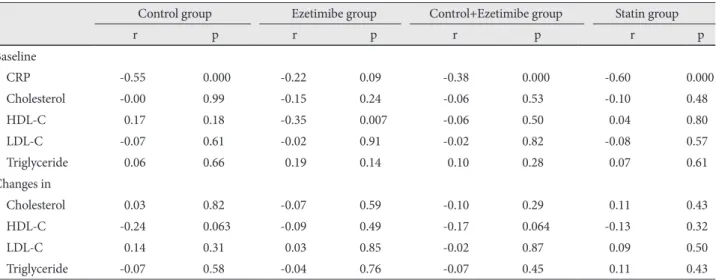
0.03, p=0.85), the control+ezetimibe (r=-0.02, p=0.87), and the statin groups (r=0.09, p=0.50) (Table 3). Changes in CRP levels were negatively associated with baseline CRP levels in the control+ezetimibe (r=-0.38, p=0.000) (Fig. 1), the control (r=-0.55, p=0.000), and the statin groups (r=-0.60, p=0.000), and in the ezetimibe group with borderline significance (r=

-0.22, p=0.09). In the ezetimibe group, changes in CRP levels were negatively related to baseline HDL-C levels (r=-0.35, p=

0.007). During the follow-up period, a patient in the ezeti- mibe group experienced elevation of AST and ALT ≥3-fold the upper normal limit. No patient experienced elevation of creatine kinase ≥10-fold the upper normal limit.

Discussion

This case-controlled study demonstrated that ezetimibe, a

new cholesterol lowering drug, failed to decrease CRP levels

in patients already taking statins, despite marked reduction in

cholesterol and LDL-C levels. This finding suggests that cho-

lesterol reduction itself does not modify the inflammatory pro-

cesses, and that the anti-inflammatory effects of statins may

not be secondary to lipid-lowering effect, but due to other

pathways.

(3)

The present study had lower baseline CRP levels (0.82-0.84 mg/L) than previous studies (more than 2 mg/L).

14-16)

In the pre- sent study, changes in CRP levels were associated with base- line CRP levels. High baseline CRP levels predicted the de- crease of CRP levels during the follow-up period. This finding is consistent with that of previous studies.

21)

Therefore, the dif- ference in baseline CRP levels may explain the discrepancy between the present study and previous studies.

To exclude the effect of low baseline CRP levels, a third gr-

oup of patients with similar CRP levels and without statin th- erapy were included. In these patients, statin lowered CRP levels. Therefore, lower baseline CRP levels alone cannot expl- ain the difference between the present study and previous ones.

Ezetimibe did not reduce CRP levels.

14)15)

Several studies have suggested that the combined therapy of statin and ezet- imibe may decrease CRP levels more so than statin monothera- py.

14)15)

However, as the primary aims of most previous stud- ies focused on the drug’s efficacy on lipid and safety, baseline Table 1. Comparison of patient baseline clinical characteristics

Ongoing statin therapy

p New statin therapy

(n=59) Control (n=60) Ezetimibe (n=59)

Sex (M/F) 16/44 15/44 1000. 24/35

Age 0057.8±10.1 0059.7±11.9 0.340 057.9±11.7

Height (cm) 159.0±6.5 159.7±8.5 0.620 160.5±8.80

Weight (kg) 065.2±9.9 064.3±9.3 0.640 064.8±12.5

Associated disease, n (%)

Hypertension 40 (66.7) 37 (62.7) 0.700 46 (78)

IHD 5 (8.3) 14 (23.7) 0.026 08 (13.6)

DM 2 (3.3) 1 (1.7) 1000. 03 (5.1)

Medication, n (%)

Atorvastatin 25 (41.7) 18 (30.5) 0.110 59 (100)

Lovastatin 25 (41.7) 21 (35.6)

Pitavastatin 08 (13.3) 12 (20.3)

Simvastatin 2 (3.3) 08 (13.6)

Alcohol, n (%) 07 (11.7) 06 (10.2) 1000. 13 (22.0)

Smoking, n (%) 07 (11.7) 06 (10.2) 1000. 05 (8.5)

IHD: ischemic heart disease, DM: diabetes mellitus Table 2. Changes in CRP, lipid and lipoprotein profiles

Ongoing statin therapy

p New statin therapy

(n=59) Control (n=60) Ezetimibe (n=59)

Pre 00.84±0.76 00.83±0.68 0.820 00.82±0.73

CRP(mg/L) Post 00.90±0.94 01.14±1.21 0.550 00.65±0.57

p 0.420 0.110 0.008

Pre 221.7±30.9 228.1±31.1 0.270 256.8±27.2

Cholesterol (mg/dL) Post 212.3±30.1 182.1±25.6 0.000 181.2±24.5

p 0.002 0.000 0.000

Pre 056.0±13.1 056.8±10.4 0.720 55.1±9.5

HDL-C (mg/dL) Post 055.3±12.8 055.8±11.3 0.810 054.1±10.3

p 0.420 0.250 0.290

Pre 130.0±28.3 138.5±21.2 0.090 172.9±28.4

LDL-C (mg/dL)* Post 123.7±26.5 099.6±20.0 0.000 101.8±22.6

p 0.028 0.000 0.000

Pre 174.3±86.0 153.3±66.8 0.410 149.1±86.8

Triglyceride (mg/dL) Post 165.7±82.4 126.3±54.2 0.003 128.2±58.0

p 0.300 0.000 0.030

Mean±SD. *Calculated by Friedewald equation in cases with triglyceride levels <400 mg/dL. CRP: C-reactive protein, HDL-C: high density

lipoprotein-cholesterol, LDL-C: low density lipoprotein-cholesterol

(4)

CRP levels were different between the groups. In a study wh- ich evaluated the effect on CRP levels, baseline CRP levels were different by 12%.

15)

In the present study, baseline CRP levels were similar between the control and the ezetimibe groups.

The efficacy of the co-administration of ezetimibe on CRP levels may be different with the types or the dosage of statins.

In general, the addition of ezetimibe to simvastatin (14.3- 16.6%) was more effective than the addition of ezetimibe to atorvastatin (-0.3-10%).

14)15)22-24)

The addition of ezetimibe de- creased CRP levels only in higher dose of statin in some stud- ies

14)

or only in lower dose in other studies.

22)

In a study which compared the effects on CRP between at- orvastatin and simvastatin+ezetimibe, combined therapy fa- iled to provide incremental reduction of CRP levels in spite of further reduction of LDL-C by 8.1%.

22)

Therefore, it is un- clear whether co-administration of ezetimibe with statin po- tentiates the CRP lowering effect of statins.

There are two studies that assessed the effect of ezetimibe

on CRP levels in patients already taking statins.

16)25)

In one st- udy, addition of ezetimibe decreased CRP levels. However, baseline CRP levels were different by 23.5%.

16)

That study enrolled hypercholesterolemic patients having taken statins for 6 weeks and more.

16)

In the present study, almost all patients were taking statins over 12 months. In the JUPITER study, ro- suvastatin in patients with elevated CRP levels reduced CRP levels from 4.2 mg/L to 2.2 mg/L after 12 months, and reduc- ed further to 1.8 mg/L after 24 months.

26)

Therefore, difference in the duration of statin therapy may explain the discrepancy between these two studies. It is possible that the addition of ezetimibe to statin simultaneously or sequentially facilitate reduction of CRP levels without further reduction compared with the long-term statin therapy. Lower baseline CRP in the present study may partially be explained by the effects of long-term statin therapy.

In another study, the addition of ezetimibe to patients tak- ing statins decreased CRP levels in Caucasian patients but not in African and Hispanic patients, although the difference did not reach statistical significance. As such, there is a possi- bility of ethnic difference.

25)27)

Recently, pooled data includ- ing the above two studies

16)25)

showed that addition of ezeti- mibe to patients taking statins decreased CRP levels.

28)

Statins reduce cardiovascular events not only in hypercho- lesterolemic patients, but also in high-risk patients with nor- mal or low cholesterol levels.

1)2)

It has been suggested that the cardioprotective effects of statins are mediated both by their potent effects on cholesterol levels and by other pathways, such as the inflammatory, oxidative, and thrombotic process- es.

3-5)

Almost all reports have demonstrated that statins re- duce CRP levels.

10)11)

However, It is not known whether the pleiotropic effects of statins are mediated by cholesterol reduction per se, or by other mechanisms. It is because old cholesterol lowering drugs are not as potent as statins in reducing cholesterol lev- Table 3. Relation of changes in CRP levels with baseline lipid levels and their changes

Control group Ezetimibe group Control+Ezetimibe group Statin group

r p r p r p r p

Baseline

CRP -0.55 0.000 -0.22 0.09 -0.38 0.000 -0.60 0.000

Cholesterol -0.00 0.99 -0.15 0.24 -0.06 0.53 -0.10 0.48

HDL-C 0.17 0.18 -0.35 0.007 -0.06 0.50 -0.04 0.80

LDL-C -0.07 0.61 -0.02 0.91 -0.02 0.82 -0.08 0.57

Triglyceride 0.06 0.66 0.19 0.14 0.10 0.28 -0.07 0.61

Changes in

Cholesterol 0.03 0.82 -0.07 0.59 -0.10 0.29 -0.11 0.43

HDL-C -0.24 0.063 -0.09 0.49 -0.17 0.064 -0.13 0.32

LDL-C 0.14 0.31 0.03 0.85 -0.02 0.87 -0.09 0.50

Triglyceride -0.07 0.58 -0.04 0.76 -0.07 0.45 -0.11 0.43

Mean±SD. CRP: C-reactive protein, HDL-C: high density lipoprotein-cholesterol, LDL-C: low density lipoprotein-cholesterol

Fig. 1. The relation between baseline CRP levels and changes in CRP levels in the control and the ezetimibe groups. CRP: C-reac- tive protein.

6 4 2 0 -2

-4

Baseline CRP (mg/L)

Ch an ge in C RP (m g/ L)

0 1 2 3 4

y=-0.47x+0.58

r=-0.38

p=0.000

(5)

els. Ezetimibe lowers LDL-C by 16.9-18.7%.

12-16)

Its potency exceeds that of old cholesterol lowering drugs and is equiva- lent to earlier statins, lovastatin or pravastatin. These statins also lower CRP levels.

10)11)

In the present study, ezetimibe did not decrease CRP lev- els in patients taking statins in spite of marked lowering of LDL-C levels by 28.1%. In addition, changes in CRP levels were not related to changes in LDL-C levels in all groups.

This finding indicates that the anti-inflammatory effect of statin may not be secondary to cholesterol reduction.

Several studies have compared the effects on the pleiotro- pic mechanisms of cholesterol-reduction by ezetimibe with that by statins. Cholesterol reduction by ezetimibe, either as monotherapy or in addition to statins, failed to improve en- dothelial vasodilator function reduce platelet reactivity, oxi- dative stress, and inflammatory parameters.

17-19)

These find- ings are consistent with the results of the present study.

Recently published studies are also consistent with the pres- ent study.

29)30)

In the present study, changes in CRP levels were mainly associated with baseline CRP levels, and this finding is con- sistent with previous reports.

21)

In the ezetimibe group, CRP levels decreased in patients with lower baseline HDL-C lev- els and increased in those with higher baseline HDL-C lev- els (r=-0.35, p=0.007). In the control group, changes in CRP levels were negatively related to those in HDL-C levels with borderline significance (r=-0.24, p=0.063). This may have occurred as the inflammation processes decrease HDL-C levels.

This study has several limitations. The number of patients is smaller than that in previous studies. However, baseline CRP levels were well balanced in contrast to previous stud- ies. As described above, lower baseline CRP levels may ac- count for the difference between the outcomes of the present study and that of previous studies. This study was performed in a single hospital in Asia. The effect of ezetimibe may be variable between ethnic populations. Ischemic heart disease was more frequent in the ezetimibe group than in the con- trol group, and this difference may influence the results.

In summary, ezetimibe failed to decrease CRP levels in patients taking statins in spite of marked reduction of total and LDL-C levels. Changes in CRP levels were not associat- ed with that of LDL-C at all. Therefore, cholesterol reduction itself may not be able to reduce inflammatory processes in patients taking statins.

Acknowledgments

This Research was supported by the Chung-Ang University Research Grants in 2009.

REFERENCES

1) Baigent C, Keech A, Kearney PM, et al. Efficacy and safety of choles- terol-lowering treatment: prospective meta-analysis of data from 90,056

participants in 14 randomised trials of statins. Lancet 2005;366:1267- 2) Kim CJ. In the shadow of the “Statin Festival”. Korean Circ J 2006; 78.

36:77-83.

3) Forrester JS, Libby P. The inflammation hypothesis and its potential relevance to statin therapy. Am J Cardiol 2007;99:732-8.

4) Davignon J. Beneficial cardiovascular pleiotropic effects of statins. Cir- culation 2004;109(23 Suppl 1):III39-43.

5) McFarlane SI, Muniyappa R, Francisco R, Sowers JR. Clinical review 145: pleiotropic effects of statins: lipid reduction and beyond. J Clin Endocrinol Metab 2002;87:1451-8.

6) Ross R. Atherosclerosis: an inflammatory disease. N Engl J Med 1999;

340:115-26.

7) Libby P. Current concepts of the pathogenesis of the acute coronary syndromes. Circulation 2001;104:365-72.

8) Kuller LH, Tracy RP, Shaten J, Meilahn EN. Relation of C-reactive protein and coronary heart disease in the MRFIT nested case-control study. Multiple Risk Factor Intervention Trial. Am J Epidemiol 1996;

144:537-47.

9) Ridker PM. Clinical application of C-reactive protein for cardiovas- cular disease detection and prevention. Circulation 2003;107:363-9.

10) Ridker PM, Rifai N, Pfeffer MA, Sacks F, Braunwald E. Long-term effects of pravastatin on plasma concentration of C-reactive protein.

The Cholesterol and Recurrent Events (CARE) Investigators. Circula- tion 1999;100:230-5.

11) Jung KS, Lee KE, Lee SH, et al. Effect of hydroxymethyl glutaryl co- enzyme A reductase inhibitor on high sensitivity C-reactive protein le- vels in hypercholesterolemic patients without atherosclerotic diseases.

Korean Circ J 2004;34:381-7.

12) Dujovne CA, Ettinger MP, McNeer JF, et al. Efficacy and safety of a potent new selective cholesterol absorption inhibitor, ezetimibe, in pa- tients with primary hypercholesterolemia. Am J Cardiol 2002;90:

1092-7.

13) Knopp RH, Gitter H, Truitt T, et al. Effects of ezetimibe, a new chole- sterol absorption inhibitor, on plasma lipids in patients with primary hypercholesterolemia. Eur Heart J 2003;24:729-41.

14) Ballantyne CM, Houri J, Notarbartolo A, et al. Effect of ezetimibe co- administered with atorvastatin in 628 patients with primary hypercho- lesterolemia: a prospective, randomized, double-blind trial. Circula- tion 2003;107:2409-15.

15) Sager PT, Melani L, Lipka L, et al. Effect of coadministration of eze- timibe and simvastatin on high-sensitivity C-reactive protein. Am J Cardiol 2003;92:1414-8.

16) Gagne C, Bays HE, Weiss SR, et al. Efficacy and safety of ezetimibe added to ongoing statin therapy for treatment of patients with primary hypercholesterolemia. Am J Cardiol 2002;90:1084-91.

17) Piorkowski M, Fischer S, Stellbaum C, et al. Treatment with ezetimibe plus low-dose atorvastatin compared with higher-dose atorvastatin alone: is sufficient cholesterol-lowering enough to inhibit platelets? J Am Coll Cardiol 2007;49:1035-42.

18) Landmesser U, Bahlmann F, Mueller M, et al. Simvastatin versus ez- etimibe: pleiotropic and lipid-lowering effects on endothelial function in humans. Circulation 2005;111:2356-63.

19) Fichtlscherer S, Schmidt-Lucke C, Bojunga S, et al. Differential effects of short-term lipid lowering with ezetimibe and statins on endothelial function in patients with CAD: clinical evidence for ‘pleiotropic’ func- tions of statin therapy. Eur Heart J 2006;27:1182-90.

20) Expert Panel on Detection, Evaluation, and Treatment of High Blood Cholesterol in Adults. Executive Summary of The Third Report of The National Cholesterol Education Program (NCEP) Expert Panel on Detection, Evaluation, And Treatment of High Blood Cholesterol In Adults (Adult Treatment Panel III). JAMA 2001;285:2486-97.

21) Kim CJ. Effects of fenofibrate on C-reactive protein levels in hypertri- glyceridemic patients. J Cardiovasc Pharmacol 2006;47:758-63.

22) Ballantyne CM, Abate N, Yuan Z, King TR, Palmisano J. Dose-com-

parison study of the combination of ezetimibe and simvastatin (Vytorin)

versus atorvastatin in patients with hypercholesterolemia: the Vytorin

(6)

Versus Atorvastatin (VYVA) study. Am Heart J 2005;149:464-73.

23) Bays HE, Ose L, Fraser N, et al. A multicenter, randomized, double-bl- ind, placebo-controlled, factorial design study to evaluate the lipid-al- tering efficacy and safety profile of the ezetimibe/simvastatin tablet com- pared with ezetimibe and simvastatin monotherapy in patients with pri- mary hypercholesterolemia. Clin Ther 2004;26:1758-73.

24) Pearson T, Ballantyne C, Sisk C, Shah A, Veltri E, Maccuttin D. Com- parison of effects of ezetimibe/simvastatin versus simvastatin versus at- orvastatin in reducing C-reactive protein and low-density lipoprotein cholesterol levels. Am J Cardiol 2007;99:1706-13.

25) Pearson TA, Denke MA, McBride PE, Battisti WP, Brady WE, Pal- misano J. A community-based, randomized trial of ezetimibe added to statin therapy to attain NCEP ATP III goals for LDL cholesterol in hy- percholesterolemic patients: the ezetimibe add-on to statin for effec- tiveness (EASE) trial. Mayo Clin Proc 2005;80:587-95.

26) Ridker PM, Danielson E, Fonseca FA, et al. Rosuvastatin to prevent vascular events in men and women with elevated C-reactive protein. N Engl J Med 2008;359:2195-207.

27) Pearson TA, Denke MA, McBride PE, et al. Effectiveness of ezetimibe added to ongoing statin therapy in modifying lipid profiles and low- density lipoprotein cholesterol goal attainment in patients of different races and ethnicities: a substudy of the Ezetimibe add-on to statin for effectiveness trial. Mayo Clin Proc 2006;81:1177-85.

28) Pearson TA, Ballantyne CM, Veltri E, et al. Pooled analyses of effects on C-reactive protein and low density lipoprotein cholesterol in place- bo-controlled trials of ezetimibe monotherapy or ezetimibe added to baseline statin therapy. Am J Cardiol 2009;103:369-74.

29) Liu PY, Liu YW, Lin LJ, Chen JH, Liao JK. Evidence for statin plei- otropy in humans: differential effects of statins and ezetimibe on rho-as- sociated coiled-coil containing protein kinase activity, endothelial function, and inflammation. Circulation 2009;119:131-8.

30) Conard SE, Bays HE, Leiter LA, et al. Efficacy and safety of ezetimibe

added on to atorvastatin (20 mg) versus uptitration of atorvastatin (to

40 mg) in hypercholesterolemic patients at moderately high risk for

coronary heart disease. Am J Cardiol 2008;102:1489-94.

수치

Fig. 1. The relation between baseline CRP levels and changes in  CRP levels in the control and the ezetimibe groups

참조

관련 문서

Whether to be or not the effect of tacrolimus has been examined in two ways : one is comparing erythrocyte sedimentation rate (ESR) and C-reactive protein (CRP) before

As more people have travelled to foreign countries recently, so has the importance of the bonus mileage that airlines offer. However, the previous studies

protein levels in control or PIG3 depleted HCT116 and HeLa cells were tested. by

And the objective of radiation safety control is to ensure radiation safety by limiting the probability of stochastic effects below the acceptable ALARA

Effects of Group Art Therapy by Using Hanji on Spontaneity of the Osteoporosis Eldery

Generally urban freeway is the principal arterial corridor that is intended to provide for high levels of safety and efficiency in the movement of

Conclusion: We found that aroma foot reflex massage enhance on sleep, reduce depression levels in elderly with dementia patients. therefore this intervention can be utilized

For large number of molecules and large number of energy levels, there is a dominating configuration. The weight of the dominating configuration is much more larger than