Received: May 17, 2017 Revised: Jul 13, 2017 Accepted: Jul 25, 2017 Published online Sep 6, 2017 Correspondence to: Hyun Jun Park https://orcid.org/0000-0003-0566-9574
Department of Urology, Pusan National University Hospital, 179 Gudeok-ro, Seo-gu, Busan 49241, Korea.
Tel: +82-51-240-7347, Fax: +82-51-247-5443, E-mail: [email protected] pISSN: 2287-4208 / eISSN: 2287-4690
World J Mens Health 2018 May 36(2): 161-170 https://doi.org/10.5534/wjmh.17017
Safety and Effectiveness of Once-Daily Tadalafil
(5 mg) Therapy in Korean Men with Benign Prostatic Hyperplasia/Lower Urinary Tract Symptoms in a
Real-World Clinical Setting: Results from a Post- Marketing Surveillance Study
Ji Eon Won1 , Ji Yeon Chu1 , Hyunah Caroline Choi1 , Yun Chen2 , Hyun Jun Park3 , Héctor José Dueñas4
1Lilly Korea, Seoul, Korea, 2Lilly Suzhou Pharmaceutical Company, Shanghai, China, 3Department of Urology, Pusan National University School of Medicine, Busan, Korea, 4Eli Lilly de Mexico, Mexico City, Mexico
Purpose: The aim of this study was to investigate the safety and effectiveness of tadalafil 5 mg once daily (quaque die [everyday], QD) among Korean men with benign prostatic hyperplasia (BPH)/lower urinary tract symptoms (LUTS) in a real-world clinical setting.
Materials and Methods: This was a single-country, prospective, observational cohort study in which patients newly pre- scribed tadalafil 5 mg QD for the treatment of BPH/LUTS were followed-up for 12±2 or 24±2 weeks, or to the last treatment, during post-marketing surveillance. Safety was evaluated in terms of the frequency of treatment-emergent adverse events (TEAEs) and serious adverse events (SAEs). Effectiveness was assessed by changes in the International Prostate Symptom Score (IPSS) from baseline to each endpoint.
Results: All patients receiving ≥1 dose of tadalafil 5 mg QD (N=637) were included in the safety population. Two percent of patients (n=13) experienced 15 TEAEs of mild (n=10; 66.7%) or moderate (n=5; 33.3%) severity. No severe TEAEs and no SAEs were reported. Effectiveness evaluations included all patients receiving tadalafil who had both baseline and endpoint observations (12-week, N=265; 24-week, N=44). Compared with baseline, the mean IPSS total score (±standard error) signif- icantly improved by 4.7±0.3 and 6.4±0.7 points at the 12- and 24-week endpoints, respectively (p<0.0001), with significant improvements also observed on the storage, voiding, and quality of life subscores. In total, 69.1% of the patients had a clini- cally meaningful ≥3-point improvement in the IPSS total score.
Conclusions: Tadalafil 5 mg QD was well tolerated and effective in Korean men with BPH/LUTS in a real-world clinical setting.
Keywords: Lower urinary tract symptoms; Phosphodiesterase 5 Inhibitors; Prostatic hyperplasia; Safety; Tadalafil
This is an Open Access article distributed under the terms of the Creative Commons Attribution Non-Commercial License (http://creativecommons.org/licenses/by-nc/4.0) which permits unrestricted non-commercial use, distribution, and reproduction in any medium, provided the original work is properly cited.
INTRODUCTION
Lower urinary tract symptoms (LUTS) are frequent-
ly associated with benign prostatic hyperplasia (BPH).
BPH/ LUTS commonly includes both storage symp- toms (i.e., daytime urinary frequency, urgency, and
nocturia) and voiding symptoms (i.e., straining, inter- mittent stream, and incomplete emptying), which can negatively affect quality of life (QoL) [1-3]. BPH/LUTS is common in both Asian and non-Asian men, with higher incidence in older men [4,5]. A current estimate indicates that the incidence of BPH/LUTS in Korea is 2105 per 100,000 men, which is predicted to rise with an increasingly aged population [5]. Often, men present with both BPH/LUTS and erectile dysfunction (ED), and the similar risk factors for these two conditions suggest shared aspects in their etiology and pathophys- iology [3].
Until recently, a-blockers and 5-a-reductase inhibi- tors were the primary medications prescribed for BPH/
LUTS in South Korea [6,7]. However, these treatments are not effective in all patients and are associated with side effects, including sexual dysfunction, that frequently lead to discontinuation of treatment [4,8,9].
The selective phosphodiesterase type 5 (PDE-5) inhibi- tor tadalafil (Cialis®; Eli Lilly and Company, India- napolis, IN, USA), originally approved in South Korea as a treatment for ED, has been approved since 2012 to treat men with BPH/LUTS with or without ED [10].
The effectiveness and tolerability of tadalafil for this indication has been established in placebo-controlled clinical studies in Asian populations with BPH/LUTS [11-14]. An integrated analysis of Korean populations from these studies showed that tadalafil 5 mg once daily (quaque die [everyday], QD) produced clinically meaningful improvements in voiding and storage symptoms and QoL over 12 weeks [10]. However, little is known about the safety and effectiveness of tadalafil for the treatment of BPH/LUTS in real-world clinical settings.
The current paper reports the results of a post- marketing surveillance study conducted between May 21, 2012 and May 20, 2016 to monitor the safety and effectiveness of tadalafil 5 mg QD among Korean men with BPH/LUTS. Our results provide insights into the safety and effectiveness of this treatment in common clinical practice, including measures of patient QoL.
MATERIALS AND METHODS
1. Study design and patients
This was a prospective, non-interventional, post-mar- keting surveillance study of Korean men being treated with tadalafil 5 mg QD for BPH/LUTS with and with-
out ED, conducted in an ambulatory care setting. The safety population included all patients who received at least 1 dose of tadalafil 5 mg, including those who discontinued early, if safety follow-up occurred within 30 days of discontinuation. Patients were followed-up either to the last treatment (if they discontinued treat- ment prior to 12 weeks) or for surveillance periods of 12±2 or 24±2 weeks. The study population for the effec- tiveness analyses included all patients with a baseline and endpoint observation (at 12±2 or 24±2 weeks or at an early discontinuation visit).
2. Ethics statement
Each center’s institutional review board or indepen- dent ethics committee approved this study, and all pa- tients provided their written informed consent, in ac- cordance with the guiding principles of the Declaration of Helsinki. Treatment for BPH was prescribed accord- ing to the usual standard of care and was not provided by the study sponsor.
3. Inclusion and exclusion criteria
The patients included in the study were ≥19-year- old males who had been diagnosed with BPH/LUTS with or without ED and who were newly prescribed tadalafil 5 mg QD. Patients were excluded if they had taken tadalafil 5 mg in the past, were currently receiv- ing a combination of tadalafil 5 mg and other treat- ment for ED, or were simultaneously participating in a different study involving an intervention and/or inves- tigational drug. Patients with any of the following con- traindications were also excluded: use of any form of organic nitrate, hypersensitivity to tadalafil, diagnosis of hereditary degenerative retinal disorders, hereditary galactose intolerance, Lapp lactase deficiency, glucose- galactose malabsorption, non-arteritic anterior ischemic optic neuropathy, or specified cardiac and cardiovascu- lar diseases. The decision to enroll a patient was made at the discretion of the investigator.
4. Endpoints
Data were reported in a case report form by inves- tigators. The primary endpoint was to evaluate the safety of tadalafil 5 mg treatment by analyzing the in- cidence of treatment-emergent adverse events (TEAEs) and serious adverse events (SAEs). TEAEs were clas- sified according to the Medical Dictionary for Regula- tory Activities version 19.0, with System Organ Class
and Preferred Terms as the first and second levels, respectively. The secondary endpoint was to analyze treatment effectiveness. Investigators used the verified Korean-language version of the International Prostate Symptom Score (IPSS) questionnaire [15] to assess the severity of symptoms at the study baseline and at each endpoint. Each question was scored from 0 to 5 for a total IPSS range of 0 to 35 points, with higher scores representing greater severity. The storage subscore
(sum of questions 2, 4, and 7), voiding subscore (sum of questions 1, 3, 5, and 6), and QoL index (score of the QoL question) were also derived. A ≥3-point improvement in total IPSS was considered clinically meaningful [16].
Patient demographics, disease duration, BPH treat- ment history, BPH-relevant surgical history, comorbid diseases, previous PDE-5 inhibitor treatment, concomi- tant medications, and ≥22-week tadalafil use were as- sessed in relation to safety and effectiveness.
Table 1. Baseline demographics and clinical characteristics of the safety population
Characteristic Safety population (N=637)
Age (y) 57.8±9.0
≥65 137 (21.5)
Height (cm) (Nx=584) 169.7±5.4
Weight (kg) (Nx=584) 70.8±8.1
BPH/LUTS durationa (wk) (Nx=556)
Mean 51.0±119.5
Median 1.3
BPH/LUTS duration period (wk) (Nx=556)
<12 364 (65.5)
≥12 to <16 9 (1.6)
≥16 to <20 10 (1.8)
≥20 to <24 10 (1.8)
≥24 163 (29.3)
BPH treatment history (yes) 291 (45.7)
BPH-relevant surgical history (yes) 16 (2.5)
Comorbid diseasesb (yes) 463 (72.7)
Genitourinary system 334 (72.1)
Circulatory system 120 (25.9)
Endocrine, nutritional and metabolic 121 (26.1)
Neoplasms 22 (4.8)
Digestive system 38 (8.2)
Musculoskeletal and connective tissue 20 (4.3)
Mental and behavioral 11 (2.4)
Respiratory system 13 (2.8)
Skin and subcutaneous tissue 12 (2.6)
Eye and adnexa 10 (2.2)
Nervous system 8 (1.7)
Certain infectious and parasitic diseases 9 (1.9)
Factors influencing health status and contact with health services 7 (1.5) Injury, poisoning, and certain other consequences of external causes 5 (1.1)
Ear and mastoid process 4 (0.9)
Congenital malformations, deformations, and chromosomal abnormalities 1 (0.2)
Blood and blood-forming organ/immune 1 (0.2)
Symptoms, signs, and abnormal clinical and laboratory findings, NEC 27 (5.8)
Previous PDE-5 inhibitor use (Nx=635) 116 (18.3)
Values are presented as mean±standard deviation, number (%), or median only. Nx: number of patients with non-missing information (only these were included in the analysis), BPH: benign prostatic hyperplasia, LUTS: lower urinary tract symptoms, NEC: not elsewhere classified, PDE-5: phos- phodiesterase type 5. aDuration=[(Date of medication start)(Date of initial diagnosis)+1]/7. bCoding dictionary: Seventh Korean Classification of Diseases. Patients may appear in >1 category.
5. Statistical analysis
Descriptive statistics are presented as mean±standard deviation (SD) for continuous variables, unless oth- erwise indicated, and frequency and percentages are presented for categorical variables. The 95% confidence interval for TEAE incidence was calculated using the Clopper-Pearson exact method. For effectiveness analyses, changes in the IPSS score from baseline to endpoint were analyzed using the paired t-test. As the number of patients completing the 12±2-week follow- up differed from the number completing the 24±2- week follow-up, 2 separate analyses were conducted to determine the effectiveness outcomes. Differences for factors of interest were tested either by the 2-sample t- test or the Fisher exact test for categorical variables. In a sensitivity analysis, the visit windows were extended to 12±6 weeks and 24±6 weeks in order to include more patients. No imputation was applied for missing data or discontinuations. A 2-sided p-value of <0.05 was con- sidered to indicate statistical significance. Due to the exploratory purposes of this study, the multiplicity was not adjusted. All analyses were conducted using SAS ver. 9.2 or higher (SAS Institute Inc., Cary, NC, USA).
RESULTS
1. Analysis populations
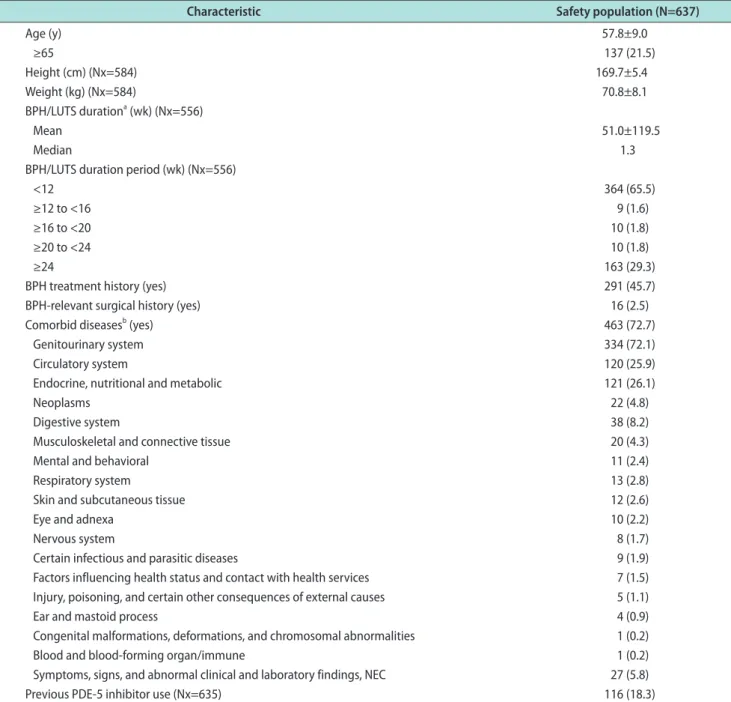
A total of 637 patients were included in the safety analysis, and their baseline demographics and clini- cal characteristics are shown in Table 1. Of these, 265 patients were included in the 12-week effectiveness
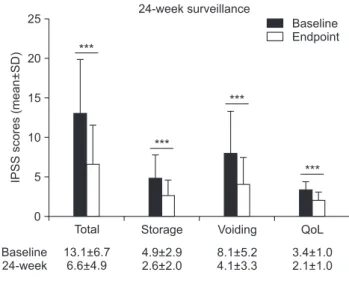
evaluation, and 44 patients were included in the 24- week surveillance effectiveness analysis (Fig. 1).
Excluded from safety analysis: N=74 Administration before contract: n=4 Violated inclusion/exclusion criteria: n=33
Prostatectomy befere treatment (except for transurethral resection of prostate): n=37
Excluded from 12-week effectiveness analysis: N=372 Missing baseline or endpoint effectiveness evaluation: n=220
Violated follow-up period ( ., <10 weeks or >14 weeks):
n=152
i.e
Excluded from 24-week effectiveness analysis: N=221 Did not consent to 24-week surveillance: n=166 Violated 24-week follow-up period
(i.e., <22 weeks or >26 weeks): n=55 Safety analysis:
N=637
12-week effectiveness N=265 analysis:
24-week effectiveness analysis: N=44 CRF retrieved:
N=711
Fig. 1. Patient populations for the safety and effectiveness analyses. CRF: case report form.
Table 2. Concomitant medication by medical specialty
Safety population (N=637) Concomitant medication usage
Yes 420 (65.9)
No 217 (34.1)
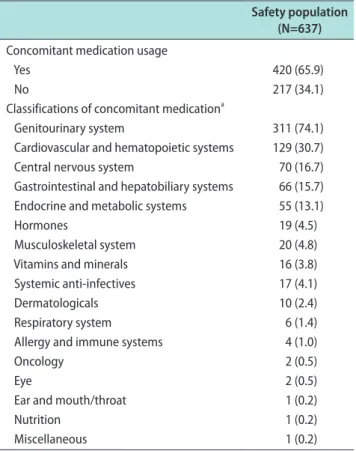
Classifications of concomitant medicationa
Genitourinary system 311 (74.1)
Cardiovascular and hematopoietic systems 129 (30.7)
Central nervous system 70 (16.7)
Gastrointestinal and hepatobiliary systems 66 (15.7) Endocrine and metabolic systems 55 (13.1)
Hormones 19 (4.5)
Musculoskeletal system 20 (4.8)
Vitamins and minerals 16 (3.8)
Systemic anti-infectives 17 (4.1)
Dermatologicals 10 (2.4)
Respiratory system 6 (1.4)
Allergy and immune systems 4 (1.0)
Oncology 2 (0.5)
Eye 2 (0.5)
Ear and mouth/throat 1 (0.2)
Nutrition 1 (0.2)
Miscellaneous 1 (0.2)
Values are presented as number (%). aCoding dictionary: Korean In- dex of Medical Specialties. Patients may appear in >1 category.
2. Demographics, baseline clinical character- istics, concomitant medications, and drug exposure
The mean age of the safety population was 57.8±9.0 years (Table 1), ranging from 30 to 86 years, with 83.7%
(n=533) patients aged ≥50 years and 21.5% (n=137) aged
≥65 years. The majority of patients (65.5%) had BPH/
LUTS for <12 weeks prior to initiating treatment, and 18.3% had a history of PDE-5 inhibitor use (Table 1).
Common comorbidities included diseases of the geni- tourinary (72.1%), circulatory (25.9%), and endocrine, nutritional, and metabolic systems (26.1%) (Table 1).
In accordance with this, a relatively high number of patients used concomitant medications throughout the study period, the most common of which were for genitourinary system (74.1%) and cardiovascular and hematopoietic system diseases (30.7%) (Table 2). Of the patient population examined in the effectiveness anal- yses, 27.8% (10 of 36), 73.1% (117 of 160), and 81.2% (56 of 69) had mild (total IPSS ≤7), moderate (total IPSS 8–19), and severe (total IPSS ≥20) BPH/LUTS, respectively, at baseline. Patients received tadalafil 5 mg QD over
a mean administration period (±SD) of 15.8±13.3 weeks (Table 3).
3. Safety: treatment-emergent adverse events
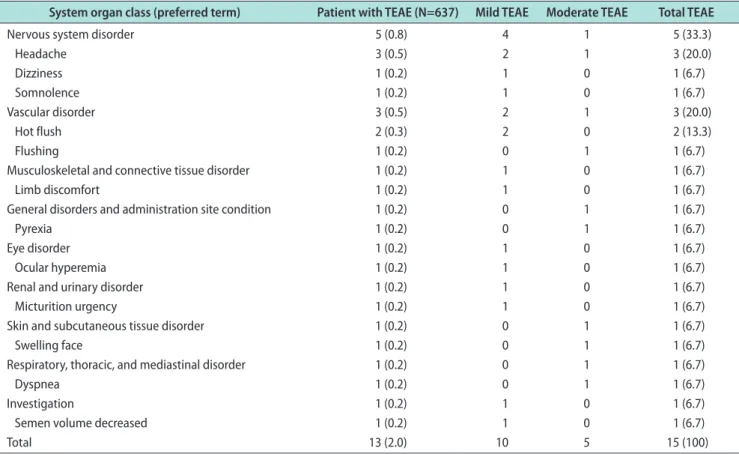
Two percent of patients (n=13) experienced 15 TEAEs of mild (n=10; 66.7%) or moderate (n=5; 33.3%) sever-
Table 3. Exposure to tadalafil
Exposure Safety population (N=637) Total administration duration (wk) (Nx=628)
Mean 15.8±13.3
Median 13.0 (0.1–108.9)
Treatment period (wk) (Nx=628)
<12 239 (38.1)
≥12 to <16 183 (29.1)
≥16 to <20 25 (4.0)
≥20 to <24 15 (2.4)
≥24 to <28 114 (18.2)
≥28 52 (8.3)
Values are presented as mean±standard deviation, median (range), or number (%). Nx: number of patients with non-missing information (only these patients were included in the analysis).
Table 4. TEAEs by MedDRA system organ class and preferred terms
System organ class (preferred term) Patient with TEAE (N=637) Mild TEAE Moderate TEAE Total TEAE
Nervous system disorder 5 (0.8) 4 1 5 (33.3)
Headache 3 (0.5) 2 1 3 (20.0)
Dizziness 1 (0.2) 1 0 1 (6.7)
Somnolence 1 (0.2) 1 0 1 (6.7)
Vascular disorder 3 (0.5) 2 1 3 (20.0)
Hot flush 2 (0.3) 2 0 2 (13.3)
Flushing 1 (0.2) 0 1 1 (6.7)
Musculoskeletal and connective tissue disorder 1 (0.2) 1 0 1 (6.7)
Limb discomfort 1 (0.2) 1 0 1 (6.7)
General disorders and administration site condition 1 (0.2) 0 1 1 (6.7)
Pyrexia 1 (0.2) 0 1 1 (6.7)
Eye disorder 1 (0.2) 1 0 1 (6.7)
Ocular hyperemia 1 (0.2) 1 0 1 (6.7)
Renal and urinary disorder 1 (0.2) 1 0 1 (6.7)
Micturition urgency 1 (0.2) 1 0 1 (6.7)
Skin and subcutaneous tissue disorder 1 (0.2) 0 1 1 (6.7)
Swelling face 1 (0.2) 0 1 1 (6.7)
Respiratory, thoracic, and mediastinal disorder 1 (0.2) 0 1 1 (6.7)
Dyspnea 1 (0.2) 0 1 1 (6.7)
Investigation 1 (0.2) 1 0 1 (6.7)
Semen volume decreased 1 (0.2) 1 0 1 (6.7)
Total 13 (2.0) 10 5 15 (100)
Values are presented as number (%). Patients may appear in >1 category. TEAE: treatment-emergent adverse events, MedDRA: Medical Dictionary for Regulatory Activities version 19.0.
ity. No severe TEAEs and no SAEs were reported.
Causal relationships between TEAEs and the study medication were considered as ‘possible’ (n=8; 53.3%) or
‘unlikely’ (n=7; 46.7%) by investigators, with no TEAEs classified as ‘certain’ or ‘probable/likely’ associated with the treatment. The most frequently reported TEAEs were headache (0.5%; 3 of 637 patients, 3 events) and hot flashes (0.3%; 2 of 637 patients, 2 events) (Table 4).
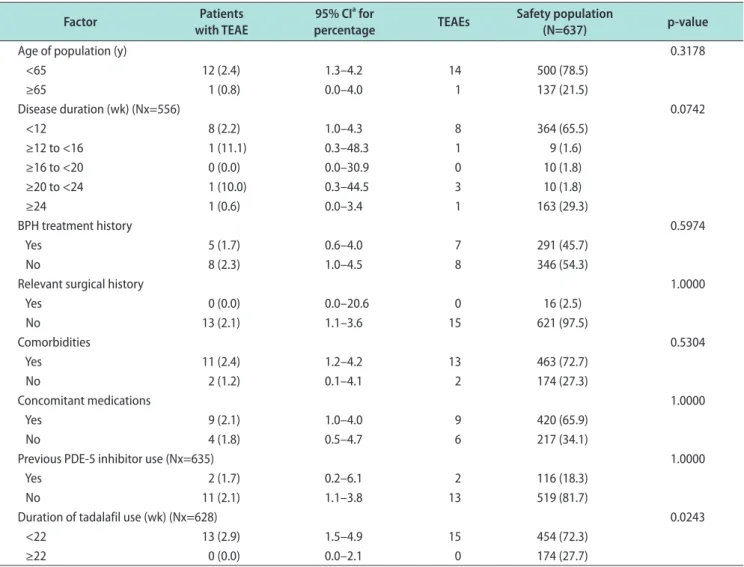
Six patients (6 of 637; 0.9%) reported TEAEs (8 events) as the reason for abandonment at follow-up. No signifi- cant differences in the incidence of TEAEs were found when analyzed according to several factors, including age ≥65 years, disease duration, BPH treatment his- tory, BPH-relevant surgical history, comorbid diseases, previous PDE-5 inhibitor treatment, and concomitant medication usage (Table 5). When analyzed by the total
duration of tadalafil administration, TEAEs were only found in patients receiving treatment for <22 weeks (N=454) and not in those receiving treatment ≥22 weeks (N=174; p=0.0243; Table 5).
4. Effectiveness: International Prostate Symp- tom Score
The mean IPSS scores and change from baseline were plotted for each endpoint (Fig. 2). Statistically significant changes from baseline were observed for the IPSS total score at both the 12- and 24-week end- points, as well as for the IPSS storage subscore, void- ing subscore, and QoL subscore (Fig. 2B). Regardless of baseline BPH/LUTS severity, the majority (69.1%; 183 of 265) of patients had a ≥3 score decrease in their to- tal IPSS, which was considered a clinically meaningful
Table 5. TEAEs by factors
Factor Patients
with TEAE
95% CIa for
percentage TEAEs Safety population
(N=637) p-value
Age of population (y) 0.3178
<65 12 (2.4) 1.3–4.2 14 500 (78.5)
≥65 1 (0.8) 0.0–4.0 1 137 (21.5)
Disease duration (wk) (Nx=556) 0.0742
<12 8 (2.2) 1.0–4.3 8 364 (65.5)
≥12 to <16 1 (11.1) 0.3–48.3 1 9 (1.6)
≥16 to <20 0 (0.0) 0.0–30.9 0 10 (1.8)
≥20 to <24 1 (10.0) 0.3–44.5 3 10 (1.8)
≥24 1 (0.6) 0.0–3.4 1 163 (29.3)
BPH treatment history 0.5974
Yes 5 (1.7) 0.6–4.0 7 291 (45.7)
No 8 (2.3) 1.0–4.5 8 346 (54.3)
Relevant surgical history 1.0000
Yes 0 (0.0) 0.0–20.6 0 16 (2.5)
No 13 (2.1) 1.1–3.6 15 621 (97.5)
Comorbidities 0.5304
Yes 11 (2.4) 1.2–4.2 13 463 (72.7)
No 2 (1.2) 0.1–4.1 2 174 (27.3)
Concomitant medications 1.0000
Yes 9 (2.1) 1.0–4.0 9 420 (65.9)
No 4 (1.8) 0.5–4.7 6 217 (34.1)
Previous PDE-5 inhibitor use (Nx=635) 1.0000
Yes 2 (1.7) 0.2–6.1 2 116 (18.3)
No 11 (2.1) 1.1–3.8 13 519 (81.7)
Duration of tadalafil use (wk) (Nx=628) 0.0243
<22 13 (2.9) 1.5–4.9 15 454 (72.3)
≥22 0 (0.0) 0.0–2.1 0 174 (27.7)
Values are presented as number (%). TEAE: treatment-emergent adverse event, CI: confidence interval, Nx: number of patients with non-missing information (only these patients were included in the analysis), BPH: benign prostatic hyperplasia, PDE-5: phosphodiesterase type 5. aCalculated by exact methods.
improvement. The effectiveness of tadalafil was not found to be influenced by advanced age (≥65 years of age), disease duration, BPH-relevant surgical history, or previous PDE-5 inhibitor usage for either surveillance period (data not shown). Statistically significant chang- es were found at 12 weeks for patients with a BPH treatment history (140 of 265 vs. 125 of 265 with no his- tory; mean change in total IPSS [± standard error, SE]
-5.2±0.4 vs. -4.0±0.4, respectively; p=0.0308) and patients taking concomitant medications (179 of 265 vs. 86 of 265 not on concomitant medication; mean change in to- tal IPSS change [±SE] -5.1±0.4 vs. -3.7±0.4, respectively;
p=0.0217). The most common concomitant medications in the latter analysis were for genitourinary (140 of 179), cardiovascular and hematopoietic (54 of 179), and gastrointestinal and hepatobiliary system (35 of 179) disorders. Further, patients receiving treatment for
≥22 weeks (113 of 264) showed a greater improvement in the total IPSS than those in the <22 weeks group (151 of 264) (mean change in total IPSS [±SE] -6.0±0.5
vs. -3.7±0.3, respectively; p<0.0001). Significantly greater improvements in symptoms were also found at the 24- week endpoint for those patients with a comorbidity (38 of 44 vs. 6 of 44 without a comorbidity; mean change in total IPSS [±SE] -7.0±0.7 vs. -2.5±0.9, respectively;
p=0.0154), with the comorbidities primarily compris- ing genitourinary diseases (31 of 44). In the sensitivity analysis (endpoints ±6 weeks), statistically significant changes in the IPSS total score and subscores were ob- served at both endpoints, consistent with the original analyses (data not shown).
DISCUSSION
This study demonstrates that tadalafil 5 mg QD for the treatment of BPH/LUTS had favorable safety and effectiveness in a real-world clinical setting. A rela- tively low number of mild to moderate TEAEs were reported, with their incidence not significantly associ- ated with any baseline parameter. In contrast to other A
IPSSscores(mean+SD)
25
20
15
10
5
12-week surveillance
0
Baseline Endpoint
Baseline 12-week
Total
***
Storage
***
Voiding
***
QoL
***
15.1+6.6 10.4+5.9
5.8+3.0 4.1+2.5
9.3+4.6 6.3+4.0
3.6+1.1 2.6+1.1
IPSSscores(mean+SD)
25
20
15
10
5
24-week surveillance
0
Baseline Endpoint
Baseline 24-week
Total
***
Storage
***
Voiding
***
QoL
***
13.1+6.7 6.6+4.9
4.9+2.9 2.6+2.0
8.1+5.2 4.1+3.3
3.4+1.0 2.1+1.0
B
ChangefrombaselineIPSS(mean+SD)
12-week surveillance 24-week surveillance
12-week 24-week 0 1 2 3 4 5 6 7 8
Total Storage Voiding QoL
4.7+0.3 6.4+0.7
***
1.7+0.1 2.4+0.3
1.0+0.1 1.3+0.1
***
***
3.0+0.2 4.1+0.5
***
Fig. 2. Change in IPSS scores as a measure of treatment effectiveness.
(A) Mean IPSS total score and subscores for the 12-week (N=265) and 24- week surveillance groups (N=44). Mean±SD is shown. (B) Mean change from baseline on all IPSS scores. Error bars represent±SE. ***p<0.0001.
IPSS: International Prostate Symptom Score, SD: standard deviation, QoL:
quality of life, SE: standard error.
drug therapies available in South Korea for BPH/
LUTS, such as a-blockers and 5-a-reductase inhibitors [7,17], none of the TEAEs were associated with sexual dysfunction, supporting results from previous clini- cal studies [11-14,18-21]. Currently, tadalafil is the only drug available in South Korea for the treatment of both BPH/LUTS and ED that is not associated with sexual dysfunction side effects, and it is the only daily treatment approved for BPH/LUTS [17]. Interestingly, TEAEs were reported only by patients receiving treat- ment for <22 weeks and not by those receiving ≥22 weeks of treatment. This suggests that tadalafil use for
≥22 weeks may be well tolerated; however, this find- ing is confounded by the fact that the <22-week group contained a greater proportion of the safety population than the ≥22-week group.
In terms of effectiveness, both the general population and patients aged ≥65 years showed significant im- provements in the total IPSS, IPSS subscores, and the QoL index, which were sustained in the 24-week sur- veillance group. The current data indicate that a prior history of BPH treatment and concomitant medication usage at the 12-week endpoint and comorbidity at the 24-week endpoint may be favorably associated with tadalafil-mediated improvement of BPH/LUTS. Since the concomitant medications and comorbidities were largely related to urogenital disorders, these findings are not surprising given the known or suspected broad actions of tadalafil across the lower urinary tract (e.g., vasodilation, anti-inflammatory, and antiproliferative actions) [4,8,22]. However, due to the relatively small study populations, particularly in the 24-week analyses (largely due to many study sites [22 of 29] opting not to participate in the longer surveillance period), the clini- cal relevance of these findings is not yet clear.
Due to the inherently observational nature of post- marketing surveillance studies, additional limitations on the interpretation of the current data exist. Nota- bly, the study lacked parallel control and comparator groups within the same study cohort, and the safety and effectiveness outcomes of tadalafil 5 mg QD could only be determined based on the change from baseline for each patient. However, the safety and effective- ness demonstrated for tadalafil 5 mg QD treatment in this BPH/LUTS Korean patient population is con- sistent with that observed in previous randomized, placebo-controlled clinical studies investigating 12-week tadalafil 5 mg treatment in Asian [11-14] and Cauca-
sian [18-21] populations with BPH/LUTS. A series of analyses integrating the data pooled from different subsets of these clinical trials consistently found that tadalafil 5 mg QD progressively and significantly im- proved IPSS total scores over 12 weeks compared to placebo, simultaneously improving ED, with no serious safety concerns [10,22-24]. In the future, larger stud- ies are desirable in order to determine the potential influences of specific additional BPH medications (e.g., α-blockers and 5-α-reductase inhibitors) and other func- tional bladder diseases (e.g., neurogenic bladder and overactive bladder) on the effectiveness of tadalafil.
CONCLUSIONS
This study adds to the existing data on tadalafil 5 mg QD for the treatment of BPH/LUTS, demonstrat- ing that the favorable safety and effectiveness ob- served in clinical studies for tadalafil extends to a real- world clinical setting. Further, this study reinforces the data on tadalafil 5 mg QD as a safe and effective treatment for the management of patients with BPH/
LUTS with and without ED as a comorbidity.
ACKNOWLEDGEMENTS
We thank the patients, their families, the study sites, and the study personnel who participated in this post- marketing surveillance study. This study and produc- tion of this manuscript were sponsored by Eli Lilly and Company. Medical writing (Marissa Philpott, Prudence Stanford, and Kaye Stenvers) and editorial support (Antonia Baldo and Teri Tucker) was provided by in- Ventiv Health Clinical and funded by Eli Lilly and Company.
Disclosure
The authors have no potential conflicts of interest to disclose.
Author Contribution
Research conception & design: Won JE, Chu JY, Choi HC, Chen Y, Park HJ, Dueñas HJ. Performing the experiments:
Won JE, Choi HC, Park HJ. Data acquisition: Chu JY, Choi HC, Chen Y, Dueñas HJ. Data analysis and interpretation:
Choi HC, Chen Y, Dueñas HJ. Statistical analysis: Choi HC, Chen Y, Dueñas HJ. Drafting of the manuscript: Choi HC,
Chen Y, Dueñas HJ. Critical revision of the manuscript: Won JE, Chu JY, Choi HC, Park HJ. Approval of final manuscript:
all authors.
REFERENCES
1. Gratzke C, Bachmann A, Descazeaud A, Drake MJ, Mad- ersbacher S, Mamoulakis C, et al. EAU Guidelines on the Assessment of Non-neurogenic Male Lower Urinary Tract Symptoms including Benign Prostatic Obstruction. Eur Urol 2015;67:1099-109.
2. McVary KT, Roehrborn CG, Avins AL, Barry MJ, Bruske- witz RC, Donnell RF, et al. Update on AUA guideline on the management of benign prostatic hyperplasia. J Urol 2011;185:
1793-803.
3. Park HJ, Won JE, Sorsaburu S, Rivera PD, Lee SW. Urinary tract symptoms (LUTS) secondary to benign prostatic hy- perplasia (BPH) and LUTS/BPH with erectile dysfunction in Asian men: a systematic review focusing on tadalafil. World J Mens Health 2013;31:193-207.
4. Yokoyama O, Igawa Y, Takeda M, Yamaguchi T, Murakami M, Viktrup L. Tadalafil for lower urinary tract symptoms second- ary to benign prostatic hyperplasia: a review of clinical data in Asian men and an update on the mechanism of action. Ther Adv Urol 2015;7:249-64.
5. Yang HJ, Lee JH, Kim YJ, Yoon JH, Lee HS. Antiviral efficacy of combination therapy with entecavir and adefovir for ente- cavir/lamivudine-resistant hepatitis B virus with or without adefovir resistance. J Med Virol 2012;84:424-30.
6. Kang JY, Min GE, Son H, Kim HT, Lee HL. National-wide data on the treatment of BPH in Korea. Prostate Cancer Pros- tatic Dis 2011;14:243-7.
7. Oh CY, Lee SH, Yoo SJ, Chung BH. Korean urologist’s view of practice patterns in diagnosis and management of benign prostatic hyperplasia: a nationwide survey. Yonsei Med J 2010;
51:248-52.
8. Albisinni S, Biaou I, Marcelis Q, Aoun F, De Nunzio C, Roumeguère T. New medical treatments for lower urinary tract symptoms due to benign prostatic hyperplasia and fu- ture perspectives. BMC Urol 2016;16:58.
9. Cindolo L, Pirozzi L, Sountoulides P, Fanizza C, Romero M, Castellan P, et al. Patient’s adherence on pharmacological therapy for benign prostatic hyperplasia (BPH)-associated lower urinary tract symptoms (LUTS) is different: is combi- nation therapy better than monotherapy? BMC Urol 2015;15:
96.
10. Lee SW, Paick JS, Park HJ, Won JE, Morisaki Y, Sorsaburu S, et al. The efficacy and safety of tadalafil 5 mg once daily in
Korean men with lower urinary tract symptoms suggestive of benign prostatic hyperplasia: an integrated analysis. World J Mens Health 2014;32:28-35.
11. Kim SC, Park JK, Kim SW, Lee SW, Ahn TY, Kim JJ, et al.
Tadalafil administered once daily for treatment of lower uri- nary tract symptoms in Korean men with benign prostatic hyperplasia: results from a placebo-controlled pilot study using tamsulosin as an active control. Low Urin Tract Symp- toms 2011;3:86-93.
12. Takeda M, Nishizawa O, Imaoka T, Morisaki Y, Viktrup L.
Tadalafil for the treatment of lower urinary tract symptoms in Japanese men with benign prostatic hyperplasia: results from a 12-week placebo-controlled dose-finding study with a 42- week open-label extension. Low Urin Tract Symptoms 2012;4:
110-9.
13. Takeda M, Yokoyama O, Lee SW, Murakami M, Morisaki Y, Viktrup L. Tadalafil 5 mg once-daily therapy for men with lower urinary tract symptoms suggestive of benign prostatic hyperplasia: results from a randomized, double-blind, place- bo-controlled trial carried out in Japan and Korea. Int J Urol 2014;21:670-5.
14. Yokoyama O, Yoshida M, Kim SC, Wang CJ, Imaoka T, Morisaki Y, et al. Tadalafil once daily for lower urinary tract symptoms suggestive of benign prostatic hyperplasia: a ran- domized placebo- and tamsulosin-controlled 12-week study in Asian men. Int J Urol 2013;20:193-201.
15. Choi HR, Chung WS, Shim BS, Kwon SW, Hong SJ, Chung BH, et al. Translation validity and reliability of I-PSS Korean version. Korean J Urol 1996;37:659-65.
16. Barry MJ, Williford WO, Chang Y, Machi M, Jones KM, Walker-Corkery E, et al. Benign prostatic hyperplasia specific health status measures in clinical research: how much change in the American Urological Association symptom index and the benign prostatic hyperplasia impact index is perceptible to patients? J Urol 1995;154:1770-4.
17. Yeo JK, Choi H, Bae JH, Kim JH, Yang SO, Oh CY, et al. Kore- an clinical practice guideline for benign prostatic hyperplasia.
Investig Clin Urol 2016;57:30-44.
18. McVary KT, Roehrborn CG, Kaminetsky JC, Auerbach SM, Wachs B, Young JM, et al. Tadalafil relieves lower urinary tract symptoms secondary to benign prostatic hyperplasia. J Urol 2007;177:1401-7.
19. Oelke M, Giuliano F, Mirone V, Xu L, Cox D, Viktrup L.
Monotherapy with tadalafil or tamsulosin similarly improved lower urinary tract symptoms suggestive of benign prostatic hyperplasia in an international, randomised, parallel, place- bo-controlled clinical trial. Eur Urol 2012;61:917-25.
20. Porst H, Kim ED, Casabé AR, Mirone V, Secrest RJ, Xu L,
et al. Efficacy and safety of tadalafil once daily in the treat- ment of men with lower urinary tract symptoms suggestive of benign prostatic hyperplasia: results of an international randomized, double-blind, placebo-controlled trial. Eur Urol 2011;60:1105-13.
21. Roehrborn CG, McVary KT, Elion-Mboussa A, Viktrup L.
Tadalafil administered once daily for lower urinary tract symptoms secondary to benign prostatic hyperplasia: a dose finding study. J Urol 2008;180:1228-34.
22. Gacci M, Andersson KE, Chapple C, Maggi M, Mirone V, Oelke M, et al. Latest evidence on the use of phosphodiester- ase type 5 inhibitors for the treatment of lower urinary tract symptoms secondary to benign prostatic hyperplasia. Eur
Urol 2016;70:124-33.
23. Gacci M, Corona G, Salvi M, Vignozzi L, McVary KT, Kaplan SA, et al. A systematic review and meta-analysis on the use of phosphodiesterase 5 inhibitors alone or in combination with α-blockers for lower urinary tract symptoms due to benign prostatic hyperplasia. Eur Urol 2012;61:994-1003.
24. Nishizawa O, Yoshida M, Takeda M, Yokoyama O, Mori- saki Y, Murakami M, et al. Tadalafil 5 mg once daily for the treatment of Asian men with lower urinary tract symptoms secondary to benign prostatic hyperplasia: analyses of data pooled from three randomized, double-blind, placebo-con- trolled studies. Int J Urol 2015;22:378-84.