c cc
2013 The Korean Academy of Prosthodontics
This is an Open Access article distributed under the terms of the Creative Commons Attribution Non-Commercial License (http://creativecommons.org/licens- es/by-nc/3.0) which permits unrestricted non-commercial use, distribution, and reproduction in any medium, provided the original work is properly cited.
*Corresponding Author: Jae-Jun Ryu
Korea University Ansan Hospital, Gojan 1-dong, Danwon-gu, Ansan, Gyeonggi-do, 425-707, Korea
+82 31 412 5370: e-mail, [email protected]
Article history: Received October 10, 2012 / Last Revision December 8, 2012 / Accepted January 5, 2013
서론
최근 치과치료에 대한 심미적인 요구가 높아짐에 따라 구치 부 수복 시 전통적인 아말감 및 골드 인레이 대신 치아색 수복 을 원하는 환자들이 많아지고 있다. 이러한 심미수복 방법에 는 복합레진을 이용한 직접법과 인레이를 이용한 간접법이 있 다. 구강 내의 와동에 복합레진을 직접 충전할 경우에는 재료 자체의 특성상 여러 임상적 문제점들이 나타날 수 있는데, 중
합수축으로 인한 미세누출, 이차 우식증, 술후 지각과민증 등 이 가장 큰 문제이고, 낮은 마모저항성과 수분에 의한 가수분 해 붕괴를 일으키는 결함이 있다.1복합레진 직접 충전법의 문 제점을 극복하기 위해서 대두된 간접법에 의한 인레이 수복 중, 세라믹 인레이는 레진 인레이에 비해 강도가 우수하며 색 조도 보다 투명하여 자연치아와 자연스러운 조화를 이룬다. 세 라믹 인레이 수복은 여러 논문을 통해 치아수복 시 훌륭한 임 상 결과를 보여 주며,2,3Computer-aided design and computer-aided http://dx.doi.org/10.4047/jkap.2013.51.1.20 ORIGINAL ARTICLE
CAD/CAM 세라믹 인레이에 대한 3종의 레진 시멘트의 전단결합강도에 관한 연구
백철우1�∙박철우1�∙박준섭2∙류재준1*
1고려대학교 임상치의학대학원 심미수복학과, 2굿윌치과병원
Shear bond strength of the three different kinds of resin cement on CAD/CAM ceramic inlay
Chul-Woo Baek1�, DDS, MSD, Cheol-Woo Park1�, DDS, MSD, Jun-Sub Park2, DDS, MSD, PhD, Jae-Jun Ryu1*, DDS, MSD, PhD
1Department of Esthetic Restorative Dentistry, Graduate School of Clinical Dentistry, Korea University, Seoul, Korea,
2Goodwill Dental Hospital, Pusan, Korea
Purpose: The purpose of this study was to evaluate the bond strengths between the latest CAD/CAM ceramic inlay and various resin cements which are used primarily for esthetic restoration. Materials and methods: Cylindrical ceramic blocks(Height: 5 mm, diameter: 3 mm) were fabricated by using Cerec3 and bonded on the dentin of the ninety extracted caries-free molars using three different kinds of resin cement(Unicem�, Biscem�, and Variolink II�) according to the manufacturer's instructions. Ninety specimens were divided into 3 groups according to three different kinds of resin cement. Half of each group were conducted thermocycling under the conditions of the 5 - 55℃, 5,000 cycle but the other half of them weren't. All specimens were kept in normal saline 37℃, for 24 hours before measuring the bond strength. The shear bond strength was measured by Universal testing machine with a cross head speed of 0.5 mm/min. The results were analyzed statistically by t-test and one-way ANOVA. Results: Unicem�group showed the highest shear bond strength despite a slight decline by thermocycling. The shear bond strength of Unicem�group and ValiolinkII�group were significantly influenced by thermocycling, whereas Biscem�group was not influenced (P<.05). There were no significant differences in the bond strength between the three groups without thermocycling, but there was significant differences between Unicem�group and Valiolink II�group with thermocycling(P<.05). Conclusion: It has been shown to be clinically effective when the self-adhesive resin cements Unicem�and Biscem�were used instead of the etch-and-rinse resin cement Valiolink II�during the bonding of CAD/CAM ceramic inlay restorations with teeth. (J Korean Acad Prosthodont 2013;51:20-6)
Key words: Resin cement; Cerec3; Ceramic inlay; Shear bond strength; Thermocycling
�These authors contributed equally to this work.
manufacturing (CAD/CAM) 시스템의 발전으로 치과기공소를 거 치지 않고 당일 수복이 가능하게 되어 빠른 치료를 원하는 환 자들의 높은 관심을 받고 있다. Cerec 시스템을 이용한 세라믹 수복물의 제작은 그 과정을 단순화시킴으로써 효율적일 뿐만 아니라 신뢰할 만한 결과를 보여 준다.4E.max CAD HT block은 400 MPa 이상의 굽힘강도를 가지며 투명도가 높아 심미성이 아 주 뛰어나다.5
세라믹 인레이의 임상적 성공은 치질과의 접착강도가 중요 하기 때문에 접착제의 선택과 접착과정에 크게 영향을 받는 다.6여러 연구에서 세라믹 인레이의 접착시 글래스 아이오노 머 시멘트나 인산아연 시멘트를 사용한 경우보다 레진 시멘트 를 사용한 경우에 더 높은 결합강도를 보였다고 보고하였다.7,8 하지만 레진 시멘트를 사용하기 위해서는 통상의 산 부식과 프라이머, 본딩 과정을 거쳐야 하기 때문에 불편하다. 최근에 이러한 불편함을 해결하기 위해서 개발된 self-adhesive 레진 시 멘트는 자가 접착 기능을 갖고 있기 때문에 기존의 산 부식과 프라이머, 본딩 과정을 거쳐야 하는 복잡함을 없애고 접착과 정을 한번으로 압축시켰으며 상아질의 전처리 없이도 상아질 과의 접착을 가능하게 하였다.9대표적인 self-adhesive 레진 시멘 트의 제품으로 Unicem�(3M ESPE, Seefeld, Germany)과 Biscem� (BISCO, Schaumberg, USA) 등이 있다.
따라서 CAD/CAM 세라믹 인레이를 수복할 때 임상에서 자주 사용되는 self-adhesive 레진 시멘트와 전통적인 etch-and-rinse 레진 시멘트 사이의 전단결합강도를 측정해 봄으로써, 보다 적합한 레진 시멘트가 무엇인지를 알아보고자 하였다.
연구 재료 및 방법 1. 시편 제작
발거된 우식이 없는 90개의 건전한 대구치를 준비하여 생리 식염수에 보관한 후 fine grit diamond bur를 사용하여 상아질이 노 출되도록 교합면 중심와에서 상아법랑질 경계의 직하방까지 수평으로 삭제하고 600 grit sand paper로 매끈하게 연마하였다.
직경 3 mm, 높이 5 mm 철사를 복제한 균일한 원기둥 모양의 세라믹 블록을 제작하기 위해서 CAD/CAM 시스템(Cerec3, Sirona, Germany) 장비를 이용하여 전용 세라믹 블록(Ivoclar e.max CAD HT block A2 shade, Ivoclar Vivadent, Liechtenstein)을 절삭하였 다. 세라믹 블록의 부착면은 5% 불산으로 20초간 산 부식 및 60
초간 silane (Ultradent, USA) 처리를 시행하였다.
상아질이 노출된 90개의 치아를 3개의 군으로 나누고, 각각 세라믹 블록을 치아면에 접착하기 위해서 2개의 self-adhesive 레진 시멘트(Unicem�, Biscem�)와 통상적인 etch-and-rinse 레진 시 멘트(Variolink II�)를 사용하였다(Table 1). Self-adhesive 레진 시멘 트의 경우 치아 면에는 특별한 처치를 하지 않았고, 레진 시멘 트를 세라믹 블록의 부착면에 고르게 펴서 바르고 한 명의 실 험자가 손가락의 최대 힘을 이용하여 수직방향으로 20초간 압 력을 가하였다. 잉여시멘트는 브러쉬로 제거하고 광중합기 (Bluephase�, Ivoclar Vivadent, Liechtenstein)를 사용하여 4면에서 각 각 20초씩 광조사하였다. Etch-and rinse resin cement은 치아면에 etching과 bonding제를 제조사의 지시대로 적용하였다(Fig. 1).
2. 열순환 처리
구강 내 온도변화를 재현하기 위해서 각 군마다 세라믹 블록 이 접착된 30개의 시편을 절반으로 나눠서 절반은 5 - 55℃, 5,000 cycle 조건 하에서 thermocycling을 시행하였고 다른 절반은 thermocycling을 시행하지 않았다. Thermocycling 과정은 5℃와 55℃ water bath 에 각각 30초씩, 이동시간은 5초의 조건 하에서 이 루어졌고, 열 자극 이외의 시간에는 시편을 37℃, 100% 습도의 incubator에 보관하였다.
Table 1. Composition of resin cements used in this study
Resin cement Main composition Manufacturer
Unicem� methacrylate monomers containing phosphoric acid groups, silanated fillers 3M ESPE, USA Biscem� Bis (hydroxyethyl methacrylate) phosphate (base); tetraethylene glycol dimethacrylate; dental glass Bisco, USA
Variolink II� Bis-GMA+, TEGDMA++, UDMA+++ Ivoclar Vivadent, Liechtenstein
+Bis-GMA: bisphenol A-glycidyl methacrylate, ++TEGDMA: triethyleneglycol dimethacrylate, +++UDMA: urethane dimethacrylate.
Fig. 1. Cementation of ceramic and prepared specimen.
Cylindrical ceramic block (D: 3 mm×H: 5 mm)
Exposed dentine surface
Embedded tooth
Embedding dental sone
3. 전단결합강도의 측정
상아질 면에 세라믹 블록이 접착된 시편을 석고 매몰 후 Universal testing machine (Instron�, MA, USA)에 수직으로 고정하고 0.5 mm/min 의 전단속도로 파절되는 순간의 힘(N/mm2= MPa)을 기록하여 전단결합강도를 측정하였다(Fig. 2).
4. 통계 분석
SAS Ver. 9.2 (SAS Institute, Cary, NC, USA) 프로그램으로 각 군 을 단측검정 t-test를 이용하여 유의수준 0.05로 검증하였다. 세 개의 군을 비교 시 one-way ANOVA를 사용하고 Tukey's test를 이 용하여 사후 검정을 실시하였다.
결과
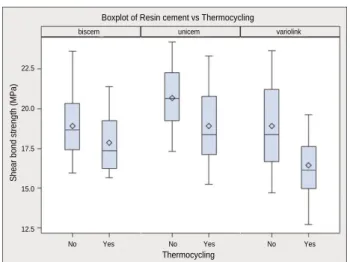
1. 세 군의 전단결합강도 값을 thermocycling 시행 여부 에 따라 비교하였을 때 다음과 같은 결과를 얻었다 (Fig. 3, Tables 2, 3)
(1) Unicem�군은 thermocycling을 시행하지 않은 경우의 평균은 20.67이고 시행한 경우의 평균은 18.93으로 통계적으로 접 착강도에 유의한 차이가 있었다(P<.05).
(2) Biscem�군은 thermocycling을 시행하지 않은 경우의 평균은 18.93이고 시행한 경우의 평균은 17.85로 통계적으로 접 착강도에 유의한 차이가 없었다(P<.05).
(3) Variolink II�군은 thermocycling 을 시행하지 않은 경우의 평 균은 18.91이고 시행한 경우의 평균은 16.43으로 통계적 으로 접착강도에 유의한 차이가 있었다(P<.05).
2. 세 군을 동시에 비교하였을 때 다음과 같은 결과를 얻 었다.
(1) Thermocycling을 시행하지 않은 경우 one-way ANOVA분 석 결과 3개의 군 사이에 통계적으로 유의한 차이가 없었 다(P<.05)(Table 4).
(2) Thermocycling을 시행한 경우one-way ANOVA 분석 결과 3 개 의 군 사이에 통계학적으로 유의한 차이가 있었기 때문 에 다중비교 검토하였다(P<.05)(Table 5). Biscem�군과 Unicem�군은 유의한 차이가 없었고 Biscem�군과 Variolink II�군도 유의한 차이가 없었다. 그러나 Unicem� 군과 Variolink II�군은 유의할 만한 차이가 있었다(Table 6).
Fig. 2. Shear bond test in universal testing machine. Fig. 3. Shear bond strength values of all groups with/without thermocycling.
Table 2. Mean and Standard variation of the shear bond strength (MPa) of all groups with/without thermocycling (Mean ± SD)
Thermocycling Resin cement
Unicem� Biscem� Variolink II� No 20.67 ± 1.98 18.93 ± 2.09 18.91 ± 2.69 Yes 18.93 ± 2.40 17.85 ± 1.91 16.43 ± 2.01
Table 3. T-test of Unicem�, Biscem�, and Variolink II�with/without thermocycling
Group t value P-value*
Unicem� 2.17 .039
Biscem� 1.47 .153
Variolink II� 2.86 .008
Instron cross head (0.5 mm/min)
Cylindrical ceramic block (D: 3 mm×H: 5 mm) Tooth
Metal Zig
Embedding dental stone
Instron�
Boxplot of Resin cement vs Thermocycling biscem unicem variolink
Shear bond strength (MPa)
22.5
20.0
17.5
15.0
12.5
No Yes No Yes No Yes Thermocycling
Thermocycling 시행 여부와 상관없이 Unicem�군은 접착강도의 평균이 20.67 MPa와 18.93 MPa로 다른 레진 시멘트와 근소한 차 이지만 가장 높았다.
고찰
본 연구는 최근 각광받고 있는 CAD/CAM 시스템인 Cerec3 장비를 사용하여 심미수복에 많이 사용되는 Ivoclar e.max CAD HT block과 3종의 레진 시멘트 (Unicem�, Biscem�, Variolink II�) 간의 전단결합강도를 비교하여 세라믹 수복물을 접착하기에 적절한 레진 시멘트를 알아보고, 기존의 etch-and-rinse 레진 시멘 트 대신 self-adhesive 레진 시멘트를 사용하였을 때 접착강도에 문제가 없는지를 알아보고자 하였다.
Etch-and-rinse 레진 시멘트의 경우 여러 단계의 과정을 거치며, 성공적인 접착을 위해서는 전 처리제 및 본딩제의 film thickness 가 중요하다. 만약 균일한 두께를 얻지 못하거나 적절한 wet bonding을 얻지 못할 경우에는 결합력이 감소한다. 반면, self- adhesive 레진 시멘트는 치아를 위한 산성 모노머를 포함하고 있 기 때문에 추가적인 표면 전처리 과정없이 사용가능하고 치면 의 수분조절에 덜 민감하다.10,11또한 여러 논문에서 self-adhesive 레진 시멘트는 기존의 etch-and-rinse 레진 시멘트에서의 접착 계면을 보이지는 않지만 변형된 smear layer를 이용하여 상아질 과 법랑질에서 훌륭한 접착력과 변연적합성을 보여 주었다.12-17 두 종류의 레진 시멘트 간의 결합강도에 대하여 상반된 결과 를 보고한 여러 문헌을 살펴보면, 전단결합강도에 관한 실험 논문 중 Variolink II�가 Unicem�보다 강한 접착을 보인다는 결과 가 있는 반면에,18,19Variolink II�가 Unicem�과 비슷하거나 낮은 값
을 보인다는 결과도 있었다.20,21De Munck 등12과 Flury 등22은 상아 질에 대한 미세인장 결합강도 실험에서 통계학적으로 유의한 차이를 나타내지 않으며, 주사전자현미경 관찰을 통해 self- adhesive 레진 시멘트가 상아질에 아주 얕은 접착을 이루고 있음 을 보고하였다. 한편 self-adhesive 레진 시멘트에 관한 연구에서 Unicem�은 통계적으로 다른 접착제들과 유사한 접착강도를 보이거나,19,21다른 자가 접착 레진 시멘트보다 항상 높은 결합 강도 값을 보고하는 연구가 있어 혼란스럽다.23,24이처럼 서로 다양한 연구 결과를 보이는 이유는 결합강도가 실험 매개 변 수의 적용뿐만 아니라 실험 방법에도 크게 영향을 받기 때문 이다.
법랑질 접착에 대한 self-adhesive 레진 시멘트의 적용방법에 관 해서도 논란이 있기 때문에 본 연구에서는 법랑질을 모두 삭 제하고 상아질 표면만을 접착 대상으로 삼았다. 또한 보다 실 제적인 비교가 되도록 과거 Unicem�연구에서 주로 쓰던 mixing machine을 이용한 혼합 방식이 아니라 다른 self-adhesive 레진 시멘트와 동일한 Unicem clicker type을 선택하였다.
Self-adhesive 레진 시멘트의 장기적인 작용에 관하여 알아 보 기 위해서 thermocycling을 시행한 기존 연구가 많지 않았다.
Brunzel 등25은 RelyX Unicem의 접합력에 관한 연구에서 "soft"
thermocycling (37,500 cycle, 20 - 40℃) 및 "hard" thermocycling (37,500 cycle, 5 - 55℃) 간에 통계적으로 유의한 차이가 없음을 보 고하였고, Holderegger 등26은 5 - 55℃에서 1,500 cycle thermocycling 후 모든 luting 시멘트의 접착력은 감소하였는데, 그 중 RelyX Unicem의 변화가 최소였다고 보고하였다. 본 연구에서는 5 - 55℃
에서 5,000 cycle thermocycling을 시행하였다. 이전 연구에서 ISO TR 11450 표준에 의한 5 - 55℃에서 500 cycle thermocycling이 장기 Table 4. One-way ANOVA for shear bond strength without thermocycling
Source DF Sum of squares Mean square F value P-value
Resin cement 2 30.779 15.389
2.98 .062
Error 42 217.140 5.170
Total 44 247.919
Table 5. One-way ANOVA for shear bond strength with thermocycling
Source DF Sum of squares Mean square F value P-value
Resin cement 2 47.269 23.634
5.28 .009
Error 42 187.828 4.472
Total 44 235.097
Table 6. Result of Tukey multiple comparisons for shear bond strength with thermocycling
Resin cement N Mean SD F value P-value Tukey
Unicem� 15 18.932 2.397 A
Biscem� 15 17.852 1.908 5.28 .009 A,B
Variolink II� 15 16.429 2.007 B
간 상아질 결합의 효율성을 검증하기에는 부족한 것으로 평가 되었다.27Ernst 등28은 5℃와 55℃의 온도가 통상적인 열순환의 조건으로 사용되기에 적절한 온도 범위라고 하였고, Yap 등29이 5,000 cycle 은 임상적으로 약 6개월 정도의 기간과 비슷하다고 하였다.
이상의 연구 결과를 토대로 CAD/CAM을 이용하여 세라믹 인레이를 당일 수복할 때 기존의 etch-and-rinse 레진 시멘트 대신 self-adhesive 레진 시멘트를 사용하더라도 결합강도에는 문제 가 없음을 확인하였다. 그러나 이번 연구에서 다른 사람의 발 치된 치아를 사용하였기 때문에 구강상태를 완벽하게 재현하 거나 완전히 동일한 실험조건을 이루기에 한계가 있었다. 또 한 이번에 3종의 레진 시멘트만 사용되었는데 더 정확한 비교 실험을 위해서 보다 많은 종류의 레진 시멘트와 시편을 대상 으로 추가 연구가 필요하리라 생각된다. 향후 연구에서는 ther- mocycling을 더 많은 cycle 조건 하에서 인공 노화 과정을 더욱 세 분화하거나 기계적 응력 측정(씹는 시뮬레이션 형태의 예) 방 법 및 세라믹과 상아질 계면에서 발생하는 레진 시멘트의 파절 면 분석을 포함한다면 더욱 의미있는 연구가 되리라 사료된다.
결론
Self-adhesive 레진 시멘트인 Unicem�과 Biscem�을 사용하여 CAD/CAM 세라믹 인레이를 접착하면 그 과정이 간략할 뿐만 아니라 접착강도 면에서도 우수하여 etch-and-rinse 레진 시멘트 인 Valiolink II�를 충분히 대체할 수 있으며, 이는 임상적으로 유 용하다.
참고문헌
1. Irie M, Suzuki K. Current luting cements: marginal gap formation of composite inlay and their mechanical properties. Dent Mater 2001;17:347-53.
2. Hayashi M, Tsuchitani Y, Kawamura Y, Miura M, Takeshige F, Ebisu S. Eight-year clinical evaluation of fired ceramic inlays.
Oper Dent 2000;25:473-81.
3. Hayashi M, Tsuchitani Y, Miura M, Takeshige F, Ebisu S. 6-year clinical evaluation of fired ceramic inlays. Oper Dent 1998;23:
318-26.
4. Fasbinder DJ, Dennison JB, Heys D, Neiva G. A clinical eval- uation of chairside lithium disilicate CAD/CAM crowns: a two-year report. J Am Dent Assoc 2010;141:10S-4S.
5. Wiedhahn K. From blue to white: new high-strength material for Cerec-IPS e.max CAD LT. Int J Comput Dent 2007;10:79-91.
6. Diaz-Arnold AM, Vargas MA, Haselton DR. Current status of luting agents for fixed prosthodontics. J Prosthet Dent 1999;81:135-41.
7. Tjan AH, Dunn JR, Grant BE. Marginal leakage of cast gold crowns luted with an adhesive resin cement. J Prosthet Dent 1992;67:11- 5.
8. White SN, Sorensen JA, Kang SK, Caputo AA. Microleakage
of new crown and fixed partial denture luting agents. J Prosthet Dent 1992;67:156-61.
9. Han L, Okamoto A, Fukushima M, Okiji T. Evaluation of physical properties and surface degradation of self-adhesive resin cements. Dent Mater J 2007;26:906-14.
10. Mazzitelli C, Monticelli F, Osorio R, Casucci A, Toledano M, Ferrari M. Effect of simulated pulpal pressure on self-adhesive ce- ments bonding to dentin. Dent Mater 2008;24:1156-63.
11. Moszner N, Salz U, Zimmermann J. Chemical aspects of self- etching enamel-dentin adhesives: a systematic review. Dent Mater 2005;21:895-910.
12. De Munck J, Vargas M, Van Landuyt K, Hikita K, Lambrechts P, Van Meerbeek B. Bonding of an auto-adhesive luting mate- rial to enamel and dentin. Dent Mater 2004;20:963-71.
13. Monticelli F, Osorio R, Mazzitelli C, Ferrari M, Toledano M.
Limited decalcification/diffusion of self-adhesive cements into dentin. J Dent Res 2008;87:974-9.
14. Behr M, Hansmann M, Rosentritt M, Handel G. Marginal adaptation of three self-adhesive resin cements vs. a well-tried adhesive luting agent. Clin Oral Investig 2009;13:459-64.
15. D'Arcangelo C, De Angelis F, D'Amario M, Zazzeroni S, Ciampoli C, Caputi S. The influence of luting systems on the mi- crotensile bond strength of dentin to indirect resin-based composite and ceramic restorations. Oper Dent 2009;34:328-36.
16. Mo¨rmann W, Wolf D, Ender A, Bindl A, Go¨hring T, Attin T. Effect of two self-adhesive cements on marginal adaptation and strength of esthetic ceramic CAD/CAM molar crowns. J Prosthodont 2009;18:403-10.
17. Sarr M, Mine A, De Munck J, Cardoso MV, Kane AW, Vreven J, Van Meerbeek B, Van Landuyt KL. Immediate bonding ef- fectiveness of contemporary composite cements to dentin. Clin Oral Investig 2010;14:569-77.
18. Piwowarczyk A, Bender R, Ottl P, Lauer HC. Long-term bond between dual-polymerizing cementing agents and human hard dental tissue. Dent Mater 2007;23:211-7.
19. Lu¨hrs AK, Guhr S, Gu¨nay H, Geurtsen W. Shear bond strength of self-adhesive resins compared to resin cements with etch and rinse adhesives to enamel and dentin in vitro. Clin Oral Investig 2010;14:193-9.
20. Bitter K, Paris S, Pfuertner C, Neumann K, Kielbassa AM.
Morphological and bond strength evaluation of different resin ce- ments to root dentin. Eur J Oral Sci 2009;117:326-33.
21. Hikita K, Van Meerbeek B, De Munck J, Ikeda T, Van Landuyt K, Maida T, Lambrechts P, Peumans M. Bonding effectiveness of adhesive luting agents to enamel and dentin. Dent Mater 2007;23:71-80.
22. Flury S, Lussi A, Peutzfeldt A, Zimmerli B. Push-out bond strength of CAD/CAM-ceramic luted to dentin with self-adhesive resin cements. Dent Mater 2010;26:855-63.
23. Radovic I, Monticelli F, Goracci C, Vulicevic ZR, Ferrari M. Self- adhesive resin cements: a literature review. J Adhes Dent 2008;10:251-8.
24. Viotti RG, Kasaz A, Pena CE, Alexandre RS, Arrais CA, Reis AF. Microtensile bond strength of new self-adhesive luting agents and conventional multistep systems. J Prosthet Dent 2009;102:306-12.
25. Brunzel S, Yang B, Wolfart S, Kern M. Tensile bond strength of a so-called self-adhesive luting resin cement to dentin. J Adhes Dent 2010;12:143-50.
26. Holderegger C, Sailer I, Schuhmacher C, Schla¨pfer R, Ha¨- mmerle C, Fischer J. Shear bond strength of resin cements to hu- man dentin. Dent Mater 2008;24:944-50.
27. Gale MS, Darvell BW. Thermal cycling procedures for labora-
tory testing of dental restorations. J Dent 1999;27:89-99.
28. Ernst CF, Euler T, Willershausen B. Approximal temperature in- crease and decrease during thermocycling in vivo. J Dent Res 1997;
Special Issue, Abstr 231:42.
29. Yap AU, Wang X, Wu X, Chung SM. Comparative hardness and modulus of tooth-colored restoratives: a depth-sensing mi- croindentation study. Biomaterials 2004;25:2179-85.
ORIGINAL ARTICLE
CAD/CAM 세라믹 인레이에 대한 3종의 레진 시멘트의 전단결합강도에 관한 연구
백철우1�∙박철우1�∙박준섭2∙류재준1*
1고려대학교 임상치의학대학원 심미수복학과, 2굿윌치과병원
연구 목적: 본 연구는 최근 심미수복에 주로 사용되는 CAD/CAM 세라믹 인레이와 각종 레진 시멘트간의 결합강도를 알아보고자 하였다.
연구 재료 및 방법: 원기둥모양의세라믹블록(높이: 5 mm, 직경: 3 mm)을Cerec3로제작하고, 총90개의우식이없는대구치의상아질표면에세종류의레진시멘트(Unicem�, Biscem�, Variolink II�)를 사용하여 각각 제조업체의 지시에 따라 접착했다. 90개의 시편을 레진 시멘트의 종류에 따라 3개의 군으로 나누고, 각 군의 절반은 5 - 55℃, 5,000 cycle 조건 하에서 thermocycling을 시행하였고, 다른 절반은 시행하지 않았다. 모든 시편은 결합강도를 측정하기 전에 37℃ 생리 식염수에 24시간 동안 보관되었다. 전단결합강도 는 만능시험기를 이용하여 0.5 mm/min의 cross head speed로 측정하였다. 결과 값은 t-test 및 one-way ANOVA를 사용하여 통계 분석하였다.
결과:Unicem�군의 전단결합강도가 thermocycling 후에 약간 감소했으나 3 개의 군 중 가장 높은 결합 강도를 보였다. Unicem�및 Valiolink II�군의 전단결합강도가 thermocycling 에 영향을 받았지만 Biscem�은 영향을 받지 않았다(P<.05). Thermocyling 전에는 3개의 군 간의 결합강도에 유의한 차이가 없었지만, thermocyling 후에는 Unicem�과 Valiolink II�군 간에 유의한 차이가 있었다(P<.05).
결론: CAD/CAM 세라믹 인레이 수복물을 치아에 접착할 때, etch-and-rinse 레진 시멘트인 Valiolink II�대신self-adhesive 레진 시멘트인 Unicem�과 Biscem�을 사용해도 임상적 으로 유용하다. (대한치과보철학회지 2013;51:20-6)
주요단어: 레진 시멘트; Cerec3; 세라믹 인레이; 전단결합강도; 열순환
�이 저자들은 본 연구에 동일한 기여를 하였음.
*교신저자: 류재준
425-707 경기 안산시 단원구 고잔1동 516 고려대학교의료원 안산병원 치과 031-412-5370: e-mail, [email protected]
원고접수일: 2012년 10월 10일 / 원고최종수정일: 2012년 12월 8일 / 원고채택일:
2013년 1월 5일
2013 대한치과보철학회
이 글은 크리에이티브 커먼즈 코리아 저작자표시-비영리 3.0 대한민국 라이선스에 따라 이용하실 수 있습니다.
c cc