Printed in the Republic of Korea DOI 10.5012/jkcs.2011.55.3.341
4-Chloro-2-((E)-(Isopropylimino)methyl)phenol 코발트(II) 착물에 대한 결정 구조 및 열분해 연구
Xiao-Hua Pu*
Department of Chemistry and Chemical Engineering, Baoji University of Arts and Sciences, Baoji 721013, P. R. China
(접수 2010. 5. 24; 수정 2010. 11. 15; 게재확정 2011. 2. 21)
Crystal Structure and Thermal Decomposition Studies on Cobalt (II) Complex of 4-Chloro-2-((E)-(Isopropylimino)methyl)phenol
Xiao-Hua Pu*
Department of Chemistry and Chemical Engineering, Baoji University of Arts and Sciences, Baoji 721013, P. R. China. *E-mail: [email protected]
(Received May 24, 2010; Revised November 15, 2010; Accepted February 21, 2011)
요 약. Schiff base 코발트(II) 착물, bis[4-chloro-2-((E)-(isopropylimino) methyl) phenol]cobalt(II),을 합성하고 단결정 X-ray 회절 분석을 하였다. 코발트 (ii) 합성물의 현상학적, 속도론적 및 기계적 특성은 TG/DTG법으로 연구하였다. 실험 데이터 에 기초하여, 활성화 에너지, 지수 앞자리인자, 활성화 엔트로피와 같은 속도론적 파라미터를 계산하였으며, 가장 가능성 있는 메카니즘 함수로는 g(α)=α2이 추정되었다. 따라서, 모든 분해 단계에서 속도 조절 단계는 1차원 확산 과정(Parabolic model) 이다.
주제어: 코발트(II) 착물, 결정 구조, Coats-Redfen, 분해, 속도론적, 가장 가능한 메카니즘
ABSTRACT. The Schiff base cobalt(II) complex, bis[4-chloro-2-((E)-(isopropylimino) methyl) phenol]cobalt(II), has been prepared and characterized by single-crystal X-ray diffraction analyses. The phenomenological, kinetic and mechanistic aspects of the cobalt (II) complex have been studied by TG/DTG techniques. On the basis of the experimental data, the kinetic parameters such as activation energy, pre-exponential factor and entropy of activation were computed, and then the most prob- able mechanism function was estimated as g(α)=α2. Hence the rate controlling process at all stages of decomposition is one- dimensional diffusion (Parabolic model).
Keywords: cobalt(II) complex, crystal structure, Coats-Redfern, decomposition, kinetic, most probable mechanism
INTRODUCTION
Transition metal complexes containing oxygen and nitrogen donor Schiff base ligands had been of research interest for many years for their industrial and biological applications.1-4 Li et. al. had reported the crystal structure of bis[4-chloro-2-(cyclohexylim-inomethyl)-phenolato]- cobalt(II) and bis[4-chloro-2-(cyclohexyliminomethyl)- phenolato]zinc(II),5-6 which are of great interests in coor- dination chemistry in relation to catalysis and enzymatic reactions, magnetism and molecular architectures. The sym- metrical bis(aza crown ether)s cobalt(II) complexes had been prepared and had proven to be a model to mimic hydrolase in PNPP hydrolysis.7 A wide variety of cobalt(II) complexes had been studied as model compounds for nat- ural oxygen carriers and for their use in O2 storage.8 Even
though many Schiff bases using 5-Chlorosalicy-laldehyde and amines had been studied,9-12 as ligands, no work had been done with 5-chlorosalicylaldehyde and isopropy- lamine as the basic nucleus of Schiff bases. In addition, the thermal behaviour of this type of complex is almost unknown, because systematic thermal analysis has not been carried out.
In this paper, we report synthesis and thermal behaviour of a new cobalt(II) complex, bis[4-chloro-2-((E)-(isopro- pylimino)methyl)phenol]cobalt(II) (Scheme 1). The struc- ture of the complex had been established accurately from the single crystal X-ray diffraction study. The Co(II) ion in the monomeric unit seems to reside in a distorted tetra- hedral environment and bonds to two oxygen atoms and two nitrogen atoms from two Schiff bases. Thermal stud- ies supported the chemical formulation of the complex
and showed that the complex decomposes in four steps.
The kinetic parameters such as activation energy, pre- exponential factor and entropy of activation of the com- plex were calculated. The mechanism for the thermal decom- position process was also proposed.
EXPERIMENTAL
Physical measurements
Thermogravimetric analyses were carried out on a Pyris Diamond TG/DTA SII thermal analyzer, Perkin Elmer.
Instrument calibration was performed with standard indium samples of known melting temperature. For the kinetics measurements, about 3 mg sample was weighted in to an open platinum crucible. The selected heating rate was 5 K.min-1, and nitrogen gas of high purity (> 99.999%) with a flow rate of 50 mL min-1 was used as carrier gas.
The kinetic evaluation of the thermal decomposition of the complex was done using origin 8.0.
Synthesis of the complex
To the vigorously stirred solution of 5-Chlorosalicyla- ldehyde (0.1 mmol, 15.7 mg) in EtOH (1 cm3), was added dropwise a colourless solution of isopropylamine (0.1 mmol, 5.9 mg) in solution of EtOH (1 cm3) with stirring at room temperature for 1 h. To the resulting orange solution was added Co(NO3)2·6H2O 0.1 mmol, 35.3 mg). The mix- ture was stirred for 1 h. Dark red block-shaped crystals of the title complex grew after two weeks. The product was filtered, washed with EtOH, and dried over anhydrous CaCl2 in vacuo overnight. Yield: 90%. Anal. Calcd. (%) for (C20H22CON2O2Cl2): C, 54.09; H, 5.19; N, 6.01. Found (%): C, 54.13; H, 5.21; N, 6.05.
X-ray single crystal structure determination A dark red block crystal of the title complex having approximate dimensions of 0.26 mm × 0.22 mm × 0.11 mm
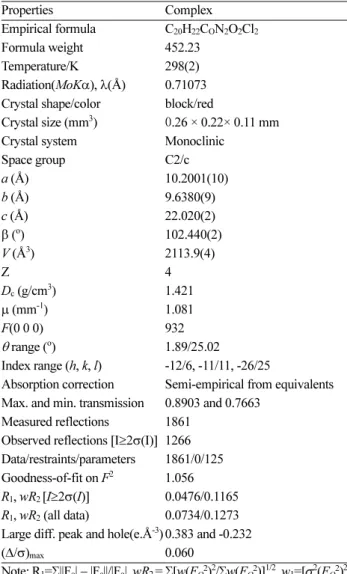
was mounted on a glass fiber in a random orientation. The data were collected on a Bruker SMART 1000 CCD dif- fractometer at 298(2) K. The unit cell parameters and data collections were performed using Bruker SMART program13 with graphite-monochromatic MoKα radiation (λ=0.71073Å). Semiempirical absorption correction was applied by using the SADABS program.14 The structure was solved by direct methods and refined by full-matrix least-squares techniques on F2 using the SHELXL-97 program package.15 All the non-hydrogen atoms were refined anisotropically, and hydrogen atoms were located at their idealized positions. The crystal data and structure refinement parameters for the complex are summarized in Table 1. Selected bond lengths and angles are given in Table 2.
Scheme 1. The structure of the title complex.
Table 1. Crystal data and structure refinement parameters Properties Complex
Empirical formula C20H22CON2O2Cl2
Formula weight 452.23
Temperature/K 298(2)
Radiation(MoKα), λ(Å) 0.71073 Crystal shape/color block/red
Crystal size (mm3) 0.26 × 0.22× 0.11 mm Crystal system Monoclinic
Space group C2/c
a (Å) 10.2001(10)
b (Å) 9.6380(9)
c (Å) 22.020(2)
β (o) 102.440(2)
V (Å3) 2113.9(4)
Z 4
Dc (g/cm3) 1.421
µ (mm-1) 1.081
F(0 0 0) 932
θ range (o) 1.89/25.02
Index range (h, k, l) -12/6, -11/11, -26/25
Absorption correction Semi-empirical from equivalents Max. and min. transmission 0.8903 and 0.7663
Measured reflections 1861 Observed reflections [I≥2σ(I)] 1266
Data/restraints/parameters 1861/0/125 Goodness-of-fit on F2 1.056
R1, wR2[I≥2σ(I)] 0.0476/0.1165 R1, wR2 (all data) 0.0734/0.1273 Large diff. peak and hole(e.Å-3) 0.383 and -0.232
(∆/σ)max 0.060
Note: R1=Σ||Fo|− |Fc||/|Fo|, wR2=Σ[w(FO2)2/Σw(FO2)]1/2, w1=[σ2(FO2)2 + (0.0612(FO2 + 2FC2)/3)2 + 0.0000(FO2 + 2)/3)]-1
RESULTS AND DISCUSSIONS
Description of the crystal structure
The structure of the complex including atom-number- ing scheme, is shown in Fig. 1. The X-ray diffraction anal- ysis of the complex shows, that the central cobalt(II) atom is four coordinate and bonds to two nitrogen atoms and two oxygen atoms from two 4-chloro-2-((E)-(isopropy- limino)methyl)phenol Schiff bases in the usual trans arrangement. Each Schiff base acts as a bidentate ligand.
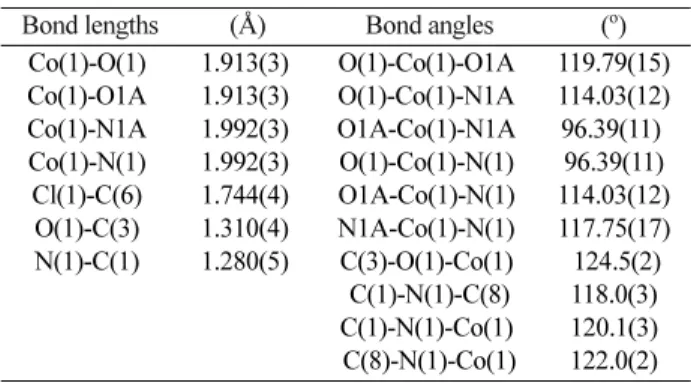
The geometry around cobalt(II) is in a distorted tetrahe- dral environment, where the dihedral angle between the two coordination planes defined by O1Co1N1 and O1ACo1N1A is 86.60o, nearly perpendicular, which could be interpreted in terms of the isopropyl substituent having a bigger steric effect than the diphenylmethyl sub- stituent on the geometry of these kinds of complexes.16 The phenyl ring plane (C2/C3/C4/C5/C6/C7) and the che- late ring (O1/Co1/N1/C1/C2/C3) are nearly coplanar with a dihedral angle of 3.4(2)o. This is true of the correspond- ing planes which were generated by symmetry. Bond angles also show that the coordination geometry about the cobalt atom is a distorted tetrahedral structure, with O1Co1N1, N1Co1N1A and O1Co1O1A angles of 96.39(11),
117.75(17) and 119.79(15), respectively. The Co1O1 and Co1N1 distances are 1.913(3) and 1.992(3) Å, respec- tively, which are approached to the values found in other four coordinate cobalt complexes with similar ligands.5,8 Discrete monomeric molecules in both structures are held together by weak intermolecular interactions of cobalt atom with H8 and weak hydrogen bonds C9-H9---C2, which connect the independent molecules to form a one- dimentional chain (Fig. 2).
Phenomenological aspect
The thermal behavior of the complex was characterized using TG/DTG methods. The TG/DTG measurements of the complex were carried out within a temperature range from room temperature up to 800oC. Typical thermo- gram of the complex is shown in Fig. 3. The complex undergoes a four-stage decomposition pattern in the range 107-582oC. The first decomposition stage starts at 107 and ends at 167oC with the DTG peak at 133oC. The cor- responding mass loss (9.5%) is attributed to the loss of the adsorbed water molecules.17 The second stage of decom- position starts at 194 and comes to an end at 345oC with the DTG peak at 330oC. The corresponding mass loss is 11.57% (calcd. 12.17%), which is associated with the decomposition of one (CH3)2C-N group of the ligand. Par- tial decomposition starts with the third step, which fol- lows immediately after the second step in the 345-414oC range with DTG peak at 387oC. This step includes sep- aration of the other (CH3)2C-N from the ligand with a mass loss 11.21% (calcd. 12.17%). The remaining part of the ligand is lost in the 414-590oC range where the final decomposition takes place at 520 with metal carbonate as the residue.18
Table 2. Selected bond lengths and bond angles
Bond lengths (Å) Bond angles (o) Co(1)-O(1)
Co(1)-O1A Co(1)-N1A Co(1)-N(1) Cl(1)-C(6) O(1)-C(3) N(1)-C(1)
1.913(3) 1.913(3) 1.992(3) 1.992(3) 1.744(4) 1.310(4) 1.280(5)
O(1)-Co(1)-O1A O(1)-Co(1)-N1A O1A-Co(1)-N1A O(1)-Co(1)-N(1) O1A-Co(1)-N(1) N1A-Co(1)-N(1) C(3)-O(1)-Co(1) C(1)-N(1)-C(8) C(1)-N(1)-Co(1) C(8)-N(1)-Co(1)
119.79(15) 114.03(12) 96.39(11) 96.39(11) 114.03(12) 117.75(17) 124.5(2) 118.0(3) 120.1(3) 122.0(2) Symmetry codes: (A) -x+1,y,-z+3/2
Fig. 1. Molecular structure of the title complex. Displacement ellipsoids are drawn at the 30% probability level.
Fig. 2. The packing structure of the complex along the b-axis, showing the formation of 1D-chains by weak intermolecular Co….H interactions and weak hydrogen bonds C9-H9---C2.
Kinetic aspect
According to non-isothermal kinetic theory, thermal decomposition process can be described by Coats-Red- fern equation.19
The kinetic parameters such as the activation energy (Ea) and the pre-exponential factor (A) are also calculated by this equation, where T–absolute temperature, A–pre- exponential factor, R–gas constant, ϕ–heating rate and Ea
–activation energy.
The assignment of the specific mechanism of thermal decomposition is based on the assumption that the form of g(α) depends on the reaction mechanism. On plotting log[g(α)/T2] vs. 103/T calculated from TG trace for thirty- seven types20 of mechanism functions, the most probable mechanism corresponding to the linear plot can be esti- mated.21
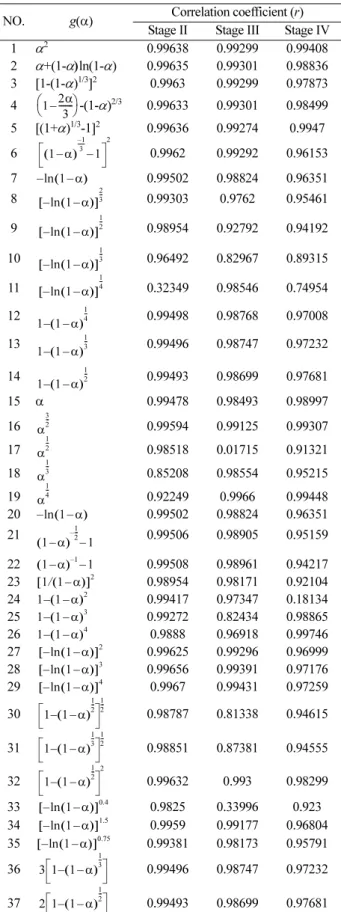
The correlation coefficient r (as shown in Table 3) are obtained by plotting log[g(α)/T2] vs. 103/T. The parame- ters show that the correlation coefficient of No. 1 is better than others, and therefore g(α)=α2 would be the most probable mechanism function in all stages of decompo- sition. The mechanism of decomposition is one-dimen- sional diffusion. This represents the “Parabolic model”.
The entropy of activation (∆S) is also calculated for each stage of thermal decomposition in the complex using the following relationship,
where A–pre-exponential factor, k–Boltzmann constant, Ts–peak temperature, DS–entropy of activation and R–
log g α( ) T2
--- logAR ϕEa
--- 1 2RT Ea ---
– Ea
2.303RT --- –
=
A kTS ---eh
∆sR ---
=
Fig. 3. TG and DTG curves of the complex.
Table 3. Correlation coefficients calculated using thirty-seven forms of g(α) for the complex
NO. g(α) Correlation coefficient (r) Stage II Stage III Stage IV
1 α2 0.99638 0.99299 0.99408
2 α+(1-α)ln(1-α) 0.99635 0.99301 0.98836 3 [1-(1-α)1/3]2 0.9963 0.99299 0.97873 4 -(1-α)2/3 0.99633 0.99301 0.98499 5 [(1+α)1/3-1]2 0.99636 0.99274 0.9947
6 0.9962 0.99292 0.96153
7 0.99502 0.98824 0.96351
8 0.99303 0.9762 0.95461
9 0.98954 0.92792 0.94192
10 0.96492 0.82967 0.89315
11 0.32349 0.98546 0.74954
12 0.99498 0.98768 0.97008
13 0.99496 0.98747 0.97232
14 0.99493 0.98699 0.97681
15 α 0.99478 0.98493 0.98997
16 0.99594 0.99125 0.99307
17 0.98518 0.01715 0.91321
18 0.85208 0.98554 0.95215
19 0.92249 0.9966 0.99448
20 0.99502 0.98824 0.96351
21 0.99506 0.98905 0.95159
22 0.99508 0.98961 0.94217
23 0.98954 0.98171 0.92104
24 0.99417 0.97347 0.18134
25 0.99272 0.82434 0.98865
26 0.9888 0.96918 0.99746
27 0.99625 0.99296 0.96999
28 0.99656 0.99391 0.97176
29 0.9967 0.99431 0.97259
30 0.98787 0.81338 0.94615
31 0.98851 0.87381 0.94555
32 0.99632 0.993 0.98299
33 0.9825 0.33996 0.923
34 0.9959 0.99177 0.96804
35 0.99381 0.98173 0.95791
36 0.99496 0.98747 0.97232
37 0.99493 0.98699 0.97681
1 2α ---3
⎝ – ⎠
⎛ ⎞
1 α–
( )
1 –3 ---
1 –
2
1 α–
( )
ln –
1 α–
( )
ln [– ]23---
1 α–
( )
ln
[– ]
12 ---
1 α–
( )
ln [– ]13---
1 α–
( )
ln
[– ]
14 ---
1 1 α–( – )
14 ---
1 1 α–( – )
13 ---
1 1 α–( – )
12 ---
α
3 2---
α
12 ---
α
1 3---
α
14 ---
1 α–
( )
ln –
1 α– ( )–12---–1
1 α– ( )–1–1
1/ 1 α( – )
[ ]2
1 1 α–( – )2 1 1 α–( – )3 1 1 α–( – )4 1 α–
( )
ln [– ]2
1 α–
( )
ln [– ]3
1 α–
( )
ln [– ]4
1 1 α( – )
12 ---
–
12 ---
1 1 α( – )
13 ---
–
12 ---
1 1 α–( – )12---
2
1 α–
( )
ln [– ]0.4
1 α–
( )
ln [– ]1.5
1 α–
( )
ln
[– ]0.75 3 1 1 α( – )
13 ---
–
2 1 1 α( – )
12 ---
–
gas constant.
The activation energy (Ea), pre-exponential factor (A) and entropy of activation (∆S) for stages II-IV of decom- position are listed in Table 4. The negative values of entropy of activation indicate that the activated complex has a more ordered structure than the reactants.22
CONCLUSIONS
A new complex of Co(II) with Schiff base was synthe- sized and the structure was determined by X-ray crystal- lography study.
The TG data reveal that the complex undergoes a four- stage solid state thermal decomposition pattern. The kinetic model function was g(α)=α2. The kinetic parameters such as activation energy, pre-exponential factor and entropy of activation of the complex were calculated. The mecha- nism for the different decomposition stages is found to be one-dimensional diffusion (Parabolic model).
Supplementary material: CCDC 773456 contains the supplementary crystallographic data for this paper. These data can be obtained free of charge at www.ccdc.cam.ac.uk/
conts/retrieving.html [or from the Cambridge Crystallo- graphic Data Center (CCDC), 12 Union Road, Cambridge CB2 1EZ, UK; fax:+44(0)1223-336033; email: deposit@
ccdc.cam.ac.uk].
Acknowledgement. We are grateful to the support of the research grant of Phytochemistry Key Laboratory of Shaanxi Province of the People's Republic of China. (No.
09JS068).
REFERENCES
1. Chen, D.; Martell, A. E.; Sun, Y. Z. Inorganic Chemistry 1989, 13, 2647.
2. Elmali, A.; Zeyrek, C. T.; Elerman, Y.; Durlu, T. N. Jour- nal of Chemical Crystallography 2000, 3, 167.
3. Chakraborty, J.; Samanta, B.; Pilet, G.; Mitra, S. Struct.
Chem. 2006, 17, 585.
4. Yilmaz, I.; Ilhan, S.; Temel, H.; Kilic, A. J. Incl. Phenom.
Macrocycl. Chem. 2009, 63, 163.
5. Li, Z. X.; Zhang, X. L. Acta. Cryst. 2005, E61, o2806.
6. Li, Z. X.; Zhang, X. L. Acta. Cryst. 2005, E61, m1755.
7. Zhang, C. G.; Tian G. H.; Liu, B. Transition Metal Chem- istry 2000, 25, 377.
8. Deligönü, N.; Tümer, M.; Serin, S. Transition Metal Chem- istry 2006, 31, 920.
9. Li, Z. X.; Zhang, X. L.; Wang, X. L. Acta. Cryst. 2006, E62, o4513.
10. Zhang, X. L.; Li, Z. X. Acta. Cryst. 2007, E63, o319.
11. Kabak, M.; Elmali, A.; Kavlako lu, E.; Elerman, Y.; Durlu, T. N. Acta. Crystallogr. 1999, C55, 1650.
12. Patel, N. H.; Parekh, H. M.; Patel, M. N. Transition Metal Chemistry 2005, 30, 13.
13. Bruker (2000). SMART (Version 5.0) and SAINT (Ver- sion 6.02).Bruker AXS Inc., Madison, Wisconsin, USA.
14. Sheldrick, G. M. SHELXTL. Structure Determination Soft ware Suite. Siemens Industrial Automation, Analytical Instrumentation, USA, 1995.
15. Sheldrick, G. M. SADABS. Siemens area detector absorp- tion (and other) correction. University of Göttingen: Ger- many, 1997.
16. Fernández-G, J. M.; Ruíz-Ramírez, O. L.; Toscano, R. A.;
Macías-Ruvalcaba, N.; Aguilar-Martínez, M. Transition Metal Chemistry 2000, 25, 511.
17. Deligönül, N.; Tümer, M. Transition Metal Chemistry 2006, 31, 920.
18. Mohamed, G. G.; Abd El-Wahab, Z. H. Journal of Ther- mal Analysis and Calorimetry 2003, 73, 347.
19. Coats, A.W.; Redfern, J. P. Nature 1964, 201, 68.
20. Hu, R. Z.; Gao, S. L.; Zhao, F. Q.; Shi, Q. Z.; Zhang, T.
L.; Zhang, J. J. Thermal analysis kinetics (section two) Science press: Perkin, China, 2008.
21. Satava, V. Thermochim. Acta. 1971, 2, 423.
22. Mathew, S.; Nair, C. G. R.; Ninan, K. N. Thermochim. Acta.
1989, 155, 247.
gˇ Table 4. Kinetic parameters for thermal decomposition of the com-
plex
Stage Ea/kJ·mol–1 A/s–1 ∆S /J·K-1·mol-1
II 58.40644 594.97 -192.66
III 32.33933 330.40 -198.87
IV 48.18225 490.13 -198.05