Multiple Segmental Eccrine Spiradenoma
Vol. 27, No. 4, 2015 435
Received September 18, 2014, Revised December 10, 2014, Accepted for publication December 15, 2014
Corresponding author: Hong Sang, Southern Medical University, Department of Dermatology, Jinling Hospital, 305 Zhongshan North Road, Nanjing, Jiangsu 210003, China. Tel: 86-25-80860092, Fax:
86-25-84815775, E-mail: [email protected]
This is an Open Access article distributed under the terms of the Creative Commons Attribution Non-Commercial License (http://
creativecommons.org/licenses/by-nc/4.0) which permits unrestricted non-commercial use, distribution, and reproduction in any medium, provided the original work is properly cited.
Ann Dermatol Vol. 27, No. 4, 2015 http://dx.doi.org/10.5021/ad.2015.27.4.435
CASE REPORT
Multiple Segmental Eccrine Spiradenoma with a
Zosteriform Pattern: A Case Report and Literature Review
Fang Ren1,2, Zhili Hu2, Qingtao Kong2, Hong Sang1,2
1Southern Medical University, 2Department of Dermatology, Jinling Hospital, Nanjing University of Medicine, Nanjing, China
Eccrine spiradenoma usually occurs as solitary tender nodules. However, it rarely occurs as multifocal localized tu- mors or has zosteriform distribution. We report the case of a 32-year-old woman with a 20-year history of itchy lesions on the left side of the back and forearm with a zosteriform distribution. Before disease onset, almost no patients have in- ducing factors, but our patient received an injection before- hand; however, whether this was coincidental or causative remains unknown. The lesions became very itchy after per- spiration or eating spicy food, which has never been reported.
A literature search revealed 22 cases of multiple segmental eccrine spiradenoma; we summarized the clinical character- istic in order to aid diagnosis and treatment selection. (Ann Dermatol 27(4) 435∼438, 2015)
-Keywords-
Eccrine spiradenoma, Itchy, Multiple, Zosterifrom
INTRODUCTION
Eccrine spiradenoma (ES) is a rare benign dermal tumor of apocrine differentiation originating from cutaneous sweat glands that may be sporadic or familial; it was first described in 1956 by Kersting and Helwing. It mainly affects adults, with the highest incidence in the fourth decade of life1.
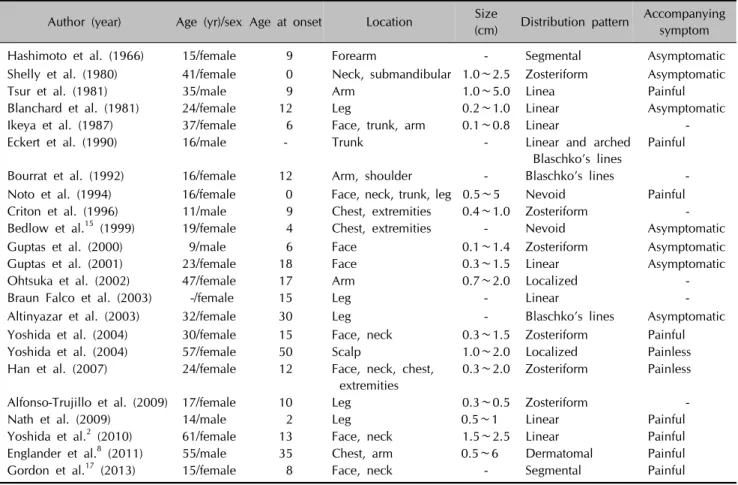
Yoshida et al.2 divided ES into solitary and multiple ES on the basis of its clinical appearance. Most presentations of ES are solitary and show no predilection for any sex. However, multiple ES predominantly affects women, with a male/fe- male ratio of 1:3. Multiple ES can be described as multi- focal or localized with a linear zosteriform distributionand nevoid or blaschkoid pattern (Table 1); however, there is no definitive classification3.
CASE REPORT
A 32-year-old Chinese woman presented to our hospital complaining of slow-growing painless itchy lesions on the left side of the back and forearm starting approximately 20 years ago with onset about 12-year-old previously as multi- ple nodules on the arm that gradually increased in size and number. When she was 12 years old, she received a hep- atitis B vaccine injection on the left forearm. She stated her lesions were itchy but not painful, and that the itchiness in- creased after perspiration or eating spicy food. She also felt formication on occasion. She was otherwise well with no other significant medical or family history. Physical exami- nation revealed multiple asymptomatic well-circumscribed blue-to-violet round-to-oval subcutaneous nodules; they exhibited a zosteriform distribution from the left upper back to the forearm (Fig. 1). On palpation, the lesions were rubbery, firm, and fixed to the overlying skin, ranging be- tween 0.5 and 1.5 cm in size.
Histological analysis revealed 2 kinds of tumor cells: small darkly staining basaloid cells, and large pale cells. The nod- ules comprised basaloid cells arranged in a trabecular pat- tern surrounded by eosinophilic fibrous strands (Fig. 2).
Small darkly staining basaloid cells and larger cells with pale nuclei in the center of the clusters and numerous scat- tered lymphocytes were observed, consistent with a diag- nosis of ES. There was no evidence of malignant transfor- mation.
F Ren, et al
436 Ann Dermatol
Table 1. Clinical features of reports cases of segmental eccrine spiradenoma
Author (year) Age (yr)/sex Age at onset Location Size
(cm) Distribution pattern Accompanying symptom
Hashimoto et al. (1966) 15/female 9 Forearm - Segmental Asymptomatic
Shelly et al. (1980) 41/female 0 Neck, submandibular 1.0∼2.5 Zosteriform Asymptomatic
Tsur et al. (1981) 35/male 9 Arm 1.0∼5.0 Linea Painful
Blanchard et al. (1981) 24/female 12 Leg 0.2∼1.0 Linear Asymptomatic
Ikeya et al. (1987) 37/female 6 Face, trunk, arm 0.1∼0.8 Linear -
Eckert et al. (1990) 16/male - Trunk - Linear and arched
Blaschko’s lines
Painful
Bourrat et al. (1992) 16/female 12 Arm, shoulder - Blaschko’s lines -
Noto et al. (1994) 16/female 0 Face, neck, trunk, leg 0.5∼5 Nevoid Painful
Criton et al. (1996) 11/male 9 Chest, extremities 0.4∼1.0 Zosteriform -
Bedlow et al.15 (1999) 19/female 4 Chest, extremities - Nevoid Asymptomatic
Guptas et al. (2000) 9/male 6 Face 0.1∼1.4 Zosteriform Asymptomatic
Guptas et al. (2001) 23/female 18 Face 0.3∼1.5 Linear Asymptomatic
Ohtsuka et al. (2002) 47/female 17 Arm 0.7∼2.0 Localized -
Braun Falco et al. (2003) -/female 15 Leg - Linear -
Altinyazar et al. (2003) 32/female 30 Leg - Blaschko’s lines Asymptomatic
Yoshida et al. (2004) 30/female 15 Face, neck 0.3∼1.5 Zosteriform Painful
Yoshida et al. (2004) 57/female 50 Scalp 1.0∼2.0 Localized Painless
Han et al. (2007) 24/female 12 Face, neck, chest, extremities
0.3∼2.0 Zosteriform Painless
Alfonso-Trujillo et al. (2009) 17/female 10 Leg 0.3∼0.5 Zosteriform -
Nath et al. (2009) 14/male 2 Leg 0.5∼1 Linear Painful
Yoshida et al.2 (2010) 61/female 13 Face, neck 1.5∼2.5 Linear Painful
Englander et al.8 (2011) 55/male 35 Chest, arm 0.5∼6 Dermatomal Painful
Gordon et al.17 (2013) 15/female 8 Face, neck - Segmental Painful
Fig. 1. Zosteriform dermal nodules on the back and forearm.
DISCUSSION
Eccrine sweat glands are simple tubular glands that open directly to the surface; they are found all over the body, especially in the palms, soles, and axillae4. No cases of ES have been reported on glabrous skin or strong occurrence on the trunk, and head and neck regions. ES presents as a dermal or subcutaneous papulonodules of varying size up
to 6 cm.It may mimic other painful skin tumors including leiomyoma, angiolipomas, neuroma granular cell tumors, etc.4,5. As such, computed tomography and magnetic reso- nance imaging can aid the diagnosis of this kind of tumor, especially for tumors in the deep dermis or subcutaneous tissues6,7. However, the definitive diagnosis of ES requires skin biopsy.
The etiology of ES remains unknown. Although autosomal dominant transmission has been suggested, this has not been confirmed2. ES has traditionally been designated a tu- mor of eccrine lineage thought to be an undifferentiated or poorly differentiated benign adnexal neoplasm8. The proposed mechanism of multifocal ES is that an abnormal clone of multipotent stem cells of the folliculosebaceous- apocrine unit arises during embryogenesis, subsequently producing a proliferation of abnormal cells and resulting in nodule formation and possible malignant transformation9,10. Trauma is proposed to be aprecipitating factor4,11, but the mechanism remains unsubstantiated. Although the present patient had a history of an injection, it is uncertain if this is coincidental or causative. Most cases of ES are solitary nod- ules, and multiple ES is rare: only 22 cases of multifocal segmental ES have been reported. ES exhibits no specific
Multiple Segmental Eccrine Spiradenoma
Vol. 27, No. 4, 2015 437 Fig. 2. (A) Multiple well-circumscribed dermal nodules comprising basophilic cells in the deep dermis. The basaloid cells are arranged in a trabecular pattern with eosinophilic fibrous strands (H&E, ×40). (B) High-powered view demonstrating small dark basaloid cells with hyperchromatic nuclei, larger cells with pale nuclei in the center of the clusters, and numerous lymphocytes scattered throughout (H&E, ×400).
characteristic location, but the literature shows that most tumors are distributed on the front of the body and above the waistline (Table 1). The tumors 0.1∼6.0 cm, and the age of onset ranges from 0∼61 years. The most significant clinical characteristic of the nodules is pain or tenderness in 91% of patients, which occurred intermittently and was never continuous12; however, Mambo13 reports that pain and tenderness are less common. The cause of pain in ES is unclear. Moreover, the reasons for the various pre- sentations of ES are unclear. The present patient exhibited multiple itchy ES nodules arranged in a zosteriform pat- tern; however, she had no family history of the disease.
Although most reported cases of ES are benign, long-stand- ing benign ES can transform into malignant ES. Malignant transformation of ES is associated with aggressive behav- ior, a high recurrence rate, and the subsequent develop- ment of fatal metastases14. Although cases of benign ES with epidermal ulceration have been reported13, epidermal ulceration is still a clinical characteristic associated with carcinoma. De novo malignant ES has also been reported.
Malignant transformation occurs more often in multifocal ES than solitary ES1.
Surgical excision is the predominant choice of treatment for tumor clearance; surgery is unnecessary if the lesions are not disfiguring, increasing in size and number, or painful.
There are no clear recommendations for margins for stand- ard excision1. However, if the tumors are multifocal or ex- tensive, surgery is impractical; in such cases, radiotherapy or CO2 laser should be considered as alternative treat- ments15. Ter Poorten et al.16 treated cases with small dis- crete lesions by surgical resection combined with CO2 la-
ser ablation; the treatment was effective with symptomatic relief. Trials using intralesional botulinum toxin A and in- tralesional triamcinolone have been used to treat multiple ES17. Nevertheless, additional long-term follow-up is re- quired to determine the optimal management strategy.
ES is a benign tumor of unclear etiology originating from the eccrine sweat glands. It may present as multifocal tu- mors arranged in zosteriform pattern. Pain is usually the most striking symptom, but our patient only reported itch- ing, especially after perspiration or eating spicy food; this is probably because ES originates from eccrine sweat glands, which would be most active in ES during perspi- ration16. Surgical excision is the mainstay treatment.
Nonetheless, better methods are requiredto treat this disease.
REFERENCES
1. Rahim RR, Rajan N, Langtry JA. Infiltrative recurrent eccrine spiradenoma of the anterior neck treated using Mohs micrographic surgery. Dermatol Surg 2013;39:1711-1714.
2. Yoshida A, Takahashi K, Maeda F, Akasaka T. Multiple vascular eccrine spiradenomas: a case report and published work review of multiple eccrine spiradenomas. J Dermatol 2010;37:990-994.
3. Scheinfeld NS, Tarlow MM, Burgin S. Blaschkoid eccrine spiradenomas. Cutis 2002;70:73-75.
4. Siegel HJ, Said-Al-Naief N, Long J, Lopez-Ben RR, Klein M.
Giant eccrine spiradenoma of the hand. Am J Orthop (Belle Mead NJ) 2008;37:E141-E143.
5. Naversen DN, Trask DM, Watson FH, Burket JM. Painful tumors of the skin: “LEND AN EGG”. J Am Acad Dermatol 1993;28:298-300.
F Ren, et al
438 Ann Dermatol
6. Hawnaur JM, Dobson MJ, Zhu XP, Watson Y. Skin: MR imaging findings at middle field strength. Radiology 1996;
201:868-872.
7. Mirrashed F, Sharp JC, Krause V, Morgan J, Tomanek B.
Pilot study of dermal and subcutaneous fat structures by MRI in individuals who differ in gender, BMI, and cellulite grading. Skin Res Technol 2004;10:161-168.
8. Englander L, Emer JJ, McClain D, Amin B, Turner RB. A rare case of multiple segmental eccrine spiradenomas. J Clin Aesthet Dermatol 2011;4:38-44.
9. Clarke J, Ioffreda M, Helm KF. Multiple familial trichoepi- theliomas: a folliculosebaceous-apocrine genodermatosis. Am J Dermatopathol 2002;24:402-405.
10. Chou SC, Lin SL, Tseng HH. Malignant eccrine spiradenoma:
a case report with pulmonary metastasis. Pathol Int 2004;
54:208-212.
11. McKee PH, Fletcher CD, Stavrinos P, Pambakian H. Carci- nosarcoma arising in eccrine spiradenoma. A clinicopatho- logic and immunohistochemical study of two cases. Am J
Dermatopathol 1990;12:335-343.
12. Revis P, Chyu J, Medenica M. Multiple eccrine spirade- noma: case report and review. J Cutan Pathol 1988;15:
226-229.
13. Mambo NC. Eccrine spiradenoma: clinical and pathologic study of 49 tumors. J Cutan Pathol 1983;10:312-320.
14. Meyer TK, Rhee JS, Smith MM, Cruz MJ, Osipov VO, Wackym PA. External auditory canal eccrine spiradenocar- cinoma: a case report and review of literature. Head Neck 2003;25:505-510.
15. Bedlow AJ, Cook MG, Kurwa A. Extensive naevoid eccrine spiradenoma. Br J Dermatol 1999;140:154-157.
16. Ter Poorten MC, Barrett K, Cook J. Familial eccrine spirade- noma: a case report and review of the literature. Dermatol Surg 2003;29:411-414.
17. Gordon S, Styron BT, Haggstrom A. Pediatric segmental eccrine spiradenomas: a case report and review of the literature. Pediatr Dermatol 2013;30:e285-e286.