Immediate Effects of Upper Trapezius Stretching in More and Less Tensed Positions on the Range of Neck Rotation in Patients
With Unilateral Neck Pain
Kyue-nam Park1, MSc, PT, Sung-min Ha2, PhD, PT, Si-hyun Kim1, MSc, PT, Oh-yun Kwon3, PhD, PT
1Dept. of Physical Therapy, The Graduate School, Yonsei University,
2Kinetic Ergocise Based on Movement Analysis Laboratory,
3Dept. of Physical Therapy, College of Health Science, Yonsei University, Dept. of Ergonomic Therapy, The Graduate School of Health Science, Yonsei University
Abstract
1)The purpose of this study was to compare the immediate effects of upper trapezius muscle stretching in more tensed position (MTP) and less tensed position (LTP) on the change of range of motion (ROM) for neck rotation, and the ROM for conjunct neck motions at end-range of neck rotation toward the painful side in patients with unilateral neck pain. Eighteen patients with unilateral neck pain were recruited for the study’s MTP group, and 18 age-, weight- and gender-matched patients with unilateral neck pain were recruited for LTP group. The ROM changes in active neck primary and conjunct motions were measured using a cervical ROM inclinometer in the sitting position. Our results showed that both upper trapezius stretching method in MTP and LTP were significantly effective in increasing the ROM of neck rotation toward painful side in patients with unilateral neck pain. However, a significantly greater increase in the ROM for neck rotation and a further decrease in conjunct neck extension during neck rotation toward the painful side were shown in MTP group, compared to LTP group. The upper trapezius stretching in MTP is useful in increasing the ROM of neck rotation and decreasing the range of conjunct neck extension during neck rotation toward the painful side in patients with unilateral neck pain.
Key Words: Position; Range of motion; Stretching; Unilateral neck pain; Upper trapezius muscle.
Introduction
The reduced active range of motion (ROM) may be useful as an indicator of physical impairment when evaluating patients with mechanical chronic neck pain and/or whiplash-associated disorders (Cagnie et al, 2007; Chen et al, 1999; Chiu and Sing, 2002; Gargan et al, 1997; Jordan et al, 1997). The reduced active ROM of neck rotation, among other motions, is especially useful to discriminate sig- nificantly between asymptomatic persons and patients with persistent whiplash or mechanical neck pain (Dall’Alba et al, 2001; Lee et al, 2003). A previous study reported that 33% of mechanical neck pain
was located in the central neck and 67% in the uni- lateral neck (Lee et al, 2005).
Unilateral restricted ROM for neck rotation toward the painful side has been found in patients with uni- lateral neck pain (UNP) (Fryer and Adams, 2011).
According to a previous study, conjunct neck lateral bending and extension occur when performing neck rotation toward the painful side in patients with UNP (Fryer and Adams, 2011). Sahrmann (2011) stated that neck rotation, accompanied by an unwanted conjunct extension and lateral bending, may cause asymmetrical stress in the posterior neck.
Mobilization, acupuncture, and active stretching exercises are commonly used to decrease neck pain Corresponding author: Oh-yun Kwon [email protected]
and increase neck mobility (Coppieters et al, 2003;
Hoving et al, 2002; Hurwitz et al, 2005; Ma et al, 2010). To increase the reduced ROM for neck rota- tion, several studies have focused on joint stiffness (Hoving et al, 2002; Hurwitz et al, 2005). Joint ma- nipulation or mobilization on the cervical spine is ef- fective for increasing the ROM of neck rotation in patients with chronic neck pain (Hoving et al, 2002;
Hurwitz et al, 2005). However, joint manipulation can have the negative effect of producing dissections in- volving of the vertebral arteries, and thus lead to the need for endovascular stenting and cranial surgery (Albuquerque et al, 2011).
Among the conservative methods, active muscle stretching is recommended due to the fact that it is safe, inexpensive, easy to perform, and can be ap- plied as a regular self-administered exercise (Ylinen et al, 2007). In particular, the upper trapezius, which is a common site of trigger point in patients with chronic neck pain relative to other neck muscles, is likely to be shortened (Borg-stein and Simons, 2005;
Iwama et al, 2001; Kamanli et al, 2005). The upper trapezius has an attachment from the cervical spine region directly to the scapula and clavicle (Sahrmann, 2011). Decreased passive tension of the upper trapezius can lead to a decreased load on the cervical spine connecting to the scapula and clavicle, and permit improved neck motions and less painful movement during neck motions (Sahrmann, 2011).
Upper trapezius muscle stretching to reduce passive tension is recommended to relieve neck pain, reduce pressure pain threshold of upper trapezius, and in- crease neck mobility (Ylinen et al, 2007).
Although a previous study has shown the effects of muscle stretching on the increase in neck mobility (Ylinen et al, 2007), no study has investigated the effects of upper trapezius stretching on the restricted ROM for neck rotation toward the painful side in patients with UNP. To gain an increased ROM max- imally using muscle stretching, the stretching posi- tion that places the greatest tension on the muscle is important (Sullivan et al, 1992). The conservative
stretching position of the upper trapezius comprises only neck contralateral lateral bending (Ylinen et al, 2007). Yet the upper trapezius is able to perform contralateral neck rotation and extension as well as ipsilateral lateral bending (Sahrmann, 2011).
Therefore, the aim of this study was to compare the immediate effect of upper trapezius stretching in a more tensed position (MTP) and in a less tensed position (LTP) on the change of the ROM for neck rotation toward the painful side and conjunct neck motions in patients with UNP. The hypothesis was that upper trapezius stretching in MTP would be more effective than the conservative stretching method in LTP on improving the ROM for neck ro- tation toward the painful side and decreasing the conjunct neck motions in patients with UNP.
Methods
Subjects
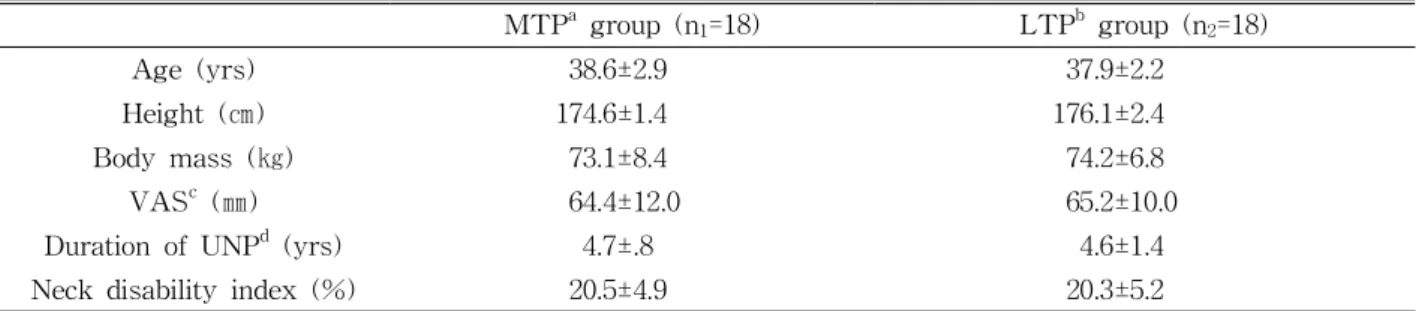
Thirty-six male patients (41.6±3.2 years) with UNP were selected, and diagnosed with work-related chronic UNP at a workplace-based work-conditioning center in Korea. In this study, chronic UNP was de- fined in terms of the duration of UNP, which had to have exceeded six months (Ylinen et al, 2007). The average intensity of UNP was above 30 on a verbal pain scale ranging from 0 to 100 in millimeters (Table 1). The neck disability index was used to in- vestigate the level of disability due to neck pain (Johnston et al, 2008). Patients had sustained their injuries at the workplace, and were treated with physical therapy at hospital using mainly modalities, before participating in this study. Patients were re- cruited at the start of this study based on their par- ticipation in a workplace-based conditioning program.
Eighteen patients with UNP were recruited for MTP group. Another eighteen age-, gender-, and weight-matched patients with UNP, the control group, were recruited for upper trapezius stretching in LTP. The exclusion criteria included bilateral neck
MTPa group (n1=18) LTPb group (n2=18)
Age (yrs) 38.6±2.9 37.9±2.2
Height (㎝) 174.6±1.4 176.1±2.4
Body mass (㎏) 73.1±8.4 74.2±6.8
VASc (㎜) 64.4±12.0 65.2±10.0
Duration of UNPd (yrs) 4.7±.8 4.6±1.4
Neck disability index (%) 20.5±4.9 20.3±5.2
amore tensed position for upper trapezius stretching,bless tensed position for upper trapezius stretching,
cvisual analogue scale, dunilateral neck pain.
Table 1. General characteristics (N=36)
Figure 1. Cervical range of motion (CROM) inclinometer.
pain, radiating pain, migraine or dizziness, and being unable to perform active stretching of the upper tra- pezius due to neck pain. Before this study, the prin- cipal investigator explained all of the experimental procedures to the patients in detail. All patients signed an informed consent form.
Instrument
The cervical ROM inclinometer (CROM, Performance Attainment Associates, Roseville, USA) measures the primary and conjunct neck ROM for flexion, extension, lateral bending, and rotation using separate inclinometers. These inclinometers are at- tached to a frame resembling three eyeglasses. The inclinometers for the sagittal (flexion and extension) and frontal planes (lateral bending) have a grav- ity-dependent needle, and the other for the transverse plane (rotation) has a magnetic needle (Figure 1).
The patients wear a magnetic neck brace with the magnetic needle on the transverse plane. The in-
clinometers are marked in 2° increments. A previous study demonstrated the intra- and inter-rater reli- ability of the CROM inclinometer with an intra-class correlation coefficient range of .89 to .99 (Tousignant et al, 2002; Tousignant et al, 2006).
Procedures
Before performing active stretching of the upper trapezius, we measured the primary and conjunct ROM of each patient. To measure active neck ROM, all patients were asked to sit upright on a chair and look straight ahead. The tester explained and demon- strated neck motions to the patients. All patients performed a warm-up exercise, which involved re- peating the six neck motions three times (Dall’Alba et al, 2001). To prevent compensatory trunk motions and perform accurate measurement of the active neck ROM, the upper thoracic region was restrained on the backrest with an orthopedic belt. The CROM inclinometer was placed on the head of each partic- ipant by the investigator. The patients were in- structed to place their head in the neutral position.
The neutral head position was defined and confirmed by 0° on the three inclinometers, without any mo- tions on the sagittal, frontal, and transverse plane (Dall’Alba et al, 2001). Patients were asked to per- form neck flexion, extension, lateral bending, and ro- tation to the end range of each motion as much as possible. The patients were asked to keep their heads at the end range of each motion without any UNP for 5 s so that the investigator could record the degrees of primary and conjunct motions. The
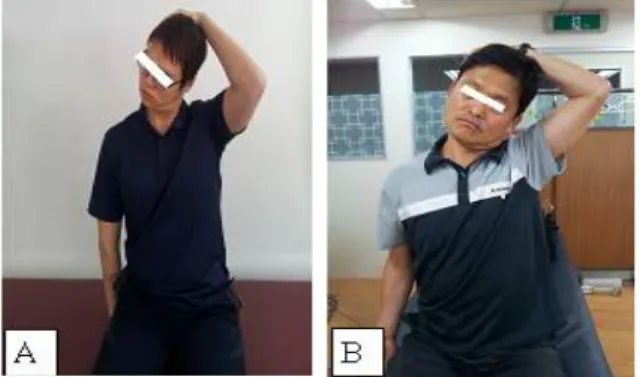
Figure 2. Upper trapezius stretching (A:
more tensed position (MTP), B: less tensed position (LTP)).
conjunct neck motion was measured as the angular values about the two conjunct axes associated with the maximum primary axis value. The conjunct ROM values in our study describe the conjunct mo- tion at the end-of-range of primary neck motions (Dall’Alba et al, 2001). Three trials were performed for each motion. The mean value of the three trials was calculated to determine the ROM.
After measurement of the ROM, patients with UNP were randomized into two groups: MTP and LTP groups. Randomization was conducted by an investigator using computer-generated random numbers. The patients in each group were in- dividually advised how to perform the stretching ex- ercises in MTP and LTP by the principal investigator. Two stretching positions (MTP and LTP) were maintained for 30 s and repeated three times. A resting period lasting 30 s was given in between each session.
Upper trapezius stretching in MTP The patients were asked to sit upright on a chair and look straight ahead. To reduce scapular elevation and upward rotation, the ipsilateral hand was placed below the buttock. Patients were then asked to per- form deep neck flexion, ipsilateral neck rotation to- ward painful side, and contralateral lateral bending using the opposite hand in a diagonal direction.
Patients were asked to maintain deep neck flexion when performing the ipsilateral neck rotation and contralateral lateral bending during stretching in
MTP (Figure 2A).
Upper trapezius stretching in LTP The conservative method of upper trapezius stretching was performed in LTP. Patients were asked to sit upright on a chair and look straight ahead. Patients were then asked to perform con- tralateral lateral bending using the opposite hand on the frontal plane horizontally (Häkkinen et al, 2007) (Figure 2B).
After stretching in each group, we immediately measured the neck ROM for primary and conjunct neck motions in the same way described above.
Statistical Analysis
An independent t-test was used to compare the amount of changed ROM between MTP and LTP groups after stretching. A paired t-test was used to compare the amount of changed ROM within the MTP and LTP groups after stretching. The level of statistical significance was set at p<.05. Data was expressed as the mean and standard deviation.
Statistical analyses were performed using SPSS 12.0 software (SPSS Inc., Chicago, IL, USA).
Results
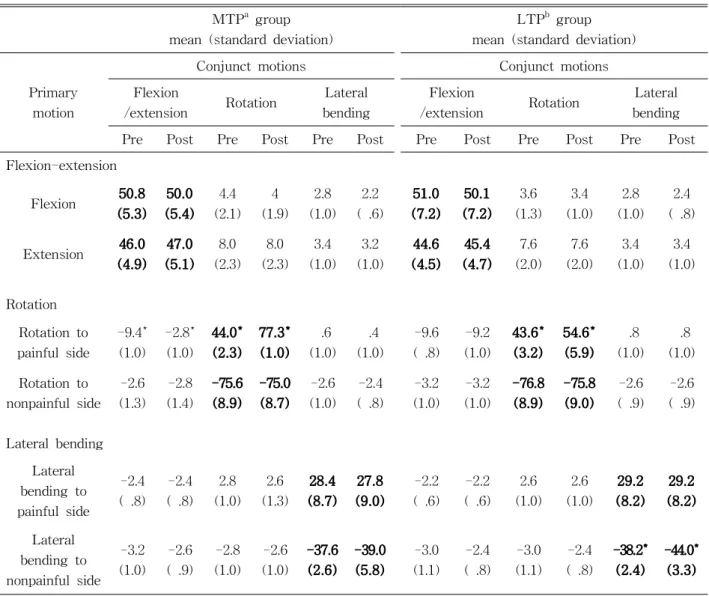
The range of neck rotation toward the painful side was significantly increased in both MTP and LTP groups (p<.05) (Table 2). A greater increase in the ROM for neck rotation in MTP group compared to LTP group was shown (p<.05) (Table 3). In MTP group, the range of conjunct neck extension at end-range of neck rotation was significantly de- creased after stretching in MTP (p<.05) (Table 2).
However, there was no difference in the range of conjunct neck extension during neck rotation after the stretching in LTP (Table 2). The range of lateral bending was significantly increased in the LTP group (p<.05). On the other hand, the range of later- al bending was not significantly different in MTP
MTPa group mean (standard deviation)
LTPb group mean (standard deviation)
Primary motion
Conjunct motions Conjunct motions
Flexion
/extension Rotation Lateral bending
Flexion
/extension Rotation Lateral
bending
Pre Post Pre Post Pre Post Pre Post Pre Post Pre Post
Flexion-extension
Flexion 50.8 (5.3)
50.0 (5.4)
4.4 (2.1)
4 (1.9)
2.8 (1.0)
2.2 ( .6)
51.0 (7.2)
50.1 (7.2)
3.6 (1.3)
3.4 (1.0)
2.8 (1.0)
2.4 ( .8)
Extension 46.0 (4.9)
47.0 (5.1)
8.0 (2.3)
8.0 (2.3)
3.4 (1.0)
3.2 (1.0)
44.6 (4.5)
45.4 (4.7)
7.6 (2.0)
7.6 (2.0)
3.4 (1.0)
3.4 (1.0)
Rotation Rotation to painful side
-9.4*
(1.0) -2.8*
(1.0) 44.0*
(2.3) 77.3*
(1.0) .6 (1.0)
.4 (1.0)
-9.6 ( .8)
-9.2 (1.0)
43.6*
(3.2)
54.6*
(5.9) .8 (1.0)
.8 (1.0) Rotation to
nonpainful side -2.6 (1.3)
-2.8 (1.4)
-75.6 (8.9)
-75.0 (8.7)
-2.6 (1.0)
-2.4 ( .8)
-3.2 (1.0)
-3.2 (1.0)
-76.8 (8.9)
-75.8 (9.0)
-2.6 ( .9)
-2.6 ( .9)
Lateral bending Lateral bending to painful side
-2.4 ( .8)
-2.4 ( .8)
2.8 (1.0)
2.6 (1.3)
28.4 (8.7)
27.8 (9.0)
-2.2 ( .6)
-2.2 ( .6)
2.6 (1.0)
2.6 (1.0)
29.2 (8.2)
29.2 (8.2)
Lateral bending to nonpainful side
-3.2 (1.0)
-2.6 ( .9)
-2.8 (1.0)
-2.6 (1.0)
-37.6 (2.6)
-39.0 (5.8)
-3.0 (1.1)
-2.4 ( .8)
-3.0 (1.1)
-2.4 ( .8)
-38.2*
(2.4)
-44.0*
(3.3)
*p<.05, amore tensed position, bless tensed position, "Pre" and "Post" means the value of ROM before and after upper trapezius stretching in MTP and LTP respectively, Mean values of primary neck motions are shown in bold type, For conjunct motion, mean raw values are displayed, Negative values indicate extension on the sagittal plane and lateral flexion and rotation to the non-painful side on the frontal and transverse plane.
Table 2. Primary and conjunct neck motions in pre- and post-stretching period (Unit: °)
Mean of difference of ROMa (°)
MTPb group LTPc group p
Neck rotation toward painful side 33.3±3.6 11.0±5.1 <.01*
Conjunct neck extension at end-range of neck rotation -6.6±1.4 -.4±.8 <.01*
Neck lateral bending toward nonpainful side 2.6±2.3 5.6±5.8 .02*
arange of motion, bmore tensed position for upper trapezius stretching, cless tensed position for upper trapezius stretching, ROM difference = ROM after stretching - ROM before stretching, *p<.05.
Table 3. Comparison of ROM difference in both MTP and LTP groups
group (Table 2).
Discussion
When measuring the neck ROM, neck rotation was shown to be the most restricted direction, illus- trating the difference between healthy subjects and patients with neck pain (Lee et al, 2003). Patients with UNP also have a restricted ROM for neck rota- tion unilaterally with conjunct neck extension and lateral bending toward the painful side (Fryer and Adams, 2011). To the best of our knowledge, this is the first study to show that upper trapezius muscle stretching is capable of increasing the restricted ROM of neck rotation toward the painful side and decreasing the conjunct neck extension during neck rotation in patients with UNP. Additionally, we dem- onstrated that upper trapezius stretching in MTP was more effective way to increase ROM for neck rotation and conjunct neck extension at end-range of primary neck rotation than stretching in LTP (Table 3).
Muscle stretching is an effective way to increase the ROM (Hoving et al, 2002; Hurwitz et al, 2005).
When applying joint manipulation to the cervical spine during 4 weeks, the ROM of neck rotation in- creased by about 10° in patients with neck pain (Häkkinen et al, 2007). This improvement is com- parable to other techniques that focus on the upper trapezius muscle, such as acupuncture and stretching (Häkkinen et al, 2007; Wang et al, 2007). Previous studies demonstrated that acupuncture and stretching on the upper trapezius muscles during 4 weeks can result in about 20° and 10° improvement in neck ro- tation in patients with chronic neck pain, respectively (Häkkinen et al, 2007). This means that techniques focusing on the muscle can increase the range of neck rotation safely without stressing the joint cap- sule by manipulation. In our study, the greater in- creased ROM for neck rotation (mean value : 33°) was shown when using upper trapezius stretching in MTP compared to other techniques, such as the con-
servative stretching method and acupuncture of the upper trapezius (Häkkinen et al, 2007; Wang et al, 2007). This result suggests that the active upper tra- pezius stretching technique in MTP can result in a better ROM gain in patients with UNP than the oth- er techniques.
In our study, upper trapezius stretching in MTP was more effective than LTP group in increasing the range of neck rotation toward the painful side in pa- tients with UNP. To perform the effective muscle stretching, the muscle would be placed in the posi- tion with the greatest tension (Takasaki et al, 2007).
In our study, the position of the upper trapezius re- quires contralateral lateral bending with ipsilateral neck rotation, flexion, scapular downward rotation, and depression, which makes the upper trapezius muscle more tense than with the conservative stretching method. The neck position in the con- servative stretching method requires only lateral bending toward the contralateral side (Ylinen et al, 2007). Lateral bending of the neck alone may not be enough to tense the upper trapezius during con- servative stretching. Therefore, upper trapezius stretching in MTP may give rise to a greater in- creased ROM in neck rotation than LTP group.
Conjunct neck extension during neck rotation showed a greater decrease in MTP group than LTP group. The neck position in MTP group included deep neck flexion with neck rotation and lateral bending. Maintaining deep neck flexion during upper trapezius stretching in MTP may influence on de- creasing the range of conjunct neck extension at end-range of neck rotation. Additionally, the actions of the upper trapezius can contribute to neck ex- tension during rotation (Sahrmann, 2011).
There was significantly more increased range of lateral bending toward nonpainful side in LTP than MTP group after stretching. Because upper trapezius stretching in LTP focused on just lateral bending, LTP is able to increase the range of lateral bending toward nonpainful side.
This study has several limitations. First, our pa-
tients were male so the results cannot be generalized to women. Second, we could not measure the re- al-time primary and conjunct neck motions using a three-dimensional motion analysis system when per- forming neck motions. However, unlike the three-di- mensional motion analysis system, CROM is easy to use in the clinical setting for patients with UNP in order to assess the ROM for primary and conjunct neck motion (Tousignant et al, 2002). Third, this study immediately confirmed the effects of upper trapezius stretching. Therefore further studies would be needed to demonstrate the long-term effects of upper trapezius stretching in MTP on the change in ROM for axial rotation and conjunct neck motions in patients with UNP.
Conclusion
Both upper trapezius stretching methods in MTP and LTP were effective for increasing the reduced ROM for neck rotation in patients with UNP. Upper trapezius stretching methods in MTP was more ef- fective than stretching in LTP on increasing the ROM for neck rotation and decreasing the conjunct neck extension during neck rotation toward the pain- ful side in patients with UNP. We recommend that clinicians adopt the upper trapezius stretching in MTP over other techniques, since it increases the range of neck rotation toward the painful side easily for patients with UNP in the clinical setting.
References
Albuquerque FC, Hu YC, Dashti SR, et al.
Craniocervical arterial dissections as sequelae of chiropractic manipulation: Patterns of injury and management. J Neurosurg. 2011;115(6):1197-1205.
Borg-Stein J, Simons DG. Focused review:
Myofascial pain. Arch Phys Med Rehabil.
2002;83(3 Suppl 1):S40-47, S48-49.
Cagnie B, Cools A, De Loose V, et al. Reliability and normative database of the Zebris cervical range-of-motion system in healthy controls with preliminary validation in a group of patients with neck pain. J Manipulative Physiol Ther.
2007;30(6):450-455.
Chen J, Solinger AB, Poncet JF, et al. Meta-analysis of normal cervical motion. Spine (Phila Pa 1976).
1999;24(15):1571-1578.
Chiu TT, Sing KL. Evaluation of cervical range of motion and isometric neck muscle strength:
Reliability and validity. Clin Rehabil. 2002;16(8):
851-858.
Coppieters MW, Stappaerts KH, Wouters LL, et al.
The immediate effects of a cervical lateral glide treatment technique in patients with neurogenic cervicobrachial pain. J Orthop Sports Phys Ther.
2003;33(7):369-378.
Dall'Alba PT, Sterling MM, Treleaven JM, et al.
Cervical range of motion discriminates between asymptomatic persons and those with whiplash.
Spine (Phila Pa 1976). 2001;26(19):2090-2094.
Fryer G, Adams JH. Magnetic resonance imaging of subjects with acute unilateral neck pain and re- stricted motion: A prospective case series. Spine J. 2011;11(3):171-176.
Gargan M, Bannister G, Main C, et al. The behav- ioural response to whiplash injury. J Bone Joint Surg Br. 1997;79(4):523-526.
Häkkinen A, Salo P, Tarvainen U, et al. Effect of manual therapy and stretching on neck muscle strength and mobility in chronic neck pain. J Rehabil Med. 2007;39(7):575-579.
Hoving JL, Koes BW, de Vet HC, et al. Manual therapy, physical therapy or continued care by the general practitioner for patients with neck pain. A randomized, controlled trial. Ann Intern Med. 2002;136(10):713-722.
Hurwitz EL, Aker PD, Adams AH, et al. The effects of P-A mobilization on the cervical range of motion and pain for patients with chronic neck pain. J Kor Soc Phys Ther. 2005;17(4):519-535.
This article was received January 5, 2013, was reviewed January 8, 2013, and was accepted February 1, 2013.
Iwama H, Ohmori S, Kaneko T, et al. Water-diluted local anesthetic for trigger-point injection in chronic myofascial pain syndrome: Evaluation of types of local anesthetic and concentrations in water. Reg Anesth Pain Med. 2001;26(4):
333-336.
Johnston V, Jull G, Souvlis T, et al. Neck movement and muscle activity characteristics in female of- fice workers with neck pain. Spine (Phila Pa 1976). 2008;33(5):555-563.
Jordan A, Mehlsen J, Ostergaard K. A comparison of physical characteristics between patients seeking treatment for neck pain and age-matched healthy people. J Manipulative Physiol Ther.
1997;20(7):468-475.
Kamanli A, Kaya A, Ardicoglu O, et al. Comparison of lidocaine injection, botulinum toxin injection, and dry needling to trigger points in myofascial pain syndrome. Rheumatol Int. 2005;25(8):604-611.
Lee H, Nicholson LL, Adams RD. Cervical range of motion associations with subclinical neck pain.
Spine (Phila Pa 1976). 2004;29(1):33-40.
Lee H, Nicholoson LL, Adams RD, et al. Body chart pain location and side-specific physical impair- ment in subclinical neck pain. J Manipulative Physiol Ther. 2005;28(7):479-486.
Ma C, Wu S, Li G, et al. Comparison of minis- calpel-needle release, acupuncture needling, and stretching exercise to trigger point in myofascial pain syndrome. Clin J Pain. 2010;26(3):251-257.
Sahrmann SA. Movement System Impairment Syndromes of the Extremities, Cervical and
Thoracic spines. St Louis, Mosby, 2011;66-78.
Sullivan MK, Dejulia JJ, Worrell TW. Effect of pel- vic position and stretching method on hamstring muscle flexibility. Med Sci Sports Exerc. 1992
;24(12):1383-1389.
Takasaki H, Aoki M, Muraki T, et al. Muscle strain on the radial wrist extensors during mo- tion-simulating stretching exercises for lateral epicondylitis: A cadaveric study. J Shoulder Elbow Surg. 2007;16(6):854-858.
Tousignant M, Duclos E, Laflèche S, et al. Validity study for the cervical range of motion device used for lateral flexion in patients with neck pain. Spine (Phila Pa 1976). 2002;27(8):812-817.
Tousignant M, Smeesters C, Breton AM, et al.
Criterion validity study of the cervical range of motion (CROM) device for rotational range of motion on healthy adults. J Orthop Sports Phys Ther. 2006;36(4):242-248.
Wang C, Xiong Z, Deng C. Miniscalpel-needle versus triggerpoint injection for cervical myofascial pain syndrome: A randomize comparative trial. J Altern and Complement Med. 2007;13(1):14-16.
Ylinen J, Kautiainen H, Wirén K, et al. Stretching exercises vs manual therapy in treatment of chronic neck pain: A randomized, controlled cross-over trial. J Rehabil Med. 2007;39(2):126- 132.