Introduction
According to the 8th Report of Korean Child-Adolescent Well-Being Index and its International Comparison (Institute for Social Development Studies, 2017), the Korean child-adolescent subjective well-being index was the lowest out of 22 Organization for Economic Co-operation and Development (OECD) member countries. Among various fields,
“satisfaction with my life”(personal happiness) was drastically lower than the average among OECD countries, which shows that Korean adolescents perceived low levels of satisfaction What Makes Korean Youth Happy: Self-Directedness Mediates the Relationship between Parenting and Subjective Well-Being
Ara Choi
1· Sook Lee
21
Department of Family Environment & Welfare, Chonnam Nation University, Lecturer;
2Department of Family Environment & Welfare, Chonnam Nation University, Professor
무엇이 한국 청소년들을 행복하게 하는가: 부모의 양육행동과 주관적 안녕감의 관계에서 자율성의 매개효과
최아라
1·이숙
21
전남대학교 생활환경복지학과 강사,
2전남대학교 생활환경복지학과 교수
Received: August 20, 2019 Revised: October 7, 2019 Accepted: October 20, 2019
Corresponding Author:
Sook Lee
Department of Family Environment &
Welfare, Chonnam National University, 77 Yongbong-ro, Buk-gu, Gwangju 61186, Korea
Tel: +82-62-530-1323 Fax: +82-62-530-1329 E-mail: [email protected]
Abstract
Korean adolescents have a lower subjective well-being compared to their counterparts in other Organization for Economic Co-operation and Development member countries as well as experience more psychological difficulties than adults. Previous research shows that parenting behavior has a considerable influence on adolescent subjective well-being. Additionally, the personality dimension of self-directedness, the ability to regulate personal behavior to obtain onindividual goals, has a positive influence on subjective well-being. This study analyzed the structural relationship between parenting behavior, self-directedness, and the subjective well-being of Korean adolescents as well as investigated the mediating effect of self-directedness in the relationships between parenting behaviors and the subjective well-being of adolescents. Participants were 325 middle school students in Gwangju, Korea, who completed measures of self-directedness (from the Korean Junior Temperament and Character Inventory), subjective well-being (Well-Being Scale of Adolescents in Korea), and perceived parenting behaviors (My Memories of Upbringing – Short Korean version). Results showed that emotional warmth had a statistically significant direct impact on adolescents’ subjective well-being. However, the findings also indicated a statistically significant indirect impact mediated by self-directedness. Rejection and overprotection had a statistically significant indirect effect on adolescents’ subjective well-being that was mediated by self-directedness. The results provide information that can be used to develop programs to improve the subjective well-being of adolescents as well as confirm the importance of parenting behavior and self-directedness during adolescence.
Keywords
parenting behavior, self-directedness, subjective well-being, adolescents, happiness
Family and
Environment
Research
with their lives. This illustrates a social phenomenon in Korea where psychological dissatisfaction accompanies increasing affluence. Korea Institute for Health and Social affairs (Jin & Go, 2013) reported trends in adolescent suicide rates among OECD countries indicating that the OECD average suicide rate in the children and youth category (10–
24 years old) declined from 7.7 persons in 2000 to 6.5 in 2011, but over the same period the suicide rate for the same population category in Korea increased from 6.4 in 2000 to 9.4 in 2011. The increasing prevalence of suicide among Korean children and adolescents is notable in consideration of the link between youth suicide and happiness.
According to “Korean Social Trends 2015”(Statistical Research Institute, 2015), the adult stress index rate was 24.4%, while the youth stress index rate was 37.0%; 10.3%
of adults experienced feelings of depression, while 26.7%
of adolescents reported the same experience. These figures show that adolescents experience more psychological difficulties than adults.
Two possible factors may threaten the well-being of Korean adolescents. The first factor is Koreans’ attitudes toward education. Middle school students spend more time in school than in elementary school, enjoy less free time, and feel more academic pressure (Sim, 2018). Further, Korean parents place more pressure on their children for academic achievement when their children enter middle school (Kim, 2014). Korean teenagers cannot leverage unique strengths or discover their dreams because they are compelled to focus on academic subjects relevant to the university entrance examination (Korea Youth Counseling Institute, 2002) and study them by rote rather than identifying and freely exploring areas of personal interest.
This educational system placed Korea at the top of the OECD Program for International Student Assessment (PISA) ranking but at the bottom of the happiness index ranking (Organization for Economic Co-operation and Development, 2015).
The second factor stems from Korea’s sociocultural characteristics. A more individualistic mindset is replacing Korea’s previously collective social environment, a change
driven by its rapid social Westernization (Park, 2011).
Korean youth place more emphasis on freedom as per individual beliefs, whereas middle-aged and older- generation people focus more on relationships out of a collectivist mindset (Kim, 2014). Due to these social circumstances, Korean society frowns upon signs of autonomy and self-determination in adolescents. For example, adolescents end up receiving a “spoiled child”
stigma if they talk openly about their position and thoughts to adults, get their hair dyed, or wear favorite clothes instead of school uniforms. This discourages and causes stress for adolescents who cannot freely express thoughts and utilize free will. The sociocultural context determines the individuals’ pursuit of autonomy (Markus & Kitayama, 2003), but the co-existence of individualist beliefs and collectivist expectations in Korean society suppresses Korean adolescents’ expressions of freedom and autonomy, which can influence happiness (Jeon et al., 2011).
Despite the social phenomenon in which Korean youth are found to be less happy than youth in other countries, society does not perceive the issue of happiness in adolescents as a priority because of stereotypes where people believe that:
“it is natural for adolescents to experience anxiety and maladjustment because it is a part of development”, “It’s because of puberty”, or “trying to satisfy current desires is inappropriate if they want a better future.” Therefore, the subjective well-being of adolescents needs to be treated as important because low subjective well-being increases risky behavior in adolescents (Savi Çakar & Tagay, 2017) and high subjective well-being enables adolescents to become satisfied with pursuing a healthy and adaptive lifestyle (Kim, 2011).
Subjective Well-Being
Researchers are actively conducting studies on happiness
and the well-being of individuals due to the academic
trends of positive psychology as well as studying personal
happiness within a framework of concepts such as well-
being, positive mood, life satisfaction, subjective quality
of life, and subjective well-being. The perception that
subjective judgments are essential when measuring quality of life has become mainstream (Diener, 2000), leading to the emergence of subjective well-being as the main concept that represents personal well-being (Jung, 2015).
Keyes (2005) combined the three domains of emotional, psychological, and social well-being to define subjective well-being. He argued that happiness requires people to pursue personal growth as part of their endeavor toward psychological well-being while also attempting to become contributing members of society and feeling subjectively satisfied with their lives. In this regard, he also called for a comprehensive approach to well-being. Therefore, based on the concept of subjective well-being of Keyes (2005), this study defines subjective well-being as recognized by integrating emotional well-being, psychological well-being, and social well-being.
Both Seligman (2014) and Lyubomirsky et al. (2005) have made significant contributions to happiness research. The researchers suggest that genetic factors (temperament), external factors (geographic and contextual variables) and internal factors (free will and high autonomy) affect happiness. Based on the theoretical underpinnings, we can expect genetic factors, environmental factors, and autonomous factors to influence the subjective well-being of adolescents. The genetic factors are characteristics set from birth and are difficult to change. However, both environmental interventions and individual self- awareness and efforts can change environmental factors and autonomous factors. Hence, some studies assume that adolescents can become happier by addressing these two factors (You & Yi, 2010).
Subjective Well-Being and Parenting Behavior
First, environmental factors that affect the subjective well-being of adolescents include parenting behavior (Park, Kim, & Cheon, 2013; Song & Han, 2015; Yoo, 2014).
Parenting behavior refer to the consistent and overall attitudes or behavior of parents while raising a child.
Studies have highlighted the important influence on child development as a child enters the adolescent stage (Lee,
1988; Rohner & Pettengill, 1985; Schaefer, 1965).
Many preceding studies on the relationship between parental behaviors and adolescent well-being report that parental emotional warmth has a positive effect on adolescent well-being, regardless of country or culture (Asscher et al., 2007; Han & Grogan-Kaylor, 2012; Kim, 2011; Yang et al., 2008). Researchers have also found that parental rejection (punishment and hostility) has a negative effect on the well-being of adolescents (Han &
Grogan-Kaylor, 2012; Yang et al., 2008). In a study by Ahn (2012), overprotection had a negative effect on Korean adolescents’ well-being. Conversely, Yang et al. (2008) reported that overprotection had a positive effect on older Chinese adolescents’ well-being, and Moon (2008) reported that overprotection had a positive effect on Korean children’
s subjective well-being.
These previous studies show that parenting behavior influence the subjective well-being of adolescents. However, parenting influences on adolescents’ subjective well-being varied depending on the sub-dimension of parenting behavior considered; therefore, it is necessary to examine the relationship between adolescents’ subjective well-being and each dimension of parenting behavior.
Subjective Well-Being and Self-Directedness
Autonomous factors that influence the subjective well- being of adolescents include self-directedness (Garcia, 2011;
Garcia & Moradi, 2012; Garcia et al., 2013; H. L. Lee,
2013), autonomy (Cho, 2016; Hong & Park, 2017). Of these,
self-directedness is one character dimension of Cloninger’s
(1987) personality model that refers to the ability to control,
modify, and adjust individual behavior to match a given
situation to achieve selected personal goals and values. Self-
directedness is the ability for self-control and maintaining
a sense of responsibility, self-respect, and self-efficacy
regarding personal behavior (Min et al., 2007) as well as the
degree to understanding and identifying as an autonomous
individual. In Korea, the translation of autonomy is used to
represent Cloninger’s self-directedness; consequently, this
study also uses self-directedness as autonomy.
Researchers have defined autonomy as the ability to act independently without direction by an external force (Deci & Ryan, 2002) and as a form of self-determination (Boden, 2008). Autonomy is an important developmental task that adolescents must achieve (Blos, 1983; Steinberg, 1990). Under the “Definition and Selection of Competencies (DeSeCo) Project”, the OECD selected “acting autonomously”
as one of the three main competence categories that an individual must have to survive the future (as cited in Choi & Park, 2010). The development of autonomy during adolescence is an important developmental task that studies have previously emphasized and regard as a generational requirement for future society (Choi, Lee, &Yun, 2017).
Recent studies have explored self-directedness (autonomy) and well-being (happiness and life satisfaction).
Garcia and colleagues (Garcia, 2011; Garcia & Moradi, 2012;
Garcia et al., 2013) argued that Cloninger’s personality model is a new approach that relates to the subjective well- being of adolescents and reported that self-directedness has the strongest positive relationship with adolescents’
subjective well-being in cross-sectional and longitudinal studies. In a study conducted by Y. G. Lee (2013), self- directedness had a positive effect on overall subjective well- being along with all subtypes of subjective well-being which shows its important influence on the subjective well-being of Korean adolescents. Further, many preceding studies have reported that autonomy (self-directedness) influences adolescents’ well-being (H. L. Lee, 2013; Li & Ahn, 2016;
Ryan & Deci, 2000). However, preceding studies mostly addressed relationships between a teacher, parental support autonomy and subjective well-being instead of studying self-directedness directly. Therefore, we examined the effect of adolescents’ perceived self-directedness on their subjective well-being.
Parenting Behavior and Self-Directedness
Parenting behavior are relevant to the development of self-directedness (autonomy) in adolescents. Self- directedness is a dimension of character and has a close relationship with parenting behavior in that the latter
has an important influence on aspects of psychological development such as character, emotions, self-concept, and sense of value (Sohn et al., 2001). To elaborate, Kim and Oh (2015) found that maternal rearing behaviors influenced character traits such as self-directedness and cooperation;
in addition, studies conducted by Jang (2008) and Kim (2013) found that parental support had a positive influence on self-directedness (autonomy), while overprotection had a negative influence. Maccoby and Martin (1983) reported that controlling or strict parenting harms the development of a child’s autonomy.
Subjective Well-being, Parenting Behavior, and Self- Directedness
Kim and Min (2006) found that self-directedness mediated the influence of doting and overprotective parenting on youth depression. Cho (2016) also found that a mother’s psychological control influences adolescents’
subjective well-being through autonomy.
The results imply that each sub-dimension of parenting behavior has a different effect on the child’s development of self-directedness (autonomy).
Previous research alludes that self-directedness mediates the influence of parenting behavior on the subjective well- being of adolescents. However, existing studies have only addressed fragmentary relationships between parenting behavior and subjective well-being or supporting autonomy and subjective well-being; in addition, only a few studies have examined the structural relationship between parenting behavior, self-directedness, and subjective well-being.
Hypotheses
Based on the theoretical and empirical research reviewed, we hypothesized that parenting behavior would influence the subjective well-being of adolescents and that self- directedness mediates this relationship. We further hypothesized that parenting behavior sub-dimensions (emotional warmth, rejection, and overprotection) would have different effects on adolescents’ subjective well-being.
We believe that the relationship between parenting
behavior, self-directedness, and adolescents’ subjective well-being examined in the present research is highly relevant to modern-day Korea. The rapid Westernization of Korean society gave rise to significant changes in culture and social values (Kim, 2014). The demand for a more equal relationship between parents and children is replacing the traditional emphasis on strict discipline and filial duties;
a reduced number of children in a family also gave rise to changing parenting behavior such as overprotection.
This shift led many parents to explore parenting skills that can contribute to a child’s happiness. Korea’s rapid transformation from a collectivist to individualist society has also effected changes in the way society perceives and recognizes the expression of autonomy among adolescents.
This study focuses on the relationship between parenting behavior, self-directedness, and adolescents’ subjective well-being that will contribute to envisioning educational and policy interventions to enhance and in happiness among Korean adolescents.
Method
Participants
We selected 325 male and female Korean middle school students in the first to third years (aged 14–16) living in Gwangju, Korea. Participants consisted of 134(41.2%) boys and 191(58.8%) girls. Regarding the distribution of students per grade level, 83(25.5%) were in 1
stgrade, 103(31.7%) in 2
ndgrade, and 139(42.8%) in 3
rdgrade. Regarding family size, 21(6.5%) students’ families had one child, 208(64.3%) had two, and 96(29.2%) had three. We asked students to self-evaluate the economic status of their family based on subjective perceptions into three categories of high, medium, and low. Eighty-four students(25.8%) identified their family’
s economic status as high, 207(63.7%) as medium, and 34(10.5%) as low.
Procedure
Prior to conducting the study, the Chonnam National
University Institutional Review Board approved our research protocol CNU IRB, No. 1040198-150729-HR- 042-03. The research involved students from four middle schools; we randomly selected one school from each district of Gwangju in September, 2017. We provided students and parents a written explanation about the survey and consent forms, and allowed one week for participants to provide consent to participate. We distributed the survey to 400 students, for which we obtained consent from both students and their parents, and all students participated in our study voluntarily. Participants returned 355 of the 400 questionnaires, and we ultimately excluded 30 of these during the coding process due to insincere responses (all answers recorded in the same number, duplicate answers for each question item, or a significant number of unanswered items.). The final analysis included 325 questionnaires.
Measures
Perceived parenting behavior
We evaluated perceived parental behaviors using the Korean version (Moon, 2008) of the Egna Minnen Betraffande Uppfostran–My Memories of Upbringing (EMBU)–short. Arrindell and Engebretsen (2000) designed the EMBU, and other researchers have translated it into many languages. The EMBU-short has 23 items and consists of three sub-dimensions: emotional warmth, rejection, and overprotection. Emotional warmth (7 items) is rearing behavior associated with “Your parents show that they love you.” Rejection (8 items) is rearing behavior associated with “Your parents criticize you in front of others”. Over protection (8 items) is rearing behavior associated with “When you come home, you have to tell your parents what you have been doing.” Participants rate the EMBU items on a 4-point Likert scale with responses ranging from 1=No, never to 4=Yes, most of the time.
We conducted a confirmatory factor analysis using the
three sub-dimensions of child-rearing behavior as latent
variables to examine the structural equation model. We
excluded five items with a factor loading of .50 or below from the analysis. We then performed a second confirmatory factor analysis with a total of 18 items excluding these five items. The results supported the convergent validity on all three sub-dimensions (emotional warmth, rejection, and overprotection), as they demonstrated a factor loading of .50 or above. The internal consistency reliability estimates for emotional warmth, rejection, and overprotection in this study were .89, .89, and .77, respectively.
Self-directedness
We evaluated self-directedness using the Self- Directedness Scale from the Korean standardized Junior Temperament and Character Inventory (JTCI). Cloninger et al. (1994) developed the Temperament and Character Inventory (TCI), and there are translations of the measure in many languages. Oh and Min (2004) standardized the Korean version of the JTCI. The character inventory of adolescents consists of three personality dimensions: self- directedness, cooperativeness, and self-transcendence. The Self-Directedness (SD) Scale consists of 14 items concerning the ability to exhibit self-control and individual behavior to achieve goals and values. The scale consists of four sub- dimensions: Responsibility vs Blaming (SD1), Purposefulness
and vs Lack of Goal Direction (SD2), Resourcefulness vs Inertia (SD3), and Self-Acceptance vs Self-Striving (SD4).
Participants rate the self-directedness items on a 4-point Likert scale with responses ranging from 0=Rarely or none of the time to 3=Most or all of the time. The internal consistency reliability estimate for the Self-Directedness Scale was .73.
Subjective well-being
We evaluated subjective well-being using the Korean standardized Well-Being Scale of Adolescent in Korea (K-WBSA). Keyes (2005) designed the Subjective Well- Being Scale (SWBS). The K-WBSA has 12 items and consists of three sub-dimensions: emotional well-being (“It’s fun to live”), psychological well-being (“Every day, I live faithfully as I planned”), and social well-being (“I have a sense of belonging in school, club, and community activities”). Participants rate the K-WBSA items on a 6-point Likert scale with responses ranging from 1=No, never to 6=Yes, every day. The internal consistency reliability estimate for the K-WBSA was .91. The reliability of the sub-dimensions of subjective well-being were .93 for emotional well-being, .76 for psychological well-being, and .82 for social well-being.
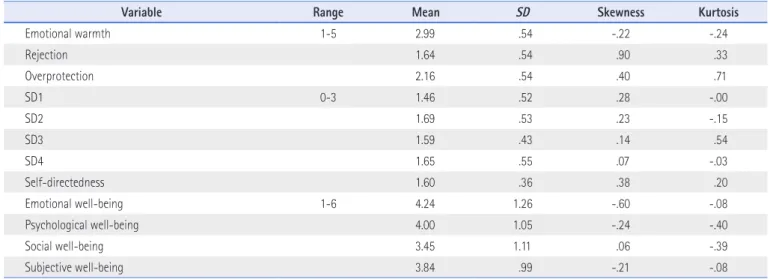
Table 1. Descriptive Statistics (N=325)
Variable Range Mean SD Skewness Kurtosis
Emotional warmth 1-5 2.99 .54 -.22 -.24
Rejection 1.64 .54 .90 .33
Overprotection 2.16 .54 .40 .71
SD1 0-3 1.46 .52 .28 -.00
SD2 1.69 .53 .23 -.15
SD3 1.59 .43 .14 .54
SD4 1.65 .55 .07 -.03
Self-directedness 1.60 .36 .38 .20
Emotional well-being 1-6 4.24 1.26 -.60 -.08
Psychological well-being 4.00 1.05 -.24 -.40
Social well-being 3.45 1.11 .06 -.39
Subjective well-being 3.84 .99 -.21 -.08
Note. M=mean; SD=standard deviation; SD1=Responsibility vs Blaming; SD2=Purposefulness vs Lack of goal direction; SD3=Resourcefulness vs Inertia; SD4=Self-
acceptance vs Self-striving.
Data Analysis
We used SPSS Statistics ver. 18.0 (SPSS Inc., Chicago, IL, USA) and AMOS ver. 18.0 (IBM Co., Armonk, NY, USA) to analyze the data collected in this study. We calculated Cronbach’s alpha coefficients to verify the reliability of the measurement tools as well as the descriptive statistics of frequency, mean, and standard deviation to determine the general tendencies of the variables. A data set must exhibit a multivariate normal distribution to perform multivariate analysis. Therefore we examined the skewness and kurtosis to test for the normality of the data in the present research.
Next, we conducted Perarson’s correlation analysis to explore the relationships between the variables. We used confirmatory factor analysis and fit indexes to verify the measurement model and structural model. We performed
bootstrapping tests to verify the mediating effect of self- directedness by looking at structural relationships among the variables through estimates of the appropriately verified research model.
Results
First, we performed a descriptive statistical analysis to examine the general trends regarding the variables used in the analysis. Table 1 shows the results. Also, to analyze a structural equation model, the observed variables must demonstrate normal distribution; that is, they must have a multivariate normal distribution. We examined the skewness and kurtosis of the data to determine if they satisfy this requirement; consequently, there was no problem estimating the parameters by analyzing the structural equation model.
We analyzed the correlations to assess the relationships between the variables in the research model analysis, which we present in Table 2. All correlations were significant.
We performed a confirmatory factor analysis (CFA) to verify the validity of the measured variables in the structural model analysis. To evaluate the suitability of the measurement model, we used the root mean squared error Table 2. Correlation Analysis (N=325)
1 2 3 4 5
Emotional warmth 1
Rejection -.52
***1
Overprotection -.18
**.55
***1
SD .41
***-.35
***-.22
***1
Subjective well-being .47
***-.28
***-.13
*.51
***1
*
p<.05,
**p<.01,
***p<.001.
Table 3. Direct, Indirect, Total Effects of Model
Emotional Warmth Parenting Model
Paths Direct effect Indirect effect Total effect
Emotional warmth → Self-directedness .51
***- .51
**Emotional warmth → Subjective well-being .22
***.30
**.52
**Self-directedness → Subjective well-being .58
***- .58
**Rejection Parenting Model
Paths Direct effect Indirect effect Total effect
Rejection → Self-directedness -.44
***- -.44
**Rejection → Subjective well-being .00 -.30
**-.30
**Self-directedness → Subjective well-being .69
***- .69
**Overprotection Parenting Model
Paths Direct effect Indirect effect Total effect
Overprotection → Self-directedness -.39
***- -.39
**Overprotection → Subjective well-being .11 -.28
**-.17
**Self-directedness → Subjective well-being .73
***- .73
****
p<.01,
***p<.001.
of approximation (RMSEA), the comparative fit index (CFI), and the Tucker-Lewis index (TLI), χ
2=664.738( p<.001), CFI=.915, TLI=.904, RMSEA=.063, which showed that the goodness of fit indexes of the measurement model satisfied the acceptance standards.
A structural equation modeling analysis assessed the causal relationships between the unobserved variables.
We used the χ
2test statistic, CFI, TLI, and RMSEA index to verify the extent to which the selected research model conformed to the observed data, and we evaluated the
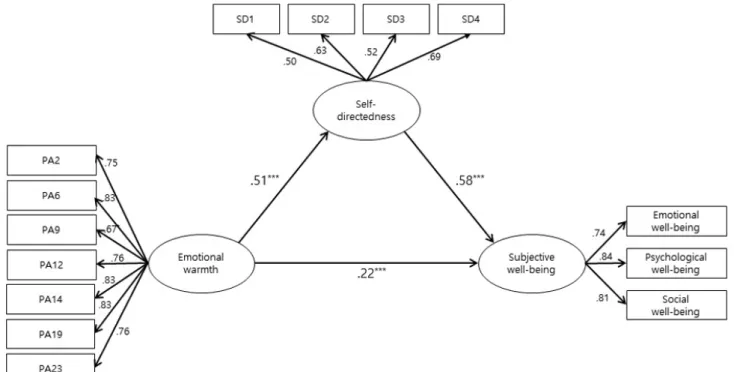
Figure 1. Structural Equation Modeling for SWB (Emotional warmth Parenting Model).
Figure 2. Structural Equation Modeling for SWB (Rejection Parenting Model).
suitability of the research model. We examined the goodness of fit index of the structural model regarding parental emotional warmth, self-directedness, and adolescents’
subjective well-being, with the following results: χ
2