특 집
Electrochemical Properties of Activated Carbon Capacitor Adopting a Proton-conducting Hydrogel Polymer Electrolyte
Mohammed Latifatu*, Kwang Man Kim**, Yong Joo Kim, and Jang Myoun Ko*,†
*Division of Applied Chemistry and Biotechnology, Hanbat National University, Daejon 305-719, Republic of Korea
**Research Team of Power Control Devices, Electronics and Telecommunications Research Institute (ETRI), Daejon 305-700, Republic of Korea
(Received October 23, 2012, Revised November 5, 2012, Accepted November 18, 2012)
수소이온전도성 고분자 겔전해질을 적용한 활성탄소계 전기이중층 캐패시터의 전기화학적 특성
모하메드 라티파두*․ 김광만**․ 김용주 ․ 고장면*,†
*대전광역시 유성구 동서대로 125, 한밭대학교 화학생명공학과
**대전광역시 유성구 가정로 218, 한국전자통신연구원 Power Control Devices 연구팀 접수일(2012년 10월 23일), 수정일(2012년 11월 5일), 게재확정일(2012년 11월 18일)
ABSTRACT:An electric double-layer capacitor (ELDC) of activated carbon electrode is prepared using a proton-conducting hydrogel polymer electrolyte, which is composed of poly(vinyl alcohol), silicotungstic acid, H3PO4, and deionized water.
A solid film by evaporating the hydrogel polymer electrolyte is also prepared for comparison. The hydrogel polymer electrolyte also acts as a separator with the thickness of about 80 μm and the room-temperature ionic conductivity of 10-2 S cm-1. The EDLC containing the symmetric electrodes of activated carbon shows the specific capacitance of 58 F g-1 at 100 mV s-1 with a good cycle life, implying that the hydrogel polymer electrolyte is very promising for use in EDLCs.
요 약:폴리비닐알콜, 규소텅스텐산, 인산 및 수용액으로 구성된 80 μm의 두께의 고분자겔 전해질 필름을 제조하여 활성탄소계 전기이중층 케페시터를 제조하였다. 제조한 고분자겔 전해질 필름은 상온에서 10-2 Scm-1의 높은 이온전 도도를 나타내었으며, 본 전해질 필름을 적용한 활성탄소계 전기이중층 케패시터는 100 mV/s에서 58 Fg-1의 높은 캐패시턴스 특성과 우수한 수명특성을 나타내었다.
Keywords:electric double-layer capacitor, activated carbon electrode, polymer electrolyte, electrochemical properties
†Corresponding Author. E-mail: [email protected]
Ⅰ. Introduction
Electric double-layer capacitor (EDLC) is an energy storage system, in which the polarization of electrodes in opposite di- rections leads to accumulation of opposite charges at the elec- trolyte/electrode interface.1 The EDLCs could provide high- power capability (typically within 60-120 s), excellent reversi- bility (90-95% or higher), and long cycle life (>105). It also could achieve 20-200 times larger capacitance per unit volume or mass than conventional capacitors.2. The EDLC for rever- sible electrical energy storage and delivery is comprised in principle of an electrolyte solution and two porous electrodes sandwiching the solution. The electrolyte is consisted typically
of one or more solvents containing one or more dissolved ionic species. In many cases, physical and electrochemical properties of the electrolyte become a key factor in determining the in- ternal resistance and power capability of the capacitor. Because of high ionic conductivity, the electrolyte of capacitor has been used in aqueous or organic solution for assembly of capacitor greatly. The liquid electrolyte may result in problems when handling and packaging the capacitor, and moreover, it may leak if it is used for a long time. Thus, replacing liquid electro- lyte by solid electrolyte has become the focus of capacitor studies. Recently, many attempts have been made to develop all solid-state capacitor since this approach offers attractive features, such as easy fabrication, rugged construction, no liq- uid leak, long shelf-life, safety, and a wide range of operation temperature. The all solid-state capacitor could be realized by
using solid or gel polymer electrolyte.3
Heteropolyacid is a good candidate for solid electrolyte due to the high proton conductivity in the solid state, which is an attractive feature in fuel cells and capacitors. Some draw- backs, such as poor film-forming capability and sensitivity to moisture, have so far limited application as solid electrolyte.4 A study was also tried by incorporating the heteropolyacid in polymer matrix to enable the formation of good solid elec- trolyte with high conductivity and good mechanical property.5 That is, an electrochemical capacitor adopting poly(vinyl alco- hol) (PVA) and silicotungstic acid (SWA) was suggested as an EDLC with good stability and cycle life over three months.
The PVA with SWA could form a solid film, and thereby the film was used as an electrolyte system in an electro- chemical capacitor.4 The PVA has also been used in preparing a number of hydrogels. For instance, an acidic hydrogel elec- trolyte was successfully prepared from aqueous solution of 4 M H2SO4, PVA, and glutaraldehyde to design a capacitor.6 In this study, a proton-conducting hydrogel polymer electrolyte (HPE) comprising of PVA, SWA, orthophosphoric acid (H3PO4), and deionized water is developed and used in the fabrication of an EDLC using activated carbon electrodes.
Ⅱ. Experimental
The precursor solution of the HPE was first prepared by mixing PVA (Aldrich, Mw = 130000, 5 wt.%) as a polymer matrix, SWA (H4SiW12O40, Aldrich, 43 wt.%) as a proton-con- ducting agent, H3PO4 (5 wt.%) as proton-conducting salt, and deionized water (47 wt.%) as a solvent. For the EDLC electro- des, a slurry was prepared by mixing activated carbon (80 wt.%) as an active materials, poly(vinylidene fluoride) (Aldrich, 10 wt.%) as a polymer binder, vapor-grown carbon fiber (Showa Denko, 10 wt.%) as a conducting agent, and N-meth- yl-2-pyrrolidone as a solvent. The viscous slurry was then ap- plied on an aluminum foil, spread by a doctor blade apparatus, and finally evaporated in an oven at 110 ℃ to yield the EDLC electrode.
A symmetric two-electrode EDLC was fabricated with a pair of the activated carbon electrodes (1 cm × 1 cm) and the HPE.
The EDLC was assembled as follows: 0.07 ml of the electro- lyte precursor solution was spread on the activated carbon elec- trode with the help of a brush. The coated electrode was slight- ly air-dried at 25 ℃ to evaporate some of the water component to form the HPE-laminated electrode. The EDLC was then fabricated by fusing two HPE-laminated electrodes together.
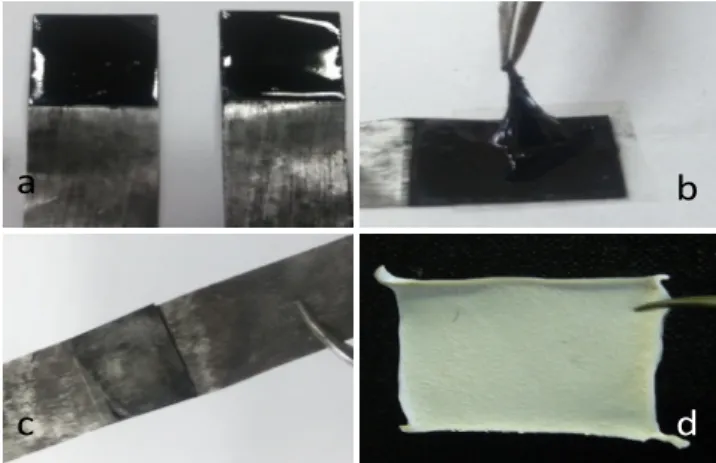
Figure 1 shows some images of the HPE, HPE-laminated elec- trode, and the fabricated EDLC device. The HPE was served as separator and electrolyte simultaneously in this study. A solid film of the precursor solution of PVA/SWA/H3PO4 was also made by solution-cast method for comparison. The sol-
a b
c d
Figure 1. (a) depicts an activated carbon electrode with the laminated HPE; (b) shows tough and adhesive nature of the HPE laminate; (c) shows a fabricated EDLC prepared by fus- ing two activated carbon electrodes with the laminated HPE together; (d) indicates the SPE.
ution was cast onto a clean glass plate for evaporation of ex- cess water at room temperature and then vacuum dried over- night at 40 ℃ to dry the film completely. Figure 1d shows the image of the PVA/SWA/H3PO4 solid film polymer electro- lyte (SPE). The film was kept in a desiccator to remove moisture. The thickness of the film was about 90 μm. An EDLC was also fabricated by inserting the SPE between the two activated carbon electrodes.
The electrochemical properties of the EDLC devices were evaluated using cyclic voltammetry and electrochemical im- pedance spectroscopy. The cyclic voltammetry was carried out using an Autolab imstrument (P/GStat 100, Eco Chemie) at different scan rates of 100-1000 mV s-1 in the potential range of 0-1.5 V (vs. Ag/AgCl). A three-electrode cell was used with Ag/AgCl (saturated KCl, 0.222 V vs. SHE) as a reference electrode and platinum as a counter electrode.
Ⅲ. Results and discussion
PVA (-[CH2-CHOH]n-) is a water-soluble synthetic polymer which has excellent film-forming, emulsifying, and adhesive properties due to its high tensile strength and flexibility. It is an atactic material but exhibits certain crystallinity as the hydroxyl groups are small enough to fit into the lattice without disrupting it.8 On the other hand, hydrogels are three-dimen- sional polymeric networks that trap water in the polymer ma- trices mainly by surface tension and other weak interactions.
Hydrogels comprising synthetic polymers, such as PVA, have high structural integrity and good mechanical stability. These hydrogels can also absorb large amount of water in the poly- mer matrix that helps fine-tuning their ionic conductivity.9
However, in many cases, conductivity is not part of the in- herent characteristics of the hydrogel and is provided by other elements which are incorporated within the polymer network of the hydrogel (e.g., conductive particles, conducting poly- mer, etc.). Therefore, it is important to develop a conductive hydrogel system that retains its conductivity at different gel swelling ratios and also displays enhanced mechanical per- formance.10
The prepared PVA-based HPE shows a high proton-con- ductivity of 10-2 S cm-1, which may be considered as a result of synergistic contribution from SWA and triprotic acid (H3PO4). The high conductivity of the HPE is also aided by the large amount of water which is trapped in the polymer matrix. The laminated HPE also has a tough appearance (see Figure 1b). The toughness comes from the PVA which has the ability to provide mechanical strength in the hydrogel by H-bond induced crosslinking. In aqueous solutions, entangled aggregates of H-bonded PVA molecules are formed.11 The hy- drogel also has a sticky, adhesive-like appearance. This adhe- sive-like nature of the HPE ensured a very good contact be- tween the two electrodes. They are inseparable after fusing them together. This tight contact enables the HPE to form good interfacial contacts with the electrode materials.
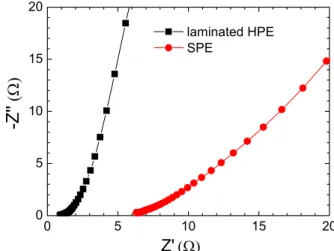
In order to assess the compatibility of the electrodes and the hydrogel electrolytes, the EDLCs containing the laminated HPE and the SPE were subjected to complex impedance meas- urements at 25 ℃. Figure 2 shows that there is a vast differ- ence in the impedance characteristics of the EDLCs containing the laminated HPE and the SPE. The ohmic resistance of the EDLC with the SPE is larger than that with the laminated HPE. This is because the proton-conductivity of the SPE is lower than the laminated HPE. The high conductivity of the laminated HPE results from the large amount of water in the polymer matrix. Deducing from the impedance arcs in high- frequency region, the charge transfer resistance at the elec- trode/electrolyte interface of the EDLC with the laminated HPE is smaller than that with SPE. Thus, the EDLC with the laminated HPE exhibits a better interfacial compatibility be- tween the EDLC electrode and the hydrogel electrolyte.
The cyclic voltammograms of the EDLCs with the laminated HPE and the SEP deviate slightly from ideal rectangular shape.
However, the electric double-layer occurs at the electrode/elec- trolyte interface. Moreover, visible peaks due to redox re- actions cannot be observed, which is implying that these elec- trolytes are stable within the applied potential range and also good capacitor devices in both cases. Again from Figure 3, the voltammogram size of the SPE-based EDLC is very small compared to that of the laminated HPE-based EDLC. This is due to the high ionic conductivity of the HPE-based EDLC.
The good electric contacts at the electrode/electrolyte interface and good compatibility of all constituents of the unit capacitor
0 5 10 15 20
0 5 10 15 20
Z' (Ω)
-Z'' (Ω)
laminated HPE SPE
Figure 2. Nyquist plots of the EDLCs containing the laminated HPE and SPE.
0.0 0.3 0.6 0.9 1.2 1.5
-6 -4 -2 0 2 4 6 8
SPE laminated HPE
Current density (A g-1 )
Potential (V vs. Ag/AgCl)
@100 mV s-1
Figure 3. Cyclic voltammograms of the EDLCs containing the laminated HPE and SPE at scan rate of 100 mV s-1.
are responsible for the good electrochemical characteristics in the HPE-based EDLC, comparable to that with the SPE. As shown in Figue 4, both the EDLCs with the HPE and SPE show a decreasing capacitance with increasing the scan rate.
However, the specific capacitance of the HPE remains higher than that of the SPE throughout the range up to 1000 mV s-1.
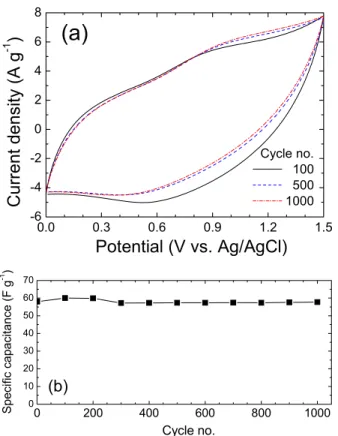
Figure 5a shows three cyclic voltammograms obtained after 100, 500 and 1,000 cycles, respectively, at a voltage sweep rate of 100 mVs-1, for the EDLC containing the HPE. The three voltammograms ae almost overlapping and have a volt- age window of 0-1.5 V, suggesting an excellent cycle life.
Figure 5b shows the specific capacitance as a function of cycle number for the EDLC containing the HPE at a scan rate of 100 mVs-1. The EDLC with the laminated HPE has a stable specific capacitance of 57 F g-1 for the 1000th cycle. The initial
0 200 400 600 800 1000 0
10 20 30 40 50
60 laminated HPE
SPE
Specific capacitance (F g-1 )
Scan rate (mV s-1)
Figure 4. Specific capacitances of the EDLCs as a function of scan rate
0.0 0.3 0.6 0.9 1.2 1.5
-6 -4 -2 0 2 4 6 8
Current density (A g-1 )
Potential (V vs. Ag/AgCl)
Cycle no.
100 500 1000
(a)
0 200 400 600 800 1000
0 10 20 30 40 50 60 70
Cycle no.
Specific capacitance (F g-1 )
(b)
Figure 5. (a) Cyclic voltammograms of the EDLC containing the laminated HPE at 100 mV s-1 and (b) the specific capaci- tance at 100 mV s-1 as a function of cycle number.
specific capacitance for the EDLC with the HPE was 60 F g-1, which decreases gradually and attains a stable value of 58 F g-1 after the 500th cycle. This excellent tread shown by the EDLC with the HPE makes the HPE a good candidate as a polymer electrolyte system for electrochemical capacitors.
Aside the SWA and H3PO4 contributing to the ionic con-
ductivity of the EDLC and leading to high specific capacitance, the PVA as a polymer matrix also plays a significant role in the high specific capacitance of the EDLC. The PVA pos- sess a fairly high degree of hydrophobicity due to the presence of long carbon-chains with few hydrophilic pendant groups,11 in contrast to hydrogels consisting of natural polymers such as gelatin. The hydrophobic nature of the PVA polymeric com- ponent in the hydrogel electrolyte also improves the compati- bility between the poly(vinylidene fluoride) binder in the elec- trode matrix and the hydrogel electrolyte, thereby resulting in good penetrability of the latter within the pores of the elec- trodes. The PVA also provides the adhesive nature of the lami- nated HPE ensuring a good contact between the two electrodes with the electrolyte. In addition, the SWA and the H3PO4 form a conductive network with the PVA enabling it to provide the required mechanical resistance against the external forces in the HPE.
Ⅳ. Conclusions
In this paper, an EDLC is fabricated using activated carbon electrodes and a proton-conducting adhesive-like HPE, which is started from an aqueous solution of PVA, SWA, and H3PO4. Electrochemical tests prove that the EDLC with the HPE has good proton-conductivity, highly stable potential window of 0-1.5 V even though the hydrogel contains the water content of about 50 wt.%. A specific capacitance of 58 F g-1 and ex- cellent cycle life for 1000 cycles can be achieved for the EDLC with the HPE at 100 mVs-1, implying that the HPE is attractive for use in electrochemical capacitors.
Acknowledgements
This study was supported by a grant from the cooperative R&D Program (B551179-10-01-00) funded by the Korea Re- search Council Industrial Science and Technology, and a grant (M2009010025) from the Fundamental R&D Program for Core Technology of Materials funded by the Korean Ministry of Knowledge Economy.
References
1. C.-P. Tien, W.-J. Liang, P.-L. Kuo, and H.-S. Teng, “Electric double layer capacitors with gelled polymer electrolytes based on poly(ethylene oxide) cured with poly(propylene oxide) di- amines”, Electrochim. Acta, 53, 4505 (2008).
2. Y. Zhang, H. Feng, X. Wu, L. Wang, A. Zhang, T. Xia, H. Dong, X. Li, and L. Zhang, “Progress of electrochemical capacitor electrode materials: A review”, Intern. J. Hydrogen Energy, 34, 4889 (2009).
3. Y. G. Wang and X. G. Zhang, “solid-state polymer nano- composite electrodes for flexible, ultrathin supercapacitors”,
solid state ionics, 166, 61 (2004).
4. H. Gao, Q. Tian, K. Lian, “Polyvinyl alcohol-heteropoly acid polymer electrolytes and their applications in electrochemical capacitors”, Solid State Ionics, 181, 874 (2010).
5. K. Lian and C. M. Li, “Solid polymer electrochemical capaci- tors using heteropoly acid electrolytes”, Electrochem. Commun., 11, 22 (2009).
6. S. Nohara, T. Miura, C. Iwakura, and H. Inoue, “Electric double layer capacitor using polymer hydrogel electrolyte with 4 M H2SO4 Aqueous Solution”, Electrochemistry, 75, 579 (2007).
7. http://en.wikipedia.org/wiki/polyvinyl_alcohol.
8. S. Paţachia, C. Florea, C. Friedrich, and Y. Thomann, “Tailo- ring of poly(vinyl alcohol) cryogels properties by salts addi- tion”, Express Polym. Lett., 3, 320 (2009).
9. S. Sampath, N. A. Choudhury, and A. K. Shukla, “Hydrogel membrane electrolyte for electrochemical capacitors”, J.
Chem. Sci., 121, 727 (2009).
10. S. Naficy, J. M. Razal, G. M. Spinks, G. G. Wallace, and P. G. Whitten, “Electrically Conductive, Tough Hydrogels with pH Sensitivity”, Chem. Mater., 24, 3425 (2012).
11. S. Gupta, T. J. Webster, and A. Sinha, “Evolution of PVA gels prepared without crosslinking agents as a cell adhesive surface”, J. Mater. Sci. Mater. Med., 22, 1763 (2011).