Influence of Blend Mode of Extender Oil on the Properties of EPDM/PP-Based Thermoplastic Vulcanizates
Sung-Su Na, Ki Chan Song*, and Su-Kyung Kim †
Department of Polymer Engineering, Chonnam National University, Gwangju 500-757, Korea
*Engineering Research Institute, Chonnam National University, Gwangju 500-757, Korea (Received July 31, 2009, Revised & Accepted August 11, 2009)
이피디엠/폴리프로필렌 열가소성 경화물에서 오일의 블렌드 방식이 경화물의 물성에 미치는 영향
나 성 수 ․ 송 기 찬
* ․ 김 수 경 † 전남대학교 고분자공학과, * 공업기술연구소 (2009년 7월 31일 접수, 2009년 8월 11일 수정 및 채택)
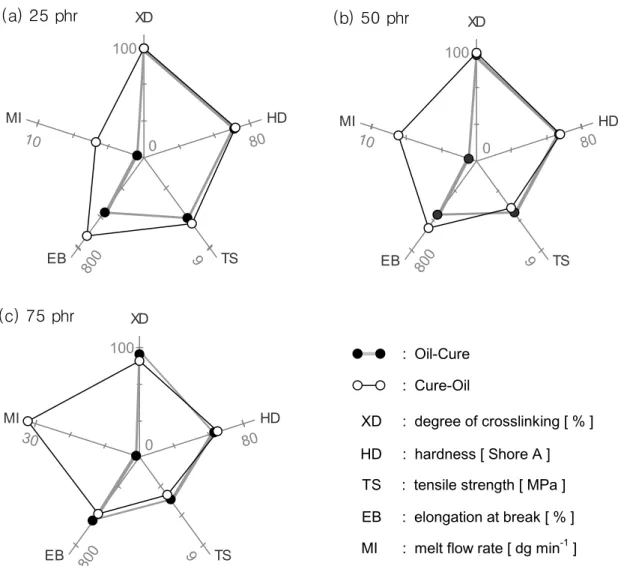
ABSTRACT:Influence of blend mode of extender oil on the properties of thermoplastic vulcanizates (TPVs), based on an ethylene-propylene-diene copolymer (EPDM) and a polypropylene (PP), was studied. The EPDM/PP TPVs were prepared in an open roll mill using two different modes in blending sequence of paraffinic oil and phenolic curative, i.e., Oil-Cure and Cure-Oil modes. Degree of cross-linking by gel fraction and properties such as hardness, tensile strength, elongation at break, and melt flow rate were investigated as a function of extender oil content for the two modes. Little influence of the blend mode of extender oil on the degree of cross-linking and mechanical behaviors was observed. However, the use of Cure-Oil mode in the preparation of EPDM/PP TPVs resulted in a marked increase in the level of processability as reflected by melt flow index, as compared to the use of Oil-Cure mode.
요 약:이피디엠/폴리프로필렌 열가소성 경화물을 오일의 배합 순서를 달리한 두 가지 방식(오일 블렌드 후 가교 방식과 가교 후 오일 블렌드 방식)으로 제조하여 가교도(겔분율), 경도, 인장강도, 신율, 용융흐름지수 등을 조사, 오일의 블렌드 방식이 열가소성 경화물의 물성에 미치는 영향을 알아보았다. 오일의 블렌드 방식에 따른 두 경화물의 가교도와 기계적 물성의 차는 크지 않았으나, 가공성에 있어서는 가교 후 오일 블렌드 방식으로 제조한 경화물의 용융흐름지수가 현저히 증가한 결과를 보였다.
Keywords:thermoplastic vulcanizates, EPDM, polypropylene, extender oil, blend mode
† Corresponding Author. E-mail: [email protected]
Ⅰ . Introduction
Thermoplastic elastomers are polymer materials that com- bine the processing characteristics of thermoplastics with the elastic and mechanical properties of vulcanized rubbers. An important class of thermoplastic elastomers is thermoplastic vulcanizates (TPVs). TPVs are produced by dynamic vulcan- ization of blends containing a thermoplastic and an elas- tomer. 1-5 The effect of the dynamic vulcanization of elas- tomer/plastic blends is to produce compositions which have the improvements in permanent set, ultimate mechanical prop- erties, hot oil resistance, melt strength, and thermoplastic fabricability. In addition, these materials are readily reground and recycled. 6 With thermoset rubbers, neither regrind nor re- cycle is possible without severe chemical modification of the
materials.
In many applications thermoplastic elastomers are able to replace thermoset rubbers because they offer equivalent or bet- ter performance, generally with a significant cost saving due to part fabrication cost differences. 4 In order to replace the thermoset rubbers, TPVs should become more rubber-like in properties and so an increase in amounts of rubber is required.
By increasing the rubber content, however, processing proper- ties inherent in the TPVs may be lost. In such cases, in- corporation of the processing or extender oil is required to improve processability of the TPVs.
Extender oils are compatible hydrocarbon oils employed in
substantial quantities as a cost-reducing liquid filler in rubber
industry. The oils can improve the resistance to oil swell, heat
stability, hysteresis and permanent set as well as the economic
benefit and the processing properties of the compositions. The
effect of the oils on processability is complex since this will
not only involve a reduction in compound viscosity but also extrudate smoothness, power consumption during compound- ing, and shaping and filler dispersion.
Elastomers are complex viscoelastic materials and their me- chanical response behavior strongly depends on the loading procedure, loading history, time and temperature. 7,8 While there has been considerable attention given to the loading pro- cedure of curing agent in the polyolefin/EPDM blends, 9-12 there has been little interest in mixing sequence of extender oil. In this study, we have prepared thermoplastic vulcanizates of EPDM and PP in a roll mill using two different modes in loading sequence of extender oil. The changes of cross-link density, and mechanical and processing properties of the TPVs prepared using the two modes were investigated and compared.
Ⅱ. Experimental
1. Materials
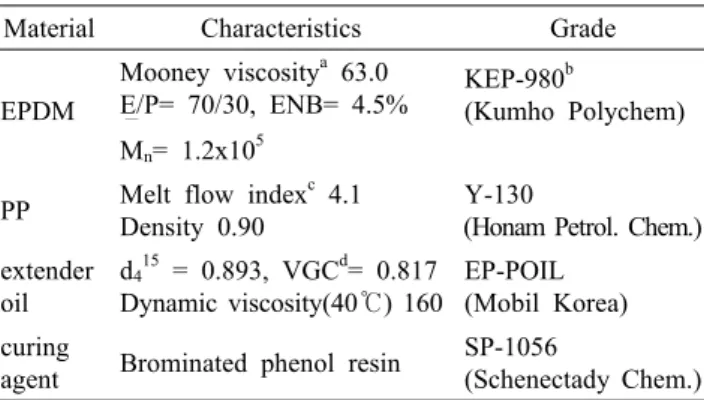
Materials included in this work are listed in Table 1. The ethylene-propylene-diene copolymer (EPDM) with ethylidene norbonene as a termonomer and the polypropylene (PP) were commercially available grades. In the EPDM, 75 phr of oil was comprised in the base-polymer. The extender oil used was the same rubber-grade as paraffinic oil extended in the EPDM.
The ingredients such as curatives and antioxidant were also used as received from the suppliers.
2. Preparation of TPVs
Compounding of the EPDM and PP with the extender oil and additives was carried out in an open roll mill (Kansai Roll, 8″Electric) at a temperature of 180 ℃ using two differ- ent modes. The extender oil loadings were selectively varied from 0 to 75 at 25 phr intervals, and the amounts of phenolic curative, zinc oxide, stearic acid were fixed with 5, 5, and 1 phr
Table 1. Materials and Their Characteristics Material Characteristics Grade
EPDM
Mooney viscosity a 63.0 E/P= 70/30, ENB= 4.5%
M
―
n = 1.2x10 5
KEP-980 b
(Kumho Polychem)
PP Melt flow index c 4.1 Density 0.90
Y-130
(Honam Petrol. Chem.) extender
oil
d 4 15 = 0.893, VGC d = 0.817 Dynamic viscosity(40℃) 160
EP-POIL (Mobil Korea) curing
agent Brominated phenol resin SP-1056
(Schenectady Chem.)
a ML1+8 120℃, b include 75 phr of oil,
c ASTM D1238 (230℃, 2.16㎏), d viscosity gravity constant.
based on the amount of base-polymer in the EPDM, respec- tively. Antioxidant was 0.2 phr of polypropylene weight.
The EPDM, PP, and additives except for the paraffinic oil and phenolic curative were preblended in the roll mill at 180
℃ for 10 min. One mode was to mix the preblended EPDM/
PP mixture with the oil for 10 min and then cure the EPDM in the oil-extended compound dynamically for another 10 min (Oil-Cure mode). The other mode was to dynamically cure the preblended mixture first and blend the dynamically cured compound with the oil afterward (Cure-Oil mode). Figure 1 shows a schematic diagram of the compounding procedure for the Oil-Cure and Cure-Oil modes.
3. Samples preparation
Samples from the appropriately compounded materials were prepared in a compression moulding machine (Nisshin Kagaku, HP-2000TS) under a pressure of 14.7 MPa and at a temper- ature of 200 ℃ for 10 min, then the sheets prepared were cut using a cutter (JIS No. 1). The test specimens were sub- sequently kept in an oven at 25 ℃ for 72 h.
4. Measurements
Mechanical tests were performed according to JIS K-6301 test method and five samples per formulation were tested.
Tensile strength and elongation at break were measured on a tensile testing machine (Monsanto, Tensometer-10) with crosshead rate of 500 mm min -1 . Shore A hardness was de- termined using a durometer (Ueshima, HD-101N). The hard- ness was observed after 5 s of pressor foot contact. Mechanical properties of the TPV after hot-air aging were also measured.
The aging study was carried out in an air-circulating oven at 135 ℃ for 168 h following the method described in ASTM D 573. Degree of cross-linking was described in terms of gel fraction. The gel fraction was determined by means of a typical extraction procedure of refluxing in boiling xylene for 3 h.
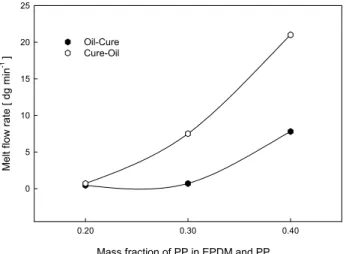
The solution was subsequently filtered and the insolubles were combined and dried under vacuum at 140 ℃ to constant weight. The gel fraction was defined as the weight fraction of undissolved portion after making suitable corrections for the soluble and insoluble components. 13,14 Processing property was evaluated as a melt flow index. The melt flow index was determined according to ASTM D 1238 using a melt flow tester (Toyoseiki, Melt Indexer) at 230 ℃ with a load of 10 kg.
Ⅲ . Results and Discussion
1. Degree of cross-linking
Degree of cross-linking introduced during dynamic vulcan-
Open roll mill, 180℃
gap between the rolls: 0.5~2.0㎜
PP, Antioxidant
EPDM
ZnO, Stearic acid
Oil Curing agent
Curing agent Oil
Mixing (2 min) Blending (5 min) Mixing (3 min)
Dynamic Curing (10 min)
Blending (10 min) Dynamic
Curing (10 min) Blending (10 min)
Oil-Cure Cure-Oil
Figure 1. Schematic diagram of compounding procedure.
Mass fraction of PP in EPDM and PP [ - ]
0.20 0.30 0.40
G el f raction X 10 0 [ % ]
84 88 92 96
100 Oil-Cure
Cure-Oil
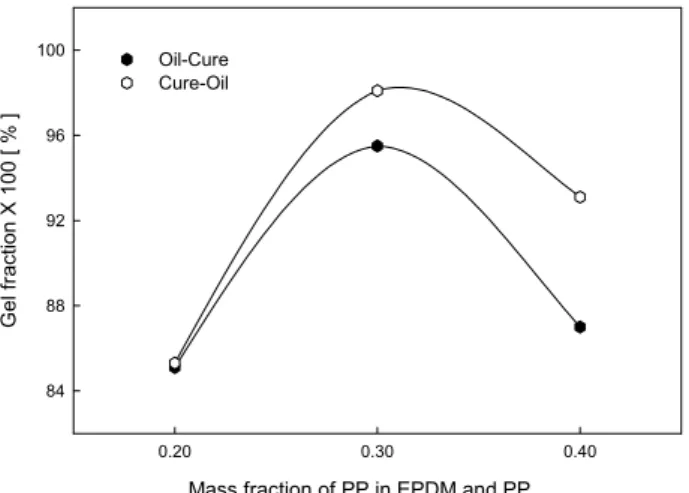
Figure 2. Gel fraction versus amount of PP in the EPDM/PP TPVs prepared using different blend modes for 50 phr of ex- tender oil.
ization has been recognized as being important in deter- mining properties of the resulting TPV. 2,15 Figure 2 shows the gel fraction with the composition of EPDM and PP for the loading of 50 phr of extender oil. From this figure, it can be seen that the Oil-Cure materials have low gel fraction com- pared to the Cure-Oil ones. This indicates that a chemical cross-linking was hindered by the extender oil mixed before the addition of curing agent. The effects of the extender oil
Amount of extender oil [ phr ]
0 25 50 75
Gel f rac tio n X 10 0 [ % ]
84 88 92 96 100
Oil-Cure Cure-Oil
Figure 3. Gel fraction versus extender oil content for 70/30 EPDM/PP TPVs prepared using different blend modes.
contents on the gel fractions in 70/30 EPDM/PP TPVs pre-
pared using the two modes are shown in Figure 3. The gel
fraction of the EPDM increased to be a certain amount of
oil due to the improved dispersion of curatives. However, the
gel fraction decreased in the case of oil exceeded a critical
amount, indicating that additional cross-linking in a partly
cross-linked EPDM was reduced by significant amounts of ex-
tender oil.
2. Tensile property
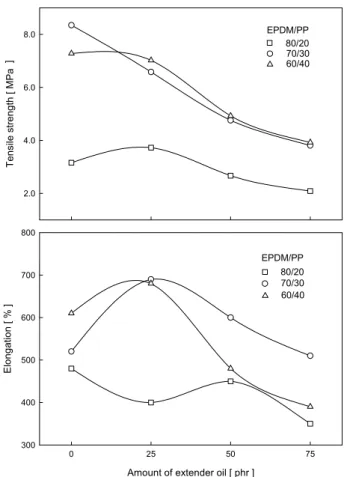
Tensile strength and elongation at break of the TPVs with several compositions for the Oil-Cure mode are shown in Figure 4 and those for the Cure-Oil mode are shown in Figure 5. The values of tensile strength for the two modes decreased gradually with increasing amounts of extender oil. The 70/30 EPDM/PP TPVs for the composition ratio of EPDM/PP and the Cure-Oil samples for the blend mode of extender oil showed the higher tensile properties. These are due to the high- er chemical cross-links in the corresponding samples and agree well with the gel fraction behaviors. In general, ultimate tensile properties are an inverse function of elastomer particle diame- ter and improve continuously as the chemical cross-link of the elastomer phase increases. 6,16,17
It is noted that, as shown in Figure 4, the vulcanizates pro- vided ultimate elongation of 520% at 0 phr of extender oil, which decreased to 480% at 25 phr and then increased to 580%
at 75 phr in the case of 70/30 EPDM/PP TPVs, representing a minima at intermediate oil contents in the Oil-Cure speci- mens. On the other hand, upon varying amounts of extender
Amount of extender oil [ phr ]
0 25 50 75
El ongat ion [ % ]
300 400 500 600 700 800
Tens ile s tre ngt h [ MPa ]
2.0 4.0 6.0
8.0 EPDM/PP
80/20 70/30 60/40
EPDM/PP 80/20 70/30 60/40
Figure 4. Effect of extender oil content on the tensile proper- ties of EPDM/PP TPVs with various compositions for the Oil-Cure mode.
oil in the Cure-Oil specimens, the ultimate elongations of 520, 690, 600, and 510% were obtained at 0, 25, 50 and 75 phr, respectively, showing convex upward elongation curves in Figure 5. These behaviors may be caused by a number of fac- tors acting independently and simultaneously, including de- creasing crystallinity of PP by blending with EPDM, mecha- nochemical degradation of PP, and chemical cross-linking of EPDM. 12 In addition to the above-mentioned factors, size and shape of dispersed phase, amount and location of extender oil, etc. may be included. In EPDM/PP/oil-based TPV, 18-20 the oil is generally believed to be predominantly absorbed by the EPDM phase. Some oil can reside in the amorphous region of PP phase. In this work, it would appear that in the Oil-Cure samples most oil was located in the EPDM phase because the dynamic curing was conducted after mixing the EPDM with the extender oil, whereas in the Cure-Oil samples some amounts of oil existed in an amorphous region of the PP phase and/or in a boundary between the EPDM phase and the PP phase because the extender oil was added to the partially cross-linked EPDM phase resulting from the dynamic curing.
Even though this statement should need additional inves-
Te ns ile s tr engt h [ MP a ]
2.0 4.0 6.0 8.0
Col 1 vs Col 3 Col 1 vs Col 5 Col 1 vs Col 7
Amount of extender oil [ phr ]
0 25 50 75
El onga tion [ % ]
300 400 500 600 700 800
EPDM/PP 80/20 70/30 60/40
70/30 60/40 80/20 EPDM/PP
Figure 5. Effect of extender oil content on the tensile proper-
ties of EPDM/PP TPVs with various compositions for the
Cure-Oil mode.
Table 2. Hardness Test Results Blend
Mode
EPDM/PP (wt./wt.)
Amount of extender oil (phr)
0 25 50 75
Oil-Cure
80/20 58 51 46 42
70/30 75 68 63 57
60/40 85 80 76 71
Cure-Oil
80/20 58 55 46 43
70/30 75 69 64 60
60/40 85 80 78 72
tigation, this distribution of oil over the EPDM and PP phases, together with other structural factors, would seem to lead to the variation of tensile property.
3. Hardness
The results of hardness testing are given in Table 2. As the amount of EPDM increased, the hardness of TPVs decreased. The decrease in hardness results from a rubbery nature of the EPDM. It is generally observed that as the ratio of EPDM to PP increases, the layer of PP between the EPDM phases becomes progressively thinner. Consequently, the TPV will become more rubber-like in properties, and less like a thermoplastic. Thus it will have a lower hardness and modulus, lower set, and a more linear tensile stress-strain curve. 4 The hardness value also decreased straightforwards with increasing amounts of extender oil. This is due to a plasticizing effect of extender oil. 19,21,22 When the blend mode of extender oil was varied, however, the hardness was essentially unchanged.
It is known that polypropylene/EPDM or ethylene-propylene rubber (EPR) combinations are especially useful as replace- ments for general-purpose vulcanized rubbers such as natural rubber, styrene-butadiene rubber, and EPDM. 23 To replace the thermoset rubbers, TPVs have to become a products having a lower hardness. It is considered that a composition ratio of EPDM/PP and amount of extender oil may be adopted to con- trol the hardness of TPVs.
4. Thermal aging
Polymeric materials like rubbers usually suffer from oxida- tion degradation during processing, storage and end-use.
Oxidation of rubber can result in loss of physical properties such as tensile strength, elongation, flexibility, and so on. In the case of a partly cross-linked PP/EPDM blends, 24 the sam- ples showed a remarkable decrease in the tensile strength and elongation at break due to one year's exposure outdoors but the hardness and tensile modulus increased to some extent caused by desorption of oil during the exposure period. In
T en si le str eng th [ M P a ]
2.0 4.0 6.0
8.0 Before After aging
Oil-Cure Cure-Oil
Amount of extender oil [ phr ]
0 25 50 75
El ong ati on [ % ]
300 400 500 600 700 800
Before After aging Oil-Cure
Cure-Oil
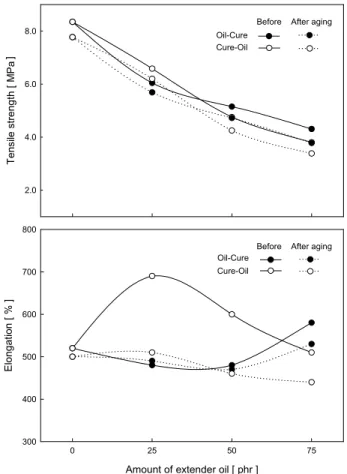
Figure 6. Variation of tensile properties as a function of ex- tender oil content for 70/30 EPDM/PP TPVs before and after thermal aging.
this study, the samples prepared using the two modes were subjected to oxidation in an air-circulating oven at 135 ℃ for 168 h and mechanical properties were measured. The estimated tensile properties for the specimens before and after thermal aging are shown as a function of extender oil contents in Figure 6. Tensile strength of the original materials for 70/30 EPDM/
PP TPVs varied from 8.35 to 3.81 MPa. After the exposure, the tensile strength values of all the specimens for the two modes decreased in similar amounts, about 0.35-0.53 MPa.
The values of elongation at break in the Oil-Cure specimens
decreased slightly as a result of the hot-air aging. However,
the Cure-Oil specimens showed the marked decrease of 180,
140, and 70% for 25, 50, and 75 phr of extender oil, res-
pectively. The reason may be that the oil located in an interface
between the EPDM and the PP and/or in an amorphous region
of PP migrated onto the surface of the TPVs during thermal
aging and this should cause the decrease in the elongation
values. Figure 7 is the hardness values both before and after
aging for the Oil-Cure and Cure-Oil samples. After aging,
there was no significant difference in the hardness for all the
samples.
Amount of extender oil [ phr ]
0 25 50 75
Har dne ss [ Shor e A ]
50 55 60 65 70 75
80 Before After aging
Oil-Cure Cure-Oil
Figure 7. Variation of Shore A hardness as a function of ex- tender oil content for 70/30 EPDM/PP TPVs before and after thermal aging.
Mass fraction of PP in EPDM and PP [ - ]
0.20 0.30 0.40
M el t f low rate [ dg mi n
-1] 0 5 10 15 20 25
Oil-Cure Cure-Oil
Figure 8. Melt flow rate versus amount of PP in the EPDM/PP TPVs prepared using different blend modes for 50 phr of ex- tender oil.
5. Processability