The Spectrum of Laser Instruments for Laser Acupuncture Application
Hwang Eui-hyoung*, Yang Chang-sop** and Jang In-soo**
*Dept. of Oriental Rehabilitation Medicine, Sunchang Heath Center
**Dept. of Internal Medicine, College of Korean Medicine, Woosuk University
Objectives : During the past three decades there has been a significant evolution of laser acupuncture application in the nature of the clinical approach and the research of traditional medicine and laser therapy field. However, there have been no standard and guideline of laser equipment can be applied as laser acupuncture. This study aims to investigate the condition of laser equipment required as a laser acupuncture method.
Methods : First, we performed literature search using the Medline (from 1999 to Oct 2008) to confirm types and ranges of laser equipments that can be applied as laser acupuncture. In addition, we investigated the characters of acupoints such as sites and depths, and compared with penetrating depths of each laser.
Results : A total of 37 articles for clinical studies using laser acupuncture were selected, and 41 lasers were used. GaAs laser was used three times, GaAlAs laser 14, InGaAlP 18, HeNe laser 4, and Argon laser and CO2 laser were used one time, respectively. From all 361 points of fourteen meridians, depths of 341 points(94.5%) were 1 cun (2.3-3.2cm) or less. The mean depth of all points was 0.48 cun(1.1-1.5cm).
Hence, it appeared that the majority of therapeutic lasers satisfied with the condition. HeNe, InGaAlP, GaAlAs, GaAs lasers are recommended for laser acupuncture, however, it may plausible that other surgical
1)
레이저침 시술에 사용되는 레이저 기기의 적용 범위에 대한 고찰
황의형*․양창섭**․장인수**
*순창군 보건의료원 한방재활의학과
**우석대학교 한의과대학 한방내과학교실
․접수 : 2009. 1. 10. ․수정 : 2009. 1. 25. ․채택 : 2009. 1. 27.
․교신저자 : 장인수, 전북 전주시 완산구 중화산동 2-5 우석대학교 부속한방병원
원 저
Abstract
lasers could be used as the laser acupuncture, because it have the biostimulation effect to some extent, too.
Conclusions : It is suggested that to select appropriate laser type and give the adequate output power to reach the acupoints under the skin using laser acupuncture. Further evaluation and research for the condition of laser acupuncture are warranted.
Key words : Laser acupuncture, therapeutic laser, Korean medicine, Application, Suitability
Ⅰ. 서 론
레이저침은 전통적인 침치료에 레이저 광선을 결 합한 치료방법으로 1973년 캐나다의 Plog에 의하여 HeNe 레이저를 침 치료에 도입한 이후 사용되기 시 작하였다1-5). 침에 대해서 비교적 익숙한 동양권에 비 해서 상대적으로 서양에서는 문화적인 차이로 인하여 침 치료를 낯설고 어렵게 여기는 경향이 있다. 그런 배경으로 인해 동양에서보다 서구에서 직접 피부 자 입을 하지 않는 레이저침에 대한 연구가 더 활발히 진행되어 왔다.
레이저침은 통증의 치료 이외에도 손목굴증후군 (carpal tunnel syndrome), 수술 후 오심구토(postop- erative nausea and vomiting : PONV), 불면증, 알코 올 중독 등의 광범위한 질환 치료에 적용되고 있다
6-10). 특히 통증이 없는 장점이 있어서 주의력결핍과
잉행동장애(ADHD) 등을 포함하는 소아질환에도 많 이 사용되고 있다6-10). 그 외에도 최근에는 functional magnetic resonance imaging(fMRI)나 transcranial doppler sonography(TCD), positron emission tomography(PET) 등을 이용하여 레이저침 자극에 대한 대뇌의 변화를 보고하는 연구들이 많이 발표되고 있다11-16).
그러나 아직까지 국내는 물론 국외에서도 레이저침 에 적용이 가능한 레이저 기기에 대한 일정한 규격과 지침이 마련되어 있지 않다. 이에 저자들은 레이저의 종류에 따른 투과 깊이(penetration depth)와 경혈의 일반적인 특성과의 관계를 살펴보고, 기존의 레이저 침 연구에서 사용된 레이저의 종류와 범위에 대하여 고찰해 보고자 한다.
Ⅱ. 본 론
1. 의료용 레이저(medical laser)의 종류
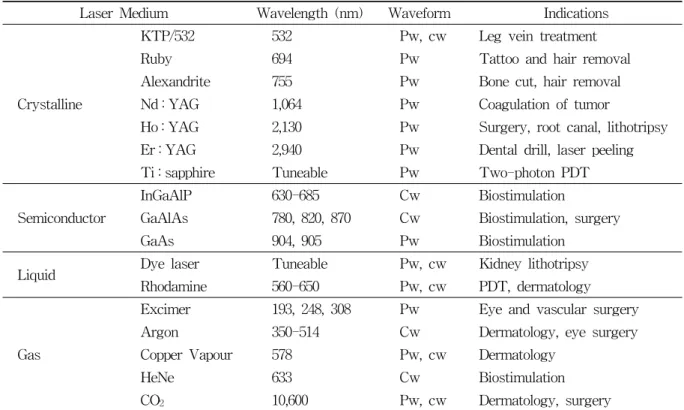
레이저의 종류는 수백 가지가 넘으며, 의료용 레이 저의 종류도 많지만, 그 중에서도 널리 쓰이는 레이저 를 매질의 종류에 따라서 파장과 파형 분류, 적응증을 정리하면 Table 1과 같다4). 레이저는 매질에 따라서 기체, 액체, crystalline, 반도체(semiconductor) 레이 저로 나뉘며, 심지어는 물방울로도 레이저를 만들 수 있다. 대개는 매질의 특성과 파장대에 따라서 레이저 의 고유 속성이 결정된다. 파장이 유사하여 성질이 비 슷한 레이저도 있는데, 예전에 많이 사용되었던 HeNe 레이저(633nm)의 경우에도 파장대가 비슷한 반도체 레이저의 일종인 InGaAlP 레이저(630-685nm)로 대체 되어 최근에는 거의 쓰이지 않는다4).
의료용 레이저는 크게 각종 수술에 사용되는 외과 레이저(surgical laser)와 치료레이저(therapeutic laser) 로 구분된다. 외과레이저는 적외선 레이저인 CO2 레 이저와 excimer laser가 널리 알려져 있는데, CO2 레 이저는 적외선 레이저로 투과 깊이가 대단히 낮아 서(0.2mm 이내)17) 피부의 사마귀나 점을 제거하는 등의 광응고(photocoagulation) 목적으로 흔히 사용 되며, excimer 레이저는 자외선 레이저로 안과의 각 막 절제를 통한 시력 교정 등의 광절제(photo- ablation) 목적으로 사용된다4). 치료레이저는 가시광 선 및 적외선 레이저가 사용되며, chromophore bio- molecule에 흡수된 photon이 respiratory chain에 영 향을 미쳐서 세포 고유기능의 활성과 면역 기능에 작 용하여 야기되는 국소 및 전신 효과를 일으키는 생체 자극효과(biostimulation)를 목적으로 사용된다4,18).
Table 1. Types of Medical Laser4)
Laser Medium Wavelength (nm) Waveform Indications
Crystalline
KTP/532 532 Pw, cw Leg vein treatment
Ruby 694 Pw Tattoo and hair removal
Alexandrite 755 Pw Bone cut, hair removal
Nd : YAG 1,064 Pw Coagulation of tumor
Ho : YAG 2,130 Pw Surgery, root canal, lithotripsy
Er : YAG 2,940 Pw Dental drill, laser peeling
Ti : sapphire Tuneable Pw Two-photon PDT
Semiconductor
InGaAlP 630-685 Cw Biostimulation
GaAlAs 780, 820, 870 Cw Biostimulation, surgery
GaAs 904, 905 Pw Biostimulation
Liquid Dye laser Tuneable Pw, cw Kidney lithotripsy
Rhodamine 560-650 Pw, cw PDT, dermatology
Gas
Excimer 193, 248, 308 Pw Eye and vascular surgery
Argon 350-514 Cw Dermatology, eye surgery
Copper Vapour 578 Pw, cw Dermatology
HeNe 633 Cw Biostimulation
CO
210,600 Pw, cw Dermatology, surgery
Pw : pulse wave, cw : continuous wave.
2. 기존 레이저침 연구에 사용된 레이저의 종류
저자들은 PubMed(http://www.ncbi.nlm.nih.gov/entrez/
query.fcgi)의 문헌 검색을 통하여 1999년부터 2008년 까지 보고된 레이저침을 사용한 임상연구 논문을 검색하였다.
대조임상시험(randomized control trial: RCT)과 증례보고(case study)는 대상에 포함시켰으며, 문헌고 찰 연구는 제외하였고, 언어제한(language limitation) 은 하지 않았다. 영문 제목과 초록을 통해서 검색된 자료 중에서, 저자들의 접근이 가능한 언어(한국어, 영어, 중국어, 일본어, 독일어)의 문헌은 최대한 확인 하여 포함시켰다.
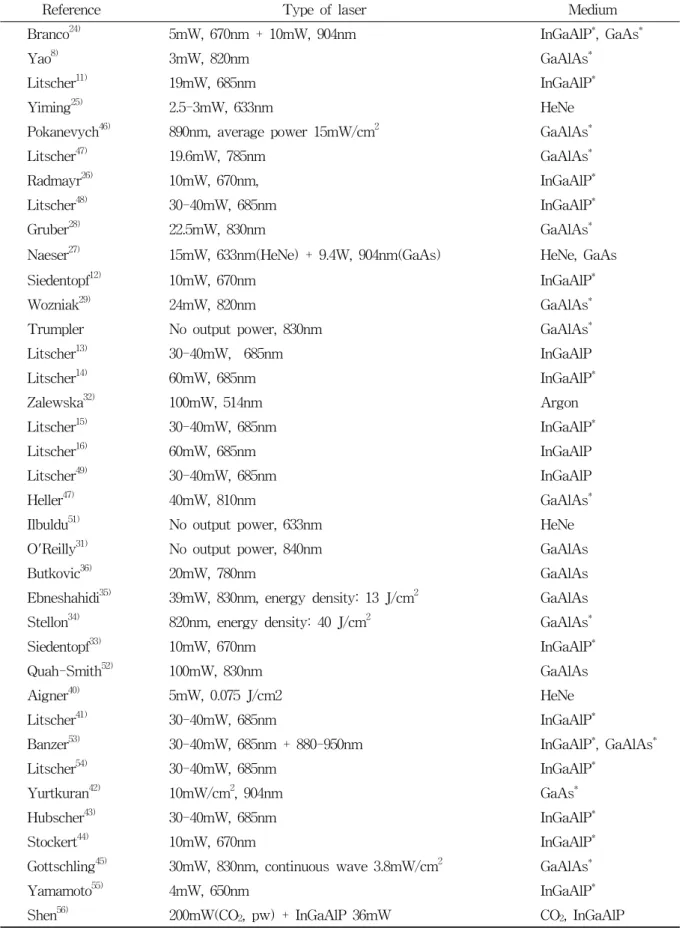
검색 결과 41편의 문헌이 검색되었으며, 그 중에서 본문이나 초록의 내용으로 레이저 기기에 대한 충분 한 정보를 얻을 수 없는 문헌은 제외하여, 총 37편의 문헌을 조사하였다. 이 연구들에서 사용된 레이저의 종류는 다음과 같다(Table 2).
3. 의학적 적용에 따른 레이저침의 종류와 출력
치료레이저(therapeutic laser)의 효과는 온열작용 (thermic effect)이 아니라 생체자극효과(biostimulation effect)가 중요한 치료 기전이며4,19), 실제로 열을 거의 발생시키지 않는 경우도 많다. 이러한 치료레이저의 자극 효과가 경혈이나 경근, 경맥에 영향을 미칠 때, 조기치신(調氣治神)의 한의학적 치료 기전을 가져올 수 있다19). 치료레이저 이외에도 외과레이저 역시 biostimulation effect를 가지고 있다고 알려져 있다4). 따라서 외과레이저도 레이저침의 용도로 사용할 수 있으나, 일반적인 적응증을 고려할 때 레이저침으로 잘 사용되지 않는다.
레이저침은 치료레이저의 생체자극효과를 경혈이 나 경락, 경근에 적용하기 위한 목적으로 사용하므로 경혈을 자극할 정도로 피부를 투과할 수 있어야 하고, 생체자극 효과를 낼 수 있는 충분한 기능을 발휘할 수 있어야 한다. 생체자극을 목적으로 치료레이저로 널리 사용되는 레이저 종류는 아래와 같다(Table 3).
Table 2. Types of Laser Applied in Laser Acupuncture Studies
Reference Type of laser Medium
Branco
24)5mW, 670nm + 10mW, 904nm InGaAlP
*, GaAs
*Yao
8)3mW, 820nm GaAlAs
*Litscher
11)19mW, 685nm InGaAlP
*Yiming
25)2.5-3mW, 633nm HeNe
Pokanevych
46)890nm, average power 15mW/cm
2GaAlAs
*Litscher
47)19.6mW, 785nm GaAlAs
*Radmayr
26)10mW, 670nm, InGaAlP
*Litscher
48)30-40mW, 685nm InGaAlP
*Gruber
28)22.5mW, 830nm GaAlAs
*Naeser
27)15mW, 633nm(HeNe) + 9.4W, 904nm(GaAs) HeNe, GaAs
Siedentopf
12)10mW, 670nm InGaAlP
*Wozniak
29)24mW, 820nm GaAlAs
*Trumpler No output power, 830nm GaAlAs
*Litscher
13)30-40mW, 685nm InGaAlP
Litscher
14)60mW, 685nm InGaAlP
*Zalewska
32)100mW, 514nm Argon
Litscher
15)30-40mW, 685nm InGaAlP
*Litscher
16)60mW, 685nm InGaAlP
Litscher
49)30-40mW, 685nm InGaAlP
Heller
47)40mW, 810nm GaAlAs
*Ilbuldu
51)No output power, 633nm HeNe
O'Reilly
31)No output power, 840nm GaAlAs
Butkovic
36)20mW, 780nm GaAlAs
Ebneshahidi
35)39mW, 830nm, energy density: 13 J/cm
2GaAlAs
Stellon
34)820nm, energy density: 40 J/cm
2GaAlAs
*Siedentopf
33)10mW, 670nm InGaAlP
*Quah-Smith
52)100mW, 830nm GaAlAs
Aigner
40)5mW, 0.075 J/cm2 HeNe
Litscher
41)30-40mW, 685nm InGaAlP
*Banzer
53)30-40mW, 685nm + 880-950nm InGaAlP
*, GaAlAs
*Litscher
54)30-40mW, 685nm InGaAlP
*Yurtkuran
42)10mW/cm
2, 904nm GaAs
*Hubscher
43)30-40mW, 685nm InGaAlP
*Stockert
44)10mW, 670nm InGaAlP
*Gottschling
45)30mW, 830nm, continuous wave 3.8mW/cm
2GaAlAs
*Yamamoto
55)4mW, 650nm InGaAlP
*Shen
56)200mW(CO
2, pw) + InGaAlP 36mW CO
2, InGaAlP
* : Laser medium was estimated by the wavelength.
Table 3. Type of Laser Commonly Applied as Therapuetic Laser4)
Type Wavelength (nm) Laser medium Maximum effective depth (mm) Output range (mW)
HeNe 633 Gas 8-10 0-60
InGaAlP 633-700 Semiconductor 20 0-100
GaAlAs 780-890 Semiconductor 35 100-1000
GaAs 904 Semiconductor 20-30 0-100
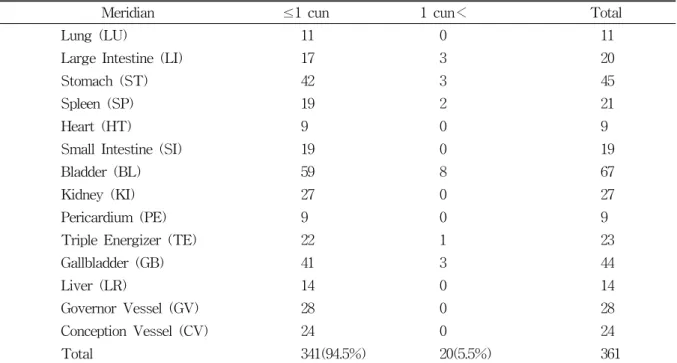
Table 4. Numbers of Acupoints on Each Meridians According to the Depth
Meridian ≤1 cun 1 cun< Total
Lung (LU) 11 0 11
Large Intestine (LI) 17 3 20
Stomach (ST) 42 3 45
Spleen (SP) 19 2 21
Heart (HT) 9 0 9
Small Intestine (SI) 19 0 19
Bladder (BL) 59 8 67
Kidney (KI) 27 0 27
Pericardium (PE) 9 0 9
Triple Energizer (TE) 22 1 23
Gallbladder (GB) 41 3 44
Liver (LR) 14 0 14
Governor Vessel (GV) 28 0 28
Conception Vessel (CV) 24 0 24
Total 341(94.5%) 20(5.5%) 361
경혈 자극을 위한 레이저의 출력(output power)에 대해서 몇 와트(W) 또는 몇 주울(J/second)이 적절한 지를 규정한 문헌은 없으며, 연속모드(continuous mode)와 펄스모드(pulse mode)가 어느 것이 더 우수 한지 등에 대한 연구 결과는 보고된 바가 없다. 레이 저의 출력은 환자에게 투여하는 약의 용량과 같이 중 요한 것으로4), 레이저가 생체자극 효과를 발생시키기 위해서는 probe apparatus에서 일정 정도 이상의 출 력밀도를 가지고 있어야 한다. 초기의 레이저침 연구 는 1mW 이하의 출력이 많이 사용되었으나, 최근에는 60mW까지14) 다양하게 사용되고 있다.
4. 경혈 자극을 위한 레이저의 투과 깊이
레이저는 매질에 따라서 투과 깊이가 일정한 차이
도달하느냐가 한때 뜨거운 쟁점이 되었으나20,21), 레이 저가 피부 아래로 일정한 깊이까지 도달한다는 연구 가 잇달아 보고되었고22,37), 피부아래까지 도달한 이후 에도 레이저스페클(laser speckle)이 관찰됨으로써, 레 이저 광선의 고유 속성인 결맞음(coherence)이 유지 된다는 사실이 확인된 뒤로 최근에는 더 이상 논란이 되고 있지는 않다4).
레이저침은 피부 아래에 위치하는 경혈 및 경락 자극을 목표로 하고 있으므로, 일정 정도의 경혈 깊 이까지 도달할 수 있는지 고려되어야 한다. 경혈의 깊이는 책마다 차이가 있지만, 침구학 교재38)를 기 준으로 살펴보면 십이경맥(十二經脈)과 임맥(任脈), 독맥(督脈)을 포함하는 십사경맥(十四經脈)에 속한 경혈 361개 중에서 1촌(寸, cun) 이하의 깊이에 위 치하고 있는 경혈이 94.5%를 차지한다(Table 4).
각 경혈 깊이의 최소와 최대값의 중앙값을 취하여
寸을 2.3-3.2cm 정도로 환산하면23,30), 약 1.1-1.5cm 이다. 문헌에 따라 차이가 나지만 레이저침에 많이 쓰이는 레이저 중에서 투과깊이가 가장 얕은 HeNe 레이저가 약 8-10mm인 것을 감안할 때, CO2 레이 저를 제외한 대부분의 HeNe, InGaAlP, GaAlAs, GaAs 레이저는 사용이 가능할 것으로 생각된다.
투과 깊이가 0.2mm 이내로 대단히 낮아서 표피 (epidermis) 조차 통과하지 못하는 CO2 레이저의 경 우에는 레이저침으로 사용이 가능할지에 대해서 다소 논란이 있을 수 있으나 최소침법(minimal acu- puncture)이나 피내침의 효과를 지지하는 문헌39)이 있기 때문에 단정적으로 판단하기는 어렵다.
Ⅲ. 고찰 및 결론
1960년에 Maiman이 Ruby laser를 처음으로 발진 시키고 나서, 1961년부터 의학 분야에서 레이저가 연 구되기 시작하였다4,19). 외과 분야에서 주로 사용되어 온 레이저는 1967년에 헝가리의 메쉬떼르(Mester)가 손상된 세포의 회복을 빠르게 하는 효과가 있음을 발 견하여 생체자극(biostimulation) 효과를 처음으로 보 고한 이래로 치료레이저(therapeutic laser) 분야가 발 전되어 왔다. 생체자극 효과는 세포 성장을 촉진시키 고, 손상에 대한 회복을 촉진하며, 세포 고유기능을 활성화하는 등의 효과가 있음이 밝혀져 있다4).
레이저침은 감염의 우려가 없고, 무엇보다 통증이 없어서 침에 대한 두려움이 많은 환자들이나 소아과 에서 적용하기에 편리하다. 최근에는 유럽을 중심으 로 레이저침을 사용하는 임상논문이 증가하고 있으며, 다양한 질환의 치료에 시도되고 있다6-10).
이렇듯 전통적인 침을 대신해서 레이저침의 활용 이 증가하고 있는 데에 비해서, 레이저침의 치료 가이 드라인이나 레이저 기기에 대한 일정한 규격과 지침 이 정해지지 않다. 따라서 어떤 레이저 기기가 레이저 침 치료에 적합한지에 대한 검토가 필요하다.
이를 위해 Medline의 문헌 검색을 통하여 1999년 부터 2008년까지 레이저침을 사용한 임상연구 논문들 을 검색하여 조사한 결과, 총 37편의 논문에서 6가지 레이저를 사용되었다. 이중에서 GaAs 레이저 3회, GaAlAs 레이저 14회, InGaAlP 레이저 18회, HeNe 레이저 4회, Argon 레이저와 CO2 레이저가 각각 1회 사 용되었다(Table 2). 이 중에서 HeNe 레이저와 InGaAlP
레이저는 파장이 유사하여 동일한 적응증을 가지고 있으므로 이 두 기기의 사용빈도를 합치면 전체 레이 저침의 50% 이상에 해당한다. HeNe 레이저는 gas 레 이저이기 때문에 주기적으로 gas tube를 교체해 주어 야 하고, gas chamber로 인해서 기기의 크기가 커지 거나 심지어 tube가 깨지는 경우도 있다. 이에 비해서 반도체 레이저인 InGaAlP 레이저는 생산 단가도 저 렴하고 크기가 작으며 반영구적이어서, HeNe 레이저 가 InGaAlP 레이저로 대체되고 있어서 앞으로는 InGaAlP 레이저의 활용이 더 많아질 것으로 추정된 다. 비록 일부이지만 Argon 레이저와 CO2 레이저도 사용되었는데, 이들은 모두 외과레이저로 비록 어느 정도의 생체자극 효과가 있다고 하더라도, 레이저침 에는 많이 활용되지는 않는 편이다. 그렇다고 레이저 침으로 사용되지 못한다고 단정할 수는 없지만 이를 레이저침으로 사용하는 것에는 어느 정도 제약이 따 르는 것은 사실이다.
레이저 기기를 레이저침으로 사용하기 위해서는 두 가지의 요소를 만족해야 한다고 생각된다. 첫째 레 이저가 경혈에 대한 최소한의 투과 깊이를 가져야 한 다는 것이고, 둘째 레이저가 경혈에 대한 최소한의 생 체자극효과를 내야 한다는 것이다.
경혈에 대한 투과 깊이를 확인하기 위해서는 먼저 경혈의 깊이에 대해 조사를 해 볼 필요가 있다. 이를 위해서 십이정경(十二正經)과 임․독맥을 포함한 14 경맥 361혈의 깊이를 조사해본 결과, 이 중에서 94.5%는 1寸이하의 깊이를 가지고 있다(Table 4). 1 寸의 길이는 개인에 따라 다르기 때문에, 체격과 체형 에 따라서 달라지는 경혈의 깊이를 쉽게 정할 수 있 는 이점이 있다. 현재의 도량형을 기준으로 1寸은 대 략 2.3-3.2cm가 된다20,21). 또한 361개 경혈의 평균 깊 이는 0.48寸으로 이는 약 1.1-1.5cm에 해당한다.
HeNe 레이저는 약 8-10mm의 투과력을 가지고 있 고, InGaAlP 레이저는 이보다 좀 더 투과력이 높으며, 적외선 레이저인 GaAlAs 레이저는 20-30mm, GaAs 레이저는 30-50mm의 투과력을 가지고 있으므로4), 각 각의 적응증에 따라서 깊은 경혈을 사용할 경우에는 적당한 레이저를 선택할 필요가 있을 것으로 생각된 다. 같은 적외선 레이저이지만 CO2 레이저는 투과깊 이가 낮아서(0.2mm 이내), 피부를 투과하지 못하므로 적용에 유의할 필요가 있다.
레이저가 생체자극효과를 내기에 충분한 자극량을 가져야 하는데, 그러기 위해서는 레이저가 일정 정도 이상의 출력밀도를 가지고 있어야 한다. 출력(output
power)의 단위는 와트(W)이므로 레이저의 출력도 와 트(W)나 밀리와트(mW)로 표시한다. 출력이 강할수 록 출력밀도(W/cm2)가 커지므로 최근에는 높은 출력 을 선호하는 경향이 있다. 또한 에너지는 출력에 시간 을 곱한 것이므로 에너지가 같을 때 출력이 클수록 조사 시간이 줄어든다. 최근의 연구 동향을 보면 레이 저의 출력이 점차 증가되는 것을 알 수 있으며, 2002 년 이후로는 InGaAlP 레이저는 100mW의 출력을 가 진 기기가 사용되고 있으며, GaAlAs 레이저 기기는 100-1,000mW의 제품이, GaAs 레이저는 100mW의 제품이 많이 쓰이고 있다. 레이저가 1-2mW의 출력을 지녀도 좋은 효과를 낼 수 있으나 동일 시간을 치료 할 때는 출력이 클수록 생체자극 효과를 더 쉽게 얻 을 수 있다4)(Table 3).
이상과 같이 레이저침에 사용되는 레이저 기기의 종류와 적용 범위에 대해서 살펴보았다. 다양한 적용 증에 대하여 레이저침이 사용되는 만큼, 사용 방법에 대한 일률적인 방식을 정하기는 어려움이 있으며, 기 기의 특성을 감안해서 적절하게 선택해야 할 것으로 생각된다. 한의학의 중요한 치료 수단의 하나인 침 치 료가 임상적인 적용증을 넓히고 효과를 높이기 위해 서는 레이저침을 비롯한 다양한 신기술을 적극적으로 활용할 필요가 있다. 적절한 기기의 선택과 숙련된 조 작 방법에 따른 적용을 통해서 레이저침 치료가 침구 학의 영역에서 좋은 치료 기술로서 널리 활용되기를 기대한다.
Ⅳ. 참고문헌
1. Whittaker P. Laser acupuncture: past, present, and future. Lasers Med Sci. 2004 ; 19(2) : 69- 80.
2. Plog FMW. Biophysical application of the laser beam. In: Koebner HK, editor. Lasers in medicine.
New York : John Wiley. 1980. p. 21- 37.
3. 황의형. 레이저침 치료의 유용성에 대한 메타분석.
우석대학교 대학원 2005.
4. 장인수, 신금백 共譯. Tunér J, Hode L 原著. 레이 저 치료학. 서울 : 정담. 2006 : 8-112.
5. 장인수 譯. Litscher G, Schikora D 原著. 레이저 침 치료학. 서울 : 메디컬코리아. 2007.
clinical outcome after low-level laser acupunc- ture, microamps transcutaneous electrical nerve stimulation, and other alternative therapies-an open protocol study. J Altern Complement Med.
1999 ; 5(1) : 5-26.
7. Schlager A, Offer T, Baldissera I. Laser stim- ulation of acupuncture point P6 reduces postop- erative vomiting in children undergoing strabis- mus surgery. Br J Anaesth. 1998 ; 81(4) : 529- 32.
8. Yao S. 46 cases of insomnia treated by semi- conductor laser irradiation on auricular points. J Tradit Chin Med. 1999 ; 19(4) : 298-9.
9. Trumpler F, Oez S, Stahli P, Brenner HD, Juni P. Acupuncture for alcohol withdrawal: a ran- domized controlled trial. Alcohol Alcohol. 2003 ; 38(4) : 369-75.
10. Arnold LE. Alternative treatments for adults with attention-deficit hyperactivity disorder (ADHD).
Ann NY Acad Sci. 2001 ; 931 : 310- 41.
11. Litscher G, Wang L, Wiesner-Zechmeister M.
Specific Effects of Laserpuncture on the Cerebral Circulation. Lasers Med Sci. 2000 ; 15 : 57-62.
12. Siedentopf CM, Golaszewski SM, Mottaghy FM, Ruff CC, Felber S, Schlager A. Functional mag- netic resonance imaging detects activation of the visual association cortex during laser acu- puncture of the foot in humans. Neurosci Lett.
2002 ; 327(1) : 53-6.
13. Litscher G, Schikora D. Cerebral vascular effects of non-invasive laserneedles measured by trans- orbital and transtemporal Doppler sonography.
Lasers Med Sci. 2002 ; 17(4) : 289-95.
14. Litscher G. Cerebral and peripheral effects of laser needle-stimulation. Neurol Res. 2003 ; 25(7) : 722-8.
15. Litscher G, Rachbauer D, Ropele S, Wang L, Schikora D, Fazekas F, Ebner F. Acupuncture using laser needles modulates brain function: first evidence from functional transcranial Doppler sonography and functional magnetic resonance imaging. Lasers Med Sci. 2004 ; 19(1) : 6-11.
16. Litscher G. Effects of acupressure, manual
EEG bispectral index and spectral edge fre- quency in healthy volunteers. Eur J Anaes- thesiol. 2004 ; 21(1) : 13-9.
17. Jang I, Park J. Can carbon dioxide laser substitute moxibustion? Lasers Med Sci. 2008 Jul : DOI 10.1007/s10103-008-0586-7.
18. Jang I, Yang C, Choi H, Hwang E. Pediatric applications of laser acupuncture: a systematic review. Proceedings of the Laser Congress Korea. 2008 Oct 16-19 ; Seoul, Korea.
19. 장인수, 조기호, 김영석, 배형섭, 이경섭, 강신화, 선중기. 저단계 레이저 치료에 대한 국내 논문 분 석 및 한의학적 임상 활용 방안. 대한한의학회지.
2001 ; 22(3) : 251-260.
20. Baldry P. A Review of Low-Power Laser Pain- Relieving Controlled Clinical Trials. Acup Med.
1993 ; 11(1) : 2-10.
21. Baldry P. Laser therapy. In : Filshie J, White A.
editor. Medical acupuncture : a western scientific approach. Edinburgh, UK : Churchill Livingstone. 1998 : 193-201.
22. Esnouf A, Wright PA, Moore JC, Ahmed S.
Depth of penetration of an 850nm wavelength low level laser in human skin. Acupunct Electrother Res. 2007 ; 32(1-2) : 81-6.
23. Wikipedia. Available from: URL: http://zh.
wikipedia.org/wiki/%E5%BA%A6%E9%87%8 F%E8%A1%A1
24. Branco K, Naeser MA. Carpal tunnel syndrome:
clinical outcome after low-level laser acupunc- ture, microamps transcutaneous electrical nerve stimulation, and other alternative therapies an open protocol study. J Altern Complement Med.
1999 Feb ; 5(1) : 5-26.
25. Yiming C, Changxin Z, Ung WS, Lei Z, Kean LS. Laser acupuncture for adolescent smokers a randomized double-blind controlled trial. Am J Chin Med. 2000 ; 28(3-4) : 443-9.
26. Radmayr C, Schlager A, Studen M, Bartsch G.
Prospective randomized trial using laser acu- puncture versus desmopressin in the treatment of nocturnal enuresis. Eur Urol. 2001 Aug ; 40(2) : 201-5.
27. Naeser MA, Hahn KA, Lieberman BE, Branco
KF. Carpal tunnel syndrome pain treated with low-level laser and microamperes transcutane- ous electric nerve stimulation : A controlled study. Arch Phys Med Rehabil. 2002 ; 83(7) : 978-88.
28. Gruber W, Eber E, Malle-Scheid D, Pfleger A, Weinhandl E, Dorfer L, Zach MS. Laser acupuncture in children and adolescents with exercise induced asthma. Thorax. 2002 ; 57(3) : 222-5.
29. Wozniak P, Stachowiak G, Pieta-Dolinska A, Oszukowski P. Laser acupuncture and low- calorie diet during visceral obesity therapy after menopause. Acta Obstet Gynecol Scand. 2003 ; 82(1) : 69-73.
30. 고려대학교 중국어사전편찬위원회 편. 중한사전.
서울 : 고대민족문화연구소. 1992 : 423.
31. O’Reilly BA, Dwyer PL, Hawthorne G, Cleaver S, Thomas E, Rosamilia A, Fynes M. Trans- dermal posterior tibial nerve laser therapy is not effective in women with interstitial cystitis.
J Urol. 2004 ; 172(5 Pt 1) : 1880-3.
32. Zalewska-Kaszubska J, Obzejta D. Use of low- nergy laser as adjunct treatment of alcohol addiction. Lasers Med Sci. 2004 ; 19(2) : 100-4.
33. Siedentopf CM, Koppelstaetter F, Haala IA, Haid V, Rhomberg P, Ischebeck A, Buchberger W, Felber S, Schlager A, Golaszewski SM. Laser acupuncture induced specific cerebral cortical and subcortical activations in human. Lasers Med Sci. 2005 ; 20(2) : 68-73.
34. Stellon A. The use of laser acupuncture for the treatment of neurogenic pruritus in a child a case history. Acupunct Med. 2005 ; 23(1) : 31-3.
35. Ebneshahidi NS, Heshmatipour M, Moghaddami A, Eghtesadi-Araghi P. The effects of laser acupuncture on chronic tension headache a randomised controlled trial. Acupunct Med. 2005 ; 23(1) : 13-8.
36. Butkovic D, Toljan S, Matolic M, Kralik S, Radesic L. Comparison of laser acupuncture and metoclopramide in PONV prevention in children. Paediatr Anaesth. 2005 Jan ; 15(1) : 37-40.
37. Kolarova H, Ditrichova D, Wagner J. Pene- tration of the laser light into the skin in vitro.
Lasers Surg Med. 1999 ; 24(3) : 231-5.
38. 대한침구학회 교재편찬위원회 편저. 침구학(상) 경락수혈. 서울 : 집문당. 2008.
39. Mann F. A new system of acupncture. In : Filshie J, White A. editor. Medical acupuncture : a western scientific approach. Edinburgh, UK : Churchill Livingstone. 1998 : 61-66.
40. Aigner N, Fialka C, Radda C, Vecsei V.
Adjuvant laser acupuncture in the treatment of whiplash injuries: a prospective, randomized placebo-controlled trial. Wien Klin Wochenschr.
2006 Mar ; 118(3-4) : 95-9.
41. Litscher G. Electroencephalogram-entropy and acupuncture. Anesth Analg. 2006 Jun ; 102(6) : 1745-51.
42. Yurtkuran M, Alp A, Konur S, Ozcakir S, Bingol U. Laser acupuncture in knee osteo- arthritis : a double-blind, randomized controlled study. Photomed Laser Surg. 2007 Feb ; 25(1) : 14-20.
43. Hubscher M, Vogt L, Banzer W. Laser needle acupuncture at Neiguan (PC6) does not mediate heart rate variability in young, healthy men.
Photomed Laser Surg. 2007 Feb ; 25(1) : 21-5.
44. Stockert K, Schneider B, Porenta G, Rath R, Nissel H, Eichler I. Laser acupuncture and probiotics in school age children with asthma: a randomized, placebo-controlled pilot study of therapy guided by principles of Traditional Chinese Medicine. Pediatr Allergy Immunol.
2007 Mar ; 18(2) : 160-6.
45. Gottschling S, Meyer S, Gribova I, Distler L, Berrang J, Gortner L, Graf N, Shamdeen MG.
Laser acupuncture in children with headache: A double-blind, randomized, bicenter, placebo- controlled trial. Pain. 2008 ; 137(2) : 405-12.
46. Pokanevych VV, Macheret IeL, Chupryna HM, Kovalenko OIe. The combination of reflex- otherapy and homeopathy in treating patients with facial nerve neuropathy. Lik Sprava. 2000 Mar ; (2) : 115-9.
spectroscopy and acupuncture-results of a pilot study. Biomed Tech (Berl). 2000 ; 45(7-8) : 215-8.
48. Litscher G, Schikora D. Cerebral vascular effects of non-invasive laserneedles measured by transorbital and transtemporal Doppler sonography. Lasers Med Sci. 2002 ; 17(4) : 289-95.
49. Litscher G, Wang L, Huber E, Schikora D, Schwarz G. Quantification of gender specific thermal sensory and pain threshold before and after laser needle stimulation. Biomed Tech (Berl). 2004 May ; 49(5) : 106-10.
50. Heller G, Langen PH, Steffens J. Laser acu- puncture as third-line therapy for primary nocturnal enuresis. First results of a prospective study. Urologe A. 2004 Jul ; 43(7) : 803-6.
51. Ilbuldu E, Cakmak A, Disci R, Aydin R.
Comparison of laser, dry needling, and placebo laser treatments in myofascial pain syndrome.
Photomed Laser Surg. 2004 Aug ; 22(4) : 306-11.
52. Quah-Smith JI, Tang WM, Russell J. Laser acupuncture for mild to moderate depression in a primary care setting a randomised controlled trial. Acupunct Med. 2005 Sep ; 23(3) : 103-11.
53. Banzer W, Hubscher M, Seib M, Vogt L. Short time effects of laser needle stimulation on the peripheral microcirculation assessed by laser Doppler spectroscopy and near-infrared spec- troscopy. Photomed Laser Surg. 2006 Oct ; 24(5) : 575-80.
54. Litscher G. Effects of laserneedle stimulation in the external auditory meatus on brainstem and very early auditory evoked potentials in humans.
Neurol Res. 2006 Dec ; 28(8) : 837-40.
55. Yamamoto T, Schockert T, Boroojerdi B. Treat- ment of juvenile stroke using Yamamoto New Scalp Acupuncture (YNSA) a case report.
Acupunct Med. 2007 Dec ; 25(4) : 200-2.
56. Shen X, Zhao L, Ding G, Tan M, Gao J, Wang L, Lao L. Effect of combined laser acupuncture on knee osteoarthritis: a pilot study. Lasers Med Sci. 2008 Jan 5. DOI 10.1007/s10103-007-0536-9.