학 술 논 문
191
Effect of Laser Acupuncture on Arterial Pulse
Jaekyong Cho and Dong Hwan Kang
1Department of Semiconductor Engineering, Gyeongsang National University, Gyeongnam 660-701, South Korea
1
Kangdong Oriental Medical Clinic, Gyeongnam 660-050, South Korea
(Manuscript received 19 August 2015; revised 24 September 2015; accepted 25 September 2015)
Abstract: Laser acupuncture is defined as the stimulation of traditional acupuncture points with low-intensity, non- thermal laser irradiation. Possible advantages in using laser acupuncture are the noninvasive, painless and low risks of infection treatment. The purpose of this study is to assess the effect of laser acupuncture on the quality and wave- form of arterial pulses. Ten acupuncture points were stimulated repeatedly three times in 30 individuals by laser with emission in the near infrared spectral region (808 nm) using an out power and power density of 45 mW and 143 W/
cm
2. The analysis of pulse quality and waveform was performed based on the measurement of arterial pressure of the left and right wrist, using a 3-dimensional blood pressure pulse analyzer. Excess-like pulse quality of subjects before laser acupuncture changed significantly to balanced pulse quality after 10, 20, and 30 minutes of laser acu- puncture; coefficient of deficient or excess, C
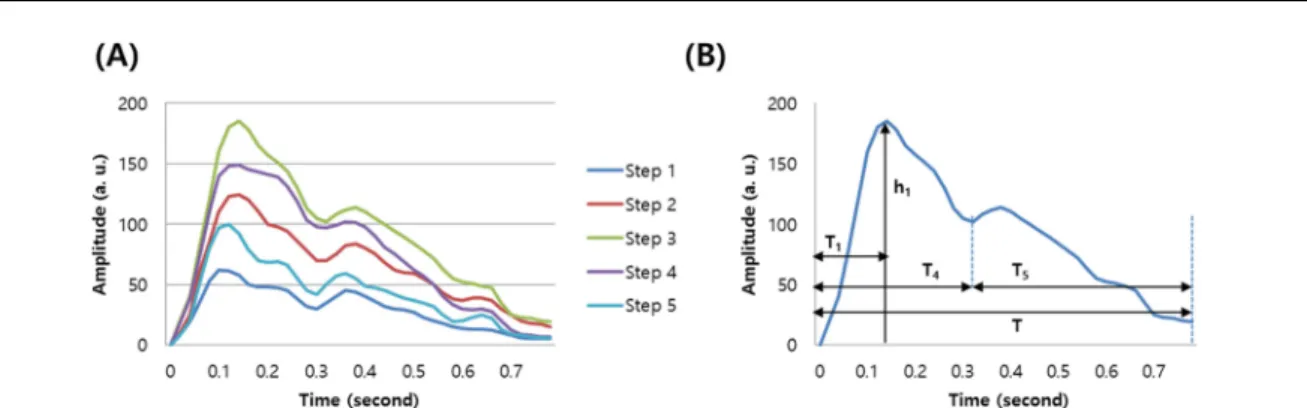
DE, decreased significantly from 0.68 before acupuncture to 0.61, 0.55, and 0.55 after 10, 20, 30 minutes of laser acupuncture (p ≤ 0.006), respectively. Other pulse qualities, floating or sink- ing, slow or rapid, choppy or slippery did not change significantly by laser acupuncture (p > 0.05). Pulse waveform analysis showed that amplitude of main peak (systolic function or aortic compliance, h
1) of left and right artery pulse waves decreased significantly after 10, 20, and 30 minutes of laser acupuncture (p < 0.05). Other parameters, dura- tion of one cardiac cycle (T), duration of rapid systolic ejection (T
1), duration of the systolic phase (T
4), and duration of the diastolic phase (T
5) of left and right artery pulses did not change significantly after laser acupuncture (p > 0.05).
Key words: laser acupuncture, arterial pulse, pulse analyzer, pulse quality, pulse waveform
I. Introduction
Although needle acupuncture’s incidence of adverse events is small, especially given the large number of treatments, complications such as hepatitis trans- mission and pneumothorax have occurred [1,2]. Such problems, coupled with many people’s aversion for needles, make laser therapy attractive. Laser acu- puncture is defined as the stimulation of traditional acupuncture points with low-intensity, nonthermal laser irradiation [3].
Laser acupuncture is a noninvasive and low risk of infection, and painless potential alternative to trad-
itional needle acupuncture. Researchers shined laser light on various parts of the body and found that light traveled under the skin to other acupuncture points, but it did not travel to places that were not on acupuncture meridians. It appears that the body contains a sort of fiber optic network—where light enters an acupuncture point, travels through the meridian and can be detected at other places along the meridian with a sensitive photon detector [4].
Studies show that laser acupuncture can help re- generate cells, decrease pain, reduce inflammation, and improve circulation [5]. Recent studies on laser acupuncture have included advanced brain imaging, as well as several other modern protocols for measuring various physiological effects to the body. These studies show that laser acupuncture has physiological effects, not only locally, but also in the brain, similar to needle acupuncture [6].
However published laser acupuncture studies have concentrated mostly on pain relief [3]. Few laser acu-
Corresponding Author : Jaekyong ChoDepartment of Semiconductor Engineering, Gyeongsang National University, 501 Jinju Daero, Jinju, Gyeongnam 660-701, Korea
TEL: +82-55-772-1736 / FAX: +82-55-772-1739 E-mail: [email protected]
This work was supported by the Gyeongsang National University Fund for Professors on Sabbatical Leave, 2014.