Biomedical Science Letters 2017, 23(2): 80~88 http://dx.doi.org/10.15616/BSL.2017.23.2.80 eISSN : 2288-7415
Effect of Ginkgo biloba Extract (EGb 761) on Serum Cholesterol Levels in Wild-type C57Bl/6 Mice
Jin Woo Kim1, Jin Sung Hong2, Byung Il Yoon1, Ki-Jong Rhee3, Chang Six Ra4 and Bae Dong Jung1,†
1College of Veterinary Medicine & Institute of Veterinary Science, Kangwon National University, Chuncheon 24341, Korea
2Division of Bioresource Sciences, Kangwon National University, Chuncheon 24341, Korea
3Department of Biomedical Laboratory Science, College of Health Sciences, Yonsei University at Wonju, Gangwon-do 26493, Korea
4Department of Animal Resource Science, College of Animal Life Science, Kangwon National University, Chuncheon 24341, Korea
Ginkgo biloba extract (EGb 761) is a standardized extract of Ginkgo biloba leaves and has anti- atherosclerosis properties. Many patients with atherosclerosis disorders take Ginkgo biloba extracts to supplement current therapy. In addition, normal healthy individuals also take Ginkgo biloba extracts for prophylactic purposes. However, it is unknown whether supplementation of Gingko biloba extracts in healthy individuals offer a benefit. In this study, we assessed whether EGb 761 could provide beneficial effects on serum cholesterol levels in normal mice. Wild-type C56Bl/6 mice were orally administered EGb 761 at 25 mg/kg (Group 3) or 50 mg/kg (Group 4) every other day for 40 days. We found that the serum levels of HDL-cholesterol (HDL-C) were significantly increased in EGb 761 and lovastatin treated groups.
Treatment with EGb 761 and lovastatin resulted in reduced serum total cholesterol and LDL-cholesterol (LDL-C) compared to control group. Serum lecithin cholesterol acyltransferase (LCAT) levels were higher in EGb 761 and lovastatin treated group compared to the control group. However, no difference was observed in serum APO A-I levels between the control group and treatment group. These results suggest that EGb 761 can increase HDL-C resulting in increased serum LCAT levels.
Key Words: Ginkgo biloba extract, Cholesterol, HDL-cholesterol, LDL-cholesterol, Lecithin cholesterol acyltransferase
서 론
최근 고지방, 고단백 등 동물성 식품의 섭취가 증가된 식생활의 불균형과 환경 변화 및 스트레스 등 복합적 요 인으로 인하여 심장병이나 동맥경화 및 고혈압 등 순환
기계 관련 질병이 많이 발생하고 있다(Black and Garbutt, 2002). 고지방의 과잉 섭취로 인한 혈액 내 콜레스테롤 농 도의 증가와 지방운반을 담당하는 low density lipoprotein (LDL)의 혈관 벽 내 축적은 동맥경화를 유발하는 원인 으로 밝혀졌다(Holvoet et al., 1998). 그러나 high density lipoprotein (HDL)은 LDL 산화 억제와 reverse cholesterol
*Received: June 18, 2017 / Revised: July 3, 2017 / Accepted: July 3, 2017
†Corresponding author: Bae Dong Jung. College of Veterinary Medicine & Institute of Veterinary Science, Kangwon National University, Chuncheon 24341, Korea.
Tel: +82-33-250-8674, Fax: +82-33-259-5625, e-mail: [email protected]
○CThe Korean Society for Biomedical Laboratory Sciences. All rights reserved.
○CCThis is an Open Access article distributed under the terms of the Creative Commons Attribution Non-Commercial License (http://creativecommons.org/licenses/by-nc/3.0/) which permits unrestricted non-commercial use, distribution, and reproduction in any medium, provided the original work is properly cited.
Original Article
transport를 통해 동맥혈관 벽의 잉여 콜레스테롤을 제거 하고 혈관의 플라그 생성을 억제하는 것으로 알려졌다 (Cockerill et al., 2001; Ishikawa et al., 1992; Parthasarathy et al., 1990). 이러한 이유에 혈액 내 LDL 농도 저하 및 HDL 농도 증가의 유도는 동맥경화를 예방하는 하나의 방법이 될 수 있다(O'Conell and Genest, 2001). 혈액 내 LDL 및 HDL 농도는 식이요법으로 조절될 수 있지만 식이요법으 로 콜레스테롤의 대사과정을 제어하는 것에는 개개인의 많은 노력과 시간이 필요하고 동맥경화의 개선 여부도 불 확실하다는 한계가 있다. 그래서 천연물질의 지속적인 섭 취나 약물 투여를 통하여 혈중 콜레스테롤을 낮추거나 HDL 농도를 높여 지질의 과산화를 방지하려는 연구가 다양하게 진행되었다. 녹차와 새 송이 버섯의 천연추출 물은 혈중 콜레스테롤 농도를 낮추는 항동맥경화 효과가 있는 것으로 보고되었다(Muramatsu et al., 1986; Mori et al., 2008). 약물로써는 statin계 약물이 HMG-CoA reductase를 억제시켜 혈중 콜레스테롤의 농도를 억제하기에 콜레스테 롤 혈중 환자에서 치료의 목적으로 사용되고 있다(Li et al., 2016; Yamashita et al., 2010).
Ginkgo biloba extract (EGb 761)은 표준화된 은행잎의 추출물로서 24%의 flavonoid glycosides와 6%의 terpene lactone 등을 함유하고 있으며(Wang et al., 2017) 암, 심장과 뇌의 허혈성 손상 및 AIDS 등의 예방 및 치료에 이용하 기 위한 연구가 활발히 진행되었다(Tchantchou et al., 2007;
Liu et al., 2005). EGb 761에 포함된 flavonoid 계열의 화합 물은 생체 내 지질 과산화 억제하고, 동맥경화 및 고지 혈증에 대한 예방 효과가 있는 것으로 밝혀졌다(Liu et al., 2006). 최근 우리는 EGb 761이 대장염에 효과가 있고 (Rhee et al., 2014) type I과 type II 당뇨병 모델에서 EGb 761의 투여가 중성지방의 양을 효과적으로 감소시키는 결과를 보고하였다(Rhee et al., 2015). 이러한 효과를 갖는 EGb 761은 혈액 순환 개선을 위해 상품화 되었고 장기간 섭취하는 경우가 많다. 그러나 EGb 761의 투여가 혈중 콜 레스테롤의 농도에 미치는 영향에 관해서는 상이한 결과 가 있다. Al-Attar (2012)와 Drieu et al. (2000)은 EGb 761의 투여가 혈중 콜레스테롤의 농도에는 영향을 미치지 않는 것으로 보고하였다. 하지만 우리의 예비실험에서는 EGb 761의 투여가 마우스 혈중의 콜레스테롤의 농도를 낮추는 것으로 나타났다.
본 연구에서는 혈중 콜레스테롤의 농도에 대한 EGb 761의 효과를 명확히 하고자 하였다. 질병 모델이 아닌 정 상의 마우스를 사용하였고 지속적인 EGb 761의 투여가
유도하는 혈중 콜레스테롤의 변화를 lovastatin의 효과와 비교 분석하였다. 또한 혈중 콜레스테롤의 농도 감소에 대 한 기전을 알아보기 위하여 HDL의 주성분이고 콜레스테 롤을 간으로 수송하여 대사를 촉진하는 단백질인 apoli- poprotein A-I (Apo A-I)과 lecithin cholesterol acyltransferase (LCAT)의 농도를 ELISA법을 이용하여 측정하였다. 또한 간에서 지질 과립의 변화와 혈중 지방산의 변화를 측정하 였다.
재료 및 방법
실험동물 및 연구재료
본 실험에 사용된 EGb 761은 powder 형태로 독일 Schwabe Pharmaceuticals에서 친절하게 공급 받았으며, lovastatin은 Sigma-Aldrich (St. Louis, MO, USA)에서 구입하 였다. 시료를 각각 농도에 맞춰 각 마우스 당 0.2 ml의 saline에 희석하여 경구 투여하였다. 마우스는 평균체중이 25 ± 0.7 g인 28마리의 C57Bl/6를 Nara Biotech (Daejeon, Korea)에서 구입하여 1주일 간 적응시켰으며 7마리씩 4군 으로 나누어 사육하였다. 물과 사료(EEGJ30060; Cargill Agri Purina, Seongnam, Korea)는 자유롭게 섭취할 수 있도 록 하였다(강원대학교 동물실험윤리위원회 승인번호, KW- 161001-2). 격일로 디지털 계량기를 이용하여 체중을 측 정하고 일정한 시간에 saline, lovastatin 그리고 EGb 761을 이틀에 한번 총 20회 경구 투여하였다. 사육실의 온도 (18±1℃)와 명암(09:00~21:00)은 12시간 cycle 조명으로 최적상태를 유지시켰다. 사육 40일 간의 최종 일에는 12시 간 절식시켰고 마지막으로 체중을 측정하였다. 에테르 마 취 후 심장에서 채혈하고 간을 적출하여 무게를 측정하였 다. 조직 염색을 위한 간은 포름알데하이드에 보관하고 western blot analysis를 위한 조직은 액체질소로 냉동시킨 후 -80℃에서 보관하였다. 생화학적 검사를 위한 혈액은 약 1시간 정도 냉장 보관하여 혈액을 응고시켰다. 그 후 1,500 rpm에서 20분간 원심분리한 후 혈청을 취하여 실험 에 사용하였다.
혈청 중 glucose 및 insulin 농도 분석
Glucose의 양은 ACCU-CHEK Go (Roche Diagnostics Inc., Korea)를 사용하여 측정하였다. Insulin의 농도는 ELISA kit (Shinbayagi Co., Shinbukawa, Gunma, Japan)로 450 nm에 서 측정하였다.
혈청 중 triglyceride (TG), free fatty acid (FFA), 콜레스 테롤(total cholesterol), LDL 그리고 HDL의 농도 분석
중성지방은 AceChem TG Kit (YD Diagnostics Inc., Korea) 을 이용하여 측정하였다. 혈청 10 μl를 원심분리기용 튜브 에 넣고 효소용액 1.0 ml와 혼합하여 실온에서 5분간 방 치한 후 96 well plate에 옮겨 1시간 이내에 standard 시약 을 대조로 하여 600 nm에서 흡광도를 측정하였다. 콜레 스테롤은 혈청 10 μl를 원심분리기용 튜브에 넣고 total cholesterol kit (YD Diagnostics Inc., Korea) 1.0 ml와 혼합하 여 실온에서 5분간 방치한 후 96 well plate에 옮겨 1시간 이내에 standard 시약을 대조로 하여 600 nm에서 흡광도를 측정하였다. LDL은 혈청 10 μl를 원심분리기용 튜브에 넣 고 효소용액(LDL-cholesterol kit, no. A308-L, YD Diagnostics Inc., Korea) 1.0 ml와 혼합하여 실온에서 5분간 방치한 후 96 well plate에 옮겨 1시간 이내에 표준시약을 대조로 하 여 600 nm에서 흡광도를 측정하였다. HDL은 혈청 10 μl를 원심분리기용 튜브에 넣고 효소용액(HDL-cholesterol kit no. A308-H, YD Diagnostics Inc., Korea) 1.0 ml와 혼합하여 실온에서 5분간 방치한 후 96 well plate에 옮겨 1시간 이 내에 표준시약을 대조로 하여 546 nm에서 흡광도를 측정 하였다. Free fatty acid (FFA)는 Free Fatty Acid Quantification kit (Biovision Inc., CA, USA)를 사용하여 측정하였다.
간 내 지방과립 변화
간은 부검 시 절제하여 4℃ 포름알데하이드에 하루 동 안 보관 후 지방과립 관찰을 위해 cryostat을 사용하여 5 μm 두께로 냉동 박절하였다. 함수-탈수 처리를 거쳐 파 라핀 블록을 제작하여 4 μm 두께의 미세절편을 만들어 슬 라이드글라스에 부착시켰다. 제작된 슬라이드는 hemato- xylin and eosin (H&E) 염색을 시행하여 광학현미경으로 관찰하였다(Emamat et al., 2016)
혈청 중 LCAT, APO A-I 농도 분석
LCAT의 농도는 ELISA kit (Cell Biolabs, CA, USA)를 이 용하여 450 nm에서 농도를 측정하였다. APO A-I의 농도 는 ELISA kit (Uscn Life Sciences, Wuhan, China)를 이용하여 450 nm에서 농도를 측정하였다.
통계처리
모든 실험 결과는 mean ± S.D로 나타내었으며, SPSS v 2.2의 ANOVA test의 통계처리 방법으로 통계적 유의성 검
정을 조사하였다. 유의수준은 P < 0.05로 하였다.
결 과
체중 변화
마우스의 40 일간의 체중 변화를 Fig. 1에 나타내었다.
생리식염수를 투여한 saline군과 비교하여 lovastatin 30 mg /kg 투여군과 EGb 761 25 mg/kg 또는 50 mg/kg 투여군에 서 유의적인 체중 변화는 나타나지 않았다(Fig. 1A). 체중 대비 간의 무게를 비율로 나타냈다(Fig. 1B). Saline군과 비 교하여 lovastatin 투여군과 EGb 761 투여군에서 변화는 나타나지 않았다.
혈청 내 TG, FFA 농도
혈청 내 TG, FFA 수치는 Fig. 2A, 2B에 나타냈다. Saline Fig. 1. Body weight change and liver/body weight ratio. (A) Body weight change of mice administered with saline, lovastatin (30 mg/kg), EGb 761 (25 mg/kg) or EGb 761 (50 mg/kg) for 40 days. (B) Liver/body weight ratios of mice administered with saline, lovastatin (30 mg/kg), EGb 761 (25 mg/kg) or EGb 761 (50 mg/kg) for 40 days. Values are expressed as mean ± SEM of 7 mice per group. Statistical analyses were performed with one-way ANOVA test. No statistically significant changes in body weight and liver/
body weight ratio were observed.
A
B
투여군(198.4±12.2 mg/dl)과 비교하였을 때 lovastatin 투 여군(194.8±8.6 mg/dl), EGb 761 (25 mg/kg) 투여군(194.9±
8.7 mg/dl), EGb 761 (50 mg/kg) 투여군(193.2±6.8 mg/dl) 모 두에서 TG 수치 변화는 관찰되지 않았다(Fig. 2A). FFA 경우도 saline군(1.4±0.4 nmol/μl)과 비교하였을 때 lova- statin 투여군(1.4±0.2 nmol/μl), EGb 761 (25 mg/kg) 투여군 (1.3±0.2 nmol/μl), EGb 761 (50 mg/kg) 투여군(1.1±0.3 nmol
/μl) 모두에서 변화가 없었다(Fig. 2B).
혈청 내 glucose 및 insulin 농도
혈청 내 glucose 함량은 Fig. 2C에 나타내었다. Glucose의 수치는 saline 투여군(133.1±5.5 mg/dl)에 비하여 lovastatin 투여군(135.2±4.6 mg/dl), EGb 761 (25 mg/kg) 투여군(136.8
±5.2mg/dl), EGb 761 (50 mg/kg) 투여군(130.7±3.2 mg/dl)
Fig. 2. Effect of EGb 761 treatment on serum levels of triglyceride, free fatty acid, glucose, insulin, total cholesterol, LDL-C and HDL-C. Mice were administered with saline, lovastatin (30 mg/kg), EGb 761 (25 mg/kg) or EGb 761 (50 mg/kg) for 40 days. (A), triglyceride (TG), (B) free fatty acid, (C) glucose, (D) insulin, (E) total cholesterol, (F) low-density lipoprotein cholesterol (LDL-C), (G) high-density lipoprotein cholesterol (HDL-C). Statistical analyses were performed with one-way ANOVA test. Values are expressed as mean ± SEM of 7 mice per group. **P<0.01.
A B
C D
E F
G
모두에서 유의적인 변화는 관찰되지 않았다(Fig. 2C). 혈청 insulin 함량은 Fig. 2D에 나타내었다. Insulin의 혈청 수치 는 saline군(4.5±0.8 mg/dl)에 비하여 비하여 lovastatin 투여 군(4.3±0.6 mg/dl), EGb 761 (25 mg/kg) 투여군(4.6±0.7 mg/
dl), EGb 761 (50 mg/kg) 투여군(4.0±0.7 mg/dl) 모두에서 유 의적인 변화는 관찰되지 않았다.
혈청 내 TC, LDL, 그리고 HDL 농도
TC의 변화는 Fig. 2E에 나타냈다. Saline 투여군(248.2±
47.8 mg/dl)에 비교하여 lovastatin 투여군(163.6±10.4 mg/
dl), EGb 761 (25 mg/kg) 투여군(158.3±17.4 mg/dl), EGb 761 (50 mg/kg) 투여군(152.5±14 mg/dl) 모두 유의적으로 감소 하였다. EGb 761의 저농도 투여군(25 mg/kg)과 고농도 투 여군(50 mg/kg)에서 농도 의존적 감소는 나타나지 않았다.
LDL의 변화는 Fig. 2F에 기록하였다. LDL의 경우 saline 투여군(50.9±6.8 mg/dl)에 비하여 lovastatin 투여군(34.6±
4.5 mg/dl), EGb 761 (25 mg/kg) 투여군(32.7±6.6 mg/dl),
EGb 761 (50 mg/kg) 투여군(29.1±3.1 mg/dl) 모두 유의적 으로 감소하였다. HDL의 변화는 Fig. 2G에서 나타냈다.
HDL 혈청 수치는 control 군(41.7±4.1 mg/dl)에 비하여 lovastatin 투여군(59.4±3.7 mg/dl), EGb 761 (25 mg/kg) 투여 군(60.5±5.8 mg/dl), EGb 761 (50 mg/kg) 투여군(61.1±4 mg/
dl) 모두 유의적으로 증가하였다(Fig. 2G). LDL과 HDL의 농도에 대한 EGb 761의 투여는 lovastatin의 투여와 비교 하여 비슷한 수준의 효과를 보였으나, EGb 761 저농도와 고농도 투여군 간의 농도 의존적 효과는 나타나지 않았다.
간 내 지방과립 변화
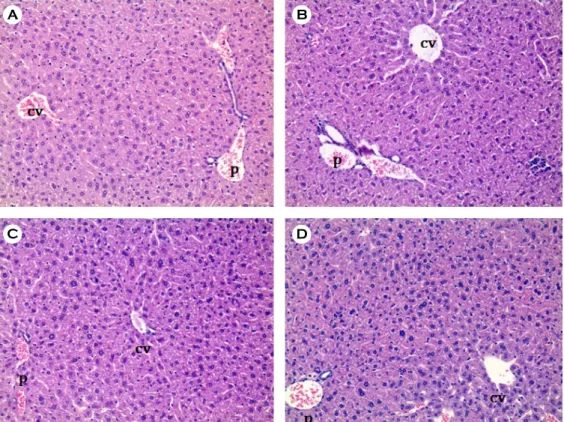
간조직의 지방과립의 변화를 관찰한 결과는 Fig. 3에 나 타냈다. Saline 투여군(Fig. 3A)과 비교하여 lovastatin 투여 군(Fig. 3B), EGb 761 (25 mg/kg) 투여군(Fig. 3C), EGb 761 (50 mg/kg) 투여군(Fig. 3D) 모두에서 지방과립의 변화는 없었다(Thoolen et al., 2010).
Fig. 3. Histology of liver section. Mice were administered with saline, lovastatin (30 mg/kg), EGb 761 (25 mg/kg) or EGb 761 (50 mg/kg) for 40 days. The liver was excised, sectioned and stained with hematoxylin-eosin. (A) saline, (B) lovastatin, (C) EGb 761 (25 mg/kg), (D) EGb 761 (50 mg/kg). Representative images are shown. ×100 magnification.)
A
C D
B
혈청 LCAT 농도
혈청 LCAT 함량은 Fig. 4A에 나타내었다. LCAT의 혈청 내 농도는 saline 투여군(3.18±0.46 ng/ml)에 비하여 lova- statin 투여군(5.06±0.33 ng/ml), EGb 761 (25 mg/kg) 투여군 (4.80±0.43 mg/dl), EGb 761 (50 mg/kg) 투여군(4.84±0.45 ng /ml)에서 모두 통계적 유의성을 갖는 증가가 나타났다.
혈청 내 APO A-I 농도
혈청 APO A-I 함량은 Fig. 4B에 나타내었다. APO A-I의 혈청 내 농도는 saline 투여군(18.51±4.63 ng/ml)에 비교하 여 lovastatin 투여군(18.28±3.17 ng/ml), EGb 761 (25 mg/
kg) 투여군(19.24±4.55 mg/dl), EGb 761 (50 mg/kg) 투여군 (19.24±2.17 ng/ml) 모두에서 통계적 유의성을 갖는 변화 는 나타나지 않았다.
고 찰
본 연구에서 정상상태의 마우스에 이틀에 한 번, 총 20회의 지속적인 EGb 761 경구 투여는 혈액 내 TC의 농 도와 LDL의 농도를 유의적으로 감소시키고 HDL의 농도 는 유의적으로 증가시키는 것으로 밝혀졌다. 이들의 혈액 내 농도에 대한 EGb 761 저농도 투여군(25 mg/kg)과 고농 도 투여군(50 mg/kg) 간의 농도 의존적 효과 차이는 나타 나지 않았다. EGb 761 투여의 효과는 lovastatin 30 mg/kg
투여 효과와 비교하였다. Lovastatin은 혈중 TC와 LDL를 감소시키는 효과가 있다(Li et al., 2016; Yamashita et al., 2010). Lovastatin를 30 mg/kg의 농도로 이틀에 한 번, 총 20회 경구 투여한 결과 혈액 내 TC와 LDL의 농도를 감 소시켰다. 이것은 EGb 761 투여군의 효과와 매우 유사한 결과로 정상적인 상태의 마우스에서 EGb 761과 lovastatin 의 지속적인 경구 투여는 TC와 LDL의 혈액 내 농도를 충분히 감소시킬 수 있음을 나타낸다.
본 실험의 결과에서는 EGb 761과 lovastatin의 지속적인 경구 투여로 혈액 내 HDL 농도가 증가될 수 있다는 것이 증명되었다. HDL이 관여하는 reverse cholesterol transport 는 동맥혈관 벽의 잉여 콜레스테롤을 제거하여 혈관의 플 라그 형성을 억제함으로써 혈장 콜레스테롤 제거율을 증 가시킨다(Badimon et al., 1990; Holvoet et al., 1998; Rifai et al., 1999). 최근 연구에 따르면 HDL은 reverse cholesterol trans- port 이외에도 항산화 작용과 항염증 작용으로 혈관내피 세포 보호하여 관상동맥질병의 예방에 효능이 있다고 알 려져 있다(Assmann and Gotto, 2004; Asztalos et al., 2007;
Cockerill et al., 2001; Parthasarathy et al., 1990). 이러한 사실 로 EGb 761의 경구 투여에 HDL의 증가는 TC의 감소와 밀접한 관련이 있는 것으로 판단된다. 우리의 결과에서 lovastatin의 지속적인 투여도 HDL의 증가를 가져왔다. 하 지만 lovastatin 또는 statin 계열의 약제 투여가 HDL 농도 에 영향을 미치지 않는다는 보고도 있다(Li et al., 2016;
Yamashita et al., 2010). 우리의 결과는 정상상태에서 EGb Fig. 4. Effect of EGb 761 on serum levels of LCAT and APO A-I. Mice were administered with saline, lovastatin (30 mg/kg), EGb 761 (25 mg/kg) or EGb 761 (50 mg/kg) for 40 days. (A) lecithin cholesterol acyltransferase (LCAT) and (B) apolipoprotein A-I (APO A-I).
Values are expressed as mean ± SEM of 7 mice per group. Statistical analyses were performed with one-way ANOVA test. Values are expressed as mean ± SEM of 7 mice per group. **P<0.01.
A B
761와 lovastatin의 지속적인 경구 투여는 마우스의 혈액 내 HDL의 농도를 증가시킬 수 있다는 것을 나타내는 새 로운 결과로 생각된다.
HMG-CoA reductase는 콜레스테롤 합성 속도를 조절 하는데 EGb 761과 lovastatin은 HMG-CoA reductase의 in- hibitor의 역할을 하는 것으로 알려져 있다(Xie et al., 2009).
LCAT는 간에서 합성되어 혈장으로 방출되며 이것이 증 가하면 LDL의 농도가 감소하게 된다(Assmann and Gotto, 2004). 동맥경화는 혈관벽 평활근 세포의 증식에 의한 내 막의 비대화와 혈액의 콜레스테롤 양과 깊은 관계가 있다.
특히 혈액 내 LDL 분해의 이상이 발생하여 LDL이 동맥 의 대식세포와 내피세포에 축적되면 거대 거품세포(foam cell)가 형성되고 이 과정에서 이들 세포에는 apoptosis가 일어난다. 이 거품세포가 많아지면서 동맥벽에 지방이 축 적되어 동맥경화가 일어나게 된다(Ishikawa et al., 1992). 우 리의 결과에서 EGb 761과 lovastatin의 지속적인 경구 투여 는 혈액 내 LCAT의 양을 유의성 있게 증가시켰다. 이것 은 EGb 761과 lovastatin의 투여는 LCAT의 양을 증가시켜 혈액 내 LDL의 농도를 감소시키는 것으로 판단된다.
Apolipoprotein은 지질의 운반과 지질단백질 구조 유지 그리고 지질이 간, 혈관 벽, 지방조직에서 대사되는데 필 요한 성분이다(Durstine et al., 2002). 그 중 Apo A는 LCAT 을 활성화하여 말초조직 또는 혈관 내의 콜레스테롤을 콜레스테롤 에스테르로 전환시켜 간으로 수송한다. 전환 된 콜레스테롤 에스테르는 HDL로 이동하여 HDL로 하여 금 콜레스테롤을 제거하게 만드는 역할을 한다(Assmann and Gotto, 2004; Miller et al., 1979). 특히 APO A-I의 증가는 항동맥경화증의 역할을 하는 HDL의 증가와 비례하는 것 으로 알려져 있다(Taskinen et al., 1992). 본 실험의 결과에 서는 EGb 761와 lovastatin의 지속적인 경구 투여는 APO A-I의 단백질 농도에는 영향을 미치지 않는 것으로 나타 났다. Cholesteryl ester transfer protein (CETP)는 reverse chole- sterol transport의 주요 조절인자로 간에서 생성되어 혈중 으로 분비되는데 이는 HDL와 결합하게 된다(Tall, 1993).
CETP는 콜레스테롤 에스테르를 HDL로부터 VLDL/LDL 로 이동을 시키고 TG를 VLDL/LDL로부터 HDL로 이동 시키는 작용을 한다(Barter et al., 2003). 하지만 CETP의 경우 mouse나 rat에서는 선천적으로 결핍되어 있으므로 (Hogarth et al., 2003) 본 실험에서는 CETP의 농도 변화는 측정하지 않았다. 앞으로 EGb 761의 투여가 미치는 혈액 내 HDL 농도 상승에 대한 기전 연구는 더 필요하다고 생 각된다.
본 연구자들은 type I과 type II 당뇨병 모델에서 EGb 761의 투여가 혈중 TG의 농도를 낮추는 효과가 있었다고 보고하였다(Rhee et al., 2015). 이 효과는 EGb 761의 지속적 투여가 type I과 type II 당뇨병의 상태에 의해 유도된 간장 내 LPL의 감소를 억제하였기 때문이었다. 본 연구에서는 정상적인 상태에서 EGb 761과 lovastatin의 지속적 경구 투여가 미치는 지방산의 변화를 살펴보고자 혈액 내 TG 의 농도, FFA의 농도, 그리고 간에서의 지방산의 변화를 살펴보았다. 40일간 이틀에 한 번 EGb 761 투여는 TG의 농도, FFA의 농도, 그리고 간에서의 지방산의 변화에 어 떤 영향을 미치지 않았다. 결론적으로 본 연구를 통하여 마우스에 40일간 이틀에 한 번 EGb 761 투여는 혈액 내 LCAT의 양을 증가시켜 LDL의 농도를 감소시키고 또한 HDL의 농도를 증가시켜 TC 농도를 감소시키는 것으로 판단되며 이러한 효과는 lovastatin의 투여 효과와 유사한 것으로 생각된다.
ACKNOWLEDGEMENTS
본 연구는 2015년도 강원대학교 대학회계 학술연구조 성비(관리번호-520150283)와 농촌진흥청 농업과학기술개 발 공동연구사업(PJ012266012017)에 의해 이루어진 것입 니다.
CONFLICT OF INTEREST
The authors declare that there is no conflict of interest.
REFERENCES
Al-Attar AM. Attenuating effect of Ginkgo biloba leaves extract on liver fibrosis induced by thioacetamide in mice. Journal of Biomedicine and Biotechnology. 2012: 761450.
Assmann G, Gotto AM Jr. HDL cholesterol and protective factors in atherosclerosis. Circulation. 2004. 109: III-8-III-14.
Asztalos BF, Schaefer EJ, Horvath KV, Yamashita S, Miller M, Franceschini G, Calabresi L. Role of LCAT in HDL remo- deling: investigation of LCAT deficiency states. Journal of Lipid Research. 2007. 48: 592-599.
Badimon JJ, Badimon L, Fuster V. Regression of atherosclerotic lesions by high density lipoprotein plasma fraction in the cholesterol-fed rabbit. Journal of Clinical Investigation. 1990.
85: 1234-1241.
Barter PJ, Brewer HB Jr, Chapman MJ, Hennekens CH, Rader DJ, Tall AR. Cholesteryl ester transfer protein: a novel target for
raising HDL and inhibiting atherosclerosis. Arteriosclerosis, Thrombosis, and Vascular Biology. 2003. 23: 160-167.
Black PH, Garbutt LD. Stress, inflammation and cardiovascular disease. Journal of Psychosomatic Research. 2002. 52: 1-23.
Cockerill GW, Huehns TY, Weerasinghe A, Stocker C, Lerch PG, Miller NE, Haskard DO. Elevation of plasma high-density lipoprotein concentration reduces interleukin-1-induced expres- sion of E-selectin in an in vivo model of acute inflammation.
Circulation. 2001. 103: 108-112.
Drieu K, Vranckx R, Benassayad C, Haourigi M, Hassid J, Yoa RG, Rapin JR, Nunez EA. Effect of the extract of Ginkgo biloba (EGb 761) on the circulating and cellular profiles of polyunsaturated fatty acids: correlation with the anti-oxidant properties of the extract. Prostaglandins, Leukotrienes and Essential Fatty Acids. 2000. 63: 293-300.
Durstine JL, Grandjean PW, Cox CA, Thompson PD. Lipids, lipo- proteins, and exercise. Journal of Cardiopulmonary Rehabili- tation. 2002. 22: 385-398.
Emamat H, Nouri M, Foroughi F, Rismanchi M, Eini-Zinab H, Hekmatdoost A. An accessible and pragmatic experimental model of nonalcoholic fatty liver disease. Middle East Journal of Digestive Diseases. 2016. 8: 109-115.
Hogarth CA, Roy A, Ebert DL. Genomic evidence for the absence of a functional cholesteryl ester transfer protein gene in mice and rats. Comparative Biochemistry and Physiology. Part B, Biochemistry and Molecular Biology. 2003. 135: 219-229.
Holvoet P, Theilmeier G, Shivalkar B, Flameng W, Collen D. LDL hypercholesterolemia is associated with accumulation of oxi- dized LDL, atherosclerotic plaque growth, and compensatory vessel enlargement in coronary arteries of miniature pigs.
Arteriosclerosis, Thrombosis and Vascular Biology. 1998. 18:
415-422.
Ishikawa Y, Inadera H, Shirai K, Hashimoto H, Fukamachi I, Saito Y, Yoshida S. Moderate oxidation of hypertriglyceridemic low-density lipoprotein causes apolipoprotein B epitope change and enhances its uptake by macrophages. Biochimica et Biophysica Acta. 1992. 1126: 60-64.
Li J, Ding L, Son, B, Xiao X, Qi M, Yang Q, Yang Q, Tang X, Wang Z, Yang L. Emodin improves lipid and glucose meta- bolism in high fat diet-induced obese mice through regulating SREBP pathway. European Journal of Pharmacology. 2016.
770: 99-109.
Liu CS, Cheng Y, Hu JF, Zhang W, Chen NH, Zhang JT. Com- parison of antioxidant activities between salvianolic acid B and Ginkgo biloba extract (EGb 761). Acta Pharmacologica
Sinica. 2006. 27: 1137-1145.
Liu X, Hao W, Qin Y, Decker Y, Wang X, Burkart M, Schötz K, Menger MD, Fassbender K, Liu Y, Long-term treatment with Ginkgo biloba extract EGb 761 improves symptoms and pathology in a transgenic mouse model of Alzheimer's disease.
Brain, Behavior, and Immunity. 2015. 46: 121-131.
McIntyre, N. Familial LCAT deficiency and fish-eye disease. Journal of Inherited Metabolic Disease. 1988. 1: 45-56.
Miller NE, Rao S, Lewis B, Borsuik G, Myhre K, Mijos OD. High density lipoprotein and physical activity. Lancet. 1979. 1: 111 -115.
Mori K, Kobayashi C, Tomita T, Inatomi S, Ikeda M. Antiathero- sclerotic effect of the edible mushrooms Pleurotus eryngii (Eringi), Grifola frondosa (Maitake), and Hypsizygus mar- moreus (Bunashimeji) in apolipoprotein E-deficient mice.
Nutrition Research. 2008. 28: 335-342.
Muramatsu K, Fukuyo M, Hara Y. Effect of green tea catechins on plasma cholesterol level in cholesterol-fed rats. Journal of Nutritional Science and Vitaminology. 1986. 32: 613-622.
O'Connell BJ, Genest J Jr. High density lipoproteins and endothelial function. Circulation. 2001. 104: 1978-1983.
Parthasarathy S, Barnett J, Fong LG. High density lipoprotein inhibits the oxidative modification of low density lipoprotein.
Biochimica et Biophysica Acta. 1990. 1044: 275-283.
Rhee KJ, Gwon SY, Hwang S, Lee CG, Jang IH, Wie MB, Jung BD. Gingko biloba Extract ameliorates colonic inflammation in DSS-induced model of colitis in mice. Biomedical Science Letters. 2014. 20: 227-236.
Rhee KJ, Lee CG, Kim SW, Gim DH, Kim HC, Jung BD. Extract of Ginkgo biloba ameliorates streptozotocin-induced type 1 diabetes mellitus and high-fat diet-induced type 2 diabetes mellitus in mice. International Journal of Medical Sciences.
2015. 12: 987-994.
Rifai N, Bachorik PS, Albers JJ. Lipids, lipoproteins and apolipo- proteins. In: Burtis CA, Ashwood ER. (Eds.), Tietz textbook of clinical chemistry. 1999. 809-861.
Shefer S, Nguyen LB, Salen G, Ness GC, Chowdhary IR, Lerner S, Batta AK, Tint GS. Differing effects of cholesterol and taurocholate on steady state hepatic HMG-CoA reductase and cholesterol 7a-hydroxylase activities and mRNA levels in the rat. Journal of Lipid Research. 1992. 33: 1193-1200.
Tall AR. Plasma cholesteryl ester transfer protein. Journal of Lipid Research. 1993. 34: 1255-1274.
Taskinen MR, Kahri J, Koivisto V, Shepherd J, Dackard CJ.
Metabolism of HDL apolipoprotein A-I and A-II in type 1
(insulin-dependent) diabetes mellitus. Diabetologia. 1992. 35:
347-356.
Tchantchou F, Xu Y, Wu Y, Christen Y, Luo Y. EGb 761 enhances adult hippocampal neurogenesis and phosphorylation of CREB in transgenic mouse model of Alzheimer's disease.
FASEB Journal. 2007. 21: 2400-2408.
Thoolen B, Maronpot RR, Harada T, Nyska A, Rousseaux C, Nolte T, Malarkey DE, Kaufmann W, Deschl U, Nakae D, Greqson R, Vinlove MP, Brix AE, Singh B, Belpoggi F, Ward JM.
Proliferative and nonproliferative lesions of the rat and mouse hepatobiliary system. Toxicologic Pathology. 2010. 38: 5S- 81S.
Wang Y, LiuY, Wu Q, Yao X, Cheng Z. Rapid and sensitive deter- mination of major active ingredients and toxic components in Ginkgo biloba leaves extract (EGb 761) by a validated UPLC- MS-MS method. Journal of Chromatographic Science. 2017.
55: 459-464.
Xie ZQ, Liang G, Zhang L, Wang Q, Qu Y, Gao Y, Lin LB, Ye S, Zhang J, Wang H, Zhao GP, Zhang QH. Molecular mech- anisms underlying the cholesterol-lowering effect of Ginkgo biloba extract in hepatocytes: a comparative study with lova- statin. Acta Pharmacologica Sinica. 2009. 30: 1262-1275.
Yamashita S, Tsubakio-Yamamoto K, Ohama T, Nakagawa-Toyama Y, Nishida M. Molecular mechanisms of HDL-cholesterol elevation by statins and its effects on HDL functions. Journal of Atherosclerosis and Thrombosis. 2010. 17: 436-451.
http://dx.doi.org/10.15616/BSL.2017.23.2.80
Cite this article as: Kim JW, Hong JS, Yoon BI, Rhee KJ, Ra CS, Jung BD. Effect of Ginkgo biloba Extract (EGb 761) on Serum Cholesterol Levels in Wild-type C57Bl/6 Mice. Biomedical Science Letters. 2017. 23:
80-88.