• 검색 결과가 없습니다.

Hypoglycemic and Hypolipidemic Effect of Rosa rugosa Radix in Streptozotocine-induced Diabetic Rats

N/A
N/A
Protected

Academic year: 2021

Share "Hypoglycemic and Hypolipidemic Effect of Rosa rugosa Radix in Streptozotocine-induced Diabetic Rats"

Copied!
6
0
0

로드 중.... (전체 텍스트 보기)

전체 글

(1)

Hypoglycemic and Hypolipidemic Effect of Rosa rugosa Radix in Streptozotocine-induced Diabetic Rats

Eun Jung Kim, Gye Yeop Kim*

Department of Physical Therapy, College of Health and Wellfare, Dongshin University

The antidiabetic effects of Rosa rugosa Radix were investigated in streptozotocine-induced diabetic rats.

Research methods and procedure: In the present study, effects of oral administration of Rosa rugosa Radix extract(100, 250, and 500 ㎎/㎏ body wt.) for 28 days on the level of serum glucose, total cholosterol, triglycerides, cereatinine, aspartate amino transferase(AST) and alanine amino transferase(ALT) in normal and streotozotocine-induced diabetic rats were evaluated. Oral administrations of the Rosa rugosa Radix extract significantly decreased serum glucose, total cholesterol, triglyceride, AST, and ALT levels, while increased serum insulin and HDL-C in diabetic rats(p<0.05). The hypoglycemic effect of the Rosa rugosa Radix extract was more effective than normal group. It is concluded that the Rosa rugosa Radix must be considered as excellent candidate for future studies on diabetes mellitus.



Key words : Rosa rugosa Radix, diabetic mellitus, hypoglycemic, hypolipidemic

* To whom correspondence should be addressed at : Gye Yeop Kim, Department of Physical Therapy, College of Health & Wellfare, Dongshin University, Naju, Jeonnam

․E-mail : [email protected], ․Tel : 061-330-3391

․Received : 2010/09/03 ․Revised : 2010/09/28 ․Accepted : 2010/10/07

Introduction

Diabetes mellitus(DM) is a common metabolic disorder characterized by increased glucose level that results from a deficiency in the production or action of insulin

1)

. A metabolic syndrome consisting of two main groups, type 1 and 2 is characterized by absolute or relative insulin deficiency or insulin resistance

2)

. The long term hyperglycemia is an important factor in the progression of macrovascular and microvascular complication, which include neuronal tissue damage, cardiovascular, cerebrovascular, and renal disease

3-5)

. Hence, effective control of the blood glucose levels is a key step in preventing or reversing diabetic complications in both types 1 and 2 diabetic patients

6)

. It is well-known, and careful control of the blood glucose level delays or protects against the development of severe complications. However, some patients develop several complications at an early stage in spite of careful control of their glucose levels, because development of complications is affected by many promotors such as the activation of polyol metabolism, protein-kinase C or oxidative stress

7-9)

.

Also, dyslipidemia is a frequent complication of diabetes and characterized by low levels of high-density lipoprotein(HDL) cholesterol, and high levels of low-density lipoprotein(LDL) cholesterol and triglyceride(TG)

10)

. Hyperlipidemia is also a metabolic complication of both clinical and experimental diabetes. Hyperglycemia can be initially treated with oral agents and insulin therapy; the latter is occasionally required to achieve target glycemic level. Plants have been an exemplary source of drugs and many of the currently available drugs have been derived directly or indirectly from them

11)

.

However, due to limited efficacy and adverse side effects of currently available therapies, it is difficult to maintain good glycemic control in most diabetic patients. Many herbal medicines have been recommended for the treatment of diabetic mellitus. Plant drugs are frequently considered to be less toxic and more free from side effects than synthetic ones

12-14)

.

Rosa rugosa Radix is distributed mainly along the coast of

Hokkaido in Japan, and is called Japanese rose. In China, the

flowers of Rosa rugosa var. plena and related plants are used

as a medicine, 'mei gui hua" for diarrhea, bleeding, and

disease of women

15)

. It is mainly used as an ingredient in tea

or source of rose oil in China. Also, the roots of Rosa rugosa

have traditionally been used to treat diabetes mellitus, pain,

and chronic inflammatory disease in Korea, Japan, and parts of

(2)

Asia.

The major components of the Rosa rugosa are vitamin C, rosamultin, quercetin, tannin, euscaphic acid, arjunetin, β -sitosterol glucoside, and campesterol glucoside

16,17)

. This plant also has high levels of polyphenolic amount to support the anti-diabetic effect of Rosa rugosa roots, and traditional herbalists continue to use the plant extract in the management of diabetes. However, there is no scientific evidence to support the anti-diabetic effect of Rosa rugosa . The purpose of the present study is to elucidate the beneficial effects of Rosa rugosa Radix and its major components in the prevention of hyperglycemia and the hypolipidemic effect of improvement of diabetic complications in streptozotocin-induced diabetic rats.

Materials and Methods

1. Preparation of herbal extracts

Rosa rugosa Radix was purchased from a retail herbal medicine farmers cooperative (Hwasun, Jeonnam, Korea) in 2009. The water extract of Rosa rugosa Radix was prepared as follows under optimal water extraction conditions. Briefly, Rosa rugosa Radix was boiled in water and then filtered, after which the aqueous phase was concentrated using a rotary vaccum evaporator and then lyophilized. The stock solution of the Rosa rugosa Radix extract was then prepared by dissolving the Rosa rugosa Radix extract in DMSO(10 ㎎/㎖) by vigorous vortex for 2 min followed by sonication. After centrifugation (× 2,000 g, 10 min), the supernatant was collected and stored at -20℃

until use. The stock solution was then diluted in saline at the concentrations indicated for the experiments.

2. Animals and experimental group

Male Sprague-Dawley(Orient, Seoul, Korea) 6 weeks of age, were housed in clean cages with controlled temperature(34-26℃), light(12 hr light and dark cycle) and relative air humidity 40-60% controlled condition. All rats had free access to standard rodent pellet food(NIH 31M, Samtako, Korea), except when fasted before experiments.

3. Induction of diabetic in rat and experimental group Diabetes was induced by a single injection of STZ(50 ㎎/

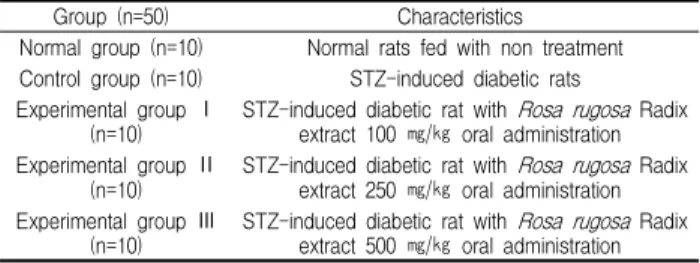
㎏ body weight, Sigma, USA) freshly dissolved in a 0.01 M citrate buffer(pH 4.5) into the intraperitoneum. The control rats were only injected with the citrate buffer. Diabetic status was confirmed in the STZ-treated rats by measuring the fasting blood glucose concentration after 72 hour. The rats with blood glucose level above 250 ㎎/㎗ were considered to be diabetic and were used in the experiment. In our study, a total 50

rats(10 normal rat and 40 diabetic rats) used. These rats were randomly divided into 5 groups of 10 rats, after STZ-induced diabetes(Table 1).

Table 1. Classification of experimental groups

Group (n=50) Characteristics

Normal group (n=10) Normal rats fed with non treatment Control group (n=10) STZ-induced diabetic rats Experimental group Ⅰ

(n=10) STZ-induced diabetic rat with Rosa rugosa Radix extract 100 ㎎/㎏ oral administration Experimental group Ⅱ

(n=10) STZ-induced diabetic rat with Rosa rugosa Radix extract 250 ㎎/㎏ oral administration Experimental group Ⅲ

(n=10) STZ-induced diabetic rat with Rosa rugosa Radix extract 500 ㎎/㎏ oral administration

4. Biochemical evaluations at the level of serum

After 28 days of oral administration, fasting blood samples were obtained at the time of sacrifice. Blood was allowed to clot and serum was separated by centrifugation at 3,500 rpm for 10 min. The serum was assayed either immediately or stored at −20℃. Serum glucose, insulin, total cholesterol, triglycerides, high density lipoprotein cholesterol, aspartate amino transferase(AST), and alanine amino transferase(ALT) levels were determined.

Fasting serum glucose concentration was determined using Glucotrend plus glucose(Roche Diagnostick GmbH, Germany). The serum insulin was assayed by enzyme-linked immunosorbent assay kit (ELISA, Boerhringer Mannheim, Germany). Alanine and aspartate transaminase(ALT, AST) was determined spectrophotometrically by the modified method of Bergmeyer and Bernt

18)

.

The serum total cholesterol, triglyceride, and high density lipoprotein cholesterol were estimated by using commercial diagnostic reagent(Bayer, USA) on biochemical analyser(RM 2060-18, Eltec. Co., Italy).

5. Histopathological examinations

Following laparotomy, the liver of each rat were examined grossly. Thereafter, the liver tissue were removed for histological study. The tissues were washed with normal saline and immersion fixed in 10% buffered formalin immediately upon removal. They were gradually dehydrated, embedded in paraffin, cut into 5 ㎛ sections and stained with hematoxylin(HHS32, Sigma, USA) and eosin(HT110232, Sigma, USA) for histological examination according to standard procedure.

6. Statistical analysis

All the data were expressed as mean ± standard

deviation(S.D.) of three replications. Statistical calculations by

SPSS version 12.0 software were carried out One-way ANOVA

(3)

was applied for determining differences between of samples.

Duncan test was taken to compare the data. Values of p<0.05 were considered as significantly different.

Results

1. Effect of Rosa rugosa Radix extract on serum glucose and insulin level

Table 2 showed that the effect of the Rosa rugosa Radix on serum glucose and insulin in normal and diabetic rats. The results showed that serum glucose of diabetic rats increased while serum insulin decreased, when compared with normal rats. The administration of the Rosa rugosa Radix at doses of 250, 500 ㎎/㎏ body weight decreased insulin level significantly toward normal values, while normal rats did not exhibit any significant alterations in serum glucose and insulin levels during the period of experiment(Table 2).

Table 2. Effect of Rosa rugosa Radix extract on serum glucose and insulin concentration

Normal

group Control

group Experimental

group Ⅰ Experimental

group Ⅱ Experimenta l group Ⅲ Glucose

(㎎/㎗) 96.44±14.38 296.88±28.24

a

190.58±15.83

b

153.67±13.59

b

175.3±17.42

bc

Insulin

(pg/㎖) 320.04±21.24 173.52±14.59

a

224.18±21.53

b

272.84±16.52

b

263.63±2.28

bc

Values are mean±SD, All values are showed mean±SD. Values with different superscripts in the same column are significant(p<.05) by Duncan's multiple range test and compare with control group.

2. The changes of total cholesterol and triglyceride level The effect of the Rosa rugosa Radix extract on total cholesterol, triglycerides, and HDL-C in serum in normal and diabetic rats. The results showed that the serum triglycerides and total cholesterol increased, when compared with normal rats. The administration of the Rosa rugosa Radix extract(100, 250, and 500 ㎎/㎏) significantly decreased serum total cholesterol and triglyceride, when compared with control diabetic rats. Also, there was a significant increase of HDL-C in experimental groups. The Rosa rugosa Radix extract at doses of 250 and 500 ㎎/㎏ were found to be more effective than 100 ㎎ /㎏(Table 3).

Table 3. Effect of Rosa rugosa Radix extract oral administration on serum lipid levels

Normal

group Control

group Experimental

group І Experimental

group Ⅱ Experimental group Ⅲ Total

cholesterol

(㎎/㎗) 75.24±10.32 96.58±12.70

a

89.20±15.04

b

84.56±13.27

b

76.32±11.62

c

Triglyceride

(㎎/㎗) 80.78±9.96 99.38±10.37

a

88.37±14.26

b

83.14±12.91

b

75.98±10.34

c

HDL-C

(㎎/㎗) 47.10±1.38 34.68±2.30

a

37.11±0.91 41.06±1.74

b

43.512±2.34

b

Values are mean±SD, All values are showed mean±SD. Values with different superscripts in the same column are significant(p<.05) by Duncan's multiple range test and compare with control group.

3. The changes of AST and ALT level

The results showed that diabetic rat's serum AST and ALT levels increased, when compared with normal group. The administration of the Rosa rugosa Radix extract significantly decreased AST and ALT levels than control group, were not significantly different from each experimental groups(Table 4).

Table 4. Effect of Rosa rugosa Radix extract oral administration on serum AST and ALT

Normal group

Control group (Diabetic)

Experimental

group І Experimental

group Ⅱ Experimental group Ⅲ AST(IU/L) 69.61±12.02 98.58±13.77

a

79.23±10.25

b

83.36±3.67

b

86.65±15.44

b

ALT(IU/L) 49.54±9.24 83.4±10.39

a

66.86±12.42

b

65.98±7.64

b

70.48±8.53

b

Values are mean±SD, All values are showed mean±SD. Values with different superscripts in the same column are significant(p<.05) by Duncan's multiple range test and compare with control group.

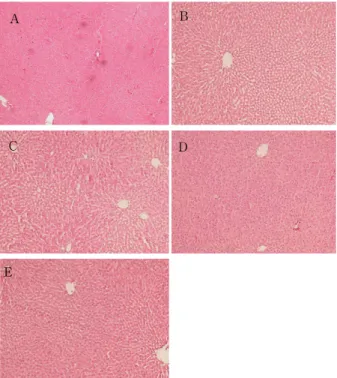
A B

C D

E

Fig. 1. Histopathological change of liver tissue in each group(H&E stain, × 100). A: Normal rats fed with non treatment. B: STZ-induced diabetic rats. C: STZ-induced diabetic rat with Rosa rugosa Radix extract 100 ㎎/㎏ oral administration. D: STZ-induced diabetic rat with Rosa rugosa adix extract 250 ㎎/

㎏ oral administration. E: STZ-induced diabetic rat with Rosa rugosa Radix extract 500 ㎎/㎏ oral administration

4. The change of liver morphology

Histopathological examination of liver in control animals showed normal hepatic lobules(Fig. 1A). The central venule with radiating columns of liver cells of normal shape and size were seen. There were no signs of congestion, inflammation, and cellular necrosis of cholestasis in control liver section.

Liver sections of STZ-diabetic control group showed appreciable histological changes compared to controls(Fig. 1B).

Those of STZ-diabetic rat showed multi-focal areas of

hepatocellular vacuolization and hypertrophy. The incidence

(4)

and intensity of tubular vacuolization and interstitial cellular infiltration in STZ-diabetic rat treated with Rosa rugosa Radix extract was much lower compared to the diabetic control liver tissue(Fig. 1C-E). Treatment with Rosa rugosa Radix extract did not alter serum AST and ALT levels as well as liver morphology of control group.

Discussion

Rosa rugosa Radix is a traditional herbal agent which has been used as an anti-diabetic, anti-oxidant, and anti-hepatotoxic in Asia

19,20)

. It has been also used for treatment of some kinds of chronic inflammatory diseases, pain, and anti-cancer

21,22)

. However, its anti-diabetic effect has not been precisely documented in spite of its increasing usage in recent years. In the present study, the effects of Rosa rugosa Radix on diabetes were assessed using a STZ-induced diabetic rats.

The single high dose STZ-induced diabetic rat is one of the animal models of type І diabetes mellitus. In this model, diabetes arises from irreversible destruction of the β-cell of the pancreas, causing reduction of insulin secretion

23)

.

In the present our results, significantly increased serum glucose concentration was observed in diabetic group. It is well known that injection of STZ significantly damages the function of pancreatic β-cells to synthesize and secrete of insulin

24)

. Also, the oral administration of Rosa rugosa Radix extract significantly decreased serum glucose concentration while increased serum insulin levels in treated diabetic rats as compared with control group. This could be due to potentiation of the insulin effect of plasma by increasing the pancreatic secretion of insulin from existing β-cells or its release from bound insulin.

In the present study, the concentrations of lipids, such as total cholesterol, triglyceride, and HDL-C were significantly changed in experimental groups than in the control group.

Also, experimental group Ⅱ and Ⅲ were found to be more effective than experimental group Ⅰ. A variety of derangements in metabolic and regulatory mechanisms, due to insulin deficiency, are responsible for the observed accumulation of lipids

25,26)

. The impairment of insulin secretion results in enhanced metabolism of lipids from the adipose tissue to the plasma. Further, it has been reported that diabetic rats treated with insulin shows normalized lipid levels

27)

. Thus, the results indicate that Rosa rugosa Radix shows insulin-like action by virtue of its lipid lowering levels. This effect could be partly due to the control of hyperglycemia.

Liver enzymes including AST and ALT are used in the evaluation of hepatic disorders. An increase in these enzyme

activities reflects active liver damage

28)

. In accordance with these findings, streptozotocin treatments has a significant role in the alteration of liver functions since the activity of AST and ALT were significantly higher than those of normal value. On the other hand, treatment of the diabetic rats with the Rosa rugosa Radix extract caused reduction in the activity of these enzymes in plasma compared to the mean values of the diabetic group and this is in agreement with that of Mansour et al

29)

. These result suggests that risk of liver hypofunction can be reduced in diabetic patients by eating Rosa rugosa Radix.

STZ-diabetic rats have been shown to exhibit an elevated plasma ALT and AST level without morphological changes in liver. More importantly, Rosa rugosa Radix 250 ㎎/㎏ and 500

㎎/㎏ may also improve other pathological conditions associated with streptozocin-induced diabetes. Many of the severe complications of diabetes mellitus, such as diabetic nephropathy, retinopathy, peripheral neuropathy, and skin ulceration, are the result of diabetic microangiopathy

30,31)

. The most common lesions seen are an increase in liver glycogen leading to vacuolization in cytoplasm and hepatocyte nuclei.

This indicates that Rosa rugosa Radix does not cause hepatoxicity in experimental groups under the conditions of the present investigation. Since Rosa rugosa Radix was found to possess significant anti-diabetic potential in diabetic mellitus, it is reasonable to believe that improvement in metabolic system and hepatic function as well as morphology could have resulted from the alleviation of the diabetic state

25)

.

These results suggest that the hypoglycmic and hypolipidemic effect of Rosa rugosa R adix is likely due to, at least in part, to the decrease of glucose concentration or increasing insulin secretion from the β-cells of the Langerhan's islets, and improving the lipid metabolism. But true mechanism of the hypoglycemic effect of Rosa rugosa Radix remains to be further studied and to be proven. In addition, further comprehensive pharmacological and oxidative stress related mechanism of Rosa rugosa Radix and anti-diabetic action including experimental chronic studies, should be carried out.

Conclusion

In conclusion, our studies provide that Rosa rugosa Radix

extract is effective decreasing in serum lipid level including

cholesterol, TG. In addition, Rosa rugosa Radix extract showed

significant decreasing effect in serum glucose and increasing

effect in insulin secretion. These results suggest that Rosa

rugosa Radix extract, a prescription of Korean traditional

(5)

medicine, may play a beneficial effect in protective against diabetic metabolic disease. Therefore, further researches will be required to isolate and determine the active pharmacological components. And finally clinical demonstration of Rosa rugosa Radix extract will be preceded.

Acknowledgments

This study was supported by funding from the Dongshin university in 2009.

References

1. Cryer, P.E. Banting Lecture. Hypoglycemia: the limiting factor in the management of IDDM. Diabetes.

43(11):1378-1389, 1994.

2. Bhaskarabhatla, K.V., Birrer, R. Physical activity and diabetes mellitus. Compr Ther. 31: 291-298, 2005.

3. Altan, V.M. The pharmacology of diabetic complications.

Curr Med Chem. 10(15):1317-1327, 2003.

4. Strojek, K. Features of macrovascular complications in type 2 diabetic patients. Acta Diabetol. 40(2):334-337, 2003.

5. Got, I. Peripheral vascular disease and diabetic foot. Rev Med Interne. 29(2):249-259, 2008.

6. Resl, M., Clodi, M. Diabetes and cardiovascular complications. Wien Med Wochenschr. 160(1-2):3-7, 2010.

7. Das Evcimen, N., King, G.L. The role of protein kinase C activation and the vascular complications of diabetes.

Pharmacol Res. 55(6):498-510, 2007.

8. Aronson, D. Hyperglycemia and the pathobiology of diabetic complications. Adv Cardiol. 45: 1-16, 2008.

9. Drews, G., Krippeit-Drews, P., Düfer, M. Oxidative stress and beta-cell dysfunction. Pflugers Arch. 460(4):703-718, 2010.

10. Vincent, A.M., Hinder, L.M., Pop-Busui, R., Feldman, E.L.

Hyperlipidemia: a new therapeutic target for diabetic neuropathy. J Peripher Nerv Syst. 14(4):257-267, 2009.

11. Grover, J.K., Yadav, S., Vats, V. Medicinal plants of India with anti-diabetic potential. J Ethnopharmacol. 81(1):81-100, 2002.

12. Makom Ndifossap, I.G., Frigerio, F., Casimir, M., Ngueguim Tsofack, F., Dongo, E., Kamtchouing, P., Dimo, T., Maechler, P. Sclerocarya birrea(Anacardiaceae) stem-bark extract corrects glycaemia in diabetic rats and acts on beta-cells by enhancing glucose-stimulated insulin secretion. J Endocrinol. 205(1):79-86, 2010.

13. Jung, M., Park, M., Lee, H.C., Kang, Y.H., Kang, E.S., Kim, S.K. Antidiabetic agents from medicinal plants. Curr Med Chem. 13(10):1203-1218, 2006.

14. Li, W.L., Zheng, H.C., Bukuru, J., De Kimpe, N. Natural medicines used in the traditional Chinese medical system for therapy of diabetes mellitus. J Ethnopharmacol.

92(1):1-21, 2004.

15. Shanghai Science-technology Publication. Dictionary of Chinese Medicine, Vol. 4, Shogakukan, Tokyo(in Japan), 1985.

16. Hatano, T., Ogawa, N., Yasuhara T., Okuda, T. Tannins of rosaceous plants. Ⅷ. Hydrolyzable tannin monomer having a valenoyl group from flower petals of Rosa rugosa THUNB. Chem Pharm Bull. 38: 3308-3313, 1990.

17. Hatano, T., Ogawa, N., Shingu T., Okuda, T. Tannins of rosaceous plants. Ⅸ. Rugosin D, E, F, and G, dimeric and trimeric hydropyzable tannins with valenoyl group(s) from petals of Rosa rugosa THUNB. Chem Pharm Bull. 38:

3341-3346, 1990.

18. Bergmeyer, H.U., Bernt, E. Enzymatic determination of ketone bodies in blood. Enzymol Biol Clin (Basel). 19:

65-76, 1965.

19. Cho, E.J., Yokozawa, T., Kim, H.Y., Shibahara, N., Park, J.C.

Rosa rugosa attenuates diabetic oxidative stress in rats with streptozotocin-induced diabetes. Am J Chin Med.

32(4):487-496, 2004.

20. Cheol, P.J., Chul, K.S., Moon, H.J., Choi, S.H., Yeon, L.K., Won, C.J. Anti-hepatotoxic effects of Rosa rugosa root and its compound, rosamultin, in rats intoxicated with bromobenzene. J Med Food. 7(4):436-441, 2004.

21. Park, J.C., Kim, S.C., Choi, M.R., Song, S.H., Yoo, E.J., Kim, S.H., Miyashiro, H., Hattori, M. Anti-HIV protease activity from rosa family plant extracts and rosamultin from Rosa rugosa . J Med Food. 8(1):107-109, 2005.

22. Jung, H.J., Nam, J.H., Choi, J., Lee, K.T., Park, H.J. 19 Alpha-hydroxyursane-type triterpenoids: antinociceptive anti-inflammatory principles of the roots of Rosa rugosa . Biol Pharm Bull. 28(1):101-104, 2005.

23. Lenzen, S. The mechanisms of alloxan and streptozotocin-induced diabetes. Diabetologia. 51(2):216-226, 2007.

24. Szkudelski, T. The mechanism of alloxan and streptozotocin action in B cells of the rat pancreas. Physiol Res.

50(6):537-546, 2001.

25. Cho, E.J., Yokozawa, T., Kim, H.Y., Shibahara, N., Park, J.C.

Rosa rugosa attenuates diabetic oxidative stress in rats with streptozotocin-induced diabetes. Am J Chin Med.

32(4):487-496, 2004.

26. Rajalingam, R., Srinivasan, N., Govindarajulu, P. Effects of

alloxan induced diabetes on lipid profiles in renal cortex

and medulla of mature albino rats. Indian J Exp Biol.

(6)

31(6):577-579, 1993.

27. Pathak, R.M., Ansari, S., Mahmood, A. Changes in chemical composition of intestinal brush border membrane in alloxan induced chronic diabetes. Indian J Exp Biol.

19(5):503-505, 1981.

28. Fortson, W.C., Tedesco, F.J., Starnes, E.C., Shaw, C.T.

Marked elevation of serum transaminase activity associated with extrahepatic biliary tract disease. J Clin Gastroenterol.

7(6):502-505, 1985.

29. Mansour, H.A., Newairy, A.S., Yousef, M.I., Sheweita, S.A.

Biochemical study on the effects of some Egyptian herbs in alloxan-induced diabetic rats. Toxicology. 170(3):221-228, 2002.

30. Shami, S.K., Chittenden, S.J. Microangiopathy in diabetes mellitus, II: features, complications and investigation.

Diabetes Res. 17(4):157-168, 1991.

31. Dahl-Jorgensen, K. Diabetic microangiopathy. Acta Paediatr

Suppl 425: 31-34, 1998.

수치

Table 1. Classification of experimental groups
Table 2. Effect of Rosa rugosa Radix extract on serum glucose and insulin concentration Normal group Controlgroup Experimentalgroup Ⅰ Experimentalgroup Ⅱ Experimental group Ⅲ Glucose (㎎/㎗) 96.44±14.38 296.88±28.24 a 190.58±15.83 b 153.67±13.59 b 175.3±17.4

참조

관련 문서

Changes in blood components decreased in total cholesterol, low density lipoprotein cholesterol, and triglyceride and increased in high density

The Effects of Inhaling Rosa Rugosa Aroma Essential Oil on Brain Function Quotient by EEG Analysis

The aim of this study was to determine the serum levels of the prohormone form of hepcidin, pro-hepcidin, and its relations with iron status and its

Contents of total cholesterol in the epididymal adipose tissue of STZ-induced diabetic rats containing barley leaf powder for 4 weeks ··· 147 Fig.. The change of growth rate

Mortality and clinical signs in SD rats about single oral administration after 3 weeks with callus extract ..... Hematological values in SD rats administered orally

Values of Glucose, T-protein, T-cholesterol and Triglyceride of Blistered fluid caused by Buhang blistering --- 19..

FBG: fasting blood glucose, TC: total cholesterol, TG: triglyceride, HDL-C: high density lipoprotein-cholesterol, LDL-C: low density lipoprotein-cholesterol,

Second, the total cholesterol, low density lipoprotein cholesterol, and triglyceride of the exercise group significantly decreased after 8 weeks of Ju-do