INTRODUCTION
Bladder outlet obstruction (BOO) is a common cause of lower urinary tract symptoms (LUTS) in elderly men over 50 yr of age (1). BOO results from various etiologic factors that may have functional and anatomical components (2).
Because of the complex etiological aspects, the issue of how to accurately evaluate BOO in men with LUTS has been de- bated for decades (3-5). Thus, when considering management of men with LUTS suggestive of BOO, it is important to take into account the specific aspects of BOO.
Currently, pressure-flow studies (PFS) are widely accepted as the gold standard diagnostic method for identifying BOO (5). Even though PFS is essential for the evaluation of BOO before invasive treatment is considered, many clinicians do not perform PFS as they consider it is invasive, time-consum- ing and expensive (6). In clinical practice, most often non- invasive methods are used to evaluate men with LUTS such as the maximal flow rate, postvoid residual volume, prostate size, and International Prostate Symptom Score (I-PSS). Inter- national guidelines suggest that mandatory and recommend-
ed tests are sufficient to conclude the diagnosis of BOO in men with LUTS (7). However, others have argued that these tests are not sufficient for the diagnosis of BOO (8, 9).
In addition, it was suggested that Asian men have a simi- lar frequency of BOO and more severe symptoms despite hav- ing a smaller prostate volume (10, 11). However, most lit- erature have been based on the population of Western, and there are few data for the Asian men with LUTS with regard to the clinical features of BOO and the factors that can pre- dict BOO.
Thus, the aim of this study was to evaluate clinical and uro- dynamic results associated with LUTS in Korean men with BOO and to determine whether non-invasive parameters can be used to predict BOO.
MATERIALS AND METHODS
This study was approved by the Institutional Review Board of the Seoul National University Hospital. All clinical data was prospectively collected from the patients undergoing eval-
272
Min-Yong Kang, Ja Hyeon Ku, and Seung-June Oh
Department of Urology, Seoul National University Hospital, Seoul National University College of Medicine, Seoul, Korea
Address for Correspondence Seung-June Oh, M.D.
Department of Urology, Seoul National University Hospital, 103 Daehak-ro, Jongno-gu, Seoul 110-744, Korea
Tel : +82.2-2072-2406, Fax : +82.2-742-4665 E-mail : [email protected]
J Korean Med Sci 2010; 25: 272-5 ISSN 1011-8934
DOI: 10.3346/jkms.2010.25.2.272
Non-invasive Parameters Predicting Bladder Outlet Obstruction in Korean Men with Lower Urinary Tract Symptoms
The goal of this study was to evaluate the clinical and urodynamic features in Korean men with lower urinary tract symptoms (LUTS) and to determine non-invasive param- eters for predicting bladder outlet obstruction (BOO). Four hundred twenty nine Kore- an men with LUTS over 50 yr of age underwent clinical evaluations for LUTS includ- ing urodynamic study. The patients were divided into two groups according to the presence of BOO. These two groups were compared with regard to age, the results of the uroflowmetry, serum prostate-specific antigen (PSA) level, prostate volume, International Prostate Symptom Score (I-PSS), and the results of the urodynamic study. Patients with BOO had a lower maximal flow rate (Qmax), lower voided volume, higher serum PSA level and larger prostate volume (P <0.05). BOO group had a significantly higher rate of involuntary detrusor contraction and poor compliance compared to the patients without BOO (P <0.05). The multivariate analysis showed that Qmaxand poor compliance were significant factors for predicting BOO. Our results show that Qmaxplays a significant role in predicting BOO in Korean men with LUTS.
In addition, BOO is significantly associated with detrusor dysfunction, therefore, sec- ondary bladder dysfunction must be emphasized in the management of male patients with LUTS.
Key Words : Prostatic Hyperplasia; Urinary Bladder Neck Obstruction; Urodynamics
Received : 4 February 2009 Accepted : 23 April 2009
ⓒ 2010 The Korean Academy of Medical Sciences.
This is an Open Access article distributed under the terms of the Creative Commons Attribution Non-Commercial License (http://creativecommons.org/licenses/by-nc/3.0) which permits unrestricted non-commercial use, distribution, and reproduction in any medium, provided the original work is properly cited.
Non-invasive Parameters Predicting Bladder Outlet Obstruction 273
uation for LUTS, between January 2002 and October 2008.
All 465 patients with LUTS were enrolled in this study. The exclusion criteria were the following: Patients younger than 50 yr of age, having either prostate cancer or bladder cancer, a previous history of prostate surgery or pelvic radiation, ure- thral strictures, or any neurological dysfunction that could affect bladder function. Thus, a retrospective analysis was conducted on 429 men with LUTS over 50 yr of age.
The enrolled patients underwent a specific clinical evalu- ation including medical history, digital rectal examination, focused neurologic examination, I-PSS, urinalysis, serum pro- state specific antigen (PSA) level, uroflowmetry, and mea- surement of postvoid residual volume with ultrasound blad- der scan, transrectal ultrasonography, and urodynamic stud- ies including the PFS.
The urodynamic evaluation was performed using a Solar Video Urodynamic system (Medical Measurement Systems B.V., Enschede, the Netherlands), according to the recom- mendations of the International Incontinence Society Good Urodynamics Practices protocol (12). BOO was determined by the BOOI with the following formula: BOOI=PdetQmax- 2Qmaxfrom the PFS (13). The patients were divided into two groups according to the presence of BOO (BOOI ≥40) or the absence of BOO (BOOI <40) (13). We defined the poor compliance of the bladder if its value was less than 40 cmH2O/
mL (14).
We compared these two groups with respect to age, max- imal flow rate (Qmax), voided volume, postvoid residual vol- ume, serum PSA level, prostate volume, I-PSS, and the uro- dynamic variables. The Statistical Package for the Social Sci- ences, version 12.0 (SPSS Inc, Chicago, IL, USA) was used for the statistical analysis. The patient characteristics were analyzed by the Student’s t-test and chi-square test. Univari- ate analysis was conducted using the chi-square test and lin- ear regression analysis. The multivariate analysis was per- formed with the bivariate logistic regression. P<0.05 was accepted as statistically significant.
RESULTS
The characteristics of each patient group are shown in Table 1. Patients with BOO had a lower Qmax(7.34±3.12 vs. 11.49
±5.24) (P<0.05) and lower voided volume. Also patients with BOO had a higher serum PSA level (3.45±4.12 vs.
2.45±3.42) (P<0.05) and a larger prostate volume (50.95± 28.16 vs. 41.63±21.64) (P<0.05). For the urodynamic param- eters, patients with BOO had a significantly higher rate of involuntary detrusor contraction (34.3%, 47/137 vs. 24.3%, 71/292) and poor compliance (19.1%, 26/137 vs. 6.3%, 18/
292) compared to the patients without BOO. However, no significant differences were found for age, postvoid residual volume, maximal cystometric capacity, and symptom scores between the two groups (P>0.05, Table 1).
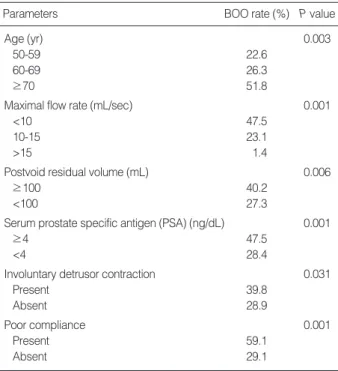
The univariate analysis showed that several parameters had significant predictive value for BOO (Table 2); an older age,
*Student’s t-test; �Chi-square test were used for data analysis.
Qmax, maximal flow rate; BOOI, bladder outlet obstruction index; IPSS, International Prostatic Symptom Score.
Parameters
Bladder outlet obstruction Present (n=137) Absent (n=292)
P value
Age (yr) 69.90±7.67 67.08±7.60 0.412*
Qmax(mL/sec) 7.34±3.12 11.49±5.24 0.001*
Voided volume (mL) 199.47±116.39 288.23±137.75 0.012*
Postvoid residual 139.42±110.90 105.01±120.40 0.92*
volume (mL)
Maximal cystometric 346.57±110.52 386.29±106.10 0.256� capacity (mL)
Involuntary detrusor 47 (34.3) 71 (24.3) 0.037� contraction (%)
Poor compliance (%) 26 (19.1) 18 (6.3) 0.001�
BOOI 63.87±26.91 19.01±14.67 0.001*
Prostate specific 3.45±4.12 2.45±3.42 0.047*
antigen (ng/dL)
Total prostate volume 50.95±28.16 41.63±21.64 0.003*
(mL)
Transition zone volume 25.42±22.72 18.53±16.62 0.002*
of prostate (mL)
IPSS (sum) 19.32±8.80 19.82±8.07 0.089*
Voiding symptom 10.97±5.81 11.79±5.57 0.516*
Storage symptom 8.31±3.91 8.09±3.71 0.225*
Quality of life 4.07±1.34 4.22±1.42 0.678*
Table 1. Comparison of clinical parameters between patients with bladder outlet obstruction (BOO) and without BOO
Parameters BOO rate (%) P value
Age (yr) 0.003
50-59 22.6
60-69 26.3
≥70 51.8
Maximal flow rate (mL/sec) 0.001
<10 47.5
10-15 23.1
>15 1.4
Postvoid residual volume (mL) 0.006
≥100 40.2
<100 27.3
Serum prostate specific antigen (PSA) (ng/dL) 0.001
≥4 47.5
<4 28.4
Involuntary detrusor contraction 0.031
Present 39.8
Absent 28.9
Poor compliance 0.001
Present 59.1
Absent 29.1
Table 2. Univariate analysis of predicting factors for bladder outlet obstruction (BOO) with using chi-square test
274 M.-Y. Kang, J.H. Ku, and S.-J. Oh
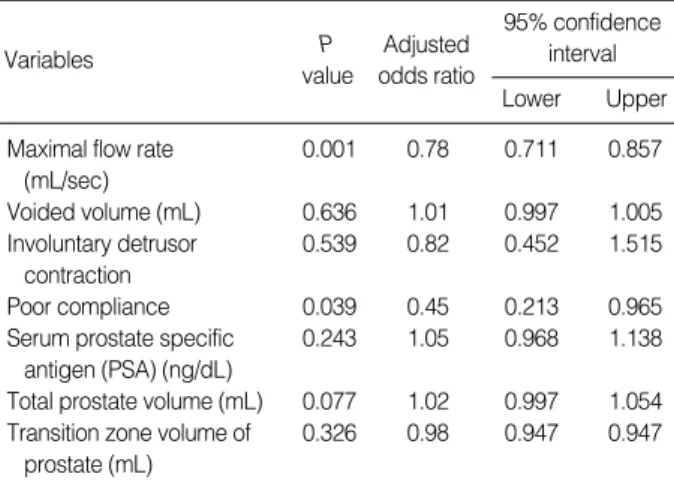
increase in the rate of obstruction and a decrease of the Qmax. Patients with BOO had a higher rate of significant postvoid residual volume (more than 100 mL) and serum PSA level (more than 4 ng/dL). The multivariate analysis showed that only Qmaxand poor compliance were significant predictive factors for BOO (Table 3).
DISCUSSION
The results of this study showed that male LUTS patients with BOO had a higher serum PSA level and a larger prostate volume than those without BOO. Although other investi- gations reported that prostate volume and serum PSA level were poorly correlated with BOO (15, 16), our results sug- gest that BOO was associated with prostate size and serum PSA level; these factors may indicate progression of benign prostatic hyperplasia. However, no significant differences were found for age, postvoid residual volume, maximal cystomet- ric capacity, and symptom scores between the men with BOO and those without BOO. In addition, only two parameters, the Qmaxand poor compliance, were significant independent predictive factors for BOO by the multivariate analysis. Sonke et al. (17) demonstrated that frequently used diagnostic param- eters such as prostate volume, postvoid residual volume and I-PSS were not useful for the prediction of BOO, and the corre- lation between these parameters and the PFS findings was poor. Vesely et al. (2) reported similar findings; no correlation was noted for the degree of obstruction and the differences in these parameters, in addition to the Qmax. They reported that the simple, non-invasive diagnostic methods were not accurate for the diagnosis of BOO.
On the other hand, Steele et al. (18) showed that combin- ing the symptom scores, maximal flow rate, and prostate volume were useful non-invasive parameters for predicting BOO, although these parameters had poor predictive power
when used alone. Tanaka et al. (19) also demonstrated that men with LUTS and BOO can be identified by the prostate volume, Qmax, postvoid residual volume, and I-PSS with a 90% positive predictive value. Thus, the ability of these vari- ables to predict BOO remains controversial.
Recently, other factors used to predict BOO have been reported and include intravesical prostatic protrusion, pro- static urethral angle, and the detrusor wall thickness. Nose et al. (20) suggested that the sensitivity of intravesical pro- static protrusion grade increased in direct proportion to the grade of obstruction; they confirmed that the IPP grading system was useful for the diagnosis of BOO. Oelke et al. (6) conducted a prospective study to find non-invasive tests for the evaluation of BOO; they suggested ultrasound measure- ments of detrusor wall thickness was better than the Qmax, postvoid residual volume or prostate volume for the diagno- sis of BOO. Cho et al. (21) also showed that prostatic urethral angle was an important factor associated with BOO in pati- ents with LUTS; they reported that patients without anatom- ical obstruction could be successfully treated with a transure- thral incision of the bladder neck, which resulted in the reso- lution of bladder neck elevation. However, these novel meth- ods require further confirmation.
Although not a few urologists treat patients with LUTS suggestive of BOO based on the suspicion of anatomic ob- struction due to prostate enlargement, BOO is considered to be often combined with functional factors such as secondary bladder dysfunction (22, 23). If men with LUTS have BOO combined with an overactive bladder, resolution of the obstruc- tion by reduction of the prostate size may not cure the pati- ent’s symptom. Consistent with this concept, the present study showed that secondary bladder function changes, such as detrusor overactivity or poor compliance, were more com- mon in patients with BOO. Several investigations have shown that secondary bladder dysfunction was independently asso- ciated with BOO (24, 25). The hypothetical explanations for BOO induced bladder dysfunction have been illustrated in animal and human models (26-28). According to prior experimental results, BOO induces marked remodeling of the bladder wall, which includes cellular hypertrophy, hyper- plasia and reorganization of the relative structural relation- ship between connective tissue and smooth muscle elements (26, 27). As the duration of BOO increases, bladder function may decompensate, characterized by functional instability such as an overactive bladder, poor compliance, increasing postvoid residual volume, and decreased contractility (28).
Thus, a combination of pathophysiologic factors must be con- sidered when treating men with BOO. Based on the results of present study, we suggest BOO must be treated in males with LUTS as BOO subsequently induces deleterious blad- der change. And we are planning to perform further study to investigate the impact of BOO on bladder function.
In conclusion, even though several non-invasive methods used for the evaluation of BOO, only maximal flow rate plays
Variables
95% confidence interval P
value
Adjusted odds ratio
Lower Upper Maximal flow rate 0.001 0.78 0.711 0.857
(mL/sec)
Voided volume (mL) 0.636 1.01 0.997 1.005 Involuntary detrusor 0.539 0.82 0.452 1.515
contraction
Poor compliance 0.039 0.45 0.213 0.965
Serum prostate specific 0.243 1.05 0.968 1.138 antigen (PSA) (ng/dL)
Total prostate volume (mL) 0.077 1.02 0.997 1.054 Transition zone volume of 0.326 0.98 0.947 0.947
prostate (mL)
Table 3. Multivariate logistic regression of predicting factors for bladder outlet obstruction
Non-invasive Parameters Predicting Bladder Outlet Obstruction 275
a significant role in predicting of BOO in Korean men with LUTS. Thus, abnormal finding of uroflowmetry indicates the need for performing PFS. In addition, BOO is significantly associated with detrusor dysfunction, therefore, secondary bladder dysfunction must be emphasized in the management of male patients with LUTS suggestive of BOO.
REFERENCES
1. Dmochowski RR. Bladder outlet obstruction: etiology and evalua- tion. Rev Urol 2005; 7 (Suppl 6): S3-13.
2. Vesely S, Knutson T, Fall M, Damber JE, Dahlstrand C. Clinical diagnosis of bladder outlet obstruction in men with lower urinary tract symptoms: reliability of commonly measured parameters and the role of idiopathic detrusor overactivity. Neurourol Urodyn 2003;
22: 301-5.
3. Boormans JL, van Venrooij GE, Boon TA. Invasively estimated International Continence Society obstruction classification versus noninvasively assessed bladder outlet obstruction probability in treat- ment recommendation for LUTS suggestive of BPH. Urology 2007;
69: 485-90.
4. Ozawa H, Chancellor MB, Ding YY, Nasu Y, Yokoyama T, Kumon H. Noninvasive urodynamic evaluation of bladder outlet obstruction using Doppler ultrasonography. Urology 2000; 56: 408-12.
5. Nitti VW. Pressure flow urodynamic studies: the gold standard for diagnosing bladder outlet obstruction. Rev Urol 2005; 7 (Suppl 6):
S14-21.
6. Oelke M, Ho_fner K, Jonas U, de la Rosette JJ, Ubbink DT, Wijkstra H. Diagnostic accuracy of noninvasive tests to evaluate bladder out- let obstruction in men: detrusor wall thickness, uroflowmetry, postvoid residual urine, and prostate volume. Eur Urol 2007; 52: 827-34.
7. AUA Practice Guidelines Committee. AUA guideline on manage- ment of benign prostatic hyperplasia (2003). Chapter 1: diagnosis and treatment recommendations. J Urol 2003; 170: 530-47.
8. Homma Y, Gotoh M, Takei M, Kawabe K, Yamaguchi T. Predic- tability of conventional tests for the assessment of bladder outlet ob- struction in benign prostatic hyperplasia. Int J Urol 1998; 5: 61-6.
9. Sirls LT, Kirkemo AK, Jay J. Lack of correlation of the American Urological Association Symptom 7 Index with urodynamic bladder outlet obstruction. Neurourol Urodyn 1996; 15: 447-56.
10. Choi J, Ikeguchi EF, Lee SW, Choi HY, Te AE, Kaplan SA. Is the higher prevalence of benign prostatic hyperplasia related to lower urinary tract symptoms in Korean men due to a high transition zone index? Eur Urol 2002; 42: 7-11.
11. Tsukamoto T, Kumamoto Y, Masumori N, Miyake H, Rhodes T, Girman CJ, Guess HA, Jacobsen SJ, Lieber MM. Prevalence of pro- statism in Japanese men in a community-based study with compari- son to a similar American study. J Urol 1995; 154: 391-5.
12. Scha_fer W, Abrams P, Liao L, Mattiasson A, Pesce F, Spangberg A, Sterling AM, Zinner NR, van Kerrebroeck P. Good urodynamic practices: uroflowmetry, filling cystometry, and pressure-flow stud- ies. Neurourol Urodyn 2002; 21: 261-74.
13. Abrams P. Bladder outlet obstruction index, bladder contractility
index and bladder voiding efficiency: three simple indices to define bladder voiding function. BJU Int 1999; 84: 14-5.
14. Abrams P. Urodynamic techniques. In: Abrams P. Urodynamics.
3rd ed. Bristol: Springer; 2006; 67-72.
15. Madersbacher S, Klingler HC, Djavan B, Stulnig T, Schatzl G, Schmidbauer CP, Marberger M. Is obstruction predictable by clini- cal evaluation in patients with lower urinary tract symptoms? Br J Urol 1997; 80: 72-7.
16. Belal M, Abrams P. Noninvasive methods of diagnosing bladder outlet obstruction in men. part 1: nonurodynamic approach. J Urol 2006; 176: 22-8.
17. Sonke GS, Heskes T, Verbeek AL, de la Rosette JJ, Kiemeney LA.
Prediction of bladder outlet obstruction in men with lower urinary tract symptoms using artificial neural networks. J Urol 2000; 163: 300-5.
18. Steele GS, Sullivan MP, Sleep DJ, Yalla SV. Combination of symp- tom score, flow rate and prostate volume for predicting bladder out- flow obstruction in men with lower urinary tract symptoms. J Urol 2000; 164: 344-8.
19. Tanaka Y, Masumori N, Itoh N, Tsukamoto T, Furuya S, Ogura H.
The prediction of bladder outlet obstruction with prostate volume, maximum flow rate, residual urine and the international prostate symptom score in patients with lower urinary tract symptoms. Hin- yokika Kiyo 2001; 47: 843-7.
20. Nose H, Foo KT, Lim KB, Yokoyama T, Ozawa H, Kumon H. Accu- racy of two noninvasive methods of diagnosing bladder outlet obstruc- tion using ultrasonography: intravesical prostatic protrusion and velocity-flow video urodynamics. Urology 2005; 65: 493-7.
21. Cho KS, Kim JH, Kim DJ, Choi YD, Kim JH. Relationship between prostatic urethral angle and urinary flow rate: its implication in benign prostatic hyperplasia pathogenesis. Urology 2008; 71: 858-62.
22. Knutson T, Edlund C, Fall M, Dahlstrand C. BPH with coexisting overactive bladder dysfunction- an everyday urological dilemma.
Neurourol Urodyn 2001; 20: 237-47.
23. Wadie BS, Ebrahim el-HE, Gomha MA. The relationship of detru- sor instability and symptoms with objective parameters used for diag- nosing bladder outlet obstruction: a prospective study. J Urol 2002;
168: 132-4.
24. Oelke M, Baard J, Wijkstra H, de la Rosette JJ, Jonas U, Ho_fner K.
Age and bladder outlet obstruction are independently associated with detrusor overactivity in patients with benign prostatic hyperplasia.
Eur Urol 2008; 54: 419-26.
25. Sullivan MP, Yalla SV. Detrusor contractility and compliance char- acteristics in adult male patients with obstructive and nonobstruc- tive voiding dysfunction. J Urol 1996; 155: 1995-2000.
26. Levin RM, Haugaard N, O’Connor L, Buttyan R, Das A, Dixon JS, Gosling JA. Obstructive response of human bladder to BPH vs. rab- bit bladder response to partial outlet obstruction: a direct compari- son. Neurourol Urodyn 2000; 19: 609-29.
27. Mirone V, Imbimbo C, Longo N, Fusco F. The detrusor muscle: an innocent victim of bladder outlet obstruction. Eur Urol 2007; 51:
57-66.
28. Agartan CA, Whitbeck C, Chichester P, Kogan BA, Levin RM. Effect of age on rabbit bladder function and structure following partial outlet obstruction. J Urol 2005; 173: 1400-5.