pISSN 1598-642X eISSN 2234-7305
유산균 발효에 의한 십전대보탕의 발효 전 후 성분 변화 연구
양민철·정상원·마진열*
한국한의학연구원 신한방제제연구센터
Received : Septembr 8, 2011 / Revised : October 28, 2011 / Accepted : December 5, 2011
Analysis of Constituents in Sipjundaebo-tangs Fermented by Lactic Acid Bacteria. Yang, Min Cheol, Sang Won Jeong, and Jin Yeul Ma*. Center for Herbal Medicine Improvement Research, Korea Institute of Oriental Medicine, Daejeon 305-811, Korea − The purpose of this study was to investigate changes in the con- tents of constituents in Sipjundaebo-tang (SJ) and its fermentations (FSJ) with 8 species of lactic acid bacteria.
Eight strains of lactic acid bacteria, Lactobacillus casei KFRI129, L. plantarum KFRI 144, L. curvatus KFRI 166, L. hilgardii KFRI 229, L. delbruekil subsp. lactis KFRI 442, L. casei KFRI 692, L. gasseri KCTC 3163, and Bifidobacterium breve KFRI 744, were utilized for the fermentation of Sipjundaebo-tang. As a result we identified three constituents which increased and two constituents which decreased. The increased constitu- ents were isolated by chromatographic techniques and then their structure elucidated using NMR and MS. The decreased constituents were confirmed by comparing standard compounds. These compounds were quantita- tively analyzed using the HPLC/DAD system. The increased constituents were identified to be cinnamyl alco- hol (1), liquiritigenin (3), and nodakenetin (5), while the decreased constituents were liquiritin (2) and nodakenin (4). Generally, liquiritin (2) and nodakenin (4) were noted as having decreased in fermented Sip- jundaebo-tangs (FSJs), while cinnamyl alcohol (1), liquiritigenin (3), and nodakenetin (5) were seen to have increased. Sipjundaebo-tang fermented by L. plantarum KFRI144 exhibited the most remarkable changes in all of fermentations. The eight lactic acid bacteria all demonstrated differing decomposable rates on the five maker compounds in fermented Sipjundaebo-tang (FSJ).
Keywords: Sipjundaebo-tang, fermentation, cinnamyl alcohol, liquiritigenin, nodakenin, HPLC/DAD
서 론
발효법이란 일정한 온도에서 매균( 菌)을 이용해서 발효 (醱酵)토록 함으로써 약성의 변화 및 새로운 약효의 생성과 더불어 효과를 증강시키는 방법을 말한다[17]. 일정 처리를 거친 약재는 적합한 온도와 습도의 조건하에서발효를 진행 하게 된다[14]. 발효는 일반적으로 Bifidobacterium sp., Saccharomyces sp. 등의 유익균을 이용하며, 이 과정 중에 아미노산, 비타민 유기산 등의 유용 성분이 만들어지고 배 당체 성분은 가수분해 되어 활성형 물질로 전환된다[19]. 최 근 식품 뿐만 아니라 한약제 및 한방 제제에 대한 발효 연 구가 활발히 이루어지고 있다[3, 15, 19].
십전대보탕(十全大補湯)은 예로부터 원기회복제로 널리 알 려져 있으며, 인삼(人蔘, Panax ginseng), 백출(白朮, Atract- ylodes japonica), 복령(茯笭, Poria cocos), 감초(甘草, Gly- cyrrhiza glabra), 숙지황(熟地黃, preparata of Rehmannia
glutinosa), 당귀(當歸, Angelica gigas), 천궁(川芎, Cnidium officinale), 백작약(白芍藥, Paeonia lactiflora), 황기(黃 , Astragalus membranaceus), 육계(肉桂, Cinnamomum cassia), 건강(乾薑, Zingiber officinale), 대추(大棗, Zizyphus jujuba) 로 구성되어 있으며, 일명 십보탕(十補湯) 또는 십전산(十全 散)으로도 불리며 황기건중탕(黃 建中湯), 팔물탕(八物湯)을 합해서 하나의 처방을 만든 것으로서 기혈(氣血)의 구쇠(俱 衰)와 음양(陰陽)의 병약( 藥)에 대한 치료 효과가 있다고 알려져 있다[2]. 최근에는 항암제 투여시 감소되는 흉선세포 의 세포생존율이 십전대보탕과 병용투여시 흉선세포의 세포 생존율이 증가된다는 보고가 있으며[4], 빈혈[18], 항산화 및 뇌신경 세포보호 효과[11], 간 보호 효과[5]에 대하여 연구 보고 되고 있다.
본 연구에서는 십전대보탕을 재료로 8종의 다른 유산균을 이용하여 발효 전후의 십전대보탕의 성분 변화를 관찰하고 향후 발효 한약으로서의 십전대보탕의 가치를 평가하고자 하였다.
*Corresponding author
Tel: +82-42-868-9466, Fax: +82-42-868-9573 E-mail: [email protected]
재료 및 방법 약재 추출
십전대보탕(Sipjundaebo-tang, SJ)의 한약재 구성은 인삼 (Panax ginseng) 240 g, 백출(Atractylodes japonica) 240 g, 복령(Poria cocos) 240 g, 감초(Glycyrrhiza glabra) 240 g, 숙지황(preparata of Rehmannia glutinosa) 240 g, 당귀 (An- gelica gigas) 240 g, 천궁(Cnidium officinale) 240 g, 백작 약(Paeonia lactiflora) 240 g, 황기(Astragalus membranaceus) 200 g, 육계(Cinnamomum cassia) 200 g, 건강(Zingiber offi- cinale), 74.5 g, 대추(Zizyphus jujuba) 100 g 이다.
이들 한약재는 영천약업사(Gyeongbuk Yeongcheon, Korea) 에서 구입하였으며 대한약전에 기술된 각각 약재 항목에 적 합한 것을 엄선하여 사용하였고, 초고속 진공 저온 약탕기 (Cosmos-600, KyungSeo Machine Co., Incheon, Korea)에 한약재와 증류수 24945 mL를 넣고 전탕 추출법으로 115oC 에서 3시간 열탕 추출한 다음 standard testing sieve(150 µm, Retsch, Haan, Germany)를 이용해 탕액을 여과하였다.
발효 조건
발효에 사용된 8종의 유산균은(L. casei KFRI 129, L.
plantarum KFRI 144, L. curvatus KFRI 166, L. hilgardii KFRI 229, L. delbruekil subsp. lactis KFRI 442, L. casei KFRI 692, L. gasseri KCTC 3163, Bifidobacterium breve KFRI 744) 한국식품연구원(Korea Food Research Institute:
KFRI, Seongnam, Korea) 식품미생물 유전자은행에서 분양 받았다. Lactobacillus spp.는 MRS broth(Difco, Detroit, MI, USA)에서, B. breve KFRI 744은 Reinforced Clostridial Medium(Difco)에서 계대 배양한 뒤 초기균수를 1×10⁶ CFU/
mL로 조절하여 inoculum으로 사용하였다. 1N NaOH를 이 용하여 여과한 십전대보탕의 pH를 7.0으로 조정한 후 121oC, 1.5 기압에서 15분간 가압멸균하고, 상온까지 냉각시킨 후, 유산균을 1%(v/v)로 접종하고 37oC의 항온배양기에서 48시 간 동안 정치 배양을 한 후 standard testing sieve로 여과하 여 동결 건조하여 분석에 사용하였다.
발효 후 증가 성분의 분리
십전대보탕 원탕과 8종의 십전 대보탕 유산균 발효물을 HPLC/DAD를 이용하여 비교 분석한 결과 8종의 발효물에 서 3개의 증가한 peak와 2개의 감소한 peak를 관찰되었으며, 8종 발효물 중 가장 뚜렷한 변화를 보인 L. plantarum KFRI 144 발효물로부터 3개의 증가한 peak의 분리 정제를 수행한 후 분광학적 분석 방법에 의해 구조를 규명하였다. 2개의 감 소한 성분은 표준 물질의 tR(retention time) 및 DAD spec- trum과 비교 분석하여 성분 규명을 수행하였다.
L. plantarum KFRI 144로 발효하여 얻어진 발효 십전대 보탕의 건조분말 20 g을 물에 suspension하여 ethyl acetate,
n-BuOH 순으로 용매 분획 후 이들 용매 분획을 HPLC 분 석을 한 결과 발효 후 증가성분이 ethyl acetate 분획에 존재 하는 것을 확인하여 ethyl acetate 분획에 대하여 발효 후 증 가 성분의 분리를 실시하였다. 우선 ethyl acetate 분획(1.0 g)에 대하여 C18 flash column chromatography(100% H2O, 20%, 40%, 60%, 80, 100% MeOH)를 실시하여 7개의 분 획으로(F1-F7) 나누었다. 이 중 F5 분획(300 mg)을 60%
MeOH를 유출용매로 하여 C18 open column chromatog- raphy를 실시하여 4개의 분획으로 나누었다(F51-F54). 이 중 F52(80 mg) 분획을 prep HPLC(chloroform/methanol, 20:1) 를 이용하여 compound 3(2.5 mg)을 얻었고 F54(150 mg) 에서는 prep HPLC(n-hexane/ethyl acetate, 1:1)를 이용하여 compound 5(2.0 mg)을 획득하였다. F6 분획(300 mg)에서는 prep HPLC(n-hexane/EtOAc, 7:1)를 반복 실시하여 compound 1(12 mg)을 획득하였다.
Compound 1
Colorless oil; EI-MS m/z 134 [M]+; 1H-NMR (CD3OD, 600 MHz) δ 7.40 (2H, d, J = 7.4 Hz, H-2, 6), 7.28 (2H, dd, J = 7.4, 7.4 Hz, H-3, 5), 7.20 (1H, dd, J = 7.4, 7.4 Hz, H- 4), 6.59 (1H, d, J = 16.0 Hz, H-7), 6.35 (1H, dt, J = 16.0, 5.5 Hz, H-8), 4.25 (2H, d, J = 5.5 Hz, H-9); 13C-NMR (CD3OD, 100 MHz) δ 138.5 (C-1), 131.6 (C-7), 123.0 (C- 4), 129.6 (C-3, 5), 128.5 (C-8), 127.4 (C-2, 6), 63.5 (C-9).
Compound 3
Yellow powder; ESI-MS m/z 279 [M+Na]+; 1H-NMR (CD3OD, 500 MHz) δ 2.70 (1H, dd, J = 17.0, 3.0 Hz, H- 3a), 3.00 (1H, dd, J = 17.0, 13.0 Hz, H-3b), 5.38 (1H, dd, J
= 13.0, 3.0 Hz, H-2), 6.35 (1H, d, J = 2.0 Hz, H-8), 6.51 (1H, dd, J = 8.5, 2.0 Hz, H-6), 6.83 (2H, d, J = 8.5 Hz, H- 3', 5'), 7.32 (2H, d, J = 8.5 Hz, H-2', 6'), 7.75 (1H, d, J = 8.5 Hz, H-5); 13C-NMR (CD3OD, 75 MHz) δ 45.1 (C-3), 81.2 (C-2), 104.1 (C-8), 112.0 (C-6), 115.1 (C-10), 116.4 (C- 3', 5'), 129.2 (C-2', 6'), 130.4 (C-5), 131.3 (C-1'), 159.1 (C- 4'), 165.8 (C-9), 167.2 (C-7), 193.7 (C-4).
Compound 5
White powder; ESI-MS m/z 269 [M+Na]+; 1H-NMR (CDCl3, 500 MHz) δ 7.60 (1H, d, J = 9.5 Hz, H-4), 7.22 (1H, s, H-5), 6.74 (1H, s, H-8), 6.21 (1H, d, J = 9.5 Hz, H-3), 4.74 (1H, dd, J = 9.0, 8.5 Hz, H-2'), 3.25 (1H, dd, J = 15.5, 8.5 Hz, H-3'a), 3.19 (1H, dd, J = 15.5, 9.5 Hz, H-3'b), 1.40 (3H, s, CH3), 1.24 (3H, s, CH3); 13C-NMR (75 MHz, CDCl3) δ 163.5 (C-2), 161.5 (C-7), 156.0 (C-10), 143.8 (C-4), 125.2 (C- 6), 123.5 (C-5), 113.0 (C-9), 112.5 (C-3), 98.0 (C-8), 91.3 (C- 2'), 71.6 (C-4'), 29.7 (C-3'), 26.3 (CH3), 24.5 (CH3).
시약 및 기기
HPLC 분석에 사용된 water 및 acetonitrile은 J.T Baker (Phillipsburg, NJ, USA)의 HPLC급 용매를 사용하였다. 지 표 물질인 uiritigenin, cinnamyl alcohol은 Sigma-Aldrich (St Louis, MO, USA), liquiritin은 Wako Pure Chemical Industries, Ltd.(Osaka, Japan), nodakenin은 식품의약품 안 전청에서 각각 구입하여 사용하였다.
분석에 사용한 HPLC system은 Elite Lachrom HPLC/DAD system(Hitachi High-Technologies Co., Tokyo, Japan)을
사용하였으며 L-2130 pump, L-2200 auto-sampler, L-2350 column oven, L-2455 diode array UV/VIS detector, EZchrom Elite software(version 3.3.1a)로 구성되어있다. NMR spec- trum은 Varian사의 INOVA 600, INOVA 400NB NMR (Varian Co., USA), Bruker사의 AVANCE 500 MHz, 300 MHz NMR(Bruker Co., Germany)로 부터, low-resolution ESI, EI MS spectrum은 ESI-IT-TOFMS(Shimadzu Co.
Japan)와 JMS-600W EI-MS(JEOL Co., Japan)를 사용하여 측정하였다. Prep HPLC는 Gilson pep HPLC(Wisconsin, Fig. 1. Structures of compounds 1-5 of unfermented and fermented Sipjundaebo-tang (SJ, FSJ). 1. Cinnamyl alcohol; 2. Liquiritin; 3.
Liquiritigenin; 4. Nodakenin; 5. Nodakenetin.
Fig. 2. HPLC/DAD spectrums of compounds 10-5. 1. Cinnamyl alcohol; 2. Liquiritin; 3. Liquiritigenin; 4. Nodakenin; 5. Nodakenetin.
USA)를 사용하여 성분을 분리하였으며, 333, 334 pump, UV/VIS151 detector로 구성되어 있다. Prep HPLC column 은 Ascentis Si(10×250 mm, 10 µm, Supelco Co., USA) 및 Agilent prep-sil(21.2×250 mm, 10 µm, Agilent Co., USA) column을 사용하였다. Open column chromatography 용 C18 powder는 YMC 사의 YMC*Gel ODS-A (particle size 75 µm, YMC Co., Ltd., Japan)를 사용하였다.
HPLC 분석 조건
HPLC 분석 column은 OptimaPak C18(4.6 mm×250 mm, 5 µm, RS tech Co., Daejeon, Korea)을 사용하였으며, 이동 상의 유속을 1 mL/min로 하여 5% acetonitirile을 5분 동안 흘린 후 65분간 100% acetonitrile까지 비율을 증가 시킨 후 10분 동안 100% acetonitrile을 흘려 총 80분 동안 분석을 수행하였으며, column oven의 온도는 40oC로 유지하였다.
Injection volum은 10 µL를 주입하였으며, 파장은 지표 성분 의 최대 흡수 파장에 따라 cinnamyl alcohol (1)은 250, liquiritin (2) 및 liquiritigenin (3)은 276, nodakenin (4) 및 nodakenetin (5)은 330 nm에서 분석하였다.
검량선 작성 및 검액 조제
Cinnamyl alcohol은 400, 200, 50, 12.5, 3.13 µg/mL, li-
quiritin은 55, 13.75, 3.43, 0.85, 0.21 µg/mL, liquiritigenin은 100, 25, 6.25, 1.56, 0.39µg/mL, nodakenin은 250, 62.5, 15.63, 3.91, 0.98 µg/mL, nodakenetin은 100, 25, 6.25, 1.56, 0.39 µg/mL의 농도로 단계적으로 희석한 시료를 분석 하여 검량선을 작성하였으며, 십전대보탕 및 발효 십전대보 탕의 검액은 40 mg/mL의 농도로 조제한 후 syringe filter (PVDF, 0.45 µm, non-sterile, Advantec MFS Inc., Japan) 로 여과하여 분석하였다(Table 1).
지표 성분의 정량 분석
정량 분석은 지표 성분의 면적을 검량선에 대입하여 십전 대보탕 및 발효 십전대보탕에 함유되어 있는 지표 성분의 함 량을 계산 하였다(Table 2).
Table 1. Standard curves and R2 value of compounds 1-5.
Components Retention time
(tR, min) Regression equationa R2 (n=5) Cinnamyl alcohol (1) 30.19 y = 256771x - 266629 0.9999 Liquiritin (2) 22.41 y = 59302x + 4957.8 1.0000 Liquiritigenin (3) 29.21 y = 78746x + 31379 0.9997 Nodakenin (4) 23.26 y = 60910x - 84127 0.9992 Nodakenetin (5) 28.66 y = 247441x + 41837 1.0000
ay, peak area; x, concentration (µg/mL).
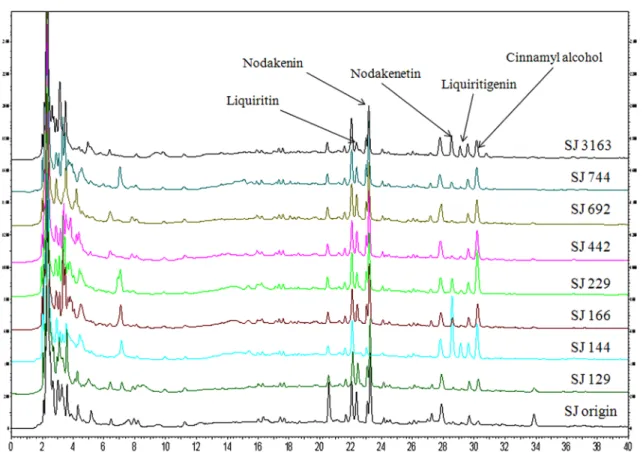
Fig. 3. HPLC/DAD chromatograms of SJ and FSJs at 203 nm. SJ origin: unfermented Sipjundaebo-tang; SJ129: L. casei KFRI 129;
SJ144: L. plantarum KFRI 144; SJ166: L. curvatus KFRI 166; SJ229: L. hilgardii KFRI 229; SJ442: L. delbruekil subsp. lactis KFRI 442;
SJ692: L. casei KFRI 692; SJ3163: L. gasseri KCTC 3163; SJ744: B. breve KFRI 744.
결 과 구조 해석
발효 후 성분 변화가 가장 뚜렷한 L. plantarum KFRI 144 십전대보탕 발효물 20g으로부터 증가한 3종의 성분을 분리 정제하였으며 1H-, 13C-NMR, MS 및 기존 문헌[16, 1, 10]과 비교하여 compound 1, 3, 5에 대하여 각각 cinnamyl alcohol (1), liquiritigenin (3), nodakenetin (5)으로 구조를 규명하였으며, 2종의 감소한 성분은 표준 물질의 HPLC tR
(retention time) 및 DAD spectrum을 비교 분석 한 결과 liquiritin (2) 및 nodakenin (4)으로 규명되었다.
HPLC chromatogram과 검량선
Cinnamyl alcohol (1), liquiritin (2), liquiritigenin (3), nodakenin (4), nodakenetin (5)은 각각 30.19, 22.41, 29.21, 23.26, 28.66 min에서 검출되었으며, 이들 성분의 peak 면적 에 대한 검량선에 대한 R2 value는 0.9992 이상으로 높은 직 선성을 나타내었다(Table 1).
발효 균주별 cinnamyl alcohol (1) 함량
십전대보탕(SJ)을 발효 하기 전 cinnamyl alcohol의 함량 은 27.41±0.12 µg/mL이었으나 발효에 따라 전체 8종의 십 전대보탕 발효물에서 cinnamyl alcohol의 함량이 증가하였 으며 L. hilgardii KFRI 229 발효물은 357.39±1.50 µg/mL (1303.9% 증가)로 발효 균주 중 가장 높은 함량을 나타내었 다. L. casei KFRI 129로 발효한 십전대보탕의 cinnamyl alcohol 함량은 92.27±0.50 µg/mL(336.6% 증가)로 균주 중 가장 낮은 함량을 나타내었다(Table 2).
발효 균주별 liquiritin (2) 함량
SJ의 발효 전 liquiritin의 함량은 44.48±0.20 µg/mL이었으
나 발효에 따라 전체 8종의 십전대보탕 발효물에서 liquiritin 의 함량이 감소하였으며 L. plantarum KFRI 144 발효물이 발효전과 비교하여 1.8%인 0.81±0.05 µg/mL로 발효 균주 중 가장 높은 분해능을 나타내었다. L. casei KFRI 692는 발효전과 비교하여 84.6% 수준인 37.62±0.50 µg/mL로 발 효 균주 중 가장 낮은 분해능을 나타내었다(Table 2).
발효 균주별 liquiritigenin (3) 함량
SJ의 발효 전 liquiritigenin의 함량은 1.24±0.04 µg/mL 이었으나 발효 후에는 L. casei KFRI 692를 제외한 7종의 균주 발효물에서 liquiritigenin의 함량이 증가하였다. L.
plantarum KFRI 144 발효물이 24.46±0.32 µg/mL(1972.6%
증가)로 발효물 중 가장 높은 함량을 나타내었으며, L. casei KFRI 692는 0.99±0.17 µg/mL로 발효 균주 중 가장 낮은 분해능을 나타내었으며, 발효 후 함량이 오히려 감소되었다 (Table 2).
발효 균주별 nodakenin (4) 함량
SJ의 발효 전 nodakenin의 함량은 86.39±0.32 µg/mL 이 었으나 발효 후 모든 발효물에서 함량이 감소하였으며, L.
plantarum KFRI 144 발효물이 발효전 대비 13.4%인 11.57
±0.50 µg/mL로 발효 균주 중 가장 높은 분해능을 나타내었 다. L. casei KFRI 129의 발효물은 84.25±0.10 µg/mL(발효 전 대비 97.5%)로 발효 균주 중 가장 낮은 분해능을 나타내 었다(Table 2).
발효 균주별 nodakenetin (5) 함량
SJ의 발효 전 nodakenentin의 함량은 0.89±0.03 µg/mL 이었으나 발효 후 L. casei KFRI 129, L. casei KFRI 692 를 제외한 모든 균주에서 함량이 증가하였다. L. plantarum KFRI 144의 발효물은 23.08±0.10 µg/mL(2593.3% 증가)으 Table 2. Contents changes of unfermented and fermented Sipjundaebo-tang (SJ and FSJ)a.
SJb Cinnamyl alcohol (1) 250 nmc
Liquiritin (2) 276 nm
Liquiritigenin (3) 276 nm
Nodakenin (4) 330 nm
Nodakenetin (5) 330 nm
SJ origin 27.41±0.12 44.48±0.20 1.24±0.04 86.39±0.32 0.89±0.03
SJ 129 92.27±0.50 34.95±0.73 2.80±0.08 84.25±0.10 0.75±0.01
SJ 144 262.02±3.21 0.81±0.05 24.46±0.32 11.57±0.50 23.08±0.10
SJ 166 193.27±2.23 28.45±0.60 2.93±0.01 75.54±1.22 2.88±0.03
SJ 229 357.39±1.50 25.13±0.34 5.41±0.10 72.28±0.80 5.12±0.13
SJ 442 218.62±0.42 36.41±0.10 4.45±0.13 81.78±1.32 0.94±0.02
SJ 692 186.18±0.34 37.62±0.50 0.99±0.17 72.48±1.50 0.68±0.03
SJ 3163 130.56±0.32 13.06±0.23 16.59±0.82 60.21±0.42 7.29±0.01
SJ 744 179.32±0.19 26.26±0.72 3.02±0.01 80.41±0.56 2.34±0.05
aUnit of contents :µg/mL.
bSJ origin: unfermented Sipjundaebo-tang; SJ129: L. casei KFRI 129; SJ144: L. plantarum KFRI 144; SJ166: L. curvatus KFRI 166; SJ229:
L. hilgardii KFRI 229; SJ442: L. delbruekil subsp. lactis KFRI 442; SJ692: L. casei KFRI 692; SJ3163: L. gasseri KCTC 3163; SJ744: B.
breve KFRI 744.
cDetection UV wavelength.
로 발효 균주 중 가장 높은 함량을 나타내었으며, L. casei KFRI 129와 L. casei KFRI 692에 의해 발효된 SJ의 noda- kenetin 함량은 0.75±0.01, 0.68±0.03 µg/mL로 발효 후 함량 이 오히려 감소하였다(Table 2).
고 찰
HPLC/DAD system을 이용하여 십전대보탕 및 8종의 십 전대보탕 유산균 발효물을 분석한 결과 전체적으로 8종의 유산균 발효물에서 tR 30.19, 29.21, 28.66 min의 peak가 발 효 전과 비교하여 증가 한 것을 관찰하였으며, tR 22.41, 23.26 min의 peak는 감소하였다. 특히 L. plantarum KFRI 144 발효물에서 이들 5종의 성분 변화가 가장 뚜렷하였다.
표준 물질의 tR(retention time) 및 DAD spectrum을비교 분석하여 2종의 감소한 성분은 liquiritin (2) 및 nodakenin (4)으로 규명하였으며, L. plantarum KFRI 144 동결 건조물 에서 용매 분획 및 각종 chromatographic 기술을 이용하여 발 효 후 증가한 3종 성분을 분리 정제 후 NMR, MS 분석을 이 용하여 cinnamyl alcohol (1), liquiritigenin (3), nodakenetin (5)으로 화학 구조를 규명하였다. 또한 이들 증감 성분 5종 에 대하여 십전대보탕 및 8종의 유산균 발효물에 대하여 정 량 분석을 수행하여 유산균주별 성분 변화를 관찰하였으며, 다음과 같은 결론을 도출 할 수 있었다.
1. L. casei KFRI 129, L. plantarum KFRI 144, L.
curvatus KFRI 166, L. hilgardii KFRI 229, L. delbruekil subsp. lactis KFRI 442, L. casei KFRI 692, L. gasseri KCTC 3163, B. breve KFRI 744 등 8종의 유산 균주로 발 효 한 십전대보탕에서는 전반적으로 liquiritin (2), nodakenin (4)의 함량은 감소한 반면 cinnamyl alcohol (1), liquiri- tigenin (3), nodakenetin (5)의 함량은 증가하였다.
2. L. plantarum KFRI 144의 균주로 발효 한 십전대보탕 발효물에서 높은 cinnamyl alcohol (1), liquiritigenin (3), nodakenetin (5)의 함량 증가와 liquiritin (2) nodakenin (4) 의 높은 분해능을 보여 8종의 십전대보탕 발효물 중 성분 변화가 가장 뚜렷하였다.
3. L. casei KFRI 129 및 L. casei KFRI 692를 이용하 여 발효한 십전대보탕은 liquiritin (2), nodakenin (4)에 대하 여 낮은 분해능을 나타내었으며, cinnamyl alcohol (1), liquiritigenin (3), nodakenetin (5)의 미약한 함량 증가로 인 해 8종의 유산균 발효물 중 가장 낮은 성분 변화를 나타내 었다.
4. 십전대보탕 구성 약재 중 이들 성분의 기원 약재로는 cinnamyl alcohol (1)은 육계(肉桂, Cinnamomum cassia), liquiritin (2) 및 liquiritigenin (3)은 감초(甘草, Glycyrrhiza glabra), nodakenin (4) 및 nodakenetin (5)은 당귀(當歸, Angelica gigas)로부터 유래됐을 것으로 추정된다.
5. 십전대보탕 발효 조건과 같이 십전대보탕을 첨가하지
않은 상태에서 8종의 유산균만을 각각 증식 배양하여 syringe filter(PVDF, 0.45 µm, non-sterile, Advantec MFS Inc., Japan)로 여과 한 후 HPLC 분석을 한 결과 특이 peak가 전 혀 없는 것으로 보아 유산균 및 다른 발효 부산물들이 발효 십전대보탕 성분 분석에 큰 영향을 미치지 않는 것으로 추 정된다.
이상의 결과로 미루어 십전대보탕의 발효에 있어서 발효 균주에 따라 각각의 십전대보탕의 성분 변화가 다르게 나타 날 수 있다. 식품이나 한약재의 발효 중 배당체의 가수 분해 로 생성되는 저분자의 aglycone의 증가는 체내의 흡수율 및 생리활성의 증가로 인해 효능이 증가된다고 알려져 있다[7, 13]. 8종의 유산균 발효물에서 liquiritin (2)과 nodakenin (4) 의 함량 감소와 이들 배당체의 aglycone인 liquiritigenin (3) 및 nodakenetin (5)의 함량 증가는 발효 중 배당체가 가수 분해된다는 사실을 뒷받침한다. 발효 후 cinnamyl alcohol (1)의 증가에 대한 mechanism은 아직 알려져 있지 않다. 8 종의 유산균주로 발효된 십전대보탕의 성분 변화를 관찰한 결과 L. plantarum KFRI 144 발효물이 다른 7종의 발효물 에 비하여 가장 뚜렷한 성분 변화를 나타내어 8종의 균주 중 발효 효과가 가장 우수한 것으로 사료된다.
발효 후 증가하는 cinnamyl alcohol (1)는 항당뇨[8] 및 항염증[9] 효과가 알려져 있으며, liquiritigenin (3)은 항암 [20], 항염증[6], estrogen receptor[12] 효과가 연구보고 되었 다. 따라서 본 연구를 통해 십전대보탕의 발효 후 성분의 변 화는 체내 십전대보탕의 흡수율 증가와 효능 강화에 기여를 할 것으로 사료되며, 다양한 발효 한약의 개발 가능성을 제 시 할 수 있을 것으로 사료된다.
요 약
십전대보탕의 발효 전 후 성분 변화를 분석하기 위해 8종 의 유산균을 이용하여 발효한 십전대보탕과 발효하지 않은 십전대보탕을 비교 분석하여 발효 후 증가한 3종의 성분과 감소한 2종의 성분을 규명하여 각 유산 균주에 대하여 5종 성분의 정량 분석을 실시하였다. 증가한 3종의 성분은 각종 크로마토그래픽 기술을 이용하여 분리 정제 후 NMR, MS 등의 분광학적 분석기법을 이용하여 구조를 규명하였으며, cinnamyl alcohol (1), liquiritigenin (3) 및 nodakenetin (5) 으로 규명되었다. 발효 후 감소한 성분은 표준품과 HPLC 비 교분석(retention time, DAD spectrum)을 통하여 liquiritin (2) 및 nodakenin (4)으로 구조를 규명하였다. 8종의 유산 균 주로 발효한 십전대보탕의 성분 변화를 분석한 결과 L.
plantarum KFRI 144 발효물이 다른 유산균 발효물에 비하 여 cinnamyl alcohol (1), liquiritigenin (3) 및 nodakenetin (5) 성분이 대체적으로 가장 높게 증가하였으며, liquiritin (2) 및 nodakenin (4) 성분이 가장 큰 비율로 감소하여 8종의 유 산 균주 중 발효 효과가 가장 우수하였다.
Acknowledgement
This work was supported by a grant (K11050) from the Korea Institute of Oriental Medicine, Ministry of Education, Science and Technology (MEST), Republic of Korea.
R
EFERENCES1. Choi, J. H., J. N. Choi, S. Y. Lee, S. J. Lee, K. H. Kim, and Y. K. Kim. 2010. Inhibitory activity of diacylglycerol acyl- transferase by glabrol isolated from the roots of licorice.
Arch. Pharm. Res. 33: 237-242.
2. Heo, J. 1993. Hangul Donguibogam. p. 817. Minjoong- Seogak, Seoul, Korea.
3. Jung, B. G., J. H. Ko, S. J. Cho, H. B. Koh, S. R. Yoon, D.
U. Han, and B. J. Lee. 2010. Immune-enhancing effect of fermented Maesil (Prunus mume Siebold & Zucc.) with probiotics against Bordetella bronchiseptica in mice. J. Vet.
Med. Sci. 72: 1195-1202.
4. Kim, D. K., J. S. Eun, H. Jeon, and J. M. Song. 1998. Effect of sipjeon-daebo-tang on thymocytes of anti-tumor drugs administered mice. J. Herbology. 13: 129-135.
5. Kim, H. S. 1976. A study on the effect of SIM ZUN DAE BO TANG administered in rabbit with hepatic disfunction on the rate of recovery. Kor. J. Orient. Int. Med. 1: 78-84.
6. Kim, Y. W., R. J. Zhao, S. J. Park, J. R. Lee, I. J. Cho, C. H.
Yang, S. J. Kim, and S. C. Kim. 2008. Anti-inflammatory effects of liquiritigenin as a consequence of the inhibition of NF-kappaB-dependent iNOS and proinflammatory cytokines production. Br. J. Pharmacol. 154: 165-173.
7. Kwak, C. S., M. S. Lee, and S. C. Park. 2007. Higher anti- oxidant properties of Chungkookjang, a fermented soybean paste, may be due to increased aglycone and malonylgly- coside isoflavone during fermentation. Nutr. Res. 27: 719- 727.
8. Lee, H. S. 2002. Inhibitory activity of Cinnamomum cassia bark-derived component against rat lens aldose reductase. J.
Pharm. Pharm. Sci. 5: 226-230.
9. Lee, H. S., B. S. Kim, and M. K. Kim. 2002. Suppression effect of Cinnamomum cassia bark-derived component on nitric oxide synthase. J. Agric. Food. Chem. 50: 7700-7703.
10. Lee, S. H., D. S. Shin, J. S. Kim, K. B. Oh, and S. S. Kang.
2003. Antibacterial coumarins from Angelica gigas roots.
Arch. Pharm. Res. 26: 449-452.
11. Lee, S. Y., H. W. Kim, G. Y. Kim, C. H. Choi, Y. C. Yun, and H. W. Jung. 2009. Protective effects and anti-oxidative effects of sipjeon-daebo-tang and gami-sipjeon-daebo-tang in c6 glioma cell. Kor. J. Oriental Physiology & Pathology.
23: 1292-1298.
12. Mersereau, J. E., N. Levy, R. E. Staub, S. Baggett, T.
Zogovic, S. Chow, A. R. William, T. Mary, C. Isaac, F. B.
Leonard, and C. L. Dale. 2008. Liquiritigenin is a plant- derived highly selective estrogen receptor beta agonist. Mol.
Cell. Endocrinol. 283: 49-57.
13. Okabe, Y., T. Shimazu, and H. Tanimoto. 2011. Higher bioavailability of isoflavones after a single ingestion of aglycone-rich fermented soybeans compared with glucoside- rich non-fermented soybeans in Japanese postmenopausal women. J. Sci. Food. Agric. 91: 658-663.
14. Park, J. H., H. J. Kim. and M. J. Lee. 2009. The role of gut microbiota in obesity and utilization of fermented herbal extracts. Journal of Society of Korean Medicine for Obesity Research. 12: 1-14.
15. Park, J. H., J. U. Jung, K. T. Kweon, M. J. Seo, E. K. Seo, Y.
K. Park, and J. H. Lee. 2010. Nodakenin and decursin contents of fermented Angelicae Gigantis Radix by 4 species strain. J. Herbology. 25: 7-10.
16. Pouchert, C. and J. Behnke. 1993. The Aldrich Library of
13C and 1H FT NMR spectra edition 1 volume2. p 392.
Aldrich Chemical Co., St. Louis, USA
17. Shin, D. W. 2010. Hannyhak-GangLon II. p. 327. Shinilbooks Press, Seoul, Korea.
18. Yang, M. J., Y. J. Kim, and T. S. Park. 2003. Effect of dietary supplementation of sypjeondaebotang or jahyulyang- geuntang on iron bioavailability in rats. The Korean Nutri- tion society. 36: 262-269.
19. You, Y. H., J. H. Koh, S. O. Chung, W. J. Jun, and K. M.
Kim. 2009. Effects of fermented Ssanghwatang on swim- ming capacity in mice. Food. Sci. Biotechnol. 18: 275-277.
20. Zhang, S. P., Y. J. Zhou, Y. Liu, and Y. Q. Cai. 2009. Effect of liquiritigenin, a flavanone existed from Radix glycyrrhizae on pro-apoptotic in SMMC-7721 cells. Food. Chem. Toxicol.
47: 693-701.