Received February 16, 2021, Revised March 26, 2021, Accepted March 26, 2021 Corresponding author: Dong-Il Kim
Department of Obstetrics and Gynecology, College of Korean Medicine, Dongguk University, 27 Dongguk-ro, Ilsandong-gu, Goyang 10326, Korea Tel: +82-31-961-9060, Fax: +82-31-961-9009, E-mail: [email protected]
This study was supported by the Traditional Korean Medicine R & D Program funded by the Ministry of Health & Welfare through the Korea Health Industry Development Institute (KHIDI) (HB16C0048-010016).
CCThis is an open access article distributed under the terms of the Creative Commons Attribution Non-Commercial License (http://creativecommons.org/licenses/ by-nc/4.0) which permits unrestricted non-commercial use, distribution, and reproduction in any medium, provided the original work is properly cited.
수족냉증의 침 치료법에 대한 고찰
최수지1 ㆍ최윤석2 ㆍ이연선2 ㆍ노은지1 ㆍ김동일1
1동국대학교 한의과대학 부인과교실, 2동국대학교 한의과대학
A Review of Acupuncture Treatment Methods for Cold Hypersensitivity of Hands and Feet
Su-Ji Choi1, YunSeok Choi2, Yeon Sun Lee2, Eun-Ji Noh1, Dong-Il Kim1
1Department of Obstetrics & Gynecology, College of Korean Medicine, Dongguk University,
2College of Korean Medicine, Dongguk University
Objectives : The purpose of this study is to review the acupuncture treatment for cold hypersensitivity of hands and feet. Methods : We searched articles in 7 search engines with keywords related to ‘Cold hypersensitivity of hands and feet’ and ‘Raynaud disease’
in March 2021. Clinical studies that used acupuncture for cold hypersensitivity of hands or feet were included. Animal studies and nonclinical data were excluded. Data on acupuncture treatment such as methods, site, duration, frequency, and period were analyzed. Also, network analysis between acupoints was conducted. Results : Of 41 selected articles, there were 32 case reports, 7 randomized controlled trials, and 2 uncontrolled clinical studies. Studies were conducted using manual acupuncture, elec- troacupuncture, warm needling, pharmacopuncture, fire needling, and auricular acupuncture. Most studies used more than one acupoint (n=40), and there were 111 acupoints selected for acupuncture treatment for cold hypersensitivity of hands and feet. The most commonly used acupoint was LI11 (n=27). In terms of the correlation of acupoints, LI11 had the highest value of degree centrality at 0.6989. The mean treatment time, number of treatments, and duration were 26.8±8.87 minutes, 15.51±15.75 times, and 77.69±132.80 days. Conclusions : The results of this study could be useful in establishing the evidence for performing standardized acupuncture treatment for cold hypersensitivity of hands and feet.
Key words : cold hypersensitivity, Raynaud disease, acupuncture, clinical trial, acupuncture points
서 론
수족냉증은 냉증의 범위에 속하며, 한의학에서는 ‘수족궐냉’,
‘수족역냉’, ‘수족궐한’ 등으로 표현되고 있다1). 냉증은 일종의 ‘냉 각과민증(Cold Hypersensitivity)’으로, 일반적으로 추위를 느끼지 않을 온도에서도 신체의 특정 부위가 차고 시려서 일상생활을 유
지하기 어려운 상태를 말한다2). 냉증의 원인은 명확히 밝혀지지 않았으나, 자율신경계통 실조에 의한 혈관운동의 변조, 전신적 순 환장애가 주요 원인으로 알려져 있다2).
냉증은 동양인에 빈발하며 특히 여성이 남성보다 3:2 정도로 많 다. 여성 환자의 발생 상황을 연령별, 시기별로 보았을 때 20∼30 대 가임기에 가장 많으나 사춘기 및 갱년기에도 발생하며, 산후
여성에서 특히 많이 발생한다3). 부위별로는 전신, 수족, 소복, 음 부, 요부, 배부의 순으로 빈발한다3).
냉증은 혈액 순환장애와 열 발생 장애가 직접적인 원인이 되나, 다양한 원인으로 발생할 수 있다. 위장장애로 인한 체력의 저하, 빈혈, 저혈압, 자율신경의 이상에 의한 모세혈관의 수축, 골반내의 울혈, 수분대사장애 등이 원인이 될 수 있다4). 또한 자율신경실조 증, 레이노씨병, 말초신경염, 다발성 신경염, 손목굴증후군 등과 같은 질병에서도 냉증이 유발될 수 있다. 한의학에서는 비양허, 신 양허, 어혈, 혈허, 기허, 수독 등의 원인으로 기혈의 운행 장애나 기혈과 양기의 부족하여 나타나는 것으로 보고 있다4).
수족냉증이란 손발에 냉증이 느껴지는 증상으로, 심하면 손으 로 일할 때나 악수할 때도 불편감을 유발하고, 더운 날씨에도 양말 이나 장갑을 신어야 하는 등 삶의 질을 저해한다. 수족냉증은 다음 의 세 가지 경우를 포함하고 있다. 첫째. 추위를 느끼지 않을 만한 온도에서 수족냉증을 느끼는 경우, 둘째. 추위를 느낄 만한 온도에 서 주변 사람보다 과도하게 수족냉증을 느끼는 경우, 셋째. 추운 환경에서 따뜻한 환경으로 이동 시 증상이 쉽게 회복되지 않는 경 우5).
수족냉증은 증상명이지만 한의학적으로는 화병과 같이 하나의 증후군으로 인식되며, 일종의 질환의 범주에 포함되고 있다6). 그러 나 현재 국내에서 진단에서 사용하고 있는 한국표준질병사인분류 (Korean Standard Classification of Diseases, KCD)에는 수족냉 증이라는 상병명이 없다. 따라서 이 연구에서 수집한 기초 연구자 료는 자각적 수족냉증과 냉각과민증을 대상으로 한 연구뿐만 아니 라, 수족냉증을 주 증상으로 하는 일차성 레이노증후군(레이노병) 을 대상으로 한 것까지 포함하였고, 원인 질환이 분명하거나 이차 성 레이노증후군으로 진단된 경우는 제외하였다.
수족냉증의 한의학적 치료로는 침치료, 뜸치료, 한약치료, 온열 치료 등 여러 방법이 활용되고 있으나, 침 치료의 경우에는 여러 치료 방법이 다양하게 혼재되어 있어 치료를 재현하기 어려웠다.
이 연구는 문헌고찰을 중심으로 수족냉증의 한의학적 침치료에 서 활용된 침치료 방법을 분석하고, 이를 바탕으로 표준화된 침치 료를 수행하기 위한 근거 자료를 제공하기 위해 이루어졌다. 이러 한 연구를 통해 얻어진 지견을 논문으로 보고하고자 한다.
대상 및 방법
1. 연구 대상 및 자료 수집 방법
논문의 검색은 연구진 2명이 독립적으로 국내외 전자데이터베
이스 검색을 통해 수행하였다. 국외 데이터베이스 검색은
‘PUBMED (www.ncbi.nlm.nih.gov/pubmed)’, ‘Cochrane Li- brary Central Register of Controlled Trials (CENTRAL, www.
cochranelibrary.com)’, ‘Excerpta Medica dataBASE (EMBASE, www.embase.com)’는 [(‘Cold hypersensitivity in the hands and feet’ OR ‘Raynaud’) AND ‘acupuncture’]를 검색어로 사용 하였고, ‘China National Knowledge Infrastructure (CNKI, oversea.cnki.net)’는 [(‘Cold hypersensitivity in the hands and feet’ OR ‘Raynaud’ OR ‘手足冰冷’ OR ‘脚冰冷’ OR ‘手冷’ OR
‘足冷’ OR ‘手足冷’) AND (‘acupuncture’ OR ‘acupoint’ OR ’中 药’ OR ‘针刺’ OR ‘针’ OR ‘刺’ OR ‘电针’ OR ‘水针’ OR ‘温针’)]
을 사용하였다. 국내 문헌은 ‘과학기술 지식인프라 Science ON (scienceon.kisti.re.kr)’, ‘학술연구정보서비스(www.riss.kr)’, ‘오 아시스 전통의학정보포털(oasis.kiom.re.kr)’을 이용하여 추가 검 색하였다. 검색어는 ‘수족냉증’ OR ‘Cold hypersensitivity’ OR
‘Cold hypersensitivity in the hands and feet’ OR ‘Cold sensitivity in the hands and feet’ OR ‘Raynaud’ OR ‘厥陰證’
OR ‘궐음증’으로 하였다. 검색기간은 2021년 1월 22일부터 시작 하여 2021년 3월 20일까지 진행하였으며 2020년 12월까지 출간 된 논문으로 한정하였다.
2. 선정과 제외기준
검색된 논문 중 침치료가 치료 중재로 사용되었고, 수부 또는 족부의 냉증을 호소하는 환자를 대상으로 하는 임상논문을 연구대 상으로 포함하였다. 논문을 선별함에 있어 발행 언어에 제한을 두 지 않았으며, 논문의 주제가 수족냉증이 아닌 논문, 원인 질환이 분명하거나 이차성 레이노증후군으로 인한 냉증만을 대상으로 한 논문, 문헌고찰 및 리뷰 논문, 사용된 혈위를 명시하지 않은 논문, 논문 원본을 구할 수 없는 논문은 제외하였다. 침치료의 범주는 전통적인 침치료 이외에 약침, 전침, 온침, 화침 등을 포괄하였다.
3. 자료 분석
최종 선택된 논문을 중심으로 연구의 기본 정보와 침 치료 방법 에 대해서 분석하였다. 연구 국가, 연구 유형, 연구 대상자 등의 연구 기본 정보를 요약하였고, 침 치료 방법은 세부 치료 방법, 침 치료 시간 및 빈도, 치료 기간, 사용 혈위 등을 확인하여 정리하였 다. 단순 기술 통계를 위해서 Excel을 활용하였고, 경혈 간의 네트 워크 분석을 위해 Netminer4.0 소프트웨어를 적용하여 활용 경혈 간 관계의 특징을 정량적으로 파악하고 시각적으로 표현하였다.
결 과
1. 기본 정보
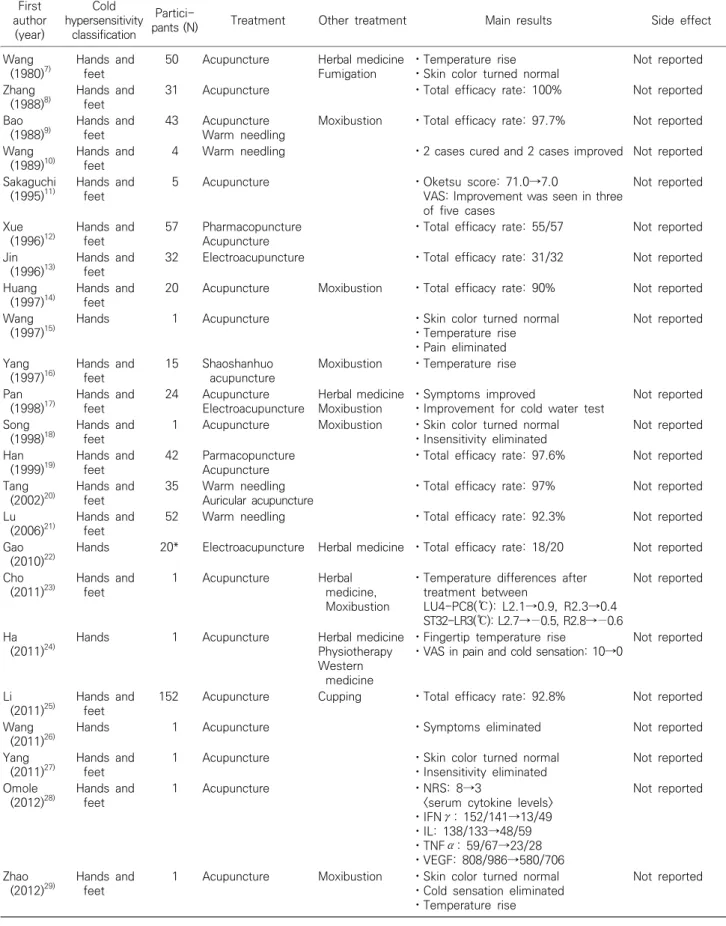
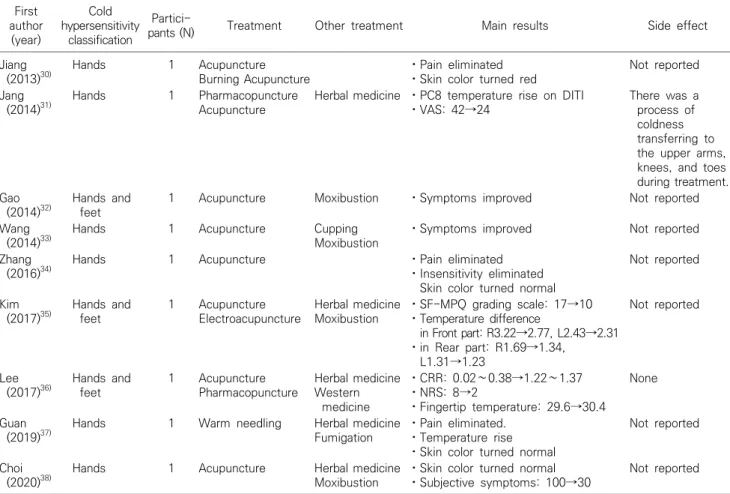
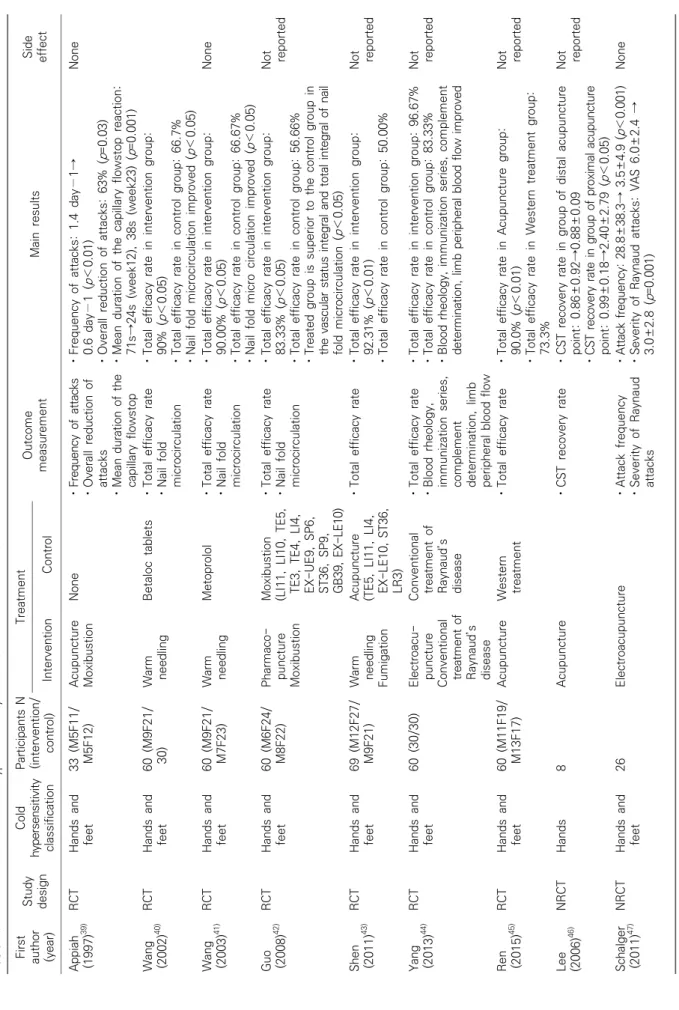
총 41편의 연구가 선별되었고(Fig. 1), 기본 특성은 다음과 같다 (Table 1, 2).
1) 연구 디자인: 총 41편의 임상 연구 중 증례 보고는 32편7-38) (78.05%), 무작위대조군 임상연구는 7편39-45) (17.07%), 비대조군 임상연구는 2편46,47) (4.88%)이었다.
2) 연구 국가: 총 41편의 임상연구 중 한국에서 시행된 연구가 7편(17.07%)23,24,31,35,36,38,46)이 있었고, 중국에서 시행된 연구가 30 (73.17%)편7-10,12-22,25-27,29,30,32-34,37,40-45), 일본에서 시행한 연구가 1편11) (2.44%), 미국에서 시행한 연구가 1편28) (2.44%), 독일에서 시행한 연구가 1편39)(2.44%), 오스트리아에서 시행한 연구가 1편47) (2.44%)이었다.
3) 발표년도: 연도별 논문의 편수를 보면 1980∼1989년 사이에
4편7-10), 1990∼1999년 사이에 10편11-19,39), 2000∼2009년 사이에
Table 1. Basic characters of cold hypersensitivity of hands and feet included case reports First
author (year)
Cold hypersensitivity
classification
Partici-
pants (N) Treatment Other treatment Main results Side effect
Wang (1980)7)
Hands and feet
50 Acupuncture Herbal medicine Fumigation
ㆍTemperature rise ㆍSkin color turned normal
Not reported
Zhang (1988)8)
Hands and feet
31 Acupuncture ㆍTotal efficacy rate: 100% Not reported
Bao (1988)9)
Hands and feet
43 Acupuncture Warm needling
Moxibustion ㆍTotal efficacy rate: 97.7% Not reported
Wang (1989)10)
Hands and feet
4 Warm needling ㆍ2 cases cured and 2 cases improved Not reported
Sakaguchi (1995)11)
Hands and feet
5 Acupuncture ㆍOketsu score: 71.0→7.0
VAS: Improvement was seen in three of five cases
Not reported
Xue (1996)12)
Hands and feet
57 Pharmacopuncture Acupuncture
ㆍTotal efficacy rate: 55/57 Not reported Jin
(1996)13)
Hands and feet
32 Electroacupuncture ㆍTotal efficacy rate: 31/32 Not reported
Huang (1997)14)
Hands and feet
20 Acupuncture Moxibustion ㆍTotal efficacy rate: 90% Not reported
Wang (1997)15)
Hands 1 Acupuncture ㆍSkin color turned normal
ㆍTemperature rise ㆍPain eliminated
Not reported
Yang (1997)16)
Hands and feet
15 Shaoshanhuo acupuncture
Moxibustion ㆍTemperature rise Pan
(1998)17)
Hands and feet
24 Acupuncture Electroacupuncture
Herbal medicine Moxibustion
ㆍSymptoms improved
ㆍImprovement for cold water test
Not reported
Song (1998)18)
Hands and feet
1 Acupuncture Moxibustion ㆍSkin color turned normal ㆍInsensitivity eliminated
Not reported
Han (1999)19)
Hands and feet
42 Parmacopuncture Acupuncture
ㆍTotal efficacy rate: 97.6% Not reported Tang
(2002)20)
Hands and feet
35 Warm needling Auricular acupuncture
ㆍTotal efficacy rate: 97% Not reported
Lu (2006)21)
Hands and feet
52 Warm needling ㆍTotal efficacy rate: 92.3% Not reported
Gao (2010)22)
Hands 20* Electroacupuncture Herbal medicine ㆍTotal efficacy rate: 18/20 Not reported Cho
(2011)23)
Hands and feet
1 Acupuncture Herbal
medicine, Moxibustion
ㆍTemperature differences after treatment between
LU4-PC8(℃): L2.1→0.9, R2.3→0.4 ST32-LR3(℃): L2.7→−0.5, R2.8→−0.6
Not reported
Ha (2011)24)
Hands 1 Acupuncture Herbal medicine
Physiotherapy Western
medicine
ㆍFingertip temperature rise
ㆍVAS in pain and cold sensation: 10→0
Not reported
Li (2011)25)
Hands and feet
152 Acupuncture Cupping ㆍTotal efficacy rate: 92.8% Not reported
Wang (2011)26)
Hands 1 Acupuncture ㆍSymptoms eliminated Not reported
Yang (2011)27)
Hands and feet
1 Acupuncture ㆍSkin color turned normal
ㆍInsensitivity eliminated
Not reported Omole
(2012)28)
Hands and feet
1 Acupuncture ㆍNRS: 8→3
<serum cytokine levels>
ㆍIFNγ: 152/141→13/49 ㆍIL: 138/133→48/59 ㆍTNFα: 59/67→23/28 ㆍVEGF: 808/986→580/706
Not reported
Zhao (2012)29)
Hands and feet
1 Acupuncture Moxibustion ㆍSkin color turned normal ㆍCold sensation eliminated ㆍTemperature rise
Not reported
Table 1. Continued First
author (year)
Cold hypersensitivity
classification
Partici-
pants (N) Treatment Other treatment Main results Side effect
Jiang (2013)30)
Hands 1 Acupuncture
Burning Acupuncture
ㆍPain eliminated ㆍSkin color turned red
Not reported
Jang (2014)31)
Hands 1 Pharmacopuncture
Acupuncture
Herbal medicine ㆍPC8 temperature rise on DITI ㆍVAS: 42→24
There was a process of coldness transferring to the upper arms, knees, and toes during treatment.
Gao (2014)32)
Hands and feet
1 Acupuncture Moxibustion ㆍSymptoms improved Not reported
Wang (2014)33)
Hands 1 Acupuncture Cupping
Moxibustion
ㆍSymptoms improved Not reported
Zhang (2016)34)
Hands 1 Acupuncture ㆍPain eliminated
ㆍInsensitivity eliminated Skin color turned normal
Not reported
Kim (2017)35)
Hands and feet
1 Acupuncture Electroacupuncture
Herbal medicine Moxibustion
ㆍSF-MPQ grading scale: 17→10 ㆍTemperature difference
in Front part: R3.22→2.77, L2.43→2.31 ㆍin Rear part: R1.69→1.34,
L1.31→1.23
Not reported
Lee (2017)36)
Hands and feet
1 Acupuncture Pharmacopuncture
Herbal medicine Western
medicine
ㆍCRR: 0.02∼0.38→1.22∼1.37 ㆍNRS: 8→2
ㆍFingertip temperature: 29.6→30.4
None
Guan (2019)37)
Hands 1 Warm needling Herbal medicine
Fumigation
ㆍPain eliminated.
ㆍTemperature rise ㆍSkin color turned normal
Not reported
Choi (2020)38)
Hands 1 Acupuncture Herbal medicine
Moxibustion
ㆍSkin color turned normal ㆍSubjective symptoms: 100→30
Not reported
SF-MPQ : Short Form Mcgill Pain Questionnaire, DITI : Digital Infrared Thermographic Imaging, VAS : Visual Analog Scale, NRS : Numeric Rating Scale, IFN : Interferon, IL : Interleukin, TNF : Tumor Necrosis Factor, VEGF : Vascular Endothelial Growth Factor, CRR : Cooling Rewarming Ratio.
*Primary Raynaud’s disease : 12, Secondary Raynaud’s : 8.
6편20,21,40-42,46), 2010∼2020년 사이에 21편22-38,43-45,47) 발행되었다.
증례 보고는 각각 4편7-10), 9편11-19), 2편20,21), 17편22-38)이 발행되었 으며 무작위대조군임상연구는 각각 0편, 1편39), 3편40-42), 3편43-45) 이 발행되었다. 비대조군 임상연구는 2000∼2009년 사이에 1편46), 2010∼2020년 사이에 1편47)이 발행되었다(Table 3).
4) 연구 대상자: 수집된 연구들의 대상자 특성을 분석하였을 때, 전체 연구대상자는 1035명이었고 2편의 연구25,44)에서 성별이 표기되지 않아 성별이 표기된 연구대상자는 823명이었다. 성별이 표기된 823명 중 611명(74.2%)이 여성이었고, 212명(25.8%)이 남 성이었다. 대상자의 나이는 10대부터 70대까지 다양하게 분포하 였다.
대상자 수는 증례보고 32편 중 증례수가 50명 미만인 연구가 28편8-11,13-20,22-24,26-38), 50명 이상 100명 미만인 연구가 3편7,12,21), 100명 이상인 연구가 1편25)이었다. 무작위 대조군 연구 7편 중 증
례수가 50명 미만인 연구가 1편39), 50명 이상인 연구가 6편40-45)이 었다. 비대조군 임상연구 2편46,47)은 모두 증례수가 50명 미만이었 다.
2. 침치료 방법 1) 치료 방법
주 치료 중재법을 살펴보았을 때, 침치료를 단독으로 사용한 것 이 19편8,10-13,15,19-21,26-28,30,34,40,41,45-47), 침치료와 기타치료를 함께 사용한 것이 22편7,9,14,16-18,22-25,29,31-33,35-39,42-44)이었다. 침치료 외 에 사용된 기타치료로는 한약치료, 부항치료, 뜸치료, 훈증치료, 양방치료 등이 있었다(Table 4). 침치료 방법으로는 일반 침치료, 전침치료, 약침치료, 온침치료, 화침치료, 이침치료가 활용되었다.
(1) 침치료: 침치료 방법으로 정리해보면, 일반 침치료가 29회로 가장 많았고, 온침치료가 8회, 전침치료가 6회, 약침치료가 5회 사
Table 2. Basic characters of cold hypersensitivity of hands and feet included clinical trials First author (year) Study design Cold hypersensitivity classification Participants N (intervention/ control)
Treatment Outcome measurementMain resultsSide effectInterventionControl Appiah (1997)39)RCTHands and feet33 (M5F11/ M5F12)Acupuncture MoxibustionNoneㆍFrequency of attacks ㆍOverall reduction of attacks ㆍMean duration of the capillary flowstop ㆍFrequency of attacks: 1.4 day−1→ 0.6 day−1 (p<0.01) ㆍOverall reduction of attacks: 63% (p=0.03) ㆍMean duration of the capillary flowstop reaction: 71s→24s (week12), 38s (week23) (p=0.001) None Wang (2002)40)RCTHands and feet60 (M9F21/ 30)Warm needlingBetaloc tabletsㆍTotal efficacy rate ㆍNail fold microcirculation
ㆍTotal efficacy rate in intervention group: 90% (p<0.05) ㆍTotal efficacy rate in control group: 66.7% ㆍNail fold microcirculation improved (p<0.05) Wang (2003)41)RCTHands and feet60 (M9F21/ M7F23)Warm needlingMetoprololㆍTotal efficacy rate ㆍNail fold microcirculation ㆍTotal efficacy rate in intervention group: 90.00% (p<0.05) ㆍTotal efficacy rate in control group: 66.67% ㆍNail fold micro circulation improved (p<0.05) None Guo (2008)42)RCTHands and feet60 (M6F24/ M8F22)Pharmaco- puncture Moxibustion
Moxibustion (LI11, LI10, TE5, TE3, TE4, LI4, EX-UE9, SP6, ST36, SP9, GB39, EX-LE10) ㆍTotal efficacy rate ㆍNail fold microcirculation ㆍTotal efficacy rate in intervention group: 83.33% (p<0.05) ㆍTotal efficacy rate in control group: 56.66% ㆍTreated group is superior to the control group in the vascular status integral and total integral of nail fold microcirculation (p<0.05) Not reported Shen (2011)43)RCTHands and feet69 (M12F27/ M9F21)Warm needling Fumigation
Acupuncture (TE5, LI11, LI4, EX-LE10, ST36, LR3) ㆍTotal efficacy rateㆍTotal efficacy rate in intervention group: 92.31% (p<0.01) ㆍTotal efficacy rate in control group: 50.00%
Not reported Yang (2013)44)RCTHands and feet60 (30/30)Electroacu- puncture Conventional treatment of Raynaud’s disease
Conventional treatment of Raynaud’s disease ㆍTotal efficacy rate ㆍBlood rheology, immunization series, complement determination, limb peripheral blood flow ㆍTotal efficacy rate in intervention group: 96.67% ㆍTotal efficacy rate in control group: 83.33% ㆍBlood rheology, immunization series, complement determination, limb peripheral blood flow improved
Not reported Ren (2015)45)RCTHands and feet60 (M11F19/ M13F17)AcupunctureWestern treatmentㆍTotal efficacy rateㆍTotal efficacy rate in Acupuncture group: 90.0% (p<0.01) ㆍTotal efficacy rate in Western treatment group: 73.3%
Not reported Lee (2006)46)NRCTHands8AcupunctureㆍCST recovery rateㆍCST recovery rate in group of distal acupuncture point: 0.86±0.92→0.88±0.09 ㆍCST recovery rate in group of proximal acupuncture point: 0.99±0.18→2.40±2.79 (p<0.05) Not reported Schalger (2011)47)NRCTHands and feet26ElectroacupunctureㆍAttack frequency ㆍSeverity of Raynaud attacks
ㆍAttack frequency: 28.8±38.3→ 3.5±4.9 (p<0.001) ㆍSeverity of Raynaud attacks: VAS 6.0±2.4 → 3.0±2.8 (p=0.001) None M : Male, F : Female, RCT : Randomized Controlled Trial, VAS : Visual Analog Scale, NRCT : Non-Randomized Controlled Trial, CST : Cold Stress Test.
Table 5. Treatment methods of acupuncture
Acupuncture N
Manual acupuncture 29
Warm needling 8
Electroacupuncture 6
Pharmacoacupuncture 5
Auricular acupuncture 2
Burning acupuncture 1
Table 3. Year of publication Year of
publication
Case
report RCT Uncontrolled clinical trials Total
1980∼1989 4 0 0 4
1990∼1999 9 1 0 10
2000∼2009 2 3 1 6
2010∼2020 17 3 1 21
Total 32 7 2 41
Table 4. Treatment methods of cold hypersensitivity of hands and feet
Treatment N (%)
Acupuncture 19 (46.3%)
Acupuncture+Moxibustion 8 (19.5%)
Acupuncture+Cupping 1 (2.4%)
Acupuncture+Herbal medicine 2 (4.9%)
Acupuncture+Fumigation 1 (2.4%)
Acupuncture+Western medicine 1 (2.4%)
Acupuncture+Herbal medicine+Moxibustion 4 (9.8%) Acupuncture+Herbal medicine+Fumigation 2 (4.9%) Acupuncture+Herbal medicine+Western medicine 1 (2.4%) Acupuncture+Herbal medicine+Western
medicine+Physiotherapy
1 (2.4%) Acupuncture+Moxibustion+Cupping 1 (2.4%)
Total 41
용되었다. 이침치료는 2회, 화침치료는 1회 사용되었다(Table 5).
일반 침치료 29회 중 일반 침치료만 사용한 것은 21편7,8,11,14-16,
18,23-29,32-34,38,39,45,46)이 있었다. 온침치료 8회 중 온침치료만 사용한
것은 5편10,21,37,40,41)이었고, 일반 침치료와 함께 사용한 것이 1편9), 훈증치료와 함께 사용한 것이 1편43), 이침치료와 함께 사용한 것이 1편20)이 있었다. 전침치료 6회 중 전침치료만 사용한 것은 4편13,17,22,44)
이었고, 일반 침치료를 함께 사용한 것이 1편23), 이침치료와 함께 사용한 것이 1편47) 있었다. 온침치료 8회 중 온침치료만 사용한 것은 5편10,21,37,40,41)이었고, 일반 침치료와 함께 사용한 것이 1편9), 훈증치료와 함께 사용한 것이 1편43), 이침치료와 함께 사용한 것이 1편20)이 있었다. 약침치료 5회 중 약침치료만 사용한 연구는 1편37) 이었고, 일반 침치료와 함께 사용한 것은 4편12,19,31,36)이 있었다.
약침액의 경우 1편의 연구19)에서는 보고가 없었고, 자하거약침을 활용한 연구가 1편31), 단삼, 당귀, 포도당 혼합 주사액을 활용한 연구가 1편12), 단삼주사액을 활용한 연구가 1편42), 봉침을 활용한 연구가 1편36) 있었다. 이침치료는 온침치료와 함께 사용한 것이 1편20), 전침치료와 함께 사용한 것이 1편47) 있었다. 화침치료는 일 반 침치료와 함께 사용한 연구가 1편30) 있었다.
(2) 복합치료(침치료와 기타치료): 침치료를 단독으로 사용한 것
이 19편8,10-13,15,19-21,26-28,30,34,40,41,45-47), 침치료와 기타치료를 함께 사용한 것이 22편7,9,14,16-18,22-25,29,31-33,35-39,42-44)이었다(Table 4).
침치료 외 1가지 치료를 사용한 것은 총 13편으로, 뜸치료와 함께 사용한 것이 8편9,14,16,18,29,32,39,42), 부항치료와 함께 사용한 것이 1 편25), 한약치료와 함께 사용한 것이 2편22,31), 훈증치료와 함께 사용 한 것이 1편43),양방치료와 함께 사용한 것이 1편44)이었다. 침치료 외 2가지 이상의 치료를 사용한 것은 총 9편이 있었다. 침치료 외 2가지 이상의 기타치료를 사용한 경우, 한약치료와 뜸치료가 함께 사용된 경우가 4편17,23,35,38), 한약치료와 훈증치료가 함께 사용된 경우가 2편7,37), 뜸과 부항이 함께 사용된 경우가 1편33)이 있었다.
양방치료가 함께 사용된 경우는 총 2편이었는데, 한약치료와 양방 치료가 함께 사용된 1편36), 한약치료와 양방치료, 물리치료가 함께 사용된 경우가 1편24) 있었다.
2) 치료 부위
(1) 활용 경혈: 41편의 연구 중 단일 경혈을 사용한 연구는 1편28) 이었고 합곡(LI4)을 활용하였다. 협척혈(EX-B2)을 활용한 논문 4
편22,27,30,44)을 포함하여, 복수의 경혈을 사용한 연구는 40편이었다.
협척혈을 하나의 경혈로 간주하였을 때, 경외기혈 및 12개의 이침 혈을 포함하여 총 111개의 경혈이 사용되었음을 확인할 수 있었다 (Table 6). 가장 많이 활용된 경혈은 27건 사용된 곡지(LI11)이었 고, 다음으로는 합곡(LI4)이 26건, 족삼리(ST36)가 23건, 태충 (LR3)이 18건, 외관(TE5)이 17건, 삼음교(SP6) 16건, 팔사(EX- UE9) 13건 순으로 활용되었다.
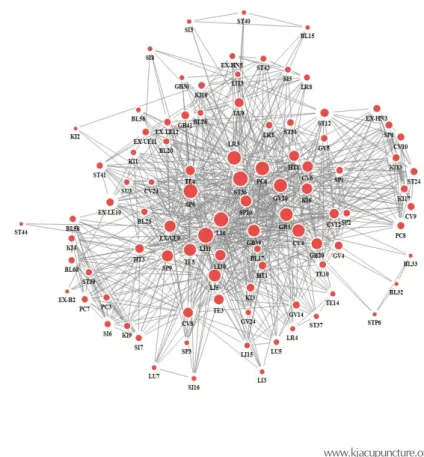
(2) 복수 경혈 활용: 각 연구에서는 최소 1개부터 최대 19개의 경혈이 활용되었다. 대부분의 논문들에서 여러 경혈들이 함께 사 용되고 있어서, 이들간의 관계에 대해 분석하고자 네트워크 중심 성 분석을 수행하였다. 표준경혈명을 활용하지 않아 분명하지 않 은 이침혈 12개와 경외기혈 5개(臂中, 八衝, 血府, 氣旁, 上風濕點) 는 분석에서 제외하였다. 경혈 간의 네트워크 구조를 시각화하였 을 때, 곡지(LI11), 합곡(LI4), 족삼리(ST36), 삼음교(SP6) 등의 경 혈이 비교적 많이 활용되어 크기가 크고 네트워크의 중심에 위치 하는 것을 확인할 수 있었다(Fig. 2). 함께 사용된 경혈 수가 많을수
Fig. 2. A network of acupoints.
Table 6. Frequency of acupoints
Frequency Name of acupoints
27 LI11
26 LI4
23 ST36
18 LR3
17 TE5
16 SP6
13 EX-UE9
9 PC6
8 GB39, CV4, SP9, LI10 7 TE4, GB34, GV20, EX-LE10 5 LI5, ST41
4 SP10, CV6, EX-B2, TE3
3 CV8, GB41, HT1, HT8, LU9, CV12, GB20, KI3, KI6, 2 BL17, GV14, GV4, HT3, KI10, LI13, EX-LE12,
EX-UE11, ST12
1 LR1, BL15, BL20, BL23, BL26, BL32, BL33, BL56, BL58, BL60, CV24, EX-HN5, GB30, GV24, GV5, KI1, KI2, KI4, KI9, LI15, LI3, LR4, LR8, LU5, LU7, PC3, PC7, SI16, SI3, SI5, SI6, SI7, SI8,SP1, SP2, SP3, ST34, ST37, ST39, ST40, ST43, ST44, STP6, SU3, TE10, TE14, AA* (肝, 交感, 内分泌, 脾, 腎, 神經, 心, 熱, 肺, 55, 67, 68), 臂中*, 八衝*, 血府*, 氣旁*, 上風濕點*
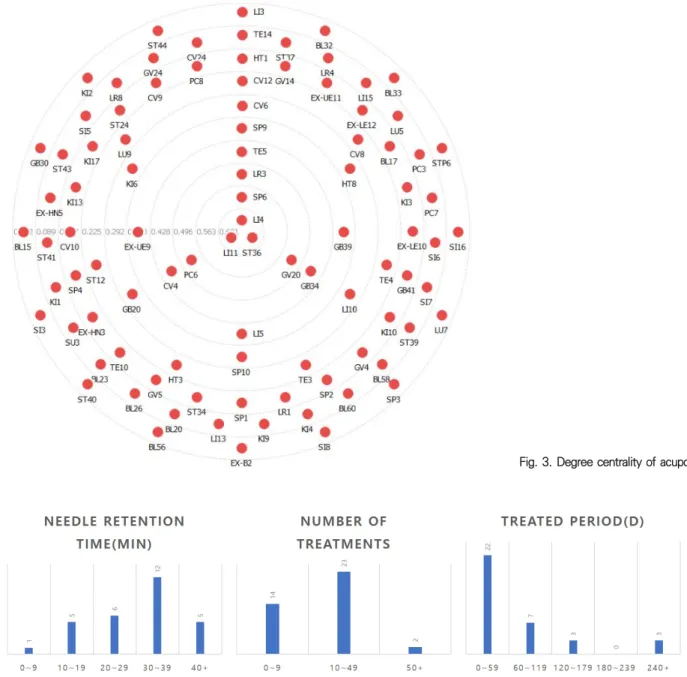
록 연결 중심성(Degree centrality)이 높아지는데, 그 값이 1에 가 까울수록 많은 경혈과 연결되어 경혈 간 네트워크에서 영향력이 크다고 해석할 수 있다48). 곡지(LI11)가 Degree centrality 값이 0.6989로 가장 높았고, 족삼리(ST36)가 0.6882, 합곡(LI4)이 0.6452,
삼음교(SP6)가 0.6129, 태충(LR3)이 0.5591 순으로 높은 값을 가 져 많은 경혈들과 함께 사용되고 있음을 알 수 있었다(Fig. 3).
3) 치료 시간, 횟수, 빈도, 기간(Fig. 4)
(1) 치료 시간: 전체 연구 중 29편의 연구8,9,11-14,16-18,21-23,25,26,
28-32,35-38,40,41,43,44,46,47)에서 유침 시간을 보고하였다. 4일간 이침을
유침하는 연구47)를 제외하면, 전체 연구의 침 치료 시간은 평균 26.8±8.87분이었고, 증례 보고의 경우 평균 26.75±9.63분, 전향 적 임상연구의 경우 평균 27±6.71분으로 나타났다. 최솟값은 5분 에서 최댓값은 40분이었다. 10분 미만이 1편28), 10분이상 20분 미만이 5편8,9,11,38,46), 20분이상 30분 미만이 6편23,26,30,31,35,36), 30 분이상 40분 미만이 12편12,13,17,18,21,29,32,37,40,41,43,44), 40분 유침한 경우가 4편14,22,25,27), 4일 유침한 경우가 1편47)으로 연구의 과반수 가 20분 이상 유침하였다.
(2) 치료 횟수: 두 편의 증례 보고7,23)만 제외하고 모두 침 치료 횟수 또는 빈도를 보고하였다. 빈도만 나와 있는 경우 전체기간에 빈도를 곱하여 계산하였다. 침 치료 횟수는 최소 1회부터 최대 86 회까지로 분포하였다. 횟수가 범위로 제시된 경우 중간값을 가지 고 평균을 계산하였을 때, 전체 연구의 침 치료 횟수는 평균 15.51±
15.75회이었고, 증례 보고의 경우 평균 14.83±16.21회(최소 2 회∼최대 86회), 전향적 임상연구의 경우 평균 17.78±14.78회(최 소 1회∼최대 50회)로 나타났다.
(3) 치료 기간: 6편의 증례 보고12,15,18,23,27,32)를 제외한 35편의
Fig. 3. Degree centrality of acupoints.
Fig. 4. Characteristics of acupuncture treatment.
논문에서 침 치료 기간을 보고하였다. 평균 값을 구하기 위해 년과 월로 보고된 경우 각각 365일, 30일로 환산하여 계산하였다. 증례 보고에서 평균값이 제시된 경우 평균값을, 범위로 제시된 경우에 는 중간값을 평균 계산에 활용하였다. 전체 연구에서의 치료기간 은 최소 5일에서 730일까지 분포하였고, 평균 치료기간은 77.69±
132.80일로 조사되었다. 증례 보고의 경우 평균 49.77±44.99일 (최소 5일∼최대 365일), 전향적 임상연구의 경우 평균 158.33±
242.43일(최소 7일∼최대 2년)로 나타났다.
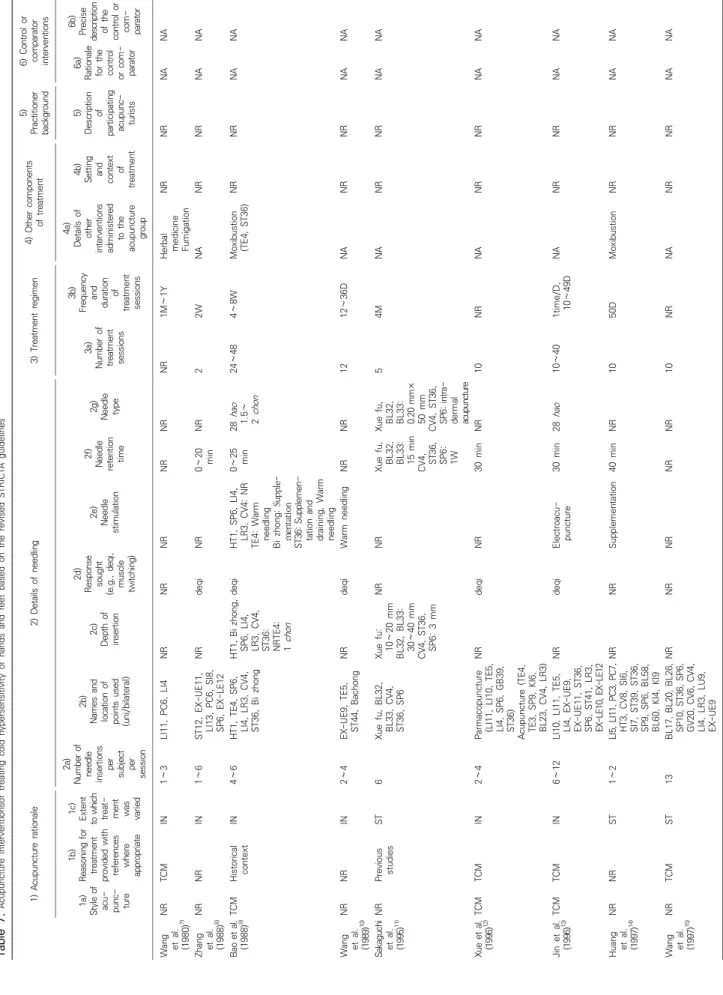
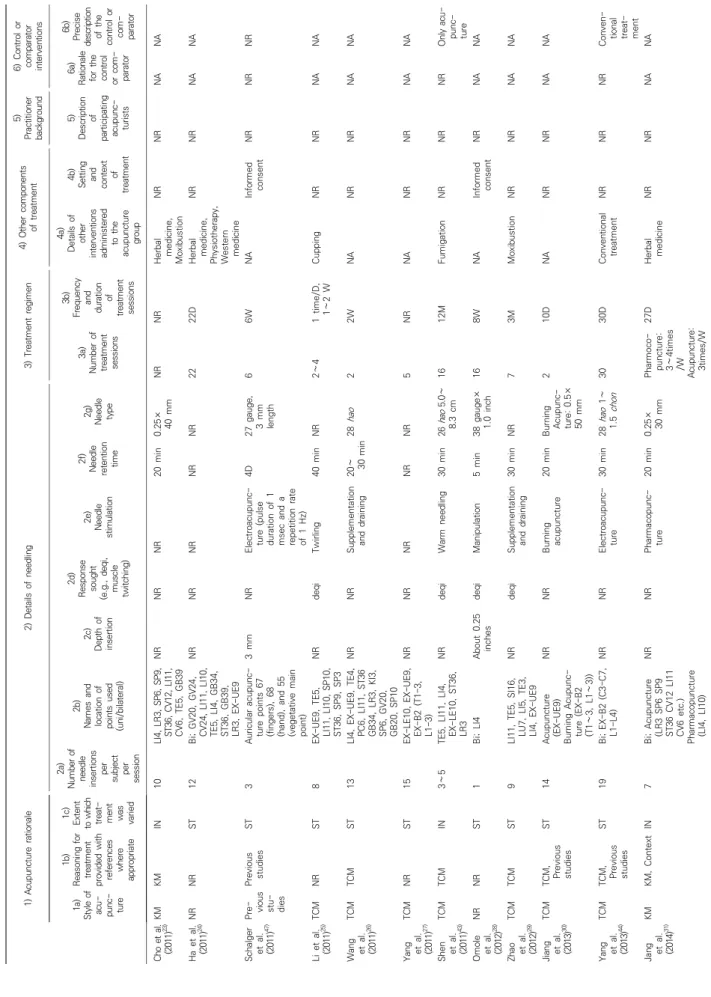
4) STRICTA (The standards for reporting interventions in clinical trials of acupuncture)49) 항목 평가
STRICTA의 모든 항목을 만족시킨 논문은 한 편도 없었다. 각 항목별 자세한 내용은 다음과 같다(Table 7).
(1) 침치료에 대한 논거(Acupuncture rationale): 30개의 논문 이 중의 또는 한의학을, 1개의 논문이 이전 연구를 토대로 침법을 시행하였으며, 정확한 이유가 적혀지지 않은 경우 알수 없음으로 표시하였다. 치료에 변화를 허용한 정도는 16개의 논문에서 발병 부위 및 증상에 따라 혈위를 선택하였기에 IN (Individual)로 표시