D I A B E T E S & M E T A B O L I S M J O U R N A L
This is an Open Access article distributed under the terms of the Creative Commons At- tribution Non-Commercial License (http://creativecommons.org/licenses/by-nc/3.0/) which permits unrestricted non-commercial use, distribution, and reproduction in any medium, provided the original work is properly cited.
The Association between Apolipoprotein A-II and
Metabolic Syndrome in Korean Adults: A Comparison Study of Apolipoprotein A-I and Apolipoprotein B
Dong Won Yi1, Dong Wook Jeong2, Sang Yeoup Lee2, Seok Man Son1, Yang Ho Kang1
1Division of Endocrinology and Metabolism, Department of Internal Medicine, 2Department of Family Medicine, Pusan National University Yangsan Hospital, Pusan National University School of Medicine, Yangsan, Korea
Background: Apolipoprotein A-II (apoA-II) is the second-most abundant apolipoprotein in human high-density lipoprotein and its role in cardio metabolic risk is not entirely clear. It has been suggested to have poor anti-atherogenic or even pro-athero- genic properties, but there are few studies on the possible role of apoA-II in Asian populations. The aim of this study is to evalu- ate the role of apoA-II in metabolic syndrome (MetS) compared with apolipoprotein A-I (apoA-I) and apolipoprotein B (apoB) in Korean adults.
Methods: We analyzed data from 244 adults who visited the Center for Health Promotion in Pusan National University Yang- san Hospital for routine health examinations.
Results: The mean apoB level was significantly higher, and the mean apoA-I level was significantly lower, in MetS; however, there was no significant difference in apoA-II levels (30.5±4.6 mg/dL vs. 31.2±4.6 mg/dL, P=0.261). ApoA-II levels were more positively correlated with apoA-I levels than apoB levels. ApoA-II levels were less negatively correlated with homocysteine and high sensitivity C-reactive protein levels than apoA-I levels. The differences in MetS prevalence from the lowest to highest quar- tile of apoA-II were not significant (9.0%, 5.7%, 4.9%, and 6.6%, P=0.279). The relative risk of the highest quartile of apoA-II compared with the lowest quartile also was not significantly different (odds ratio, 0.96; 95% confidence interval, 0.95 to 1.04;
P=0.956).
Conclusion: Compared with apoA-I (negative association with MetS) and apoB (positive association with MetS) levels, apoA-II levels did not show any association with MetS in this study involving Korean adults. However, apoA-II may have both anti-ath- erogenic and pro-atherogenic properties.
Keywords: Apolipoprotein A-II; Cardio-metabolic risk; Metabolic syndrome
Corresponding author: Yang Ho Kang
Department of Internal Medicine, Pusan National University Yangsan Hospital, Pusan National University School of Medicine, 20 Geumo-ro, Mulgeum-eup, Yangsan 626-770, Korea
INRTODUCTION
Plasma high density lipoprotein (HDL) is very heterogeneous, but apolipoprotein A-I (apoA-I) and apolipoprotein A-II (apoA-II) are two main sub-populations of HDL [1]. The anti- atherogenic properties of apoA-I, the major structural apoli- poprotein of HDL, are widely known [2-5], but in the case of apoA-II, the second most abundant structural apolipoprotein
associated with HDL [1], the role on these properties is con- troversial. There have been several studies, showing an inverse relationship between cardiovascular disease, including type 2 diabetes mellitus, and plasma apoA-II levels [6-9]; however, other studies have suggested that elevated apoA-II levels may be pro-atherogenic [10], or have shown no relationship be- tween cardiovascular disease and apoA-II levels [11,12].
Recently, Onat et al. [13] showed that low serum apoA-II pISSN 2233-6079 · eISSN 2233-6087
concentrations confer risk of metabolic syndrome (MetS) and type 2 diabetes mellitus among Turkish adults at 4 years fol- low-up. There are few studies about the association between apoA-II and MetS, a constellation of atherosclerotic cardiovas- cular disease risk factors [14], and the possible properties of apoA-II in cardiovascular risk are even less clear, especially in Asian populations. Therefore, we tried to investigate the rela- tionship of apoA-II with MetS and other inflammatory mark- ers in Korean adults and the possible roles of apoA-II in com- parison with other well-known lipid markers, such as apoA-I (anti-atherogenic) and apoB (pro-atherogenic).
METHODS
Subjects and measurements
Our study subjects included 244 adults (20 to 70 years of age;
159 men and 85 women) who visited the Center for Health Promotion at Pusan National University Yangsan Hospital for routine health examinations between December 2009 and April 2010. All subjects had no history of coronary heart dis- ease (CHD) or cerebro-vascular disease. Subjects who were being treated with lipid-modifying agents or on estrogen re- placement therapy, and those with hyperthyroidism, hypothy- roidism, liver disease (serum levels of aspartate aminotrans- ferase [AST] or alanine aminotransferase [ALT] were greater than three times the upper limit of the reference range), serum triglyceride levels ≥ 400 mg/dL, or abnormal serum creatinine levels (male, ≥1.5 mg/dL; female ≥1.3 mg/dL) were excluded.
Height and weight were measured while subjects wore light clothing without shoes. Body mass index (BMI) was calculat- ed as weight (kg) divided by height (m) squared and was used as an estimate of overall adiposity. Waist circumference, an es- timate of central obesity, was measured with a soft tape on standing subjects midway between the lowest rib and the iliac crest. Blood pressure was measured on the right arm with sub- jects in a sitting position after a 5-minute rest. Venous blood was sampled after an overnight fast. Fasting glucose was mea- sured by the glucose oxidase method (Synchron LX-20; Beck- man Coulter Inc., Fullerton, CA, USA). Standard liver enzyme, total cholesterol, HDL cholesterol (HDL-C), and serum tri- glyceride (TG) concentrations were measured with an autoan- alyzer using an enzymatic colorimetric method (Hitachi 7600;
Hitachi Ltd., Tokyo, Japan). Serum levels of apoA-I, apoA-II, and apoB were measured by turbidimetric immuno assay us- ing the automatic immunoassay analyzer Roche E-170 (Roche,
Basel, Switzerland). The metabolic syndrome criteria used were those of the modified, revised NCEP-ATP III (using the WHO Western Pacific Region obesity criteria and defining glucose levels as ≥100 mg/dL [5.24 mmol/L]) [15,16], which defines metabolic syndrome as the presence of at least three of the fol- lowing five traits: 1) Abdominal obesity: waist circumference
≥90 cm in men, ≥80 cm in women, 2) Hypertriglyceridemia (HyperTG): ≥150 mg/dL, (1.70 mmol/L), 3) Low HDL-C: <40 mg/dL (1.03 mmol/L) in men and <50 mg/dL (1.29 mmol/L) in women, 4) Hypertension: systolic blood pressure ≥130 mm Hg or diastolic pressure ≥85 mm Hg or on anti-hypertensive med- ication, 5) High fasting glucose: ≥100 mg/dL (5.54 mmol/L) or under treatment for diabetes. This study was approved by the Ethical Committee of Pusan National University Yangsan Hospital in Yangsan, Korea.
Statistical analysis
All data are given as mean±standard deviation for continuous variables. Median values are also indicated in the cases of AST, ALT, TG, and high sensitivity C-reactive protein (hs-CRP), which have skewed distributions. Components of MetS and other clinical characteristics were compared between subjects with and without MetS using an independent-sample Student’s t-test and Mann-Whitney U test in variables with a skewed distribution. To evaluate the association between apoA-II and other variables, including apoA-I and apoB, we performed Pearson’s partial correlation coefficients analyses, adjusting for age and sex. Because triglycerides and hs-CRP levels had skewed distributions, values were log-transformed before sta- tistical analysis. The total subjects were divided into quartiles based on the distribution of apoA-I, apoA-II, and apoB. The prevalence of MetS in each quartile was indicated as a percent- age and compared using the chi-square test. Finally, the odd ratios and corresponding 95% confidence intervals for the highest quartile of apoA-I, apoA-II, and apoB were calculated as an estimate of the relative risk of MetS by logistic regression analyses, with the lowest quartile used as the reference catego- ry. Statistical analyses were performed with an SPSS statistical package (SPSS Inc., Chicago, IL, USA). A probability value of less than 0.05 was considered significant.
RESULTS
The prevalence of MetS in this study was 26.2%. All values of MetS components were significantly higher in subjects with
MetS than in those without MetS. ApoA-I levels were signifi- cantly lower (128.0±20.3 mg/dL vs. 137.4±18.5 mg/dL; P=
0.001) and apoB levels were significantly higher (101.7±24.2 mg/dL vs. 88.9±20.4 mg/dL; P<0.001) in the MetS group compared with the non-MetS group. ApoA-II levels were low- er (30.5±4.6 mg/dL vs. 31.2±4.6 mg/dL; P=0.261) in the MetS group, but there was no statistical significance (Table 1).
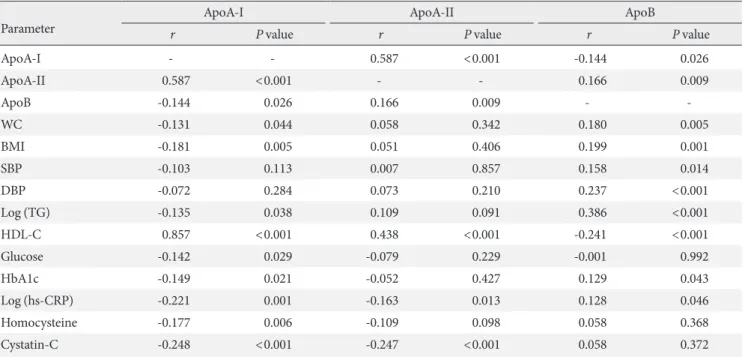
After adjusting for age and sex, apoA-II levels were more positively correlated with apoA-I levels (r=0.587, P<0.001) than apoB levels (r=0.166, P=0.009). When the significant correlation was limited to a coefficient >0.200, apoB levels showed significant positive correlations with diastolic blood pressure (r=0.237, P<0.001) and logTG (r=0.386, P<0.001).
ApoB also showed weak positive correlations with waist cir- cumference (r=0.180), BMI (r=0.199), and systolic blood pressure (r=0.158). ApoA-I levels showed weak negative cor- relations with waist circumference (r=-0.131), BMI (r=-0.181), logTG (r=-0.135), and fasting glucose levels (r=-0.142). ApoA- II levels showed significant positive correlation with HDL-C levels (r=0.438, P<0.001), but its correlation was weaker than that of apoA-I levels (r=0.857, P<0.001). ApoB levels showed significant negative correlation with HDL-C levels (r=-0.241, P<0.001). Among the inflammatory markers, apoA-II levels were less negatively correlated with homocysteine and log (hs- CRP) (r=-0.109, P=0.098, and r=-0.163, P=0.013, respec- tively) than apoA-I levels (r=-0.177, P=0.006, and r=-0.221, Table 1. Clinical characteristics of the study subjects (n=244)
Parameter Total MetS (n=64) Non-MetS (n=180) P value
Age, yr 52.9±8.2 53.1±7.9 52.8±8.4 0.771
BMI, kg/m2 24.5±2.9 26.4±2.9 23.8±2.6 <0.001
WC, cm 88.2±7.6 93.8±6.5 86.2±7.0 <0.001
SBP, mm Hg 121.2±13.3 128.4±12.3 118.7±12.7 <0.001
DBP, mm Hg 79.4±10.0 85.0±8.9 77.4±9.6 <0.001
FBS, mg/dL 99.9±36.6 116.6±50.9 93.9±27.7 0.001
HbA1c, % 5.8±0.8 6.3±1.2 5.6±0.6 <0.001
ApoA-I, mg/dL 134.9±19.4 128.0±20.3 137.4±18.5 0.001
ApoA-II, mg/dL 31.0±4.6 30.5±4.6 31.2±4.6 0.261
ApoB, mg/dL 92.2±22.2 101.7±24.2 88.9±20.4 <0.001
TC, mg/dL 217.8±38.6 217.5±46.3 217.9±35.6 0.953
TG, mg/dL 130.0±97.4 (102.5) 201.6±118.2 (178.5) 104.5±74.1 (84.5) <0.001a
HDL-C, mg/dL 53.7±14.0 44.5±11.6 56.9±13.4 <0.001
LDL-C, mg/dL 139.3±34.3 140.3±39.3 139.0±32.5 0.819
AST, IU/L 28.1±13.4 (25) 33.0±20.5 (27) 26.3±9.2 (24.5) 0.035a
ALT, IU/L 30.0±22.4 (24) 37.9±30.1 (26) 27.2±18.2 (22.5) 0.030a
Uric acid, mg/dL 5.6±1.5 5.9±1.5 5.5±1.6 0.111
BUN, mg/dL 16.5±4.2 15.7±3.7 16.7±4.3 0.053
Creatinine, mg/dL 1.0±0.2 1.0±0.2 1.0±0.2 0.142
hs-CRP, mg/dL 0.17±0.27 (0.08) 0.27±0.36 (0.15) 0.13±0.22 (0.65) <0.001a
Homocysteine, umol/L 12.8±5.3 13.2±3.9 12.7±5.6 0.432
Cystatin-C, mg/L 0.80±1.40 0.83±0.15 0.78±0.13 0.027
Data are presented as mean±standard deviation (median) unless otherwise indicated. P value was calculated from independent t-test unless otherwise indicated.
MetS, metabolic syndrome; BMI, body mass index; WC, waist circumference; SBP, systolic blood pressure; DBP, diastolic blood pressure; FBS, fasting blood sugar; ApoA-I, apolipoprotein A-I; ApoA-II, apolipoprotein A-II; ApoB, apolipoprotein B; TC, total cholesterol; TG, triglyceride;
HDL-C, high density lipoprotein cholesterol; LDL-C, low density lipoprotein cholesterol; AST, aspartate aminotransferase; ALT, alanine ami- notransferase; BUN, blood urea nitrogen; hs-CRP, high sensitivity C-reactive protein.
aMann-Whitney test.
P=0.001, respectively) (Table 2).
Among the components of MetS, apoA-II levels were sig- nificantly higher in subjects with hypertriglyceridemia (32.2±
4.7 mg/dL vs. 30.5±4.4 mg/dL; P=0.013), and significantly lower in subjects with low HDL-C levels (27.9±3.1 mg/dL vs.
31.8±4.5 mg/dL; P<0.001). ApoA-I levels were significantly lower in subjects with low HDL-C levels (114.2±11.0 mg/dL vs. 140.1±17.5 mg/dL; P<0.001). ApoB levels were signifi- cantly higher in subjects with hypertriglyceridemia (104.5±
25.4 mg/dL vs. 87.5±18.8 mg/dL; P<0.001) and high blood Table 2. Partial correlation coefficients adjusted for age and sex for ApoA-I, Apo-AII, ApoB, metabolic risk factors, and other in- flammatory markers
Parameter ApoA-I ApoA-II ApoB
r P value r P value r P value
ApoA-I - - 0.587 <0.001 -0.144 0.026
ApoA-II 0.587 <0.001 - - 0.166 0.009
ApoB -0.144 0.026 0.166 0.009 - -
WC -0.131 0.044 0.058 0.342 0.180 0.005
BMI -0.181 0.005 0.051 0.406 0.199 0.001
SBP -0.103 0.113 0.007 0.857 0.158 0.014
DBP -0.072 0.284 0.073 0.210 0.237 <0.001
Log (TG) -0.135 0.038 0.109 0.091 0.386 <0.001
HDL-C 0.857 <0.001 0.438 <0.001 -0.241 <0.001
Glucose -0.142 0.029 -0.079 0.229 -0.001 0.992
HbA1c -0.149 0.021 -0.052 0.427 0.129 0.043
Log (hs-CRP) -0.221 0.001 -0.163 0.013 0.128 0.046
Homocysteine -0.177 0.006 -0.109 0.098 0.058 0.368
Cystatin-C -0.248 <0.001 -0.247 <0.001 0.058 0.372
ApoA-I, apolipoprotein A-I; ApoA-II, apolipoprotein A-II; ApoB, apolipoprotein B; WC, waist circumference; BMI, body mass index; SBP, sys- tolic blood pressure; DBP, diastolic blood pressure; TG, triglyceride; HDL-C, high density lipoprotein cholesterol; hs-CRP, high sensitivity C- reactive protein.
Table 3. Comparison of mean ApoA-I, ApoA-II, and ApoB levels between subjects with and without individual metabolic com- ponent disorders
Metabolic disorder ApoA-I, mg/dL ApoA-II, mg/dL ApoB, mg/dL
Mean±SD P value Mean±SD P value Mean±SD P value
Abdominal obesity (n=121) 133.7±19.1 0.308 31.2±4.6 0.586 94.6±23.5 0.095
Normal (n=123) 136.2±19.7 30.9±4.5 89.9±20.6
Hypertriglyceridemia (n=68) 132.9±20.2 0.326 32.2±4.7 0.013 104.5±25.4 <0.001
Normal (n=176) 135.7±19.1 30.5±4.4 87.5±18.8
Low-HDL (n=48) 114.2±11.0 <0.001 27.9±3.1 <0.001 95.2±21.8 0.290
Normal (n=196) 140.1±17.5 31.8±4.5 91.5±22.2
Hyperglycemia (n=76) 133.7±20.8 0.524 31.1±5.0 0.902 93.7±26.3 0.521
Normal (n=168) 135.5±18.8 30.9±4.4 91.5±20.0
High blood pressure (n=100) 132.8±20.3 0.150 30.9±4.7 0.862 98.5±23.0 <0.001
Normal (n=144) 136.5±18.7 31.1±4.5 87.9±20.5
Data are presented as mean±standard deviation. P value was calculated from independent t-test.
ApoA-I, apolipoprotein A-I; ApoA-II, apolipoprotein A-II; ApoB, apolipoprotein B; SD, standard deviation; HDL, high density lipoprotein.
pressure (98.5±23.0 mg/dL vs. 87.9±20.5 mg/dL; P<0.001) (Table 3).
These three markers were divided into quartiles and the prevalence of MetS was evaluated. The prevalence of MetS sig- nificantly decreased with an increase in apoA-I quartile (12.3%, 4.1%, 4.9%, and 4.9%; P<0.001). Conversely, MetS significant- ly increased with an increase in apoB quartile (4.9%, 4.1%, 7.0%, and 10.2%; P=0.007). However, there were no signifi- cant differences in MetS prevalence according to the increase in apoA-II quartile (9.0%, 5.7%, 4.9%, and 6.6%; P=0.279) (Fig. 1).
In logistic regression analysis after adjusting for age and sex, the relative risk of the highest quartile of apoA-I compared with the lowest quartile was significantly decreased (odds ratio [OR], 0.46; 95% confidence interval [CI], 0.09 to 0.82; P=
0.027), and that of apoB was significantly increased (OR, 3.27;
95% CI, 1.36 to 7.86; P=0.010). However, there was no signifi- cant difference in the case of apoA-II (OR, 0.96; 95% CI, 0.95 to 1.04; P=0.956) (Table 4).
DISCUSSION
In the present study, we tried to evaluate the relationship be- tween apoA-II and MetS in comparison with apoA-I (a mark- er for anti-atherogenic properties) and apoB (a marker for pro- atherogenic properties) in Korean subjects. ApoA-I levels were found to be significantly lower in the MetS group and they
were negatively correlated with components of MetS, such as waist circumference, triglyceride levels, and fasting glucose levels. ApoA-II levels, however, did not differ significantly be- tween the MetS group and non-MetS group and showed no significant correlations with MetS components, except HDL- C. Furthermore, apoA-II was less negatively correlated with homocysteine and hs-CRP values, which are also known as markers with pro-atherogenic potential, than was apoA-I with homocysteine and hs-CRP values. With regard to the relation- ship between homocysteine and apoA-II, Taskinen et al. [17], reported that the greater the increase in homocysteine levels induced by fenofibrate, the smaller the increases in HDL-C and apoA-I levels, but there was a highly significant and posi- tive relationship between fenofibrate-induced changes in ho- mocysteine and apoA-II levels. These findings may suggest that apoA-II is less anti-atherogenic than apoA-I [18,19]. Ac- cording to another study [9], apoA-II accounts for about 20%
of HDL, and mean serum apoA-II concentrations are general- ly 4 times lower than mean apoA-I levels in normolipidemic subjects. So, this may explain our result of apoA-II being posi- tively correlated with HDL-C levels (r=0.438), while its corre- lation was also weaker than that of apoA-I levels (r=0.857).
In a study by Birjmohun et al. [9], apoA-II levels showed positive correlation with triglyceride and HDL-C levels in spite of the inverse correlation between triglyceride and HDL- C levels. The authors explained that this result may be due to apoA-II inhibiting lipoprotein lipase and hepatic lipase activi- ties, resulting in less hydrolysis of triglyceride-rich lipoproteins, which leads to increased triglyceride levels. In our study, apoA- II levels were positively correlated with apoB levels (r=0.166), as well as apoA-I levels, and apoA-II levels were significantly higher in the hypertriglyceridemic group. These findings also appear consistent with a previous study related to the pro-ath- Table 4. Adjusted ORs (95% CI) for metabolic syndrome in the highest quartiles of ApoA-I, Apo A-II, and ApoB com- pared with the lowest quartiles using logistic regression analy- ses and adjusted by age and sex
Parameter Metabolic syndrome
OR (95% CI) P value
ApoA-I 0.46 (0.09-0.82) 0.027
ApoA-II 0.96 (0.95-1.04) 0.956
ApoB 3.27 (1.36-7.86) 0.010
OR, odds ratio; CI, confidence interval; ApoA-I, apolipoprotein A-I;
ApoA-II, apolipoprotein A-II; ApoB, apolipoprotein B.
Fig. 1. Prevalence of metabolic syndrome according to quar- tiles of ApoA-I, ApoA-II, and ApoB. Graphic bars are expressed as percent. Differences in prevalence among quartiles of each lipid marker were analysed using the chi-square test. ApoA-I, apolipoprotein A-I; ApoA-II, apolipoprotein A-II; ApoB, apo- lipoprotein B; 1, 1st quartile; 2, 2nd quartile; 3, 3rd quartile; 4, 4th quartile. aP<0.001; bP=0.007 compared to the 4th quartile.
15
10
5
0
%
1 2 3 4 1 2 3 4 1 2 3 4 a
b
ApoA-I ApoA-II Apo-B
erogenic potentials of apoA-II [10].
Recently, Onat et al. [13] showed that low serum apoA-II concentrations appear to predict incident MetS (relative risk, 3.5) and type 2 diabetes mellitus (relative risk, 4.5) in both sex- es at an increment of 1 standard deviation, which is consistent with previous studies [6-9]; however, increased apoA-II values were not associated with prevalent or incident CHD and tend- ed to be marginally atheroprotective only in males. In our study, the prevalence of Mets decreased as the quartiles of apoA-I in- creased, and increased with increasing quartiles of apoB, but there were no significant differences in MetS percentage be- tween quartiles of apoA-II. Moreover, the relative risk of the highest quartile of apoA-II compared with the lowest quartile was not significantly different in logistic regression analysis af- ter adjusting for age and sex. Birjmohun et al. [9] demonstrat- ed that apoA-II levels are associated with a decreased risk of future CAD in apparently healthy people in a nested case-con- trol study in the prospective EPIC-Norfolk cohort in the Unit- ed Kingdom, but the authors commented that application of these results to non-white populations must be done with cau- tion. So, given the results of Onat et al. [13] and our study, the possible role of apoA-II in cardiometabolic risk in Asian pop- ulations may be marginally atheroprotective or inconclusive.
It is widely known that HDL-C reduces cardiometabolic risk by enhancing the transfer of peripheral free cholesterol to the liver through the process called ‘reverse cholesterol trans- port.’ Some studies have reported that HDL containing apoA-I might be more effective in capturing cell-derived cholesterol for cholesterol efflux, the first step of reverse cholesterol trans- port, than HDL containing both apoA-I and apoA-II [20,21].
Furthermore, the effects of apoA-II on HDL metabolism are more complex and it may have both potential deleterious ef- fects and beneficial effects [22]. The pro-atherogenic proper- ties of apoA-II may inhibit lecithin-cholesterol acyltransferase [23,24], and inhibit hepatic cholesteryl uptake from HDL prob- ably through the class B type 1 scavenger receptor dependent pathway [25,26]. The anti-atherogenic properties of apoA-II may inhibit cholesteryl ester transfer protein activity [27] and increase hepatic lipase activity [28]. Thus, our findings provide further evidence of the complex relationship between apoA-II and cardiovascular risk.
Our study has several limitations. First, it was performed using a cross-sectional design and did not control for potential biases from diet, physical activity, smoking and drinking his- tory, and drug medication status (except for anti-lipid agents).
Second, the total number of enrolled subjects was relatively small. Thus, a large-scale, prospective study will be needed to elucidate the exact role of apoA-II in cardiovascular disease.
In summary, apoA-II levels did not show any association with MetS in this study of Korean adults. However, apoA-II may have both anti-atherogenic and pro-atherogenic proper- ties that may be caused by the diverse activities of apoA-II in association with cardiometabolic risk.
CONFLICTS OF INTEREST
No potential conflict of interest relevant to this article was re- ported.
ACKNOWLEDGMENTS
This study was supported by the Clinical Research Grant (2010), Pusan National University Yangsan Hospital.
REFERENCES
1. Cheung MC, Albers JJ. Characterization of lipoprotein parti- cles isolated by immunoaffinity chromatography. Particles containing A-I and A-II and particles containing A-I but no A-II. J Biol Chem 1984;259:12201-9.
2. Rader DJ. Molecular regulation of HDL metabolism and func- tion: implications for novel therapies. J Clin Invest 2006;116:
3090-100.
3. Puchois P, Kandoussi A, Fievet P, Fourrier JL, Bertrand M, Ko- ren E, Fruchart JC. Apolipoprotein A-I containing lipoproteins in coronary artery disease. Atherosclerosis 1987;68:35-40.
4. Parra HJ, Arveiler D, Evans AE, Cambou JP, Amouyel P, Bing- ham A, McMaster D, Schaffer P, Douste-Blazy P, Luc G, Rich- ard JL, Ducimetiere P, Fruchart JC, Cambien F. A case-control study of lipoprotein particles in two populations at contrasting risk for coronary heart disease. The ECTIM Study. Arterioscler Thromb 1992;12:701-7.
5. Genest JJ Jr, Bard JM, Fruchart JC, Ordovas JM, Wilson PF, Schaefer EJ. Plasma apolipoprotein A-I, A-II, B, E and C-III containing particles in men with premature coronary artery disease. Atherosclerosis 1991;90:149-57.
6. Syvanne M, Kahri J, Virtanen KS, Taskinen MR. HDLs con- taining apolipoproteins A-I and A-II (LpA-I:A-II) as markers of coronary artery disease in men with non-insulin-dependent diabetes mellitus. Circulation 1995;92:364-70.
7. Buring JE, O’Connor GT, Goldhaber SZ, Rosner B, Herbert PN, Blum CB, Breslow JL, Hennekens CH. Decreased HDL2 and HDL3 cholesterol, Apo A-I and Apo A-II, and increased risk of myocardial infarction. Circulation 1992;85:22-9.
8. Roselli della Rovere G, Lapolla A, Sartore G, Rossetti C, Zam- bon S, Minicuci N, Crepaldi G, Fedele D, Manzato E. Plasma lipoproteins, apoproteins and cardiovascular disease in type 2 diabetic patients. A nine-year follow-up study. Nutr Metab Cardiovasc Dis 2003;13:46-51.
9. Birjmohun RS, Dallinga-Thie GM, Kuivenhoven JA, Stroes ES, Otvos JD, Wareham NJ, Luben R, Kastelein JJ, Khaw KT, Boekholdt SM. Apolipoprotein A-II is inversely associated with risk of future coronary artery disease. Circulation 2007;
116:2029-35.
10. Alaupovic P, Mack WJ, Knight-Gibson C, Hodis HN. The role of triglyceride-rich lipoprotein families in the progression of atherosclerotic lesions as determined by sequential coronary angiography from a controlled clinical trial. Arterioscler Thromb Vasc Biol 1997;17:715-22.
11. Sweetnam PM, Bolton CH, Downs LG, Durrington PN, MacKness MI, Elwood PC, Yarnell JW. Apolipoproteins A-I, A-II and B, lipoprotein(a) and the risk of ischaemic heart dis- ease: the Caerphilly study. Eur J Clin Invest 2000;30:947-56.
12. Brousseau T, Dupuy-Gorce AM, Evans A, Arveiler D, Ruidav- ets JB, Haas B, Cambou JP, Luc G, Ducimetiere P, Amouyel P, Helbecque N. Significant impact of the highly informative (CA)n repeat polymorphism of the APOA-II gene on the plas- ma APOA-II concentrations and HDL subfractions: the EC- TIM study. Am J Med Genet 2002;110:19-24.
13. Onat A, Hergenc G, Ayhan E, Ugur M, Can G. Impaired anti- inflammatory function of apolipoprotein A-II concentrations predicts metabolic syndrome and diabetes at 4 years follow-up in elderly Turks. Clin Chem Lab Med 2009;47:1389-94.
14. Ford ES. Risks for all-cause mortality, cardiovascular disease, and diabetes associated with the metabolic syndrome: a sum- mary of the evidence. Diabetes Care 2005;28:1769-78.
15. WHO Expert Consultation. Appropriate body-mass index for Asian populations and its implications for policy and interven- tion strategies. Lancet 2004;363:157-63.
16. Grundy SM, Cleeman JI, Daniels SR, Donato KA, Eckel RH, Franklin BA, Gordon DJ, Krauss RM, Savage PJ, Smith SC Jr, Spertus JA, Costa F; American Heart Association; National Heart, Lung, and Blood Institute. Diagnosis and management of the metabolic syndrome: an American Heart Association/
National Heart, Lung, and Blood Institute Scientific Statement.
Circulation 2005;112:2735-52.
17. Taskinen MR, Sullivan DR, Ehnholm C, Whiting M, Zannino D, Simes RJ, Keech AC, Barter PJ; FIELD study investigators.
Relationships of HDL cholesterol, ApoA-I, and ApoA-II with homocysteine and creatinine in patients with type 2 diabetes treated with fenofibrate. Arterioscler Thromb Vasc Biol 2009;
29:950-5.
18. Joy T, Hegele RA. Is raising HDL a futile strategy for athero- protection? Nat Rev Drug Discov 2008;7:143-55.
19. Barter PJ, Rye KA. The rationale for using apoA-I as a clinical marker of cardiovascular risk. J Intern Med 2006;259:447-54.
20. Lagrost L, Dengremont C, Athias A, de Geitere C, Fruchart JC, Lallemant C, Gambert P, Castro G. Modulation of cholesterol efflux from Fu5AH hepatoma cells by the apolipoprotein con- tent of high density lipoprotein particles. Particles containing various proportions of apolipoproteins A-I and A-II. J Biol Chem 1995;270:13004-9.
21. Barbaras R, Puchois P, Fruchart JC, Ailhaud G. Cholesterol ef- flux from cultured adipose cells is mediated by LpAI particles but not by LpAI:AII particles. Biochem Biophys Res Commun 1987;142:63-9.
22. Tailleux A, Duriez P, Fruchart JC, Clavey V. Apolipoprotein A-II, HDL metabolism and atherosclerosis. Atherosclerosis 2002;164:1-13.
23. Durbin DM, Jonas A. Lipid-free apolipoproteins A-I and A-II promote remodeling of reconstituted high density lipoproteins and alter their reactivity with lecithin:cholesterol acyltransfer- ase. J Lipid Res 1999;40:2293-302.
24. Labeur C, Lambert G, Van Cauteren T, Duverger N, Vanloo B, Chambaz J, Vandekerckhove J, Castro G, Rosseneu M. Displace- ment of apo A-I from HDL by apo A-II or its C-terminal helix promotes the formation of pre-beta1 migrating particles and decreases LCAT activation. Atherosclerosis 1998;139:351-62.
25. Pilon A, Briand O, Lestavel S, Copin C, Majd Z, Fruchart JC, Castro G, Clavey V. Apolipoprotein AII enrichment of HDL enhances their affinity for class B type I scavenger receptor but inhibits specific cholesteryl ester uptake. Arterioscler Thromb Vasc Biol 2000;20:1074-81.
26. de Beer MC, Durbin DM, Cai L, Mirocha N, Jonas A, Webb NR, de Beer FC, van Der Westhuyzen DR. Apolipoprotein A-II modulates the binding and selective lipid uptake of recon- stituted high density lipoprotein by scavenger receptor BI. J Biol Chem 2001;276:15832-9.
27. Lagrost L, Persegol L, Lallemant C, Gambert P. Influence of apolipoprotein composition of high density lipoprotein parti-
cles on cholesteryl ester transfer protein activity. Particles con- taining various proportions of apolipoproteins AI and AII. J Biol Chem 1994;269:3189-97.
28. Mowri HO, Patsch JR, Gotto AM Jr, Patsch W. Apolipoprotein
A-II influences the substrate properties of human HDL2 and HDL3 for hepatic lipase. Arterioscler Thromb Vasc Biol 1996;
16:755-62.